Introduction
The presence of computers and the Internet in Canadian households, classroom settings, and work places has revolutionized information seeking. According to a Statistics Canada survey conducted in 2009, 80 per cent of all Canadians are using the Internet (Statistics Canada, 2009). The percentage of users who reported using the Internet specifically to access health or medical information increased dramatically from 22 per cent in 2000 to 70 per cent in 2009. The Internet has become a medium for the widespread dissemination of health information; however, differences exist among individuals who actually make use of this valuable resource. Internet users who are better educated, have higher incomes, and are under the age of 65 are more likely to have searched for online health information, which suggests the existence of a digital divide (Fox & Fallows, Reference Fox and Fallows2003).
Differences related to age are dissipating; however, as indicated by computer use among older adults. In 2000, only 11 per cent of Canadian seniors aged 65–74 reported using the Internet, whereas by 2007, 45 per cent of this age group said they used the Internet (Statistics Canada, 2009). In the future, we are likely to see a greater number of older adults using the Internet, since Internet use among adults aged 55–64 is similar to use by the general population. For instance, in the United States, less than one third (31%) of seniors (over 65 years of age) have ever ventured online, whereas more than two thirds (70%) of next-generation seniors (ages 55–65) have done so (Kaiser Family Foundation, 2005). Statistics from the Pew Internet and American Life Project indicate that from 2006–2008, 45 per cent of seniors aged 70–75 were online (Jones & Fox, Reference Jones and Fox2009). As experienced Internet users age, it becomes increasingly important to consider how this sector of the population uses the Web to locate health information and how they make use of the information they find online.
Internet Searching and Older Adults
The purpose of the current study was to examine search patterns among older adult Internet users. Researchers were particularly interested in health information seeking behaviour and whether adults over the age of 55 are being critical consumers of the information they find online. Similarities were also found between successful searchers in printed text and online environments.
Although older adults (aged 65 and over) are the demographic with the lowest number of Internet users, they also have the highest growth rate (Statistics Canada, 2009). According to Statistics Canada, Internet use among older adults in 2007 was nearly four times higher than in 2000. In 2007, almost one half of all Canadians over the age of 65 had used the Internet within the preceding 12 months (Statistics Canada). Much of this growth can be attributed to pre-existing Internet users who have aged, because as online baby boomers age, seniors are becoming increasingly “wired” (Fox, Reference Fox2004).
According to the Statistics Canada (2009) survey, over one half (52%) of older adults who used the Internet had searched for online health information. Interestingly, younger adults (aged 45 to 65) used the Internet to research health information more often than senior adults. This was attributed to the fact that younger adults tended to be more experienced Internet users, and online experience has been linked to searching for health information (Statistics Canada). It is also possible that older adults trust their physicians to provide the information they need (Statistics Canada). For both younger and older adults, information on specific diseases was the most common type of health information sought by Internet users (Statistics Canada).
Among older adults who have used the Internet to find health information, the most frequently researched topics include prescription drugs (37%) and general drug information (13%) (Kaiser Family Foundation, 2005). Additional health-related search topics include nutrition, exercise, or weight (9%); cancer (7%); and heart disease and arthritis (6%) (Kaiser Family Foundation). Approximately one third of older adults report that they have discussed Web-based health information with their doctor or health care provider; one quarter of older adults report that they have changed their behaviour in response to information they found online and that this information influenced their decision on how to treat an illness (Kaiser Family Foundation). Internet-based access to health information is associated with better health among older adults (McConatha, Reference McConatha and Morrell2002). This correlation could be related to an increase in perceived control and empowerment over personal and social aspects of their lives (McMellon & Schiffman, Reference McMellon and Schiffman2002), or to other factors such as socioeconomic status. Individuals who have higher incomes and more education tend to be healthier and are also more likely to own and use a computer to seek out online health information (Fox & Fallows, Reference Fox and Fallows2003; McConatha).
Researchers who examined the psychological impact of learning how to use the Internet at an older age have found that this skill can contribute to a sense of well-being and empowerment (Shapira, Barak, & Gal, Reference Shapira, Barak and Gal2007). In this study, the researchers tailored an educational intervention to help older adults learn Internet skills and then promoted their actual use. Elderly participants who began using the Internet felt less depressed and lonely, more satisfied with life, more in control, and more pleased with their current quality of life than elderly participants who were engaged in other activities during the same time period (e.g., painting, sewing and needlework, ceramics). Internet use had such a positive impact on older adults because it increased their experience of control and independence (Shapira et al.).
White et al. (Reference White, McConnell, Clipp, Branch, Sloane and Pieper2002) compared a wait-list control group and a group of seniors who were given Internet training and access over a five-month period to determine whether Internet use can lessen social isolation among older adults. Participants were given pre-and post-program questionnaires which measured loneliness, depression, locus of control, computer attitudes, number of confidants, and overall quality of life. Although there were trends towards less loneliness, less depression, more positive attitudes toward computers, and more confidence among older adults who were regular Internet users, the results were not statistically significant. The White study also found that most elderly participants continued to use the Internet on a weekly basis following the training period (White et al.).
Other studies have found that older adults report less anxiety, and increased confidence and self-efficacy, about online searching when they are given Internet training. For example, Chu & Mastel-Smith (Reference Chu and Mastel-Smith2010) offered older adults a five-week computer and Internet training course that focused on helping participants to find health information on the Internet. The training involved a combination of participant modeling, self-instructed performance, and performance exposure. Results suggested positive psychosocial outcomes and benefits of decreased anxiety, increased computer confidence, and increased self-efficacy among older adults who participated in an Internet training program.
The Internet may allow older adults to assume a more active role in their health care. Unfortunately, online medical information is associated with several limitations. Examples include difficulties in finding, understanding, and using online health information, as well as variability in the quality of information provided on websites (Benigeri & Pluye, Reference Benigeri and Pluye2003). These difficulties are not specific to older adults. However, to address their implications for older adults, it is important to gain an understanding of the cognitive and behavioural processes involved in Web searching among older adults. This includes understanding their search strategies and information needs (Morrell, Reference Morrell2002). Research is needed to assess factors impacting online searching in order to develop strategies for presenting health information in a more comprehensible and accessible fashion for seniors.
Another consideration is whether health information sites are “senior friendly”. A site that might be considered “senior friendly” would be one that includes readable text, a focus on increasing memory and comprehension, and content that is easy to navigate (Hart, Chaparro, & Halcomb, Reference Hart, Chaparro and Halcomb2008). In a recent study, researchers found that “senior friendly” websites contributed to higher task success among older online users (Hart et al., Reference Hart, Chaparro and Halcomb2008). Additional research in this area has found that “ease of navigation” was one of the most important attributes for a “senior friendly” site (Hardt & Hollis-Sawyer, Reference Hardt and Hollis-Sawyer2007). The online activity of seniors also reflects the fact that they are more likely to be novice users (Fox, Reference Fox2005). New users tend to begin with e-mail and information seeking, but shy away from activities such as online shopping or banking. As the population ages, it is likely that there will be increased rates of connectivity and activities that require higher rates of trust among online seniors (Fox).
Health Information on the Internet
Using the Internet as a health resource has been associated with better health-related outcomes among individuals suffering from a chronic disease (Kalichman et al., Reference Kalichman, Benotsch, Weinhardt, Autsin, Luke and Cherry2003). Internet use, moreover, has been linked to better disease knowledge and active coping among chronically ill patients (Kalichman et al.). Cancer patients have reported that access to practical and experiential information from others fighting similar battles helped them make sense of their experience and was highly valued (Ziebland, Reference Ziebland2004). However, there is also the possibility that the association between Internet use and better health outcomes is mediated by socioeconomic factors (Fox & Fallows, Reference Fox and Fallows2003).
Researchers have also explored whether differences exist between individuals who chose to use the Internet first to find health information and those who chose other sources. Koch-Weser, Bradshaw, Gualtieri, and Gallagher (Reference Koch-Weser, Bradshaw, Gualtieri and Gallagher2010) used data from a large sample of respondents (2,338) who completed surveys mailed through the National Cancer Institute’s Health Information National Trends Survey (Cantor, Coa, Crystal-Mansour, Dipko, Sigman, Reference Cantor, Coa, Crystal-Mansour, Davis, Dipko and Sigman2007) to examine whether individuals who used the Internet as a first resource for health information differed in terms of demographics, information preferences, information-seeking confidence, and communication with providers from those who used other sources. These researchers found that Internet users were younger, more educated, had higher incomes, preferred numbers over words to describe chance, and thought it very important to obtain personal medical information electronically (Koch-Weser et al.). Information seekers who used the Internet as a first source of health information also were more critical and less satisfied users of health care (Koch-Weser et al.).
Assessing Website Quality
People may be aware of the need to be critical consumers of information found on the Internet but may not know how to determine whether online information is credible (Rozmovits & Ziebland, Reference Rozmovits and Ziebland2004). Common strategies developed to address the lack of credibility include showing a distinct preference for non-commercial sites and sites affiliated with well-known medical centres or established institutions. To assess website accuracy, critical consumers also tend to compare information from a Web search against previous knowledge and against information found on a variety of websites (Toms, Freund, Kopak, & Bartlett, Reference Toms, Freund, Kopak and Bartlett2003). The effectiveness of this strategy depends on the quality of the websites used for comparison: if multiple sites contain low-quality information, comparing information is futile. Examples of low-quality information would be sites containing controversial or misleading statements or information that is not evidence based. Internet users report that online health information would be more valued if credibility issues were addressed (Rozmovits & Ziebland).
Alexander and Tate (Reference Alexander and Tate1999) summarized five traditional evaluation criteria for Web resources. The first criterion is authority or whether the material was generated by a credible person or organization with sufficient knowledge of the subject area. The second is accuracy, which means the degree to which information is reliable and free of errors. The third criterion is objectivity, which focuses on whether there is a bias to the information presented. The fourth is currency and relates to when the page was created or last updated. The final criterion is coverage, which refers to the breadth of information provided and whether the topic is adequately explored (Alexander & Tate).
Research has also investigated website characteristics that contribute to judgments of credibility, such as “design look” (Wathen & Burkell, Reference Wathen and Burkell2002). Website features that affect the design look include colour, graphics, and ease of use. Also, an absence of obvious website errors such as “dead” links and slow download speed are important for credibility judgments (Wathen & Burkell). Additional factors contributing to credibility include lack of spelling errors, the presence of references, and correct content. Characteristics of the message itself, such as consistency and clarity, are also crucial for high credibility ratings. Overall, credibility ratings are affected by characteristics of the source, message, and receiver (Wathen & Burkell).
Additionally, researchers have found that individuals generally have poor website assessment strategies and typically do not actively search for a website’s source, author, or sponsor, and often do not even visit the site’s home page (Eysenbach & Kohler, Reference Eysenbach and Kohler2002). According to Eysenbach and Kohler, most people are unable to recall the company or organization sponsoring the websites from which they obtain information, and often have difficulty classifying the source of a website in broad categories (i.e., government agency, public institution, university, commercial organization, private person, or self-help group). Research has also found that people often access low-quality websites with commercial content and information that is biased or unhelpful (Perez-Lopez, Reference Perez-Lopez2004). The Perez-Lopez study found that there was a lack of comprehensive medical information about menopause online and that the majority of health information found online falls short of general quality standards. Web searchers typically adopt a least-effort approach to information seeking and will accept information they consider to be unreliable if it is more readily available (Bates, Reference Bates2002).
Studies have shown that people tend to use structural clues and characteristics of the website’s uniform resource locator (URL) to form expectations of site quality and usefulness (Kim & Kamil, Reference Kim and Kamil2000). An example of this strategy would be to judge a site address ending in .org or .edu as more reliable than a site address ending in .com. Research has also suggested that completeness of online health information is an important criterion contributing to credibility judgments (Dutta-Bergman, Reference Dutta-Bergman2004). Completeness of information can be conceptualized as the extent to which a topic is comprehensive, balanced, and adequately portrayed (Eysenbach, Powell, Kuss, & Sa, Reference Eysenbach, Powell, Kuss and Sa2002). Completeness can be determined by comparing information presented with that presented on other sites, and then deciding if one site provides more information, references, and contact information than another site (Alexander & Tate, Reference Alexander and Tate1999). When adults in one study were asked to rate the credibility of online health information, the source was judged as more credible when the information provided was more complete. The presence of scientific jargon did nothing to improve credibility ratings if the information on a particular website was deemed to be incomplete (Dutta-Bergman, Reference Dutta-Bergman2004). This suggests that perceptions of source credibility are also a function of message characteristics, and are not confined to evaluating the actual credentials of a site’s affiliations.
Other researchers interested in website credibility issues have found that domain suffixes, quality seals, and the name of the organization all contribute to perceived trust ratings (Wogalter & Mayhorn, Reference Wogalter and Mayhorn2008). With regards to the domain suffix, .gov and .edu were given the highest credibility ratings; .net and .com were given the lowest credibility ratings. When evaluating seals of approval, participants often gave fictitious seals credibility ratings that were equally high or higher than seals used in actual reputable websites. They also found that participants often rated fictitious organization names as trustworthy. Overall, researchers found that people have difficulty differentiating credible sites from those that are less trustworthy (Wogalter & Mayhorn).
Credibility concerns appear to be particularly important to older adults. In one study, less than one third (26%) of seniors who use the Internet indicated that they trust online health information “a lot” or “some” to provide accurate health information compared to over half (57%) of younger adults (Kaiser Family Foundation, 2001). This implies that assessment of website quality and credibility should be more common among elderly individuals. However, when asked if they check the source of websites, only 19 per cent of older adults indicated that they do so “always” or “most of the time” whereas 29 per cent of younger people stated that they had checked the website source the last time they did a search (Kaiser Family Foundation).
Closely related to issues of credibility is trust, which is also crucial when a person searches for health information online. According to a Health Information National Trends Survey, the Internet is the third most trusted source of health information (Ye, Reference Ye2010). Ye’s research examined factors that contributed to consumer trust of health information they find online. Results showed that trust in online health information predicts self-efficacy beliefs, negative emotions, and Internet use for health purposes (Ye). The Ye study also demonstrated that trust in online health information impacts cognitive, affective, and behavioural health outcomes. The researchers postulated that online health information might allow consumers to compare their health with that of people on social network sites, which subsequently affects consumers’ perceptions of their ability to manage their own health (Ye). Trust is a vital precursor to successful health interventions because it affects the degree to which a patient adheres to the recommended health changes (Ye).
Web Search Performance and Search Strategies
Certain navigational strategies and searching abilities facilitate the search performance of those who are ultimately successful at finding the information they seek (Klein, Yarnall, & Glaubke, Reference Klein, Yarnall, Glaubke, O’Neil and Perez2003). Successful searchers tend to adopt a depth-first strategy in which they determine which search nodes are most important and read these nodes longer (Gillingham, Reference Gillingham1993). Successful searchers also use well-composed keyword phrases that are on-topic and spelled correctly; scan their search results carefully; and adjust their queries after reviewing incoming information (Gillingham; Hansen, Derry, Resnick, & Richardson, Reference Hansen, Derry, Resnick and Richardson2003). Furthermore, successful searchers are also more likely to evaluate the title of search results, investigate where the site originated, and take note of any identifiers that might be in the URL address (Makinster, Beghetto, & Plucker, Reference Makinster, Beghetto and Plucker2002). When examining the performance of seniors searching online, previous website experience tends to have a positive impact on search performance, although there were no differences found based on their age or their ability to reason quickly (Priest, Nayak, & Stuart-Hamilton, Reference Priest, Nayak and Stuart-Hamilton2007).
Research investigating the cognitive processes and search strategies of college students, using printed documents, has found that individuals applying more efficient search strategies searched faster and more accurately than individuals who employed an exhaustive or erratic search strategy (Guthrie, Britten, & Barker, Reference Guthrie, Britten and Barker1991). Differences have also been found between more efficient and less efficient searchers of printed documents in how the searchers allocate their time across various aspects of different search tasks (Dreher & Guthrie, Reference Dreher and Guthrie1990). For example, when search task difficulty increases, more efficient searchers spend relatively more time in the initial stages of a text search (i.e., looking through indexes, table of contents, and glossaries). This strategy assists participants in finding relevant information more quickly and results in less time spent on the actual extraction of information needed to achieve search goals (Dreher & Guthrie, Reference Dreher and Guthrie1990).
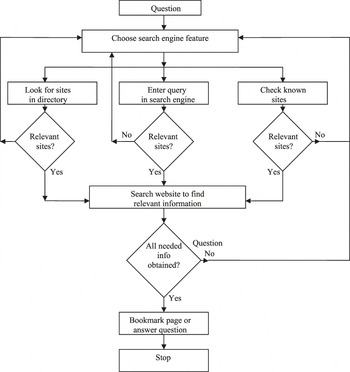
According to Guthrie and Mosenthal (Reference Guthrie and Mosenthal1987), the process of searching for information in printed documents requires formulation of a goal, selection of a category of text for inspection, extraction of relevant details, and repeating this process until a solution is achieved. Symons (Reference Guthrie2005) has developed a model of Web searching based on Guthrie’s (Reference Guthrie1988) cognitive processes of document searching (see Figure 1). Consistent with Guthrie’s model, Symons found that search efficiency on the Web was related to the amount of time allocated to different search states. As the difficulty of a Web search task increases, more time is allocated to the planning stages of searching among participants who complete the tasks most efficiently (Symons).
Applying Guthrie’s (Reference Guthrie1988) model to web searching (Symons, Reference Symons2005).

Description of Present Study
The current study explored search patterns of older adults who found high-quality health information online. We also investigated the time allocated to various search states among participants who found high- versus low-quality sites. We obtained descriptive information about the types of health topics that seniors researched and whether they were critical consumers of information found online. We predicted that participants would have difficulty verifying credibility and recalling the website source, and believed that similar patterns of successful searchers in printed text environments would emerge in hypertext environments.
Method
Participants
We recruited a community-dwelling sample of adults over the age of 55 by means of postcards and posters, and through local organizations, community events, and public bulletin boards. Two recruitment and data collection locations were established. In the first, we recruited participants in a small town in rural Nova Scotia (n = 10); in the second, we recruited participants in a small town in New Brunswick (n = 73). Data collection took place in two separate locations: the first was a lab in an academic building at a small university; the second was in an office space in a residential home. The setup and computer equipment were otherwise very similar, and the methodology was consistent across settings.
Of the 83 individuals who participated in this study, 45 were females and 38 were males, with ages ranging from 55 to 86 years (M = 62.16, SD = 5.41). Fifty of the participants were retired and 33 were working. Occupations, both current and former, included the following: 20 worked in an administrative/clerical capacity (24%); 17, as educators (20%); 14, in health care (17%); 8, in a technical capacity (10%); 6, in management (7%); 4, in military/law enforcement (5%); 3, in marketing/sales (4%); 3, as nannies/housekeepers (4%); 2, as business owners (2%), 2, as architects (2%); and 4, in other capacities (5%).
We verbally explained all tasks and answered any questions participants had about the study procedure before it began. Participants were also given a printed consent form, which reiterated the experimental procedure, ensured confidentiality, and advised that participants were free to withdraw from the study at any point.
Materials
Computers and Software. Participants performed the Internet search task on either a Dell Precision 670 or a Dell Latitude D 600 computer. TechSmith Corporation’s Morae software (Morae, 2004) was installed on these computers to record and summarize computer-related actions including search time, mouse clicks, webpage changes, and window/dialog events. Search time was calculated and began when participants clicked on the Internet Explorer icon; search time ended when they bookmarked their chosen website. A summary of mouse clicks was also provided by the Morae software, which consisted of all mouse clicks (left and right) made during each search. The total number of webpage changes was also calculated, which involved each incident when a new page was loaded into the browser. Windows dialog events were also summarized, which included all windows or dialogs that were resized, moved, or that received focus during a search. All questionnaires and written responses were completed on a Dell Latitude D 600 computer, using MediaLab software (MediaLab, 2004).
Search Tasks. Participants were asked to perform two Internet search tasks, both of which consisted of finding treatment information about various health conditions. The first search involved participants’ finding information about one of the following health topics: heart disease, arthritis, skin cancer, or dementia. This search gave participants the opportunity to become familiar with searching for online health information. The second search involved participants’ finding treatment information about a health topic of their choice. In this article, we focus on the second search only.
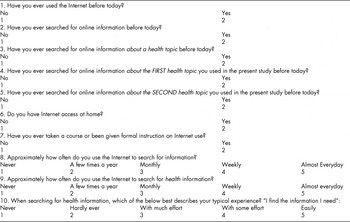
Search Experience Inventory. Participants were asked to complete the Search Experience Inventory (see Table 1). This inventory, created for the current study, consists of (a) questions related to past experiences searching for health information, (b) history of success with Internet searches, (c) sources of Internet access, and (d) average time spent online. Although this inventory was not piloted prior to our current study for psychometric utility, the survey questions are straightforward and are believed to have face validity.
Search Experience Inventory

Critical Consumer Questionnaire. The final questionnaire consisted of six questions designed to assess whether participants were critical consumers of online information (see Table 2). In developing these questions for the current study, we included items about the source of participants’ chosen websites and their beliefs about the credibility of these sites. Although this questionnaire was not piloted prior to the current study for psychometric utility, the survey questions are straightforward and are believed to have face validity.
Critical Consumer Questionnaire

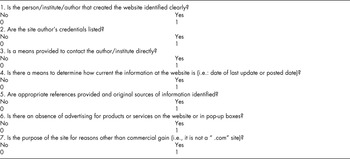
Assessment of Website Quality. Upon completion of data collection, we completed an Assessment of Website Quality Inventory (see Table 3) for the website chosen by participants. This 7-item measure is based on a compilation of popular indicators of website quality. A grid was created whereby criteria from 15 different sources were plotted, and the items that came up consistently on multiple measures were combined to create this scale (Barker, Reference Barker2002; Burns, 2002; Charnock & Shepperd, Reference Charnock and Shepperd2004; Eysenbach & Diepgen, Reference Eysenbach and Diepgen1998; Kapoun, Reference Kapoun1998; Eysenbach & Kohler, Reference Eysenbach and Kohler2002; Gagliardi & Jadad, Reference Gagliardi and Jadad2002; Kent State University, 2004; Mitretek Systems, 1999; National Cancer Institute, 2005; National Center for Complementary and Alternative Medicine, 2002; National Institute on Aging Information Center, 2003; Schrock, Reference Schrock2006; Seidman, Steinwachs, & Rubin, Reference Seidman, Steinwachs and Rubin2003; Tate & Alexander, Reference Tate and Alexander1996). The most common criteria found among the 15 sources listed above included the following: (a) author identified, (b) credentials listed, (c) contact information provided, (d) date last updated posted, (e) references included, (f) absence of advertising, and (g) non-commercial origin. Fourteen websites were randomly chosen and scored by a first, then by a second, rater which produced an inter-rater reliability score of 86 per cent accuracy (r = .88, p < .001). This scale was used to rate the quality of participants’ chosen websites, during their first and second searches, both to assess whether participants were choosing quality sites in their search for health information and to provide an indication of their level of cognitive engagement with the search tasks.
Assessment of Website Quality Inventory

This scale was compiled based on the following sources: Barker, Reference Barker2002; Charnock & Shepperd, Reference Charnock and Shepperd2004; Eysenbach & Diepgen, Reference Eysenbach and Diepgen1998; Kapoun, Reference Kapoun1998; Eysenbach & Kohler, Reference Eysenbach and Kohler2002; Gagliardi & Jadad, Reference Gagliardi and Jadad2002; Kent State University, 2004; Mitretek Systems, 1999; National Cancer Institute, 2005; National Center for Complimentary and Alternative Medicine, 2002; National Institute on Aging Information Center, 2003; Schrock, Reference Schrock2006; Seidman, Steinwachs, & Rubin, Reference Seidman, Steinwachs and Rubin2003; Tate & Alexander, Reference Tate and Alexander1996.
Procedure
Practice Search Task. We first asked participants to complete a practice search. This task was designed to familiarize participants with the computer setup and to answer any questions they had about the experimental procedure. This search was solely for practice purposes and was not used in any data analyses. Instructions included the following request:
Please find a website containing information about the weather forecast in Halifax, Nova Scotia. Once you have this information, bookmark the website and record the predicted high temperature _____ for tomorrow.
Participants were then asked to search for information about a health topic of their choice. Instructions included the following request:
Think of a health topic that you would like to use for an Internet search task. When you have decided on a topic, please enter it here _____________________. Now try to find a webpage containing information about treatment options that you would recommend to a friend. When you have found this website please bookmark it. You will then be asked to indicate what you liked and disliked about the webpage.
When participants finished the search task, they were asked to complete the Critical Consumer Questionnaire and the Search Experience Inventory.
Results
Previous Internet Experience. Seventy-seven participants (93%) had used the Internet before, and 74 (89%) had searched for online information before. There were 59 (71%) participants who reported they had used the Internet to find health information in the past, 24 (28%) who had looked for information about their first search topic in the past, and 31 (37%) who had looked for information about their second search topic in the past. When asked if they had Internet access at home, 74 participants (89%) indicated they did; however, only 18 (22%) had ever taken a course or been given formal instruction on Internet use.
Frequency of Internet Use. Participants were also asked to indicate how often they use the Internet to search for information. Twenty-four participants (32%) said they searched the Internet every day, 17 (23%) said they did so weekly, and 19 (26%) reported they did so monthly. The remaining 14 participants (19%) indicated that they rarely used the Internet. Conversely, when asked how often they search for health information online, 38 (46%) reported searching for health information only a few times a year, and 24 (29%) had never used the Internet to find health information previously.
Typical Online Experience. When asked about their typical online experience, 29 (35%) said they usually find the information they need “easily”, 42 (51%) said they do so “with some effort”, 5 (6%) reported doing so “with much effort”, 4 (5%) said they “hardly ever” found it, and 3 (4%) indicated that they “never” find the information they need.
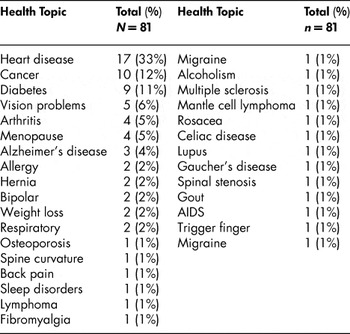
Health Topics. The most commonly researched diseases were heart disease (20%), cancer (12%), and diabetes (11%). Table 4 lists the complete list of health topics searched by participants.
Researched health topics

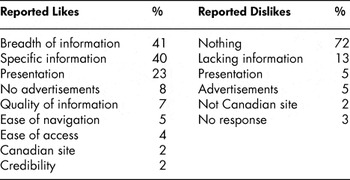
Likes and Dislikes of Chosen Website. Following the search, participants were asked to describe what they liked and disliked about the website they chose. Thirty-four participants indicated that they liked the breadth of information (41%); 33 liked the fact that the website had specific information they were looking for (40%), and 19 participants mentioned the presentation of the site (23%). When asked to describe what they disliked about their chosen website, 60 participants (72%) said “nothing”, and 11 (13%) indicated their site was lacking information. Table 5 lists the complete data set for likes and dislikes.
Reported likes and dislikes of chosen websiteFootnote *

* Some participants offered multiple responses to this question
Credibility. Only 24 individuals (29%) reported that they had checked the source of their chosen website to make sure it was credible. When participants were asked if they could recall the source, only 14 (17%) were able to do so correctly. Despite this low percentage of individuals who could recall the actual source of their website, 80 out of 83 participants (96%) believed that the site they chose was credible. When participants were asked why they believed their website to be credible, 27 (33%) based this decision on previous knowledge; 22 (26%) stated that the site had good information; 15 (18%) said they were familiar with the source; 5 (6%) reported it was the presentation of the site that made it credible; 3 (4%) said it was because the site was not selling products; 3 (4%) said they believed the site to have professional input; 2 (2%) stated that it was because the site was a Canadian or national organization; and 1 (1%) reported that they believed the site to be regulated. Five participants (6%) did not respond to this question.
Classification of Website Source. Following the search, participants were asked to classify the source of their chosen website into one of six possible categories. The majority of participants (63%) believed the source of their site to be a public institution or self-help group (.org); 20 participants (24%) thought their site was a commercial organization (.com); 6 (7%) classified their website as a university site (.edu); and 5 (6%) chose government agency (.gov). Overall, only 12 participants (15%) correctly classified the source of their chosen website. Among those who were correct, all participants bookmarked and correctly classified their webpage as a .org site.
Website Domains. Commercial sites were the most popular website choice, with 35 (42%) choosing a .com site. The next most popular choice was non-profit organization sites, with 21 (25%) choosing .org sites. The remaining domains of websites chosen were as follows: 8 (10%) chose a website URL ending in .gov; 6 (7%), in .net; 6 (7%), in .ca; 1 (1%), in .uk; 1 (1%), in .edu; 1 (1%), in .info; and 1 (1%), in .md.
Web Searching Behaviour. With regards to Web searching behaviour, there were no differences, between participants who had more search experience and those who had less search experience, on any of the dependent variables: search time t(41) = .75, p = .73; mouse clicks t(41) = 1.29, p = .23; webpage changes t(41) = .34, p = .99; window/dialog events t(41) = .47, p = .95.
Website Quality Ratings. There were no significant differences in website quality ratings according to the amount of search experience participants reported: t(80) = .68, p = .81. Similarly, there were no significant differences on the total word count participants provided in their summaries, according to search experience: t(83) = .73, p = .76.
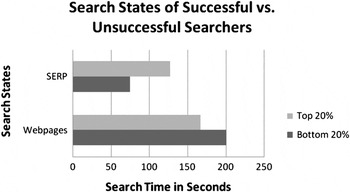
Search States and Website Quality. The amount of time spent in each search state was calculated. Search state was defined as being either on the search engine results page (SERP) or within a website. We measured the search state to see if participants who found better-quality websites took more time at a particular stage of search. SERP is likened to the planning stages of search, such as when a reader of a textbook spends time searching the table of contents. Search state was measured by examining visual recordings of searches in the Morae software and inserting markers to indicate when a search state was started or stopped. We compared participants who found websites that were rated in the top 20 per cent against participants who found websites that were rated in the bottom 20 per cent, and found significant differences between these two groups according to the amount of time spent in SERP. Participants who chose high-quality websites spent significantly more time in SERP than participants who chose poor-quality sites – t(15) = 8.69, p < .001 – and spent significantly less time exploring websites than those who chose poor quality sites: t(15) = 6.19, p < .001.
Overall, there was no significant difference in total search time among those who chose high-quality sites (M = 293.85, SD = 155.32) and those who chose low-quality sites (M = 275.09, SD = 163.06); t(15) = 2.00, p = .06. These differences are presented graphically in Figure 2.
Amount of time spent in webpages versus search engine results pages (SERP) among participants who chose sites that were rated in the top 20 per cent and bottom 20 per cent according to website quality

Discussion
Almost all individuals who participated in this study had used the Internet and had searched for online information previously. Half of the sample indicated that they searched the Internet every day or a few times a week, and most participants reported they had used the Internet to find health information before this study. Previous research has generally reported lower percentages of Internet use among this age group. The Kaiser Family Foundation (2005) found that 31 per cent of individuals over age 65, and 70 per cent of adults between the ages of 55 and 64, had gone online. The Foundation also found that only 21 per cent of individuals over age 65 and 53 per cent of individuals aged 55–64 have ever used the Internet to find health information (Kaiser Family Foundation). More-recent Canadian statistics have reported similar usage rates among next-generation seniors (aged 55–65) but higher rates among adults over age 65, with 45 per cent of this age group using the Internet (Statistics Canada, 2009). When compared with findings of previous Internet research, it appears that the participants in our study had higher Internet use rates. The findings of our study also suggest that Internet use has increased among older adults or that there was a slight selection bias, in that individuals who signed up for this study were more likely to be Internet users.
Many participants acknowledged the importance of finding credible information on the Internet but were uncertain how to seek out indicators of credibility when exploring a website. The overwhelming majority of participants believed that the website they chose during their second search in our study was credible, even though less than a third of participants actually checked the source of their website to verify this belief. Even fewer were able to correctly recall the source of their chosen website. These findings are consistent with previous Internet research focusing on younger cohorts. Eysenbach and Kohler (Reference Eysenbach and Kohler2002) found that people generally have poor website assessment strategies and typically do not actively search for a website’s source, author, or sponsor. It makes sense that older adults would have limited online information literacy skills considering that the majority of participants had never taken a course or been given formal instruction in this area.
Participants in this study employed strategies, other than checking the website source, as a means of judging if a particular website was credible. Many participants based their judgment on knowledge they had beforehand about the medical condition they were researching. They also tended to believe a site was credible if it provided “quality” information, a wide range of information, or the specific information they were seeking. This is similar to previous Internet research examining younger adults which found that individuals tend to rely on message characteristics, content, and site aesthetics as a means of evaluating website credibility (Dutta-Bergman, Reference Dutta-Bergman2004).
Some comments provided by participants revealed a certain level of naivety among older adults who stated that “because [the information] was on the Internet it must be credible”. One participant also believed that people are “not allowed to put medical information on the Internet unless it is checked by someone”. Apparently, some older adults automatically trust online health information without recognizing the importance of being critical consumers of the Internet. This highlights the need for additional public education programs to increase popular awareness of the possibility of poor-quality information on the Internet and to help people learn how to determine website credibility. Moreover, if older adults increase their knowledge of how to navigate a search engine, this should have a positive impact on the quality of information they find.
The concept of credibility is difficult to define. Accordingly, then, we explored what the word “credible” meant to the older adults who participated in this study. When asked to describe what elements or attributes contributed to their credibility judgments, participants talked about information that was “concise”, “clear”, “organized”, and presented in an “orderly manner”. They also valued information that was “not patronizing” and “offered alternatives as well as guidance for further questions”. Additional indicators of credibility for these older adults were that sites used “medical terms” and that the information was “consistent with prior knowledge”.
Navigator tools are available that can assist users in their quest to find credible health information on the Internet (Health on the Net, 2010). The Health on the Net Foundation (HoN) also offers a code of ethics and guidelines for site managers regarding the minimum standards for high-quality medical information. Sites can apply for certification through HoN which indicates to users that the site is striving to contribute high-quality information (Health on the Net, 2010). Such tools and certification procedures could be particularly useful to older adults to help ensure that they are accessing credible information.
When participants were asked to classify the source of their chosen website into one of six broad categories, few (15%) were able to do so correctly. The majority of participants believed the website they chose was created by a public institution or self-help group. Very few participants (7%) thought the source of their chosen website was a commercial organization, when in fact the majority were .com sites. This suggests that many older adults are relying on websites created with the intention of commercial gain to obtain health information. Although undoubtedly there are several .com sites with reliable and unbiased health information, it is equally likely that many sites are slanted by commercial interests. For example, drug-company-sponsored sites were found to give significantly more emphasis to medication in the treatment of post-traumatic stress disorder (PTSD), rather than other treatment options (Mansell & Read, Reference Mansell and Read2009). Such sites may be beneficial to users, as long as individuals are aware of the possibility of bias and explore these webpages in a critical fashion.
Although most of our study participants had never taken a course on Internet use, several individuals mentioned that they would be interested in doing so. Considering the growing number of older adults who are using the Internet to find health information, it is imperative that resources be available to help guide users on how to navigate the web in a critical fashion. It would also be helpful to increase general awareness surrounding the reality of low-credibility websites and promote strategies to help distinguish poor-quality sites from those of higher quality.
Analyses of search recordings revealed that study participants who chose high-quality websites spent significantly more time examining the SERP and significantly less time within the actual websites than those who chose poor-quality sites. These findings are similar to previous research that examined patterns of successful searchers within printed text documents (Dreher & Guthrie, Reference Dreher and Guthrie1990; Symons, Reference Symons2005).
Limitations
Bias is a possibility among the sample of older adults who volunteered to participate in the current study, inasmuch as there may be differences between the average older adult and those who are willing to take part in a study involving computers. This sample of participants may have been more technologically inclined than many older adults. Participants were more educated than the average older adult which means that they were also more likely to have a higher socioeconomic status. These biases suggest that findings of this study should be interpreted with caution and that they may not apply to older adults with less computer use, lower education, and lower socioeconomic status.
Further demographic considerations involved the large proportion of participants who worked in the health care field. Interestingly, research has found that whether or not participants are health professionals has little influence on behaviour, attitude, or beliefs surrounding information they found online (Lemire, Pare, Sicotte, & Harvey, Reference Lemire, Pare, Sicotte and Harvey2008). These researchers also found that the health professionals were slightly less impressed with the quality of information, found it slightly less trustworthy, and felt that it was slightly less useful than the rest of the sample (Lemire et al.). Similar attitudes may have been detected in the current sample, although we did not explore this avenue.
Another potential limitation is that the current study involved a healthy sample of older adults. Differences may have existed if the sample consisted of individuals managing a chronic disease or if participants were caring for ill family members. Individuals who have a personal interest in the health information they seek may be more motivated to think about credibility issues than those who are not personally connected to the material.
Note, also, that comparisons were not made between participants from the two separate data collection locations. Differences may have existed between participants from a rural versus urban location and an academic versus residential setting. Participants may have been more relaxed in the residential setting than in the laboratory setting, although we attempted to ensure that computer equipment and overall setup were similar across locations.
The Search Experience Inventory and Critical Consumer Questionnaire, developed for the purposes of this study, were not piloted to test psychometric utility. As we have mentioned, the questions were asked straightforwardly and believed to have face validity. Prior medical knowledge was not evaluated in the current study and there was also no screening process for visual acuity, although participants were encouraged to wear corrective eyeglasses if they were needed.
Future Research
It would be interesting to learn if similar results would be found in a study involving topics other than health conditions. According to Toms et al. (Reference Toms, Freund, Kopak and Bartlett2003), individuals search differently depending on the purpose of their search. When people are doing research, they usually seek out specific site genres, when looking for travel information they typically adopt a more geographic approach, when shopping they tend to search for products, and when looking for consumer information they usually focus on finding reliable sites (Toms et al., Reference Toms, Freund, Kopak and Bartlett2003). This suggests that differences would exist if people searched for information genres other than health topics.
When participants were asked to write about their own personal determinants of credibility, they often mentioned comparisons between the information they found and their prior knowledge. Future researchers may wish to include a measure of prior knowledge to see how this influences search behaviours and credibility ratings. They may also want to further explore issues of credibility and examine how older adults define this key concept.
It will also be important to investigate the impact of levels of trust as to whether users seek out information from the Internet, their health care providers, or both, and how age affects trust in the information source. Overall, older adults tend to have higher levels of trust for their health care providers than their younger counterparts. One study found that elderly patients (aged 75 and older) had very high levels of trust in their physician and tended to accept medication recommendations, irrespective of side-effect severity (Herve, Mullet, & Sorum, Reference Herve, Mullet and Sorum2004). Additional research has found that older adults are most likely to identify doctors and pharmacists as the sources they would trust “a lot” to provide information on prescription drugs (Donohue, Huskamp, Wilson, & Weissman, Reference Donohue, Huskamp, Wilson and Weissman2009). It would be of significance to see how these trust ratings vary when study participants search online sources.
Researchers are also in the beginning stages of exploring trust of online health information from collaborative information sources such as social networks, blogs, discussion boards, and other user-generated forums (Moturu, Liu, & Johnson, Reference Moturu, Liu and Johnson2008). Trust and credibility concerns will be a major issue in these areas where there are not a lot of restrictions and users freely contribute information of varying quality (Moturu et al.). More research is needed in the realm of social media and collaborative information sharing sources, and on the impact these mediums have on seniors’ consumption of health information. Additional studies will also need to consider the increasing popularity and use of mobile Internet handheld devices, such as cell phones and tablets (Purcell & Rainie, Reference Purcell and Rainie2011).
Although research on Web searching behaviour has grown exponentially over the past two decades, further investigation is required into the search patterns of older adults. The current study highlights the importance of teaching older adults about the hazards of online information and helping them develop strategies to assess website quality. Many participants felt that website credibility was important; however, few participants knew how to verify whether a particular site was credible. Our study also found that participants who chose higher-quality websites spent significantly more time examining the SERP, and significantly less time within the actual websites, than those who chose poor-quality sites. These findings have meaningful implications for training programs designed to teach older adults to be more-effective and -efficient consumers of online information. Because older adults are the fastest-growing population of online users, it is imperative that researchers continue investigating their online needs and patterns of use.