I. INTRODUCTION
Shape-memory polymers (SMPs) are a class of smart polymeric materials that can recover the original shape from a temporary shape by external stimuli on demand. Thermal-sensitive SMPs that use temperature change as their external stimulus are the most common SMPs. Reference Hearon, Besset, Lonnecker, Ware, Voit, Wilson, Wooley and Maitland1–Reference Wu, Huang and Tan9 Since the 1960s, covalently cross-linked polyethylene has found broad applications as heat-shrinking films or tubings. The importance of SMPs is gradually being taken seriously to date. In the past 50 years, SMPs have attracted considerable attention because of its unique properties. Reference Santo10–Reference Chan Vili12
Common SMP chemical components include polynorbornene, Reference Yang, Huang, Yu, Jiang, Zhang and Xie13 polycaprolactone, Reference Le, Kulangara, Adler, Leong and Ashby14 polyurethane, Reference Sahoo, Jung, Yoo and Cho15–Reference Xu, Fu, Huang, Pei, Chen, De Hosson, Kraft and Reuben18 styrene copolymer, Reference Richard, Korey and Lisa19,Reference Fei and Cavicchi20 and epoxy. Reference Feldkamp and Rousseau21,Reference Zheng, Fang, Cao, Zhao and Xie22 Among these SMPs, shape-memory epoxy resins have higher modulus and greater thermal and chemical stabilities than the others. They are commonly used as matrix materials in structural composites, which drastically improve the stiffness and shape recovery force of SMPs. Liu et al. Reference Liu, Han, Tan and Du23 investigated the shape-memory properties of epoxy-based.
SMPs with different curing degrees. They found that epoxy-based SMPs with different curing degrees have excellent shape-memory performances and a wide range of well-separated transition temperatures. Xie and Rousseau Reference Xie and Rousseau24 found that varying the cross-link density by substituting the diamine curing agent with a monoamine could tune the glass transition temperature (T g) of epoxy-based SMPs. Liu et al. Reference Liu, Gall, Dunn and McCluskey25 filled shape-memory epoxy with 20 wt% SiC nanopowder, and found that the recovery force of the SMP nanocomposite was also higher than that of pure SMP.
Although shape-memory epoxies have several advantages than the other SMPs, the recovery force of shape-memory epoxy is relatively low, which limit their application. Reference Meng and Hu26,Reference Gunes and Jana27 To overcome these problems, a novel shape-memory epoxy resin system is prepared in this study using hydro-epoxy, hexahydrophthalic anhydride, and diglycidyl 4,5-epoxy tetrahydro phthalate. The thermal, mechanical, and shape-memory properties of the materials are systematically investigated by differential scanning calorimetry (DSC), dynamic mechanical analysis (DMA), bend test, and U-type shape-memory test. Fundamental trends are established between the chemical structure, cross-link density, T g, rubbery modulus, bend strength, and shape-memory properties.
II. EXPERIMENTAL
A. Materials
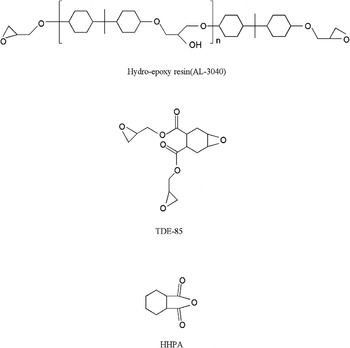
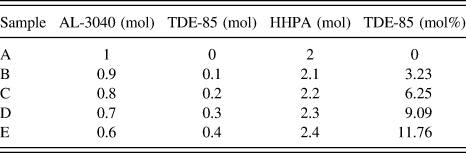
The chemical structures of the reactants are shown in Fig. 1. Hydro-epoxy resin (AL-3040) with an epoxy value of 0.43 eq/100 g was manufactured by Yantai Aolifu Chemical Industry Co., Ltd., People's Republic of China. The diglycidyl 4,5-epoxy tetrahydro phthalate (TDE-85, epoxy value 0.85 eq/100 g) was supplied by Tianjin Jindong Chemical Factory, People's Republic of China. The curing agent hexahydrophthalic anhydride (HHPA) was purchased from Zhejiang Alpharm Chemical Technology Co., Ltd., People's Republic of China. All chemicals were used as received. The detailed formulations of the shape-memory epoxy series are summarized in Table I. After mixing the three-part epoxy (AL-3040, HHPA, and TDE-85), degassing was carried out at 60 °C in a 25-inch Hg vacuum oven to obtain a bubble-free prepolymer. After degassing, the prepolymer solution was placed between two teflon-covered glass plates using a 4 mm thick rubber spacer. Thermal curing program was performed at 80 °C for 5 h, 120 °C for 4 h, and 150 °C for 2 h. Upon the completion of curing, the epoxy samples were demolded and cut into rectangular shapes for DMA, bend, and deformation-recovery tests.
Chemical structures of the hydro-epoxy resin, TDE-85, and HHPA.

Compositions of the shape-memory epoxy series.

Note: TDG-85 (mol%) is the mole fraction of TDE-85, which is calculated by n TDE-85/(n AL-3040 + n TDE-85 + n HHPA) × 100%.
III. METHODS
A. Fourier transformed-infrared (FT-IR) spectra
Structural changes in the shape-memory epoxy resin were investigated using an FT-IR spectrometer (Nicolet iS10, Thermo-scientific, Waltham, MA) from 4000–500 cm−1.
B. Differential scanning calorimetry
The thermal properties of the shape-memory epoxy resin were characterized using a differential scanning calorimeter (MDSC 2910, TA Instruments Corporation, New Castle, DE) carried out under nitrogen from 40 to 200 °C at a heating rate of 10 °C/min.
C. Dynamic mechanical analysis
The thermomechanical properties of the shape-memory epoxy resin were investigated using a dynamic mechanical analyzer (Q800, TA Instruments Corporation, New Castle, DE) in multifrequency-strain mode from 40 to 200 °C. The sample dimensions were 28 mm3 × 13 mm3 × 4 mm3. The samples were heated at a rate of 3 °C/min, and an applied strain of 0.1% was oscillated at a constant frequency of 1 Hz.
D. Bend test
Three-point bending tests were carried out using a universal testing machine (Instron 4467, Instron Corporation, Canton, MA) with rectangular samples at room temperature (20 °C). The span was 64 mm, and the crosshead speed was 2 mm/min. The sample dimensions were 85 mm3 × 15 mm3 × 4 mm3, and the bend strength under fixed deflection (1.5 mm × 4 mm) was measured.
E. U-type shape-memory test
Rectangular samples (85 mm3 × 15 mm3 × 4 mm3) were used to evaluate the shape-memory properties of the epoxy resin. Five samples were measured under each condition. A shape-memory test was performed according to the following steps. (i) The samples were heated to T g, T g + 10 °C, and T g + 20 °C in an oven and held for 10 min for full heating. The T g values were obtained from DMA (tan δ). (ii) The samples were bent into U shapes, circling a center axis with a 10 mm diameter. The bending angle was recorded as θfirst. The U-shaped samples were then quickly removed from the oven and dipped into a cold water bath (20 °C) with a constant external force. Afterward, the U-shaped samples were left at room temperature for 2 h, and the bending angle was recorded as θfixed. (iii) To quantify shape-memory properties, the U-shaped samples were placed in an oven set to the temperature at which they were deformed, and the shape recovery process was observed. When the samples did not change, the recovery time was recorded. This recovery time was designated as the shape recovery time for the said temperature. The bending angle was then recorded as θrec. The shape fixity ratio (R f) and shape recovery ratio (R r) were calculated using Eqs. (1) and (2).
 $${R_{\rm{f}}} = {{{\theta _{{\rm{fixed}}}}} \mathord{\left/ {\vphantom {{{\theta _{{\rm{fixed}}}}} {{\theta _{{\rm{first}}}}}}} \right. \kern-\nulldelimiterspace} {{\theta _{{\rm{first}}}}}} \times 100\% \quad ,$$
 $${R_{\rm{r}}} = {{{\theta _{{\rm{fixed}}}} - {\theta _{{\rm{rec}}}}} \mathord{\left/ {\vphantom {{{\theta _{{\rm{fixed}}}} - {\theta _{{\rm{rec}}}}} {{\theta _{{\rm{fixed}}}}}}} \right. \kern-\nulldelimiterspace} {{\theta _{{\rm{fixed}}}}}} \times 100\% \quad .$$
IV. RESULTS AND DISCUSSION
A. FT-IR
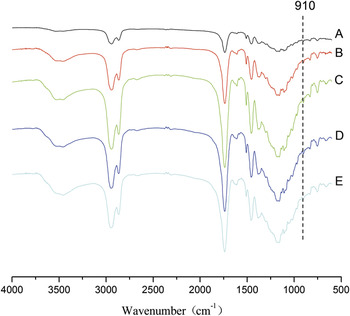
Figure 2 shows the FT-IR spectra of the shape-memory epoxy resins from 4000–500 cm−1. No absorption was observed for each polymer at 910 cm−1, which is the characteristic absorption of the epoxy group. The shape-memory epoxy network is based on the reaction of HHPA with a stoichiometric amount of a blend of hydro-epoxy resin and TDE-85; hence, this finding indicates that the epoxy has completely reacted with the curing agent. HHPA contains a carbonyl group (C=O) in its molecular structure; hence, all polymers show strong absorptions at 1740 cm−1 because of the stretching vibration of the C=O bond. According to Fig. 2, the absorption of carbon-oxygen double bonds becomes stronger as the TDE-85 content increases in the polymer network. The molar ratio of the carbonyl group in the polymer network improves as the TDE-85 content increases because of the carbonyl groups in TDE-85.
FT-IR spectra of the shape-memory epoxy series.

B. Thermal and dynamic mechanical analyses
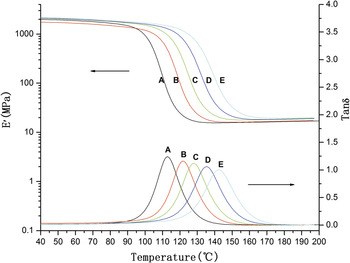
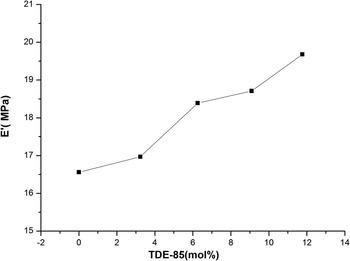
In this study, the peak of the tan δ versus temperature curve is defined as DMA T g. A good SMP usually exhibits a change on storage modulus (E′) for more than 2–3 orders below and above DMA T g. Figure 3 shows that the E′ below DMA T g is approximately two orders of magnitude larger than that above DMA T g, indicating that the shape-memory epoxy resin meets the requirements. For instance, the E′ of sample C at 25 °C is 2120 MPa, but only 17.97 MPa at 165 °C. Figure 3 also reveals that E′ increases as the TDE-85 content increases. For a clearer illustration, Fig. 4 reveals the relationship between E′ and TDE-85 content at 180 °C. In the shape-memory epoxy resin network, the average molecular weight between cross-link points decreases with increasing tri-functional epoxy resin (TDE-85) content, thereby increasing the cross-link density of the polymer network. Thus, E′ increases with increasing TDE-85 content. Figure 4 also reveals that these shape-memory epoxy resins have higher E′ than the other shape-memory epoxies. Reference Liu, Han, Tan and Du23,Reference Leng, Wu and Liu28 Thus, these shape-memory epoxy resins have higher recovery force.
DMA curves of the shape-memory epoxy series.

Relationship between storage modulus and TDE-85 content at 180 °C.

A closer examination of Fig. 3 reveals that the DMA T g of the polymer increases with increasing TDE-85 content. For instance, the DMA T g of sample A is only 113 °C, whereas the DMA T g of sample E is 142 °C. T g is the essential transition temperature from the freezing to free-motion states of segments in a polymer network. In the shape-memory epoxy resin network, the cross-link density increases with increasing TDE-85 content. Consequently, the segment movement is hindered, leading to increase in DMA T g. Similar results have been reported for other shape-memory epoxies. Reference Wei, Zhu, Tang, Liu and Xie29
Figure 3 also reveals the decrease in relaxation peak height of the polymer with increasing TDE-85 content. Relaxation peak height is associated with molecular mobility, revealing that molecular mobility decreases with increasing TDE-85 content.
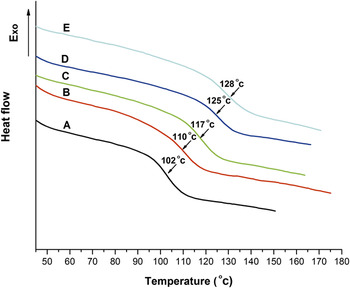
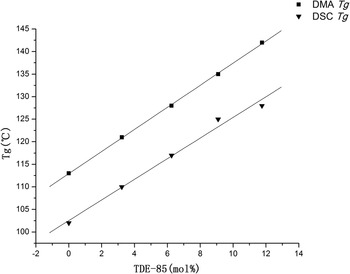
These polymers are further characterized using DSC, and the curves are shown in Fig. 5. The T g values obtained from the DSC analysis are also marked in Fig. 5. In the discussion below, DSC T g is used to represent the T g value measured by DSC. As shown in Fig. 5, all polymers exhibit distinct DSC T g values ranging from 102 to 128 °C, which gradually increase with increasing TDE-85 content. For a clearer illustration, T g values obtained from DSC and DMA are summarized in Fig. 6. The T g values obtained from DSC are approximately 12 °C lower than those obtained from DMA. This difference may be attributed to the frequency effect in the DMA test, consistent with previous studies. Reference Sheng, Hu, Wang, Ma and Gu30,Reference Zhang, Li, Lu, Jin, Liu and Xu31
DSC curves of the shape-memory epoxy series.

T g values of the shape-memory epoxy series.

C. Mechanical property analysis
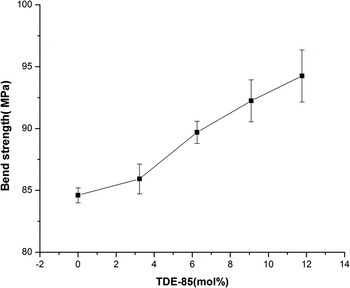
The relationship between bend strength and TDE-85 content at room temperature is shown in Fig. 7. The bend strength gradually increases with increasing TDE-85 content at room temperature. For instance, the bend strength of sample A at 25 °C is only 84.61 MPa, whereas that of sample E is 94.25 MPa. Notably, the bend strength of the material is increased by 11.39% with the addition of 11.76 mol% TDE-85. In the epoxy network, the cross-link points are completely responsible for carrying the load; thus, increase in bend strength is expected with increasing cross-link density.
Relationship between bend strength and TDE-85 content at room temperature.

D. Shape-memory property analysis
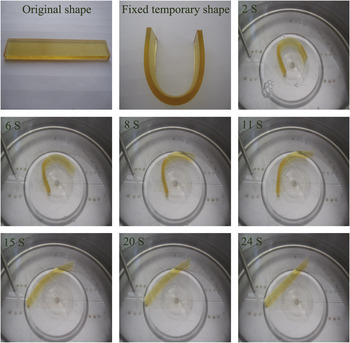
To investigate the shape-memory properties of the epoxy series, the samples were tested at T g, T g + 10 °C, and T g + 20 °C using the U-type shape-memory test. The T g values were obtained by DMA (tan δ). According to the results, the shape fixity ratio of the shape-memory epoxy series (sample A through E) can reach 100% regardless of the deformation temperature used. The results also show that full recovery can be observed after only several minutes at T g, T g + 10 °C, and T g + 20 °C; hence, the shape recovery ratio of the series can reach 100%. Figure 8 shows a series of photographs on the shape recovery process of sample C in a 130 °C paraffin oil bath. The U-shaped specimen is obtained by vacuum casting. The U-shaped specimen is heated to 130 °C in an oven and held for 10 min for full heating. The specimen is then deformed into a straight shape through bending. Upon cooling under load, the deformed temporary shape is fixed. Full recovery is observed after only 16 s when the specimen is placed in a 130 °C paraffin oil bath.
The shape recovery process of sample C in a 130 °C paraffin oil bath.

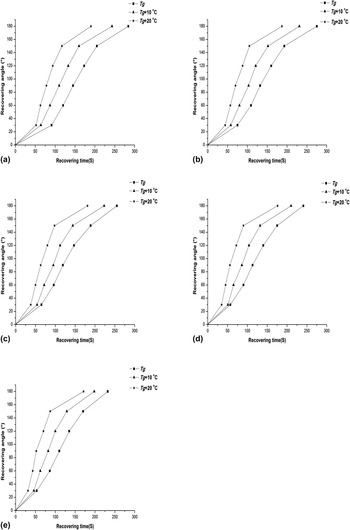
Figure 9 shows the relationship between recovery angle and recovery time of the shape-memory epoxy series at T g, T g + 10 °C, and T g + 20 °C. Figure 9 reveals that the slope of the curve is generally higher from 30° to 150°, indicating a relative low recovery rate at the start and terminal stage. This phenomenon can be explained by the possibility that the release of internal stress is followed by a relatively strong friction between the segments at the start stage, thereby decreasing the recovery rate. At the final stage, the stored strain energy is released in large quantities at the incipient stage, thereby slowing the recovery rate. The same trend of shape recovery rate has been reported in the literature. Reference Wei, Zhu, Tang, Tian and Xie32
Relationship between recovering angle and recovering time of the shape-memory epoxy series at different temperatures.

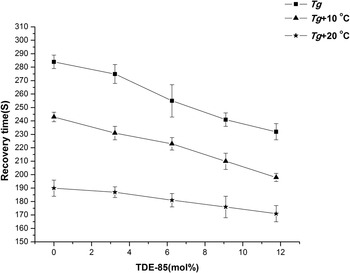
The relationship between shape recovery time and TDE-85 content at T g, T g + 10 °C, and T g + 20 °C is shown in Fig. 10. The shape recovery time gradually decreases with increasing TDE-85 content. In the U-type shape-memory test, the strain energy is stored in the form of internal stress in a temporary shape. Figure 3 shows that E′ increases with increasing TDE-85 content, indicating that more strain energy is stored as AG-80 content increases, during which the sample is deformed. Thus, the shape recovery time decreases with increasing TDE-85 content.
Relationship of shape recovery time and TDE-85 content at different temperatures.

V. CONCLUSION
A shape-memory epoxy resin system is prepared using hydro-epoxy, HHPA, and diglycidyl 4,5-epoxy tetrahydro phthalate. The effect of TDE-85 content on the thermal, mechanical, and shape-memory properties of shape-memory epoxy resin is studied in detail. DSC and DMA measurements on the shape-memory epoxy resins show that the T g and rubber modulus gradually increase as TDE-85 content increases. The room-temperature bend strength of the material increases with increasing TDE-85 content. The U-type shape-memory test on these shape-memory epoxy resins shows that they have excellent shape-memory performances. The shape recovery time of shape-memory epoxy resin systems decreases with increasing TDE-85 content. These results are attributed to the increase in TDE-85 content.
ACKNOWLEDGMENT
This work was supported by the Fundamental Research Funds for the Central Universities (No. 2014G3213005).