Introduction
Catalytic oxidation by inexpensive, safe, and environmentally friendly oxidants, such as oxygen, hydrogen peroxide or t-butyl hydro peroxide is a feasible method for the synthesis of many commodity chemicals as well as perfumes, drugs, and pharmaceuticals.[ Reference Caron, Dugger, Ruggeri, Ragan and Ripin 1 , Reference Punniyamurthy, Velusamy and Iqbal 2 ] Benzaldehyde is an important intermediate in organic synthesis and is widely used in cosmetics, perfumery, food, and pharmaceutical industries. At present, benzaldehyde is mainly produced by the gas-phase oxidation of toluene or liquid-phase oxidation of benzyl alcohol on industrial and laboratory scales.[ Reference Zhan, Hong, Mbah, Huang, Ibrahim, Du and Li 3 , Reference Liu, Tan, Yin, Yu and Zhou 4 ] However, these processes lead to generation of large amounts of by-products, and the selectivity is poor; this limits benzaldehyde applications. Recently, selective oxidation of benzyl alcohol to benzaldehyde using O2 as the oxidant in the presence of a heterogeneous catalyst in a packed bed reactor has attracted much attention because the process generates a small amount of by-products.[ Reference Ma, Guo and Xiang 5 ] Supported metal catalysts have been widely used in selective oxidation of benzyl alcohol to benzaldehyde. Many of these catalysts showed good activity and selectivity, but the reaction temperature in most cases was above 300 °C. In addition, these catalysts are usually recycled by tedious and time-consuming processes, including centrifugation and re-dispersion cycles, thus hampering the re-usability of recycled catalysts in aqueous solutions.[ Reference Lin and Doong 6 ]
Nobel metal nanostructures have recently received much attention because of their unique optical, catalytic, and electrochemical properties combined with nano-scaled effect, which make them suitable materials for potential applications in various fields such as catalytic-oxidation aromatic alcohols, Reproducible SERS substrates, antimicrobial activity, and application of electrochemistry, etc.[ Reference Wang, Fu, Wang, Wang, Chen and Xu 7 , Reference Sau, Rogach, Jackel, Klar and Feldmann 8 ] Silver nanoparticles (AgNPs) have been found to play an important role in several catalytic processes including low-temperature CO oxidation, reductive catalysis of chlorinated or nitrogenated hydrocarbons,[ Reference Zeng, Zhang, Chen and Xia 9 ] and organic synthesis.[ Reference Gong and Mullins 10 , Reference Hutchings 11 ] However, because of their high surface energy, naked AgNPs tend to form agglomerates, which could lead to the decrease of active site and catalytic activity of AgNPs. Therefore, to overcome this problem, noble metal nanoparticles are fabricated on polymer matrix to form nanocomposites and act as the catalysts.[ Reference Mondal, Rana and Malik 12 – Reference Jiang, Wang and Sun 16 ] Nowadays, polymer–noble-metal nanocomposites have received a great deal of attention owing to their excellent physical and chemical properties as well as the possibility of applications in the fields of catalysis, electronic devices, etc.[ Reference Zhang, Jin and Xia 17 – Reference Li, Wu, Yea and Wei 19 ] As we know, due to the powerful, convenient and cost-effective, intensive attention has been attracted for supporting highly active catalysts like noble metal nanoparticles onto electrospinning nanofibrous mats.[ Reference Sawada, Sakai and Taya 20 ] In addition, electrospun nanofibrous materials enjoy the priority due to their remarkable characteristics, such as extremely large surface area to volume ratio, flexibility in surface functionalities, and superior mechanical performance (e.g., stiffness and tensile strength) compared with any other material,[ Reference Destaye, Lin and Lee 21 ] which are of benefit to the diffusion of substrate or product molecules onto/from active sites. These outstanding properties make the polymer nanofibers to be the optimal candidates for many important applications (e.g., composite nanofibers were used as deactivated chemical agents or water remediation).[ Reference Supaphol and Chuangchote 22 – Reference Miao, Wang, Chen, Liu and Liu 25 ] Among the polymers, polyacrylonitrile (PAN), which is a polymer rich in cyano groups, is very important for metal-incorporated nanostructure formation. Significantly, PAN nanofibrous scaffold can be modified to graft abundant amine and imine groups which could provide sufficient chemisorption sites for silver ions to promote the electroless plating of silver.[ Reference Li, Wang, Wang, Cheng and Wang 26 , Reference Hooper, Werho, Hopson and Palmer 27 ] The immobilization of various AgNPs onto complex two-dimensional or three-dimensional (3D) nanofibrous surfaces is an important issue for nanotechnology, which could provide a simple strategy to construct hierarchical catalytic materials with high reactive activities and convenience to re-use.
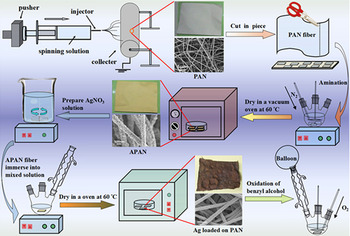
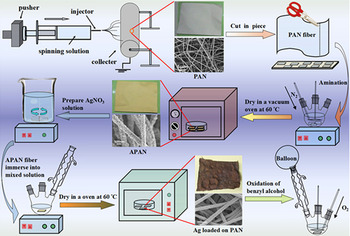
In this study, a series of AgNPs/PAN nanofibrous mats with different reaction temperature were prepared via a convenient and environmentally friendly route combining electrospinning, amination, and electroless plating technique, as shown in Scheme 1. The resultant composite nanaofibrous mats have been characterized by scanning electron microscopy (SEM), energy-dispersive spectrometer (EDS), transmission electron microscopy (TEM), X-ray diffraction (XRD), and Fourier transform infrared (FT-IR). The resultant composite membranes showed an efficient catalytic activity for reduction of 4-nitrophenol (4-NP) to 4-aminophenol (4-AP) and showed the favor separation, recovery, and cyclic utilization properties. More important, the AgNPs/PAN composite nanaofibrous mats also exhibited the low-temperature selective oxidation of benzyl alcohol to benzaldehyde that confirmed by gas chromatography–mass spectroscopy (GC–MS) analysis, and expected to promote its practical applications in the field of industrial synthesis reactions.
The schematic representation for amination and immobilization of AgNPs on PAN nanofibrous mats.
Experimental
Materials
PAN (M w = 150,000) power, N, N′-dimethylformamide (DMF, AR), silver nitrate (AgNO3, AR), trisodium citrate (Na3C6H5O7, AR), sodium borohydride (NaBH4, AR), polyvinylpyrrolidone (PVP) were purchased from aladdin Co. Ltd. (China) and used as received without further purification.
Preparation of PAN nanofibers
Typically, PAN was firstly dissolved in DMF by mild stirring for 12 h to obtain a (PAN: 10 wt%) homogeneous transparent solution. About 6 mL of the PAN/DMF solution was placed in a 10 mL syringe. The syringe was placed in a syringe pump that maintained a solution feeding rate of 0.1 mm/h. A grounded metallic rotating roller covered with a piece of aluminum foil was used as collector, which rotated at 500 rpm. The distance between the needle tip and collector was 15 cm, and the voltage was set at 15 kV.
Fabrication of aminated PAN (APAN) nanofibrous mats: The detailed methods and procedures for the preparation of PAN nanofibrous mats and APAN nanofibrous mats with amine and imine groups on their surfaces were carried out according to the method described elsewhere.[ Reference Wang, Fu, Wang, Wang, Chen and Xu 7 ] In briefly, the PAN nanofibrous mats (4.0 × 4.0 cm2, ~0.01 g) were immersed into a mixture of diethylenetriamine (DETA) solution (105 mL) in a 500 mL three-neck round-bottom flask containing sodium carbonate (4.5 g) as catalyst; the reaction was allowed to proceed at 90 °C with N2 gas passing through the reaction mixture for 2 h for the amination of PAN nanofibers. Afterward, the membranes were separated from the solution when the mixture was cooled down to room temperature, thoroughly rinsed with deionized water until a pH level of 7 was reached. These were subsequently dried at 60 °C in a vacuum oven overnight.
Immobilization of AgNPs on PAN nanofibrous mats
Immobilization of Ag nanoparticles on APAN nanofibrous mats was fabricated by the electroless plating technique. AgNPs were prepared by the reduction of AgNO3 using NaBH4 together with trisodium citrate and PVP. In briefly, 10 mL of 5.9 × 10⁻² m AgNO3 and 10 mL of 4 × 10⁻² m trisodium citrate aqueous solutions were mixed under vigorous stirring for 5 min. Then, 3 mL of solution containing 0.16 g PVP was added to the mixture. 0.1 g of NaBH4 powder was added into the mixture with further stirring for 5 min. A brown solution was obtained. Upon further stirring for a several minutes, the mixture was added in a 250 mL three-neck flask and then refluxed at 100, 60, and 20 °C, respectively. Subsequently, the APAN membranes were immersed into the mixture solutions and kept stirring for 2 h. The resulting solution was cooled down to room temperature. The Ag ions were adsorbed on the surface of nanofibrous mats by the amine and imine groups. Finally, the sample was re-dispersed in distilled water for further characterization.
Catalytic reduction of 4-NP
Prior to the catalytic reduction of 4-NP, the silver nanoparticles loaded on PAN nanofibrous mats were rinsed thoroughly with deionized water. In a typical reaction, 4 mL of 0.02 m solution of 4-NP was firstly dissolved in 46 mL deionized water. NaBH4 (0.326 g) was then added to the solution, resulting in a color change from colorless to bright yellow occurred. After stirring for 30 min, the AgNPs/PAN nanofibrous mats (obtained at 60 °C, 4.0 × 4.0 cm2, ~0.12 g) were added into the mixture solution. The catalytic reduction of 4-NP was carried out under visible light. The same volume of the mixture were taken out at the intervals of 10 min and concentration of 4-NP in the solution was immediately recorded via UV−vis spectrometer (U-3010, Hitachi) in the range of 200−600 nm at room temperature.
Catalytic selective oxidation of benzyl alcohol
The selective oxidation of benzyl alcohol was performed in a 50 mL three-neck round bottom flask using a water condenser. Typically, in which, a piece of the AgNPs/PAN nanofibrous mats (obtained at 60 °C, 4.0 × 4.0 cm2, ~0.01 g) and 20 mL of acetonitrile as solvent were added to the reactor containing 2 mL of benzyl alcohol. Besides, an air balloon was placed on top of the condenser. Then the reactor was heated up to 76 °C and the reaction was carried out under visible light unless otherwise noted. After reaction, the oxidation products were collected at different reaction times and identified using a GC–MS(MS:5973I/GC: 6890N). Conditions of GC–MS: carrier gas (N2) at 140 K; temperature program 60 °C, 1 min, 15 °C/min, 180 °C, 15 min; injector, 280 °C; detector, 280 °C.
Characterization
The microstructures and crystal phase of the as-prepared samples were analyzed with a SIEMENS Diffractometer D5000 XRD with Cu Kα radiation source at 35 kV, with a scan rate of 10° s−1 in the 2θ range of 5°–85°. The ULTRA-55 field-emission SEM (FE-SEM) at an accelerating voltage of 10 kV and JSM-2100 TEM were used to characterize the morphologies of the as-prepared samples. The UV–vis diffuse reflectance spectra were obtained for the dry-pressed disc samples using a UV–vis spectrometer (U-3010, Hitachi). FT-IR spectra were performed on a Nicolet 5700 instrument using potassium bromide (KBr) tablet method.
Results and discussion
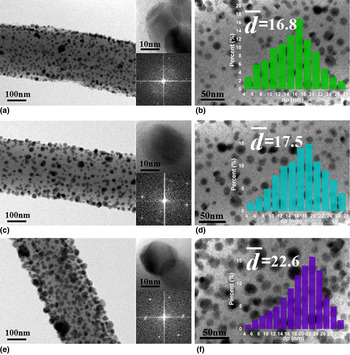
Here, we demonstrate a convenient and cost-effective route to prepare AgNPs/PAN composite nanofibrous mats. As-prepared three products at different reaction temperature are presented in Table S1. When the reaction temperature was controlled at 20 °C, the average diameter of AgNPs that immobilized on PAN nanofibrous mats was found about ~16.8 nm. Increasing the reaction temperature to 60 and 100 °C increased the size of AgNPs to 17.5 and 22.6 nm, respectively. However, the entire above three composites exhibited similar Ag atomic ratio due to same amount of Ag source has been added into the reaction system.
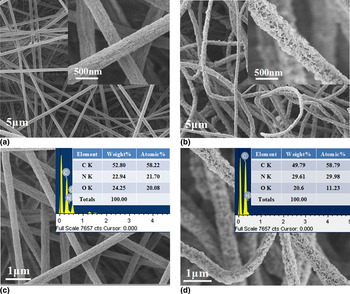
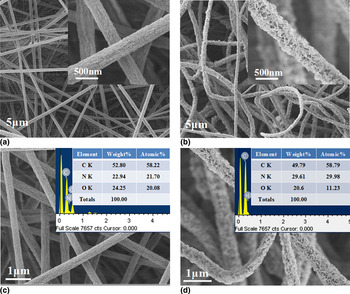
The morphology of AgNPs/PAN composite nanofibrous mats is displayed in Fig. 1. The typical SEM images of as-prepared PAN nanofibrous mats with rough surface are shown in Figs. 1(a) and 1(c). The average diameter of PAN nanofibrous mats are about 350 nm. The APAN nanofibrous scaffolds with abundant amine and imine groups is prepared by the graft of diethylenetriamine (DETA) on PAN nanofibrous mats surfaces. The size of resultant APAN nanofibrous mats is increased to about 500 nm after amination treatment, as shown in Figs. 1(b) and 1(d). The obvious increment of APAN fiber diameter is attributed to the expansion of PAN nanofibrous mats during the surface modification reaction. Significantly, close observation shows that the surface of APAN nanofibrous mats have been uniformly covered by the 3D nanoplates layer with open scale-like structure, probably ascribed to the graft of DETA on the surface of nanofibers and causing the expansion of skin layer of PAN [insert in Fig. 1(b)]. The synthesis of APAN nanofibrous mats which can be used as “anchoring sites” immobilize AgNPs was reported in earlier.[ Reference Li, Wang, Wang, Cheng and Wang 26 ] The 3D nanoplate layers with open scale-like structure is an important issue for nanotechnology, which can provide the suitable sites to immobilize AgNPs and construct hierarchical structure with high reactive activities and convenience to re-use. Due to abundant amine and imine groups of the APAN nanofibrous mats, the amount of nitrogen in nanofibrous mats would be improved. As-prepared PAN and APAN nanofibrous membranes have been confirmed by EDS analysis. As shown the insets in Figs. 1(c) and 1(d), the weight and atomic percentage of N in original PAN are 22.94% and 21.70%, respectively. After amination treatment, the values are increased to 29.61% and 29.98%, respectively.
SEM images of PAN (a, c), APAN nanofibrous mats (b, d), and EDS analysis spectra of PAN nanofibrous mats before and after amination treatment inset in panels (c) and (d).
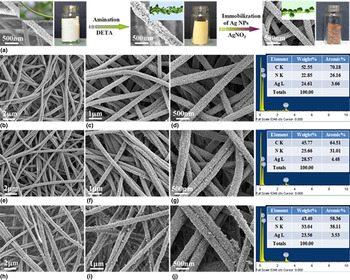
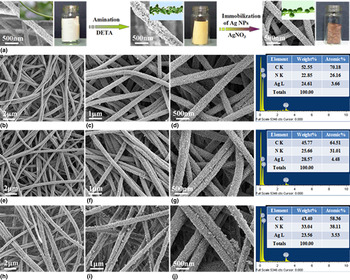
The amination and immobilization process is shown in Fig. 2(a). Due to the open scale-like structure on the surface of APAN nanofibrous, these could endow the surfaces with sufficient “anchoring sites” for metal ions or nanoparticles to realize the effective immobilization process. The resultant APAN nanofibrous mats are yellowish after amination. Then, the APAN nanofibrous mats are immersed into the AgNO3 aqueous solution. These APAN nanofibrous mats are turned into brown after 2 h of reduction process with different temperature. This change in color indicates the formation of AgNPs on the surface of APAN nanofibrous mats. Figures 2(b)–2(d) shows the SEM image of the resultant AgNPs/PAN composite nanofibrous mats obtained at 20 °C. The AgNPs are uniformly dispersed on the surface of nanofibrous mats and the atomic ration of AgNPs is 3.66% according to the result of EDS analysis. It was observed that by increasing the reaction temperature to 60 °C, few AgNPs aggregations were observed in Figs. 2(e)–2(g). The atomic ration of AgNPs was increased to 4.48%. By further increasing the reaction temperature to 100 °C, more AgNPs aggregations with larger size were observed, as shown in Figs. 2(h)–2(j). However, the atomic ration of AgNPs was decreased to 3.53%. The result indicates that temperature is an important factor to affect the preparation and distribution of AgNPs.
Schematic representation for amination and immobilization of AgNPs on PAN nanofibrous mats (a), SEM images and EDS analysis spectra of AgNPs/PAN composite nanofibrous mats obtained with 20 °C (b–d), 60 °C (e–g), and 100 °C (h–j).
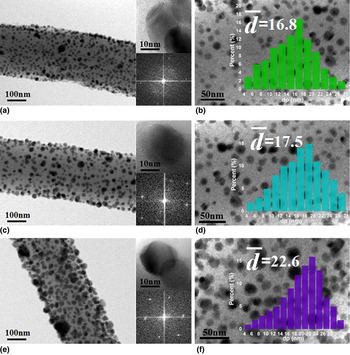
These above results were further confirmed by TEM analysis. Figure 3(a) shows the TEM image of AgNPs/PAN composite nanofibrous mats obtained at 20 °C. The AgNPs are high uniformly dispersion on the APAN nanofibrous mats and size distribution of AgNPs can be founded in Fig. 3(b). It can be seen that the average size of these AgNPs is ~16.8 nm. Under the reaction temperature at 60 °C, the AgNPs with ~17.5 nm in diameter were observed, as shown in Figs. 3(c) and 3(d). The size of AgNPs increased with improving reaction temperature can be explained by the LaMer mechanism.[ Reference Watzky and Finke 28 , Reference Stoeva, Zaikovski, Prasad, Stoimenov, Sorensen and Klabunde 29 ] As AgNPs with smaller size are easier to dissolve in order to grow to greater nanoparticles at higher temperature. It is worth noting that the heat treatment resulted in agglomeration of the particles as a function of reaction temperature. Therefore, some degree of agglomeration at the higher reaction temperature appears unavoidable.[ Reference Vattikuti, Byon, Shim and Reddy 30 , Reference Modak, Ammar, Mazaleyrat, Dasc and Chakrabartia 31 ] The size of AgNPs was increased to ~22.5 nm with reaction temperature at 100 °C, as shown in Figs. 3(e) and 3(f). The HR-TEM and selected area diffraction (SAED) patterns of AgNPs on nanofibrous mats obtained by different route were also provided in Fig. 3. These images indicate that the AgNPs with high-quality single crystal.
TEM image of Ag NPs/PAN composite nanofibrous mats, TEM, HR-TEM, SEAD images and size distributions of composite nanofibrous mats dispersed with AgNPs obtained with 20 °C (a, b), 60 °C (c, d), and 100 °C (e, f).
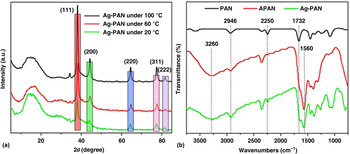
The crystalline structures of the as-synthesized composite nanofibrous mats were confirmed by powder XRD analysis [Fig. 4(a)]. An obvious broad peak with 2θ from 12.5° to 23.2° was observed from all samples, which is assigned to amorphous PAN. After immobilization of Ag nanoparticles on PAN nanofibrous mats, five reflection peaks at 2θ = 38.1°, 44.4°, 64.4°, 77.5°, and 81.6° were observed. In addition, these peaks can be well indexed on the basis of face-centered cubic silver JCPDS (No. 87−0717), which are corresponded to the (111), (200), (220), (311), and (222) lattice planes of Ag. Moreover, the intensity of AgNPs reflection peaks is significantly enhanced under higher temperature reaction condition, which implies the crystallinity of AgNPs has been increased.
XRD patterns of AgNPs/PAN composite nanofibrous mats obtained with 20, 60, and 100 °C (a). FT-IR spectra of PAN, APAN, and AgNPs/PAN composite nanofibrous mats (b).
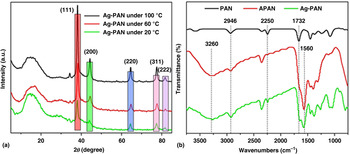
Figure 4(b) shows the FT-IR spectra of PAN, APAN, and AgNPs/PAN composites. The peaks about 2946 cm–1 (CH stretching vibration in CH, CH2, and CH3 groups), 2250 cm–1 (C≡N stretching), and 1732 cm–1 (C=O stretching), corresponding to that of the original PAN fiber. However, these characteristic peaks are almost disappeared completely for APAN. A new strong broad band with the peak at 3260 cm–1 was observed which corresponds to the overlapping bands of both OH and NH groups after amination. The peak at 1564 cm−1 is assigned to the bending vibration band of the amine N–H group, indicating the graft of DETA on PAN. Additionally, the C=O peak of an ester at 1732 cm−1 is weaken due to reaction of the amine groups with the DMF and the signal overlapping and formation of H-bond between C=O and N–H groups. After immobilization of AgNPs on nanofibrous memebranes, a weak and broad peak at ~3260 cm−1 assigned to N–H group can be observed. Later, the peak at 1732 cm–1 becomes clear again. It implies the microenvironment of C=O group has been released due to the reaction of AgNPs and N–H groups and the weaken of H-bond reaction.[ Reference Yu, Chen, Rice, Wang, White and Sun 32 ]
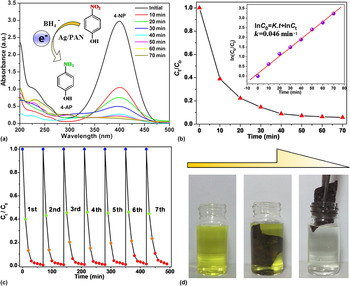
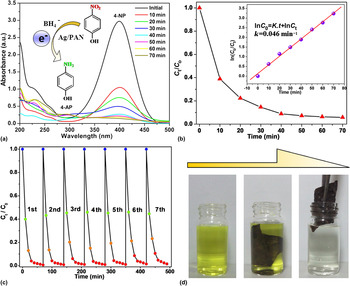
For evaluation the catalytic performance, the as-prepared AgNPs/PAN composite nanofibrous mats obtained at 60 °C are firstly investigated as heterogeneous catalysts for the reduction of 4-NP to 4-AP in the presence of NaBH4. As shown in Fig. 5(a), the pure 4-NP shows a distinct spectral profile with a maximum absorption peak at 400 nm. The absorption intensity becomes weaker after immersion of AgNPs/PAN composite nanofibrous mats into 4-NP solution. More than 90% of 4-NP were removed within 60 min. The concentration change of 4-NP compounds (C t/C o) again reaction time is shown in Fig. 5(b). Due to the concentration of NaBH4 is higher than 4-NP and can be considered as a constant during the reaction period, namely, the rate of reduction is independent of the concentration of NaBH4, and the reaction could be considered pseudo-first-order with respect to the concentration of 4-NP.[ Reference Nie, Liang, Shen, Gao, Chen and Hou 33 ] The concentration of 4-NP at time (t) is denoted as C t, and the initial concentration of nitrophenols at t = 0 is regarded as C 0. The C t/C 0 is measured from the relative intensity of absorbance (A t/A 0). ln(C t/C 0) versus time (t) can be obtained based on the absorbance as the function of time, and good linear correlations can be obtained [inset in Fig. 5(b)], suggesting that the reactions follow the kinetic equation: lnC 0−lnC t = k·t. Then, the kinetic reaction rate constant (k) was estimated from the slopes of the linear relationship to be 0.045 min−1 for AgNPs/PAN composite nanofibrous mats. To estimate accurately the catalytic activity of AgNPs/PAN composite nanofibrous mats, the turnover frequency (TOF) on the basis of surface Ag atom may be measured. The TOF on the basis of surface Ag atom may be calculated as: TOF = (number of 4-NP molecular converted)/(number of surface Ag atoms)/(reaction time, min).[ Reference Zahed and Hosseini-Monfared 34 ] After calculation, the value of TOF is 0.14 min−1. According to compare with other catalysts,[ Reference Sawada, Sakai and Taya 20 , Reference Wakayama, Setoyama and Fukushima 35 ] these results clearly indicate that AgNPs/PAN composite nanofibrous mats with excellent catalytic activity which can enhance the catalytic efficiencies. In view of practical applications, it is of great significance to investigate the cycle stability of the resultant products. The as-prepared AgNPs/PAN composite nanofibrous mats showed catalytic and convenient separation properties which can be easily recycled using tweezers take out from the solution compare with pulverous catalyst after the catalytic reduction. Figure 5(c) shows the recyclable reduction of 4-NP in the presence of AgNPs/PAN composite nanofibrous mats nanocatalysts. The catalysts can be successfully recycled and reused for at least eight successive cycles of reaction with stable conversion efficiency of about 100%. It indicates the high stability of the resultant composite membrane. However, the conversion efficiency of 4-NP using AgNPs as catalyst that stabilized by citrate drops a little after the second cycle, which is primarily attributed to the loss of AgNPs after periodic centrifugation/re-dispersion cycle. The color of solution is changed from dark yellow to colorless against reaction time [Fig. 5(d)].
UV–vis adsorption spectra of the reduction of 4-NP by Ag NPs/PAN composite nanofibrous mats (a), the concentration change in 4-NP compounds (C t/C0) in the presence of Ag NPs/PAN composite nanofibrous mats and the inset shows the linear relationship of ln(C t/C0) as a function of time for 4-NP (b), conversion efficiency of 4-NP in seven successive cycles of reductional (c), the photographs of color of reactive solution using the composite nanofibrous mats as catalyst (d).
Owing to unique optical, catalytic, and electrochemical properties combined with nanoscaled effect, AgNPs can be considered as a good catalysts for selective oxidation of benzyl alcohol.[ Reference Bulushev, Reshetnikov and Kiwi-Minsker 36 ] However, it is difficult to investigate the recoverable catalytic properties of these nanocatalytic systems because of their aggregation and tiny sizes which make them hard to separate. In this work, AgNPs are attached on nanofibrous mats support, which facilitate cyclic utilization. Herein, the catalytic performance of AgNPs/PAN composite nanofibrous mats is further evaluated by oxidization of benzyl alcohol to benzaldehyde in the presence of oxygen as an oxidant at 76 °C (see the detailed information in the Experimental section), as shown in Scheme 2.
Selective oxidation of benzyl alcohol to benzaldehyde by AgNPs/PAN composite nanofibrous mats as catalysts.

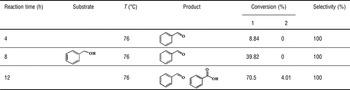
The reaction products are examined by GC–MS. Table I shows the results of oxidation of benzyl alcohol and selectivity to benzaldehyde. It was found that after the reaction for 4 h, the conversion of benzyl alcohol was 8.84% (Fig. S2), and the conversion increased to approximately 40% after 8 h (Fig. S3). The selectivity to benzaldehyde is 100% for both cases. Moreover, after reaction for 12 h, the conversion of benzyl alcohol and selectivity to benzaldehyde could reach up to 70% and 94.6%, respectively (Fig. S4). These results demonstrate the excellent catalytic ability of AgNPs/PAN composites for the selective oxidation of benzyl alcohol at low temperature. During catalytic reactions, O2 is present as O2−, O−, and O2−. Nucleophilic oxygen (O2−) is mainly responsible for the partial oxidation of organic compounds (hydrocarbons), and electrophilic oxygen (O−and O2−) participates in the peroxidation reaction, leading to the formation of COx. Benzaldehyde production depends on nucleophilic oxygen (O2−).[ Reference Pajonk 37 ] In this work, the active Ag species are almost uniformly dispersed on the support surface as a result of PAN fiber with attractive features of structural characteristics such as high porosity and interconnectivity. The highly dispersion of AgNPs is help to increase the specific surface area of the active components and therefore accelerate the formation of active oxygen species and promote the migration of oxygen species to the support surface, namely, oxygen spillover.[ Reference Zhao, Hu, Deng and Lu 38 , Reference Jia, Zhang, Gu, Ping, Guo, Zhong and Su 39 ]
Results of selective oxidation of benzyl alcohol using the AgNPs/PAN composite nanofibrous mats as catalysts.
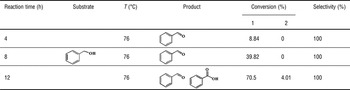
Reaction conditions: benzyl alcohol 2 mL; catalyst (4.0 × 4.0 cm2, ~0.12 g); reaction time 4–12 h; temperature 76 °C; 1, benzaldehyde; 2, benzoic acid.
Conclusion
In this work, we demonstrated a reliable, environmentally friendly, and cost-efficient method to prepare AgNPs/PAN composite nanofibrous mats via combining the electrospinning technology from complex-containing polymer solution, amination of PAN nanofibrous, and electroless plating technique. The resultant composite membranes exhibited efficient catalytic activity for the reduction of 4-NP. In addition, as-prepared composite nanofibrous mats were active for the aerobic oxidation of alcohols, exhibit excellent catalytic activity in the low-temperature selective oxidation of benzyl alcohol to benzaldehyde. When the reaction temperature was controlled at 76 °C, the conversion of benzyl alcohol and the selectivity for benzaldehyde reached 70% and 94.6%, respectively. Moreover, the composite membrane-like catalysts offered significant advantages, such as low dosage, easy recycling, easy to separate from liquid environment, and excellent stability, this all indicate that the catalyst had great potential for industrial application.
Supplementary material
For supplementary material for this article, please visit http://dx.doi.org/10.1557/mrc.2015.85
Acknowledgments
This work was financially supported by the National Natural Science Foundation of China (grant numbers 51373155 and 51133006) and “521 Talents Training Plan” in Zhejiang Sci-Tech University (ZSTU).