Introduction
Each year, around 40 million people worldwide need palliative and end-of-life care, of whom nearly 80% live in middle- or low-income countries (WHO, 2018). One of the greatest barriers to palliative and end-of-life care in middle- and low-income countries is the healthcare professionals' lack of training (Connor and Sepulveda, Reference Connor and Sepulveda2014; WHO, 2018). Educational resources exist; however, most of them are only available in English, including instruments that measure educational needs (Connor and Sepulveda, Reference Connor and Sepulveda2014). To determine what educational resources need to be translated and culturally adapted to middle- and low-income countries, these educational needs-assessment instruments must first be translated into and culturally adapted for local languages and contexts.
Brazil — a middle-income country and the largest country in Latin America — has seen a growth in palliative and end-of-life care. However, as with many other middle- and low-income countries, there is no valid instrument to measure the educational needs of healthcare professionals regarding palliative and end-of-life care. To fill this gap, we translated the End-of-Life Professional Caregiver Survey (EPCS) into Brazilian Portuguese and culturally adapted it to the Brazilian context. The EPCS, which was developed and validated in English and primarily used in a North American context, identifies the educational needs of healthcare professionals regarding palliative and end-of-life care (Lazenby et al., Reference Lazenby, Ercolano and Schulman-Green2012). In this article, we report on the translation and cultural adaptation process and the results of the evaluation of psychometric properties of the Brazilian EPCS (BR-EPCS) (Supplementary Material).
Methods
Study design
This cross-sectional study involved in the translation, cultural adaptation, and validation of the EPCS for use with Portuguese-speaking health professionals in Brazil. This study was conducted in two phases: (1) the translation and cultural adaptation of the EPCS (Kulis et al., Reference Kulis, Bottomley and Velikova2017) and (2) the evaluation of psychometric properties of the BR-EPCS (Supplementary Material).
Sample
Following the recommendation of 10 subjects for each instrument item for studies that investigate psychometric properties, including the factor analysis (Terwee et al., Reference Terwee, Bot and de Boer2007), it was determined that a minimum sample size of 280 participants was needed. Participants were included if they had a bachelor's degree in social work, physical education, nursing, pharmacy, physiotherapy, phonoaudiology, medicine, nutrition, dentistry, psychology, or occupational therapy and if they were actively and professionally engaged in palliative or end-of-life care during the data-collection period. These professionals were not necessarily from specific palliative care units.
Instruments
Demographic characteristics
The following data were collected: age (years), gender, highest education level, professional discipline, time working in palliative care, whether the participant had received palliative care training, and whether the participant had completed advance directives.
End-of-Life Professional Caregiver Survey
Originally developed in the USA, the EPCS is a 28-item educational needs-assessment instrument that uses a 5-point Likert scale (0 = Not at all, 4 = Very much). It is composed of three factors: patient- and family-centered communication, cultural and ethical values, and effective care delivery (Lazenby et al., Reference Lazenby, Ercolano and Schulman-Green2012). The total EPCS score is calculated by summing item points (total possible score = 112). Higher values reflect higher knowledge and, therefore, lower levels of educational needs (Lazenby et al., Reference Lazenby, Ercolano and Schulman-Green2012).
Procedures
Translation and cultural adaptation
To obtain a BR-EPCS (Supplementary Material) that linguistically and conceptually reflected the wording and structure of the EPCS, we followed the European Organisation for Research and Treatment of Cancer — Quality of Life Group's design for translation and cultural adaptation (Kulis et al., Reference Kulis, Bottomley and Velikova2017).
Evaluation of psychometric properties of the BR-EPCS
Participants were recruited from groups of palliative care interested in social networks (WhatsApp, Facebook, and Telegram). After answering eligibility screening questions, if eligible, the participants received a password-protected link to online an open-source survey software (https://www.limesurvey.org/), on which they completed the demographic data-collection questionnaire and the EPCS. The data were collected from January to May 2018. Only questionnaires that were fully answered were considered for data analysis.
Data analysis
We described the demographic data and responses to items on the EPCS using frequencies, percents, and measures of central tendency and dispersion. We conducted parallel analyses with Monte Carlo simulations to obtain information regarding the number of factors to be extracted/retained in the factorial analysis (Horn, Reference Horn1965). Then, on the Mplus 7 software, we identified factor items using exploratory structural equation modeling (ESEM) and confirmatory factor analysis (CFA), and also estimated by the weighted least squares means and variance method and the GEOMIN oblique rotation (Aparuhov et al., Reference Aparuhov, Muthén and Muthén2009). For this analysis, we considered the original study's three-factor internal structure (Lazenby et al., Reference Lazenby, Ercolano and Schulman-Green2012). We used the comparative fit index (CFI; ≥0.90 values show reasonable adjustment), root mean square error of approximation (RMSEA), and standardized root mean square residual (SRMR; ≤0.06 values show adjustment, with an acceptable maximum limit of 0.08) to adjust the indexes for the structural model (Hair et al., Reference Hair, Black and Anderson2010; Kline, Reference Kline2011). We assessed inter-factor correlations (Φ) using GEOMIN factor correlations. We used Cronbach's α to measure internal consistency.
We conducted bivariate (Student's t-test and ANOVA) and multivariate (multiple linear regression) analyses to test whether participants' demographic characteristics were associated with differences in total BR-EPCS and factor mean scores at the level p ≤ 0.05 (two-tailed) (Dancey and Reidy, Reference Dancey and Reidy2006; Hair et al., Reference Hair, Black and Anderson2010).
Ethical considerations
The study is conformed to the provisions of the Declaration of Helsinki and was approved by the Ethical Committee in Research of the Botucatu Medical School — Universidade Estadual Paulista “Júlio de Mesquita Filho” (protocol no. 2.421.530).
Results
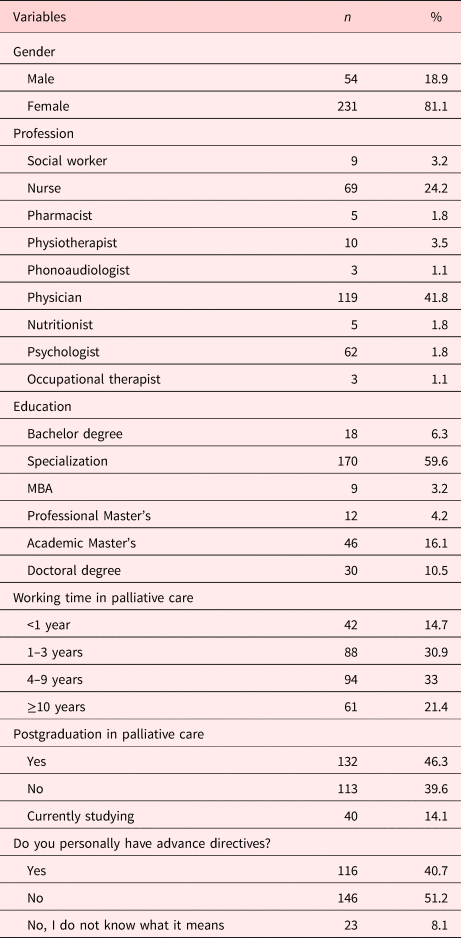
The sample consisted of 285 participants with an average age of 38.44 [±8.39; (24–69)] years. Table 1 describes participants' demographic characteristics.
Sample characteristics

Pilot test — cultural adaptation
The judges suggested deleting the original EPCS item that assessed professionals' comfortability in discussing clinician-assisted death as this is not legal in any region in Brazil.
Psychometric properties
Parallel and factor analysis
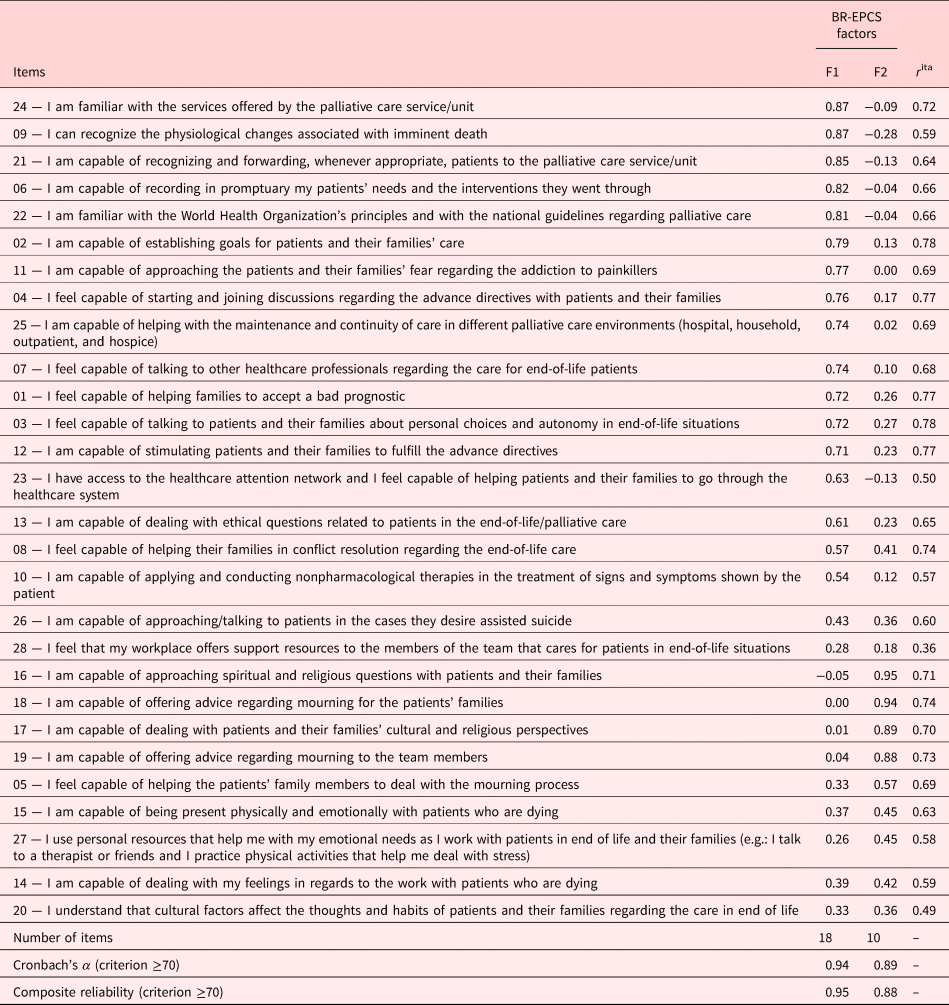
The results of the parallel analysis indicated that two factors should be retained. The ESEM and CFA results confirmed the two-factor model (CFI = 0.96, RMSEA = 0.08, and SRMR = 0.06). The final factors were the 19-item Factor 1, labeled “Care effectiveness,” Cronbach's α = 0.94; and the 9-item Factor 2, labeled “Mourning and ethical and cultural values,” Cronbach's α = 0.89. Table 2 displays each item's estimated parameter by factor. The inter-factor correlation (Φ) was 0.58. The Cronbach's α value for the entire BR-EPCS was 0.95.
Factorial matrix and BR-EPCS measured factors’ precision/reliability

F1, given care effectiveness; F2, mourning and ethical and cultural values.
a Item-total correlation; the estimated factorial loads were significant at the level of p < 0.05.
Associations between demographic characteristics and total and factor mean scores
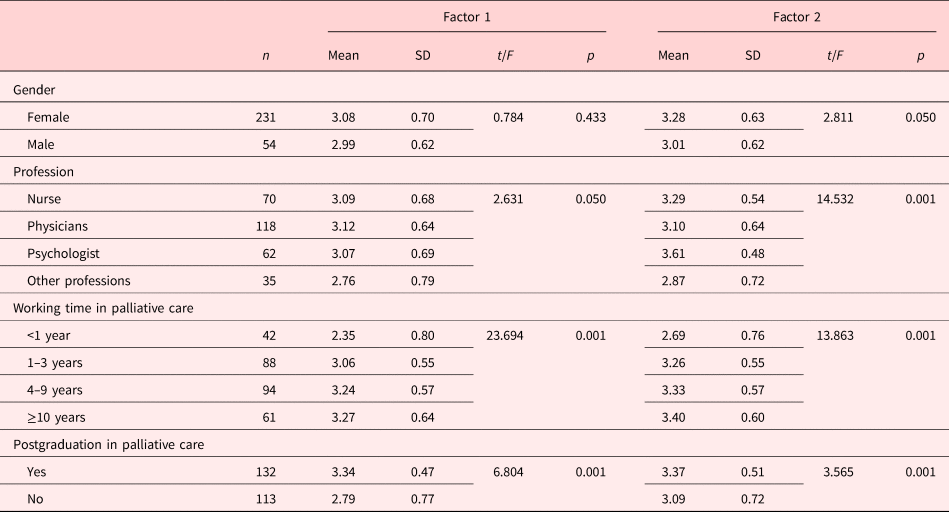
Factors 1 and 2 mean scores were 3.06 (±0.69) and 3.23 (±0.64), respectively. The analysis that sought to identify significant differences in the BR-EPCS score factors in function of the sample characterization variables showed significant differences (p < 0.05) in the following variables: gender, profession, time working with palliative care, and palliative care training (Table 3). No significant differences were found for age, education, and advance directives.
Comparison of mean scores of factors of sample characteristics

We found that the male participants scored lower in Factor 2 when compared to the female participants. In the “professions” variable analysis, the professionals compared were physician, psychologist, nurse, and “other professions” (social workers, occupational therapist, nutritionist, phonoaudiologist, pharmacists, and physiotherapist) in order to make the group sizes less discrepant. In Factor 1, the “other professions” showed lower mean scores in comparison to physicians. However, in Factor 2, the psychologists scored better when compared to nurses, physicians, and “other professions,” revealing more accurate comprehension regarding mourning and ethical and cultural values. Differences in this factor were also seen in the “other professions” group, which scored lower than the nurses and physicians. Regarding the time of experience working, the group with the lowest working time (those with up to 1 year) showed lower scores in both factors in comparison with groups with higher experience and working time in the area. When the variable in analysis was palliative care training, in both factors (Factor 1 t = 6.804, df = 283, p ≤ 0.001 and Factor 2 t = 3.565, df = 283; p ≤ 0.001), the group of professionals who are post graduated in palliative care showed superior scores when compared to the group that lacked postgraduation in this area.
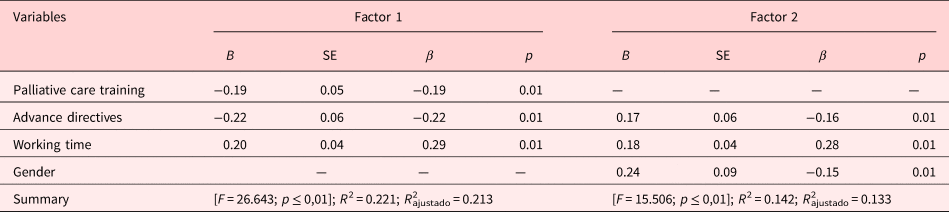
At last, the multiple linear regression analysis showed that the palliative care training, advance directives, and working time explain approximately 21% of the Factor 1 score variation. The Factor 2 variations could be explained in approximately 13% by the variables' advance directives, working time, and gender (Table 4).
Multiple linear regression analyses on BR-EPCS factors

Discussion
This study's results showed that the BR-EPCS is a reliable and valid instrument to identify the educational needs of healthcare professionals who work in the palliative care area. This is the first instrument with validity evidence empirically demonstrated to evaluate this construct among Brazilian healthcare professionals.
The judges questioned item 26's presence, which is related to assisted suicide, since this practice is not allowed in Brazil. However, we understand that, regardless of the legal prohibition thereof for the use of this practice, patients can question the professional about this topic. Therefore, it is important for the professional to be capable of dealing with this situation, so we decided to keep item 26 in the BR-EPCS.
We have found that in the Brazilian reality, the construct evaluated by the EPCS expressed itself in two factors, differently from the instrument's original version, which presents three factors (Damásio, Reference Damásio2012). This can be explained due to the fact that, backed by the literature, we have chosen to use factorial analyses from the policorical correlation matrixes, which are more adequate to grasp the correlation in cases which the scale replies are of the ordered categorical type, as it is in the EPCS (Muthén and Muthén, Reference Muthén and Muthén1998–2012; Aparuhov et al., Reference Aparuhov, Muthén and Muthén2009). Moreover, we have used the parallel analysis method to index the number of factors to be extracted, which is a more robust and rigorous method from the psychometrical point of view (Damásio, Reference Damásio2012).
The instrument was capable of identifying significant differences between the groups, regarding palliative care educational needs, which means that the BR-EPCS made it possible to differ individuals based on their knowledge level of the construct in question. Therefore, from the BR-EPCS predictive capability, it was possible to show the profile of the professionals who would have the larger training needs regarding this theme. Professionals without palliative care training, who lack their advance directives and who have low experience working in the area, presented educational needs related to the effectiveness of the given care. Men who lack their advance directives with low experience working in the palliative care area presented educational needs related to mourning and ethical and cultural values (Factor 2). It is possible that professionals who have their own advance directives feel more comfortable to discuss aspects related to the end of life with their patients (Lazenby et al., Reference Lazenby, Ercolano and Schulman-Green2012).
Medical doctors were highlighted for presenting higher scores in Factor 1, showing less educational needs in comparison to the other professions regarding the effectiveness of the given care. Historically, the palliative care has been ignored in medicine and many times ridiculed, as unworthy of attention (Case et al., Reference Case, Orrange and Weissman2013). Nowadays, the scenario is different. Palliative care is expanding in the medical area, with an expressive number of specialized medical doctors, scholarship programs for studies in the area, and a raising demand for medical positions in public hospitals and palliative care programs (Case et al., Reference Case, Orrange and Weissman2013). However, in Factor 2, psychologists were highlighted, followed by nurses, medical doctors, and “other professions,” respectively. We understand that this is justified by the fact that psychologists have specific knowledge and skills for the specialized service with patients and their families who face serious illnesses and the end-of-life process (Fan et al., Reference Fan, Lin and Lin2015).
The BR-EPCS presented as a psychometrically valid instrument for a single scale (nonspecific for certain occupations) to evaluate the educational needs of healthcare professionals by means of factors that encompass ample mastery of the palliative care. However, the low number of social workers, pharmacists, physiotherapists, phonoaudiologists, nutritionists, and occupational therapists in our study can be considered as a study limitation. The reduced participation rate may indicate the low insertion of these categories in Brazilian palliative care and, moreover, the need to find other recruitment methods.
Longitudinal studies are recommended to evaluate the BR-EPCS's responsiveness among Brazilian healthcare professionals, as well as investigations that evaluate the temporal stability of their responses (test and re-test) are recommended.
In this study, we have carried out the translation, the cultural adaptation, and the evaluation of BR-EPCS psychometrical properties, demonstrating its reliability and validity for the investigation of the healthcare professionals' multidisciplinary educational needs who work with palliative care in Brazil (Supplementary Material). This study can contribute to the international discussion regarding the professional education in palliative care, on top of supplying an instrument that can be used for both educational and research purposes, since it can guide the development of educational interventions in palliative care. Therefore, the use of the BR-EPCS can contribute to the improvement of the healthcare assistance, considering the fact that better qualified professionals and the scientific evidence that guides their practice are essential for a better healthcare assistance.
Supplementary material
The supplementary material for this article can be found at https://doi.org/10.1017/S1478951519000993.
Acknowledgments
The authors thank Tamara Macieira, Rodney Segura Cavalcante, and Professor Maria Amélia de Campos Oliveira for their collaboration in this study.