

Part 1 Introduction
Preliminaries
The autumnal Durgā Pūjā, the ten-lunar-day worship of the goddess Durgā, also known as Caṇḍī or Caṇḍīkā, is one of the most important festivals in East India and Nepal. Throughout villages and cities in Bengal, Orissa, Assam and the Kathmandu Valley the occasion is marked by pomp and circumstance. In Bengal especially, this worship is a reflection of a culture that has given goddesses a privileged position over male deities from at least the time of the Pālas.Footnote 2 However, despite the availability of material from the eighteenth century to the present day, the worship of the goddess prior to the colonial presence still remains to a great extent terra incognita. Sanskrit paddhatis (ritual manuals) from the medieval era are among the few records available from Bengal that shed light on the pedagogical and performative context of the rite. The purpose of this article is to provide a synchronic sketch of the medieval ceremony based on the influential and widely cited medieval manual, the Durgāpūjātattva (“The truth concerning the rite of Durgā”, henceforth DPT) of Raghunandana Bhaṭṭācārya (1520–1575 ce)Footnote 3 supported by parallel accounts of the rite contained in related literature. The sketch will be used as a broad framework to illustrate the manner in which the ceremony was performed or could have been performed in Bengal during the fourteenth to the sixteenth centuries ce.
While the article presents a largely empirical study of a particular ritual text, it aims to show that this work was not composed in a vacuum but within a broader historical context. In order to understand properly and appreciate a text like the DPT, which at first sight misleadingly strikes one as a pedantic work of little theoretical or historical value, it is important to study in tandem: (i) the network of related texts and (ii) the ritual/performative history of which it is a part and which it implicitly narrates. The broader tasks of uncovering this implicit history, presenting the literary and social milieux of the ritual and conceptualising how it may have looked in performance, are undertaken in Parts 1 and 2. Regarding these matters, I cannot claim to have been exhaustive. I have merely attempted to lay the groundwork for a fuller cultural query. Before a more elaborate exposition is carried out, it is essential to complete the basic task of preparing and presenting the material. With this aim, the article presents in Part 3, an emended transcript accompanied by an annotated English translation of the main rites of the DPT, previously only available in Sanskrit.
Given the paucity of descriptive documents on ancient India such as letters, biographies, eye-witness accounts, diaries etc., prescriptive material forms one of the few detailed historical records of religious praxis. It is not unreasonable to extract paradigms regarding rituals from paddhatis for, as defined by the tradition, they are systematised distillations of their more authoritative, but remote and at times lacunose, scriptural sources. These scriptures ultimately guide all religious ceremonies within Brahmanism, a religion that, from its most archaic manifestation in the Vedas, has privileged sacred text in sanctioning all matters of doctrine and practice. According to the learned medieval exegete Bhaṭṭa Rāmakaṇṭha:
For any scripture a Paddhati is a text which enables the performance of the rituals [of that scripture] along with the Mantras [that accompany them] by succinctly arranging in the order [of performance] (i) the [instructions] explicitly stated [in that scripture but] dispersed in various places [throughout its length], and (ii) whatever [else] those explicit statements imply. An example is the Yajñasūtra in the case of the [Kāṭhaka] Yajurveda’.Footnote 4
The paddhati therefore bears, a direct relationship to practice (prayoga). Although dryly prescriptive in approach, the relevance of paddhati literature is by no means meagre. The beauty of a work like the DPT lies in what it does not explicate: behind the pedantry, prescriptions and ritual jargon, ranges, as backdrop, a whole un-inscribed world of ritual performance, pageantry, utterance and gesture whose full impact, like theatre, can only occur at the moment of its enactment. The paddhati is therefore the “script” for this grand theatre, and though we will never see the action as it originally unfolded on stage, we can, with the aid of this script, intelligently and, I think, correctly, imagine how, and even why, that drama manifested in history. At the outset it must be acknowledged that the picture they present is, at best, generalised. Much like dramatic scripts, these texts are to be understood as providing only a guideline for they were inevitably supplemented by additional ritual details particular to a lineage and household. Nevertheless they do form for the performer the binding essence of the rite, the sacred “blueprint” underlying all customisations.
One can easily argue that there is a danger in this reliance on paddhatis, for like scripture they may well reflect an ideal; and whether what they prescribed truly did occur can be anybody's guess. On the other hand, inscriptional evidence from South East Asia unequivocally demonstrating the relevance of paddhatis in shaping praxis significantly challenges this view.
The Khmer kingdom has left behind several inscriptions recording how prescriptive literature from India guided the ceremonies performed for the state: the inscriptions of Banteay Srei of 1306 and Jayavarman II (802–835 ce) being particularly revelatory of the use of paddhatis in the domain of the court. The first inscription, for instance, is an ordinance commanding the incumbents of Khnār Grāṅ to worship the deity following the verses of a vraḥ pāñjiy (Sacred Manual) dealing with worship at the sacred sites (kṣetropacāra); the second reporting that, under the auspices of King Jayavarman II, the Brāhmaṇa Hiraṇyadāma performed a state-ritual founding the independent Khmer kingdom of Angkor and developed the cult of Devarāja for Jayavarman's court by extracting in a paddhati the core elements of the Viṇāśikha scripture of the Vāmaśrotas doctrinal current of the Śaiva canon.Footnote 5
Admittedly such precise evidence for the impact of the medieval paddhatis of the Durgā Pūjā on actual practice is unknown, a rare exception being the Durgābhaktitaraṅgiṇī of Vidyāpati which, from the dedicatory verses to the Maithila King Dhīrasiṃha at the end, demonstrates its influence over the Navarātra ceremony at the court of the Oinwar lineage of Mithilā (discussed in greater detail later). But there is evidence of an indirect kind showing that such literature did indeed shape the performance of the Durgā Pūjā: we have, for instance, the testimony of current Durgā Pūjā rites such as those performed by the Bengali brāhmaṇa clan of the Lahiris of Varanasi (studied by Rodrigues 2003) or those given in the encyclopaedic Purohita Darpaṇa Footnote 6, the manual currently most widely followed in Bengal. These in most of their particulars conform very closely to the rubric described in the medieval paddhatis, preserving the basic rituals and their order over the successivie tithis of the bright first quarter of Āśvina and the same litany, still recited during modern performances. There is therefore a continuity with the medieval ritual tradition. For instance, in rites such as awakening the goddess in a bilva tree (bodhana), cutting the bilva branch, warding away ghosts from the ritual space, installing the ancillary spells (aṅganyāsa), the summoning (āvāhana) of the goddess, infusing the vital breaths (prāṇapratiṣṭhā), the meditation (dhyāna) verses and others, the mantras chanted by the priest are to be traced in the DPT. Furthermore, it is also important to note that the medieval paddhatis had a prolific afterlife, being diligently copied and circulated up to the eighteenth century in a number of manuscripts (I have so far encountered three complete manuscripts of the DPT and four of the Durgābhaktitaraṅgiṇī not used by the editors of the printed texts), demonstrating that the scribal tradition obviously felt they needed to be preserved for use.
A break with the past only seems to have appeared in the growing brahmanisation of the current rites. These tend to diminish the once-predominant Tantric element by incorporating more Vedic verses; display Durgā primarily as a serene and benevolent matriarch in an image accompanied by the gods Kārttikeya, Gaṇeśa, Lakṣmī and Sarasvatī who are designated as her family (though her depictions throughout the early medieval literature conceive of her in stark contrast as a potentially threatening deity attended by female acolytes, rather than a family); show hesitation in animal sacrifice (where the previous rites enjoin many buffaloes, goats, rams and even human heads, the present rite usually involves no more than a goat);Footnote 7 do away with the caste dissolving Festival of Śavaras (Śāvoratsava) once performed at the end of the medieval rite; and diminish the presence of ferocious, ambivalent forms of Durgā connected with Kālī.
Whatever concerns one may harbour about the dangers in drawing conclusions about real practice from normative literature, it is important nevertheless to start placing this textual corpora within a historical context, to unravel their ritual syntax, to understand what they are trying to say and how that syntax was translated into gesture in the sphere of ritual. The task of interpretation must be done, and the dangers risked. Indeed, the problems in interpretation can be resolved by reading widely around a paddhati (for read in isolation it yields little meaning), reading the literature with which the author has familiarity and being aware of current practices that may preserve elements or modified elements of the tradition referred to by the author. If approached with caution, good sense and an awareness of related literature, prescriptive compositions can provide valuable and intriguing insights into how deities were conceptualised in cults, how their relation to men was enacted in ritual practice, what was necessary for the performance of their ritual, who was performing them and for whom they were being performed. Taking into account these factors, I have sketched a provisional paradigm in the analytical parts of the article that suggests rather than states, attempting not to overstretch my interpretation.
The Social and Literary Contexts of the Durgāpūjātattva and the Medieval Autumnal Rite
From the fourteenth to the sixteenth centuries, a significant number of manuals on the Durgā Pūjā were composed in Mithilā and Bengal, indicating that during this period there was a rise in demand for the pūjā. An already thriving tradition of goddess worship and a conservative reaction to the ruling Muslim power may have added impetus to this growth. The writers of these works were smārta brahmins – the predominant religious elite in Mithilā and Bengal – codifiers and commentators of the vast body of secondary Brahminical literature known as smṛti.
Prior to the smārta compositions, the pedagogical history of the Durgā Pūjā remains largely obscure, and it is difficult to know the form of the worship that was most widely taught to ritual-specialists. Although Purāṇic passages on the festival of the goddess abound, they are dispersed, patchy and difficult to date given that the Purāṇas themselves are mostly protean and composite texts that have mutated and grown over periods of time.Footnote 8 Before it was systematised by the smārta paṇḍitas, there were various versions of the rite. It probably differed in detail from region to region and kingdom to kingdom. There must have been private manuals and traditions in every kingdom customised to suit the particular needs of courts and communities. Locally influential goddesses with individual personalities and cults were worshipped as unique forms of Durgā with distinctive versions of the Navarātra, which led to a great degree of diversity and autonomy in the rite. The codification and intellectualisation (discussions on categorisation, time etc.) of the pūjā began in earnest from the medieval period (twelfth century ce onwards) when, as we shall see, the smārtas began a concerted effort to formulate a universal programme and a textual basis of authority for the rite which remains largely intact even today. Before their appropriation of the ritual within brahminical exegetical discourse in the twelfth century, the Durgā Pūjā had hardly been commented upon by scholars writing in Sanskrit. For the purpose of this article, I have therefore restricted my study of the rite to this period that marked the efflorescence of learned literature on the Durgā Pūjā, and its attainment of a more uniform structure.
Of the two layers of Brahminical orthodoxy, the smārtas are the second and more catholic layer. The first, known as the śrautas, are experts in the literature collectively called śruti, the primary scriptures of the Brahmins consisting of the four Vedas. They are taught to maintain the sacred fires throughout their lives by uninterrupted offerings of Vedic oblations. The importance of the Vedic ritual is thus fundamental to the śrauta, deities being merely nominal in worship and not the means of salvation. The smārtas are, in contrast, theistic in their approach. For instance they include the worship of five gods from the Purāṇas (Sūrya, Śiva, Gaṇeśa, Durgā, Viṣṇu) into the regular rituals, holding them in high regard while at the same time avoiding sectarian partisanship to any one deity. Thus between the highest strata of Brahminical orthodoxy and the various sects that give importance to specific gods, theirs is the middle ground. They are considered experts on the smṛti (hence smārta), the secondary scriptures of the Brahmins comprising the Purāṇas that contain ancient legends on, among other topics, the deities of their regular worship, a complex and large body of rituals not included in the Vedic texts, histories and genealogies. Apart from the Purāṇas, the smṛti-texts also comprise the law books on which the ethical order of the Hindus are based (dharmaśāstra). These as well as the epics, the Mahābhārata and the Rāmāyaṇa, also fell in the purview of smārta intellectual activity.
The smārta influence on orthodox religious practice is evidenced in that by the late medieval period, they had overtaken the śrautas as the majority orthodox group, and while the religion followed by the śrautas was by no means defunct, it did represent an older faith that was rapidly being superceded by the expansion of the smṛti literature and the faith promoted therein. This Purāṇic and epic religious tradition incorporated local customs such as particular sacred sites (tīrthas), local deities and their shrines, festivals and Tantricised rituals. It was eclectic, unlike the śrauta faith which clung resiliently to the ancient Vedic sacrifice. Raghunandana Bhaṭṭācārya, the author of the DPT, was himself an eminent and prolific scholar of this oeuvre. Composed in a theistic and assimilative spirit, the DPT describes and codifies for Brahminical use the ten-day autumnal worship of Durgā in Bengal, drawing primarily on the Purāṇas for scriptural authority but also referring, surprisingly, to a few TantrasFootnote 9 in a demonstration of its inclusive approach. It is the most elaborate of all the Bengali smārta manuals on the Durgā Pūjā and, true to the spirit of a paddhati, is a “path” both through the thorny fields of scripture (in its opening Pramāṇa section) and the obscurities of ritual minutieae (in its closing Prayoga section). For the reader it thus gives the richest and most comprehensive idea of the medieval rite and this was the main reason why I examined the work for this article.
The political milieu of eastern India at the time was favourable for the composition of all sorts of religious treatises. Mithilā– the region straddling the Bengal-Bihar border – flourished as an independent Hindu kingdom. Bengal on the other hand was divided into many smaller political units and had a strong and long tradition of local government, first under the Afghans and then under the Mughals from 1575 onwards. Twelve of these self-governing territories were called bhuinyas. Owing to little control from the Centre, they enjoyed virtual independence and often violently opposed overlordship.Footnote 10 Besides the bhuinyas, a number of smaller landlords (zamindārs), both Hindus and Muslims, also held power. They held hereditary rights over their land and considered themselves independent rulers.
It was in this context of diverse regional powers that scholars of smṛti literature attained influence in various parts of Bengal and in the Mithilā court as formulators of Hindu temporal and religious law. Raghunandana himself authored no fewer than twenty-eight treatises he titled “Tattvas”, literally “Verities”, on a range of subjects with bearing on legislature and proper Brahminical etiquette; while in the court of Mithilā, the author Vidyāpati, in the footsteps of his ancestor Caṇḍeśvara Ṭhakkura, wrote, as resident scholar and minister, a number of similar tomes for the benefit of the state. The broad and inclusive patronage network in both regions supported their work. Many local rājās made large endowments to Sanskrit scholars. So highly regarded was the smārta opinion on social norms, that in Bengal there is even evidence that a smārta was patronised by a Muslim king, one Bṛhaspati Rāyamukuṭa who belonged to the court of the King Jalāl-ud-dīn (1418 ce–1431ce) and composed many smṛti works under his patronage.Footnote 11 The main impact of the work of the smārtas affected the laws of inheritance – an area of crucial interest for this body of kings and gentry. The Dāyatattva, a commentary on Jīmūtavāhana's influential legal treatise the Dāyabhāga, was, for instance, Raghunandana's contribution to medieval inheritance legislation. Besides inheritance, all manner of topics were covered by the smārtas impacting the private life of an individual, such as pilgrimages, the proper time for religious observances, ceremonial purification, marriage, post-mortuary rites (śrāddha) and even the most personal actions such as when to copulate with one's wife, hygiene, ablutions, conduct while bathing etc. Framing their axioms in encyclopaedic works called nibandhas (digests), the smārtas authorised an exhaustive programme of observances for the Hindu householder to maintain in his life.
All the most important smārtas of the time had composed at least one work on Durgā worship, drawing mainly from passages attributed to the Devī Purāṇa, Kālikā Purāṇa,Viṣṇudharmottara Purāṇa, Bhaviṣya Purāṇa, the Bṛhannandikeśvara and/or Nandikeśvara Purāṇa(s) and other smārta-compositions to guide their ritual programmes.Footnote 12 These discussions on the goddess's rite are often included as chapters in the very digests the smārtas had authored to codify the legal and religious practices of Indian kingdoms. This shows that the rite of the goddess was viewed as being essential to the calendrical ritual cycle of a Hindu kingdom, for it was accorded status among the religious principles thought to underlie Brahminical government.
As early as the twelfth century, a chapter quoting in verbatim the Mahānavamī rites from the Devīpurāṇa appeared in the Rājadharmakāṇḍa (Chapter on the Duties of a King) of the Kṛtyakalpataru of Lakṣmīdhara, counsellor of King Govindacandra of the Gāhāḍavāla kingdom. It is in the east though, that the first elaborate ritual programmes, involving a spectacular build-up over ten lunar days in the month of Āśvina ending in the Mahāṣṭamī, Navamī and Daśamī triad, appear. In Mithilā, Caṇḍeśvara Ṭhakkura included in the Kṛtyaratnākara (1314 ce –1324 ce),Footnote 13 the most famous of his “Jewel Mines” or “Oceans”, a lengthy 135 pages on goddess rites spread over the entire month of Āśvina, beginning from the dark eighth and continuing up to the bright tenth.Footnote 14 In Bengal, the earliest works preceding and influencing Raghunandana were the chapter “Ascertaining the Rite of Durgā” (Durgotsavanirṇạya) from the Kālaviveka of Jīmūtavāhana (1100 ce – 1150 ce)Footnote 15, indeed the earliest smārta to proselytise the Durgā Pūjā, and the Durgotsavaviveka of Śūlapāṇi (1375 ce – 1460 ce)Footnote 16, a treatise on the autumnal worship which quotes Jīmūtavāhana and thus was later than him. In addition, Śūlapāṇi also composed the Vāsantīviveka, a treatise on the three-tithi spring worship of Durgā in Caitra. These are concise and learned treatises formed of, according to the norm of paddhatis, sequential citations spread throughout scriptures selected to add muscle to the programmes advocated by the authors, with elaboration provided in between. In the interim between Śūlapāṇi's work and the DPT, further discussions on the pūjā appeared in a chapter in the Kṛtyacintāmaṇi of Vācaspati Miśra (1425ce – 1480 ce). Raghunandana's teacher Śrīnātha Ācāryacūḍāmaṇi (1470 ce –1540 ce), who wrote the Kṛtyatattvārṇava,”An Ocean of Verities on Ritual Duties” was also the author of a Durgā Pūjā treatise.Footnote 17 The main purpose of all these works seems to have been formulating a systematic programme based on Purāṇic authorities. Given, as we have seen, the pedigree of the smārtas as legislators, their endorsement of the pūjā would have added considerably to its brahmanical credibility and consequent popularity among brahmanical kings.
The smārta work to have most influence on the DPT, as it indeed did on others such as Vācaspati Miśra,Footnote 18 was the Durgābhaktitaraṅgiṇī (“A River of Devotion to Durgā”) of Vidyāpati (1375 ce – 1450 ce) a court treatise composed sometime in the fifteenth century for the Oinwar lineage at Mithilā. Vidyāpati is chiefly famous for his poetic compositions in the Maithilī language, but he was at the same time actively engaged in composing śāstric literature in Sanskrit. His Durgābhaktitaraṅgiṇī gives us a clear idea of how a courtly Durgā pūjā may have been conducted in medieval East India. Roughly equalling the length of Raghunandana's work, it is one of the more elaborate Durgā pūjā manuals to have been written in the period, for it not only gives citations (in the first part) like the former works but also more detailed instructions to the reader (in the second). In addition to the rites mentioned by Śūlapāṇi, it includes Tantricised rituals of power – a first among the smārta manuals – perhaps tailored specially for the ruling Maithila lineage. Thus it seems that in the interim between Jīmūtavāhana's and Vidyāpati's works, the Durgā Pūjā may have developed its ritual repertoire so that by the time Raghunandana's DPT appeared sometime in the sixteenth century, the autumnal worship was – in scale and importance – a notable event in Bengal.
The impact of the Gauḍīya-Durgāpūjā was felt even outside Bengal, for in discussions of the Navarātra in other smārta works, the Gauḍas are frequently cited as authorities. Kamalākara Bhaṭṭa, who lived and worked in Varanasi, author of the Nirṇayasindhu and uncle of Gāgābhaṭṭa the architect of Śivājī's Vedic coronationFootnote 19, quotes profusely from the “Gauḍanibandhas” in his chapter on the āśvinanavarātra, citing Purāṇic passages sourced from Vidyāpati, Śrīnātha or Raghunandana, thereby teaching rites taken directly from them. Some of the Durgā Pūjā rites codified in his work on the authority of these Gauḍas are as follows: (i) the worship of the goddess between pratipat to pañcamī (based on the Bhaviṣya Purāṇa from the Durgābhaktitaraṅgiṇī: atha pratipadādiṣu viśeṣo durgābhaktitaraṅginyāṃ bhaviṣye); (ii) bodhana in a bilva tree on ṣaṣṭhī (Devī Purāṇa from the Gauḍanibandhas: gauḍanibandhe devīpurāṇe); (iii) patrikāpraveśana (based on Śrīnātha's Kṛtyatattvārṇava: patrikāpūjā. . .iti kṛtyatattvārṇave uktam); (iv) the mūrtisthāpana (based on the Devī Purāṇa from the Durgābhaktitaraṅgiṇī and the Kālikā Purāṇa from the Kṛtyatattvārṇava: devīmūrtisthāpane viśeṣo durgābhaktitaraṅginyāṃ devīpurāṇe and kṛtyatattvārṇave kālikāpurāṇe); (v) homas on navamī with the mantra beginning “Jayantī Maṅgalā Kālī etc.” (based on the Durgābhaktitaraṅgiṇī and others: durgābhaktitaraṅgiṇyādigauḍagrantheṣv api navamyāṃ homa uktaḥ and durgābhaktitaraṅginyāṃ tu tilair jayantīmantreṇa ca homa uktaḥ) vi) visarjana on Vijaya Daśamī (based on the Devī Purāṇa from the Durgābhaktitaraṅgiṇī: daśamyāṃ devīṃ visarjayet. tad uktaṃ durgābhaktitaraṅginyāṃ devīpurāṇe); (vi) nīrājana of an army at the tail end of Daśamī and the auspicious sighting of a white wagtail (based on the Jyotiṣa from the Bengali nibandhas: gauḍanibandhe jyotiṣe).Footnote 20
There may have been several reasons why the smārtas chose to write so many Durgā Pūjā treatises. First, Śāktism was well-entrenched in the religious traditions of Mithilā and Bengal, and in the literature of the brahmanical authors of those places can be viewed a reflection of the local Śākta current. Among the vast body of religious customs that were codified by the Bengali and Maithila smārtas the only “deity-specific” works are indeed on Durgā [as opposed to works on Śiva worship or Viṣṇu worship]. Given the prevalence of Śāktism in the region, there must have existed a high demand for the rite of the goddess among rich, landed local patrons who required manuals for their households. The treatises must have been written in part to serve the interests of these local patrons. For, as Bhaṭṭa Rāmakaṇṭha had observed, paddhatis are only written for their practical application in ritual. Second, the Gauḍa smārtas were the first to proselytise rites in the āśvinapūjā particular to Kāmarūpa, Bengal and Mithilā that were not performed elsewhere in India, such as the south or the west, before their codification by these authors. This suggests that the promotion and elevation of a ritual programme indigenous to that region may have formed, consciously or unconsciously, a motive for the composition of these works. As Hazra has demonstrated, verses on the rites preceding Aṣṭamī beginning with the goddess's adornment from the First (pratipat) to the Fifth (pañcamī), her adhivāsana and bodhana in the bilva tree, her worship in nine leaves (patrikāpūjā), the tying of the nine leaves with an aparājitā creeper, the visarjana in water and the performance of the śāvarotsava are missing from the nibandhas authored in southern and western India, and even in works from parts closer to Bengal such as Orissa.Footnote 21 Hazra argues that the early smṛti writers of western and southern India had no knowledge of the verses describing these rites while later authors discuss them on the authority of an East Indian source, such as we find in the case of Kamalākara in his acknowledgement of the “Gauḍanibandhas” with regard to the rites of the Pratipat–Pañcamī sequence and the bodhana. Three of the Purāṇas cited as the sources for this tradition by the eastern authors – the Kālikā, the Nandikeśvara and the Bṛhannandikeśvara – were mostly popular in the East, being either unknown in the West, or made known to western and southern authors by the Gauḍas. Out of these, the Kālikā concerns the sacred geography of Kāmarūpa and thus indubitably betrays an Assamese orientation. With regard to the mysterious and now lost Nandikeśvara and Bṛhannandikeśvara Purāṇas, Hazra notes that the smṛti writers of Bengal and Orissa were the first to recognise and utilise their contents. Among them, only the Bengalis cited these Purāṇas in connection with the Durgā Pūjā. Citations from these Purāṇas were used by the Gauḍas particularly in relation to Durgā's adhivāsana in a bilva tree on the evening of ṣaṣṭhī and the worship of the navapatrikā. Raghunandana himself quotes on six occasions from a Nandikeśvara Purāṇa and (though both may be the same work) a Bṛhannandikeśvara in the Pramāṇa section, most importantly attributing the offering of the navapatrikā to these scriptures (nandikeśvarapurāṇāt bilvapatrādikam api deyam). It is for instance from the Bṛhannandikeśvara that the verse naming the nine leaves is cited in the Pramāṇa part of the DPT:
atra bṛhannandikeṡvarapurāṇam:Footnote 22
saptamyāṃ patrikā pūjyā rambhādinavabhir yutā |
rambhā kaccī haridrā ca jayantī bilvadāḍimau ∥
aśoko mānakaś caiva dhānyañ ca nava patrikāḥ |
mahīmayī ca mūrtir me putrāyurdhanavṛddhaye |
On this matter, the Bṛhannandikśvara Purāṇa [states]:
On Saptamī a [nonet] of leaves must be worshipped accompanied by Rambhā etc.Footnote 23 The Nine Leaves are the plantain (rambhā), kaccī, turmeric (haridrā), barley (jayantī), Aegle marmelos (bilva), pomegranate, aśoka, Arum indicum (mānaka) and rice. A clay image of myself [must] also [be worshipped] for sons, long life and wealth.
Given the celebrity of the Nandikeśvara/Bṛhannandikeśvara, primarily in the East, the worship of the nine leaves was clearly a custom prevalent in that region (the nine must have been connected in some way to the nine nights of the Navarātra). Hazra perceptively notes that western authors betrayed their unfamiliarity with the navapatrikā:
In treating of the navapatrikāpūjā Kamalākara quotes this verse [see above]. . .but reads ‘kavi’ for ‘kaccī’ and ‘māna-vṛkṣaś ca’ [for ‘mānaka’] clearly showing that neither Kamalākara nor his countrymen were familiar with kaccī and māna. The learned editor of the Nirṇayasindhu frankly admits that he did not understand what objects were meant by the words ‘māna’ and ‘kavi’ occuring in the text of the Nirṇayasindhu. Now the word ‘kaccī’. . .has been used in the above verse to mean the ‘kacu’ plant so well known in Bengal, Mithilā and Kāmarūpa its peculiar spelling ‘cc’ is common in the Bengal Nibandhas. . .The mānaka (popularly called ‘māna’ or mānakacu in Bengal) is one of the varieties of arum. As neither kaccī nor mānaka is mentioned in the Amarakoṣa or any other famous lexicon, Kamalākara and his countrymen as well as the learned editor of the printed text of the Nirṇayasindhu totally failed to understand their meaning and made the mistakes mentioned above.Footnote 24
Hazra even suspected that certain verses used by the Gauḍas were spurious and although the harvest rites were practiced as local custom, an authoritative source had to be invented where none could be found in scripture. He goes as far as to suggest that the authors of the East Indian manuals doctored verses from the Bhaviṣya and Liṅga Purāṇas and used them as genuine citations:
We can reasonably presume therefore that chapters consisting of verses on the methods of the Durgā Pūjā as followed in Bengal were written by scholars of this province and inserted into the texts of the Bhaviṣya and the Liṅga Purāṇa current among them so that these methods though determined mostly by local customs of Bengal might be regarded as based on authoritative śāstric injunctions.Footnote 25
That the Southern smṛti-authors were unaware of these passages from the version of those Purāṇas available to them serves to emphasise this point. Most western works composed after Raghunandana, such as the Puruṣārthacintāmaṇi by the western Viṣṇubhaṭṭa (whose clan hailed from Patan in Gujarat), do not discuss the Pratipat–Pañcamī adornment rites, the śāvarotsava and the visarjana in water at all, leading to the strong possibility that such rites were not popular outside Bengal after their codification by the Gauḍas. Their variable presence in later literature from the western regions of India confirms the eastern provenance of these, rituals that in some mode or form venerate the goddess as the essence of creative energy pervading the natural world (see Part 2). The western tradition, as we shall see later, did not emphasise this harvest aspect of the Durgā Pūjā in contrast to the eastern custom.
It could also have been the case that separate recensions of these Purāṇas were available to the Gauḍas.Footnote 26 Since different versions of the Purāṇas were customarily used by different authors, the smārtas were very careful to identify which version they were using in their citations. One finds these identifications made often before verse-citations in such forms as hemādrau skānde (the Skanda Purāṇa from Hemādri) or a tithitattve laiṅge (the Liṅga Purāṇa from [Raghunandana's] Tithitattva). These were not gratuitous comments but evidence of exegetical precision where many canons proliferated. What seems the likelier possibility is that the rites described above were always associated with the Navarātra of the eastern regions, at least from the time of their documentation in their source Purāṇas, but were unknown outside these parts (or rather the sections in the Purāṇas containing them were unknown), until their codification from the twelfth century onwards by the eastern smārtas beginning with the earliest, Jīmūtavāhana.
The eastern rites of the Navarātra and a chronology of their codification by the SMĀRTAS:
< = drawing on

Among these rites, only the bodhana in a bilva tree is possibly eastern. This is because, though generally absent in early western and southern treatises, the ritual is discussed on a rare occasion in the twelfth-century Caturvargacintāmaṇi of Hemādri of Devagiri,Footnote 27 indicating that the custom was known among a few outside Bengal during Jīmūtavāhana's time. Hazra, refuting this possibility, was of the opinion that this western author probably sourced the rite from an east Indian workFootnote 28 (op. cit., p. 4, n. 13). More evidence on this ritual is needed.
As for the set of nine leaves, though eastern, they appear to be a fairly new entrant to the scheme of the Bengali rite. Jīmūtavāhana, the earliest writer on the eastern rite, understood the nine leaves differently: for he interprets “patrikā” in the phrase saptamyāṃ patrikāpūjā (leaf worship on the seventh) to mean a bilva leaf: patrikā bilvaśākhā (Durgāpūjāviveka, p. 31), rather than the nine crops cited by the other Gauḍas. This means that prior to the publication of the Bṛhannandikeśvara verse by Vidyāpati and Śūlapāṇi (authors later than Jīmūtavāhana), either the worship of leaves on Saptamī was centred on the bilva alone (and given the strong Śākta-Śaivite association of the bel, this would not be surprising), or the nine leaves formed an undocumented local custom prevalent in Bengali villages.
Though unnoticed by Hazra, the worship of nine forms of Durgā on Mahāṣṭamī in a drawn diagram, beginning with Rudracaṇḍā in the east, is also a tradition particular to the east, originating in the literature of Mithilā. Caṇḍeśvara Ṭhakkura is the first to discuss it at length, stipulating the drawing of the goddesses in a circuit (maṇḍalākāreṇa) or in a straight line (ṛjupaṅktyā).Footnote 29 Without identifying the source, he cites a verse remarkably similar to an Agni Purāṇa passage (see below in Part 3) and this mysterious passage attributes the tradition of the maṇḍalic nine Durgās to a Skandayāmala, a work unknown to me. The cited line where this attribution is made states sthāpyā vṛttena paṅktyā vā ity uktaṃ skandayāmale (The [goddesses] must be installed in a circle or a line – such is taught in the Skandayāmala. This work was obviously Tantric, for Caṇḍeśvara understands it to mean “a particular āgama” (skandayāmala āgamaviśeṣo). It must have been under the auspices of Caṇḍeśvara that the Nava Durgās were introduced into Nepal (where they form a dynamic theatrical ceremony even today), for he made frequent trips to that kingdom, performing a tulāpuruṣa rite on the banks of the Vāgmatī in 1314 ce and eventually settling there with the exiled court of his patron Harisena when Ghiyās-ud-din Tughlaq, the sultan of Delhi, laid seige to Mithilā.Footnote 30 Thereafter the tradition is more elaborately described in the Durgābhaktitaraṅgiṇī of Caṇḍeśvara's descendant Vidyāpati, indicating that, even later than half a century after Caṇḍeśvara, the nine Durgās remained an important fixture of the Mithilā rite. The first Gauḍa to refer to the Navadurgāpūjā is Raghunandana, and thus the worship appears to have filtered during the sixteenth century through Mithilā into Bengal, where it has now ossified into the rite of the lotus-shaped sarvatobhadramaṇḍala, still performed in most Bengali Durgā Pūjās. But it never percolated to the west, perhaps on account of its Tantric overtone, for none of the western authors, even after Raghunandana discuss it.
Finally, the Śāvarotsava formed an ancient and exclusively eastern tradition celebrating Vijayadaśamī as it is never associated with western and southern rites, even by the later western smārtas after Raghunandana.Footnote 31 Instead, the more militarised tradition attributed to the Gopathabrāhmaṇa outside Bengal, represented by such authors as HemādriFootnote 32, Kamalākara, Viṣṇubhaṭṭa Āṭhavale and southern treatises such as Sāmrājyalakṣmīpīṭhikā of anonymous authorship, celebrated this auspicious tithi with the worship of a śamī tree on the outskirts of the town and the worship of Aparājitā, goddess of victory and her attendants Jayā and Vijayā. Like the śāvarotsava, the śamīpūjā was a civic rite involving all citizens, but unlike the egalitarianism of its eastern counterpart where all men temporarily became equal and casteless for a day, the śamīpūjā could only be performed by a royal personage in his representative capacity while leading the community and the troops.Footnote 33 Aparājitā-worship for protection and victory on the eve of battle survived in the Maithila Navarātra but never appeared in Bengal.
On the whole it would seem that the east had or developed a strong tradition of harvest rites centred in the six days between the First (pratipat) to the Seventh (saptamī) honouring the goddess as an embodiment of fecundity, coupled with Tantricised rituals preceding and complementing the warrior rites of Mahāṣṭamī-Mahānavamī. With the unprecedented efflorescence in smārta literature on the topic, many of these rites (with the exception of the śāvarotsava and the navadurgāpūjā) were circulated among smārtas outside Bengal, Mithilā and Kāmarūpa and added to the established curriculum of autumnal goddess worship.
Side by side with the fecundity of the goddess, a key feature highlighted in these Eastern ritual texts – particularly in early writers like Caṇḍeśvara, Jīmūtavāhana and Vidyāpati and to a lesser extent even in Raghunandana's work – is Durgā's role as a granter and legitimiser of royal power. Her ritual worship was connected to augmenting the power of a ruler and his kingdom. A parallel can be found in early medieval Śaivism– as demonstrated by Sanderson, Śaivism created ties with the state by developing Śaiva rituals that enhanced the power of the king.Footnote 34
As the lineage goddess of many kings, Durgā or a goddess assimilated with Durgā, contributed to their distinction, was spiritually linked to the successes of their clans and publicly worshipped during the autumnal festival during which time kings would renew their ties with the state by inaugurating the military year with splendid court ceremonies honouring the goddess.Footnote 35 Indeed scholars such as Gupta and Gombrich have remarked on the interplay between the martial Devī, kings and power.Footnote 36 Such a role is not without attestation in scriptural and secular literature composed in the medieval era, particular in the Purāṇas, where Durgā is held to be of particular importance for the attainment and preservation of kingship, the favours granted by her to the mythical rulers Suratha, Rāma and the Pāṇḍavas being a few examples in legend and the epics portraying this regal role.Footnote 37 Although the scriptures emphasise that the worship of Durgā is “democratic”, so that all the four castes (the Śūdra is also included in the DPT, see 3. i), and even those deemed outsiders or reprehensible, are able, at least in theory, to perform her pūjā,Footnote 38 in practice it had, from the eighth to the fourteenth centuries ce, tended to benefit one the most – the warrior (kṣatriya), especially a sovereign. We know, for instance, from the ending to Vidyāpati's influential Durgābhaktitaraṅgiṇī, that it was composed for his patron King Dhīrasiṃha of the Oinwar lineage who ruled Mithilā from 1326 to 1526 ce.Footnote 39
This ancient connection between the goddess and the king's “kingship” underlies the Durgā Pūjā paddhatis written in medieval east India where, particularly in the early strata exemplified by the paddhatis of Jīmūtavāhana, Caṇḍeśvara and Vidyāpati, the goddess's worship was primarily performed as a rite of royal power by one who sought to obtain control of all domains (sarvavaśyatā) and sanctify his sovereign status. Conventionally, the festival would initiate the new military year. Kings in princely states of Rajasthan, such as Mewar, the Vijayanagara Empire in the south, the Marāṭha kingdom in the west, and closer to the east, in Mithilā and Cooch-Behar, celebrated and ritually constituted their power with grand Navarātra festivals before they started off on their campaigns (yātrā).Footnote 40
However, as we shall see below, the royal aspect greatly diminished in the medieval rite of the east that was to succeed the one in Vidyāpati. In later sources such as in the DPT, and indeed in all the Gauḍa manuals, harvest rites and motifs such as the bilva and the navapatrikā overshadow war rituals, suggesting that the community in which the worship was offered was agricultural, and concerns over fertility were paramount. Indeed in 1959 D.P. Chattopadhyaya pointed out the agricultural basis of the Bengali rite, finding allusions to female genitalia and pregnancy in the lotus motif of the sarvatobhadramaṇḍala and the anthropomorphic figure painted on the pūrṇaghaṭa used during the rite, and, though his final comment that the pūjā “is just agricultural magic” is rather reductive, he does indeed mark a particular trend which I examine further below.Footnote 41
The agricultural augmentations to the Durgā Pūjā may be connected to the fact that, in Bengal, the goddess and her various forms were historically sacred to particular villages as grāmadevīs (village goddesses). The association between the goddess and the village community is still in evidence in many pīṭhas (sacred sites associated with the goddess) in the district of Birbhum in West Bengal, where, as the Śaiva legend holds, Satī's body parts fell. The community surrounding the pīṭha honours the goddess with annual performances of the Durgā Pūjā and her presence is held accountable for a good harvest and the sustenance of the whole village.Footnote 42
An investigation of her Purāṇic myths reveals that the goddess's archaic virginal-martial character altered in the medieval period as she was syncretised with the fertility cults of mother goddesses (māṭṛs, mātṛkā) popular at regional levels. As shown by Yokochi, to whose research our knowledge of the early history of the goddess is greatly indebted, the virgin-warrior “prototype” fully appears in the sixth–seventh century ce Skanda Purāṇa, Chapters 34, 53–69,Footnote 43 in which the goddess's symbolism of motherhood and fertility is not understood to be a chief facet of her nature. It is rather her warrior properties that are central. But sometime in the eighth century ce, the virgin-warrior became cognate with Pārvatī, the archetypical consort and mother, and this assimilation is reflected in Bāṇa's Caṇḍīśataka, 102 verses in praise of the buffalo-slaying Purāṇic goddess composed sometime in that period, which eulogises her frequently as Gaurī. However this connection is made even more overt in the later eastern Purāṇas – where she is homologised with indigenous mother-goddesses – and where she is lavishly described and lauded, in no uncertain terms, as a fertility icon and an embodiment of sexual desire. For instance, in the Kālikā, a Purāṇa promoting the shrine of Kāmākhyā in Assam, the warrior Durgā is identified with the mother-goddess Kāmākhyā (Sanskrit “She who is called Sexual Desire”) who is held to energise the pīṭha in Kāmarūpa (modern day Assam) where Satī's reproductive organs are said to have fallen, and who grants sexual fulfillment. The relevant lines where this assimilation occurs are as follows:
puṣpam āropya kāmākhyāṃ śāradām āhvayen muhuḥ |
ehy ehi parameśāni sānnidhyam iha kalpaya ∥
pūjābhāgaṃ gṛhāṇemaṃ makhaṃ rakṣa namo'stu te |
durge durge ihāgaccha sarvaiḥ parikaraiḥ saha ∥
pūjābhāgaṃ gṛhāṇemaṃ makhaṃ rakṣa namo'stu te | Kālikā Purāṇa 65.30–32ab
“Placing a flower, he must repeatedly summon Kāmākhyā-Śāradā: “Arrive, arrive O Supreme Goddess, make your presence here. Accept this portion of the worship. Protect the sacrifice. Homage to you. O Durgā, Durgā, come here with all your attendants. Accept this portion of the worship. Protect the sacrifice. Homage to you”.
The next two verses instruct the worshipper to invoke Kāmākhyā with the Durgā-Gāyatrī mantra, further sealing the homology between the two deities in the course of worship.Footnote 44
The melange between the two yields a paradox. Kāmākhyā has a dual aspect, an erotic and a fierce one: when she wishes to make love she holds a garland; at other times she carries a sword, as indicated in the verse:
khaḍgaṃ tyaktvā kāmakāle sā gṛhnāti srajaṃ svayam |
yadā tu tyaktakāmā sā tadā syād asidhāriṇī ∥ Kālikā Purāṇa 58. 57.
Leaving her sword aside before making love, she takes a garland. When she has finished making love, she becomes [once again] a Sword-Bearer.
As a martial embodiment, not only does Kāmākhyā protect during the performance of an apotropaic rite (śāntikaṃ), in prison (kārāgāre nibaddho) or during raids by enemies (paracakrāgame) dressed in the trappings of a warrior deity, but, as an embodiment of sexual properties, she also enhances erotic pleasure during love-making. So the Kālikā instructs that a man must always meditate on Caṇḍikā (here of course also implying Kāmākhyā) before copulating with his wife.
pativratāyāṃ bhāryāyāṃ sadaiva ṛtusaṃgamaḥ |
kriyate caṇḍikāṃ dhyātvā tadā kāryo vibhūtaye ∥ Kālikā Purāṇa 58.9
“Copulation at the fertile period must always be performed with a devoted wife having contemplated Caṇḍikā for the sake of prosperity”.
Hence Kāmākhyā-Caṇḍikā is described as kāmadā (pleasure giving) or kāmeśvarī (goddess of pleasure) at the same time as she augments military prowess. For the worshipper, this paradox is believed to be a more potent manifestation of the “Great Goddess” and her ability to fluidly invest all forms, however opposed.
Nevertheless, despite the growing eroticisation of Caṇḍikā in the east, the old idea of her martial nature was still coveted. Thus writers of ritual works in medieval east India frequently referred to this association between Durgā and royal power in the ancient scriptures to advance the benefits of the Pūjā to new clients who no doubt were eager to possess the glitter of royalty. Thus Śūlapāṇi begins his treatise on the Durgā Pūjā citing the Devī Purāṇa and the Bhaviṣya Purāṇa, in which rewards attractive for a man of power and prestige are emphasised:
O King, when Durgā is pleased, the benefit in half the blinking of an eye
Not even Śiva is able to describe in a hundred years!
and
There is no famine nor sorrow in that land
Nor does someone suffer an untimely death where Caṇḍikā is worshipped
The man who pleases the Goddess with this rite
The Goddess nurtures as if he were Skanda in every misfortune.
There is no limit to his sons, wives, wealth and prosperity.
Having enjoyed supreme pleasures in this world he becomes the Goddess's attendant after dying.Footnote 45
Śūlapāṇi was singling out a specific sort of patron– one who like a king held a public function, owned land, was concerned with mundane goals, rather than liberation, and had wealth. It is evident from the DPT that the range of rites from the opening bodhana to the closing visarjana, the animals needed for bali and the rich offerings spread over a period of ten days would have amounted to a great expense. It was not a regular worship but a lavish one (viśeṣapūjā), as indeed it still remains to the present day. Given these conditions, which social category formed the principal clients of the pūjā in medieval Bengal?
The growing emphasis on the fecund property of the goddess in the culture of the times encouraged the rise of a new sort of patron in late medieval Bengal, one who, if not strictly a king, was desirous of the royal sheen and prestige associated in lore with Durgā-worship, while simultaneously, being closely tied to a rural setting, esteemed the earth and her yield. One indication of the slip in social patronage from king to commoner (or rather an aristocratic “commoner”) is a gloss Jimūtavāhana makes on the phrase nṛpatir api while citing a source on the nīrājana – the ritual lustration of the king's army – in his chapter on the autumnal worship in the Kālaviveka. The source discusses the benefits of the nīrājana (and the auspicious sighting of a bird thereafter) during the Durgā Pūjā with regard to a king (nṛpati). The api used after the word nṛpati in the source is obviously viewed as open to interpretation by Jīmūtavāhana. In his commentary Jīmūtavāhana writes: “By the word api even a non-king (anṛpatir api) must be implied.”Footnote 46 Jīmūtavāhana's pushing the word to make nṛpati also mean a commoner (anṛpati) implies that a range of patrons existed for the Durgā Pūjā who were not strictly kings.
Raghunandana does not mention who his patrons were. Nevertheless it is possible to unravel the social position of the intended patron via clues provided in the DPT. The first set appears in the saṃkalpa, the Formal Declaration of Intent. The saṃkalpa is taken before the initiation of any component rite of the worship. During its taking, the patron defines himself through epithets conveying what he seeks to achieve through the ritual while swearing an oath to fulfil his ritual obligations to their completion. From these epithets, the goals and status of the patron for whom the work was written can be inferred. The epithets used for the patron throughout the course of worship are as follows: ‘śrīamukadevaśarman’, ‘atulavibhūtikāmaḥ’ (2), ‘saṃvatsarasukhakāmaḥ’ (2), ‘śrīdurgāprāptikāmaḥ’/ ‘śrīdurgāprītikāmaḥ’ (4), ‘sarvabādhānirmuktatvadhanadhānyasutānvitatvakāmaḥ’, ‘sarvakāmasiddhikāmaḥ’, ‘[viśiṣṭaphaloddeśe] dhanakāmaḥ, putrakāmaḥ’, ‘skandavatpālanāsaṃkhyātaputradārādhanardhimadaihikaparamabhogalābhapūrvakāmutradevabhavana-kāmaḥ’, ‘mahābalabhavanakāmaḥ’, ‘daśavarṣānavachinnaśrīdurgāprītikāmaḥ’.Footnote 47 There are two variations given in case the patron requires specific benefits (viśiṣṭaphaloddeśe) such as wealth (dhanakāmaḥ) and sons (putrakāmaḥ). He mainly desires the following: (i) either incomparable wealth (atulavibhūtikāmaḥ) or (in case he chooses not to select this phrase) happiness for the new year (saṃvatsarasukhakāmaḥ) or simply to either please or be united with Durgā (śrīdurgāprītikāmaḥ/śrīdurgāprāptikāmaḥ); (ii) freedom from all obstacles (sarvabādhanirmuktatva) and being endowed with (-anvita) wealth (dhana), crops (dhānya) and sons (suta); (iii) to accomplish all desires (sarvakāmasiddhikāmaḥ); (iv) [to be] nurtured like Skanda [by the Goddess] (skandavatpālana-), [to have] countless sons, wives, wealth and prosperity (asaṃkhyātaputradārādhanarddhi-) along with (-mad-) supreme bliss in this world (aihaikaparamabhogalābha-) followed by heaven in the next world (pūrvakāmutradevabhavana); (v) to become extremely powerful (mahābalabhavanakāmaḥ); (vi) Durgā's affection for ten years (daśavarṣānavachinnaśrīdurgāprītikāmaḥ). Lastly his name is given as being (such-and-such-a) Devaśarman. Of these (ii) and (iv) overlap – the desire to beget sons and secure wealth being the most common concern.
From the beginning of the pūjā to the very end, what characterises the ritualised goals of the patron is desire for the enhancement of land, sons, wealth and power. Soteriological concerns are marginal as indicated in (iv), for the desired other-worldly reward is simply rebirth in heaven, not liberation from transmigratory existence. No supernatural powers are demanded, thus distinguishing the pūjā in this respect from a rite for magical siddhis. The fundamental aim of the ritual, as indicated in the saṃkalpa, is to please Durgā for material needs. We thus find the archaic terminology suggestive of royalty and monarchical aspirations still deeply embedded within a relatively new ritual structure that, on the whole, privileged symbols of fecundity and the earth. A striking feature of the patron is that he is not a warrior (kṣatriya) by caste, while conventionally the kṣatriya caste is usually associated with the demand for warrior-centric rites such as the nīrājana. This is indicated by the patron being called Devaśarman – a Brahmin name – which means that Raghunandana's text was primarily intended for a rich brahmin, a lay worshipper rather than an ascetic or a devoted initiated practitioner. In all probability he was an independent feudal lord, such was common in Bengal at the time, who owned land, ran a household, saw himself and his lineage as being responsible for the welfare and protection of those working on his estate. He would sponsor the Durgā Pūjā to celebrate the goddess to safeguard his possessions, gain a good harvest and show his rivals that he was a person of standing, rather than to secure military success and ward off danger, which were largely secondary benefits.
Evidence of Brahmin landlords who celebrated the Durgā Pūjā is scarce, but some sources attribute the performance of the first rite to a local king and bhuiyān, the Rājā Kaṃsanārāyaṇa of Tāhirapura in Varendra, a Brahmin of the Rāya lineage, sometime in 1583.Footnote 48 Kaṃsanārāyaṇa was famous for assisting Todar Mal and Munim Khan, Akbar's deputies, in dislodging the Afghan Daud Karrani from power and consolidating Mughal rule in Bengal. After being thwarted by the Akbari government in furthering his political ambitions, Kaṃsanārāyaṇa returned to Tāhirapura, having refused the post of the Diwan (finance minister) in the Mughal government in Bengal. Back in his private estate, his ambitions nipped in the bud, he experienced an urge to become a rule-abiding and dharmic leader. He asked his priest to suggest the names of religious sacrifices he could sponsor in order to regain his fading power. Eliminating the rājasūya and aśvamedha, the priests selected the Durgā Pūjā. Kaṃsanārāyaṇa commissioned his chaplain (rājapurohita) the Tantric Rameśa Śarman to compose a treatise on the autumnal Durgā Pūjā, and performed a pūjā so grand it aroused the jealousy of his rivals. They were quick to follow suit. Other sources attribute importance to the zamindār Lakṣmī Kānta, a Brahmin of the Sāvarṇi lineage, and the Rājā Vasanta Rāya of Raigarh as the joint-promulgators of the first autumnal rite in Bengal in the year 1585.Footnote 49 The success of this rite, which was public and attended by many people, meant that it soon attracted other patrons among the landlord class. Whatever the truth of these claims, they nevertheless point to the fact that the Mughal invasion marked a watershed in history for the Bengali autumnal rite, along with the growing assertion and confidence of the zamindāri class. Landlords in the mould of Kaṃsanārāyaṇa, Lakṣmī Kānta and Vasanta Rāya possibly exemplify the kind of patrons Raghunandana's pūjā may have attracted; and the spread of the Durgā-rite, suggestive as it was of traditional regality, was inextricably linked to their demonstration and ritual constitution of political splendour and might.
A further example may be found in an account of the Mughal invasion of Bengal in the poem entitled Annadāmaṅġal by the eighteenth-century Bengali poet Bhāratacandra. In the third book, Bhāratacandra describes the fortunes of a local chieftain, Bhavānanda Majumdār of Baguyan – ‘nām khub huśiyār bāṅgālī bāmon’ (a Bengali Brahmin of great valour) who is said to have begun the worship of the goddess after his campaign against the Muslims. The story therefore adapts as its central motif an old Śākta theme of goddess worship by kings before and during battles whose pedigree stretches back to such ancient sources as the seventh-century Prakrit Gauḍavaho of Bappaī and modifies it to suit the temper of the times. In contrast to her martial character in early literature, the goddess in the Annadāmaṅgal, like the Assamese Kāmākhyā-Caṇḍikā, is perceived as the fecund force of the cosmos, associated with new life and food. She is also depicted as the saviour of the pious Brahmin against the Muslims. However, here the character of the deity is different from the early sources in which the theme of worshipping the goddess before battles is presented– the goddess of Bhavānanda's Durgā Pūjā, like the Assamese Kāmākhyā-Caṇḍikā, is conceived as having mainly fecund, nurturing qualities.
The book, opening with the Mughal deputy Mānsiṃha's arrival in Bengal to fight King Pratāpāditya of Vardhamāna, narrates that the Rajput enlisted the support of Bhavānanda in his war. Bhavānanda was a fervent devotee of Annapūrṇā, an agricultural form of the Purāṇic Durgā held in high regard in Bengal as the giver of crops and nourishment to the human world. But in a testament to the Bengali trend of assimilating fertility goddesses with Durgā, prevalent, as we have seen, even in Assam, Annapūrṇā is also described in verses of homage as a warrior goddess herself, capable of great massacre and victory in war. For instance in the Purāṇic Mahiṣamardinī, she is called the slayer of Mahiṣa and asked to grant prosperity to the king and good fortune to the kingdom (rājār maṅgal kara rājyer kuśal), thus indicating her close ties with kingship, or in this case feudal lordship. Evoking her name which means “She who makes replete with victuals”, the poem emphasises her power to nourish through crops and food. In order to rouse the Rajput King's awareness of her mahimā (power), Annapūrṇā created a great storm that destroyed his provisions, livestock, animals and troops. Through her grace and nutritive powers, Bhavānanda provided Mānsiṃha with an abundant supply of food and grain for a week, and thus kept him and his troops alive. On Mānsiṃha enquiring about the cause of this apparent magic, Bhavānanda revealed the presence of the goddess in his life and described her ritual procedure to him. Thus enlightened by his ally, Mānsiṃha worshipped Annapūrṇā and, pleased by his devotion, she ended the storm. Thereafter, Mānsiṃha conquered Pratāpāditya of Vardhamāna in a formidable battle, and attributed his success to Annapūrṇā's nurturing of Bhavānanda. In gratitude he asked Bhavānanda to accompany him to the Delhi durbar and promised a kingdom and riches from the emperor. Before they embarked on their victorious procession northwards, Bhavānanda worshipped Annapūrṇā in order to secure her blessings before the campaign (yātrā).
On his arrival in Delhi, Mānsiṃha praised Bhavānanda's conduct and Annapūrṇā's majesty to Jahangir, the Mughal emperor, and requested him to reward the Brahmin with a kingdom. However Jahangir spurned his request, casting scorn on Annapūrṇā as a satanic demoness and clapping Bhavānanda behind bars. In prison, Bhavānanda sang a hymn to Annapūrṇā in despair. She travelled to Delhi with her companions Jayā and Vijayā, granted him abhaya (fearlessness) and in her wrath, switching into her wild aspect, commanded her hordes of yoginīs, ḍākinīs, bhūtas, guhyakas and bhairavas to lay seige to Delhi in scenes highly evocative of Durgā and her fury in such Sanskrit sources as the Kathāsaritsāgara 15.1 and the battle scenes of the Purāṇas. But in the case of the Annadāmaṅgala the poet replaces Purāṇic demons with the Muslims, and the ghost hordes of myth invade the homes of Mughal Delhi instead of the battlefields of heaven, gleefully terrorising the women of the zenana in a pastiche of their onslaught on the gods. Then Annapūrṇā proceeded to rob the city of all its provisions. Note again how it is the ability to nurture and provide victuals that is emphasised as the goddess's ultimate power over the cosmos. Punishment is conceptualised as the threat of the goddess to cut all nutritive cords and it is only by this threat of starvation that the emperor is brought to his senses. He then begged Bhavānanda's pardon. In the prison the goddess manifested, in divine visions, her māyāprapañca, her paradoxical abilities to pervade and sustain the world in a bewildering array of ultimately delusory forms.The emperor was surrounded on all sides by scenes of the goddess's legend from the Devīmāhātmya, where again Annapūrṇā's identity merges with the Purāṇic warrior Durgā. In some places he witnessed her slaying of the demons Madhu and Kaiṭabha, the buffalo demon Mahiṣa; in others he saw the messenger's account of the goddess to Śumbha-Niśumbha, the slaying of the demon Dhūmralocana, the deaths of Raktabīja, Caṇḍa and Muṇḍa by Cāmuṇḍā, Śumbha and Niśumbha's deaths, the appearance of the goddess before the merchant Samādhi and the king Suratha, the central human characters in the Devīmāhātmya myth and so on. Astonished and overcome, he wished to worship the goddess and encouraged the rest of the Muslim populace to become Śāktas. What follows now appears conventional in a goddess story: pleased by the Mughal king's worship, her anger abated and Annapurṇā granted him her vision. On his triumphant return from Delhi to his estate, Bhavānanda with a great fanfare began an annual Spring worship to Annapūrṇā in Caitra.Footnote 50 This is also described by the smārtas as Durgā's Vernal Rite, the Vāsantīpūjā.Footnote 51
The Annadāmaṅgala illuminates a particular moment in Bengali devotional history, marking, perhaps for the first time, in sophisticated, bold and witty verse, the rise of the cult of the agricultural Durgā in the domain of the aristocratic feudal home, whose presence pervades the medieval Bengali Durgā Pūjā. Durgā in various local manifestations symbolic of the nurturing “mother”, rather than the “Demon-Slayer” (though this still remained a shadowy trace in the background), was worshipped during the medieval period in Bengal – both through the autumnal and the spring rites by zamindārs of influence who regarded her as the reason for their success. For just as Annadā was a cornucopia of food, so was she believed to overflow with glory, gifts and wealth.
As demonstrated in both the Annadāmaṅgala and in the case of Kaṃsanārāyaṇa, these zamindārs were mainly small but proud chieftains whose political fortunes were on the rise. Their impact on the genesis of an urban Bengali culture and lifestyle was significant: they were sophisticated and erudite patrons of the arts, setting standards in their domains that were to be copied all over Bengal in other well-to-do homes, often well versed in Sanskrit, Bengali and Persian. In their spiritual lives some (such as the zamindār Cakradhara Bhuyān, feudatory of Mānsingh)Footnote 52 believed they held a private relationship with Durgā, and by virtue of this personal affinity, regarded themselves to be superior to more established kings and the Muslim superpowers, evidenced in Bhavānanda's own defiance of the Mughals. In fact, the rise of the cult of the agricultural Durgā among the aristocracy of Bengal was tied up with the reinvigoration of Bengali Brahmin identity that sought to preserve its religious purity against the dominance of the Muslims. The Śākta zamindārs believed that in all actions in life they were favoured by this goddess's grace, a belief that encouraged their independence and feats of heroism. For what set Durgā apart from a salvific male god who could grant power but ultimately remained at an impersonal distance from mortals was the view in the literature and culture of the age that her relationship with select worshippers was private, intense and palpable, marked by fits, trances, possession. She appears to the elect in dream visions (as in the Kathāsaritsāgara 7.3 or 7.8.57–59) or in person (as in Bhavānanda's tale) or in the form of a young girl (such as the boatmen's encounter with the runaway bride in the poem Īśvarī Pāṭnī from the Annadāmaṅgal) when exhorted. These appearances, highly charged and visceral, are rare and consequently greatly valued by the worshipper. In literature we find that those to whom she appears profit immeasurably in the fruition of their ambitions. She appears to them not once but many times in their lives, during moments of crisis or change, such as when Bhavānanda is imprisoned in Delhi or when he returns home to Bengal, a successful man after his travels. And the goddess herself profits in equal measure, being vaunted, feted and paid lavish tribute by her grateful votary. To ensure the continuance of this mutually profitable relationship, the compact between chieftain and goddess is carefully maintained in his family, generation after generation, biannually celebrated during the beginning of the harvest in Spring and the military year in Autumn.
Let us now consider the particulars of the feudal pūjā. One thing is clear about the worship prescribed in the DPT: it was not a court rite. Earlier pūjās of Durgā tended mainly to be court events that secured the interests of the entire kingdom. The Durgābhaktitaraṅgiṇī is one of the earliest medieval east Indian sources for the court rite. The pūjā in that work was obviously envisaged on a much grander scale than Raghunandana's. Lists of offerings to the goddess include many kinds of cloth, ornaments such as jewels, crowns, gold vessels, parasols with gold and copper handles, chowries with gold and jewelled handles, appointed beds, canopies, horses, cows, white buffaloes, slave girls, three kinds of crested banners, land grants, crops and so forth gifts that only a well-endowed and opulent court could muster.Footnote 53 Raghunandana's text in contrast gives a comparatively restrained inventory, followed usually by the option yathāśakti/yathālābhaṃ (according to one's means; as he is able to procure) indicating a more modest backdrop for the ritual and that the performer was not as wealthy as a king. Furthermore, had his patrons been kings, Raghunandana would surely have included a dedicatory verse, standard in most texts commissioned by royalty.
A key ritual of kingship during the Durgā Pūjā was the lustration of the king's army (nīrājana). Towards the end of the goddess's festival, a monarch would lustrate his army and his possessions before setting off on his campaign. Many Purāṇas discuss the nīrājana of a king's army during the Durgā Pūjā in some detail. A myth from the Kālikā Purāṇa says that Indra performed the nīrājana after Durgā's battle with Mahiṣa to ward off evil and to bring prosperity to the army of the gods and the kingdom of heaven.Footnote 54 So Jīmūtavāhana underlines the necessity of the lustration for kings during the goddess's festival by citing the passage:
On the Twelfth, Eighth or Fifteenth of the bright half of Kārttika
Conjoined with Aśva a king must perform the apotropaic [rite] known as the Nīrājana.
When the nīrājana is completed, in that direction where he sees
A wagtail depart, the king having gone acquires immediate power over enemies.Footnote 55
The nīrājana followed by the king's yātrā (military campaign) is commonplace in most of the smārta paddhatis. Vidyāpati, for instance, devotes a substantial portion of his work to this, citing as one of his authorities Bhojarāja, King of Dhāra. A royal gateway (toraṇa) measuring ten cubits (daśahastam ucchritaṃ) in length and eight cubits in width (vistāre’ṣṭau) is to be erected facing the east (prāṅmukhaṃ), decorated with crested banners and garlands (dhvajamālāvibhūṣitaṃ) and well protected with medicinal herbs (surakṣitaṃ cauṣaḍhibhiḥ). After being bathed and purified, the king's horses are led by armoured soldiers (saṃnāhikapuraḥsarāḥ) with the chanting of hymns (brahmaghoṣaiḥ) and musical accompaniment (gītavāditraniḥsvanaiḥ) eulogised by bards, panegyrists and musicians (sūtamāgadhagandharvaiḥ stūyamānas) and protected by weapon-bearing soldiers and grooms (śastrahastaiś ca puruṣais tathaivāśvopajīvibhiḥ. . .rakṣyamāṇāś) to the gateway. The officiant lights a fire near the southern pillar and, having offered an oblation in the fire, he blesses the king. In the north and south of the gate stand eight able-bodied men (aṣṭau maṇuṣyā avyaṅgā ulkāhastādvidhā sthitāḥ) bearing blazing torches in each hand in order to protect the horses from fire-fearing rakṣasas. The fire is passed around from torch to torch. The horses are sprinkled with the remaining oblation or offered ‘piṇḍas’ (rice balls) with an invocation. The oblation is fed to the horses and they are consecrated with verses recited into their right ear. They are then sprinkled with water from kuśa grass and led by the king and his ministers through the gateway with cries of “Jaya” (Victory). It is quite apparent that the nīrājana was envisaged as a state rite that would protect the army and ensure its success in forthcoming campaigns.Footnote 56
However, in the case of the DPT the nīrājana is no longer performed on an army and there is no mention of the king's yātrā following it. The nīrājana is now performed only for the goddess's image. Metaphors of kingship are retained in the worship, such as the ringing of the bell which is described as the “sound of victory”, the chowrie (cāmara), the parasol (chatra), the crested banner (dhvaja) – the three emblems of sovereignty, the worship of weapons (astrapūjā/śastrapūjā) and the obligatory animal sacrifice whereby the patron would become a mahābala, kinglike in his powers. But in the absence of an army, these have now become domesticated rites of state power that are merely symbolic in their function.
A further rite performed in the court pūjā was the ritual entrance of the horses in the king's stable. Its importance lay in empowering warhorses for battle. It was performed on the bright second lunar day of the worship and continued up to the ninth. In the Durgābhaktitaraṅgiṇī the rite is perfomed to the deities Revanta and Uccaiḥśravas to ward off malignant forces from the horses.Footnote 57 In the DPT this rite is not taught at all. Clearly the patron of the DPT did not require such an obviously military component of the worship and, indeed, all martial rites are supplanted by agricultural rites from the first phase of the pūjā up to the night of the seventh (Saptamī) lunar day. The warrior rites are now concentrated in the antepenultimate and penultimate days [see Table of the Main Rites], a move that, I strongly suspect, reveals they may be completely phased out in due course from the ritual sequence. The structure of the pūjā had changed in the DPT so that a clear division between the two sets of agricultural and warrior rites became discernible. In the court rite of Vidyāpati this division was not maintained and warrior rites frequently overlapped with agricultural rites. This harvest–warrior schism in the ritual structure appeared in the Bengali rite even before Raghunandana, in the works Jīmūtavāhana, Śūlapāṇi and Śrīnātha and he thus represents a mature phase of this development.
All these factors indicate that the pūjā was being performed in the domain of private Bengali households rather than in the royal courts.Footnote 58 It had thus adapted from being a rite of state empowerment to a rite that empowered a wealthy household. Hence rites that prepared the state for armed conflict are either completely eschewed or kept only in name, while rites that brought a good harvest or added the qualities of kingship to the patron and his household are maintained. This transition was no doubt encouraged by a particular phenomenon in Bengali history when, as previously noted, there was an upsurge of local landlords. They maintained lavish homes in lieu of courts, so complex in organisation that they formed small kingdoms unto themselves. Bhavānanda's administration, for instance, is vividly described by Bhāratacandra in the following way:
An overjoyed Bhavānanda Majumdār, having bathed and worshipped his deity, stepped out of the inner quarters of his house. The clock-man made the clock ring out the hour and the baton-man stood in front with his stick. The king's secretary who looks after the collection of taxes (dewān), the officer for the measurement of land (āmīn), the official who drafts letters on behalf of the king (bakṣī), the officials who take care of papers and files (munshī, daptarī) and the treasurer (khājāñcī) were all duly appointed after great deliberation. The draftsman and the assistant started doing the accounts. The representative of the king (nāyeb) wrote out the edict (farmān) in accordance with his command and despatched it to the suburban areas (maphasval). All the subdivisions (pargaṇā) were brought under his rule. All subjects, village headsmen and revenue collectors came to see the new ruler. They brought gifts of different kinds (śiropā) and also monetary offerings (selāmī) which were four times the gifts that were offered. In this way, gradually, all formalities of a royal state (rājatva) were started and maintained. (Bhavānanda) coming to know that the month of Agrahāyana (now considered the eighth month of the Bengali year) is the beginning of the year, decided that the collection of revenue should start on the auspicious day. Having joyfully passed the months of Pauṣa, Māgha and Phālguna, (Bhavānanda) started worshipping Goddess Annadā in the month of Caitra.Footnote 59
Households modelled on royal courts such as this were the likely settings for goddess worship throughout Bengal. Zamindārs like Bhavānanda emulated the mannerisms and customs of larger kings, describing their domains as “rājatvas” (kingdom), using the administrative divisions and titles of the more powerful Islamic court such as dewans, munshis, nayabs and so forth and including in their life-style the use of rituals conventionally associated with Hindu kingship, although they would not have necessarily initiated military campaigns. This was because zamindārs were primarily keepers of land and not soldiers. Nevertheless they were eager to sponsor the worship of the goddess for prestige and sanctification, and also to assert their religious identity against the Islamic government that held power.
Be it in the court or in the large household, the fundamental context for the rite remained the same. The worship of Durgā was attached to bastions of privilege and power. What is significant in this movement from court to household is that the rite diffused from centres of state power to localised levels of power represented by the landed gentry. In tandem with this development, the martial character of the deity, once sacred to the old warrior races that ran kingdoms and waged wars, also diminished as she came increasingly to be viewed as a pacific deity with power over the harvest on which the Bengali feudal household depended. With the demise of monarchies and fiefdoms, rituals associated with the empowerment of state and household naturally grew redundant. Thus in the modern pūjā, the role of the zamindāri patron, his family and the feudal home has been taken over by the civic community. The majority of modern Bengali Durgā Pūjās are collective and funded by urban organisations through subscriptions.
Part 2. An Overview of the Ritual Procedure of the Durgāpūjātattva:
All forms of Caṇḍī-worship were construed by mainstream Brahminical religion as antinomian to some degree: bloodshed in the presence of the deity during the animal sacrifice, the visible offering of the blood and Tantric worship, essential to goddess worship at least in Bengal, were viewed with suspicion by most Vaidikas, on account of their inherent impurity.Footnote 60 This may explain why, for instance, they do not appear in the Navarātra rites in more orthodox regions such as Tanjore. Their performance in the open during the public rites of the Durgā Pūjā – an event attended by large numbers of people – required additional support. The challenge for Raghunandana, a strict orthodox Brahmin, would have been to prepare a form of worship that occupied the middle ground – one that worshipped the goddess properly, that is to say with blood and Tantric rituals – while at the same time not being seen to cause impurity in the eyes of brahminical orthodoxy. Therefore the rites in the DPT are a blend of Tantricised and orthodox Brahminical elements. While the orthodox elements gave the rites the legitimate basis sought after by the feudal lord, the Tantric rites would have made the power-bestowing element of the pūjā more effective, and would have been seen to propitiate the wrathful nature of the goddess.
Immediately recognisable Tantricised rites in the DPT are the bhūtaśuddhi (purification of gross matter), nyāsa (installation of mantras on the body) and the worship of the Mother goddesses (mātṛs). Contemplative Tantric rites of visualisation and self-identification with the deity are also common features of the worship Raghunandana advocates. Indeed a striking feature of the DPT is the strong emphasis laid on Tantric meditation, unaccounted, to my knowledge, in any of the other smārta works. Animal sacrifice is elaborately described, indicating that though orthodox, Raghunandana was certainly not squeamish in this matter. However, every rite in the DPT operates within the framework of Brahminical purity (śauca) – offerings of the cleansing ācamana (sipping) water are made to the goddess at all times; a verse is recited during the animal sacrifice that justifies “the killing as not a killing” (yajñe vadho'vadhaḥ) thereby incurring no sin; an option to replace animal sacrifice by vegetable offerings is included; and though flesh is acceptable, alcohol is not.
Like all the smārtas, Raghunandana held that the rite was both nitya (obligatory) and kāmya (optional): that is, it was to be performed calendrically as a matter of rule, and at the same time because it fulfilled a specific need (kāma).Footnote 61 It should be noted that the smārtas were the first to apply the nomenclature of orthodox ritual to make the pūjā fit the standardised Brahminical scheme. The performance of the rituals is guided by the orthodox prescription that an appropriate time is required for the rite to be fruitful.Footnote 62 Unless the moment is propitious, the rite will yield no benefit for the patron. Thus each rite during the autumnal festival takes place at a certain time (astronomically determined) on a certain tithi, a lunar day, in the month of Āśvina. Conventionally, the Durgā Pūjā rites in Āśvina span ten lunar days, with most of the major rituals taking place in the bright phase, as Durgā is closely associated with light (tejas) in the Purāṇas. During these days, the goddess is considered to manifest herself on earth to slay evildoers and provide blessings and prosperity to all deserving humankind.
The time of the Durgā Pūjā is calculated according to the Brahminical lunar calendar which is divided, according to the phases (pakṣas) of the moon, into a bright (śukla/sita) phase and a dark (kṛṣṇa/ asita) phase. Each phase consists of fifteen tithis. According to this lunar calendar, Raghunandana stipulates seven ritual sequences (kalpas) determining the start of the pūjā: i) navamyādikalpaḥ Footnote 63: beginning on the dark ninth (navamī) of Āśvina continuing till the tenth (daśamī) in the bright phase of Āśvina, in the event that the lunar month is calculated from a New MoonFootnote 64; ii) pratipadādikalpaḥ Footnote 65: beginning on the bright first (pratipat) lasting until the bright Daśamī in the event that the calendar is counted from the full moon (as is presently the custom in Bengal) iii) ṣaṣṭhyādikalpaḥ Footnote 66: beginning from the Bright Sixth (ṣaṣṭhī) till Daśamī iv) saptamyādikalpaḥ Footnote 67: beginning on the bright seventh (saptamī) till Daśamī v) mahāṣṭamyādikalpaḥ Footnote 68: beginning with the bright “special eighth” (aṣṭamī) continuing till Daśamī vi) kevalamahāṣṭamīkalpa: worship solely on the bright “special eighth” vii) kevalamahānavamīkalpaḥ Footnote 69: worship only on the bright “special ninth”. The traditional customs of the household of the patron dictate which sequence will be followed. This seven-fold kalpa division is still maintained in the present Bengali rite.Footnote 70 The earliest reference to this system is to be found in Śūlapāṇi.Footnote 71
A hundred (śatāvṛtti) or fifteen (pañcādaśa) recitations from the Purāṇic Devīmāhātmya, the principle scripture of the brahminical worshippers of the goddess, must be performed until Mahānavamī, a feature introduced for the first time in the DPT for it does not appear in the older Gauḍīya treatises. In this scripture, the goddess's triumph over various Asuras, notably the buffalo demon Mahiṣa, and her restitution of universal order are celebrated in three histories (carita) of her deeds.Footnote 72 This recitation, a eulogy and evocation of the Supreme Goddess's actions as the sole substrate pervading the cosmos, forms the hymnal backdrop to the worship of the goddess and continues to form an important part of the present rite. During the worship, the goddess undergoes stages of transformation ultimately maturing into the omnipotent “goddess”. In the first stage, after the officiant rids the pūjā space of obstacle causers, she is ritually installed and worshipped in a tree and in a womb-shaped receptacle (ghaṭa)Footnote 73 which strongly evoke allusions to the earth and reproduction. In addition to the goddess, the nine planets, the Sun, Gaṇeśa, Śiva and Viṣṇu are worshipped in the water of the ghaṭa with flowers, perfume, lights and incense offerings. Then a chalice with the arghya water is ritually installed, its waters are induced to turn to divine nectar through the officiant's enactment of the dhenu mūdrā and the water is offered to a bilva tree along with the five-fold offerings (pañcopacāra), flowers or incense. The officiant then repeats the process of filling the arghya chalice with water (with unhusked barley, flowers, etc.) and turning it into nectar, repeats the mantra Jayantī etc. eight times, he sprinkles himself and the pūjā implements with the nectarised water, he contemplates himself as the deity, places a flower on his head with the dhyāna verses (described below), meditatively worships himself as Durgā with mental offerings (mānasopacāraiḥ), and summons the deity to be present in the bilva tree. Then offerings are made to Durgā in the bilva tree. During this period between Pratipat and Pañcamī (the first and the fifth lunar days), decorative gifts one would give a young girl on the cusp of womanhood, mainly cosmetics, accessories such as a string and a comb for tying the hair (a gesture marking a girl's coming of age), red-lac, unguents and jewellery are made to the deity's youthful presence in the ghaṭa and the bilva tree, suggesting, it would seem, her seductive and erotic potential. In the evening of the Sixth (or alternatively at dawn on the dark Ninth)Footnote 74 she is awoken in the bilva tree, with mantra recitations said to be from the Liṅga Purāṇa,Footnote 75 in a rite called the Bodhana.Footnote 76 The bel tree, which is sacred as it is described as the being of Durgā (pūjyo [. . .] durgāsvarūpataḥ) is ritually invited to the site of worship. Then, a branch from the sacred tree is cut off and installed in the pūjā room with the appropriate mantras.
On the Seventh, the goddess transforms from the ghaṭa and the bilva tree spirit into her embodied form (mūrti) by being installed (pratiṣṭhitā) in a clay image. The officiant infuses the image with life in a rite known as the Conferral of Breath'' (prāṇapratiṣṭhā). From the verses of visualisation (dhyāna) said to be from the Matsya Purāṇạ, it is evident that the clay image was that of the Purāṇic ten-armed buffalo-slaying form of the goddess, the most commonplace iconographic depiction of Durgā in the medieval period. She is now worshipped as a magnificent royal figure who kills demons, invoked as “a summation of godly essences” since she is, according to myth, formed, as a proper ruler is, through the light of the gods. Through the litany of the dhyāna, the goddess is given shape and body, internally in the imagination of the worshipper. She is visualised as a beautiful and youthful woman, radiant with a moon diadem in her hair matted on her head, three-eyed, bejewelled and triumphant over the bloodied corpse of the buffalo demon. Having thus erected the form of the goddess in his heart and in the ritual space through the vivifying utterance of the mantra, the worshipper identifies his own nature with the deity, and places a flower on his head (ātmapūjā), thereby becoming the Devī. Summoning the deity to infuse, not just himself but all parts of the pūjā site, in the next stage the goddess is invited to enter the leaves of nine crops collectively called the “Navapatrikā”. These are described as her dwelling place in the mortal world (tava martye śaraṇaṃ). The leaves are from rice, turmeric, Arum indicum (māna), barley, pomegranate, kacu, bel and the aśoka, all important crops in Bengal. Nine forms of the goddess (unconnected to the Nine Durgās worshipped later in the navadurgāpūjā) are summoned and worshipped in each of the leaves. They are Brahmāṇī (in the plantain), Raktadantikā (in the pomegranate, perhaps because of the analogy between the small red seeds of the fruit and the imagery of red fangs suggested by the name of this goddess, which means “She whose teeth are bloodied”), Lakṣmī (in the rice leaf), Durgā (in the turmeric leaf), Cāmuṇḍā (in the mānaka), Kālikā (in the kacu), Śivā (in the bilva leaf), Śokarahitā (in the aśoka leaf, probably on account of the analogy between their names, both of which mean “devoid of sorrow”) and Kārttikī in the barley leaf. The nine leaves, the bel branch and the clay image are considered the receptacles of the goddess's energy during the remainder of the rite. Among these the first two form the specifically Bengali elements. With the goddess's entrance into the nine leaves the sacred triad is fully animated with the potency of the deity. She, who is thus “created composed of all the elements” (sarvabhūtamayodbhūtā), is believed now to fully inform (sthāpitā) earth, leaf and tree, and thereby to make her presence (sānnidhyam) close to the world of men. Thus end the rites of the Durgā Pūjā that honour plants. The worship of plants in the first part of the medieval Pūjā demonstrates a close relationship between the Bengali Durgā and the harvest. She is addressed as pallave saṃsthitā (figured in a leaf) in the litany. Her identity with the Śrīphala (crab apple) and Śrī, the goddess of bounty is heightened. These modes of address paying homage to the plant-dwelling Goddess ensured that she granted the seeker of power a rich yield from his land. It is important to note that out of the ten tithis, it is only in the last three that the goddess is embodied in conventional human imagery from the Purāṇas. For the greater duration of the eastern Navarātra she is symbolised through plants, the bilva and leaves from the nine crops, which are widely grown in the region. In this way the harvest rites of the Durgā Pūjā in the DPT evoke the fecund aspect prominent, as we have seen, in the scriptures of the east, via her connection with the natural world.
From the evening of the Seventh, after the first animal is sacrificed, the rites of power commence. From now on Durgā begins to transform from a pacific deity of the harvest to a deity of war and allusions to her violence and demon-slaying Purāṇic role are made overt, particularly in the unveiling of the mūrti that depicts the goddess in this mode. During the final three days, a range of warrior rites (bali, nīrājana, astrapūjā, śastrapūjā) is perfomed that conventionally granted boons useful for a king. On the benefts of Navamī for instance, Śrīnātha, Raghunandana's teacher, cites the Bhaviṣya Purāṇa:
O Hero, in the bright half of Āśvina, on the ninth
The meritorious fruits of one who worships the Trident-Bearing Goddess – Hear.
A thousand Aśvamedha and a hundred Vājapeya sacrifices
The merits thereof a man gains surrounded in heaven by many gods.Footnote 77
While Durgā is in her warrior mode, the rites are Tantricised and she is increasingly homologised with the wild goddess Kālī thus demonstrating the privileged position of this deity in the Bengali medieval rite. Cāmūṇḍā, Kāleśvarī, Vajreśvarī, Lauhadaṇḍā, Vajriṇī – epithets for Kālī – are frequently used to invoke the goddess. Like Kālī, she is worshipped in a circuit (āvaraṇa) of ferocious female deities. Sacrifices are made to appease each of the directions where these deities hover. The identity of the goddess transforms at this stage of the rite, so that her willful and untameable properties start to take over.
An important rite during this period is the worship of the Nine Durgās, well documented in cultural studies of Bhaktapur and the Kathmandu Valley.Footnote 78 The Navadurgāpūjā is at present more important in Nepal than in Bengal, but its centrality in both the medieval Bengali and in the Mithilā rite of Vidyāpati shows that it may trace its history to the eastern Gangetic plains. The present Nepali worship involves participants from the Gāthā community who take on the identity of the Nine Durgās. They wear elaborate masks depicting each of the deities and become possessed by the goddesses. They then act as their conduit during the rite and through daily processions and dancing fill the civic space of Bhaktapur with their sacred presence. The medieval Bengali riteFootnote 79 does not have the element of possession so important to the Nepali rite. Instead, the goddesses are imagined and the worship is maṇḍalic, the sacred space (which in Nepal is the town itself) being diagrammatically represented in an image of a lotus before the clay image of Durgā. Nine wild forms of the goddess, who represent her corporate identity, are contemplated, with the central being the wildest. They are called Rudracaṇḍā, Pracaṇḍā, Caṇḍogrā, Caṇḍanāyikā, Caṇḍā, Caṇḍavatī, Caṇḍarūpā, Aticaṇḍikā and Ugracaṇḍā. They are the presiding deities of the warrior part of the pūjā. The eight-petalled lotus is a yantra, a potent symbol containing the mantra essences of the deities forming the very heart and soul of the goddess. This diagram appears to be what is now called the sarvatobhadramaṇḍala (where sarvatobhadra refers to the shape which is symmetrical from all angles), and worship of the Navadurgās on Mahāṣaṭamī in this maṇḍala survives among the Lahiris of Varanasi.Footnote 80
In this, her most dangerous form(s), cognate with Kālī, the goddess holds the greatest power and is believed to grant the worshipper any boon he desires. Hence the rites post Aṣṭamī are especially potent for the power seeker desiring victory over rivals. On Navamī the regalia of kingship such as weapons and the patron's possessions are blessed with verses from the Viṣṇudharmottara that exhort their eternal success in war. A hundred and eight oblations of sesame seeds, bilva leaves or a garland of moist blossoms of the Emblic Mylobalan are made into a fire called balada (might giving) with the “Jayantī, Maṅgalā” mantra.Footnote 81 Animal sacrifice (paśubali) is a regular feature of these days. Indeed it is one of the hallmarks of goddess worship and forms the apex of the medieval Durgā Pūjā. In performing the sacrifice, the sacrificer symbolically enacts the goddess's legendary destruction of demons. The sword, the instrument of sacrifice, is described as Caṇḍikā's tongue (rasanā) in the litany of worship. Her power as pāpanāśinī (slayer of evils) is emphasised and propitiated with hymns, thereby averting potential crises. The texts suggest that three sacrifices have to be made: one on Saptamī, a second on Mahāṣṭamī, the great eighth lunar day and and a third at midnight on the arrival of Mahānavamī, the great ninth. The aims of the sacrifice, declared in the saṃkalpa and in the hymn for boons, are to passify the fiery Caṇḍikā, her ravenous hordes of crisis-causing mātṛs, yoginīs, demons and ghosts and to transform the sacrificer into a powerful warrior (mahābala). She is addressed as Kālī, Mahākālī, Kauśikī and “She who is surrounded by ghosts” (sarvabhūtasamāvṛtā) throughout the litany, epithets honouring the occultic identity she has attained in this phase, and the worshipper requests her, while holding up the chalice containing the blood, to be continually nourished with his offering (rudhireṇa āpyāyatām). Blood is the most potent offering one may give to the goddess in order to propitiate her wild, dangerous aspect as the controller of beings of crises. It is not only rājasika, composed of rajas, the quality believed to dominate in a virile warrior, but also the substrate of life and creation. Thus satisfying her and her hungry ghost hordes with blood, the worshipper asks continual protection from danger.
A significant innovation of the sacrifice taught by Raghunandana alone is the visualisation of the sacrificial animal with Śiva by the sacrificer prior to its beheading (see notes to Paśubali). I am inclined to think that the source of this innovation may lie in the Bengali pronunciation of sarvarūpiṇaṃ (“embodiment of all”), a term used to describe the paśu in the mantra of sacrifice. Sarva and Śarva (Śiva) sound the same in Bengali (śarba) and by this confusion the paśu's epithet in the mantra becomes “śarvarūpiṇaṃ” (“embodiment of Śiva”). This may have led Raghunandana to stipulate the meditation of the paśu as Śiva. Whatever the origins of the visualisation, it achieves in underlining the strong Tantricised context of the DPT's paśubali, a first again among the Gauḍīya treatises, being richly suggestive of Śākta imagery where the goddess surmounts the corpse of Śiva. It accords well with the Śaiva tradition prevalent in Tamil myth, and the Kālikā Purāṇa where Mahiṣa and Śiva are identified with each other (see n. 100). Indeed in the south, Caṇḍī is thought to become Śiva's consort when she slays Mahiṣa.Footnote 82
For the more orthodox, Raghunandana provides the default option of using certain vegetables as substitutes such as the pumpkin and the sugar cane along with spirits, the offering of which is said to be as fruitful as the offering of a goat.Footnote 83 Towards the end of the sacrifice, the worshipper draws a tilaka on his forehead with the offered blood and recites a mantra granting him control over all beings (sarvavaśyamantra), thereby climactically underlining the power-bestowing element of the Durgā Pūjā.
On the tenth, the day the myths describe as the goddess's victory over demons, the Pūjā ends with a rite of dismissal wherein the clay image, the bel branch and the nine leaves are immersed in water and farewell is symbolically expressed. Having thus completed the cycle of her transformation, the officiant returns Devī to the elements whence he had awoken her. He coaxes her to depart into the flowing current, to go to her true abode and to return the following year. The Bengali pūjā thereby enacts a cyclical process of creation from Nature, followed by an assimilation with Nature at the end, with the promise of return. This may have suggested the rejuvenation of the entire cosmos. Her relinquishment to the elements was celebrated by a splendid civic festival called the “Śāvarotsava”, a further specifically eastern element of the Pūjā, which was evidently a time when all social constraints were let loose and caste heirarchies dissolved. The text enjoins tribal behaviour (hence the name Śāvarotsava or Festival of Tribals), persuading one to delight in sexual jokes, games, singing, dancing and spectacles, clearly indicating that the worship of the goddess was an ecstatic celebration for all, when the strict order of the Hindu domain was allowed temporary respite. The Śāvarotsava, though absent in the treatises of the west, is mentioned by eastern writers such as Jīmūtavāhana, Śūlapāṇi, and Vidyāpati and derives from the Assamese Kālikā Purāṇa, where mention of such a rite is made in 61.21–23a. The verse states:
dhūlikardamavikṣepaiḥ krīḍākautukamaṅgalaiḥ |
bhagaliṅgābhidhānaiś ca bhagaliṅgapragītakaiḥ ∥
bhagaliṅgādiśabdaiś ca krīḍeyur alaṃ janāḥ |
parair nākṣipyate yas tu yaḥ parān nākṣiped yadi ∥
kruddhā bhagavati tasya śāpaṃ dadyāt sudāruṇam |
Flinging dust and mud, with games, spectacles and hymns, naming the penis and the pudenda, singing songs about the penis and the pudenda.
And with words such as the penis and the pudenda – Men must fully enjoy themselves.
But on him who is not abused by others, nor abuses others,
The goddess being angry casts a terrible curse.
Licensed impropriety (behaving like a Śavara; fraternising with everyone), gaiety and abandonment are what the twelfth-century Jīmūtavāhana understood the Śāvarotsava to convey, and he frankly (and without śaṅkā) writes “Covered in leaves etc. like one who is of the colouring of a Śavara, his body caked in mud, after engaging in unrestrained dancing and singing with all and sundry. As for the games, spectacle and benedictory verses [stated in the verse] it means exactly the same”.Footnote 84 But the sexual overtones of the festival evidently produced mixed reactions among the smārtas. On the one hand there is Śūlapāṇi who clearly and unabashedly writes: “During [this festival] the naming of the penis and the pudenda, dancing and singing are compulsory”,Footnote 85 on the other there is Vidyāpati who seems to ‘censor’ any sexual reference from his version of the festival. He simply (and circumspectly) notes that the goddess must be attended by “singing, dancing, music, shouting, games, amazing spectacles and hymns”.Footnote 86 Among the eastern smārtas it is only Raghunandana who gives his reader a full picture of this rite, summarising the whole Kālikā Purāṇa passage in a long compound without expurgations. Perhaps, it is tempting to conjecture, his Tantric leanings evidenced in the DPT underlay his liberal spirit.
It seems to me that the Bengali rite progressively develops a paradox, balancing metaphors of harvest and birth with metaphors of sacrifice and death. Through this balancing, a clear sequence of transformation emerges centred on the theme of maturation: from embryonic essence in the bilva and the water of the ghaṭa, the Devī develops into a maiden, an idea clearly implied and honoured in the rites of adornment, then revealed in her fully matured woman's form in the splendidly attired and accoutred mūrti, transformed into a wild deity with occult properties, and finally returned to essence in water. In the course of being transformed, the saumya (benevolent) and the ugra (fierce) dimensions overlap in her identity, demonstrating that to the practioner of the Bengali tradition there was no essential difference between the two aspects, that they were concieved of as different layers in a persona that was fully integrative. Indeed this was evidently the heart of her powers in the Bengali ritual. At every stage, as Durgā progresses from spirit to form (mūrti), from harvest to war deity, she is believed to manifest her paradoxical nature and to yield specific rewards to the seeker of both martial power and the bounty of the land. At the end of this transformation, the seeker is fully empowered at all levels in the yield of crops, sons to continue his lineage and victory in his endeavours.
From Raghunandana's text it is evident that the officiant can control this movement to a certain degree – and here a simile is necessary – as if he were a magician casting spells. That the worship may well have been an orthodox model of a Tantric power-ritual – where there are similar rites of subjugating the deity, forcing it to comply to the officiant's will and releasing it thereafter – is clear in the structure of the Durgā pūjā: in the first part the deity is controlled in her spirit form, in the second she is worshipped in receptacles that contain her spirit, offered blood sacrifice and released in the end by the officiant during the visarjana when all powers have been claimed.
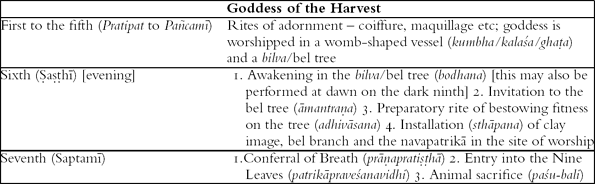
Table: The main rites during the bright phase of Āśvina according to the DPT:

Part III. Text and Translation of the Principal Rites:Footnote 87
(i) The Bodhana (Awakening) of the Goddess in a Bilva Tree:
atha bodhanam | bilvavṛkṣasamīpaṃ gatvā ācānto darbhayuktāsane upaviśya śvetasarṣapam ādāya
oṃ vetālāś ca piśācāś ca rākṣasāś ca sarīsṛpāḥ
apasarpantu te sarve ye cānye vighnakārakāḥ ∥
oṃ vināyakā vighnakarā mahogrā yajñadviṣo ye piśitāśanāś ca |
siddhārthakair vajrasamānakalpair mayā nirastā vidiśaḥ prayāntu |
iti mantrābhyāṃ śvetasarṣapaprakṣepaiḥ vighnakarān apasārya gāyatryā ghaṭasthāpanaṃ kṛtvā ghaṭādisthajale oṃ sūryāya namaḥ ity anena pūjayet | evaṃ somāya maṅgalāya budhāya bṛhaspataye śukrāya śanaiścarāya rāhave ketubhyaḥ iti grahān sampūjya pañcadevatāḥ sampūjayet | eṣa gandhaḥ oṃ sūryāya namaḥ iti pañcopacāraiḥ gandhapuṣpābhyāṃ vā pūjayet | evaṃ gaṇeśaṃ durgāṃ śivaṃ viṣṇuñ ca sampūjya arghyasthāpanaṃ kuryāt | śaṅkhādipātre dūrvākṣatadadhipuṣpāṇi dattvā yathālābhaṃ vā ‘vaṃ’ iti dhenumudrayā amṛtīkṛtya oṃ bilvavṛkṣāya namaḥ ity aṣṭadhā japtvā tenodakena ātmānaṃ pūjopakaraṇañ cābhyukṣya bilvavṛkṣe etat pādyaṃ oṃ bilvavṛkṣāya namaḥ | sāmagānām idam arghyam anyeṣām eṣo'rghaḥ | evam ācamanīyādikaṃ dadyāt | pañcopacārair gandhapuṣpābhyāṃ vā pūjayet | sambhave etad vastraṃ bṛhaspatidaivataṃ oṃ bilvavṛkṣāya namaḥ iti dadyāt | tato bilvavṛkṣe durgāṃ pūjayet | yathā śaṅkhādipātraṃ purato nidhāya tribhāgaṃ jalenāpūrya tatrākṣatapuṣpādīni dattvā yathālābhaṃ vā vaṃ iti dhenumudrayā amṛtīkṛtya
oṃ jayantī maṅgalā kālī bhadrakālī kapālinī |
durgā śivā kṣamā dhātrī svāhā svadhā namo'stu te ∥
hrīṃ oṃ durgāyai namaḥ | ity aṣṭadhā japtvā tenodakena ātmānaṃ pūjopakaraṇañ ca abhyukṣya oṃ jaṭājūṭetyādinā dhyātvā svaśirasi puṣpaṃ dattvā mānasopacāraiḥ sampūjya arghyāntaraṃ sthāpayitvā punar dhyātvā oṃ bhūr bhuvaḥ svar bhagavati durge ihāgaccha ihāgaccha iha tiṣṭha ity uktvā etat pādyaṃ oṃ jayantītyādi uktvā hrīṃ oṃ durgāyai namaḥ evam arghyādibhiḥ pañcopacārair vā pūjayet | sambhave vastraṃ punar ācamanīyañ ca dadyāt | tato vādyapuraḥsaram añjaliṃ badhvā paṭhet
oṃ iṣe māsy asite pakṣe navamyām ārdrayogataḥ |
śrīvṛkṣe bodhayāmi tvāṃ yāvat pūjāṃ karomy aham ∥
oṃ aiṃ rāvaṇasya vadhārthāya rāmasyānugrahāya ca |
akāle brahmaṇā bodho devyās tvayi kṛtaḥ purā ∥ Footnote 88
iti mantrābhyāṃ devīṃ bodhayet | śūdras tu praṇavavyāhṛtisthāne namaḥ ity uccārya pūjayet | tataḥ śuklanavamīparyantaṃ yathāśakti durgāṃ pūjayet |
Now [on the topic of the goddess's] Awakening. Approaching a bilva tree, sitting on a seat of darbha grass having performed the Ācamana rite and taking white mustard seeds [in his hands, he utters the following two verses]:
Oṃ. Spirits, flesh-eating ogres, monsters, serpents –
May they disperse, and all others who cause obstacles!
“Oṃ. May impediments, producers of impediments and terrifying flesh-eaters who are enemies of the sacrifice scatter in all directions, banished by me with white mustard [whose power] is the same as the thunderbolt.Footnote 89
After removing obstacle causers by scattering white mustard seeds while [reciting] the two mantras, installing the pot while [reciting] the Gāyatrī mantra, he must worship [the Sun] in the water inside the pot etc. with this [mantra] “Oṃ. Homage to the Sun”. After worshipping the planets in the same manner with [their respective mantras] as follows – ‘[Homage] to the Moon’, ‘to Mars’, ‘to Mercury’, ‘to Jupiter’ (bṛhaspataye), ‘to Venus’, ‘to Saturn’, ‘to Rāhu’ and ‘to Ketu’ (ketubhyaḥ)Footnote 90 – he must worship the Five Gods.
“Here is the perfume. Oṃ homage to the sun”: [with this formula] he must worship [the Five Gods] with the Five UpācārasFootnote 91 or [optionally with offerings of] perfumed powders and flowers. Thus having worshipped Gaṇeśa, Durgā, Śiva and Viṣṇu, he must ritually establish the guest water.
After placing dūrvā grass, unhusked barley, yoghurt and flowers or whatever is in his means in a shell or other chalice, [ritually] transforming the water into nectar with the Dhenu gesture [while reciting the mantra] “Vaṃ”, reciting [the mantra] “Oṃ. Homage to the Bilva Tree” eight times and sprinkling himself and the ritual implements with that water [he chants] to the bilva tree, “This is the water for washing your feet. Oṃ Homage to the bilva tree”. For chanters of the Sāma veda [the mantra is] “This is the guest water”. For others, [it is] “Here is the guest water”.Footnote 92 He must worship [the bilva tree] with the five upacāras or with perfume and flowers. If he can afford it he must offer [garments with the mantra] “This is the garment, whose presiding deity is Bṛhaspati. Oṃ Homage to the bilva tree”.
Then he must worship Durgā in the bilva tree as follows: after placing the chalice of shell or another substance before him, filling it three-quarters with water, placing unhusked barley, flowers etc. therein, or whatever he can procure and ritually transforming [the water in the chalice] into nectar with the Dhenu gesture [while reciting the seed syllable] “Vaṃ”, [he recites the following verse]:
‘Oṃ Jayantī, Maṅgalā, Kālī, Bhadrakālī, Kapālinī
Durgā, Śivā, Kṣamā, Dhātṛ, Svāhā, Svadhā – Homage to thee.
Hrīṃ Oṃ Homage to Durgā’
After reciting [this] eighteen times, sprinkling himself and the ritual implements with that water, visualising [himself as the deity] and beginning with “Oṃ. She with the coils of matted hair”, then placing the flower on his head, worshipping internally with mental offerings, placing another chalice and revisualising [himself as the deity], reciting [the mantra] “Oṃ. Earth, middle earth, heaven O Goddess Durgā, Come here! Come here! Stay here! Stay here!”, then reciting [the mantra beginning with] “This is the water for washing the feet. Oṃ Jayantī. . .” [while offering the water for the feet and after completing the recitation with] “Hrīṃ Oṃ Homage to Durgā”, he must worship in the same way with the guest water and other [offerings] or with the five upacāras. If he can afford it, he must offer a garment and the sipping water afterwards. Then, folding his hands after offering music, he must recite:
Oṃ, In the dark half-month during Āśvina, on the ninth conjoined with Ārdra,
In the bilva tree I awaken you, so that I can perform your worship
Oṃ aiṃ To slay Rāvaṇa and to favour Rāma
Did Brahmā unseasonably perform the goddess's Awakening in your case.Footnote 93
He must awaken the goddess with these two mantras. But the Śūdra must worship after saying ‘Homage’ instead of saying ‘Oṃ’. Then he must worship Durgā up to the ninth in the bright phase according to his means.
(ii) The Rites of Adornment from Pratipat to Pañcamī:.
atha pratipadādikalpaḥ|. . . iti saṅkalpya oṃ devo vaḥ ityādi sūktaṃ paṭhitvā ghaṭaṃ saṃsthāpya pūrvavad durgāṃ sampūjya gandhāmalakyādikeśasaṃskāradravyaṃ kañkatikāñ ca dadyāt | evaṃ dvitīyāyāṃ keśasaṃyamanahetukaṃ paṭṭaḍorakaṃ tṛtīyāyāṃ caraṇarāgārtham alaktakaṃ śirasi dhāraṇārthaṃ sindūraṃ mukhavilokanārthaṃ darpaṇaṃ caturthyāṃ madhuparkaṃ tilakākāraṃ rajatādikaṃ netramaṇḍanaṃ kajjalaṃ pañcamyāṃ candanam anulepanaṃ yathāśakti alaṅkārañ ca dadyāt |
Now, [on the topic of] the rites beginning on the first [of the bright phase] . . ..
After thus declaring the Saṃkalpa [the formal Declaration of Intent], reciting the verse “Oṃ Devo vaḥ”, setting up the pot and worshipping Durgā as before, he must offer substances for coiffuring the hair, such as perfume, the fruit of the Emlic myrobalan and a comb. In the same way, on the second [he must offer] a silken cord for tying the hair, on the third red lac dye to redden her feet, vermillion to wear on [the middle parting of] her hair, a mirror to view [her] face, on the fourth a mixture of milk and honey, silver etc. for shaping the ‘tīlaka’ mark, collyrium to anoint [her] eyes; on the fifth he must offer sandalwood, unguents and ornaments according to his means.
(iii) The Āmantraṇa (Invitation) and the Sthāpana (Installation):
devīṃ bodhayitvā bilvatarum āmantrayet | yadi tu patrīpraveśapūrvadine sāyaṃ ṣaṣṭhyalābhas tadā pūrvadine sāyaṃ bodhayitvā paradine āmantrayet, yadi ubhayadine sāyaṃ ṣaṣṭhyalābhas tadā sāyaṃ vinā ṣaṣṭhyāṃ bodhayitvā sāyam āmantrayet | yathā
oṃ merumandārakailāśahimavacchikare girau |
jātaḥ śrīphalavṛkṣa tvam ambikāyāḥ sadā priyaḥ |
śrīśailaśikhare jātaḥ śrīphalaḥ śrīniketanaḥ |
netavyo'si mayāgaccha pūjyo durgāsvarūpataḥ |
tato gandhaṃ gṛhītvā oṃ gandhadvārāṃ durādharṣāṃ nityapuṣṭāṃ karīṣiṇīm |
īśvarīṃ sarvabhūtānāṃ tām ihopahvaye śriyam ∥
anena gandhena amuṣyā bhagavtyā durgādevyāḥ śubhādhivāsanam astu, tato mahīṃ gṛhītvā tattan mantraṃ gāyatrīṃ vā paṭhitvā anayā mahyā amuṣyā bhagavatyā durgādevyāḥ śubhādhivāsanam astu ityādinā bilvavṛkṣe'dhivāsayet | punar gandhena | tatra dravyāṇi –
mahī gandhaḥ śilā dhānyaṃ durvā puṣpaṃ phalaṃ dadhi |
ghṛtaṃ svastikaṃ sindūraṃ śaṅkhakajjalarocanāḥ |
siddhārthaḥ kāñcanaṃ rūpyaṃ tāmracāmaradarpaṇaṃ |
dīpaḥ praśastipātrañ ca vijñeyam adhivāsane |
tata ācārāt pūjāmaṇḍapaṃ gatvā ācamya –
kadalī dāḍimī dhānyaṃ haridrā mānakaṃ kacuḥ |
bilvo’śoko jayantī ca vijñeyā navapatrikā ∥
ity uktanavapatrikāṃ pratimāñ ca sampūjya gandhādinā adhivāsayet |. . .
atha saptamīkṛtyam | tatra saptyamyāṃ mūlānakṣatrayuktāyāṃ vā kṛtasnānādiḥ kanyālagne carāṃśe vā sthāpanāya bilvatarusamīpaṃ gatvā tam abhyarcya kṛtāñjaliḥ
oṃ bilvavṛkṣa mahābhāga sadā tvaṃ śaṅkarapriya |
gṛhītvā tava śākhāñ ca durgāpūjāṃ karomy aham ∥
śākhācchedodbhavaṃ duḥkhaṃ na ca kāryaṃ tvayā prabho |
kṣamyatām bilvavṛkṣeśa vṛkṣarāja namo'stu te ∥
ity uktvā bilvavṛkṣād vāyavyanairṛtyetarasthāṃ phalayugalaśālinīṃ kevalāṃ vā śākhām oṃ chindhi chindhi phaṭ phaṭ huṃ phaṭ svāhā ity anena cchedayet | tatas tāṃ śākhāṃ gṛhītvā pūjālayam āgatya pīṭhopari sthāpayet | tataḥ śvetasarṣapam ādāya
oṃ vetālāś ca piśācāś ca rākṣasāś ca sarīsṛpāḥ |
apasarpantu te sarve ye cānye vighnakārakāḥ |
vināyakā vighnakarā mahogrā yajñadviṣo ye piśitāśanāś ca |
siddhārthakair vajrasamānakalpair mayā nirastā vidiśaḥ prayāntu |
ity etābhyāṃ śvetasarṣapaprakṣepair vighnakarān apasārya māsabhaktabaliṃ gṛhītvā eṣa māsabhaktabaliḥ
oṃ jaya tvaṃ kāli sarveśe sarvvabhūtagaṇāvṛte |
rakṣa māṃ nijabhūtebhyo baliṃ gṛhna namo'stu te |
oṃ kālyai namaḥ | oṃ mātar mātar vare durge sarvakāmārthasādhini |
anena balidānena sarvān kāmān prayaccha me ∥
iti prārthayet | tata ācārād aparājitālatābaddhāṃ navapatrikāṃ bilvaśākhāñ ca sthāpayitvā oṃ bilvaśākhāyai namaḥ iti sampūjya bilvaśākhāyāṃ mṛnmayapratimāyāñ ca etat pādyaṃ oṃ cāmuṇḍāyai namaḥ iti cāmuṇḍāṃ sampūjya
oṃ śrīśailaśikhare jātaḥ śrīphalaḥ śrīniketanaḥ |
netavyo'si mayāgaccha pūjyo durgāsvarūpataḥ ∥ Footnote 94
cāmuṇde cala cala cālaya cālaya śīghraṃ mama mandiraṃ praviśa pūjālayaṃ gaccha svāhā | iti vadet |
tato ghaṭaṃ saṃsthāpya navagrahapañcadevatāḥ sampūjya mṛnmayapratimāṃ taddakṣiṇe navapatrikāñ ca gītavādyādibhiḥ pīṭhopari sthāpayitvā bhūtaśuddhyādikaṃ vidhāya sāmānyārghyaṃ sthāpayitvā devīsamīpe tāmrādipātre bilvaśākhāṃ sthāpayitvā
oṃ āropitāsi durge tvaṃ mṛnmaye śrīphale'pi ca |
sthirātyantaṃ hi no bhūtvā gṛhe kāmapradā bhava ∥
oṃ sthāṃ sthīṃ sthirā bhava iti
Having thus awoken the goddess, he must [formally] invite the bilva tree. . . in the following way:
Oṃ. On a mountain, on the crests of Meru, Mandāra, Kailāśa and Himavat,
Were you, O Śrīphala Tree, born, eternally adored by Ambikā.
Born on the peak of the Śrīśaila, the Śrīphala tree, abode of Śrī –
Let me take you. Come! I will worship you as Durgā.
Then, taking the perfume [he recites the verse]:
Oṃ. Karīṣiṇī, perceptible through perfume, invincible and eternally abundant
The Empress of all creatures – She who is glorious I invite herein.
May the Adhivāsana of this goddess Durgā with this perfume be auspicious.
Then, taking earth, after reciting this and that mantra or the Gāyatrī, he must ritually bestow fitness on the bilva tree with [the declaration] “May the Adhivāsana of this goddess Durgā with this earth be auspicious”. And again [he repeats the same] with the perfume. The substances in this [ritual] are:
Know that earth, perfume, red arsenic, rice, durvvā grass, flowers, fruits, yoghurt,
Clarified butter, the Svastika mark, vermillion, conch shell, collyrium and Rocana,
White mustard, gold, silver, copper, a whisk, a mirror.
Lamp and a Praśastipātra (?) are [to be used] in the Adhivāsana.
Know that the nine leaves are [from] the plantain, the pomegranate, rice, turmeric, Arum indicum, the kacu, bilva, aśoka and barley –
Having worshipped the image and the nine leaves thus mentioned, he must ritually bestow fitness [to the leaves] with perfume etc . . .
Now [for] the ritual obligations on the seventh. In this case, on the seventh either conjoined with Mūla or not Footnote 95 a man having bathed etc. and having gone to the bilva tree to ritually install it during the lagna of Virgo or at Carāṃśa and having paid homage to the tree, with folded hands [he must recite]:
Oṃ. Bilva tree, of great fortune, eternally adored are you by Śaṅkara,
Having taken your branch shall I perform the worship of Durgā.
Feel no pain from the tearing of your branch O Lord,
Forgive me Lord of the bilva tree, King of Trees, Homage to thee!
Declaring thus, he must tear a branch with or without two fruits located [in a part] other than the north-west and the south-west with this [mantra]: “Oṃ Tear! Tear! Phaṭ phaṭ huṃ svāhā.” Then taking that branch, he must place it on the pīṭha after entering the ritual room. Then, having taken white mustard seeds [he must recite]:
Oṃ. Spirits, flesh-eating ogres, monsters, serpents –
May they disperse, and all others who cause obstacles!
“Oṃ. May impediments, producers of impediments and terrifying flesh-eaters who are enemies of the sacrifice scatter in all directions, banished by me with white mustard [whose power] is the same as the thunderbolt.
After removing obstacle-causers by scattering white mustard seeds with these two [verses] and having taken an offering of rice mixed with lentils, [he must recite]:
Here is the offering of rice with lentils.
Oṃ. Be triumphant Kālī, Queen of All, encompassed by all the ghost hordes,
Protect me from your ghosts, accept the offering – homage to you.
Oṃ Homage to Kālī.
Oṃ Mother, Mother, Beauteous Durgā, accomplisher of all desired objects,
With this bali offering, grant me all that I desire.
He must ask thus.
Then, placing the nine leaves bound in an aparājitā vine and the bilva branch according to custom [he must recite]: “Oṃ. Homage to the bilva branch”. Thus having worshipped, [he must offer the water for washing the feet] to the bilva branch and the clay image [saying], “This is the water for washing the feet. Oṃ Homage to Cāmuṇḍā.” Thus worshipping Cāmuṇḍā, he must say:
Born on the peak of the Śrīśaila, the Śrīphala tree, abode of Śrī –
Let me take you. Come! I will worship you as Durgā.
O Cāmuṇḍā, Come, come, shake, shake, Swiftly enter my temple, Go to the pūjā room. Svāhā.
Then, having installed the pot, having worshipped the nine planets and the five gods, having installed the clay image) and the nine leaves on its right side on the pīṭha with songs, music etc., having performed the rites such as the Purification of the Gross Elements, having set up the chalice common to all the deities and having placed the bilva branch in a copper receptacle before the clay image [he must recite]:
Oṃ. Infused are you O Durgā in the clay and also in the bilva.
Having become perfectly fixed for our sake, grant our desires in our abode
Oṃ. Be still, be fixed, be motionless.
(iv) The Prāṇapratiṣṭhā (Conferral of Breaths), Dhyāna (Visualisation) and Āhūti (Summoning):Footnote 96
iti sthirīkṛtya prāṇapratiṣṭhāṃ kuryāt | yathā pratimāyāś cakṣuṣi kajjalaṃ dattvā kapolau spṛṣṭvā oṃ kāli kāli svāhā hṛdayāya namaḥ | oṃ kāli vajriṇi śirase svāhā | oṃ kāli kāleśvari śikhāyai vaṣaṭ | oṃ kāli kāli vajreśvari kavacāya huṃ | oṃ kāli vajreśvari lauhadaṇḍāyai netratrayāya vauṣaṭ | oṃ kāli lauhadaṇḍāyai astrāya phaṭ | oṃ jayantītyādi paṭhitvā hṛdaye aṅguṣṭhaṃ dattvā
oṃ asyai prāṇāḥ pratiṣṭhantu asyai prāṇāḥ kṣarantu ca |
asyai devatvasaṃkhyāyai svāhā |
punaḥ oṃ kāli kāli svāhā hṛdayāya namaḥ ityādi sarvaṃ oṃ jayantītyādi ca paṭhitvā
oṃ manojyotir juṣatām ājyasya
bṛhaspatir yajñam imaṃ tanotu |
ariṣṭaṃ yajñaṃ sam imaṃ dadhātu
viśve devāsa iha mādayantām om pratiṣṭha ∥
ity etaiḥ kālikāpurāṇoktamantrair iti | athavā āgamoktamantraiḥ prāṇapratiṣṭhā yathā hṛdaye hastaṃ dattvā oṃ āṃ hrīṃ kroṃ yaṃ raṃ laṃ vaṃ śaṃ ṣaṃ saṃ hauṃ haṃ saḥ bhagavatyā durgāyāḥ prāṇāḥ iha prāṇāḥ punar api durgāyāḥ ity antam uktvā jīva iha sthitaḥ punaḥ durgāyāḥ ity antam uktvā iha sarvendriyāṇi punaḥ durgāyāḥ ity antam uktvā vāṅmanaścakṣuḥśrotraghrāṇaprāṇā ihāgatya sukhaṃ ciraṃ tiṣṭhantu svāhā ity | evam anyeṣāṃ gaṇeśādīnām | tataḥ sapuṣpākṣatam ādāya devīṃ dhyāyed yathā
oṃ jaṭājūṭasamāyuktām ardhendukṛtaśekharām |
locanatrayasaṃyuktāṃ pūrṇendusadṛśānanām ∥
atasīpuṣpavarṇābhāṃ supratiṣṭhāṃ sulocanām |
navayauvanasampannāṃ sarvābharaṇabhuṣitām |
sucārudaśanāṃ devīṃ pīnonnatapayodharām |
tribhaṅgasthānasaṃsthānāṃ mahiṣāsuramardinīm ∥
triśūlaṃ dakṣiṇe haste khaḍgaṃ cakraṃ kramād adhaḥ |
tīkṣṇabāṇaṃ tathā śaktiṃ vāmato'pi nibodhata ∥
kheṭakaṃ pūrṇacāpañ ca pāśam aṅkuśam eva ca |
ghaṇtāṃ vā paraśuṃ vāpi vāmataḥ saṃniveśayet ∥
adhastān mahiṣaṃ tadvad viśiraskaṃ pradarśayet |
śiraschedodbhavaṃ tadvad dānavaṃ khaḍgapāṇinam ∥
hṛdi śūlena nirbhiṇṇaṃ niryadantravibhūṣitam |
raktaraktīkṛtāṅgañ ca raktavisphuritekṣaṇam ∥
veṣṭitaṃ nāgapāśena bhrūkuṭībhīṣaṇānanam |
sapāśavāmahastena dhṛtakeśañ ca durgayā |
vamadrudhiravaktrañ ca devyāḥ siṃhaṃ pradarśayet |
devyās tu dakṣiṇaṃ pādaṃ samaṃ siṃhopari sthitam ∥
kiñcid ūrddhvaṃ tathāvāmam aṅguṣṭhaṃ mahiṣopari |
stūyamānañ ca tad rūpam amaraiḥ sanniveśayet ∥
. . .idaṃ matsyapurāṇīyaṃ dhyātvā svaśirasi puṣpaṃ dattvā so'ham iti vicintya sapuṣpākṣatam ādāya āvāhayet |
oṃ sarvabhūtamayodbhūte sarvāsuravimardini |
anukampaya māṃ devi pūjāsthānaṃ vrajasva me ∥
oṃ āvāhayāmy ahaṃ devīṃ mṛnmaye śrīphale'pi ca |
kailāśaśikharād devi vindhyādrer himaparvatāt |
āgatya bilvaśākhāyāṃ caṇḍike kuru sannidhim |
oṃ bhūr bhuvaḥ svar bhagavati durge ihāgaccha ihāgaccha ity āvāhya
oṃ sthāpitāsi mayā devi mṛnmaye śrīphale'pi ca |
āyur ārogyam aiśvaryaṃ dehi devi namo'stu te ∥
oṃ bhagavati durge iha tiṣṭha iha tiṣṭha iti sthāpayitvā kṛtāñjaliḥ
oṃ durge durgasvarūpāsi suratejomahābale |
sadānandakare devi prasīda mama siddhaye |
oṃ ehy ehi bhagavty amba śatrukṣayajayaprade |
bhaktitaḥ pūjayāmi tvāṃ navadurge surārcite |
pallavaiś ca phalopetaiḥ puṣpaiś ca sumanoharaiḥ |
pallave saṃsthite devi pūjaye tvāṃ prasīda me ∥
oṃ durge devi samāgaccha sānnidhyam iha kalpaya |
yajñabhāgān gṛhāṇa tvaṃ yoginīkoṭibhiḥ saha |
ehy ehi parameśāni sānnidhyam iha kalpaya |
pūjābhāgaṃ gṛhāṇemaṃ durge devi namo'stu te |
durge devi samāgaccha gaṇaiḥ parikaraiḥ saha |
pūjābhāgaṃ gṛhāṇemaṃ makhaṃ rakṣa namo'stu te |
Thus making [her] still, he must perform the Conferral of the Vital Breaths, in the following manner:
Having lined the eyes of the image with collyrium, after touching her cheeks [he installs the following mantras]: “Oṃ kāli kāli svāhā hṛdayāya namaḥ. Oṃ kāli vajriṇi śirase svāhā. Oṃ kāli kāleśvari śikhāyai vaṣaṭ. Oṃ kāli kāli vajreśvari kavacāya huṃ. Oṃ kāli vajreśvari lauhadaṇḍāyai netratrayāya vauṣaṭ.Oṃ kāli lauhadaṇḍāyai astrāya phaṭ”. Having recited the verse beginning with “Oṃ Jayantī. . .”, after placing his thumb on his heart [he must say]:
Oṃ May the vital breaths be conferred on her and may the vital breaths flow for her sake
Svāhā to Her, Summation of Godly Essences.
Once again after reciting “Oṃ Kāli Kāli, Hṛdayāya Namaḥ” and the whole passage beginning with “Oṃ Jayantī. . .” [he must say]
Oṃ Let the mind take delight in the light of ghee
Let Bṛhaspati extend this [sacrifice].
Let him put together this sacrifice [so that it is] unharmed
Let the All Gods rejoice here. Oṃ. Step forward.Footnote 97
The Conferral of Vital Breaths is either with these mantras stated in the Kālikā Purāṇa or with the mantras stated in the Āgamas which are as follows:
After placing his hand on his heart, [he says] “Oṃ āṃ hrīṃ kroṃ yaṃ raṃ laṃ vaṃ śaṃ ṣaṃ saṃ hauṃ haṃ saḥ The Goddess Durgā's Vital Breaths, herein the Breaths”; and again repeating from ‘Durgā's’ till the end of the verse [he says], “The Soul is present here”; and again repeating ‘Durgā’s’ till the end he says: “Here are all the sense objects”, again repeating ‘Durgā’s’ till the end, he then says: “May Speech, Mind, Sight, Hearing, Smell and the Vital Breaths remain in eternal bliss having entered herein, Svāhā”. The same [is done] for Gaṇeśa etc.
Then, having taken unhusked barley with flowers he must visualise the goddess as follows:
Oṃ [Think of] Her with coils of matted hair, with the moon's crescent as a crown,
With three eyes, with a face like the full moon
With a complexion like the atasī blossom, charmingly positioned, with charming eyes,
Endowed with fresh youth, adorned with all ornaments,
With lovely teeth, with full and uplifted breasts
Positioned in the ‘tribhaṅga posture’, slaying the buffalo demon,
A trident in her right hand, a sword, and discus in the bottom and top hands,
And know that in her left hands are a pointed arrow and a lance,
A shield, a bow fully bent, a noose and an elephant goad,
A bell or an axe must he place in the left hands.
Furthermore, he must show a headless buffalo below
And a demon holding a sword arising from where the head was torn
Pierced in the chest by the trident, adorned with spilling entrails,
His limbs daubed in blood, his eyes bloodshot and bulging
Encircled by a snake noose, his face terrible with furrowed brows,
His hair grasped by Durgā with the left hand that holds the noose.
Disgorging blood and entrails must one show the goddess's lion
The goddess's right foot is placed evenly on the lion
And the toe of her left foot slightly elevated is on the buffalo
He must affix her form in his mind while it is eulogised by the gods
. . .Having visualised [the goddess] in this verse from the Matsya Purāṇa, having placed the flower on his head, having contemplated that the deity is himself and having taken unhusked barley with flowers, he must summon her:
Oṃ O Lady born as the embodiment of all elements, slayer of all asuras
Have compassion on me, goddess. Come to my place of worship
Oṃ I summon the goddess in the clay idol and the bilva
Having entered the bilva branch, Caṇḍikā, make your presence nearby
Oṃ Earth, middle Earth, heaven, O Goddess Durgā come here come here
Thus summoning (ityāvāhya), [he must say]:
Oṃ I have embedded you O goddess in the clay idol and the bilva
Grant me long life, health and wealth, goddess. Homage to you.
Having installed her with [the verse] “Oṃ O Goddess Durgā stay here, stay here”, [he must say] with his hands folded:
Oṃ O Durgā, whose nature is hard to comprehend, who is mighty with celestial effervescence
Who produces eternal bliss, O goddess, grant me grace for my success
Come, come Amba who grants death to enemies and victory,
With devotion I worship you, the Nine Durgās, honoured by the gods
With leaves, fruits and exquisite blossoms.
O goddess infused in a leaf, I worship you, grant me grace
Oṃ. Goddess Durgā, come together. Make your presence herein
Accept the portion of the sacrifice with [your] crores of Yoginīs
Come, come Supreme One, make your presence herein
Accept this portion of the worship Durgā. Homage to you, goddess
Goddess Durgā come together with attendant hordes
Accept this portion of the worship. Protect the sacrifice. Homage to you.
(v) The Patrikāpraveśanavidhi (Entrance into the Nine Leaves):
tato navapatrikāsamīpaṃ gatvā
oṃ ehi durge mahābhāge patrikārohaṇaṃ kuru |
tava sthānam idaṃ martye śaraṇaṃ tvāṃ vrajāmy aham ∥
ity uktvā ghaṭe hrīṃ oṃ kadalīsthāyai brahmāṇyai namaḥ iti krameṇa daśopacāraiḥ pañcopacārair gandhapuṣpābhyāṃ vā pūjayet | evaṃ dāḍimasthāṃ raktadantikāṃ dhānyasthāṃ lakṣmīṃ haridrāsthāṃ durgāṃ mānasthāṃ cāmuṇḍāṃ kacusthāṃ kālikāṃ bilvasthāṃ śivāṃ aśokasthāṃ śokarahitāṃ jayantīsthāṃ kārtikīñ ca pūjayet | evaṃ gaṇeśādīnām api yathāśakti pūjā |
Then, having gone near the nine leaves [he must say]:
Oṃ. Come Durgā of great fortune, descend into these leaves
This is your home in the mortal world. I go to you for refuge.
Saying thus, he must worship [the leaves] in the pot in sequence with either the ten Upacāras, the five Upacāras or perfume and flowers, [chanting first] “Hrīṃ Oṃ Homage to Brahmāṇī in the plantain leaf”. And in the same way Raktadantikā in the pomegranate leaf, Lakṣmī in the rice leaf, Durgā in the turmeric leaf, Cāmuṇḍā in the leaf of the Arum Indicum, Kālikā in the kacu leaf, Śivā in the bilva leaf, Śokarahitā in the aśoka leaf and Kārttikī in the barley leaf. Gaṇeśa etc. are also worshipped in the same manner according to one's means.
(vi) The Bali (Sacrifice):Footnote 98
tato devīṃ pādyādibhiḥ sampūjya chāgādibaliṃ dadyāt Footnote 99 | yathā svayam uttarāmukhaḥ snātaṃ pūrvābhimukhaṃ baliṃ kṛtvā oṃ astrāya phaṭ ity avalokya oṃ agniḥ paśur āsīt tenāyajanta sa etaṃ lokam ajayad yasminn agniḥ sa te loko bhaviṣyati taṃ jeṣyasi pibaitā apaḥ | oṃ vāyuḥ paśur āsīt tenāyajanta sa etaṃ lokam ajayad yasmin vāyuḥ sa te loko bhaviṣyati taṃ jeṣyasi pibaitā apaḥ | oṃ sūryaḥ paśur āsīt tenāyajanta sa etaṃ lokam ajayad yasmin sūryaḥ sa te loko bhaviṣyati taṃ jeṣyasi pibaitā apaḥ | iti kuśodakaiḥ samprokṣya oṃ chāgapaśave namaḥ iti gandhādibhir abhyarcya
oṃ chāga tvaṃ balirūpeṇa mama bhāgyād upasthitaḥ |
praṇamāmi tataḥ sarvarūpiṇaṃ balirūpiṇam ∥
caṇḍikāprītidānena dātur āpadvināśana |
cāmuṇḍābalirūpāya bale tubhyaṃ namo'stu te ∥
yajñārthe paśavaḥ sṛṣṭāḥ svayam eva svayambhuvā |
atas tvāṃ ghātayāmy adya tasmād yajñe vadho'vadhaḥ ∥
ity uccārya aiṃ hrīṃ śrīṃ iti mantreṇa baliṃ śivarūpiṇaṃ dhyātvā tasya mūrdhni puṣpaṃ nyaset Footnote 100 | oṃ adyetyādi mahābalabhavanakāmo durgāprītikāmo vā imaṃ chāgapaśuṃ vahnidaivataṃ bhagavatyai durgādevyai tubhyam ahaṃ ghātayiṣye iti jalaṃ dadyāt | tataḥ
oṃ kṛṣṇaṃ piṇākapāṇiñ ca kālarātrisvarūpiṇam |
ugraṃ raktāsyanayanaṃ raktamālyānulepanam ∥
atraiva balidānaprakāraḥ –
bhagavān uvāca
snāpayitvā baliṃ tatra puṣpacandanavandanaiḥ |
pūjayet sādhako devīṃ mūlamantrair muhur muhuḥ ∥
uttarābhimukho bhūtvā baliṃ pūrvamukhaṃ tathā |
nirīkṣya sādhakaḥ paścād imaṃ mantram udīrayet ∥
nara tvaṃ balirūpeṇa mama bhāgyād upasthitaḥ |
praṇamāmi tataḥ sarvarūpiṇaṃ balirūpiṇam ∥
caṇḍikāprītidānena dātur āpadvināśana |
cāmuṇḍābalirūpāya bale tubhyaṃ namo'stu te ∥
yajñārthe balayaḥ sṛṣṭāḥsvayam eva svayambhuvā |
atas tvāṃ ghātayāmy adya tasmād yajñe vadho vadhaḥ ∥
aiṃ hrīṃ śrīm iti mantreṇa taṃ baliṃ matsvarūpiṇam |
cintayitvā nyaset puṣpaṃ mūrddhni tasya tu bhairava ∥
tato devīṃ samuddiśya kāmam uddiśya cātmanaḥ |
abhiṣicya baliṃ paścāt karatā[vā]lan tu pūjayet ∥
rasanārthaṃ caṇḍikāyāḥ suralokaprasādhakaḥ |
āṃ aiṃ hṛīṃ khaḍgeti mantreṇa dhyātvā khaḍgañ ca pūjayet ∥
matsvarūpiṇaṃ śivasvarūpam | [DPT, Pramāṇa]
raktāmbaradharañ caiva pāśahastaṃ kuṭumbinam |
pibamānañ ca rudhiraṃ bhuñjānaṃ kravyasaṃhatim |
evaṃ khaḍgaṃ dhyātvā
oṃ rasanā tvaṃ caṇḍikāyāḥ suralokaprasādhakaḥ |
ity abhimantrya hrīṃ śrīṃ khaḍgāya namaḥ iti gandādibhiḥ sampūjya
oṃ asir viśasanaḥ khaḍgas tīkṣṇadhāro durāsadaḥ |
śrīgarbho vijayaś caiva dharmapāla namo's tu te |
ity aṣṭau tava nāmāni svayam uktāni vedhasā |
nakṣatraṃ kṛttikā tubhyaṃ gurur devo maheśvaraḥ ∥
hiraṇyañ ca śarīraṃ te dhātā devo janārddanaḥ |
pitā pitāmaho devas tvaṃ māṃ pālaya sarvvadā ∥
nīlajīmūtasaṁkāśas tīkṣṇadaṃṣṭraḥ kṛśodaraḥ |
bhāvaśuddho'marṣaṇaś ca atitejās tathaiva ca |
iyaṃ yena dhṛtā kṣauṇī hataś ca mahiṣāsuraḥ |
tīkṣṇadhārāya śuddhāya tasmai khaḍgāya te namaḥ ∥
iti puṣpaṃ dadyāt | āṃ hrīṃ phaṭ iti khaḍgām ādāya oṃ kāli kāli vajreśvari lauhadaṇḍāyai namaḥ iti japtvā pūrvābhimukhaṃ baliṃ svayam uttarābhimukhaḥ, baliṃ uttarābhimukhaṃ svayaṃ pūrvābhimukho vā sakṛc chindyāt | tato mṛnmayādipātre rudhiram ādāya devīsammukhe sthāpayitvā oṃ adyetyādi daśavarṣāvacchinnaśrīdurgāprītikāma imaṃ chāgapaśurudhirabaliṃ dāsyāmi iti saṃkalpya eṣa chāgapaśurudhirabaliḥ oṃ jayantītyādy uccārya dadyāt | tataḥ
oṃ kāli kāli mahākāli kālike pāpanāśini |
śoṇitañ ca baliṃ gṛhna varade vāmalocane ∥
aiṃ hrīṃ śrīṃ kauśiki rudhireṇāpyāyatām iti vadet | tataś chāgaśirasi jvaladdaśāṃ dattvā oṃ adyetyādi daśavarṣāvachinnaśrīdurgāprītikāma imaṃ sapradīpacchāgapaśuśīrṣabaliṃ dāsyāmi iti saṃkalpya eṣa sapradīpacchāgapaśuśīrṣabaliḥ oṃ jayantītyādy uccārya dadyāt | tataḥ
oṃ jaya tvaṃ sarvabhūteśe sarvabhūtasamāvṛte |
rakṣa māṃ nijabhūtebhyo baliṃ bhuṅkṣva namo'stu te ∥
ity uktvā khaḍgarudhiram ādāya –
oṃ yaṃ yaṃ spṛśāmi pādena yaṃ yaṃ paśyāmi cakṣuṣā |
sa sa me vaśyatāṃ yātu yadi śakrasamo bhavet ∥
oṃ aiṃ hrīṃ śrīṃ nityaklinne madadrave svāhā iti sarvavaśyamantreṇa svīyalalāṭe tilakaṃ kuryāt |
mahiṣotsarge tu mahiṣasyāraṇyapaśutvenāgastyaprokṣitatvāt taddāne agniḥ paśur āsīd ityādimantraiḥ prokṣaṇaṃ nāsti | tataś ca etat pāṭhyam
oṃ yathā vāhaṃ bhavān dveṣṭi yathā vahasi caṇḍikām |
tathā mama ripūn hiṃsa śubhaṃ vaha lulāpaka ∥
yamasya vāhanas tvan tu vararūpadharāvyaya |
āyur vittaṃ yaśo dehi kāsarāya namo'stu te ∥
oṃ mahiṣapaśave namaḥ iti gandādibhiḥ sampūjya chāga ity atra paśo ity ūhena vadet | rudhiradāne tu phalaṃ śatavarṣāvacchinnadurgāprītiḥ | pūrvavad anyat sarvam | meṣaghāte tu meṣa ity ūhena prayoktavyam | rudhiradāne tu ekavarṣāvacchinnadurgāprītiḥ phalam | anyat sarvaṃ pūrvavat | svadeharudhiradāne tu eṣa svagātrarudhirabaliḥ
oṃ mahāmāye jaganmātaḥ sarvakāmapradāyini |
dadāmi deharudhiraṃ prasīda varadā bhava |
ity uktvā oṃ jayantītyādinā dadyāt | prabhūtabalidāne dvau vā trīn vā agrataḥ kṛtvā samprokṣya tattatpaśubhyo namaḥ ity sampūjya chāga tvam iti bahuvacanānūhena prayogaḥ | paśvantare'py evam | vākye tu mahābalabhavanakāmo'tulavibhūtikāmo durgāprītikāmo vā etān paśūn ghātayiṣye | rudhiradāne tu ‘eṣa paśurudhirabaliḥ oṃ jayantītyādy uccārya hrīṃ oṃ durgāyai namaḥ | paśuśīrṣadāne sapradīpapaśuśīrṣabaliḥ pūrvavat | kuṣmāṇḍekṣubaliṃ dadyāt | tata oṃ jayantītyādimantraṃ yathāśakti japtvā
oṃ guhyātiguhyagoptrī tvaṃ gṛhāṇāsmatkṛtaṃ japam |
siddhir bhavatu me devi tvat prasādān maheśvari |
iti japaṃ samarpayet | tataḥ stavaṃ paṭhed yathā
oṃ durgāṃ śivāṃ śāntikarīṃ brahmāṇīṃ brahmaṇaḥ priyām |
sarvalokapraṇetrīñ ca praṇamāmi sadāśivām |
maṅgalāṃ śobhanāṃ śuddhāṃ niṣkalāṃ paramāṃ kalām |
viśveśvarīṃ viśvamātāṃ caṇḍikāṃ praṇamāmy aham |
sarvadevamayīṃ devīṃ sarvalokabhayāpahām |
brahmeśaviṣṇunamitāṃ praṇamāmi sadāśivām |
vindhyasthāṃ vindhyanilayāṃ divyasthānanivāsinīm |
yoginīṃ yogamātāñ ca caṇḍikāṃ praṇamāmy aham |
īśānamātaraṃ devīm īśvarīm īśvarapriyām |
praṇato'smi sadā durgāṃ saṃsārārṇavatāriṇīm ∥
ya idaṃ paṭhet stotraṃ śṛṇuyād vāpi yo naraḥ |
sa muktaḥ sarvapāpebhyo modate durgayā saha |
atha varaprārthanam
oṃ mahiṣaghni mahāmāye cāmuṇḍe muṇḍamālini |
āyur ārogyavijayaṃ dehi devi namo'stu te |
bhūtapretapiśācebhyo rakṣobhyaḥ parameśvari |
bhayebhyo mānuṣebhyaś ca devebhyo rakṣa māṃ sadā |
sarvamaṅgalamaṅgalye śive sarvārthasādhike |
ume brahmāṇi kaumāri viśvarūpe prasīda me |
rūpaṃ dehi yaśo dehi bhāgyaṃ bhagavati dehi me |
putrān dehi dhanaṃ dehi sarvān kāmāṃś ca dehi me |
candanena samālabdhe kuṃkumena vilepite |
bilvapatrakṛtāpīḍe durge tvāṃ śaraṇaṃ gataḥ ∥
ity uccārya mūlamantreṇa puṣpāñjalitrayaṃ dadyāt | tato yathākālam annavyañjanāpūpapāyasādikam upānīya pūrvoktamantreṇa dattvā pānārthaṃ vāsitajalam ācamanīyaṃ tāmbūlañ ca dadyāt | gītavādyādibhiḥ śeṣakālaṃ nayet |
Then, having worshipped the goddess with such offerings as the foot water etc., he must offer [an animal such as] a goat etc. as sacrifice in the following manner: having faced the north after washing the sacrifice, then making it face the east and gazing [at the sacrificial weapon while chanting] “Oṃ Phaṭ to the Weapon” and [having chanted]: “Oṃ. Fire was the sacrifice. They sacrificed with him. He conquered this world. [There] where Fire dwells the world will be born for his sake. You will conquer it. Drink these waters. Oṃ The wind was the sacrifice. They sacrificed with him. He conquered this world. There where Wind dwells, the world will be born for his sake. You will conquer it. Drink these waters. Oṃ The Sun was the sacrifice. They sacrificed with him. He conquered this world. There where Fire dwells, the world will be born for his sake. You will conquer it. Drink these waters”.Footnote 101
Then, having consecrated [the animal] by sprinkling water with Kuśa grass and having paid homage [to the sacrifice] with perfumed powders etc. [while chanting] “Oṃ Homage to the goat sacrifice” and having recited:
Oṃ. O Goat, you have arrived by my good fortune in the form of the sacrificial offering
Therefore I bow down to the Embodiment of All Footnote 102, the Embodiment of Sacrifice
O You, who quell the misfortunes of your bestower through the bestowal of Caṇḍikā's pleasure,
Who are the Bali for Cāmuṇḍā's sacrifice – Homage to you.
Animals were created for the sake of the sacrifice by Self-Born Brahmā himself
Therefore I slay you now. Therefore the killing in the Sacrifice is not a killing
Thus reciting, having visualised the the sacrificial offering as Śiva with the mantra “Aiṃ hrīṃ śrīṃ”, he must place a flower on its head.
He must give the water [while declaring the Resolution]: “Oṃ Today etc. I who desire to become powerful – or [he can say] who desire to please Durgā – slay this goat sacrifice whose presiding deity is Fire for you Goddess Durgā”.
Then –
Oṃ. Dark, Trident-Bearer, Embodiment of the Night of Destruction
Fierce, red faced and eyed, garlanded and anointed with red
Clothed in red, Noose-Bearer, KuṭumbinFootnote 103
Drinking blood, feasting on a mound of carrion.
Thus visualising the sword, [he must chant]:
“Oṃ You are the tongue of Caṇḍikā who bestow the world of the gods”.
Thus empowering the sword with mantras, having worshipped it with perfumed powders etc. [chanting] “Hrīṃ śrīṃ Homage to the Sword”, [he must chant]:
Oṃ Asi, Viśasana, Khaḍga, Tīkṣṇadhāra, Durāsada,
Śrīgarbha, Vijaya and Dharmapāla – Homage to you
Thus the litany of your eight names, cited by none other than Brahmā
Your constellation the Pleaides, your guru the Lord Maheśvara
Your body is golden, your bearer the lord Janārdana
Your father is the lord Pitāmaha – protect me at all times.
Like a dark rain cloud, cruelly fanged and lean-waisted
Pure in intention, merciless and immensely powerful,
This sword by which the earth was held up and by whom Mahiṣāsura was slain
Homage to that sword, pure, sharp-edged.
Chanting this, he must offer a flower. Having held the sword chanting “Āṃ hrīṃ phaṭ”, having uttered “Oṃ Kālī Kālī, goddess of the thunder bolt, Homage to the goddess of the Iron Stake, he must decapitate the animal with one stroke while it faces the east and he faces the north, or the animal faces the north and he faces the east.
Then, having collected the blood in a chalice of such a substance as earth, having placed it before the goddess and having declared the Resolution: “Oṃ Today etc. I who wish for Durgā's affection for a duration of ten years give this bali offering of goat's blood and having recited “Here is the bali offering of goat's blood. Oṃ Jayantī. . .”, he must offer [the blood].
Then:
“Oṃ Kālī, Kālī, Awesome Kālī, Kālikā, Queller of Sins,
Accept the offering of blood O Boon Bestower, Fair-Eyed One
Aiṃ hrīṃ śrīṃ O Kauśikī. May you be nourished with blood.
Then, having placed a burning wick on the goat's head [he must declare the Resolution]: “Oṃ Today etc. I who wish for Durgā's affection for a duration of ten years give this bali offering of the goat's head with a lamp.” Having thus resolved and having said, “Here is the bali offering of the goat's head with a lamp. Oṃ Jayantī. . .”, he must offer [the head]. Then:
Oṃ Be victorious, goddess of all demons, surrounded by all demons
Protect me from your ghosts. Feast on the bali. Homage to you.
Having thus chanted and having taken the blood from the sword [he must recite]:
Oṃ Whosoever I touch with my foot, whosoever I see with my eye
May he fall in my power, [even] if he is as mighty as Śakra
Oṃ aiṃ hrīṃ śrīṃ O You who are eternally moist, flowing with passion, Svāhā
With this Mantra of Complete Subjugation he must draw a ‘tīlaka’ mark on his forehead [with the blood].
But for a buffalo sacrifice, he must not consecrate [the animal] with the mantras beginning with “Fire was the sacrifice” while [making] this offering because Agastya has [already] consecrated the buffalo since it is a forest animal. And thus the verse that must be recited is this:
Oṃ By the truth that you dislike a mount (?), by the truth that you carry Caṇḍikā,
Injure my enemies, bear good Fortune O Buffalo.
You are the mount of Yama, Imperishable bearer of impeccable limbs
Grant me long life, wealth and fame. Homage to the buffalo
Oṃ Homage to the buffalo sacrifice.
Having thus worshipped with perfumes etc., he must say “O Animal” as a modification here where ‘Goat’ [was used]. But when the blood is offered, the reward is Durgā's affection for a hundred years. Everything else is as before.
If a sheep is sacrificed, [the term] ‘Sheep’ is to be used as a modification. Everything else is as [stated] before. But if he offers blood from his body [the modification is] “Here is the bali offering of blood from my body:
Oṃ O Mahāmāyā, Mother of the Universe, Bestower of all desires
I give blood from my body. Grant me grace. Bestow boons.
Saying thus, he must offer [the blood] chanting “Oṃ Jayantī. . .”.
If there are many animal sacrifices, having grouped [them in] twos or threes before [the goddess] and having consecrated them and having worshipped them with “Homage to this and that animal” [he must sacrifice] using “O Goat You” without modification into the plural. The same is done even in the case of other animals. But [the modification] in the [sacrificer's] utterance is: “I who wish to become powerful, who wish incomparable wealth or [he may say] who wish to please Durgā shall slay these animals”. When offering blood [the modification is] “Here is the bali offering of animal blood. Oṃ Jayantī. . .” Having said this [he must chant] “Hrīṃ Oṃ Homage to Durgā.” When offering the head of the animal, [the modification is] “The bali offering of an animal head with a lamp” as before. He may give a bali offering of a pumpkin and a sugar cane. Then having uttered the mantra beginning with “Oṃ Jayantī” as many times as he can [he must pray]:
You are One who protects the secret and the supreme secret. Accept the prayer I have performed
May I have success goddess by your grace, O Maheśvarī.
Saying this he must offer the prayer.
Then, he must recite the hymn which is as follows:
Oṃ Before Durgā, the benevolent, who removes danger, Brahmāṇī the beloved of Brahmā
Leader of all worlds, Sadāśivā – I prostrate myself
Before her who is auspicious, beautiful, pure, partless and the supreme powerFootnote 104
The Goddess of the Universe, Mother of the Universe, Caṇḍikā – I prostrate myself
Before the goddess who embodies all the gods, who removes fear from all men
One who is paid homage by Brahmā, Īśa and Viṣṇu, who is Sadāśivā – I prostrate myself
Before her who dwells in the Vindhyas, whose abode is the Vindhyas, who dwells in a celestial place,
Yoginī, the Mother of Yoga, Caṇḍikā – I prostrate myself
Before the goddess who is Īśāna's mother, Īśvarī, adored by Īśvara
Durgā, who enables us to cross saṃsāra's ocean – I have prostrated myself for all time
The man who recites this hymn or listens to it
Rejoices with Durgā freed from all sins.
Now the Prayer for Boons:
Oṃ. Slayer of the buffalo, Mahāmāyā, Cāmuṇḍā, Garlanded with heads
Grant me long life, health and victory goddess. Homage to you
From demons, ghosts, flesh-eaters and Rakṣases O Supreme Goddess
From dangers, men and gods protect me eternally
O One auspicious with all good portents, benevolent, fully replete in wealth
Umā, Brahmāṇī, Kaumārī, Omniform, grant me grace
Bestow beauty, bestow fame, bestow good fortune on me O goddess
Bestow sons, bestow wealth, bestow all my desires on me
O One Smeared with sandalwood, anointed with turmeric
With a chaplet of bilva leaves O Durgā, I have come to you for refuge.
Thus reciting, he must offer three cupped handfuls of flowers with the base mantra. Then, having brought near [the goddess] rice, spiced dishes, cakes, pāyasa etc. at the appropriate hour and having offered them with the aforementioned mantra, he must offer perfumed water for drinking, water for sipping and purifying and betel nut. He must pass the time remaining with songs, musical instruments etc.
(vii) Tantricised Rites – The Bhūtaśuddhi (Purification of Gross Elements), Aṅganyāsa (Installation of Ancillary Mantras), Aṅgapūjā (Worship of the Ancillary Mantras), Āvaraṇapūjā (Worship of the Circuit of Goddesses), Bali (sacrifice) to the Directions:
atha mahāṣṭamīpūjā | tatra pūrvāṣāḍhāyutāṣṭamyāṃ kevalāyāṃ vā kṛtasnānādir ācāntaḥ pūrvamukha udaṅmukho vā darbhāsane upaviśya bhūtaśuddhiṃ kuryād yathā
so'ham iti mantreṇa jīvātmānaṃ nābhito hṛdisthe paramātmani saṃyojya pṛthivīṃ jale jalaṃ tejasi tejo vāyau vāyum ākāśe praveśya dakṣiṇāṅguṣṭhena dakṣiṇanāsāpuṭaṃ dhṛtvā yaṃ iti vāyubījena ṣoḍaśadhājaptena vāyūtkarṣaṇarūpapūrakasaṃjñayā vāyavyā dhāraṇayā dehaṃ śoṣayitvā nāsāpuṭāv aṅguṣṭhānāmikābhyāṃ dhṛtvā raṃ iti vahnibījena catuḥṣaṣṭīdhājaptena vāyustambhanarūpakumbhakasaṃjñayā agnicintanarūpayā āgneyyā dhāraṇayā dehaṃ dāhayitvā laṃ iti pṛthvībījena dvātriṃjjaptena dakṣiṇanāsāpuṭena vāyuniḥsaraṇarūpayā recakasaṃjñayā aindryā dhāraṇayā sthirīkṛtya vaṃ iti varuṇabījena vāyvādibhūtāni vyomādibhyo bahiḥkṛtvā haṃsaḥ iti mantreṇa paramātmato jīvaṃ nābhipadme nyaset |
tataḥ prāṇāyāmaḥ | dakṣiṇanāsāpuṭaṃ dhṛtvā oṃ jayantītyādimantreṇa śanair ekadhājaptena vāmanāsayā vāyūttolanarūpaṃ pūrakam nāsike dhṛtvā caturdhājaptena vāyudhāraṇarūpaṃ kumbhakam vāmanāsāṃ dhṛtvā dakṣiṇanāsayā dvidhā japtena vāyutyajanarūpaṃ recakam punar dakṣiṇanāsayā pūrakam pūrvavat tābhyāṃ kumbhakam vāmayā recakam punar vāmayā pūrakam ubhābhyāṃ kumbhakam dakṣiṇayā recakam iti |
tato’ṅganyāsaḥ | aṅguṣṭhahastāṅgulibhiḥ oṃ kāli kāli svāhā hṛdayāya namaḥ iti hṛdi | tarjanīmadhyamābhyām oṃ kāli kāli vajriṇi śirase svāhā iti śirasi | adho’ṅguṣṭhamuṣṭikayā oṃ kāli kāleśvari śikhāyai vaṣaṭ iti śikhāyām | viparītaparyastakaratalābhyāṃ oṃ kāli kāli vajreśvari kavacāya huṃ iti āśiraḥ pādaparyantam | tarjanīmadhyamānāmikābhiḥ oṃ kāli vajreśvari lauhadaṇḍāyai netratrayāya vauṣaṭ iti netrayoḥ | oṃ kāli lauhadaṇḍāyai astrāya phaṭ iti | evaṃ karanyāsaṃ nyasya ūrdhvoddhaḥ ūrdhvorddhaṃ tālatrayaṃ dattvā choṭikābhiḥ daśa diśo badhnīyāt |. . .
athāvaraṇapūjā | devyā dakṣiṇapārśve pañcopacāraiḥ gandhapuṣpābhyāṃ vā hrīṃ oṃ jayantyai namaḥ | evaṃ maṅgalāyai | kālyai | bhadrakālyai | kapālinyai | durgāyai | śivāyai | kṣamāyai | dhātryai | svāhāyai | svadhāyai | devyāḥ pūrvabhāge hrīṃ oṃ ugracaṇḍāyai namaḥ | evaṃ pracaṇḍāyai | ugracaṇḍāyai | caṇḍanāyikāyai | caṇḍāyai | caṇḍavatyai | caṇḍarūpāyai | aticaṇḍikāyai | tato devyā vāmadiśi tathaiva hrīṃ oṃ ugradaṃṣṭrāyai namaḥ | evaṃ mahādaṃṣṭrāyai | śubhadaṃṣṭrāyai | karālinyai | bhīmanetrāyai | viśālākṣyai | maṅgalāyai | vijayāyai | jayāyai | tato devīpuratas tathaiva hrīṃ oṃ maṅgalāyai namaḥ | evaṃ nandinyai | bhadrāyai | lakṣmyai | kīrtyai | yaśasvinyai | puṣṭyai | medhāyai | śivāyai | sādhvyai | yaśāyai | śobhāyai | jayāyai | dhṛtyai | ānandāyai | sunandāyai |
tato devyā dakṣiṇe catuḥṣaṣṭimātaraḥ aśaktau ṣoḍaśa aṣṭau vā pañcopacārair gandhapuṣpābhyāṃ vā pūjayet | yathā oṃ vijayāyai namaḥ | evaṃ maṅgalāyai bhadrāyai dhṛtyai śāntyai śivāyai kṣamāyai siddhyai tuṣṭyai umāyai puṣṭyai śriyai ṛddhyai ratyai dīptyai kāntyai yaśāyai lakṣmyai īśvaryai vṛddhyai śākryai jayāvatyai brāhmyai jayantyai aparājitāyai ajitāyai mānasyai śvetāyai dityai māyāyai mahāmāyāyai mohinyai lālasāyai tīvrāyai vimalāyai gauryai matyai durgāyai kriyāyai arundhatyai ghaṇṭāyai karṇāyai sakarṇāyai kapālinyai raudryai kālyai māyūryai trinetrāyai surūpāyai bahurūpāyai ripuhāyai ambikāyai carcikāyai surapūjitāyai vaivasvatyai kaumāryai māheśvaryai vaiṣṇavyai mahālakṣmyai kārttikyai kauśikyai śivadūtyai śivāyai cāmuṇḍāyai |
atha mātaraḥ | oṃ brahmāṇyai namaḥ | evaṃ māheśvaryai | kaumāryai | vaiṣṇavyai | vārāhyai | indrāṇyai | cāmuṇḍāyai | mahālakṣmyai |
pūrvādidikṣu oṃ śivadūtyai namaḥ | madhye caṇḍikāyai | mātṛṇāṃ purobhāge oṃ bhairavāya namaḥ | iti pañcopacāraiḥ pūjayet | oṃ mahiṣāsurāya namaḥ |
tato’ṅgapūjā | oṃ kāli kāli vajriṇi svāhā hṛdayāya namaḥ iti gandhapuṣpābhyāṃ pūjayet | evaṃ oṃ kāli kāli vajriṇi śirase svāhā namaḥ | oṃ kāli kāleśvari śikhāyai vaṣaṭ namaḥ | oṃ kāli vajreśvari kavacāya huṃ namaḥ | āgneyyādidikṣu | oṃ kāli kāli vajreśvari lauhadaṇḍāyai svāhā netratrayāya vauṣaṭ namaḥ | devyagre | oṃ kāli lauhadaṇḍāyai astrāya phaṭ namaḥ | iti pūrvādidikṣu pūjayet | devyāḥ śikhāṃ bhāvayan oṃ īśānāya namaḥ iti sampūjya mukhaṃ bhāvayan oṃ kāli kāli tatpuruṣāya namaḥ | hṛdayaṃ bhāvayan oṃ vajreśvari aghorāya namaḥ | adho bhāvayan oṃ lauhadaṇḍāyai vāmadevāya namaḥ | sarvāṅgaṃ bhāvayan oṃ svāhā sadyojātāya namaḥ |. . .
tato māṣānnamāṃsādyair deyo dikṣu balir niśi |
tatra eṣa māṣabhaktabaliḥ oṃ lokapālagrahanakṣatrasurāsuragaṇagandharvayakṣarākṣasavidyādharagaruḍamahoragakinnaragajendradevatāpsarobhūtapiśācakravyādamanuṣyamātṛgaṇayoginīḍākinīśākinīgaṇā imaṃ nānādravyasahitabaliṃ gṛhnantu huṃ phaṭ svāhā oṃ lokapālādibhyo namaḥ iti dattvā
oṃ śivāḥ kaṅkālavetālāḥ pūtanā jambhakādayaḥ |
sarve te tṛptim āyāntu balidānena toṣitāḥ ∥
eṣa māṣabhaktabaliḥ oṃ śivādibhyo namaḥ |Footnote 105
Now for the worship on the great eighth. In this [sequence], on the eighth lunar day either conjoined with Pūrvāṣāḍha or not, after sitting down on a seat of Darbha grass facing east or north, having bathed etc. and sipped the water for purification, a man must perform the Purification of the Gross elements as follows:-
Having united the Individual Soul with the Supreme Soul in the heart [by drawing it up] from the navel with the mantra “I am that one”and after introducing earth in water, water in fire, fire in wind and wind in ether, having held the right nostril with the right thumb and after dessicating the body by chanting the wind seed syllable ‘Yaṃ’ sixteen times with the Vāyavī visualisation known as the PūrakaFootnote 106/Inhalation, whose nature is to increase [the body] with wind and having held both nostrils with the thumb and the ring finger, having burnt the body by chanting the fire seed syllable ‘Raṃ’ sixty-four times with the Āgneyī visualisation, the contemplation of fire known as as the Kumbhaka/PotFootnote 107 whose nature is to stop the breath, having made [the body] firm by chanting the earth seed syllable ‘Laṃ’ thirty- two times [by expelling the air] through the right nostril with the Aindrī visualisation known as the ‘Recaka’Footnote 108/Exhalation, whose nature is to expel the breath and after having expunged [from the body] the [gross] elements such as wind from ether etc. by chanting the water seed syllable ‘Vaṃ’, he must install the Soul in the lotus of the navel [drawing it] from the Supreme Soul by chanting the mantra “Haṃsa”.
Next, Restraining the Breaths. Having held the right nostril, [he must complete] the Pūraka, the inhalation of the breath through the left nostril by chanting once the mantra beginning with “Oṃ Jayantī. . .” carefully, having held both nostrils, the Kumbhaka, the holding of the breath by chanting [the same mantra] four times and having held the left nostril, the Recaka, the expelling of the breath through the right nostril by chanting [the mantra] twice. [He must complete] the Pūraka again through the right nostril, the Kumbhaka with both as previously mentioned, the Recaka through the left, again repeating the Pūraka through the left, the Kumbhaka through both and the Recaka through the right.
Next, the Installation of Ancillary Mantras. With the thumb and the fingers [he must install the mantra] “Oṃ kāli kāli svāhā hṛdayāya namaḥ”Footnote 109 on the heart; with the index and middle fingers, “Oṃ kāli kāli vajriṇi śirase svāhā”Footnote 110 on the head; with the fist with thumb held down, “Oṃ kāli kāleśvari śikhāyai vaṣaṭ”Footnote 111 on the crest of the head; with the palms of both hands crossed on opposite sides, “Oṃ kāli kāli vajreśvari kavacāya huṃ Footnote 112 from the head to the feet; with the index, the middle and ring fingers, “Oṃ kāli vajreśvari lauhadaṇḍāyai netratrayāya vauṣaṭ”Footnote 113 on the eyes; “Oṃ kāli lauhadaṇḍāyai astrāya phaṭ”Footnote 114 – thus installing, he must close the ten directions by snapping his fingers after clapping thrice from top to bottom and bottom to top. . .
Next, the Worship of Durgā's Retinue. To the goddess's right with either the five upācāras or with perfume and flowers: [Jayantī] “Hrīṃ Oṃ Jayantyai Namaḥ”. In the same way: [Maṅgalā] “Maṅgalyai”; [Kālī] “Kālyai”; [Bhadrakālī] “Bhadrakālyai”; [Kapālinī] “Kapālinyai”; [Durgā] “Durgāyai”; [Śivā] “Śivāyai”; [Kṣamā] “Kṣamāyai”; [Dhātrī] “Dhātryai”; [Svāhā] “Svāhāyai”; [Svadhā] “Svadhāyai”.
To the goddess's eastern quarter (devyāḥ pūrvvabhāge): [Ugracaṇḍā] “Hrīṃ Oṃ Ugracaṇḍāyai Namaḥ”. In the same way: [Pracaṇḍā] “Pracaṇḍāyai”; [Caṇḍogrā] “Caṇḍogrāyai”Footnote 115; [Caṇḍanāyikā] “Caṇḍanāyikāyai”; [Caṇḍā] “Caṇḍāyai”; [Caṇḍavatī] “Caṇḍavatyai”; [Caṇḍarūpā] “Caṇḍarūpāyai”; [Aticaṇḍikā] “Aticaṇḍikāyai”.
In the same way to the goddess's left: [Ugradaṃṣṭrā] “Hrīṃ Oṃ Ugradaṃṣṭrāyai Namaḥ”. Likewise: [Mahādaṃṣṭrā] “Mahādaṃṣṭrāyai”; [Śubhadaṃṣṭrā] “Śubhadaṃṣṭrāyai”; [Karālinī] “Karālinyai”; [Bhīmanetrā] “Bhīmanetrāyai”; [Viśālākṣī] “Viśālākṣyai”; [Maṅgalā] “Maṅgalāyai”; [Vijayā] “Vijayāyai”; [Jayā] “Jayāyai”.
In the same way in front of the goddess: [Maṅgalā] “Hrīṃ Oṃ Maṅgalāyai”. Likewise: [Nadinī] “Nandinyai”; [Bhadrā] “Bhadrāyai”; [Lakṣmī] “Lakṣmyai”; [Kīrtti] “Kīrttyai”; [Yaśasvinī] “Yaśasvinyai”; [Puṣṭi] “Puṣṭyai”; [Medhā] “Medhyai”; [Śivā] “Śivāyai”; [Sādhvī] “Sādhvyai”; [Yaśā] “Yaśāyai”; [Śobhā] “Śobhāyai”; [Jayā] “Jayāyai”; [Dhṛti] “Dhṛtyai”; [Ānandā] “Ānandāyai”; [Sunandā] “Sunandāyai”.
Next to the Goddess's right, the sixty-four mātṛs. If he cannot [invoke these], then he must worship either sixteen or eight with the five upācāras or perfume and flowers. In the following way: [Vijayā] “Oṃ Vijayāyai Namaḥ”. Likewise: [Maṅgalā] “Maṅgalāyai”; [Bhadrā] “Bhadrāyai”; [Dhṛti] “Dhṛtyai”; [Śānti] “Śāntya”; [Śivā] “Śivāyai”; [Kṣamā] “Kṣamāyai”; [Siddhi] “Siddhyai”; [Tuṣṭi] “Tuṣṭyai”; [Umā] “Umāyai”; [Puṣṭi] “Puṣṭyai”; [Śrī] “Śriyai”; [Ṛddhi] “Ṛddhyai”; [Rati] “Ratyai”; [Dīpti] “Dīptyai”; [Kānti] “Kāntyai”; [Yaśā] “Yaśāyai”; [Lakṣmī] “Lakṣmyai”; [Īśvarī] “Īśvaryai”; [Vṛddhi] “Vṛddhyai”; [Śākrī] “Śākryai”; [Jayāvatī] “Jayāvatyai”; [Brāhmī] “Brāhmyai”; [Jayantī] “Jayantyai”; [Aparājitā] “Aparājityai”; [Ajitā] “Ajitāyai”; [Mānasī] “Mānasyai”; [Śvetā] “Śvetāyai”; [Diti] “Dityai”; [Māyā] “Māyāyai”; [Mahāmāyā] “Mahāmāyāyai”; [Mohinī] “Mohinyai”; 32. [Lālasā] “Lālasāyai”; [Tīvrā] “Tīvrāyai”; [Vimalā] “Vimalāyai”; [Gaurī] “Gauryai”; [Mati] “Matyai”; [Durgā] “Durgāyai”; [Kriyā] “Kriyāyai”; [Arundhatī] “Arundhatyai”; [Ghaṇṭā] “Ghaṇṭāyai”; [Karṇā] “Karṇāyai”; [Sakarṇā] “Sakarṇāyai”; [Kapālinī] “Kapālinyai”; [Raudrī] “Raudryai”; [Kālī] “Kālyai”; [Māyūrī] “Māyūryai”; [Trinetrā] “Trinetrāyai”; [Surūpā] “Surūpāyai”; [Bahurūpā] “Bahurūpāyai”; [Ripuhā] “Ripuhāyai”; [Ambikā] “Ambikāyai”; [Carccikā] “Carccikāyai”; [Surapūjitā] “Surapūjitāyai”; [Vaivasvatī] “Vaivasvatyai”; [Kaumārī] “Kaumāryai”; [Māheśvarī] “Māheśvaryai”; [Vaiṣṇavī] “Vaiṣṇavyai”; [Mahālakṣmī] “Mahālakṣmyai”; [Kārttikī] “Kārttikyai”; [Kauśikī] “Kauśikyai”; [Śivadūti] “Śivadūtyai”; [Śivā] “Śivāyai”; [Cāmuṇḍāyai] “Cāmuṇḍāyai”. 64.
Next the mātṛs. [Brahmāṇī] “Oṃ Brahmāṇyai Namaḥ”. Likewise: [Māheśvarī] “Māheśvaryai”; [Kaumārī] “Kaumāryai”; [Vaiśṇavī] “Vaiśṇavyai”; [Vārāhī] “Vārāhyai”; [Indrāṇī] “Indrāṇyai”; [Cāmuṇḍā] “Cāmuṇḍāyai”; [Mahālakṣmī] “Mahālakṣmyai”.
To the directions beginning with the east: [Śivadūti] “Oṃ Śivadutyai Namaḥ”. In the middle: [Caṇḍikā] “Caṇḍikāyai”. Before the mātṛs: “Oṃ Bhairavāya Namaḥ”. He must worship them with the five upacāras. [Next the Asura Mahiṣa] “Oṃ Mahiṣāsurāya Namaḥ”.
Next the Worship with the Ancillary Mantras. “Oṃ Kāli Kāli Vajriṇi Svāhā Hṛdayāya Namaḥ” he must worship with perfume or flowers. In the same way: “Oṃ Kāli Kāli Vajriṇi Śirase Svāhā Namaḥ”. “Oṃ Kāli Kāleśvari Śikhāyai Vaṣaṭ Namaḥ. Oṃ Kāli Vajreśvari Kavacāya Huṃ Namaḥ”. To the directions beginning with the Āgneya (south-east): “Oṃ Kāli Kāli Vajreśvari Lauhadaṇḍāyai Svāhā Netratrayāya Vauṣaṭ Namaḥ”. Before the goddess: “Oṃ Kāli Kāli Vajreśvari Lauhadaṇḍāyai Astrāya Phaṭ Namaḥ” – thus he must worship each direction beginning with the east. Visualising the goddess's topknot: “Oṃ Īśānāya Namaḥ”; having thus worshipped “Oṃ Kāli Kāli Tatpuruṣāya Namaḥ” while visualising the face ; while visualising the heart “Oṃ Vajreśvari Aghorāya Namaḥ; while visualising the back “Oṃ Lauhadaṇḍāyai Vāmadevāya Namaḥ”; and Visualising all the limbs “Oṃ Svāhā Sadyojātāya Namaḥ”. . .
[Worship of weapons, final worship of the nine leaves, animal sacrifice, further vegetarian offering of rice mixed with lentils to Durgā's retinue]
Then at night bali must be offered to the directions with rice mixed with lentils, flesh etc. While [making this offering to the directions] [he must say]: “Here is the bali offering of rice. Oṃ. May the Guardians of the Worlds, planets, constellations, the hordes of gods and non-gods, gandharvas, yakṣas, rakṣases, vidyādharas, Garuḍa, great snakes, kinnaras, Airāvata, the gods, apsarases, ghosts, piśācas, vultures, humans, the many mātṛs, the hordes of yoginīs, ḍākinīs and śākinīs accept this bali with many kinds of substances. Huṃ phaṭ Svāhā. Oṃ Homage to the deities beginning with the Guardians of the Worlds. Thus having made the offering [he must recite]:
Oṃ May all jackals, skeletons, vetālas, Pūtanās, Crunchers and such
obtain satisfaction having been pleased by the bali offering.
Here is the bali offering of rice mixed with lentils. Homage to jackals and so forth.
(viii) The worship of the Nine Durgās (Navadurgāpūjā) (Worship of the Nine Durgās):Footnote 116
tato devyāḥ purataḥ padmaṃ nirmāya prāgādidaleṣu karṇikāyāṃ jale vā etat pādyaṃ oṃ rudracaṇḍāyai namaḥ | abhāve pañcopacārair gandhapuṣpābhyāṃ vā pūjayet | evaṃ pracaṇḍāyai, caṇḍogrāyai, caṇḍanāyikāyai, caṇḍāyai, caṇḍavatyai, caṇḍarūpāyai, aticaṇḍikāyai, madhye ugracaṇḍāyai | tatra oṃ dakṣayajñavināśinyai mahāghorāyai yoginīkoṭiparivṛtāyai bhadrakālyai hrīṃ oṃ durgāyai namaḥ iti puṣpāñjalitrayeṇa pūjayet | Footnote 117
Next, having drawn a lotus before the goddess [he must offer the foot water] on either the petals starting from the east, the pericarp or in water [with]: “This is the foot water. Oṃ Homage to Rudracaṇḍā”. In the absence of the foot water (abhāve)Footnote 118, he must worship with either the five upācāras or with perfumed powders and flowers. Likewise [he worships the remaining deities with]: “Pracaṇḍāyai, Caṇḍogrāyai, Caṇḍanāyikāyai, Caṇḍāyai, Caṇḍavatyai, Caṇḍarūpāyai, Aticaṇḍikāyai.” In the middle: “Ugracaṇḍāyai.” In that position he must worship [Durgā as Bhadrakālī] with three cupped handfuls of flowers [chanting]: “Oṃ To Bhadrakālī, the destroyer of Dakṣa's sacrifice, immensely terrifying, surrounded by a crore of yoginīs – Hrīṃ Oṃ Homage to Durgā.”
(ix) Warrior Rituals – The Offerings, the Nīrājana (Lustration), Astrapūjā, Śastrapūjā (Worship of weapons):Footnote 119
nūtanavāsasā jalam upanīya Footnote 120 idam ācamanīyam idaṃ vastram
oṃ tantusantānasaṃyuktaṃ rañjitaṃ rāgavastunā |
durge devi bhaja prītiṃ vāsas te paridhīyatām ∥
pūrvavad ācamanīyam | yathālābham idaṃ hemabhūṣaṇam idaṃ rajatabhūṣaṇam idaṃ śaṅkhabhūṣaṇam maṇimuktādinā vicitrabhūṣaṇam sindūrabhūṣaṇam darpaṇam paṭṭasūtram vicitrabhūṣaṇam | yathālābham annapātropabhūṣaṇam, jalapātropabhūṣaṇam raityapātropabhūṣaṇam tāmrapātropabhūṣaṇam hemapātropabhuṣaṇam rajatapātropabhūṣaṇam chatropabhūṣaṇam cāmaropabhūṣaṇam dhvajopabhūṣaṇam tālavṛntopabhūṣaṇam ghaṇṭopabhūṣaṇam śaṣyopabhūṣaṇam |. . .
ghṛtatilatailasarṣapatailādyanyatamopaskṛtaṃ yathālābhaṃ vā dattvā oṃ jayadhvani mantramātaḥ svāhā iti ghaṇṭāṃ sampūjya vādayan devīṃ nīrājayet | yathalābhaṃ naivedyāni dadyāt | viśeṣanāmnā cet tadā etad ghṛtam idaṃ dadhi idaṃ dugdham ete cipiṭakāḥ ete laḍḍukāḥ ete lājāḥ etāni kadalakāni etāni nārikelaphalāni etāni jambīrāṇi ete ikṣudaṇḍāḥ etāni kuṣmāṇḍāni etāni sukhāśakāni ete modakāḥ | idam ācamanīyam | etāni tāmbūlāni jayantītyādinā dadyāt | tato yathālābhaṃ dravyaṃ dattvā yathāśakti jayantīti mantraṃ japtvā samarpya stutvā praṇamet | tato mahiṣāsurasiṃhagaṇeśādīnāṃ yathāśakti pūjā kāryā |. . .
tato'strāṇi pūjayet | devyā dakṣiṇabhāge oṃ triśūlāya namaḥ | evaṃ khaḍgāya cakrāya tīkṣṇabāṇāya śaktaye vāmabhāge kheṭakāya pūrṇacāpāya pāśāya aṅkuśāya ghaṇṭāyai | tataḥ siṃhāsanapūjā oṃ vajranakhadaṃṣṭrāyudhāya siṃhāsanāya huṃ phaṭ namaḥ |. . .
atha śastrapūjā | tatrādau khaḍgapūjā oṃ asir viśasanaḥ khaḍga iti pūrvoktaṃ paṭhan oṃ khaḍgāya namaḥ iti sampūjya churikāṃ pūjayet |
oṃ sarvāyudhānāṃ prathamaṃ nirmitāsi pinākinā |
śūlāyudhād viniṣkṛṣya kṛtvā muṣṭigrahaṃ śubham ∥
caṇḍikāyāḥ pradattāsi sarvaduṣṭanivarhiṇī |
tayā nistāritā cāsi devānāṃ pratidevatā ∥
sarvasattvātmabhūtāsi sarvāśubhanivarhiṇī ∥
churike rakṣa māṃ nityaṃ śāntiṃ yaccha namo'stu te ∥
oṃ churikāyai namaḥ | tataḥ kaṭṭārakapūjā |
oṃ rakṣāṅgāni gajān rakṣa rakṣa vājibalāni ca |
mama dehaṃ sadā rakṣa kaṭṭāraka namo'stu te ∥
oṃ kaṭṭārakāya namaḥ | atha dhanuḥpūjā |
oṃ sarvāyudhamahāmātra sarvadevārisūdana |
cāpa māṃ samare rakṣa sākaṃ śaragaṇair iha ∥
dhṛtaṃ kṛṣṇena rakṣārthaṃ saṃhārāya hareṇa ca |
trayīmūrttigataṃ devaṃ dhanurastraṃ namāmy aham ∥
oṃ dhanuṣe namaḥ | atha kuntapūjā |
oṃ prāsa pātaya śatruṃs tvam anayā lokamāyayā |
gṛhāṇa jīvitaṃ teṣāṃ mama sainyañ ca rakṣatām ∥
oṃ kuntāya namaḥ | atha varmapūjā |
oṃ śarmapradas tvaṃ samare varman sainyayaśo'dya me |
rakṣa māṃ rakṣaṇīyo'haṃ tāpaneya namo'stu te ∥
oṃ varmaṇe namaḥ | atha cāmarapūjā |
oṃ śaśāṅkakarasaṅkāśa himapiṇḍīrapāṇḍara |
protsāraya tvaṃ duritaṃ cāmarāmaravallabha ∥
oṃ cāmarāya namaḥ | atha chatrapūjā |
oṃ yathāmbudaś chādayate śivāyaināṃ vasundharām |
tathā māṃ chādaya cchatra yuddhādhvani gataṃ sadā ∥
oṃ chatrāya namaḥ | atha dhvajapūjā |
oṃ śakraketo mahāvīryaḥ suparṇas tvāṃ samāśritaḥ |
pakṣirājo vainateyas tathā nārāyaṇadhvajaḥ ∥
kāśyapeyo'mṛtāhartā nāgārir viṣṇuvāhanaḥ |
aprameyo durādharṣo raṇe devārisūdanaḥ ∥
garutvān mārutagatis tvayi sannihitaḥ sthitaḥ |
sāśvavarmāyudhānāñ ca rakṣāsmākaṃ ripūn daha ∥
oṃ dhvajāya namaḥ | atha patākāpūjā |
oṃ hutabhug vasavo rudrā vāyuḥ somo maharṣayaḥ |
nāgakinnaragandharvā yakṣabhūtamahoragāḥ ∥
pramathāś ca sahādityair bhūteśo mātṛbhiḥ saha |
śakrasenāpatiḥ skando varuṇaś cāśritas tvayi ∥
pratihantuṃ ripūn sarvān rājā vijayam ṛcchatu |
yāni prayuktāny aribhir dūṣaṇāni samagrataḥ ∥
nihatāni sadā tāni bhavantu tava tejasā |
kālanemivadhe yuddhe yuddhe tripuraghātane ∥
hiraṇyakaśipor yuddhe yuddhe devāsure tathā |
śobhitāsi tathaivādya śobhasva samaraṃ smara ∥
nīlāṃ raktāṃ sitāṃ dṛṣṭvā naśyantv āśu mamārayaḥ |
oṃ patākāyai namaḥ | atha dundubhipūjā |
oṃ dundubhe tvaṃ sapatnānāṃ ghoṣād dhṛdayakampanaḥ |
bhava bhūmipasainyānāṃ tathā vijayavardhanaḥ ∥
yathā jīmūtaśabdena hṛṣyanti varavāraṇāḥ |
tathāstu tava śabdena harṣo'smākaṃ jayāvahaḥ ∥
yathā jīmūtaśabdena strīṇāṃ trāso'bhijāyate |
tathātra tava śabdena trasyantv asmaddviṣo raṇe ∥
oṃ dundubhaye namaḥ | atha śaṅkhapūjā |
oṃ puṇyas tvaṃ śaṅkha puṇyānāṃ maṅgalānāñ ca maṅgalam |
viṣṇunā vidhṛto nityam ataḥ śāntiṃ prayaccha me ∥
oṃ śaṅkhāya namaḥ | atha siṃhāsanapūjā |
oṃ vijayo jayado jetā ripughātī priyaṅkaraḥ |
duḥkhahā śarmmadaḥ śāntaḥ sarvāriṣṭavināśanaḥ ∥
ity aṣṭau tava nāmāni yasmāt siṃhaparākramaḥ |
tena siṃhāsaneti tvaṃ nāmnā deveṣu gīyate ∥
tvayi sthitaḥ śivaḥ sākṣāt tvayi śakraḥ sureśvaraḥ |
tvayi sthito harir devas tvadarthaṃ tapyate tapaḥ ∥
namas te sarvatobhadra śivo bhava mahīpatau |
trailokyajayasarvasva siṃhāsana namo'stu te |
oṃ siṃhāsanāya namaḥ |
Next, having taken water along with new clothes [he must say]:
“This is the sipping water. This is the garment.
Oṃ Interlocked by a series of threads, dyed with a red substance [this garment],
O goddess Durgā be pleased. Wear your robe”.
Next] the sipping water as before.[With the following offerings] if he can afford them [he must say]: “This is the gold ornament. This is the silver ornament. This is the shell ornament. This is a variegated ornament of jewels and pearls etc. This is the ornament [holding] vermillion, mirror, silk cords, a variegated ornament”.
If he can afford them, [then] a secondary gift of a rice vessel, a secondary water chalice offering, a secondary brass vessel offering, a secondary copper vessel offering, a secondary gold vessel offering, a secondary silver vessel offering, a secondary offering of a parasol, a secondary offering of a yak tail whisk, a secondary offering of a standard, a secondary offering of a palm-leaf fan, a secondary offering of a bell, a secondary offering of crops. . .
[Offerings of leaves, flowers, unguents, a garland and incense]
Having worshipped a bell furnished with one of such [offerings] as ghee, sesame seed oil, mustard seed oil (ghṛtatilatailasarṣapatailādyanyatamopaskṛtāṃ)Footnote 121 or having taken whatever [other offerings] he can afford with [the mantra] “Oṃ O Sound of Victory, Mother of Mantras – Svāhā”, he must perform the Nīrājana for the goddess while ringing it. He must offer whatever cooked offerings he can procure. If he [offers the items] with their individual names, then (tadā) [he must offer them with]: “This is the ghee”; “this is the yoghurt”; “this is the milk’; “this is the flattened rice”; “these are the laddoos”; “these are the parched grains”; these are the bananas”; “these are the coconuts”; “these are the citrons”; “these are the sugar canes”; “these are the pumpkins”; “these are the cucumbers”; “these are the sweets”; “this is the sipping water”; “these are the betel nuts”. He must offer [these] with “Jayantī etc.” Next, having offered whatever substances he can afford, having uttered the ‘Jayantī’ mantra as many times as he can, having completed the presentations and having sung a hymn, he must bow down before her. Next the worship of the Asura Mahiṣa, the lion, Gaṇeśa etc. must be done to the best of his abilities.
[Āvaraṇapūjā. . .]
Next he must worship the weapons of the goddess. To the goddess's right: [A trident] “Oṃ Triśūlāya Namaḥ”. Likewise [a sword] “Khaḍgāya”, [a discus] “Cakrāya”, [a pointed arrow] “Tīkṣṇabāṇāya” [a lance] “Śaktaye”. To the left: [a shield] “Kheṭakāya”; [a fully drawn bow] “Pūrṇacāpāya”; [a noose] “Pāśāya”; [an elephant goad] “Aṅkuśāya”, [a bell] “Ghaṇṭāyai”.
Next the worship of the lion throne: “Oṃ Huṃ Phaṭ Homage to the lion throne with claws unbreakable like diamonds and teeth like weapons”.
[Navadurgāpūjā. . .]
Next the worship of the royal weapons [and insignia]. In this [ritual], the sword is worshipped in the beginning. Having worshipped the sword while reciting the previously mentioned verse beginning with “Oṃ Asi, Viśasana, Khaḍga” [ending with] “Oṃ Homage to the sword”, he must worship the churikā.
Oṃ You – who were first formed among all weapons by Pinākin
Having drawn you from his trident and having formed a beautiful hilt
The annihilator of all evils – were granted to Caṇḍikā
You the god corresponding to all the gods were liberated by her (tayā nistāritā cāsi devānāṃ pratidevatā Footnote 122 ∥
You embody the nature of everything, destroyer of all bad things
O Churikā protect me at all times. Grant me protection from dangers. Homage to you
Oṃ Homage to the churikā.
Next the worship of the dagger.
Oṃ, Protect the divisions of the army, protect elephants and cavalry
Protect my body at all times. Protect O dagger, homage to you
Oṃ Homage to the dagger
Next the worship of the bow.
Oṃ. O Premier of all weapons, destroyer of all enemies of the gods
O Bow protect me in this battle together with many arrows
Held by Kṛṣṇa to protect [the worlds] and by Hara to destroy [the worlds]
The god of the bow who embodies the Three – I pay homage
Oṃ Homage to the bow.
Next the worship of the lance.
Oṃ. O Lance, Fell enemies by means of this worldly magic
Take their life while you protect my soldiers
Oṃ Homage to the lance.
Next the worship of the armour.
Oṃ. You bestow protection in battle O Armour and glory to my troops (sainyayaśo'dyaFootnote 123)
Please protect me O Golden One. Homage to you.
Oṃ Homage to the armour.
Next the worship of the chowrie
[Luminous] as a moon beam, pale as a cuttle-fish bone,
Remove misfortune O chowrie loved by the gods
Oṃ Homage to the chowrie.
Next the worship of the royal parasol
Oṃ. Just as a cloud covers this world for the welfare [of all]
Likewise always cover me O parasol when I am on the path to war
Oṃ Homage to the parasol.
Next the worship of the crested banner.
Oṃ O Indra's insignia, Suparṇa [Garuḍa] of great valour lies on you
He is the king of birds, son of Vinatā and Viṣṇu's insignia
Son of Kāśyapa, bringer of nectar, foe of snakes, Viṣṇu's mount
He is immeasurable, unvanquished in battle, the destroyer of the enemies of the gods
Garuḍa of the speed of the wind who is fixed on you
Protect my armour, weapons and horses [but] burn my enemies
Oṃ Homage to the crested banner.
Next the worship of the flag
Fire, the Vasus, Rudras, Wind, Soma, the great Seers
Snakes, Kinnaras, Gandharvas, Yakṣas, ghosts and pythons
Pramathas with the Ādityas, Śiva with the mātṛs
Skanda Indra's general and Varuṇa are on you
To slay all rivals may the king proceed to victory
May each and every knavish trick employed by rivals
Be destroyed forever by means of your power
In the battle where Kālanemi was slain, where the Three Citadels were destroyed
In Hiraṇyakaśipu's battle, in the battle between gods and Asuras
You were splendid. Likewise shine forth today. Be mindful of this battle.
Having beheld the blue, red and white [flags] may my foes be slain at once.
Oṃ Homage to the flag.
Next the worship of the kettle-drum.
Oṃ. O Kettle drum, May you make the hearts of foes quake with your battle cry
And be the cause of increased victory for the king's army
As the best of elephants are delighted by a cloud's thunder
Thus by your sound may we feel joy victory -roused
As terror is roused in women by a cloud's thunder
Thus here in the battlefield may my enemy be terrified by your sound
Oṃ Homage to the kettle-drum.
Next the worship of the conch.
Oṃ. O Conch, auspicious among auspicious things, lucky among lucky things
Eternally held by Viṣṇu – Thus grant me protection from danger
Oṃ Homage to the conch.
Next the worship of the lion throne.
Oṃ Vijaya, Jayada, Jetṛ, Ripughātin, Priyaṃkaraḥ
Duḥkhahā, Śarmada, Śānta, Sarvāriṣṭavināśana
These are your eight names. Since you have the power of a lion
You are extolled among the gods by the name ‘Lion Throne’
Śiva and Indra king of gods are present in you in person
The lord Hari is present in you – because of you austerities are performed
Homage to you who are good in all ways. Be favourable to the king
O Lion Throne who are the quintessence of victory over the three worlds – Homage to you.
Oṃ Homage to the lion throne.
(x) The Visarjana (Dismissal):
oṃ uttiṣṭha devi cāmuṇḍe śubhāṃ pūjāṃ pragṛhya ca |
kuruṣva mama kalyāṇam aṣṭābhiḥ śaktibhiḥ saha ∥
oṃ gaccha gaccha paraṃ sthānaṃ svasthānaṃ devi caṇḍike |
vraja srotojale vṛddhyai tiṣṭha gehe ca bhūtaye ∥
ityābhyāṃ pratimāṃ bilvaśākhāñ ca navapatrikāñ ca utthāpya sthānāntare nītvā pūrvavat piṣṭapradīpādibhir nīrājayet | tato nṛtyagītavādyabrahmaghoṣakrīḍākautukamaṅgalapuraḥsaraḥ srotojalasamīpaṃ gatvā
oṃ durge devi jaganmātaḥ svasthānaṃ gaccha pūjite |
saṃvatsaravyatīte tu punar āgamanāya ca ∥
imāṃ pūjāṃ mahādevi yathāśakti niveditām |
rakṣārthan tu samādāya vrajasva sthānam uttamam ∥
ityābhyāṃ srotasi majjayet | tato dhūlakardamavikṣepakrīḍākautukamaṅgalabhagaliṅgābhidhānabhagaliṅgapragītaparākṣiptaparākṣepakarūpaṃ śāvarotsavaṃ kuryāt | tato devyā alaṅkārādikaṃ brāhmaṇebhyo dadyāt | tataḥ śāntyāśiṣo brāhmaṇebhyo gṛhnīyāt |
Oṃ Rise Goddess Cāmuṇḍā and accept the splendid worship
Make my fortune with your eight śaktis
Oṃ Depart to the supreme place, your dwelling place Goddess Caṇḍikā
Go in flowing water while you stay in my home for prosperity and wealth
Having lifted the effigy, the bilva branches and the nine leaves with these verses and having taken them elsewhere, he must lustrate them as before with piṣṭapradīpa and so forth. Next, having gone near flowing water dancing, singing, playing instruments, uttering prayers, games, amazing spectacles and singing hymns, he must submerge [the three items] in the flowing water with the following two verses:
Oṃ Goddess Durgā Mother of the Universe, go to your abode you who are worshipped
for your return when the year has ended
This worship Great Goddess offered according to my means
Accept for the sake of my protection. Go to your best abode
Next he must perform the Śāvara festival by flinging dust and mud, with games, amazing spectacles, hymns, naming the pudenda and the penis, singing songs about the pudenda and the penis, being abused by others and abusing others.
Next he must give the goddess's jewels etc. to brāhmaṇas. Next he must accept benedictions for protection against dangers from brāhmaṇas.


