1 Introduction
The current study explores the acoustic properties of the vowels and fricatives in the Seoul and KyungsangFootnote 1 dialects of Korean, considering their generational differences. The vowel and consonant inventories of Kyungsang Korean are different from those of standard Seoul Korean (e.g. Chung Reference Chung1991, Hong Reference Hong1991, Kang Reference Kang1996, Kim Reference Kim1997, Sohn Reference Sohn1999, Cho Reference Cho2002, Kuak Reference Kuak2003). For Kyungsang Korean along with any other regional dialects, however, the influence of standard Seoul Korean has increased (Lee Reference Lee2008), especially under the prevailing Korean language ideology that has emphasized homogeneity with a strong preference for Standard Seoul Korean (Silva Reference Silva2011). Accordingly, the sociolinguistic setting of the regional dialect casts doubt on whether the distinctive sound system of Kyungsang Korean is still maintained by the younger generation. In a recent study, Lee & Jongman (Reference Lee and Jongman2015) provided the phonetic evidence of sound change in the pitch accent of Kyungsang Korean based on generational and dialectal comparisons. Lee & Jongman (Reference Lee and Jongman2015) indicated that younger Kyungsang speakers do not maintain the acoustic properties of the lexical pitch accent consistent with older generations, and found that the accent pattern in the production of younger Kyungsang speakers is rather similar to that of Seoul Korean, which does not have the lexical pitch accent. Although several studies (e.g. Cho Reference Cho2002, Kuak Reference Kuak2003) noted the possibility of sound change in the segmental properties of Kyungsang Korean under the Seoul influence, no studies have provided comprehensive phonetic evidence for how similarly or differently the segment in Kyungsang speech is realized across generations as compared to Seoul Korean. To the best of our knowledge, no studies have directly compared older and younger generations in both dialects regarding the vowels and fricatives. We feel that any claim about sound change must be evaluated on the basis of a study which uses the same stimuli, recording techniques, and analysis methods throughout.
The current study looks for evidence of sound change by examining generational differences in the segments of Kyungsang Korean in apparent time (Bailey et al. Reference Bailey, Wikle, Tillery and Sand1991), where different age groups are observed at the same point in time, assuming that differences among generations of similar adults mirror actual diachronic developments in a language. Focusing on vowels and fricatives, we tested the homogeneity of Kyungsang Korean by asking whether its phonetic uniqueness in vowels and fricatives compared to standard Seoul Korean is maintained by both younger and older speakers. The dialectal comparison across generations results not only in a greater understanding of the phonetics and phonology of vowels and fricatives in contemporary Kyungsang and Seoul Korean, but also in knowledge of how similar and different the segmental properties in two different dialects are across generations. To avoid geographical variation, the current study explored the speech for the South Kyungsang Korean dialect (near Pusan city).
1.1 Vowels
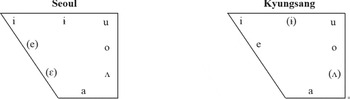
The Seoul and Kyungsang dialects of Korean are known to have a different number of vowels. Figure 1 presents the vowel inventories of Seoul and Kyungsang Korean; the vowel in parentheses has been reported as a merged vowel (/e–ɛ/, /ɨ–ʌ/).
Vowels in Seoul (left) and Kyungsang (right) Korean (adapted from Sohn Reference Sohn1999).

For Seoul Korean, previous studies generally reported seven to eight monophthongs (e.g. Hong Reference Hong1991, Yang Reference Yang1996, Sohn Reference Sohn1999, Lee & Ramsey Reference Lee and Ramsey2000, Kuak Reference Kuak2003, Lee & Ramsey Reference Lee and Ramsey2011), although some classic studies reported up to ten monophthongs, including two front rounded vowels /y/ and /ø/ (e.g. Martin Reference Martin1951, Kim Reference Kim1968). The inconsistent number of vowels between seven and eight in contemporary Seoul Korean is because of the ongoing merger of the two mid front vowels /e/ and /ɛ/. Lee & Ramsey (Reference Lee and Ramsey2011) mention that younger Seoul speakers distinguish words such as /ke/ ‘crab’ and /kɛ/ ‘dog’ only by context, but not by the phonemes. More than 20 years ago, Hong (Reference Hong1991) compared the acoustic realization of the /e/ and /ɛ/ vowels produced by a younger (24 years old) and an older (76 years old) Seoul speaker and showed that while the older speaker distinguished the mid front vowels, the younger speaker did not; the low-mid vowel /ɛ/ was raised to the high-mid /e/ vowel space for the younger speaker. Accordingly, Hong (Reference Hong1991) argued that the merger between /e/ and /ɛ/ is in progress in contemporary Seoul Korean. Therefore, given Hong's empirical observation of /e/ and /ɛ/ from more than 20 years ago, contemporary Seoul Korean may have a varying number of vowels (seven or eight) across generations.
Previous studies (e.g. Kim Reference Kim1986, Chung Reference Chung1991, Sohn Reference Sohn1999, Kang Reference Kang2001, Cho Reference Cho2002, Kuak Reference Kuak2003) mostly agreed that Kyungsang Korean has six vowels. The smaller number of vowels in Kyungsang Korean compared to Seoul is because Kyungsang has undergone many simplifications in the course of its evolution (Sohn Reference Sohn1999: 17). The dialectal difference derives from the lack of a distinction between the high central and mid back vowels (/ɨ/ and /ʌ/) in Kyungsang Korean compared to Seoul, and from the timing difference in the merger of the two mid front vowels (/e/ and /ɛ/) between the two dialects.
Regarding the neutralization between /ɨ/ and /ʌ/, there are two issues; one is that there is some disagreement across studies, and the other is that previous works mostly focused on North Kyungsang Korean (near Daegu city). Specifically, Chung (Reference Chung1991) mentioned that /ʌ/ was slightly higher in Kyungsang Korean than in the Seoul dialect, having a quality in between /ɨ/ and /ʌ/. On the other hand, on the basis of their empirical data, Kim (Reference Kim1986) and Kang (Reference Kang2001) proposed that /ɨ/ was lower in Kyungsang Korean than Seoul, and had the quality of /ʌ/ rather than /ɨ/. Notably, the proposals in Kim (Reference Kim1986), Chung (Reference Chung1991) and Kang (Reference Kang2001) were based on North Kyungsang Korean. In his theoretical study, Kuak (Reference Kuak2003) merely mentioned that speakers in the southern part of the Kyungsang region have six vowels without specifying the quality of the merged phoneme. That is, it is not clear if the merged phoneme in South Kyungsang Korean is close to /ʌ/ as in North Kyungsang Korean, or exactly what acoustic properties the six vowels have in the vowel system of South Kyungsang Korean.
For the two mid front vowels, previous studies (Chung Reference Chung1991, Kuak Reference Kuak2003, Lee & Ramsey Reference Lee and Ramsey2011) stated that the vowels merged long ago, and /ɛ/ does not exist in Kyungsang Korean. In other words, Seoul Korean has preserved the four-way height distinction of /i–e–ɛ–a/ until relatively recently, whereas Kyungsang Korean has had the three-way distinction of /i–e–a/ for a long time. Kuak (Reference Kuak2003) states that the merger started earlier in Kyungsang Korean than Seoul to decrease articulatory effort by reducing mouth opening. According to the hypothesis in Kuak (Reference Kuak2003), as the mouth opening became smaller, the four-way height distinction (i–e–ɛ–a) changed into a three-way distinction (i–e/ɛ–a) in Kyungsang Korean; the /e/–/ɛ/ merger later motivated the /ɨ/–/ʌ/ merger in Kyungsang Korean to make the vowel system symmetric, resulting in a 2–2–2 vowel system (i.e. two front, two central, and two back vowels). In fact, based on the observation on Cheju vowels (spoken on Cheju Island in the southwest part of Korea), Cho et al. (Reference Cho, Jun, Jung and Ladefoged2000) provided phonetic evidence of the diachronic development towards a symmetric vowel system. Cho et al. (Reference Cho, Jun, Jung and Ladefoged2000) indicated that in Cheju Korean the /e/–/ɛ/ merger happened earlier, and this later facilitated the /o/–/ʌ/ merger to make the vowel system symmetric (Cho et al. Reference Cho, Jun, Jung and Ladefoged2000: 10). Notably, Cho et al. (Reference Cho, Jun, Jung and Ladefoged2000) compared their acoustic data with Kim (Reference Kim1980) whose data were collected in 1969, representing older Cheju generations, and relating the /e/–/ɛ/ and /o/–/ʌ/ mergers to the overall height (F1) dimension or mouth opening. /a/ was positioned much higher in the Cho et al. (Reference Cho, Jun, Jung and Ladefoged2000) data compared to Kim (Reference Kim1980), and the F1 ranges from high to low vowels were also much smaller in Cho et al. (Reference Cho, Jun, Jung and Ladefoged2000) than in Kim (Reference Kim1980). This suggests that older Cheju speakers (Kim Reference Kim1980) who preserved /e/–/ɛ/ and /o/–/ʌ/ contrasts might open their mouth wider compared to younger speakers who lost the contrasts (Cho et al. Reference Cho, Jun, Jung and Ladefoged2000), and therefore the smaller F1 space is related to the loss of the height contrasts. Overall, the hypothesis in Kuak (Reference Kuak2003) and the empirical observation in Cho et al. (Reference Cho, Jun, Jung and Ladefoged2000) might suggest that a change in a vowel system affects not only the vowel itself, but also the relationships among the entire vowel system.
The purpose of the present acoustic study of vowels was twofold. First, we revisited the vowel systems of Kyungsang and Seoul Korean spoken by younger generations, and compared them to those spoken by older generations. We focused on the vowel pairs for which dialectal variation has been reported, namely /ɨ/–/ᴧ/ and /e/–/ԑ/, for the production data collected from 20 Seoul and 18 Kyungsang female speakers across two generations. Second, we determined the direction of vowel changes observed for younger Kyungsang and Seoul speakers by comparing them to those of the older speakers; based on this we clarify the quality of the merged phoneme between /ɨ/ and /ʌ/ in South Kyungsang Korean and describe the potential influence of the vowel changes on each vowel system. Importantly, the current study provided the participants with speech materials written in Korean orthography that distinguishes all the monophthongs. In so doing, we intended to maximize participants’ opportunity to increase any potential phonemic differences among the target vowels (Warner et al. Reference Warner, Jongman, Sereno and Kemps2004). In other words, if there is no acoustic difference between the expected merged vowels despite their differences in orthography, the acoustic results might truly be indicative of the lack of phonological distinction for the merged vowels.
We first tested whether the lack of the /ɨ/–/ᴧ/ distinction is consistently maintained between older and younger Kyungsang speakers who have been in different linguistic environments in terms of the influence of Seoul Korean; assuming that the two vowels are influenced by Seoul Korean, which clearly distinguishes /ɨ/ from /ᴧ/, we would expect generational differences in Kyungsang speakers’ /ɨ/–/ᴧ/, specifically the split of /ɨ/–/ᴧ/ for younger Kyungsang speakers. If the split occurs among younger Kyungsang speakers, the subsequent question to be tested would be the direction of the split, which is related to determining the quality of the neutralized phoneme between /ɨ/ and /ʌ/ in South Kyungsang Korean. Accordingly, we compared the vowel(s) produced by younger Kyungsang speakers to the merged /ɨ/–/ᴧ/ phoneme among older Kyungsang speakers to determine if and in which direction the merged phoneme becomes distinct.
For /e/–/ԑ/, we first examined how the two vowels are acoustically realized between Kyungsang and Seoul Korean across older and younger generations. After confirming the previous reports regarding the /e/–/ԑ/ merger, we determined the acoustic properties of the merged phoneme for each dialect and age group, and then on the basis of those properties we established the direction of the merger and thus observed if and how the vowel change occurs in relation to the vowel system in each dialect. Finally, if the timing difference of the /e/–/ԑ/ merger between the two dialects is reflected in each vowel system as seen in Cho et al. (Reference Cho, Jun, Jung and Ladefoged2000), we expected dialectal and age variations in the F1 dimension, predicting that the F1 range from the high to low vowels would be large to small in the order of older Seoul, younger Seoul, and older and younger Kyungsang speakers. This prediction was made on the assumption that (i) older Seoul speakers might need the largest F1 space due to their preservation of the four-way height distinction, (ii) for younger Seoul speakers, the large F1 space could possibly remain as a remnant of the four-way height contrast despite the recent reduction in the height distinction, and (iii) for Kyungsang speakers who did not have the four-way distinction for a long time the F1 space might have become smaller.
1.2 Fricatives
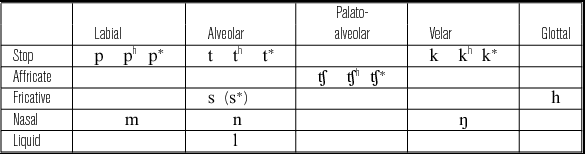
The consonant inventory of Kyungsang Korean consists of 18 segments (e.g. Chung Reference Chung1991, Kim Reference Kim1997, Sohn Reference Sohn1999, Chang Reference Chang2007). The consonants of Kyungsang Korean are not different from Seoul Korean except that the fricatives /s/ and /s*/ are not phonemically distinct in Kyungsang Korean. Table 1 Footnote 2 presents the consonant inventory in Seoul and Kyungsang Korean; /s*/ in parentheses exists in Seoul Korean, but is known to be absent in Kyungsang (Sohn Reference Sohn1999, Lee & Ramsey Reference Lee and Ramsey2011).
Consonants of Kyungsang Korean (adapted from Kim Reference Kim1997).

The two-way fricative distinction in Seoul Korean has been investigated by many researchers by comparing phonetic properties of the fricatives with those of stops and affricates which have a three-way laryngeal distinction in the voiceless region. Researchers have focused on categorizing the two types of fricatives in accordance with the three laryngeal gestures, namely fortis, lenis and aspirated. While the previous studies generally agree that one could be categorized as fortis (/s*/), they disagree on the categorization of the other fricative (/s/) due to its phonologically ambiguous patternsFootnote 3 and conflicting phonetic results. For this reason, the fricative /s/ is referred to as non-fortis (Chang Reference Chang2013), plain (Cho, Jun & Ladefoged Reference Cho, Jun and Ladefoged2002), or lenis-aspirated (Holliday Reference Holliday2012). Henceforth, this study uses the term ‘non-fortis fricative’ for /s/, following Chang (Reference Chang2013).
Although the classification of the non-fortis fricative /s/ in Seoul Korean remains controversial, the phonetic properties of the two fricatives have been well documented (e.g. Yoon Reference Yoon1999, Cho et al. Reference Cho, Jun and Ladefoged2002, Lee Reference Lee2011, Chang Reference Chang2013). The fortis and non-fortis fricatives in Seoul Korean differ in their frication/aspiration duration, centroid frequency, and H1-H2 in the following vowel. In terms of duration, in word-initial position the frication duration without the aspiration portion is shorter for the non-fortis /s/ than for the fortis /s*/ (Yoon Reference Yoon1999, Cho et al. Reference Cho, Jun and Ladefoged2002, Chang Reference Chang2013); the aspiration duration is shorter for the fortis /s*/ than for the non-fortis /s/ (Lee Reference Lee2011, Chang Reference Chang2013). When the frication duration includes the aspiration portion, the two fricatives are not significantly different (Lee Reference Lee2011). The fortis fricative has a higher centroid frequency than the non-fortis fricative (Yoon Reference Yoon1999, Cho et al. Reference Cho, Jun and Ladefoged2002, Lee Reference Lee2011, Chang Reference Chang2013). This indicates that the degree of linguopalatal contact is smaller for /s/ than /s*/ (i.e. the fortis /s*/ has a smaller front cavity than the non-fortis /s/). In terms of voice quality, previous studies agree that H1-H2 at vowel onset is higher following the non-fortis /s/ than the fortis /s*/, indicating that /s/ is associated with a more breathy phonation than /s*/. Finally, regarding fundamental frequency (f0), although Cho et al. (Reference Cho, Jun and Ladefoged2002) reported that f0 at the onset of the following vowel is significantly lower following /s/ than /s*/, this finding has not been replicated by subsequent studies; Lee (Reference Lee2011) and Chang (Reference Chang2013) reported no f0 difference between the two fricatives. Overall, the acoustic characteristics in the literature suggest that the two fricatives in Seoul Korean differ in terms of frication/aspiration duration, centroid frequency, and phonation type, although these characteristics reflect the dual nature between the lenis and aspirated categorization for the non-fortis /s/.
In Kyungsang Korean, the two voiceless alveolar fricatives have been traditionally classified as non-distinct phonemes (Sohn Reference Sohn1999, Lee & Ramsey Reference Lee and Ramsey2011), and it is generally believed that the fortis /s*/ is neutralized to the non-fortis /s/ (Holliday Reference Holliday2012). That is, while the /s*/–/s/ contrast does not exist in contemporary Kyungsang Korean, it is unclear whether the contrast disappeared through a historical development or never existed at all. Several phonetic studies have investigated the non-distinct fricatives in Kyungsang Korean (Kenstowicz & Park Reference Kenstowicz and Park2006, Holliday Reference Holliday2012). In contrast with the traditional view (Sohn Reference Sohn1999, Lee & Ramsey Reference Lee and Ramsey2011), Kenstowicz & Park (Reference Kenstowicz and Park2006) and Holliday (Reference Holliday2012) reported different acoustic characteristics between the fortis /s*/ and the non-fortis /s/ in Kyungsang Korean. Kenstowicz & Park (Reference Kenstowicz and Park2006) examined fricatives produced by seven Kyungsang speakers (three from South Kyungsang; four from North Kyungsang) in their 20s−40s and found that while Kyungsang speakers do not show reliable differences in f0 between the two fricatives, H1-H2 is higher for the non-fortis /s/ than the fortis /s*/. Given this acoustic difference in H1-H2, Kenstowicz & Park (Reference Kenstowicz and Park2006) argued that the two-way phonemic contrast is also expressed by Kyungsang speakers as well as Seoul speakers. Similar findings and conclusions were reported by Holliday (Reference Holliday2012) who examined the acoustic properties of the two fricatives produced by twelve Seoul and thirteen North Kyungsang speakers in their 20s and 30s. Holliday (Reference Holliday2012) tested if the two fricatives are indeed neutralized in Kyungsang Korean by measuring frication/aspiration duration, centroid frequency of the frication noise, and f0 and H1-H2 at the onset of the following vowels after the fricatives. Holliday (Reference Holliday2012) reported no inter-dialectal differences for the acoustic parameters as a function of fricative distinction, although the aspiration duration was generally shorter for the two fricatives in Kyungsang than those in Seoul; the two fricatives produced by younger North Kyungsang speakers are well distinguished from each other in their frication duration (/s*/ > /s/), aspiration duration (/s*/ < /s/), centroid frequency (/s*/ > /s/) and H1-H2 (/s*/ < /s/) in a similar way as in Seoul Korean. Therefore, Holliday (Reference Holliday2012) argued against the traditional view that Kyungsang's fortis /s*/ is neutralized to non-fortis /s/, concluding that the two fricatives in North Kyungsang Korean are not neutralized, at least not for younger speakers. For the inconsistency between the traditional view and his empirical findings, Holliday (Reference Holliday2012) suggested that other factors such as geographical and generational variation should be considered.
The discrepancy between the traditional view (Sohn Reference Sohn1999, Lee & Ramsey Reference Lee and Ramsey2011) and instrumental reports (Kenstowicz & Park Reference Kenstowicz and Park2006, Holliday Reference Holliday2012) prompts the question whether the inconsistency across studies is related to generational differences in the fricatives of Kyungsang Korean. That is, while the findings in Kenstowicz & Park (Reference Kenstowicz and Park2006) and Holliday (Reference Holliday2012) indicate the presence of a two-way fricative contrast for younger Kyungsang speakers, the reports in Sohn (Reference Sohn1999) and Lee & Ramsey (Reference Lee and Ramsey2011) might reflect the absence of the contrast for older Kyungsang speakers. As mentioned earlier, the previous acoustic studies (Kenstowicz & Park Reference Kenstowicz and Park2006, Holliday Reference Holliday2012) did not consider age as a factor, and, accordingly, the studies were not in a position to directly address the issue of generational variation.
The main purpose of the present acoustic study of fricatives is to examine whether or not the phonetic distinction between the fortis and non-fortis fricatives is consistently expressed by older and younger Kyungsang speakers, and to clarify the discrepancy between the traditional view and recent experimental findings. If the discrepancy is related to generational differences in the Kyungsang speakers’ fricatives, one could predict no or less of an acoustic distinction between the two fricatives for the older Kyungsang speakers compared to the younger speakers who have experienced greater influence of Seoul Korean with its two-way fricative distinction. The dialectal and generational comparisons in the acoustic study of fricatives have been made on the basis of data collected from the same 38 Seoul and Kyungsang speakers in the vowel study. The present study measured five acoustic properties that previous studies (Yoon Reference Yoon1999, Lee Reference Lee2011, Cho et al. Reference Cho, Jun and Ladefoged2002, Chang Reference Chang2013) considered as acoustic cues in distinguishing the fricatives in Seoul Korean, namely frication/aspiration duration, center of gravity (COG), the amplitude difference between the first and the second harmonic (H1-H2), and fundamental frequency (f0). We hypothesized that any of these five measures would pattern differently across dialect and age groups, if the fricatives of older Kyungsang speakers have different phonetic properties than those of the younger generation.
2 Acoustic study 1: Vowels
2.1 Methodology
2.1.1 Participants
Thirty-eight female Korean speakers participated (18 Kyungsang speakers; 20 Seoul speakers). To avoid potential variation due to gender differences, only female speakers were recorded. For the Kyungsang group, subjects born and educated in the South Kyungsang region (mostly Pusan city) were recruited; for the Seoul group, we recruited subjects born and educated in the Seoul/Kyenggi region where standard Korean is spoken. For the Kyungsang group, the 10 younger speakers ranged from 20 to 23 years of age (mean = 21 years old; s.d. = 1.2), and the eight older speakers ranged from 59 to 75 years (mean = 66.3 years; s.d. = 5.3); for the Seoul group, the 10 younger speakers ranged from 18 to 26 years of age (mean = 20.7 years old; s.d. = 2.6), and the 10 older speakers ranged from 61 to 71 years (mean = 65.8 years; s.d. = 3.8). Parents of the participants were also speakers of the target dialects. The participants had not lived in other dialect regions for more than one year. Demographic information (e.g. year of birth, education level, occupation, income) about the thirty-eight participants is presented in the appendix. Highest level of schooling was indicated. For the income level, annual income per household is considered; most of the younger participants were college students, and did not have any income. None of the speakers of either dialect reported any speech or hearing disorders, and all of the speakers were literate in Korean.
2.1.2 Procedure
Speakers produced two repetitions of each test stimulus in isolation. Each stimulus was written in Korean orthography and provided on an index card in a randomized order. Since the first author of the current study is a native speaker of Seoul Korean, a 30-year-old female Kyungsang language consultant assisted in the Kyungsang recording session to prevent any phonetic accommodation between the two dialects of Korean. Subjects were instructed to read each word as naturally as possible at a normal speaking rate, and practiced before the actual recording. Subjects were recorded in various quiet locations, such as the subject's campus, home, or village community center using a Marantz Digital Recorder (PMD 671) and a Shure head-mounted microphone. The stimuli were recorded at a sampling rate of 22050 Hz and analyzed using the software package Praat (Boersma & Weenink Reference Boersma and Weenink2010).
2.1.3 Speech materials
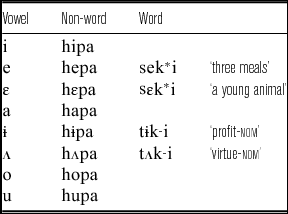
For the acoustic study of vowels, the eight Korean monophthongs of standard Korean were recorded, as listed in Table 2.Footnote 4 Each vowel occurred in a non-word context of /h(V)pa/ (V = vowel) where the preceding and following consonants are expected to have least coarticulatory effect (Hillenbrand, Clark & Nearey Reference Hillenbrand, Clark and Nearey2001). We also recorded two minimal word pairs containing the vowel pairs /ɨ/–/ᴧ/ and /e/–/ԑ/, for which dialectal variation has been reported. This allowed us to examine if the reported dialectal difference is consistent across non-word and word contexts, and if the change in vowels occurs consistently in both contexts. Although the minimal pairs could be homophones for some speaker groups due to the ongoing merger and the lack of contrast, they are distinct in Korean orthography. As stated earlier, examining the recorded data as transcribed in the orthographic form enabled us to test which phonemes are orthographically distinct but phonetically identical. In addition to the vowels of interest, /i/, /a/, /o/, and /u/ in the non-word context were recorded for the purpose of drawing vowel spaces. In total, 912 tokens were obtained for the acoustic study of vowels (12 stimuli × 2 repetitions × 38 speakers).
Stimuli recorded for the acoustic study of vowels.

2.1.4 Measurements
The first and second formant frequencies (F1, F2) of the first vowel in CVCV were measured for each token. Formant frequencies were extracted at the midpoint of the target vowel using LPC analysis with a 25 ms window. Vowel onset was determined as the onset of the first formant and vowel offset as the offset of the second formant in the spectrogram. The automatically extracted formant values were inspected to manually correct any errors. Errors were determined by referring to Yang's (Reference Yang1996) report of F1-F3 of the Seoul Korean vowels produced by ten females. If the measured F1 and F2 in the present study substantially deviated from those reported by Yang (Reference Yang1996), the formants were re-measured by hand, using LPC spectra. In addition, if the formants were not stable at the midpoint of the vowel as indicated on a spectrogram, F1 and F2 were measured in the steady-state portion closest to the vowel midpoint. A total of 22 stimuli (2.4%) were re-measured by hand.
2.1.5 Data analysis
Measurements were averaged across the two repetitions for each speaker. The data were evaluated with repeated measures Analyses of Variance (ANOVAs) testing each of the /ɨ/–/ʌ/ and /e/–/ɛ/ pairs. The ezANOVA() function of the ez package (Lawrence Reference Lawrence2013; version 4.2-2) in R (R Development Core Team 2011) was used. Four-way ANOVAs included Vowel (/ɨ/ vs. /ʌ/, /e/ vs. /ɛ/) and Context (Non-word vs. Word) as a within-subjects factor, and Dialect (Kyungsang, Seoul) and Age (Older, Younger) as between-subjects factors. Repeated measures ANOVAs were conducted for each dependent variable separately for the two vowel pairs. In reporting the statistical results, p-values less than .05 were considered significant. When there were significant interactions among the factors, pairwise t-tests further evaluated the effect of Vowel for each of the dialect and age groups.
2.2 Results
2.2.1 /ʌ/ and /ɨ/
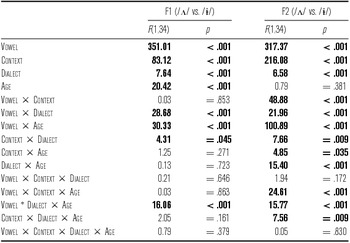
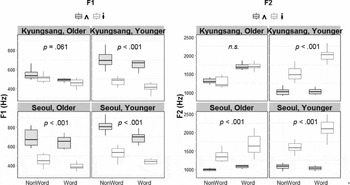
The results of repeated measures ANOVAs (Vowel × Context × Dialect × Age) on F1 and F2 for the comparison of /ʌ/ and /ɨ/ are presented in Table 3. Figure 2 displays the distribution of the measured F1 and F2 frequencies of /ʌ/ and /ɨ/ between Non-word and Word contexts for each dialect and age group. The boxplots in Figure 2 show the first and third quartiles with whiskers including ±1.5 times of the first and third quartiles, and the horizontal line in each box represents the median value.
Results of repeated-measures ANOVAs for F1 and F2 in the comparison of /ʌ/ vs. /ɨ/.

Distribution of F1 (left panel) and F2 (right panel) of /ʌ/ and /ɨ/ in Non-word and Word between older and younger speakers in Kyungsang and Seoul Korean. The p-values from pairwise t-tests testing the difference of the formant frequencies between /ʌ/ and /ɨ/ are presented for each group averaged across contexts.

With respect to F1, significant main effects were found for Vowel, Context, Dialect and Age; F1 is higher for /ʌ/ than /ɨ/, higher for Non-word (/h(V)pa/) than Word (/t(V)ki/), higher for Seoul than Kyungsang speakers, and higher for Younger than Older speakers. In Table 3, the significant two-way interaction effects indicate that the effect of Vowel differs by Dialect and Age, and the effect of Context differs by Dialect. The average F1 difference between /ʌ/ and /ɨ/ is greater for Seoul than Kyungsang speakers (F1 diff.: Seoul – 252 Hz; Kyungsang – 151 Hz), and greater for younger than older speakers (F1 diff.: younger – 254 Hz; older – 149 Hz), and that between Non-word and Word is greater for Seoul than Kyungsang speakers (F1 diff.: Seoul – 87 Hz; Kyungsang – 55 Hz). In addition, the three-way interaction of Vowel × Age × Dialect indicates that the age variation in F1 as a function of the /ʌ/–/ɨ/ distinction also differs between the two dialect groups; averaged across Context, while the average F1 difference between /ʌ/ and /ɨ/ was only 40 Hz for older Kyungsang speakers (p = .061), it ranged from 236 Hz to 267 Hz for the other three groups (p < .001 for the three groups). Overall, the results suggest that the dialectal and generational differences are due to the older Kyungsang speakers whose F1 difference in distinguishing /ʌ/ from /ɨ/ was smaller than that of the older and younger Seoul and younger Kyungsang speakers. Finally, any interaction effects involving Context did not reach significance except for Context × Dialect. This suggests that although Seoul speakers have greater F1 in Non-word than Word compared to Kyungsang speakers, the observed dialectal and generational variations in F1 for the /ʌ/ and /ɨ/ distinction pattern comparably between Non-word and Word.
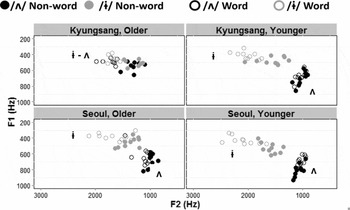
For F2, significant main effects were found for Vowel, Context, and Dialect; F2 is higher for /ɨ/ than /ʌ/, higher for Word than Non-word, and higher for Seoul than Kyungsang speakers. In Table 3, all possible two-way interactions were significant. The average F2 difference between /ʌ/ and /ɨ/ is greater for Word than Non-word (F2 diff.: Non-word – 366 Hz; Word – 676 Hz), greater for Seoul than Kyungsang speakers (F2 diff.: Seoul – 624 Hz; Kyungsang – 407 Hz), and greater for younger than older speakers (F2 diff.: Younger – 773 Hz; Older – 242 Hz); that between Non-word and Word is greater for Kyungsang than Seoul speakers (F2 diff.: Seoul – 224 Hz; Kyungsang – 318 Hz), and greater for Older than Younger speakers (F2 diff.: younger – 235 Hz; older – 306 Hz). The reported higher-order three-way interactions may provide a specific explanation for the two-way interaction effects. First, the interaction of Vowel × Age × Dialect indicates that the age difference in F2 for the two vowel distinctions also differs between the two dialect groups; averaged across Context, while the average F2 difference between /ʌ/ and /ɨ/ was only 25 Hz for older Kyungsang speakers (p = .58), it was 456 Hz, 793 Hz and 753 Hz for older and younger Seoul and younger Kyungsang speakers, respectively (p < .001 for the three groups). This suggests that the dialectal and generational differences are due to the older Kyungsang speakers who do not use F2 for the /ʌ/ and /ɨ/ distinction as much as the other three groups do. Second, the interaction of Vowel × Context × Age indicates that the F2 difference between the two vowels differs by Context and Age; averaged across Dialect, the F2 difference between /ʌ/ and /ɨ/ was greatest in Word by younger speakers (1025 Hz, p < .001), followed by Non-word by younger speakers (520 Hz, p < .001), Word by Older speakers (289 Hz, p = .004), and Non-word by Older speakers (195 Hz, p = .002). This suggests that the two vowels are more distinct in F2 (backness) when they are produced by younger than by older speakers and produced in Word than in Non-word, as illustrated in Figure 3, which shows individual F1-F2 data. Finally, for Context × Dialect × Age, averaged across Vowel, the F2 difference between Non-word and Word was greatest for older Kyungsang (422 Hz), intermediate for younger Seoul and Kyungsang (235 Hz for both groups), and lowest for older Seoul speakers (214 Hz). Given the absence of the four-way interaction including Vowel, however, the dialectal and age differences for F2 as a function of the /ʌ/–/ɨ/ distinction do not differ between the two contextual conditions.
Formant plots of /ʌ/ and /ɨ/ for older and younger speakers between Seoul and Kyungsang Korean in Non-word and Word.

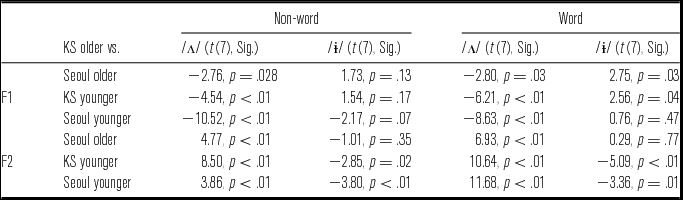
The present results indicated that younger Kyungsang speakers make a clear phonemic distinction between /ʌ/ and /ɨ/, whereas older Kyungsang speakers do not. This suggests that the two vowels which are merged or less distinct among older speakers become split for younger generations. A further question arises as to what the quality of the less distinct phoneme for older Kyungsang speakers is, and consequently what the direction of the split for the younger speakers is. Visual inspection of Figure 3 might address the issue. In Figure 3, it is noted that the older Kyungsang speakers’ non-distinct or less distinct phoneme is more closely located in the position of /ɨ/, rather than /ʌ/. To test statistical significance, a series of paired t-tests compared F1 and F2 for each /ɨ/ and /ʌ/ of older Kyungsang speakers to those of the other three groups (Table 4). For example, we compared F1 and F2 of /ɨ/ between older Kyungsang and older Seoul speakers; if the difference is not significant, the quality of /ɨ/ is considered comparable between the two groups.
Summary of paired-samples t-tests testing F1/F2 difference for each /ʌ/ and /ɨ/ between older Kyungsang and another group in Non-word and Word.

In Table 4, /ʌ/ produced by older Kyungsang speakers is significantly different from /ʌ/ produced by the other three groups in all comparisons; older Kyungsang speakers’ /ʌ/ is located in a higher and more fronted space than the other groups’ /ʌ/, which is true in both Non-word and Word contexts. In contrast, Table 4 shows that older Kyungsang speakers’ /ɨ/ is not different from /ɨ/ of the others for half of the comparisons. Therefore, we may conclude that older Kyungsang speakers’ /ʌ/ is close to the space of /ɨ/, and therefore younger Kyungsang speakers’ clear phonemic distinction between /ɨ/ and /ʌ/ might result from the split of /ʌ/ from /ɨ/.
2.2.2 /ɛ/ and /e/
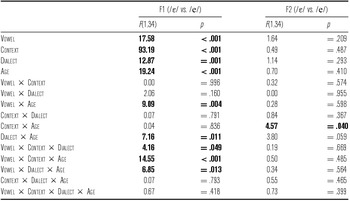
The results of repeated measures ANOVAs (Vowel × Context × Dialect × Age) on F1 and F2 for the comparison of /ɛ/ and /e/ are presented in Table 5. Figure 4 displays the distribution of the measured F1 and F2 frequencies of /ɛ/ and /e/ between Non-word and Word contexts for each dialect and age group.
Results of repeated-measures ANOVAs for F1 and F2 in the comparison of /e/ vs. /ɛ/. Bold indicates p < .05.

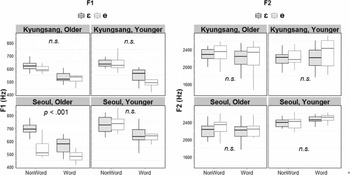
Distribution of F1 (left panel) and F2 (right panel) of /ɛ/ and /e/ in Non-word and Word between older and younger speakers in Kyungsang and Seoul Korean. The p-values from pairwise t-tests testing the difference of the formant frequencies between /ɛ/ and /e/ are presented for each group averaged across contexts.

For F1, significant main effects were found for Vowel, Context, Dialect and Age; F1 is higher for /ɛ/ than /e/, higher for Non-word than Word, and higher for Seoul than Kyungsang speakers, and higher for Younger than Older speakers. In Table 5, significant two-way interactions were found for Vowel × Age and Dialect × Age. The average F1 difference between /ɛ/ and /e/ is greater for Older than Younger speakers (F1 diff.: younger – 11 Hz; older – 69 Hz); that between the two age groups is greater for Seoul than Kyungsang speakers (F1 diff.: Seoul – 123 Hz; Kyungsang – 18 Hz). Importantly, the reported three three-way interactions in Table 5 indicate that the two-way interactions are also modulated by another factor. First, the interaction of Vowel × Age × Dialect indicates that the greater F1 difference between the two vowels for older speakers differs between the two dialect groups; averaged across Context, while the average F1 difference between /ɛ/ and /e/ ranged from 0 Hz to 21 Hz for younger Seoul and older and younger Kyungsang speakers (p >.05 for the three groups), it was 107 Hz for older Seoul speakers (p < .001). That is, while F1 significantly distinguishes /ɛ/ from /e/ for older Seoul speakers, it does not for the other three groups. Second, for Vowel × Context × Dialect, the non-parallel pattern across the three factors stems from the fact that Seoul speakers’ /ɛ/ and /e/ production in Non-word does not pattern comparably to the other conditions. Specifically, averaged across Age, the F1 difference between the two vowels was 65 Hz for Non-word produced by Seoul speakers (p = .045), whereas that for the other three conditions ranged from 7 Hz to 42 Hz (p > .05 for the three conditions). Finally, for Vowel × Context × Age, averaged across Dialect the F1 difference between the two vowels was greatest in Non-word by Older speakers (92 Hz, p < .001), followed by Word by Older speakers (45 Hz, p = .03), Word by Younger speakers (34 Hz, p = .29), and Non-word by Younger speakers (12 Hz, p = .61). Overall, the three-way interaction effects suggest that the two vowels are more distinct in F1 (height) when they are produced by Seoul than by Kyungsang speakers, older than younger speakers, and in Non-word than in Word.
For F2 in the comparison of /ɛ/ and /e/, none of the main and interaction effects were significant except for Context × Age. The average F2 value was highest for younger Seoul (2426 Hz), intermediate for older and younger Kyungsang (2221 Hz for both groups), and lowest for older Seoul speakers (2201 Hz). The F2 value for the younger Seoul speakers was significantly greater than for the other three groups (p < .05 for all comparisons).
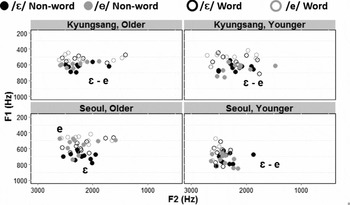
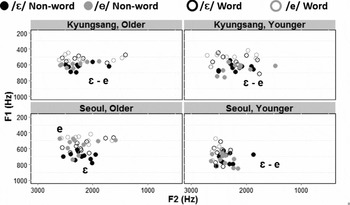
The results for the /e/–/ɛ/ pair showed that only older Seoul speakers distinguish the two mid front vowels in height (F1), as illustrated in Figure 5, where most of the older Seoul speakers have a systematic F1 difference between /e/ and /ɛ/. Notably, although the /e/–/ɛ/ merger is commonly observed for younger Seoul and older and younger Kyungsang groups, there is a dialectal difference in the F1 dimension. In Figure 5, while the merged vowel of younger Seoul Korean speakers is spaced similarly to the /ɛ/ of the older Seoul Korean speakers, its allocation is higher for both the older and the younger Kyungsang speakers compared to the merged vowel of the younger Seoul Korean speakers, that is, in the space of /e/. To statistically assess the quality of the merged vowel for younger Seoul and older and younger Kyungsang speakers, a series of paired-samples t-tests compared F1 for each /e/ and /ɛ/ of older Seoul speakers to those of the other three groups (Table 6).
Formant plots of /ɛ/ and /e/ for older and younger speakers between Seoul and Kyungsang Korean in Non-word and Word.
Summary of paired-samples t-tests testing F1 difference for each /e/ and /ɛ/ between older Seoul and another group in Non-word and Word. The degrees of freedom is 7 for the comparison with KS older, while it is 9 for the other two.

In Table 6, while F1 of /e/ produced by older Seoul speakers is significantly different from that by younger Seoul speakers in both Non-word and Word, it is not different from /e/ by the two generations of Kyungsang speakers for most cases. For /ɛ/, on the other hand, F1 of younger Seoul speakers patterns comparably to the older Seoul speakers in the two contexts; F1 of /ɛ/ by both older and younger Kyungsang speakers is different from that by the older Seoul speakers, limited to Non-word. This suggests that while the merger between /e/ and /ɛ/ happens in both Seoul and Kyungsang dialects, the acoustic realization of the merged phoneme is different between the two dialects. For younger Seoul speakers, the merger occurs through lowering of /e/ to /ɛ/, whereas the mid front vowel that merged long ago for Kyungsang speakers is more close to /e/ than /ɛ/.
2.3 Summary of results
Focusing on the vowel pairs /ɨ/–/ʌ/ and /e/–/ɛ/, the present acoustic study of vowels revisited the phonetic properties of the vowels in Seoul and Kyungsang Korean, and tested the phonetic homogeneity of the vowels across generations in the two dialects. Significant main findings are summarized below.
-
a. In Seoul Korean, /ɨ/ and /ʌ/ are distinguished in height (F1) and backness (F2) for both older and younger speakers: /ʌ/ is a lower vowel than /ɨ/, and /ɨ/ is more fronted than /ʌ/.
-
b. In Kyungsang Korean, while /ɨ/ and /ʌ/ are non-distinct or less distinct in height (F1) and backness (F2) for older speakers, the two vowels are well distinguished in both acoustic dimensions for younger speakers, suggesting that /ɨ/ and /ʌ/ are merged for the older generation but split for the younger generation.
-
c. The older Kyungsang speakers’ merged phoneme is close to /ɨ/, suggesting that /ʌ/ is split from /ɨ/ for younger speakers.
-
d. Among the four dialect and age groups, only older Seoul speakers distinguish /e/ from /ɛ/ in height (F1), but not in backness (F2): /ɛ/ is a lower vowel than /e/.
-
e. The results for /e/ and /ɛ/ correspond to the notion that /e/ and /ɛ/ had been merged long ago in Kyungsang Korean, while the merger is in progress in Seoul, indicating the dialectal difference in the time-course of the merger.
-
f. The F1 realization of the merged /e/–/ɛ/ is different between Seoul and Kyungsang Korean: while the merged /e/–/ɛ/ for younger Seoul speakers is spaced similarly to /ɛ/, it is close to /e/ for older and younger Kyungsang speakers.
2.4 Discussion
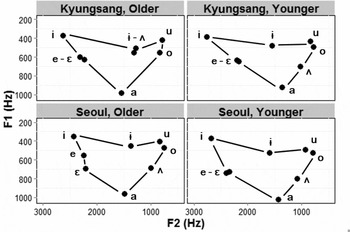
Examination of the vowels of Seoul and Kyungsang Korean between younger and older generations indicated clear generational and dialectal differences in /ɨ/–/ʌ/ and /e/–/ɛ/, suggesting sound change in the vowel systems of Kyungsang Korean as well as Seoul. Further observations regarding the change also provided acoustic evidence regarding the direction of the vowel split (/ɨ/ and /ʌ/) and merger (/e/ and /ɛ/). Figure 6 illustrates the vowel space across generations and dialects (mean F1/F2 values were extracted from the present non-word data).
Vowel space of Kyungsang (top) and Seoul (bottom) Korean for older (left) and younger (right) speakers. Because F1 and F2 of /e/ and /ɛ/ were not distinct, the dots indicating the mean F1/F2 of the two vowels sometimes overlap each other.

In Seoul Korean, while older speakers have eight vowels, younger speakers have seven vowels. The reduced number of vowels for younger speakers is due to the merger between the two mid front vowels, /e/–/ɛ/. In Kyungsang Korean, while older speakers have six vowels, younger speakers have seven vowels; the smaller number of vowels for older speakers is because of the absence of an acoustic distinction between /ɨ/ and /ʌ/ compared to younger Kyungsang and Seoul groups. Therefore, the current study argues that both Seoul and Kyungsang Korean spoken by younger generations have a vowel system with seven vowels, which result from the split of /ɨ/–/ʌ/ in Kyungsang, and the merger of /e/–/ɛ/ in Seoul Korean. Importantly, since the present findings are based on stimuli in which these vowels were orthographically distinct, we may interpret the observed dialect and generational differences as phonological properties of the vowel system.
Our finding regarding the split of /ʌ/ from /ɨ/ clarified that the merged /ɨ/–/ʌ/ phoneme in South Kyungsang Korean has a quality close to /ɨ/ rather than /ʌ/; this is contrary to Kim (Reference Kim1986) and Kang (Reference Kang2001), who studied vowels in North Kyungsang Korean and reported the merged phoneme as close to /ʌ/. The finding sheds light on the acoustic realization of the merged phoneme in South Kyungsang Korean, possibly suggesting geographical differences in the acoustic realization of vowels. As for what causes the split between /ʌ/ and /ɨ/, it seems unlikely that the split occurs as a result of an internal phonetic motivation. Cho (Reference Cho2002) and Kuak (Reference Kuak2003) also stated that the seven vowels for younger Kyungsang speakers may result from social factors such as education and mass media influences, pointing to the influence of standard Seoul Korea. Notably, the fact that the socially motivated vowel split occurs only for /ʌ/ and /ɨ/, but not for /e/ and /ɛ/ would suggest that younger Kyungsang speakers follow the vowel production of younger Seoul speakers rather than older Seoul speakers.
We also indicated that the merger results from the lowering of /e/ to /ɛ/, which is in contrast to previous studies (Hong Reference Hong1991; Kang Reference Kang1996, Reference Kang2001; Lee & Ramsey Reference Lee and Ramsey2000), which argue for a raising of /ɛ/ to /e/. To resolve these conflicting analyses, we suggest that the argument in the previous studies needs to be reconsidered. First, the argument of raising /ɛ/ to /e/ was not based on acoustic evidence or quantitative analyses, but instead most of the previous studies described the merger on the basis of authors’ impressions. Although Hong (Reference Hong1991) provided acoustic data, the data were collected only from four Seoul speakers aged 24, 39, 51 and 76 years, and based only on numerical comparison of formant frequencies without statistics. With such a small set of subjects, idiosyncrasies of each speaker may always be a problematic issue. Second, our argument of lowering /e/ to /ɛ/ in Seoul Korean might be in line with Lindblom (Reference Lindblom, Ohala and Jaeger1986), hypothesizing the diachronic development in a vowel system driven to achieve sufficient perceptual contrast. In other words, assuming that the diachronic development for vowels might occur in an effort to enhance the contrast among vowels, the merger between the two mid front vowels is more likely to occur in a direction to increase the contrast. In Figure 6, by lowering /e/ to /ɛ/ positioned in the middle between /i/ and /a/, younger Seoul speakers might be able to better enhance the high–mid–low contrast (/i/–/ɛ/–/a/) as well as the front–back contrast (/ɛ/–/ʌ/). This argument might explain the merged /e–ɛ/ vowel in Kyungsang Korean which is located in a higher position than that of younger Seoul speakers and accordingly close to /e/ rather than /ɛ/. That is, Kyungsang Korean that had not had /ʌ/ would be more likely to raise /ɛ/ to /e/ to enhance the front–back contrast (/e/–/o/). To sum up, for the merger between /e/ and /ɛ/ in Seoul Korean, while the previous studies noted ‘raising’, the present study shows ‘lowering’, which may possibly have to do with dispersing the vowels in the vowel space.
Another interesting observation is the possible reflection of the timing difference of the /e/–/ɛ/ merger between Seoul and Kyungsang Korean. Confirming Kuak (Reference Kuak2003) that the /e/–/ɛ/ merger started earlier in Kyungsang Korean than Seoul, we found that the merger is in progress for Seoul, but completed for Kyungsang. This finding led to the subsequent question whether and how the timing difference of the merger is reflected in the vowel space of the two dialects as it was in Cheju vowels in Cho et al. (Reference Cho, Jun, Jung and Ladefoged2000). Given the hypothesis in Kuak (Reference Kuak2003) regarding the relationship between the change in mouth opening and its impact on other vowels within a vowel system, it might be reasonable to expect that the different time-course of the /e/–/ɛ/ merger between the two dialects would be reflected in the height space. Therefore, similar to Cho et al. (Reference Cho, Jun, Jung and Ladefoged2000), where the generational comparison was made regarding the F1 ranges from high to low vowels in Cheju vowels, we compared the vowel height dimension (F1) across the four groups. In the present data, the F1 range from /i/ to /a/ or the F1 difference between /i/ and /a/ is greatest for younger Seoul (367–1022 Hz, F1 diff.: –654 Hz), followed by older Seoul (349–961 Hz, F1 diff.: –611 Hz), older Kyungsang (371–981 Hz, F1 diff.: –610 Hz) and younger Kyungsang speakers (380–919 Hz, F1 diff.: –539 Hz).Footnote 5 Although the older Seoul speakers who were expected to show the largest F1 range according to the preservation of the four-way height distinction do not have a particularly large F1 range compared to younger Seoul or older Kyungsang speakers, the F1 difference is indeed greater for younger Seoul than younger Kyungsang speakers. The larger difference in F1 suggests that younger Seoul speakers have a larger height space than younger Kyungsang speakers. That is, although younger Seoul speakers lost the four-way height contrast and do not need to preserve the large mouth opening, they seem to maintain a height space as large as that of older Seoul speakers. We might speculate that Seoul's more recent loss of the four-way height distinction compared to Kyungsang's is reflected as a larger F1 space. Specifically, the large F1 space preserved by older Seoul speakers for the four-way height contrast is likely to affect the vowel space of younger Seoul speakers, given that the speech of the two generations is used in the present time. Therefore, the larger F1 space for younger Seoul speakers than younger Kyungsang speakers could be additional evidence for the timing difference of the /e/–/ɛ/ merger between Seoul and Kyungsang Korean. Overall, the argument and implications regarding the /e/–/ɛ/ merger (i.e. lowering /e/ to /ɛ/ to enhance the vowel contrasts in Seoul Korean and the possible reflection of the timing difference of the merger) suggest that a merger in a vowel system occurs considering not only the relevant vowel pair, but also the relationship among all other vowels within the system. While further investigation of the relationship between vowel change and the interaction with other vowels in the inventory may be of interest it would detract from the main purpose of this paper.
3 Acoustic study 2: Fricatives
3.1 Methodology
3.1.1 Participants and procedure
The same 38 female speakers in the vowel study also participated in the acoustic study of fricatives. The data collection procedure was the same as in the vowel study.
3.1.2 Speech materials
Two disyllabic words containing word-initial fricatives (non-fortis vs. fortis) were recorded: s al-i ‘flesh-nom’ and s* ak-i ‘bud-nom’. Each fricative was followed by the vowel /a/ because spectral differences between the two fricatives are more noticeable in this context relative to other vowel contexts (Chang Reference Chang2013). Lexical tone in Kyungsang Korean was controlled with both disyllabic words having the HL pattern (i.e. s ál-i, s* ák-i). Overall, a total of 152 tokens were obtained (2 test words × 2 repetitions × 38 speakers) for the fricative study.
3.1.3 Measurements
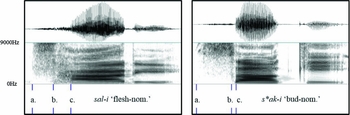
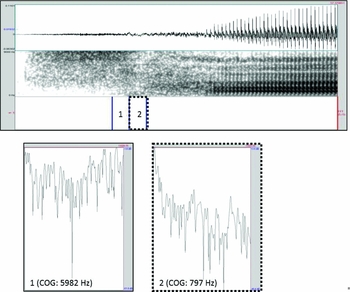
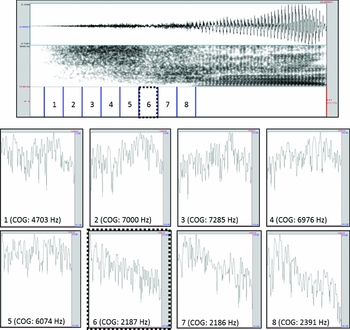
Frication duration was measured from onset of the aperiodic noise to the onset of the aspiration as indicated in both waveform and spectrograms; aspiration duration was measured from the onset of aspiration to the onset of voicing (Figure 7). The onset of voicing was determined by the onset of the first formant, and this was considered as the onset of the vowel. To determine the onset of aspiration, we considered an additional measurement criterion, namely the shape of the FFT spectrum. Lee (Reference Lee2011) observed a falling shape of the FFT spectrum during the aspiration portion reflecting a drop in energy in the higher frequencies for the aspiration, and took this as acoustic evidence of aspiration during the non-fortis fricative. In the present study, therefore, we first determined the onset of aspiration in spectrograms based on the different distribution of spectral energy between frication and aspiration, and then examined FFT spectra derived 20 ms before and after the potential onset of aspiration to check if the FFT spectrum in the later 20 ms showed the falling shape compared to the earlier 20 ms window (Figure 8); we took as onset of aspiration the point that was common to both measurement criteria. If the observation of spectral energy on the spectrogram did not provide a clear-cut onset of aspiration, FFT spectra were computed over successive 20–23 ms windows throughout the non-fortis fricative, and the onset of the first window location with the falling shape of the FFT spectrum was taken as the onset of aspiration (Figure 9). Nine tokens were measured using this method.
Example of frication/aspiration measurement for word-initial fricatives: a = frication onset; b = aspiration onset; c = vowel onset.

Example of aspiration measurement for non-fortis fricative with a clear-cut aspiration onset. The FFT spectrum extracted from the second window in the dotted line (20 ms after the onset of aspiration) shows the falling shape, confirming the change in energy distribution seen in the spectrogram.

Example of aspiration measurement for non-fortis fricative with a less clear aspiration onset. The FFT spectrum extracted from the sixth window (window size of 23 ms; 138 ms from fricative onset) shows the falling shape, and accordingly the onset of the sixth window was considered as the onset of aspiration. (See Lee Reference Lee2011 for details.)

Center of gravity was measured for the entire fricative portion including both frication and aspiration; center of gravity was also taken from FFT spectra at every 25% point between the onset and the offset of the fricative using a 20 ms window. The amplitude values for obtaining H1-H2 were taken from FFT spectra with a 25 ms window placed at the onset of the following vowel. f0 values in the following vowel after the two types of fricatives were measured at the onset of the vowel. We measured all acoustic properties using Praat (Boersma & Weenink Reference Boersma and Weenink2010).
3.1.4 Data analysis
Measurements were averaged across the two repetitions for each speaker. The data were evaluated with repeated measures Analyses of Variance (ANOVAs) with the within-subject factor of Fricative Type (/s*/ vs. /s/), and the between-subject factors of Dialect (Kyungsang, Seoul) and Age (Older, Younger) for most cases. The ezANOVA() function of the ez package (Lawrence Reference Lawrence2013; version 4.2-2) in R (R Development Core Team 2011) was used. Three-way repeated measures ANOVAs were conducted on each of the four dependent variables: frication and aspiration duration, H1-H2 and f0. For center of gravity, a four-way ANOVA including Time Window (0%, 25%, 50%, 75%, 100%) was conducted. Of a total of 152 tokens, 8 tokens (5.3%) with glottalization in the vowel were excluded from the data analysis.
3.2 Results
3.2.1 Frication and aspiration duration
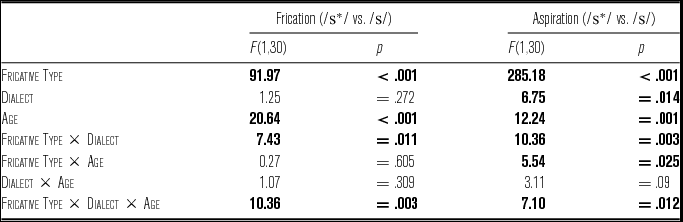
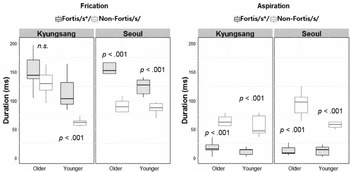
The results of repeated measures ANOVAs (Fricative Type × Dialect × Age) on the frication and aspiration duration are presented in Table 7. Figure 10 displays the distribution of the duration measures of /s*/ and /s/ for each dialect and age group.
Results of repeated-measures ANOVAs for frication and aspiration duration in the comparison of /s*/ vs. /s/. Bold indicates p < .05.

Distribution of frication (left panel) and aspiration (right panel) of /s*/ and /s/ between older and younger speakers in Kyungsang and Seoul Korean. The p-values from pairwise t-tests testing the duration differences between /s*/ and /s/ are presented for each group.

For frication duration, significant main effects were reported for Fricative Type and Age; frication duration is longer for /s*/ than /s/, and longer for older than younger speakers. In addition, the significant interaction of Fricative Type × Dialect shows that the difference in the average frication duration between /s*/ and /s/ is greater for Seoul than Kyungsang speakers (FricationDur diff.: Seoul – 61 ms; Kyungsang – 38 ms). The three-way interaction of Fricative Type × Age × Dialect indicates that the dialectal variation is also modulated by Age; while the difference in frication duration between /s*/ and /s/ is 21 ms for older Kyungsang speakers (p = .17), it was 83 ms, 44 ms and 49 ms for older and younger Seoul and younger Kyungsang speakers, respectively (p < .001 for the three groups).
Regarding aspiration duration, significant main effects were reported for Fricative Type, Dialect and Age; aspiration duration is longer for /s/ than /s*/, longer for Seoul than Kyungsang speakers, and longer for older than younger speakers. Given the significant two-way interactions of Fricative Type × Dialect and Fricative Type × Age, it is noted that the effect of Fricative Type differs by each of Dialect and Age; averaged across Age, the difference in the average aspiration duration between the two fricatives is greater for Seoul than Kyungsang speakers (AspDur diff.: Seoul – 63 ms; Kyungsang – 44 ms), and greater for older than younger speakers (AspDur diff.: older – 63 ms; younger – 48 ms). Finally, regarding the three-way interaction of Fricative Type × Age × Dialect, the fricatives /s*/ and /s/ pattern differently across dialect and age groups; the difference in aspiration duration between /s*/ and /s/ is greatest for older Seoul speakers (81 ms), followed by the other three groups, ranging from 43 ms to 49 ms (p < .001 for all four groups).
Another notable generational difference in Kyungsang's fricatives is the aspiration proportion of the total fricative portion for the non-fortis /s/. In Figure 10, although both older and younger Kyungsang speakers reported a comparable aspiration duration (61 ms for both groups), it differs proportionally. While the aspiration proportion of the fricative is 32% for older Kyungsang speakers, that for younger Kyungsang is 49%, a difference between the two generations that is greater than that in Seoul Korean (aspiration proportion: older Seoul – 49%; younger Seoul – 42%). A two-way ANOVA testing the effect of Age and Dialect on the aspiration proportion confirmed that the age difference in Kyungsang Korean is systematic across individuals, reporting a significant interaction of Dialect × Age; the age difference in the aspiration proportion for /s/ is significant for Kyungsang speakers (p = .009), whereas it is not for Seoul speakers (p = .067). The smaller aspiration proportion for older than younger Kyungsang speakers suggests that the non-fortis /s/ might be less aspirated for older than younger Kyungsang speakers. Overall, the results suggest that the two fricatives are non-distinct or less distinct for older Kyungsang speakers compared to the other groups in their durational measures.
3.2.2 Center of gravity
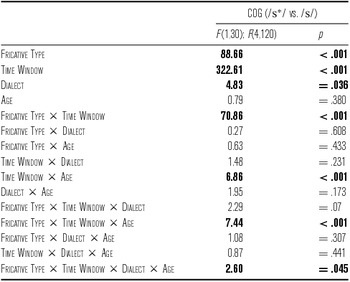
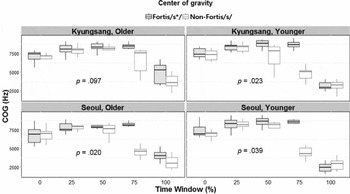
The results of repeated measures ANOVAs (Fricative Type × Time Window × Dialect × Age) on center of gravity are presented in Table 8. Figure 11 displays the distribution of the centroid frequencies of /s*/ and /s/ across time window for each dialect and age group.
Results of repeated-measures ANOVAs for center of gravity (COG) in the comparison of /s*/ vs. /s/. The degrees of freedom for any effects including Time Window are 4 (df numerator) and 120 (df denominator). Bold indicates p < .05.

Distribution of center of gravity (Hz) of /s*/ and /s/ for each time window between older and younger speakers in Kyungsang and Seoul Korean. The p-values from pairwise t-tests testing the COG differences between /s*/ and /s/ across time windows are presented for each group.

For center of gravity (COG), significant main effects were found for Fricative Type, Time Window and Dialect; COG is higher for /s*/ than /s/, higher for 25% and 50% compared to 0%, 75% and 100% of time window, and higher for Kyungsang than Seoul speakers. In addition, significant two-way interactions were found for Fricative Type × Time Window and Time Window × Age; averaged across Dialect and Age, the COG difference between the two fricatives is greater at the 75% time window than any other windows (COG diff.: 0% – 159 Hz, 25% – 51 Hz, 50% – 788 Hz, 75% – 3480 Hz, 100% – 284 Hz); across Fricative Type and Dialect, COG is greater for younger than older speakers at 0%, 25% and 50%, but greater for older than younger speakers at the 75% and 100% time windows. The three-way and four-way interactions of Fricative Type × Time Window × Age and Fricative Type × Time Window × Dialect × Age suggest that COG as a function of the fricative distinction differs across Time Window, but there are dialectal and generational variations. Figure 11 shows the dialect and generational difference, particularly at the 75% time point of fricatives; COG at 75% for older Kyungsang speakers’ non-fortis /s/ is not as low as that for the other three groups. We conducted multiple pairwise t-tests to see how the COG difference between /s*/ and /s/ varies across time windows for each of the dialect and age groups. For older and younger Seoul and younger Kyungsang speakers, the COG difference between the two fricatives at the 75% time window is always significantly different from that at other windows, indicating that the two fricatives are maximally distinct in their COG values at the 75% time point of fricatives for the three groups (p < .001 for all comparisons); however, for older Kyungsang speakers, the COG difference between the two fricatives is not significantly different at any of the five time windows, suggesting that COG as a function of the fricative distinction patterns comparably during the fricatives (p > .05 for all comparisons).
One interesting observation concerns the relationship between the effect of aspiration and the center of gravity for the non-fortis /s/. Lee (Reference Lee2011) indicated that the center of the spectral energy shifts from a high to a low frequency range at the onset of aspiration. The negative correlation between center of gravity and aspiration can also be observed in the measured center of gravity across time windows in the present study. Specifically, the proportion of the aspiration for the non-fortis /s/ was significantly less for older Kyungsang (32%) than younger Kyungsang speakers (49%), leading to the expectation of greater center of gravity values for the older speakers. In Figure 11, it was noted that center of gravity values at the 75% point for older Kyungsang speakers’ non-fortis /s/ are not as low as those for younger Kyungsang speakers, which is in line with the notion of a smaller aspiration proportion for older Kyungsang speakers than younger speakers. In other words, the 75% time window includes (part of) the non-aspirated portion of the fricative for older Kyungsang speakers but the aspirated portion for the younger Kyungsang speakers, again confirming that the non-fortis fricative produced by older Kyungsang speakers is less aspirated compared to that of younger Kyungsang speakers.
3.2.3 H1-H2 and f0
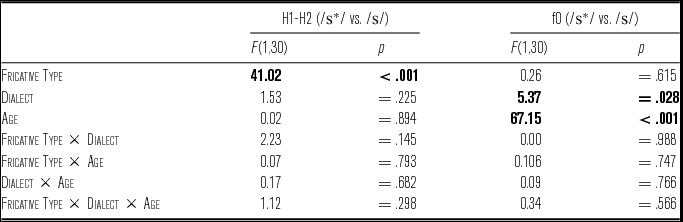
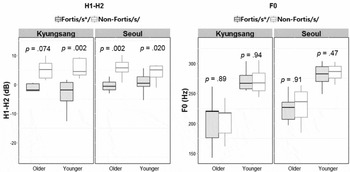
In Table 9, a three-way repeated measures ANOVA (Fricative Type × Dialect × Age) on H1-H2 reported a significant main effect of Fricative Type; in Figure 12, H1-H2 is higher for /s/ than /s*/, suggesting a more breathy phonation for /s/ compared to /s*/. None of the interactions were significant, indicating that H1-H2 patterns similarly across age and dialect groups.
Results of repeated-measures ANOVAs for H1-H2 and f0 in the comparison of /s*/ vs. /s/. Bold indicates p < .05.

Distribution of H1-H2 (left panel) and F0 (right panel) of /s*/ and /s/ between older and younger speakers in Kyungsang and Seoul Korean. The p-values from pairwise t-tests testing the H1-H2 and F0 differences between /s*/ and /s/ are presented for each group.

For f0, there were main effects of Dialect and Age; f0 is higher for Seoul than Kyungsang speakers, and higher for younger than older speakers, as seen in Figure 12. The higher f0 values for younger speakers than older speakers are in line with Benjamin (Reference Benjamin1981) who showed this effect of age on pitch change. Finally, none of the interactions were significant, indicating that the non-significance of f0 as a function of fricative type is observed across age and dialect groups.
3.3 Summary of results
The acoustic study of fricatives examined whether the fricative features in Kyungsang Korean are similar between older and younger speakers. Given the discrepancy between the traditional view and recent experimental findings regarding the Kyungsang fricatives, we explored if the discrepancy is related to generational differences. The main findings are summarized below.
-
a. We replicated previous findings (e.g. Kenstowicz & Park Reference Kenstowicz and Park2006, Lee Reference Lee2011, Holliday Reference Holliday2012, Chang Reference Chang2013): across dialect and age groups, fortis /s*/ and non-fortis /s/ differed in their frication duration (/s/ < /s*/), aspiration duration (/s/ > /s*/), center of gravity (/s/ < /s*/) and H1-H2 (/s/ > /s*/), but not in f0.
-
b. Regarding the generational variation for Kyungsang fricatives, while younger speakers distinguish the two fricatives in a similar way as older and younger Seoul speakers do, the way older Kyungsang speakers distinguish them is not comparable with that of the other groups. Older Kyungsang speakers made the /s/ and /s*/ distinction only in aspiration duration and H1-H2, whereas for the other speaker groups the two fricatives were distinct in frication duration and center of gravity as well as aspiration duration and H1-H2.
-
c. For older Kyungsang speakers, the two fricatives are non-distinct or less distinct in their frication duration and center of gravity, showing longer frication duration and greater center of gravity for the non-fortis /s/ compared to the other groups’ /s/; the proportion of the aspiration duration for the non-fortis /s/ was significantly smaller for the older Kyungsang compared to others.
-
d. The greater center of gravity value at the 75% time window for older Kyungsang speakers’ /s/ is in line with the smaller proportion of the aspiration.
3.4 Discussion
Examining the two-way fricative contrast of Kyungsang and Seoul Korean across generations indicated generational differences, suggesting sound change in the fricatives of Kyungsang Korean. Overall, the dialectal and age differences in the fricatives are related to the fact that older Kyungsang speakers’ non-fortis /s/ is less aspirated compared to that of the other groups. Notably, the lack of aspiration for the non-fortis /s/ which implies /s/ is closer to /s*/ is contrary to the traditional view of Kyungsang's fricatives that the fortis /s*/ is neutralized to the non-fortis /s/. This interpretation is in line with Holliday (Reference Holliday2012) who also suggested that the fricative feature in Kyungsang Korean tends to be closer to the fortis /s*/ rather than the non-fortis /s/. But recall that while Holliday (Reference Holliday2012) observed this lack of aspiration for younger North Kyungsang speakers, the current study observed it for older South Kyungsang speakers; the current study found that the younger Kyungsang speakers express the aspiration for the non-fortis /s/ similarly to Seoul Korean speakers. In other words, the fact that the two studies investigated participants with different geographical backgrounds might preclude us from concluding that the less aspirated feature for the non-fortis /s/ and the discrepancy among the previous studies (Sohn Reference Sohn1999, Kenstowicz & Park Reference Kenstowicz and Park2006, Lee & Ramsey Reference Lee and Ramsey2011, Holliday Reference Holliday2012) is related to the generational difference in the fricatives of Kyungsang Korean. A comparison of the current findings to Holliday (Reference Holliday2012) might suggest two possible explanations regarding the inconsistent reports in previous studies about Kyungsang fricatives. One would be that the observed generational differences regarding the less aspirated fricative /s/ for the present older Kyungsang speakers would be limited to South Kyungsang speakers, and not apply to North Kyungsang; the other explanation is that North Kyungsang Korean might also have generational differences in which the two fricatives are less distinct for older than younger speakers, which could possibly be reflected in acoustic dimensions other than aspiration duration such as COG or H1-H2. Further investigation considering inter-generational (older vs. younger) and inter-dialectal (South vs. North Kyungsang) comparisons would allow us to test the second explanation.
To sum up, the older South Kyungsang speakers patterned differently from the younger Kyungsang and Seoul speakers in making the two-way fricative contrast, especially with less aspiration for /s/. We conclude that the traditional view that Kyungsang Korean has the neutralized /s/ may be based on older Kyungsang speakers’ aspiration pattern, which is different from that in Seoul Korean, but it cannot be supported on the basis of analysis of a variety of other acoustic cues for the fricatives.
4 Conclusion
The current study investigated whether the segmental properties of Kyungsang Korean are retained by both younger and older generations. Given that the influence of Seoul Korean has increased among Kyungsang speakers, we questioned the homogeneity of the regional dialect, especially for the vowels and fricatives with features distinct from Seoul Korean.
The acoustic study of vowels tested whether the vowel system of Kyungsang Korean is maintained by both younger and older generations, focusing on the vowel pairs /ɨ/–/ʌ/ and /e/–/ɛ/. We showed that both younger Seoul and Kyungsang speakers have seven vowels, and this identical number of vowels results from the split of /ɨ/–/ʌ/ in Kyungsang Korean and merger of /e/–/ɛ/ in Seoul Korean. The acoustic study of fricatives examined whether the non-distinct fricative contrast in Kyungsang Korean reported in the literature is expressed by both younger and older generations, and thereby asked if the inconsistent reports across previous studies about whether Kyungsang Korean has one or two fricatives are related to potential generational differences. The results showed that while younger Kyungsang speakers distinguish the two-way fricative contrast in a way comparable to Seoul speakers, the way older Kyungsang speakers distinguish them is less robust than that observed in younger Kyungsang speakers by not making the acoustic distinction in frication duration and center of gravity. By establishing the generational difference in Kyungsang's fricatives, the current study clarifies the inconsistent reports across previous studies, at least for South Kyungsang Korean. Overall, the observed generational differences indicated that younger Kyungsang generations now have the same vowel and consonant inventories as younger Seoul speakers. Therefore, we conclude that the linguistic homogeneity of Kyungsang Korean is not maintained across generations, and that a diachronic sound change is underway in South Kyungsang Korean under the influence of Seoul Korean.
There are several directions in which this study can be extended. The observation here is limited to female speakers who are usually more innovative in leading linguistic change (Nevalainen & Raumolin-Brunberg Reference Nevalainen and Raumolin-Brunberg2003). Therefore, a further examination with male speakers presumably having conservative patterns would allow us to determine whether the change in the merger or split is more robust among females than males. In addition, a detailed examination of how the generational difference in segments may be related to socio-economic status will help increase our understanding of the relationship between diachronic sound change and social factors.
Acknowledgements
The JIPA Editor Adrian Simpson and three anonymous reviewers have provided us with insightful comments and critique which helped us improve this study. We would like to thank Professors Joan Sereno and Jie Zhang and fellow participants in the University of Kansas Empirical Research seminar for their helpful comments at all stages of this work. Professors Byunggon Yang and Soonbok Kwon at Pusan National University helped us recruit participants in Pusan. Portions of this study were conducted as part of the first author's dissertation at the University of Kansas.
Appendix. Demographic information about the participants
In the table below, the internal horizontal lines indicate the divisions of each dialect and age group. YOB = year of birth. Income level index: Low = less than $20,000; Mid = $20,000–$40,000; High = over $40,000