




No CrossRef data available.
Article contents
A prospective study of the association among impaired executive functioning, childhood attentional problems, and the development of bipolar disorder
Published online by Cambridge University Press: 01 June 2004
Abstract
Studies of adults who have been diagnosed with, and treated for, bipolar disorder have shown that these patients exhibit impairment on measures of executive functioning. However, it is unclear whether executive dysfunction precedes the diagnosis of bipolar illness, or develops subsequent to its onset. Moreover, investigators have failed to control for the effects of premorbid attentional problems on cognitive performance in these patients. The present authors explored these questions using data from a longitudinal prospective study of individuals at risk for major mood disorder. Results revealed that 67% of participants who met criteria for bipolar disorder in young adulthood showed impairment on the Wisconsin Card Sorting Test (WCST) when they were assessed during adolescence, as compared with 17% of individuals with no major mood diagnosis, and 19% with unipolar depression. This association between performance on the WCST and bipolar illness was not accounted for by high rates of premorbid attentional disturbance. In fact, among participants with early attentional problems, only those who ultimately developed bipolar disorder exhibited impairment on the WCST. Early attentional problems that preceded unipolar depression or no mood disorder were not associated with executive dysfunction.The findings presented in this paper come from the doctoral dissertation of the first author, which was funded by an NIMH Intramural Research Training Award. The authors are enormously grateful to Roger E. Meyer for his comments on earlier drafts of this paper and to Anne Mayfield, without whom this project would not have been possible. We are deeply indebted to Ann S. Masten, W. Andrew Collins, L. Alan Sroufe, Monica Luciana, and Carrie Borchardt, who provided invaluable guidance throughout all stages of this project, as well as Robert Asarnow, who was an important mentor during the review process. In addition, we acknowledge the contributions of Gail Inoff–Germain, who administered diagnostic interviews and neuropsychological measures at adolescent follow-up; Rula B. Garside, who undertook the painstaking job of establishing interrater reliability; Erika Sundstrom, who devoted many hours to data organization and quality assurance; and Sara Avery Torvik and Patricia Kasdan, whose combined gifts of organization and warmth created a comfortable atmosphere for study participants. Finally, we thank the extraordinary research participants of the NIMH Childrearing Study, who have shown enormous bravery and dedication by sharing with us 23 years of their lives.
Information
- Type
- Research Article
- Information
- Copyright
- © 2004 Cambridge University Press
Studies of adults who have been diagnosed with, and treated for, bipolar disorder have revealed that these patients, regardless of mood state, perform relatively poorly on executive function tasks, compared with patients with unipolar depression (Borkowska & Rybakowski, 2001) and individuals with no psychiatric illness (Ferrier, Stanton, Kelly, & Scott, 1999; Zubieta, Huguelet, O'Neill, & Giordani, 2001). By contrast, patients with bipolar disorder have not been found to significantly differ from patients with schizophrenia on some of these same measures (Hawkins, Hoffman, Quinlan, Rakfeldt, Docherty, & Sledge, 1997; Martínez–Arán, Penadés, Vieta, Colom, Reinares, Benabarre, Salamero, & Gastró, 2002; Morice, 1990; Verdoux & Liraud, 2000).
Because executive functions are widely believed to be regulated by the prefrontal cortex (Berman, Ostrem, Randolph, Gold, Goldberg, Coppola, Carson, Herscovitch, & Weinberger, 1995; Nagahama, Fukuyama, Yamauchi, Matsuzaki, Konishi, Shibasaki, & Kimura, 1996; Rezai, Andreasen, Alliger, Cohen, Swayze, & O'Leary, 1993; Stuss & Alexander, 2000; Weinberger, Berman, & Zec, 1986), the above studies suggest that this brain region may be involved in the pathophysiology of bipolar illness. Further evidence of prefrontal involvement in bipolar disorder has come from imaging and postmortem studies. Functional imaging studies have shown decreased glucose metabolism in the dorsolateral prefrontal cortex among manic patients (Al-Mousawi, Evans, Ebmeier, Roeda, Chaloner, & Ashcroft, 1996). Postmortem studies have revealed reduced glial and neuronal density, as well as glial enlargement, in the dorsolateral prefrontal cortex among patients with bipolar disorder (Rajkowska, Halaris, & Selemon, 2001), as well as decreased grey matter volume and a reduced number of glial cells in the subgenual region of the prefrontal cortex of patients with familial bipolar disorder (Öngür, Drevets, & Price, 1998). In synthesizing data from neuropsychological, imaging, and postmortem studies, several theorists have postulated that patients with bipolar disorder may suffer from impaired functioning of one or more frontal-subcortical networks (Ferrier, MacMillan, & Young, 2001; Ferrier & Thompson, 2002; Strakowski, Delbello, Adler, Cecil, & Sax, 2000).
At this point, little is known about the temporal relation between bipolar illness and apparent deficits in prefrontal cortical functioning. While executive function impairment has been observed as early as the first episode of bipolar illness (Yurgellun–Todd, Gruber, Killgore, & Tohen, 2000), it remains unknown whether these deficits precede the manifestation of illness or appear subsequent to its onset (Gourovitch, Torrey, Gold, Randolph, Weinberger, & Goldberg, 1999). Moreover, by studying individuals following the onset of disorder, investigators have been unable to tease apart the effects of pharmacological treatment and childhood psychopathology on cognitive performance and brain structure and function in these patients.
With regard to antecedent childhood psychopathology, several studies have reported elevated rates of premorbid attentional problems among patients with bipolar disorder (Carlson, Bromet, Driessens, Mojtabai, & Schwartz, 2002; Carlson, Bromet, & Sievers, 2000; Faraone, Biederman, Wozniak, Mundy, Mennin, & O'Donnell, 1997; Sachs, Baldassano, Truman, & Guille, 2000). Given findings of prefrontal involvement in attention-deficit/hyperactivity disorder (ADHD; Barkley, Grodzinsky, & DuPaul, 1992; Pineda, Ardila, Rosseli, Cadavid, Manchedo, & Mejia, 1998; Seidman, Biederman, Faraone, Weber, & Ouellette, 1997), it is possible that early attentional difficulties may be driving the association between executive function impairment and bipolar disorder.
In the current paper, we used data from a 23-year prospective longitudinal study of individuals at risk for major affective disorder, who have been studied from toddlerhood through young adulthood, to address the question of whether executive function deficits are detectable prior to formal diagnosis and treatment of bipolar disorder, and to explore the interrelations among childhood attentional problems, executive function deficits, and bipolar illness.
Methods
Participants
Participants in this study are part of a larger 23-year longitudinal prospective study of offspring of mothers with unipolar depression, bipolar illness, or no history of psychiatric illness (Radke–Yarrow, 1998). The study began in 1979 with the recruitment of families with at least two children, one between the ages of 1.5 and 3.5, and another between 5 and 7 years of age. (Exceptions were made in four cases in which the mother suffered from bipolar illness. In these families, there was only one child between the ages of 1.5 and 3.5). Families were recruited through newspaper announcements or through parent groups and local clinicians. The initial screening was conducted over the telephone, and potentially eligible families were invited to the laboratory for a structured psychiatric interview. Families were included in the study if the mother met criteria for unipolar depression or bipolar illness or had no past or present psychiatric diagnosis. If the mother met inclusion criteria, the father was interviewed. None of the fathers in the control sample met criteria for a major psychiatric illness. In families in which the mother suffered from a major affective disorder fathers were either without psychiatric disorder or suffered from anxiety and/or mood disorder.
The original sample consisted of 121 families, including 25 families in which the mother met criteria for bipolar disorder, 51 families in which the mother suffered from unipolar depression, and 45 families in which the mother had no history of psychiatric illness. Since the study's inception, there have been six families whose group membership has changed. Specifically, four mothers were switched from the unipolar to the bipolar group, and two well mothers entered the unipolar group. Furthermore, four families have been discontinued from the study because of diagnostic changes. In three control families, the father developed a major affective diagnosis and, thus, the families were no longer eligible for inclusion. In addition, one well mother met criteria for generalized anxiety disorder at Time 3, and therefore no longer met inclusion standards. The attrition rate from the original sample is 16%. Attrition has been highest among control families, of whom five families have withdrawn and two families could not be located. Three families with bipolar disorder have withdrawn, and one family could not continue because of legal complications. Finally, three families with unipolar depression have withdrawn, four families could not be located, and in one family both parents passed away prior to the Time 2 assessment.
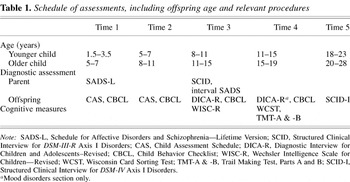
The current follow-up sample consists of 98 families, including 48 offspring of mothers with bipolar illness, 84 offspring of mothers with unipolar depression, and 60 offspring of mothers without a history of psychiatric illness. Families are predominantly middle to upper middle class. Eighty-six percent of families are Caucasian, 11% African American, 1% Latin American, and 2% Asian American. As can be seen in Table 1, the same children have been seen four times over the past 20 years at regular intervals and are currently being brought in for a fifth visit. Data collection for young adult (Time 5) follow-up is ongoing. However, because of major procedural changes regarding Time 5 data collection and organization, the present study is limited to those participants who were seen prior to July 2002. Thus, this paper reports on 102 offspring from 61 families, including 32 young adults from the bipolar risk group, 42 from the unipolar risk group, and 28 from the well group. The younger children range in age from 18 to 23, and the older siblings are between 20 and 28 years old. Approximately equal numbers of younger and older siblings have been seen at follow-up. In order to increase statistical power, younger and older sibling groups have been combined. Although an effort was made to contact participants in an unbiased manner, the present sample differs from the larger follow-up group in the following ways: a significantly higher percentage of offspring of mothers with bipolar disorder (67%) than offspring of mothers with unipolar depression (50%) and offspring of well mothers (45%) have been seen. Furthermore, a significantly larger percentage of female participants (60%) than males (42%) have been interviewed. Young adult participants are 90% Caucasian, 9% African American, and 1% Latin American. There is no difference in socioeconomic status between offspring who did or did not participate in this substudy.
Schedule of assessments, including offspring age and relevant procedures

Measures
For diagnostic assessments at each time point, clinicians (psychiatrists or clinical psychologists) or psychometricians with advanced training (i.e., psychiatric nurses or advanced candidacy PhD students) interviewed participants. Cognitive and neuropsychological measures were administered by a clinical psychologist or a trained psychometrician. In cases in which a psychometrician completed the assessments, intensive supervision and consultation with a clinical psychologist or a psychiatrist were provided. All interviewers and evaluators were blind to the diagnostic history of the child and his or her family members.
Parental mood diagnosis
Parents were interviewed at the study's inception using the Schedule for Affective Disorders and Schizophrenia: Lifetime Version (SADS-L; Endicott & Spitzer, 1978). Interviews were conducted by a psychiatric nurse who was trained by a staff member of the New York Psychiatric Institute. Ten interviews were coded independently by nurse and trainer with 100% agreement on diagnosis. Six years into the study (Time 3), parents were again assessed, this time using the Structured Clinical Interview for DSM-III-R Axis I Disorders (SCID; Spitzer, Williams, Gibbon, & First, 1992). Interval diagnoses were established using the interval SADS. To arrive at parents' lifetime diagnosis, the psychiatric interview assessments at the time of admission to the study and at the Time 3 follow-up were taken into account.
Offspring attentional deficits, behavioral problems, and mood problems
Three sources of information were used to determine the presence of offspring psychopathology during childhood and adolescence: the Child Assessment Schedule (CAS), the Child Behavior Checklist (CBCL), and the Diagnostic Interview for Children and Adolescents—Revised (DICA-R). Maternal report on the CBCL was combined with data from psychiatric interviews. To increase reliability, participants were required to meet criteria for a particular disturbance (attentional problems, behavioral problems, or depression) at repeated (two or more) visits in order to be assigned to a particular diagnostic group.
The validity of using mothers as informants in families with maternal affective illness has recently been called into question (reviewed in Richters, 1992). However, there is increasing evidence, including data from this study (Tarullo, Richardson, Radke–Yarrow, & Martinez, 1995), showing that mothers who suffer from affective illness are actually more accurate in their perception of child problems than are psychiatrically well mothers (Richters, 1992). Specifically, it appears that well mothers may have a tendency to underreport problems, relative to criterion (comparison) raters. The latter finding has been used as an argument for combining mother and child reports for the purposes of psychiatric assessment (Tarullo et al., 1995).
CAS
The CAS (Hodges, McKnew, Cytryn, Stern, & Kline, 1982) is a structured psychiatric interview for children. The CAS was used to interview children ages 5 and older at Times 1 and 2. For those children under the age of 5, an adapted play interview, corresponding with the observational portion of the CAS, was utilized. Interrater reliability was based on ratings of 10 children younger than age 5 (κ = .82) and 25 children aged 5 and older (κ = .83). For this study, the diagnoses of interest were ADHD, conduct disorder, oppositional defiant disorder, and depression.
CBCL
The CBCL (Achenbach & Edelbrock, 1981) has been normed on large national samples, and is widely used to measure childhood difficulties for clinical and research purposes. Mothers filled out the CBCL for each child at Times 1 through 4. For this study, we were interested in clinically significant scores (t score at or above the 90th percentile) on the following CBCL scales: Attention Problems, Delinquency Problems, Aggression Problems, and Anxious/Depressed.
DICA-R
At Time 3, the DICA (Herjanic & Reich, 1982), a structured psychiatric instrument designed to assess DSM-III-R diagnoses, was utilized. Both the child and the mother were interviewed regarding the child's psychiatric functioning. Interrater agreement regarding diagnostic categories was based on ratings of videotaped interviews of 63 younger and 76 older siblings. Kappas were .82 for younger children and .84 for older children. At Time 4, offspring were administered the mood disorders portion of the DICA-R. Interrater reliability was based on 26 cases, and the kappa for all affective disorders was .65.
Medication use
Medication use (current and lifetime) was formally evaluated at Time 4. Participants and their mothers each provided information regarding the youngster's use of prescribed stimulants, antidepressants, mood stabilizers, anxiolytics, and nonpsychiatric medications in the 2 months prior to their visit, as well as lifetime medication use. For purposes of this study, mother and child reports were combined.
Offspring Axis I Diagnoses at Young Adult Follow-up (Time 5)
The SCID-I (nonpatient version; First, Gibbon, Spitzer, & Williams, 1996) is a semistructured interview for making the major DSM-IV Axis I diagnoses. It was administered to young adult offspring as part of the Time 5 assessment. Interrater reliability was based on 16 cases, and kappas for the major affective diagnoses were 1.0. Using information derived from the SCID-I, interviewers assigned each participant a Global Assessment of Functioning (GAF) score to estimate their degree of functional impairment at the time of assessment (intraclass correlation = .84).
Neuropsychological measures.
Measures of executive function
The Wisconsin Card Sorting Test (WCST; Grant & Berg, 1948; Heaton, Chelune, Talley, Kay, & Curtiss, 1993) and the Trail Making Test, Part B (TMT-B; Reitan & Wolfson, 1995) are neuropsychological tests designed to measure executive function. Although there is some controversy surrounding the use of these tests as measures of frontal lobe impairment (Anderson, Damasio, Jones, & Tranel, 1991; Mountain & Snow, 1993; Reitan & Wolfson, 1995), evidence from recent brain imaging studies (Berman et al., 1995; Nagahama et al., 1996; Rezai et al., 1993; Weinberger et al., 1986) and studies of patients with frontal lobe lesions (Stuss, Levine, Alexander, Hong, Palumbo, Hamer, Murphy, & Izukawa, 2000) supports the use of these measures, particularly the WCST, in the assessment of prefrontal cortical dysfunction.
Measures of executive function were administered at Time 4 when offspring were between the ages of 11 and 19 years (mean age = 14.84 ± 2.59 years).
The WCST
The WCST (Grant & Berg, 1948; Heaton et al., 1993) is the most broadly accepted test of executive function (Stuss & Benson, 1986). The computer version of the WCST (Loong, 1989) was administered to offspring in this sample by a staff member who provided brief instructions and left the room. The computerized WCST is virtually identical to the original manually administered test in which a participant is presented with 128 cards and is told to place each one beneath 1 of 4 stimulus cards. After each try, the participant is told whether he or she is “right” or “wrong” (in the computer version, the computer supplies this feedback) but is given no other clues regarding the card sorting principle. Every time the participant achieves 10 “right” answers in a row, the organizing principle changes without warning. The procedure continues until the subject has successfully completed six sorting categories or until all 128 cards have been used (Spreen & Strauss, 1998).
For purposes of this study, we were interested in the following scores: number of categories achieved, which is the number of times a participant correctly sorts 10 cards in a row (possible scores = 0–6); percent perseverative errors, which occur when a participant repeatedly places cards according to a previously (but no longer) correct sorting strategy (Heaton et al., 1993). According to Lezak (1995), high perseverative error scores are indicative of difficulties with concept formation and the ability to profit from external feedback, as well as decreased cognitive flexibility. The last score of interest is the percent conceptual level responses (defined as three or more correct card placements in a row), which are those responses that suggest that the participant has insight into the correct sorting principle. Achieving a high percentage of conceptual level responses requires the ability to shift cognitive set and use environmental clues to successfully detect and respond to a changing organizing principal.
TMT Parts A and B
The TMT is a two-part test in which the examinee must connect a series of numbers, which are randomly arranged on a page, in the correct order (TMT-A) and then do the same with letters and numbers in alternating order (TMT-B; Spreen & Strauss, 1998). TMT-A serves as a baseline measure of psychomotor speed, visual scanning, and attention; TMT-B taps all of these abilities, as well as cognitive flexibility. Scores represent the time in seconds that it takes a participant to complete each portion of the test. Participants completed the Intermediate or the Adult version of the TMT, depending on their age at the time of testing.
Measure of overall cognitive function
The Wechsler Intelligence Scale for Children—Revised (WISC-R; Wechsler, 1974) was administered to offspring at Time 3, when participants were between the ages of 8 and 15 (mean age = 11.00 ± 2.3 years). The WISC-R is designed to measure general intellectual ability, and yields a verbal IQ score (VIQ), a nonverbal or performance IQ score (PIQ), and a full-scale IQ score (FSIQ).
Exclusion criteria
Participants were not included in this study if they had a history of epilepsy (n = 1) or an FSIQ score of less than 85 (n = 3). An additional participant was removed from analyses a priori because he suffered from neurological problems secondary to a closed head injury. A final participant was not included in the study because she was taking lithium at the time of the neuropsychological assessment, despite never having met criteria for bipolar disorder.
Statistical methods
Statistical methods were carried out using SPSS Version 10.0 for the Macintosh (Release 10.0.7a.2000; SPSS, 2000). In order to assess whether siblings from the same family could be considered independent, for purposes of statistical analysis, intraclass correlations were conducted comparing sibling scores (n = 40 sibling pairs) on continuous outcome variables. Only 34 sibling pairs completed the WCST. The following are the results of these analyses: WCST Categories Completed, intraclass correlation (ICC) = −.05, F (1, 33) = 0.90, p = .61, WCST percent perseverative errors, ICC = .06, F (1, 33) = 1.13, p = .36, WCST percent conceptual level responses, ICC = .08, F (1, 33) = 1.17, p = .33. The kappa statistic was used to compare scores on the categorical outcome variable bipolar disorder Y/N (κ = −.06, χ2 (1) = .17, p = .68, n = 40). All results were nonsignificant, and it was therefore concluded that members of sibling pairs could be treated as independent cases in subsequent analyses.
Results of analyses using the Shapiro–Wilk Test indicated that data from the WCST and TMT-A and -B were not normally distributed. Therefore, the nonparametric Mann–Whitney test was employed to compare performance on these measures across diagnostic groups. Independent samples t tests were used to compare mean GAF scores, age at Time 5, and performance on the WISC-R across diagnostic groups. Chi-square tests were used to explore gender differences, rates of early depression, attentional and behavioral problems, occurrence of a greater than 10-point difference between VIQ and PIQ, and stimulant use by young-adult mood diagnosis. Binary logistic regression was employed to look at the relation between executive function deficits and attentional problems in the prediction of bipolar disorder. The data were also explored for the presence of extreme outliers. Through this process, one participant was found to have achieved a WCST percent perseverative errors score that was more than 5 standard deviations above the mean and is suggestive of severe cognitive impairment. In fact, at the time of testing, this participant was a high school honors student with no history of attentional problems, and she achieved VIQ, PIQ, FSIQ, and TMT-B scores well within the expected range. Because of substantial behavioral and objective evidence that this participant's performance on the WCST was invalid, she was excluded from further data analysis.
Results
Characteristics of diagnostic groups at young adult assessment
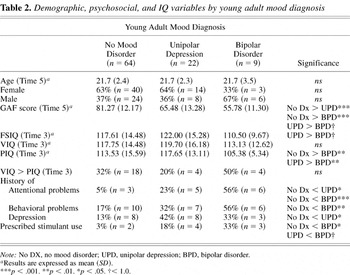
As can be seen in Table 2, there were no differences in age among individuals in our subsample who were diagnosed with bipolar illness or unipolar depression or who did not suffer from a mood disorder at young adult follow-up. Although the gender composition seemed to vary across groups, this was not statistically significant, most likely because of power limitations. Participants with no mood disorder appeared to be performing at significantly higher levels of social and occupational functioning at the time of assessment than were individuals with unipolar depression, t (81) = 5.023, p = .000, or bipolar disorder, t (69) = 5.919, p = .000, as measured by the GAF. The mean GAF score of individuals with unipolar depression fell within the mildly impaired range, whereas the mean score for participants with bipolar disorder fell within the moderately impaired range. This difference just missed significance, t (28) = 1.910, p = .066.
Demographic, psychosocial, and IQ variables by young adult mood diagnosis

Participants with bipolar disorder in young adulthood achieved a significantly lower PIQ score at Time 3 than did individuals with unipolar depression, t (26) = 3.519, p = .002, and those with no mood disorder, t (63) = 2.913, p = .007. However, it is important to note that all three groups had mean PIQ scores that fell within the average range. In addition, there was a marginal difference in FSIQ between offspring with bipolar disorder and those with unipolar depression, t (27) = 1.972, p = .059. Again, all mean FSIQ scores fell within the average range. There were no significant differences across groups in mean premorbid VIQ. Finally, although it appears that an elevated percentage of individuals who developed bipolar disorder had a greater than 10-point discrepancy between VIQ and PIQ, this was not statistically significant.
Young adults in our sample with bipolar disorder suffered significantly higher rates of early attentional, χ2 (1) = 20.923, p = .000, n = 73, and behavioral problems, χ2 (1) = 12.012, p = .001, n = 73, than did individuals with no mood disorder. Individuals with unipolar depression manifested higher rates of attentional problems, χ2 (1) = 6.315, p = .012, n = 86, and childhood depression, χ2 (1) = 6.157, p = .013, n = 86, than did offspring with no mood disorder in young adulthood. Given the heightened rate of premorbid attentional problems among individuals with bipolar disorder in our sample, it is not surprising that they were also more likely to have been prescribed stimulants during childhood or adolescence than were individuals with no mood disorder, χ2 (1) = 6.676, p = .01, n = 73.
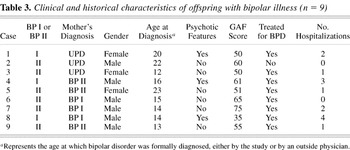
Table 3 summarizes clinical characteristics of the 9 participants who met criteria for bipolar illness in young adulthood. Three individuals have a history of episodes of major depression and mania (bipolar I disorder) and 6 participants suffer from major depressive episodes and hypomania (bipolar II disorder). These individuals represent 19% (6 of 32) of the offspring of mothers with bipolar illness, and 7% (3 of 42) of the offspring of mothers with unipolar depression. The mean age of diagnosis was 16.56 years. It is interesting that, on the whole, males were diagnosed with bipolar disorder at an earlier age (mean age of diagnosis = 15.66 years) than females (mean age of diagnosis = 18.33 years), although this difference is not statistically significant. One-third of these individuals have experienced psychotic symptoms. One-third were seen by study interviewers as being mildly functionally impaired at the time of assessment, one-third were moderately impaired, and one-third were severely limited in their functioning. All but one participant received pharmacologic treatment for bipolar disorder (i.e., their condition has been recognized and treated by their community psychiatrist). Seven out of nine participants have been hospitalized—three for mania and the rest for depression. All hospitalizations occurred following the Time 4 assessment of neuropsychological functioning.
Clinical and historical characteristics of offspring with bipolar illness (n = 9)

Exploration of the temporal relation between presence of executive function deficits and onset of bipolar disorder
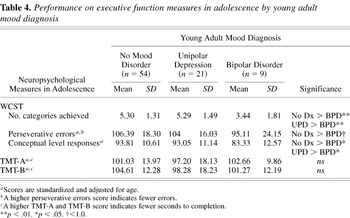
In order to test the hypothesis that participants who met the criteria for bipolar disorder in young adulthood would show executive function deficits during adolescence we examined performance differences between groups on the WCST and on the TMT-A and -B at Time 4. Table 4 shows mean scores for number of categories achieved on the WCST and age-corrected standard scores for percent perseverative errors and percent conceptual level responses (Heaton et al., 1993). Age-corrected standard scores are also used to depict performance on the TMT-A and -B based on normative data compiled and presented in Spreen and Strauss (1998). The mean WCST number of categories achieved by individuals who developed bipolar disorder was 3.44 (±1.81), which is significantly lower than that of participants with unipolar depression (z = −2.715, p = .007) or no major mood disorder (z = −3.159, p = .002) at young adult follow-up. According to normative data for the WCST (Heaton et al., 1993), this mean score falls between the 11th and 16th percentile for this age group (mean age at assessment = 14.84 years). Individuals who met criteria for bipolar disorder in young adulthood also made significantly fewer conceptual level responses on the WCST at adolescent follow-up than did participants with unipolar depression (z = −2.039, p = .04) or no major mood disorder (z = −2.399, p = .016). The mean conceptual level response score for the bipolar group was 83.33 (±12.57), which falls within the mildly impaired range, while mean scores for the other two groups were within the average range. Finally, individuals who developed bipolar disorder showed a tendency to make more perseverative errors on the WCST in adolescence than did individuals with no mood disorder at young adult follow-up (z = −1.730, p = .084). However, age-corrected scores on this measure fell within the average range for all three groups.
Performance on executive function measures in adolescence by young adult mood diagnosis

In sum, 17% of individuals with no young adult mood diagnosis, 19% of individuals with unipolar depression, and 67% of participants with bipolar disorder showed impairment on the WCST when tested during adolescence. There were no significant between-group differences on the TMT-A or TMT-B.
Two of the nine participants who were diagnosed with bipolar disorder at young adult follow-up (Time 5) had also been diagnosed by the study with bipolar II disorder at adolescent follow-up (Time 4). At Time 4, neither participant had yet received pharmacologic treatment for depression or mania, nor had they been diagnosed with bipolar disorder outside of the study. We found that, when these two participants were excluded from analyses, offspring who later developed bipolar disorder still had a lower mean WCST number of categories achieved than did individuals who were diagnosed with unipolar depression (z = −2.746, p = .006) or no mood disorder (z = −3.165, p = .002) at young adult follow-up. In addition, individuals who later developed bipolar disorder made fewer conceptual level responses than those diagnosed with unipolar depression (z = −2.151, p = .03) or no mood disorder (z = −2.538, p = .01), and they made more perseverative errors than participants with no mood disorder (z = −2.196, p = .028) and marginally more than individuals with unipolar depression (z = −1.833, p = .067). An additional analysis showed that the association between performance on the WCST in adolescence and the later development of bipolar disorder remained significant after excluding the three individuals with psychotic features: individuals with bipolar disorder were more impaired on WCST number of categories achieved than were participants with unipolar depression (z = −2.597, p = .009) or no mood disorder (z = −2.941, p = .003), and they made fewer conceptual level responses than did individuals with unipolar depression (z = −1.986, p = .047) and those with no mood disorder (z = −2.295, p = .022). Finally, offspring with bipolar illness without psychotic features exhibited a tendency to make more perseverative errors than participants with no mood disorder (z = −1.664, p = .096).
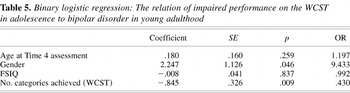
In order to ensure that the relation between impaired performance on the WCST and the later development of bipolar disorder was not accounted for by the effects of age at the time of assessment, gender, or premorbid FSIQ, a binary logistic regression was employed with these variables entered as covariates. In this and subsequent analyses the number of categories achieved on the WCST was used as the measure of executive function.1
Other studies have found this to be the most powerful variable for purposes of discriminating patients with unipolar depression and bipolar illness on the basis of performance on executive function tasks.
Binary logistic regression: The relation of impaired performance on the WCST in adolescence to bipolar disorder in young adulthood

Premorbid attentional problems, executive function impairment, and bipolar illness
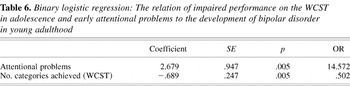
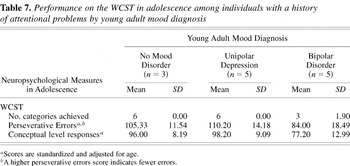
Next, a binary logistic regression was employed to determine whether impairment on the WCST was predictive of bipolar disorder, even after controlling for the effects of premorbid attentional problems. Attentional problems were entered first, followed by number of categories achieved on the WCST. Behavioral problems were not included in analyses because they were not predictive of bipolar disorder over and above attentional problems. Table 6 shows that number of categories achieved on the WCST made an independent contribution to the prediction of bipolar disorder (OR = .502, p = .005) after accounting for the effects of premorbid attentional problems (OR = 14.572, p = .005). A Pearson bivariate correlation revealed no association between early attentional problems and number of categories achieved on the WCST (r = −.114, p = .30). Indeed, Table 7 shows that impairment on the WCST was only associated with attentional problems that preceded bipolar illness. Individuals with early attentional problems who met criteria for unipolar depression or no mood disorder in young adulthood did not show impairment on the WCST in adolescence. In fact, all eight of these participants achieved the maximum number of categories possible, and group means for percent perseverative errors and percent conceptual level responses fell well within the average range. Conversely, all five individuals with early attentional problems and subsequent bipolar disorder exhibited impaired executive function skills, with mean scores on all three WCST parameters falling within the impaired range.
Binary logistic regression: The relation of impaired performance on the WCST in adolescence and early attentional problems to the development of bipolar disorder in young adulthood

Performance on the WCST in adolescence among individuals with a history of attentional problems by young adult mood diagnosis

Only one participant was taking stimulant medication at the time of testing. Nevertheless, because some reports indicate that stimulant medication may impact performance on tasks requiring the ability to shift cognitive sets (Tannock & Schachar, 1992), the above logistic regression was rerun controlling for lifetime use of stimulant medication. As expected, history of stimulant use did not account for the association between impairment on the WCST and the later diagnosis of bipolar disorder.
Discussion
We used data from a 23-year longitudinal prospective study of the offspring of mothers with bipolar illness, unipolar depression, or no psychiatric history to explore neuropsychological and behavioral predictors of bipolar illness in young adulthood. In this high-risk sample, 19% of the young adult offspring of mothers with bipolar disorder have developed bipolar disorder, as have 7% of the offspring of mothers with unipolar depression. None of the offspring of well mothers have developed bipolar illness. As a group, offspring with bipolar disorder appeared to be more impaired in occupational and interpersonal functioning at young adult follow-up than were participants with unipolar depression or no major mood disorder. Furthermore, one-third of participants with bipolar illness reported a history of psychotic symptoms, and 7 out of 9 have been hospitalized at least once for emotional difficulties. Data from this study also revealed that offspring who developed bipolar disorder achieved significantly lower premorbid PIQ scores than did participants with unipolar depression or no major mood disorder. However, mean PIQ for all three groups fell within the average range. In addition, offspring with bipolar disorder showed an elevated rate of early attentional problems compared with individuals with unipolar depression or no mood disorder, and a higher rate of early behavioral problems compared with individuals with no mood disorder. Similar findings have been reported in case studies (Coll & Bland, 1979; Dvoredsky & Stewart, 1981; Sylvester, Burke, McCauley, & Clark, 1984), cross-sectional investigations (Faraone et al., 1997; Sachs et al., 2000; Winokur, Coryell, Endicott, & Akiskal, 1993), and two other longitudinal studies (Carlson & Weintraub, 1993).
In investigating the relation between executive dysfunction in adolescence and the later onset of bipolar disorder, it was found that 67% of individuals who met criteria for bipolar disorder in young adulthood showed impairment on the WCST when they were tested during adolescence. This finding adds to evidence from cross-sectional studies that have detected executive function deficits among patients with bipolar disorder following diagnosis and pharmacologic treatment (Borkowska & Rybakowski, 2001; Zubieta et al., 2001). However, the current findings significantly clarify this literature by showing that impairment on the WCST, independent of gender, age, IQ, and premorbid attentional problems, preceded the formal diagnosis and treatment of bipolar disorder.
The current follow-up study is also informative insofar as it supports the hypothesis that variability in long-term diagnostic outcomes represents an important source of heterogeneity among youngsters with attentional problems (Faraone, 2000). Specifically, whereas early attentional problems that predated bipolar disorder were associated with impairment on the WCST, those that preceded unipolar depression or the absence of a mood disorder were not. This finding may help to explain why neuropsychological studies of children with attention-deficit/hyperactivity disorder have produced such varying results (Barkley et al., 1992; Sergeant, Geurts, & Oosterlaan, 2002).
Finally, during an era in which children with attentional problems, who also have a family history of bipolar illness, are increasingly being diagnosed with bipolar illness, it is important to note that, to date, 42% of participants in our study with both childhood attentional problems and a mother with bipolar illness have met criteria for bipolar illness at young adult follow-up. In all cases, manic/hypomanic symptoms did not occur until adolescence. Similarly, 50% of the offspring of mothers with bipolar disorder who were impaired on the WCST in adolescence have met criteria for bipolar disorder in young adulthood. In contrast, it is noteworthy that all of the offspring with both attentional problems and executive function deficits have been diagnosed with bipolar disorder. This suggests there may be different risk variables that will be predictive of later onset bipolar illness. We hope to be able to continue to follow members of our sample beyond early adulthood in order to explore similarities and differences in risk factors for early- versus later onset bipolar illness.
Implications for the development of early prevention and intervention efforts
Findings from this study support the concept of childhood attentional problems as a heterogeneous syndrome (Faraone, 2000; Jacobvitz & Sroufe, 1987). Thus, in treating early attentional difficulties, mental health professionals should take into consideration familial/genetic and behavioral risk variables, as well as neuropsychological data, when formulating individualized intervention strategies. In cases in which executive function appears to be compromised, and in which there is a well-documented parental history of bipolar illness, the possibility should be considered that overt attentional symptoms might be reflective of an underlying vulnerability for the development of bipolar disorder. However, it is important to note that, in isolation, impaired functioning on the WCST, early attentional deficits, and familial risk are nonspecific diagnostic indicators. As mentioned above, our findings showed that fewer than half of the offspring of mothers with bipolar disorder who manifested early attentional deficits, and only half who exhibited impairment on the WCST, met criteria for bipolar disorder in young adulthood. Moreover, there is some evidence that certain anxiety disorders may be associated with impairment on the WCST (Toren, Sadeh, Wolmer, Eldar, Koren, Weizman, & Laor, 2000), and both impaired functioning on the WCST and early attention deficits have been linked to risk for schizophrenia (Michie, Kent, Stienstra, Castine, Johnston, Dedman, Wichmann, Box, Rock, Rutherford, & Jablensky, 2000; Wolf, Cornblatt, Roberts, Maminski Shapiro, & Erlenmeyer–Kimling, 2002).
Limitations
Several factors limit the conclusions that may be drawn from the present study. First, only nine participants have developed bipolar disorder at young adult follow-up. Thus, there is limited power for detecting significant differences among diagnostic outcome groups. The fact that significant associations were detected may be a testament to the strength of these findings. An additional limitation comes from the fact that many participants have not yet passed through the period of highest risk for onset of bipolar disorder. Future follow-up efforts will be enlightening in this regard. In addition, at Time 4, only limited collateral information was collected as part of the formal diagnostic assessment regarding symptoms of bipolar disorder. However, these families have a long-standing relationship with the study staff, and parents keep in touch on a regular basis, providing diagnostic information and concerns well beyond the data that are gathered during formal assessment. Thus, the diagnostic decisions made at Time 4 were based on a body of information that was at least as comprehensive as that which is generally gathered during the course of a full cross-sectional diagnostic evaluation. A further limitation stems from the fact that only two measures of executive function were employed (WCST and TMT-B) at a single time point, and group differences were only significant for certain parameters of the WCST (number of categories achieved, percent conceptual level responses), not the TMT. Thus, one cannot conclude from the present study that individuals who developed bipolar disorder suffer from broad-based executive dysfunction, but rather more circumscribed deficits. In order to gain a richer understanding of the specific deficits that precede the diagnosis of bipolar disorder, future studies should include a full assessment of executive functions, including measures that assess verbal and visuospatial domains. An additional limitation to the present study is that participants in this sample are unique, in that all young adults who developed bipolar illness had mothers with a major affective disorder. In the general population, not all individuals who are diagnosed with bipolar disorder have an afflicted first-degree relative (Borchardt, Bernstein, & Crosby, 1995; Mendlewicz, 1988; Mendlewicz & Rainer, 1977). Thus, it is not clear to what extent findings can be generalized. Finally, because the subgroup of individuals who participated in this study differs in significant ways from the larger follow-up study group, it is unclear whether these findings would have been replicated using data from the entire sample.
References
REFERENCES
Achenbach, T., &
Edelbrock, C. S.
(1981).
Behavioral Problems and Competencies Reported by Parents of Normal
and Disturbed Children Aged Four through Sixteen.
Chicago:
University of Chicago Press.
Al-Mousawi, A. H.,
Evans, N.,
Ebmeier, K. P.,
Roeda, D.,
Chaloner, F., &
Ashcroft, G. W.
(1996).
Limbic dysfunction in schizophrenia and mania: A study using
18F-labeled fluorodeoxyglucose and positron emission tomography.
British Journal of Psychiatry
169,
509–516.CrossRefGoogle Scholar
Anderson, S. W.,
Damasio, H.,
Jones, R. D., &
Tranel, D.
(1991).
Wisconsin Card Sorting Test performance as a measure of frontal
lobe damage.
Journal of Clinical and Experimental Neuropsychology
13,
909–922.CrossRefGoogle Scholar
Barkley, R. A.,
Grodzinsky, G., &
DuPaul, G. J.
(1992).
Frontal lobe functions in attention deficit disorder with and
without hyperactivity: A review and research report.
Journal of Abnormal Child Psychology
20,
163–188.CrossRefGoogle Scholar
Berman, K. F.,
Ostrem, J. L.,
Randolph, C.,
Gold, J.,
Goldberg, T. E.,
Coppola, R.,
Carson, R. E.,
Herscovitch, P., &
Weinberger, D. R.
(1995).
Physiological activation of a cortical network during performance
of the Wisconsin Card Sorting Test: A positron emission tomography
study.
Neuropsychologia
33,
1027–1046.CrossRefGoogle Scholar
Borchardt, C. M.,
Bernstein, G. A., &
Crosby, R. D.
(1995).
Psychopathology in the families of inpatient affective disordered
adolescents.
Child Psychiatry and Human Development
26,
71–84.CrossRefGoogle Scholar
Borkowska, A., &
Rybakowski, J. K.
(2001).
Neuropsychological frontal lobe tests indicate that bipolar
depressed patients are more impaired than unipolar.
Bipolar Disorders
3,
88–94.CrossRefGoogle Scholar
Carlson, G. A.,
Bromet, E. J.,
Driessens, C.,
Mojtabai, R., &
Schwartz, J. E.
(2002).
Age at onset, childhood psychopathology, and 2-year outcome in
psychotic bipolar disorder.
American Journal of Psychiatry
159,
307–309.CrossRefGoogle Scholar
Carlson, G. A.,
Bromet, E. J., &
Sievers, S.
(2000).
Phenomenology and outcome of subjects with early- and adult-onset
psychotic mania.
American Journal of Psychiatry
157,
213–219.CrossRefGoogle Scholar
Carlson, G. A., &
Weintraub, S.
(1993).
Childhood behavior problems and bipolar disorder: Relationship or
coincidence?
Journal of Affective Disorders
28,
143–153.Google Scholar
Coll, P. G., &
Bland, R.
(1979).
Manic depressive illness in adolescence and childhood: Review and
case report.
Canadian Journal of Psychiatry
24,
255–263.CrossRefGoogle Scholar
Dvoredsky, A. E., &
Stewart, M. A.
(1981).
Hyperactivity followed by manic-depressive disorder: Two case
reports.
Journal of Clinical Psychiatry
42,
212–214.Google Scholar
Endicott, J., &
Spitzer, R. L.
(1978).
A diagnostic interview: The schedule for affective disorders and
schizophrenia.
Archives of General Psychiatry
35,
837–844.CrossRefGoogle Scholar
Faraone, S. V.
(2000).
Genetics of childhood disorders: XX. ADHD, part 4: Is ADHD
genetically heterogeneous?
Journal of the American Academy of Child and Adolescent Psychiatry
39,
1455–1457.Google Scholar
Faraone, S. V.,
Biederman, J.,
Wozniak, J.,
Mundy, E.,
Mennin, D., &
O'Donnell, D.
(1997).
Is comorbidity with ADHD a marker for juvenile-onset mania?
Journal of the American Academy of Child and Adolescent Psychiatry
36,
1046–1055.Google Scholar
Ferrier, I. N.,
MacMillan, I. C., &
Young, A. H.
(2001).
The search for the wandering thymostat: A review of some developments
in bipolar disorder research.
British Journal of Psychiatry,
178
(Suppl. 141),
S103–S106.CrossRefGoogle Scholar
Ferrier, I. N.,
Stanton, B. R.,
Kelly, T. P., &
Scott, J.
(1999).
Neuropsychological function in euthymic patients with bipolar
disorder.
British Journal of Psychiatry
175,
246–251.CrossRefGoogle Scholar
Ferrier, I. N., &
Thompson, J. M.
(2002).
Cognitive impairment in bipolar affective disorder: Implications
for the bipolar diathesis.
British Journal of Psychiatry
180,
293–295.CrossRefGoogle Scholar
First, M. B.,
Gibbon, M.,
Spitzer, R. L., &
Williams, J. B. W.
(1996).
User's guide for the structured clinical interview for DSM-IV
axis I disorders—research version (Version 2.0).
Washington, DC:
American Psychiatric Press.
Gourovitch, M. L.,
Torrey, E. F.,
Gold, J. M.,
Randolph, C.,
Weinberger, D. R., &
Goldberg, T. E.
(1999).
Neuropsychological performance of monozygotic twins discordant for
bipolar disorder.
Biological Psychiatry
45,
639–646.CrossRefGoogle Scholar
Grant, D. A., &
Berg, E. A.
(1948).
A behavioral analysis of degree of reinforcement and ease of
shifting to new responses in a Weigl-type card sorting problem.
Journal of General Psychology
38,
404–411.CrossRefGoogle Scholar
Hawkins, K. A.,
Hoffman, R. E.,
Quinlan, D. M.,
Rakfeldt, J.,
Docherty, N. M., &
Sledge, W. H.
(1997).
Cognition, negative symptoms, and diagnosis: A comparison of
schizophrenic, bipolar and control samples.
Journal of Neuropsychiatry and Clinical Neurosciences
9,
81–89.Google Scholar
Heaton, R. K.,
Chelune, G. J.,
Talley, J. L.,
Kay, G. G., &
Curtiss, G.
(1993).
Wisconsin Card Sorting Test Manual—Revised and Expanded.
Odessa, FL:
Psychological Assessment Resources.
Herjanic, B., &
Reich, W.
(1982).
Development of a structured psychiatric interview for children:
Agreement between child and parent on individual symptoms.
Journal of Abnormal Child Psychology
10,
307–324.CrossRefGoogle Scholar
Hodges, K.,
McKnew, D.,
Cytryn, L.,
Stern, L., &
Kline, J.
(1982).
The Child Assessment Schedule (CAS) diagnostic interview: A report
on reliability and validity.
Journal of the American Academy of Child Psychiatry
21,
468–473.CrossRefGoogle Scholar
Jacobvitz, D., &
Sroufe, L. A.
(1987).
The early caregiver–child relationship and attention-deficit
disorder with hyperactivity in kindergarten: A prospective study.
Child Development
58,
1496–1504.Google Scholar
Lezak, M. D.
(1995).
Neuropsychological assessment.
New York:
Oxford University Press.
Loong, J.
(1989).
The Wisconsin Card Sorting Task (Version 1.0).
San Luis Obisbo, CA:
Wang Neuropsychological Laboratory.
Martínez–Arán, A.,
Penadés, R.,
Vieta, E.,
Colom, F.,
Reinares, M.,
Benabarre, A.,
Salamero, M., &
Gastró, C.
(2002).
Executive function in patients with remitted bipolar disorder and
schizophrenia and its relationship with functional outcome.
Psychotherapy and Psychosomatics
71,
39–46.Google Scholar
Mendlewicz, J.
(1988).
Population and family studies in depression and mania.
British Journal of Psychiatry,
153
(Suppl. 3),
16–25.Google Scholar
Mendlewicz, J., &
Rainer, J. D.
(1977).
Adoption study supporting genetic transmission in manic depressive
illness.
Nature
268,
327–329.CrossRefGoogle Scholar
Michie, P. T.,
Kent, A.,
Stienstra, R.,
Castine, R.,
Johnston, J.,
Dedman, K.,
Wichmann, H.,
Box, J.,
Rock, D.,
Rutherford, E., &
Jablensky, A.
(2000).
Phenotypic markers as risk factors in schizophrenia: Neurocognitive
functions.
Australian and New Zealand Journal of Psychiatry
34,
S74–S85.CrossRefGoogle Scholar
Morice, R.
(1990).
Cognitive inflexibility and pre-frontal dysfunction in
schizophrenia and mania.
British Journal of Psychiatry
157,
50–54.CrossRefGoogle Scholar
Mountain, M. A., &
Snow, W. G.
(1993).
Wisconsin Card Sorting Test as a measure of frontal pathology: A
review.
Clinical Neuropsychologist
7,
108–118.CrossRefGoogle Scholar
Nagahama, Y.,
Fukuyama, H.,
Yamauchi, H.,
Matsuzaki, S.,
Konishi, J.,
Shibasaki, H., &
Kimura, J.
(1996).
Cerebral activation during performance of a card sorting task.
Brain
119,
1667–1675.CrossRefGoogle Scholar
Öngür, D.,
Drevets, W. C., &
Price, J. L.
(1998).
Glial reduction in the subgenual prefrontal cortex in mood
disorders.
Proceedings of the National Academy of Sciences of the United
States of America
95,
13290–13295.CrossRefGoogle Scholar
Pineda, D.,
Ardila, A.,
Rosseli, M.,
Cadavid, C.,
Manchedo, S., &
Mejia, S.
(1998).
Executive dysfunctions in children with attention deficit
hyperactivity disorder.
International Journal of Neuroscience
96,
177–196.CrossRefGoogle Scholar
Radke–Yarrow, M.
(1998).
Children of depressed mothers: From early childhood to maturity.
New York:
Cambridge University Press.
Rajkowska, G.,
Halaris, A., &
Selemon, L. D.
(2001).
Reductions in neuronal and glial density characterize the dorsolateral prefrontal cortex in bipolar disorder.
Biological Psychiatry,
49,
741–752.CrossRefGoogle Scholar
Reitan, R. M., &
Wolfson, D.
(1995).
Category Test and Trail Making Test as measures of frontal lobe
functions.
Clinical Neuropsychologist
9,
50–56.CrossRefGoogle Scholar
Rezai, K.,
Andreasen, N. C.,
Alliger, R.,
Cohen, G.,
Swayze, V., &
O'Leary, D. S.
(1993).
The neuropsychology of the prefrontal cortex.
Archives of Neurology
50,
636–642.CrossRefGoogle Scholar
Richters, J. E.
(1992).
Depressed mothers as informants about their children: A critical
review of the evidence of distortion.
Psychological Bulletin
112,
485–499.CrossRefGoogle Scholar
Sachs, G. S.,
Baldassano, C. F.,
Truman, C. J., &
Guille, C.
(2000).
Comorbidity of attention deficit hyperactivity disorder with early-
and late-onset bipolar disorder.
American Journal of Psychiatry
157,
466–468.CrossRefGoogle Scholar
Seidman, L. J.,
Biederman, J.,
Faraone, S. V.,
Weber, W., &
Ouellette, C.
(1997).
Toward defining a neuropsychology of attention
deficit-hyperactivity disorder: Performance of children and adolescents
from a large clinically referred sample.
Journal of Consulting and Clinical Psychology
65,
150–160.CrossRefGoogle Scholar
Sergeant, J. A.,
Geurts, H., &
Oosterlaan, J.
(2002).
How specific is a deficit of executive functioning for
attention-deficit/hyperactivity disorder?
Behavioural Brain Research
130,
3–28.Google Scholar
Spitzer, R. L.,
Williams, J. B. W.,
Gibbon, M., &
First, M. B.
(1992).
The structured clinical interview for DSM-III-R (SCID). 1.
History, rationale, and description.
Archives of General Psychiatry
49,
624–629.CrossRefGoogle Scholar
Spreen, O., &
Strauss, E.
(1998).
A compendium of neuropsychological tests: Administration, norms,
and commentary.
New York:
Oxford University Press.
SPSS.
(2000).
SPSS 10.0 for Macintosh (Release 10.0.7a.2000).
Chicago:
Author.
Strakowski, S. M.,
Delbello, M. P.,
Adler, C.,
Cecil, K. M., &
Sax, K. W.
(2000).
Neuroimaging in bipolar disorder.
Bipolar Disorders
2,
148–164.CrossRefGoogle Scholar
Stuss, D. T., &
Alexander, M. P.
(2000).
Executive functions and the frontal lobes: A conceptual view.
Psychological Research
63,
289–298.CrossRefGoogle Scholar
Stuss, D. T., &
Benson, D. F.
(1986).
The frontal lobes.
New York:
Raven Press.
Stuss, D. T.,
Levine, B.,
Alexander, M. P.,
Hong, J.,
Palumbo, C.,
Hamer, L.,
Murphy, K. J., &
Izukawa, D.
(2000).
Wisconsin Card Sorting Test performance in patients with focal
frontal and posterior brain damage: Effects of lesion location and test
structure on separable cognitive processes.
Neuropsychologia
38,
388–402.CrossRefGoogle Scholar
Sylvester, C. E.,
Burke, P. M.,
McCauley, E. A., &
Clark, C. J.
(1984).
Manic psychosis in childhood: Report of two cases.
Journal of Nervous and Mental Disease
172,
12–15.CrossRefGoogle Scholar
Tannock, R., &
Schachar, R.
(1992).
Methylphenidate and cognitive perseveration in hyperactive
children.
Journal of Child Psychology and Psychiatry and Allied Disciplines
33,
1217–1228.CrossRefGoogle Scholar
Tarullo, L. B.,
Richardson, D. T.,
Radke–Yarrow, M., &
Martinez, P. E.
(1995).
Multiple sources in child diagnosis: Parent–child concordance
in affectively ill and well families.
Journal of Clinical Child Psychology
24,
173–183.CrossRefGoogle Scholar
Toren, P.,
Sadeh, M.,
Wolmer, L.,
Eldar, S.,
Koren, S.,
Weizman, R., &
Laor, N.
(2000).
Neurocognitive correlates of anxiety disorders in children: A
preliminary report.
Journal of Anxiety Disorders
14,
239–247.CrossRefGoogle Scholar
Verdoux, H., &
Liraud, F.
(2000).
Neuropsychological function in subjects with psychotic and
affective disorders. Relationship to diagnostic category and duration
of illness.
European Psychiatry
15,
236–243.Google Scholar
Wechsler, D.
(1974).
Manual for the Wechsler intelligence scale for
children—Revised.
New York:
Psychological Corporation.
Weinberger, D. R.,
Berman, K. F., &
Zec, R. F.
(1986).
Physiologic dysfunction of dorsolateral prefrontal cortex in
schizophrenia. 1. Regional cerebral blood-flow evidence.
Archives of General Psychiatry
43,
114–124.Google Scholar
Winokur, G.,
Coryell, W.,
Endicott, J., &
Akiskal, H.
(1993).
Further distinctions between manic depressive illness (bipolar
disorder) and primary depressive disorder (unipolar depression).
American Journal of Psychiatry
150,
1176–1181.Google Scholar
Wolf, L. E.,
Cornblatt, B. A.,
Roberts, S. A.,
Maminski Shapiro, B., &
Erlenmeyer–Kimling, L.
(2002).
Wisconsin card sorting deficits in the offspring of schizophrenics
in the New York High Risk Project.
Schizophrenia Research
57,
173–182.CrossRefGoogle Scholar
Yurgellun–Todd, D. A.,
Gruber, S. A.,
Killgore, W. D. S., &
Tohen, M.
(2000).
Neuropsychological performance in first episode bipolar disorder.
International Journal of Neuropsychopharmacology,
3,
S333.Google Scholar
Zubieta, J. K.,
Huguelet, P.,
O'Neill, R. L., &
Giordani, B. J.
(2001).
Cognitive function in euthymic Bipolar I Disorder.
Psychiatry Research
102,
9–20.CrossRefGoogle Scholar
Schedule of assessments, including offspring age and relevant procedures
Demographic, psychosocial, and IQ variables by young adult mood diagnosis
Clinical and historical characteristics of offspring with bipolar illness (n = 9)
Performance on executive function measures in adolescence by young adult mood diagnosis
Binary logistic regression: The relation of impaired performance on the WCST in adolescence to bipolar disorder in young adulthood
Binary logistic regression: The relation of impaired performance on the WCST in adolescence and early attentional problems to the development of bipolar disorder in young adulthood
Performance on the WCST in adolescence among individuals with a history of attentional problems by young adult mood diagnosis
 You have
Access
- 134
- Cited by