




No CrossRef data available.
MORAL STATUS AND PERSONAL IDENTITY: CLONES, EMBRYOS, AND FUTURE GENERATIONS
Published online by Cambridge University Press: 15 June 2005
Abstract
In the first part of this article, I argue that even those entities that in their own right and for their own sake give us reason not to destroy them and to help them are sometimes substitutable for the good of other entities. In so arguing, I consider the idea of being valuable as an end in virtue of intrinsic and extrinsic properties. I also conclude that entities that have claims to things and against others are especially nonsubstitutable. In the second part, I argue that cloning poses no threat to the nonsubstitutability of these entities (and in this sense, to the dignity of persons). I also consider the relation between cloning and (what I called) holistic identity, and between the latter and genetic identity. In the concluding part of the article, I try to distinguish cases where identity over time and so-called person-affecting acts have and do not have greater moral significance than nonidentity over time and nonperson-affecting acts. I try to apply my results to cases involving embryos, future generations, and to the so-called Non-Identity Problem.
Information
- Type
- Research Article
- Information
- Copyright
- © 2005 Social Philosophy and Policy Foundation
I. Introduction
The permissibility of our actions can sometimes depend on the identities of those who will be affected by them. Investigating this phenomenon has been a traditional focus of deontological ethics. Deontological ethics claims that what we ought to do is not always a function of what will produce the best outcome: we could be morally constrained from producing the best outcome because it would require harming someone who would not himself benefit from our action, though others would. John Rawls referred to this as the moral relevance of the separateness of persons.1
See John Rawls, A Theory of Justice (Cambridge, MA: Harvard University Press, 1971), p. 29.
In Section III, I shall examine the validity of concerns about reproductive cloning that focus on the fear that cloned people will become substitutable for each other. In Section IV, I shall consider whether substitutions of harms and benefits that would be impermissible interpersonally are permissible when we act on embryos, even when there will be continuity between any such embryo and the person that will arise from it—and thus, possibly, there is identity over time of a human being (if not a person). If such substitutions are permissible, this will serve as a criticism of those who would argue that the moral status of an embryo should be that of a person if it will definitely give rise to a person (as opposed to merely having the potential to give rise to a person). I shall also consider how this bears on what is called the Non-Identity Problem and the distinction between person-affecting and non-person-affecting moral principles.
II. Types of Entities and the Importance of Personal Identity
A. Ways of mattering morally
When we say that something counts morally in its own right, we are often said to be thinking of its intrinsic worth or value rather than its instrumental value. If it were morally right to treat animals well only because this would promote kindness between persons, then animals would count morally only instrumentally. That is, they should be treated well not because of what they are in their own right, but only because of the effects on others of treating them well. Philosopher Christine Korsgaard has argued, however, that the true contrast to mere instrumental value is having value as an end, not having intrinsic value.2
See Christine Korsgaard, “Two Distinctions in Goodness,” The Philosophical Review 2 (April 1983): 169–95.
Note, however, that a thing's intrinsic properties might include relations between its parts.
See Ronald Dworkin, Life's Dominion: An Argument about Abortion, Euthanasia, and Individual Freedom (New York: Knopf, 1993).
A work of art or a tree may count morally in its own right in the sense that it gives us reason to constrain our behavior toward it (for example, not destroy it) just because that would preserve this entity. That is, independent of the pleasure or enlightenment that it does or will cause in people, a thing of aesthetic value gives us reason not to destroy it. In that sense, it counts morally. Nevertheless, this is still to be distinguished from constraining ourselves for the sake of the work of art or the tree. I do not act for its sake when I save a work of art, because I do not think of its good and how its continuing existence would be good for it when I save it. (Nor do I think of its exercising its capacities or performing its duties. Acting for the sake of its exercising capacities or performing duties might also involve acting for the entity's sake, though it need not involve seeking what is good for it.) Rather, I think of the good of the work of art, its worth as an art object, when I save it for no other reason than that it will continue to exist. By contrast, when I save a bird, I can do it for the bird's sake, because it will get something out of continuing to exist and it could be a harm to it not to continue. It seems that something must already have or have had the capacity for sentience or consciousness in order for it to be harmed by not continuing on in existence. This is because an entity must be able to get something out of its continuing existence, and a capacity for sentience or consciousness seems to be necessary for this. (I do not think either capacity is a necessary condition for us to be able to act for the sake of the entity, since each without the other is sufficient. Having the capacity is not the same as actually being sentient. It is also not the same as merely having the potential to be sentient, where the latter implies that an entity merely has the potential to have the capacity.) I shall say that an entity has (positive) moral status when in its own right, for its own sake, it gives us reason to help it and to refrain from destroying it.
On this account, a nonsentient, nonconscious embryo lacks moral status but could count morally in itself (e.g., could give us reason in its own right not to destroy it) because of its intrinsic and extrinsic properties, such as what its potential is. This is different from its merely having instrumental value because it will in fact give rise to a person that has moral status. For even if the embryo is not instrumental to there being a person (because it is deprived of an environment in which to develop), I believe its having the potential could still give it greater value than an embryo that lacks the potential. (Similarly, a Chippendale dining table may have value in itself and may have more value if it can also turn into a magnificent writing desk, though it will not.) Notice, however, that the instrumental value of an embryo might be greater if it will generate Beethoven rather than an ordinary person, even if the moral status of these two persons does not differ. Similarly, an embryo can have greater value in its own right if it has the potential to become an extraordinary human being (e.g., Beethoven) rather than an ordinary human being, even if these persons have the same moral status, and the embryo will not, in fact, generate anyone.
All this does not mean, however, that an embryo's continued existence is good for it or that it is harmed by not continuing on. Similarly, an ordinary table might, by magic, be turned into a table that can develop into a person, and it may be good to be a person, but can a table be the sort of thing that is harmed by not getting the good of its transformation? It does not seem so. The person that would come from the embryo also cannot be harmed by never coming to exist. But we can act for the sake of a person who will develop from the embryo by doing things to the embryo not for its sake but for the sake of the person who will exist. (I shall return to this issue in Section IV below.) The fact that an embryo may have value in its own right in virtue of its extrinsic properties could account for why it might be wrong to use it for frivolous purposes. If so, the ground for objecting to such acts would be like the ground for objecting to making lampshades of the flesh of deceased human beings (who had died of natural causes). The flesh has no moral status (as I am using the term), but it has an extrinsic relation to once-living human persons who had moral status, and thus it may give us reason in its own right not to use it in certain ways. (The embryo's particular intrinsic and extrinsic properties, of course, differ from those of the dead flesh.)
Those things for whose sake we can act when we save their lives may or may not give us as much reason to save them as entities whose existence cannot be extended for their own sake. For example, if we had to choose whether to destroy the Grand Canyon or a bird (holding constant the number of people who would get pleasure or be enlightened by each), it could be morally wrong to choose the Grand Canyon. This illustrates how something like a bird can count morally because it can get something out of life, without its giving more reason to act, in the sense of how significant its continuing in existence would be, relative to other things. Sometimes the remarkableness of something (such as the Grand Canyon) or its uniqueness calls for more protection than something else's having moral status.
Not all things whose lives we could save (or not destroy) for their own sake are things it would be wrong not to save or to destroy (for example, dangerous dogs). But if we did have a duty sometimes to save or not to destroy such entities, this still does not imply that all the entities that have moral status are entities to whom we owe it to save or not destroy their lives. There is a difference between one's having a duty to do something and having a duty to a specific entity to do it. The latter is known as a directed duty, and typically it has a correlative that is a right or a claim possessed by the entity to whom the duty is owed against the person who owes it.5
An exception may exist if there are duties one has to oneself, for one cannot have rights against oneself.
To what sort of entities is it possible to owe things or behaviors? Thomas Scanlon has argued that only entities capable of judgment-sensitive attitudes are entities to whom we can owe certain treatment.6
Thomas Scanlon, What We Owe to Each Other (Cambridge, MA: Harvard University Press, 1999).
I suggest this addition in my discussion of Scanlon's book; see F. M. Kamm, “Owing, Justifying, and Rejecting,” Mind 111, no. 442 (April 2002).
I have criticized Scanlon's use of his account of “owing to others” as the basis of an account of what it is for something to be wrong. I suggest it may better be understood as what makes it possible to wrong someone. See my “Owing, Justifying, and Rejecting.”
Scanlon thinks animals count morally in their own right and give us reasons to act for their sake. Hence, our conduct toward them can be right or wrong, independent of further considerations, but it cannot be owed to them and they cannot be wronged when we behave wrongly. This is because (he assumes) they are not capable of judgment-sensitive attitudes. Furthermore, he thinks that while we have a reason to help an animal in need, we can have the same reason to help a rational being in need plus an additional reason absent in the case of the animal: that is, we can owe it to the rational being to help him. On this account, the “greater” moral importance or value of rational beings (persons) gets fleshed out (in part) as the additional factor present in our relations with them: that is, we owe things to them or, as I would say, they have rights against us.
B. The bearing of personal identity on our treatment of persons
Having considered some different types of entities, I now want to consider whether and how we may take account of or ignore the facts of personal identity when we are dealing with persons.
There may be conflicts between satisfying interests or respecting rights and maximizing satisfaction of interests intrapersonally and interpersonally. (I will refer to interpersonally maximizing interests satisfied as “producing the greater good.”) Consider first the conflict between negative rights and great goods not protected by rights.9
Under “goods,” I include both benefits and the avoidance of harm.
It is often said that part of the reason why one person's right not to be paralyzed should take precedence over the greater good (when they conflict) is that others, not he, will receive the benefit of his sacrifice. Sometimes, however, it will be even worse to harm a person for his own greater benefit than it would be to harm him for the good of others. This is when we act against his will, for the charge of paternalism arises in the former case but not in the latter. In other cases, it seems that the reason for not imposing harm on one person is not that he will fail to be benefited, but rather that the greater good we produce is of the wrong sort. For example, it may consist in many small goods aggregated over many other persons, rather than a large benefit to any one other person. Consider a case in which someone has a negative right to not have his car damaged. I might nevertheless permissibly damage his car in the course of using it to rush someone else (who would otherwise die) to the hospital. If it were possible that, by damaging the car, I could produce a comparable number of additional years of life by giving an enormous number of people one minute each of additional life, would this be permissible too? It seems not. But is it really the separateness of the beneficiaries that stands in the way? Suppose that each of the beneficiaries of the small benefit faced as bad a prospect as the one person who would die (that is, suppose they were each on the point of death). Might not the small goods to many separate people then justify the imposition of harm on the one person?10
Derek Parfit emphasizes this in his Rediscovering Reasons (unpublished).
In the case just discussed, we have compared individuals one person at a time to see who will wind up worse off and who will get what, if we act one way rather than another. This procedure is called “pairwise comparison.” A proponent of pairwise comparison claims that the fact that potential recipients are separate persons—not only that the person undergoing harm is separate from anyone benefited—is relevant in deciding whether to perform an action that harms one person. By contrast, if we merely aggregate benefits over many people, then we ignore the distribution of the benefits over individual persons. (Notice that one person can be worse off than another through intrapersonal aggregation of harms, but aggregating over one life, even assuming constant personal identity, has problems of its own. For example, if one person will suffer a thousand headaches over the course of his life, but he will live seventy years and the headaches are interspersed evenly, he may be better off than someone who will have five hundred headaches over the course of a ten-year life, especially if they are bunched together.)
Arguably, the method of pairwise comparison is not adequate on its own. For sometimes it seems that a loss suffered by someone can be justified even though the benefit does not come to him but to others, each of whom would suffer less (if not aided) and benefit less (if aided) than he would. For example, suppose I refuse to save someone from death in order to save a million from paralysis. If aggregation in this case is permissible, it seems to diminish the significance of the separateness of persons in the way emphasized by pairwise comparison. Indeed, if I were to decide it was permissible to kill a person for the sake of saving the lives of a million people—a case in which each person would (if left unaided) suffer as great a loss as the one who is to be killed—this too would diminish the significance of the separateness of persons, at least as expressed by the requirement of pure pairwise comparison, since no one of the million would be any worse off (if not aided) than the one person would be if he died, nor would any one of the million receive a benefit (if aided) greater than the single person would receive if he were allowed to live.
There is, however, another way of taking account of the separateness of persons besides pure pairwise comparison. I call this “balancing of equals.” Imagine cases where there is a conflict of interests and we must decide whether to aid a smaller or a larger group (of non-overlapping persons). A person on one side of a conflict is balanced out against another on the other side, and the side with the greater number is helped, at least when each stands to lose and gain as much. This is a form of substitution of equals; for in a conflict between persons A and B, we think, from an impartial point of view, that we accomplish as much if we save B as if we save A, and hence we accomplish even more if we save B plus C. We think this even though A does not benefit if B is saved (because they are separate persons) and even though, from A's partial perspective, the outcome in which she survives is better than the one in which B survives. The balancing-of-equals approach can still respect the separateness of persons by not weighing against A's loss of twenty years of life a combination of B's loss of ten years and C's loss of ten years. That is, we can first engage in pairwise comparison to check to see if a person will suffer the greater loss and/or receive a greater benefit and only balance out those who stand to lose or gain as much. The combination of pairwise comparison and balancing allows us to justify saving a greater number rather than a smaller number of people in a conflict situation. However, if we allow an aggregation of losses suffered by several persons to outweigh another individual's greater loss (for example, saving a million from paralysis rather than one person from death), we still move beyond anything that balancing entails.
In cases involving negative rights, balancing is ruled out more frequently, even when the greater good we would produce by transgressing one person's negative right involves minimizing violations of comparable rights in others (each of whom stands to lose as much). For example, we may not kill one person to harvest his organs in order to save ten people from death. What is being relied on here to reinforce the moral significance of the separateness of persons and rule out balancing, I believe, is a claim on the part of a person to what would be taken from him (e.g., his property or his liberty) that is much stronger than anyone else's claim to it. By contrast, in cases where I must choose when to aid, each party may have the same (or no) claim on my assistance.11
I am here omitting consideration of fine points that make it permissible to take something that someone has a claim to if we do it in one way (e.g., redirecting a threat to him) but not if we do it in another way. For more on this, see my Morality, Mortality, vol. 2 (Oxford: Oxford University Press, 1996).
However, another suggestion that has been made to explain the cases involving negative rights reminds us of yet another way in which the separateness of persons has been thought to play a role in ethics. Some have said that my transgressing a right in order to prevent others from doing so produces the worse state of affairs from my perspective. The emphasis in this account seems to shift from the significance of the separateness of the potential victim and the potential beneficiaries to the significance of the separateness of a particular agent from other agents. This suggests that if another agent were to transgress someone's negative right for the sake of minimizing comparable rights violations, I would have no reason to stop him. For example, suppose B will violate A's right not to have his arm amputated in order to save many others from having their arms amputated. Do I have a reason (even if not a duty) to put aside my activities to stop the violation of A's right, rather than let it be the cause of the greater good? I think I do.12
And this is not because I would otherwise be intending the act by another's hand, for I need not be intending it. For example, I may be a very busy person, and making some effort so that transgressions do not occur is an imposition I would like to avoid, yet I have a reason to make the effort.
So far, I have been characterizing some ways in which the separateness of persons is taken account of in certain moral theories. We can summarize these ways as follows: (1) not substituting one person for another, period; (2) not substituting one person for another unless there is an equal loss and/or gain to be sustained by each; (3) not substituting one person for another when the person has a claim to control what makes him separate; (4) an agent not substituting for other agents.
C. Substitutability and ways of mattering morally
Now let us consider creatures who have a good but are not rights-bearers, and also entities of value in their own right but not ones for whose sake we can act. Let us see whether there is any principle analogous to the separateness of persons that can be applied when dealing with such entities. Would it be permissible to destroy one non-rights-bearing animal in order to prevent the destruction of others? Arguably, yes. (Notice that the sacrificeability of one animal for others is consistent with the fact that it is the sort of being that has a life of its own and could have been benefited if we had not harmed it.) Does this further imply that we may be utilitarians and simple maximizers with respect to animals? No, because it may still be wrong to aggregate small losses to many animals against a big loss to one animal at least when the former would not be as badly off (if not helped) as the latter. It might also be wrong to sacrifice a higher animal (for example, one with a greater degree of intellectual and interactive capacities) to save a greater number of lower ones. (In these respects, Robert Nozick seems to have been wrong in suggesting deontology for people and utilitarianism for animals.)13
See Robert Nozick, Anarchy, State, and Utopia (New York: Basic Books, 1974), p. 40.
Would it be permissible to destroy one embryo to save others from being destroyed, at least when the latter will develop into people? I believe so. Would it be permissible to destroy one great artwork to prevent several other comparable artworks from being destroyed? I believe so. Would it be permissible to destroy one human embryo to allow many monkey embryos to develop? I believe so.14
The argument for this is that even an embryo with the potential to be a person does not have the moral status of a person. Suppose for some reason it was good to produce monkeys but not necessary to produce another person, and the only way to produce monkeys was to sacrifice a human embryo. I think its lack of great moral importance makes the sacrifice of the embryo for a good purpose permissible.
This broad sacrificeability of one entity for the sake of others is in sharp contrast with the way it is permissible to treat a self-governing being. Yet it is also in contrast to the way we should treat some non-rights-bearing entities. For such sacrificeability is not true of entities whose value is purely symbolic, like flags, nor for holy entities. These things have no rights, and no good for whose sake we act, yet there are reasons not to destroy one for the sake of others that are analogous to reasons that apply to persons. For example, it may sometimes make no sense for it to be permissible to burn one flag to prevent many other flags from being burnt impermissibly. This is the case if it is their status as inviolable that we are concerned with in trying to save the many. For the permissibility of burning one to save others denies that very inviolability. If this is true of purely symbolic entities, but not of embryos, this suggests that the value of the embryo does not reside merely in its role as a symbol of human life. An embryo may serve merely as a symbol only when we are not interested in its future development. Hence, we may think that it makes sense to destroy one embryo for the sake of the future development of other embryos, but not for the sake of their survival as mere symbols of life in a freezer.
In Section II, I have considered different types of entities falling into increasingly narrow categories: those that count in their own right, those that have moral status, and those that can have claims against us. I have argued that the moral nonsubstitutability of the entities that can have claims against us is stronger than the nonsubstitutability of those that merely count in their own right or that merely have moral status. This is true even though those in the latter class can have separate points of view and interests of their own. In the next section, I attempt to apply these conclusions about nonsubstitutability to the issue of reproductive cloning.
III. Reproductive Cloning

There are many objections that people raise to reproductive cloning. My primary concern in this context is with the sense that it might be “a threat to one's personal identity” and to the nonsubstitutability of persons that I have discussed above. Let us deal with the substitutability issue first.15
Some material in this section is drawn from my essay “Cloning and Harm to Offspring,” New York University Journal of Legislation and Public Policy 4, no. 1 (2000).
As we have seen, nonsubstitutability in a strong sense—for example, not violating a strong negative right even to minimize the violation of comparable rights in others—pertains for the most part to the sorts of individuals to whom one can owe things: self-conscious, rational beings. Such nonsubstitutability seems connected to what we call the dignity of persons. Hence, some may think that cloning is incompatible with the dignity of persons because it would reduce nonsubstitutability. How could being a person who exists as a result of cloning deprive one of being entitled to such regard? Imagine you are under a massive delusion about the way in which you were actually produced. Everything about you remains as you are now, except that you are not the product, as you believed, of sexual reproduction, but of mono-parental cloning. Would you think that your rights had changed dramatically? I do not think you would, and I think you would be right not to. The question of the historical course of events that leads to the existence of a certain sort of being can, for the most part, be distinguished from the value of the entity that is produced and what gives it value.16
But this is not always the case, since there are interesting philosophical cases in which origins do matter to the value of an entity. For example, that a set of marks on paper is an expression of the artist's view of nature, rather than produced by the random acts of a monkey, gives it value.
I have criticized Ronald Dworkin for inordinately emphasizing origins in his account of value. See Frances M. Kamm, “Abortion and the Value of Life: A Discussion of Life's Dominion,” Columbia Law Review 95 (1995): 160, 164–65, reviewing Ronald Dworkin, Life's Dominion: An Argument about Abortion, Euthanasia, and Individual Freedom.
Is a person, if he is genetically identical to someone else (as a result of cloning or otherwise), replaceable by that second person? Sometimes people want to say that a genetic clone is not going to have the same phenotype as you do, and thus is neither going to be you, nor be a replacement for you, on this account.18
See Lee M. Silver, Comments at the New York University Journal of Legislation and Public Policy symposium “Legislating Morality: The Debate over Human Cloning,” November 19, 1999, transcript on file with the New York University Journal of Legislation and Public Policy. One's genotype is one's genetic material. One's phenotype is one's characteristics due to both genotype and environmental factors.
I owe this point to David Copp. He reminded me that a very altruistic person could be indifferent between his own survival and the survival of another. Also, someone who held an inaccurate metaphysics might not recognize the difference between himself and another.
Suppose someone told me: “If we kill you, or fire you, we will also replace you with a being that is genetically and phenotypically identical to you, but, of course, numerically distinct.” That would not in any significant way compensate me for my loss of life or job, given that I don't care about the clone. Now, this raises the question that philosophers often discuss: What is it that we ought to be concerned about in our survival? Is it just a type of gene, a phenotype, or the particular individual? It seems to many people that it is more the particular individual's survival than their type, either genetic or phenotypic, that is crucial. Now, suppose you were replaceable to everybody else; that is, suppose they do not care about you except for your genotype and your phenotype; they do not care about you as a particular person. This is not usually true, but suppose it were. It would still be the case that your right to life and to respect would be as strong as any other person's, given that you are the sort of creature who has a claim to his life and does not waive it. The crucial foundation for the idea of respect for the person or the right to life would not be changed by cloning, even if we allow for identity of phenotype.
In literature, the idea of one's double (as in Dostoyevsky's The Double)20
In this novel, Mr. G, a clerk, is rejected by all who formerly befriended him. It seems that either he has done something extremely objectionable to offend everyone, or he is not recognized by those whom he visits. As he wanders along the streets, trying to decide why he is being so badly treated, he encounters a man who looks very like himself and, in fact, calls himself by the same name and was born in the same village. Mr. G welcomes the new Mr. G into his life, sharing everything, including a position at his workplace. The newcomer begins to act outrageously, with the consequences being assigned to the first Mr. G. Life becomes unbearable for the first Mr. G, and eventually, he is tricked into entering a carriage bound for the insane asylum.
In sum, it should be emphasized that an argument based on the fact that cloning will not result in the same phenotype, though well-intentioned and probably correct, is misplaced. Respect for persons entailing strong nonsubstitutability—even if all had the same phenotype and genotype—would be based on their each being self-conscious, being capable of responding to reasons, and having a claim to their individual lives greater than anyone else has.
Notice that I have so far been arguing against the view that cloning is inconsistent with the dignity of the person in the sense that this is interpreted to meant that one could not be a person with such dignity if one had been cloned or if one had a clone in existence. But the view might be interpreted differently: Given that the clone will be a person with dignity, it is wrong to bring such a being into existence by cloning. But why should this be true? If cloning of persons were the natural form of reproduction, would there be a prima facie moral obligation to develop sexual reproduction instead, out of concern for the dignity of persons? And if not, why is there something inherently wrong with introducing reproductive cloning? Would there be such a prima facie obligation if clones were phenotypically the same? Why is it an insult to one's dignity that others share the same phenotype?
I have tried to argue that the worth and strong nonsubstitutability of persons are not incompatible with reproductive cloning, either in the sense that cloning would rob persons of dignity or that it would insult the dignity that they have. I now want to consider the view that cloning is a threat to human identity and personal identification in a less than strict sense. My comments apply equally to the cases of human clones that already exist—genetically identical twins—except that I will sometimes imagine (for argument's sake) that twins have an identical phenotype as well as genotype.
There is a sense of “personal identity” that is commonly used by psychologists, doctors, and biologists. It is what I shall call a “holistic sense” of personal identity closely related to one's phenotype—the sense in which I am a philosopher, someone who is interested in art, or someone who makes jokes. All of this is part of my holistic identity, for someone would not be me in the holistic sense if she were not interested in philosophy or art or making jokes.
Consider a way of presenting the views of those who emphasize the importance of differences in the parts of the actual phenotype with which they say we identify ourselves holistically. Figure 1 represents four logical possibilities. (I do not mean to imply that all are physically possible.) In condition A, we all have the same genotype and the same holistic phenotype. In condition B, we have the same genotype and different holistic phenotypes. In condition C, we have different genotypes and the same holistic phenotype. In condition D, we have different genotypes and different holistic phenotypes.

Logically possible genotype/phenotype relations.
To those who think that what is worrisome about reproductive cloning is only identical holistic phenotypes, condition A (where, let us assume, there is cloning) is as worrisome as condition C (where there is no cloning), and conditions B and D are equally unworrisome per se. Suppose that (contrary to fact) the only way we could ensure holistic phenotypic nonidentity were by ensuring genetic identity. Then (if genetic identity did not occur naturally) cloning would be the preferred mode of reproduction, if all we were obliged to be concerned about was holistic identity differentiation. This view seems reinforced by entertaining the following thought experiment: Suppose that we have all been misled, and all our genetic makeups are already, in fact, naturally identical. If our phenotypic differences remain as they are, we would not worry about losing a holistic sense of identity differentiation.
This psychosocial, holistic notion of personal identity is not the philosopher's notion of personal identity, however. The philosopher's notion of personal identity concerns those properties that are essential to your nature, such that if we changed them, you would no longer exist in a strict sense.21
See Harold W. Noonan, Personal Identity (London: Routledge, 1989), 2–3; and Sydney Shoemaker and Richard Swinburne, Personal Identity (Oxford: Blackwell, 1984), 4–5.
Some philosophers claim that if the same sperm and egg from which you arose had been placed in a different environment, or had been held up in some laboratory and started dividing at a later point in time, it would still have resulted in you.22
See Thomas Nagel, “Death,” in Nagel, Mortal Questions (Cambridge: Cambridge University Press, 1979), 1, 8.
As I have already noted, many people who say that a clone will not be you point to the expected phenotypic difference, and they probably do this because they think that holistic phenotypic differentiation among people is very important, even though we would not literally fear we were someone else or fear that moral nonsubstitutability would disappear if there were no such differentiation. The fact that, in the philosopher's sense, it could have been you with a different holistic phenotype may make the response to the “threat of cloning” that emphasizes continuation of phenotypic differences seem weaker. For when I consider individuals who are holistically phenotypically different from me but genetically identical, I may think that any one of those individuals is an example of what I might have been like while (to be redundant) still being me. The idea is that, though we are holistically phenotypically different, I could have had your holistic phenotype, and thus it is not holistic phenotypes but something else that is crucial to who I am. (Of course, even if we have the same genotype and could have shared holistic phenotypes, I would not be the other person, since we are numerically distinct and in fact do not share the same holistic phenotype.)
In addition, consider that there is a tension between the importance of genetic connection with offspring, and the idea that holistic phenotype, and not genotype, determines who we really are. Suppose someone offers me a genetically unrelated child who is phenotypically very similar to me, including all the same interests and values that I have. Many people think that I still would not have satisfied a supposed intense desire for genetic connection. If genetic connection is so important, this suggests that people think their genes are very important to who they are. It is the latter thought that leads people to think that they should project their genes into the future. Thus, the idea that passing on his genes is so important to a person is at war with the idea that phenotypic difference is enough to distinguish individuals from one another (in a nonphilosophical sense) and that phenotypic similarity is enough to relate them to one another.23
I am aware that the underlying drive to have one's genes pass on may only give rise to a conscious desire to reproduce, not a conscious desire to pass on one's genes. One could have the first desire before one knows anything about genes. Once one is genetically literate, however, a new desire with passing on one's genes as its object may arise.
Perhaps considerations such as these—only partially grasped, not as a full-fledged philosophical theory of identity—may underlie some people's sense that it is undesirable to have beings who share their genotype, making condition B in Figure 1 worse than condition D. Here the presupposition is that it is a genotype, or at least part of it, that is essential to me. (Of course, it cannot be the only thing essential to me, since, by hypothesis, someone else has it too.) This leaves it open that phenotypic nondifferentiation would be too high a price to pay if it alone were compatible with genetic diversity, and thus condition A in Figure 1 is the worst outcome. Now, I do not believe that thinking along these lines would provide a decisive argument against cloning, because one's genetically identical natural twin now shares one's genotype as well, and do we think there is a strong reason to prevent natural identical twinning? But perhaps thinking along these lines may provide one with a reason to prefer a world in which there is no natural twinning and a reason not to seek such twins, even with phenotypic diversity.
Twins as we know them now are synchronic (that is, they come into being simultaneously). Clones might come into being diachronically (for example, a bit later than the original or after the original has ceased to exist). It might be thought that the very thing that makes one uncomfortable with even a phenotypically different clone existing synchronically with oneself could be desirable if the clone existed diachronically after one ceased to exist. For if we cannot be immortal, having a successor who is a clone could bring us as close as possible to immortality. (According to at least one philosophical theory of personal identity, a successor to you that had certain very tight causal relations to you, might actually be you.)24
See Robert Nozick, Philosophical Explanations (Cambridge, MA: Harvard University Press, 1981), 34–35. Having a successor is different from merely having offspring in ordinary reproduction. For example, the latter do not usually begin life just as the parent is leaving it. And offspring that fuse genetic material (and perhaps phenotypic properties) of emotionally bonded people may be the ideal in ordinary reproduction. Producing such a “chimera” of two people could even be preferred to two emotionally bonded people having a biological role in helping to produce the clones of each one.
This, however, seems to be the problem. Synchronic cloning is in one way less threatening because it seems clearer that an original and a clone are separate individuals when they both exist. When the original has passed away, however, the possibility that someone else will be identified as the original may seem greater. Suppose we think such identification of a closest successor with the original is a mistake (that is, we do not accept the metaphysical theory according to which such identification is correct). Then, if identification takes place, we shall be disturbed by the sense that acts and accomplishments that are someone else's may be added to the account of the original, making “his life” beyond his control. So long as I am a token of a type, I am definitely to be distinguished from other such tokens. If I cease to be a token of this type (because I cease to be), the fact that an instance of the type could supersede me becomes a cause of concern.
IV. When Identity Might Not Matter Morally
A. The embryo of a future person
I have argued that a cloned person (just like a noncloned person) could not permissibly be harmed in order to minimize comparable harms to other persons, cloned or uncloned. Now I want to consider whether an embryo that will in fact develop into a person is also protected against less-than-lethal interventions that will negatively affect the future person and that are undertaken for the sake of benefiting other future persons by affecting other embryos from which they will develop.
Previously, I have argued against what I shall call the View:25
See F. M. Kamm, Creation and Abortion (New York: Oxford University Press, 1992); Kamm, “Cloning and Harm to Offspring,” Legislation and Public Policy 4 (2000–2001): 65–76; and Kamm, “Genes, Justice, and Obligations to Future People,” Social Philosophy and Policy 19, no. 2 (2002): 360–88.
One premise in an argument (call it the Argument) for the View26
Such an argument is made in Allen Buchanan, Dan W. Brock, Norman Daniels, and Daniel Wikler, From Chance to Choice: Genetics and Justice (New York: Cambridge University Press, 2000).
Recently, philosopher Elizabeth Harman has characterized the Argument as follows (speaking of early fetuses, whom she claims have no moral status but are capable of being harmed):
According to the existing account, we are prohibited from harming those early fetuses that will be carried to term not because of anything constitutive of the harming itself. It is not that these things, these early fetuses, are the kind of things we should not harm. It is merely that there is a bad further consequence of harming these fetuses: in the future, a baby is born who suffers from fetal alcohol syndrome or some other bad effect of the earlier harming. This bad account may fail to address the worry expressed by those who challenge the liberal view [on abortion]. The worry may not simply be that the liberal view is incompatible with prohibitions on harming early fetuses. Rather, it may be that the liberal view is incompatible with its being the case that some early fetuses are the kind of things [we are] prohibited from harming. The worry is that the liberal view cannot appeal to the nature and status of these early fetuses themselves in explaining why we are prohibited from harming them.27
Elizabeth Harman, “Creation Ethics: The Moral Status of Early Fetuses and the Ethics of Abortion,” Philosophy and Public Affairs 28, no. 4 (1999): 310–24, p. 311.
In place of the Argument, Harman offers what she calls the Actual Future Principle: “An early fetus that will become a person has some moral status. An early fetus that will die while it is still an early fetus has no moral status.”28
Ibid.
Ibid., 312 n. 3.
A problem that arises for the Actual Future Principle that does not arise for the Argument is that the former implies (when combined with Harman's view that it is possible to harm early fetuses, and presumably embryos) that we may not do things to a fetus that harm it, even when the harm is short-lived and will not affect the person whom the fetus will definitely become. This is because we have a prima facie duty not to harm a person, even when the harm is short-lived and will not go on to affect the person in the future. I think (a) it is either not true that it is impermissible to cause a short-lived harm, or (b) if it is impermissible to cause such a short-lived harm (e.g., pain), this will be true even if the embryo/fetus will not develop into a person.
I shall put this issue aside, for I am interested to show that the View is wrong and that if the Actual Future Principle implies the View, it too is wrong. Hence, either the Actual Future Principle does not imply the View and we need to know why it does not, or, I will argue, the principle is wrong. With respect to the Argument, I claim only to show (as I have tried to do elsewhere) that while its first premise may be true, it does not imply the View. That is, we can agree that any duties we have to treat a fetus in a certain way exist only because of the person it will develop into, but this does not imply the View.
Here is an example which, I believe, shows that it is permissible to affect a future person by doing something to the fetus (or to the embryo) from which he develops, though it is not permissible to affect the person in the same way by doing something to him once he exists. Suppose a woman has given a fetus genes that will result in a person with an IQ of 160. She decides this is too smart, not for the good of the person who has the high IQ, but for the good of the family. As a result, she takes a drug during early pregnancy to reduce the future person's IQ to 140.30
I first discussed this case in my book Creation and Abortion (Oxford: Oxford University Press, 1992).
For discussion of this issue, see my Creation and Abortion.
I first presented this argument in Creation and Abortion.
Because the fetus is not yet a person (or does not yet have other properties that make it an entity that is entitled to keep what is given to it)—even though it will become a person—the act of taking away characteristics the fetus has (which will impact on the person that will be) is no different from not giving it those characteristics to begin with. And one would have a right not to give a future person that one created genes sufficient for a 160 IQ. Analogously, if a parent puts money into a bank account that will belong to someone when he exists as an adult, the fact that he will exist as an adult, by itself, does not imply that it is impermissible for the parent to take back the money before the person reaches the age at which he can claim his bank account. (This is true even if the parent has not earned her own money, but has inherited it from others as people inherit their genes.)
Suppose now that the fetus is not in the woman's body, dependent on her services in carrying it. Instead, it is growing in a mechanical gestation device. Yet imagine that the world is such that if the woman engages in an activity such as exercising (no matter where), this has the effect of altering the fetus so that the person who develops will have an IQ of 140 rather than 160. Would it be permissible for her to exercise? First, consider the variant in which she has given the fetus its intelligence genes. Here I think it is permissible for her to do what causes the drop in IQ, since she is taking back what she has given to an entity not yet entitled to retain this thing. However, it would be prima facie impermissible for her to engage in the same activity when it would affect a child of hers who is in possession of genetic material that will bring about the higher IQ, material he is entitled not to be deprived of. Now consider the variant in which it is the father who gave the fetus the intelligence genes. It is true that the fetus is not entitled to keep these genes, and on the basis of his donation, the father may remove them, but that does not mean that just anyone may take an action that would remove them (or alter their effects on the child's intelligence). Since the woman in this case has neither given the relevant genes nor is contributing any efforts necessary for the fruition of the genes, I think that she may not do those things that lead to a drop in IQ to 140. (Nor may any other entity, such as a government, without the father's permission, do things to lower the IQ to 140, other things being equal.)
What about the permissibility of a parent not rendering assistance to a fetus to prevent a natural change that will lead the person who develops from the fetus to have a 140 IQ rather than a 160 IQ? If the change would occur in the fetus before it is entitled to keep the traits, I believe that one need not make as great an effort to stop the reduction in IQ as one should make once one is the parent of the child who has the 160 IQ or the genetic traits that will lead to the 160 IQ. A parent's duty to help a child keep a beneficial trait that the child already has can be stronger than a parent's duty to see to it that her offspring comes to have such a trait by helping the embryo retain the genetic material.33
Unlike the duty not to take away from (what is already) a person those things she is entitled to, the duty to provide aid does not rely so strongly on the presence of the person. For this reason, one may sense less of a difference in the fetus and child variants of cases when aiding is in question. Note that nothing I have said implies that it is better for someone acting in the interests of a future person to (1) cause a large loss to the future person by acting at his early fetus stage rather than (2) cause a small loss to that person through an action one takes when he exists. One argument for this is that if I know that I must or will do one or the other, it is ex ante in the future person's interest to waive his right against my doing (2) so that I do not do (1). A second argument is based on what I call the “principle of secondary permissibility.” Very roughly, it implies that if I will permissibly cause someone a harm in one way, it may become permissible to cause a lesser harm in a way that would otherwise be impermissible. (For more on this principle, see my Morality, Mortality, vol. 2 [New York: Oxford University Press, 1996], and my essay “Failures of Just War Theory,” Ethics 114, no. 4 [2004]: 650–92.) Hence, I think I should, in this case, do (2) rather than (1). I thank Richard Arneson for the question to which this is a response.
But now consider an in-between case.34
I owe this case to Arthur Applbaum.
Recall the View as I set it out at the beginning of this section: We have as strong a duty not to do things to an embryo that will result in harm (or fail to prevent harm) to the person that the embryo will definitely develop into as we have not to harm (or fail to prevent harm to) that person when he is already in existence. Suppose that my arguments have shown that the View is incorrect. If the View is implied by the Actual Future Principle, then the latter is incorrect.
Now, imagine again that a mother has given a fetus genetic material that would give the person it will develop into a 160 IQ. Imagine further that if the mother takes from the fetus some genetic material, this makes the fetus develop into a person with a 140 IQ instead, and the mother can then transfer the material into two other fetuses, thereby raising their IQs from 130 to 140 each. What I have said above, I think, implies that doing this would be permissible. The mother would be morally free to equalize beneficial traits among future persons by affecting their embryos, even though she thereby makes some person worse off than he would otherwise be. However, I do not think it would be permissible for her to (safely) take from a child (already a person) some characteristic that will or does give him a 160 IQ, leaving him with a 140 IQ, so that she can transfer the material into two other children, raising their IQs from 130 to 140 each.
When modifying the genome of an embryo is contemplated, it is usually in a context where we can improve the life of the person who will develop from the embryo. I have raised the possibility that it might be permissible, for good reason, to alter an embryo in a way that will cause the person who develops to be worse off than he might otherwise be. It might be noted that in the real world there would be no need to take something from one embryo in order to place it in another embryo, as a means of improving the latter, as was true in my hypothetical case. And while making one person worse off without thereby improving others could increase equality between people, this sort of “leveling down” to achieve equality is often taken to be a counterexample to the value of achieving equality. However, taking something away from one embryo without transferring anything to others could still improve the lives of persons who will develop from the other embryos. For example, it might make it more likely that they will win their share of competitions with the other person. Then there could be an increase in their absolute well-being and the charge of “leveling down” would be defeated.
B. Future generations and the Non-Identity Problem
These results bear in an important way on our responsibilities to future generations. Take the imaginary case in which we know that certain particular people will definitely exist in a hundred years. Suppose we engage in activities today that will affect the environment in such a way that the air quality will not be as good in one hundred years, though it will still be above the level that we owe to future generations. Suppose, further, that there is no person in existence yet whose environment that future environment is. I believe we may engage in such activities. But if we were (somehow) transported one hundred years hence, it could well be impermissible to engage in the same activities that reduce to the same degree the air quality that the persons then living are already enjoying. In fact, it is not necessary that these people (or the children in my previous cases) actually already be in possession of the better environment (or the more advantageous trait, whether it is the higher IQ or the genetic trait that will lead to it). Given that they are already persons, if their prospects as persons are for acquiring such a superior environment (or advantageous trait), they should not be deprived of these prospects by an event that occurs once they are persons.35
It might be said that if we act now so as to worsen the environment in a delayed manner, the future persons could not ever be in possession of the prospects for a better environment. But what I have in mind are two different causal routes: one route leads to the prospects and the other would lead to their being undone; and the event of their being undone would occur during the lifetimes of the future persons.
Finally, let me consider the possible bearing of these issues on what is known as “the Non-Identity Problem.” Derek Parfit famously argued that sometimes, at least, it seems not to matter morally whether we are affecting the same (identical) person for the worse or just making someone worse off than some separate (nonidentical) person would have been.36
See Derek Parfit, Reasons and Persons (New York: Oxford University Press, 1985).
Let us assume that the worse life in these examples is still a life worth living, and also that it is a life that is good enough to meet the standards that a responsible parent could be held to in creating new people. Then we cannot argue that people are entitled not to have the worse life because they are entitled not to be in certain states, whether by our making them worse off than they would have otherwise been or by our doing something that leads to the existence of worse-off people (than would have otherwise existed). That is, we cannot argue that person-affecting principles do not have special weight because people simply have a right not to be in the worse state. It is just the comparative worseness of one set of people that speaks against the act that produces them, just as it is the comparative worseness of the way in which a given person's life will go that speaks against acting in a way that makes him worse off.
How might what I have said against the View bear on the Non-Identity Problem? I have argued that sometimes the way in which we affect someone for the worse can make a moral difference, not just the fact that we affect him for the worse. If we affect him by doing something to him or to some trait or resource he is entitled to (only because he has it and it is or will be beneficial to him), this can have greater moral significance than if we affect him similarly by doing something to a trait or resource he is not yet entitled to because he does not yet exist as a being who can have entitlements. Standard cases in which we affect people for the worse are like the former. This leaves it open that person-affecting cases of the latter sort are not morally more significant than non-person-affecting cases, while cases of the former sort are more significant. Choosing to perform easily avoidable acts that lead to a given offspring having fewer resources may be no worse than choosing to perform easily avoidable acts that lead to creating a worse-off person rather than a different better-off person. Yet both sorts of acts may be less morally problematic than performing an act that will take from someone what he is entitled to keep (or not provide him with help he is entitled to get), resulting in his having fewer resources. If the person-affecting cases that are used to illustrate the Non-Identity Problem do not involve entitlement based on personal possession, then they do not compare the stronger form of person-affecting principles with non-person-affecting principles. This means that the argument for the moral equivalence of non-person-affecting and person-affecting actions is crucially incomplete.
V. Conclusion
In Section II of this essay, I argued that even those entities that, in their own right and for their own sake, give us reason not to destroy them (and to help them) are sometimes substitutable for the good of other entities. In so arguing, I considered the idea of being valuable as an end in virtue of intrinsic and extrinsic properties. I also concluded that entities that have claims to things and against others are especially nonsubstitutable. In Section III, I argued that reproductive cloning poses no threat to the nonsubstitutability of these entities (and in this sense, to the dignity of persons). I also considered the relation between cloning and (what I called) holistic identity, and between the latter and genetic identity. In Section IV, I tried to distinguish between (1) cases where identity over time and so-called person-affecting acts have greater moral significance than nonidentity over time and non-person-affecting acts and (2) cases where they do not have greater moral significance. I tried to apply my results to cases involving embryos, future generations, and to the so-called Non-Identity Problem.
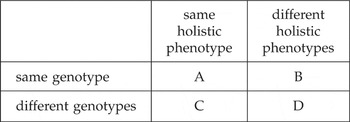
Logically possible genotype/phenotype relations.
 You have
Access
- 6
- Cited by