Introduction
One of the central questions that models of bilingual speech production need to answer refers to the role of the lexical representations of the non-response language in the course of lexicalization in the language currently used (Costa, Reference Costa2005; La Heij, Reference La Heij2005; Costa, La Heij and Navarrete, Reference Costa, Heij and Navarrete2006b; Finkbeiner, Gollan and Caramazza, Reference Finkbeiner, Gollan and Caramazza2006; Kroll, Bobb and Wodniecka, Reference Kroll, Bobb and Wodniecka2006). There is wide agreement among researchers in assuming that in the course of lexical access the lexical representations of the two languages of a bilingual become activated simultaneously (Green, Reference Green1998; Hermans, Bongaerts, De Bot and Schreuder, Reference Hermans, Bongaerts, de Bot and Schreuder1998; Costa and Caramazza, Reference Costa and Caramazza1999; Costa, Miozzo and Caramazza, Reference Costa, Miozzo and Caramazza1999; La Heij, Reference La Heij2005; Costa, Ivanova and Santesteban, Reference Costa, Ivanova and Santesteban2006a). That is, when an English–Spanish bilingual is asked to name the picture of a dog, the semantic system activates both the lexical representation in the response language (“dog”) and its corresponding translation in the non-response language (“perro”). What is the impact of having a translation word activated during the process of lexicalization in the target language? Does the activation of the lexical representations of the non-response language (e.g., Spanish) disrupt or hamper the selection of the correct lexical node in the language chosen for production (e.g., English)?
This issue has been addressed recently by means of the contextual effects in a Stroop-like task: the picture–word interference paradigm. In this paradigm, participants are asked to name a picture while ignoring the presentation of a distractor word. Perhaps the most robust effect observed with this paradigm is the semantic interference effect: picture naming latencies are higher when the distractor word (“dog”) is categorically related to the target (“cat”) than when it is unrelated (“chair”) (e.g., Lupker, Reference Lupker1979; Glaser and Glaser, Reference Glaser and Glaser1989). This effect has often been interpreted as revealing the larger interference produced by related distractors in comparison to the unrelated distractors at the lexical level during lexical selection (e.g., Schriefers, Meyer and Levelt, Reference Schriefers, Meyer and Levelt1990; Roelofs, Reference Roelofs1992; but see Rosinski, Reference Rosinski1977; and Costa, Alario and Caramazza, Reference Costa, Alario and Caramazza2005; for a different interpretation).
The semantic interference effect has been also explored in bilingual contexts, in which bilingual participants name pictures in one of their languages and distractors are presented in their other language. The evidence for the presence of semantic interference across languages is now overwhelming (e.g., Ehri and Ryan, Reference Ehri and Ryan1980; Goodman, Haith, Guttentag and Rao, Reference Glaser and Glaser1985; Hermans et al., Reference Hermans, Bongaerts, de Bot and Schreuder1998; Costa and Caramazza, Reference Costa and Caramazza1999). For example, in the case of an English–Spanish bilingual speaker, the distractor word “dog” would interfere more than the distractor word “chair” when naming the picture of a cat in Spanish (“gato”). At first sight, this effect may seem to give a positive answer to the question of whether there is competition across the two languages of a bilingual speaker. Assuming that the semantic interference effect within-language reveals lexical competition between different word candidates of the same language, the semantic interference effect between languages would indicate lexical competition between word candidates of different languages. However, according to some researchers the semantic interference across languages may just be revealing competition within languages rather than between languages (e.g., Costa et al., Reference Costa, Miozzo and Caramazza1999).Footnote 1 Thus, arguably, the semantic interference between languages cannot be taken as definitive evidence of the presence of lexical competition across languages.
Despite the precise origin of the semantic interference effect between languages, the picture–word interference paradigm has provided researchers with two other effects that have played a crucial role when assessing the presence of cross-language lexical competition. The first effect is the so-called CROSS-LANGUAGE IDENTITY EFFECT. This effect stands for the FASTER NAMING LATENCIES observed when the distractor word corresponds to the target's translation than when it is an unrelated word (Costa and Caramazza, Reference Costa and Caramazza1999; Costa et al., Reference Costa, Miozzo and Caramazza1999; Hermans, Reference Hermans2004). That is, for an English–Spanish bilingual it is faster to name the picture of a dog in Spanish (“perro”) when the distractor word is “dog” than when it is “chair”. This result is at first sight paradoxical given that if there were to be competition across languages, the lexical node corresponding to the target's translation should be the most powerful competitor, and hence should slow down picture naming latencies rather than facilitate them. In other words, if the amount of cross-lexical competition created by a semantically related distractor is proportional to its semantic overlap with the target word (an assumption required to explain the semantic interference effect in terms of lexical competition), then we should expect translation words to create the maximal competition since their semantic overlap with the target word is also maximal. But this is not what the experimental evidence shows.
The second effect is the so-called PHONO-TRANSLATION EFFECT and stands for the SLOWER NAMING LATENCIES observed when the distractor is phonologically related to the picture name's translation (Hermans et al., Reference Hermans, Bongaerts, de Bot and Schreuder1998; Costa, Colomé, Gómez and Sebastián-Gallés, Reference Costa, Colomé, Gómez and Sebastián-Gallés2003). That is, an English–Spanish bilingual is slower to name the picture of a dog in Spanish (“perro”) when the distractor word is “doll” (a distractor phonologically related to “dog”) than when it is “chair”. This effect is supposed to arise because the distractor “doll” activates the already-activated picture translation's name (“dog”). As a consequence, the lexical node “dog” is a more powerful competitor when the picture is presented with the distractor “doll” than when presented with the unrelated distractor word “chair”. In short, the target's translation (“dog”) interferes with the retrieval of the target's name in the response language (“perro”).
The combination of these two effects leads to the following paradoxical picture: when the distractor word corresponds to the picture translation's name (“dog”), naming latencies are sped up, but when it corresponds to a fragment of the picture's translation name (“doll”) they are slowed down, always in comparison to an unrelated distractor word (“chair”). This is paradoxical because if “doll” interferes more than “chair” because it activates (by virtue of its phonological similarity) the target's translation (“dog”), then we should expect such interference to be maximal when the distractor word fully overlaps with the target's translation (“dog”). Although some interpretations of this paradoxical pattern of results have been put forward (Costa et al., Reference Costa, Colomé, Gómez and Sebastián-Gallés2003; Reference Costa, Heij and Navarrete2006b; Hermans, Reference Hermans2004), we still lack a clear understanding of their origin.
One way to gain more information about the origin of these effects is to assess their reliability in other language-production tasks. In this respect, it is important to note that the effects of cross-language identity and phono-translation distractors in speech production have been assessed only by means of one experimental paradigm – the picture–word interference paradigm. Thus, given the important role of these two effects when theorizing about lexical access in speech production, it is important to assess their presence in other naming tasks. This is precisely the aim of the present two experiments. To do so, we asked Spanish–Catalan highly-proficient bilinguals to perform a Stroop task in which they had to name in their second language (L2: Catalan) the colour of the ink in which several words in their first language (L1: Spanish) were printed. The words that had to be ignored were always presented in the non-response language (L1) and the target words (the colour name of the ink) had to be produced always in L2 (Catalan). The name of the target word and its corresponding translation in the non-response language may hold different types of relationship with the name of the distractor word. Before presenting these various conditions it is important to note that two main effects that we explored in these experiments (the cross-language identity and the phono-translation effects) have already been observed when exploring the performance of this very same bilingual population in the picture–word interference paradigm (Costa et al., Reference Costa, Miozzo and Caramazza1999, Reference Costa, Colomé, Gómez and Sebastián-Gallés2003).
Experiment 1: Cross-language identity and phono-translation effects in the Stroop task
In this experiment participants were asked to name in their L2 (Catalan) the colour of the ink in which different Spanish words (L1) were presented. Given that the aim of this experiment was to assess whether the cross-language identity and the phono-translation effects were also present in a Stroop task, the design of the experiment included the following crucial conditions. First, we explored whether distractor words that were the translations of the target colours (Cross-Language Identity Condition) speeded up naming latencies in comparison to unrelated distractors. Second, we explored whether distractor words that are phonologically related to the target's translation (Phono-Translation Condition) slowed down naming latencies in comparison to unrelated distractors.
Additionally, and to assess the sensitivity of our design, we included a condition aiming at replicating the Stroop effect across languages (e.g., distractor words corresponding to the colour names different from the one the word is printed in – Incongruent Condition). Slower colour naming latencies were expected in the Incongruent than in the unrelated conditions.
Method
Participants
Twenty-five Spanish–Catalan highly-proficient bilinguals (average age of 22) took part in the experiment in exchange for course credits. They were undergraduate students at the University of Barcelona. Participants were asked to fill out a questionnaire after the experiment. Their responses to this questionnaire show that all of them had learned Spanish as L1 but acquired Catalan as their L2 at a mean age of 4 years (SD=2). They started using the L2 regularly from the age of 8 years (SD=6), and they were currently using Catalan on a regular basis. They scored their L1 and L2 proficiency levels on four domains (speech comprehension, speech production, reading and writing), on a four-point scale (4=native speaker, 3=good level, 2=medium level, 1=poor level). The average of the participants' responses to the four domains was 4 for L1, and 3.6 for L2. In short, these participants can be considered as highly-proficient bilinguals.
Material
Fifteen Spanish words (nine adjectives and six nouns) and three ink colours (blue, red and yellow) were selected. All of them had non-cognate names. Each Spanish word was presented in the centre of the screen in capital letters in one of the three ink colours. Participants were asked to name in Catalan the ink colour in which the Spanish distractor words were presented. Hence, each colour was presented with five types of Spanish distractor words: a) the name of the colour (e.g., the adjective AZUL (“blue” in Spanish) printed in blue ink (“blau” in Catalan) – Cross-Language Identity Condition); b) the name of a different colour (e.g., the adjective ROJO (“red” in Spanish) printed in blue ink – Incongruent Condition); c) the name of an unrelated adjective (e.g., the adjective LLENO (“full” in Spanish) printed in blue ink – Adjective Control Condition); d) a name phonologically related to the translation of the colour name (e.g., the noun AZUCAR (“sugar” in Spanish) that is related to AZUL (“blue” in Spanish) printed in blue ink – Phono-Translation Condition); and e) an unrelated noun word (e.g., the noun CORONA (“crown” in Spanish) printed in blue ink – Phono-Translation Control Condition).
The cross-language identity effect was to be assessed by comparing naming latencies in the Cross-Language Identity Condition and in the Adjective Control Condition, while the phono-translation effect was to be assessed by comparing naming latencies in the Phono-Translation Condition and in the Phono-Translation Control Condition. Finally, the Stroop effect was to be assessed by comparing naming latencies in the Incongruent Condition and in the Adjective Control Condition.
The distractor words included in the control conditions were matched to their corresponding experimental conditions in lemma frequency and number of letters (all Fs < 1). The words corresponding to the Phono-Translation Condition overlapped with the Spanish name of the colour ink in at least the first two phonemes (see Appendix A).
In order to reduce the number of related items, fifteen additional Spanish words (nine adjectives and six nouns) and three additional ink colours (brown, green and purple) were selected as fillers. For these fillers, each colour was presented with five Spanish words, and in none of the combinations distractors and targets bore any relationship.
In order to gain experimental power, all the word–word pairings were presented four times in four different blocks to each participant. Thus, the experiment consisted in a total of 120 trials divided into four blocks of 30 trials each (15 experimental and 15 filler trials). The order in which the blocks were presented was counterbalanced across participants. Also, the order in which the trials were presented in a given block was randomized avoiding any repetition of the same colour ink between trials.
Procedure
Participants were tested individually in a soundproof room. They were asked to name the ink colour of the words in Catalan (their L2) as fast as possible while avoiding errors. Before the experiment proper, participants were presented with six training stimuli, one trial per colour. Each trial had the following structure: 1) a question mark appeared on the screen and remained on it until participants pressed the space bar; 2) a blank interval of 50 ms; 3) a fixation point (an asterisk) was presented for 1000 ms; and 4) a word appeared in the centre of the screen for 2000 ms or until participants' response. Naming latencies were measured from the onset of the target. Participants pressed the space bar to start the next trial. After the experimental session, participants were asked to fill out a questionnaire.
Analyses
Three types of responses were scored as errors: a) verbal disfluencies (stuttering, utterance repairs, production of non-verbal sounds that triggered the voice key); b) recording failures; and c) responses different from the expected name. Also, naming latencies exceeding three standard deviations from a given participant's mean were discarded from the analysis. Three participants were excluded from the analyses since they had more than 20 errors (16% of the total trials). Analyses of variance were conducted on the naming latencies and error rates, with “Type of Distractor” (Cross-Language Identity, Incongruent, Adjective Control, Phono-Translation and Phono-Translation Control) and “Block” (1, 2, 3 and 4) as independent variables. Due to the small number of items, it is not pertinent to perform an item analysis. Also, a more detailed analysis to assess the presence of the cross-language identity effect, the phono-translation effect and the Stroop effect, was performed comparing the conditions of interest pair-wise.
Results
Following the criteria presented above, 8% of the trials were removed from the analyses. The error analyses revealed two main effects: “Type of distractor” (F (4, 84)=2.82, MSE=.18; p <.04); and “Block” (F (3, 63)=8.30, MSE=.20; p<.01). The interaction between these two variables was not significant (F< 1). In further analyses, we compared the effects of the different types of distractors across blocks. The only significant difference was that observed when comparing the Incongruent vs. Adjective Control Conditions (F (1, 21)=9.26; MSE=.15; p<.01) revealing that participants made significantly more errors when the distractor word corresponded to a colour name that when it was unrelated (the Stroop effect). The interaction between “Block” and “Type of Distractor” did not reach significant levels in any of the analyses.
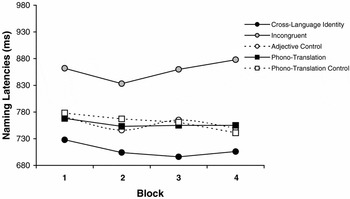
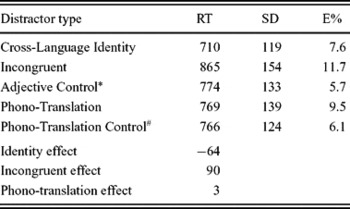
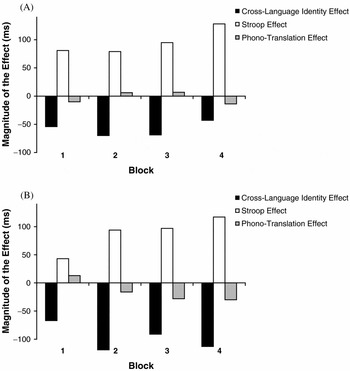
In the analyses of naming latencies, the main effect of the variable “Type of Distractor” was significant (F (4, 84)=23.99, MSE=11325.82; p<.001) while that of the variable “Block” was not (F (3, 63)=1.93, MSE=15579.62; p<.12). The interaction between the two variables was not significant (F< 1). A closer look at the results revealed that naming latencies were 64 ms faster in the Cross-Language Identity Condition (710 ms) than in the Adjective Control Condition (774 ms) (F (1, 21)=16.04; p<.01). Also, naming latencies were 91 ms slower in the Incongruent Condition (865 ms) than in the Adjective Control Condition (774 ms) (F (1, 21)=23.28; p<.01). Importantly, naming latencies in the Phono-Translation Condition (769 ms) and in the Phono-Translation Control Condition (766 ms) were almost identical (F< 1). The interaction between “Type of Distractor” and “Block” was not significant in any of these comparisons (see Figure 1 and Table 1), suggesting that the reported effects (or lack of) were constant across blocks.
Naming latencies (ms) broken by “Type of Distractor” and “Block” in Experiment 1. The cross-language identity effect can be assessed by comparing naming latencies between the Cross-Language Identity Condition and the Adjective Control Condition, while the presence of a phono-translation effect is reflected by the differences between the Phono-Translation and Phono-Translation Control Conditions. The Stroop effect is revealed by the differences between the Incongruent and Adjective Control Conditions.

Mean naming latencies (RT in ms), standard deviations (SD) and error percentages (E%) for each condition collapsed over blocks in Experiment 1.

*Control Condition used to calculate the cross-language identity and the Stroop effects.
#Control Condition used to calculate the phono-translation effect.
The results of the present experiment revealed two clear effects. First, we observed a substantial and robust Stroop effect across languages both in naming latencies and error rates (Incongruent Condition vs. Adjective Control Condition), replicating previous observations (Mägiste, Reference Mägiste1984; Chen and Ho, Reference Chen and Ho1986; Tzelgov, Henik and Leiser, Reference Tzelgov, Henik and Leiser1990): naming latencies in Catalan (e.g., BLAU “blue”) were slowed down when the Spanish word corresponded to another colour term (ROJO “red”) than when it corresponded to an unrelated word (LLENO “full”). Second, we observed a robust cross-language identity effect (Cross-Language Identity Condition vs. Adjective Control Condition): naming latencies in Catalan (e.g., BLAU “blue”) were sped up when the Spanish word corresponded to the translation of the colour name (e.g., AZUL “blue”) in which the word was printed than when it corresponded to an unrelated word (e.g., LLENO “full”).
Despite the sensitivity of our design to detect these two effects, the phono-translation effect was absent from this experiment. That is, naming latencies in Catalan (e.g., BLAU “blue”) were independent of whether the Spanish printed word was phonologically related (AZUCAR “sugar”) to the translation of the name of the colour ink in which the word was printed (AZUL “blue” in Spanish) or not (Adjective Control Condition).
At this point it is a bit problematic to interpret the lack of phono-translation effect in our experiment. This is because the absence of such an effect may have its origin in one specific property of our design: distractors in the Phono-Translation Condition were of a different grammatical class than the target words. That is, while the target responses were always adjectives, the distractors in the Phono-Translation Condition and in the Phono-Translation Control condition were nouns. It is possible that distractor words that are not potential responses in the experiment, by virtue of belonging to a different grammatical class, are less powerful competitors at the lexical level. Accordingly, the chances of detecting a phono-translation effect in our experiment would have been reduced.
Another potential caveat regarding Experiment 1 is the small number of items included in the response set (6). It is possible that the magnitude of the interference created by distractor words is reduced when the number of responses in the experiment is very small (see, La Heij, Reference La Heij1988; La Heij and Van den Hof, Reference La Heij and van den Hof1995; Caramazza and Costa, Reference Caramazza and Costa2000, Reference Caramazza and Costa2001; and Roelofs, Reference Roelofs2001). In Experiment 2 we aim at assessing the reliability of the effects reported in Experiment 1 while reducing the potential impact of these two experimental properties and by increasing the experimental power. We do so by a) using distractors from the same grammatical category as the target responses, b) increasing the number of responses in the experiment, and c) increasing the number of participants.
Experiment 2: Phono-translation effects in the Stroop task
This experiment is very similar to Experiment 1 with the following exceptions. First, the number of responses included in the response set was larger (10) than in Experiment 1 (6). Second, the distractors included in the Phono-Translation Condition and in its corresponding Control Condition were of the same grammatical class as the responses (adjectives). Third, given the difficulty of finding the appropriate distractors for the above-mentioned conditions in Spanish, distractor words were presented in Catalan and participants were asked to perform the naming task in Spanish. Consequently, the participants included in the experiment were Catalan–Spanish highly-proficient bilinguals.
Method
Participants
Forty-two Catalan–Spanish highly-proficient bilinguals (average age of 20) took part in the experiment in exchange for course credits. All of them had learned Catalan as L1 but acquired Spanish as their L2 at a mean age of 4.7 years (1.7). They started using the L2 regularly from the age of 6.8 years (3.6), and they were currently using Spanish on a regular basis. They scored their L1 and L2 proficiency levels in four domains (speech comprehension, speech production, reading and writing) on a four-point scale (4=native speaker, 3=good level, 2=medium level, 1=poor level). The average of participants' responses to the four domains was of 4 and 3.78 in L1 and L2 respectively.
Materials
Twenty Catalan words (all of them adjectives) and four ink colours (blue, red, yellow and orange) were used as experimental stimuli. All of them had non-cognate names. Each Catalan word was presented in capital letters in one of the four ink colours. Participants were asked to name in Spanish (L2) the ink colour in which the Catalan distractor words were presented. Hence, as in Experiment 1, each colour was presented five times, once with each type of Catalan distractor words: a) the name of the colour (e.g., the adjective BLAU (“blue” in Catalan) printed in blue (“azul” in Spanish) – Cross-Language Identity Condition); b) the name of a different colour (e.g., the adjective GROC (“yellow” in Catalan) printed in blue – Incongruent Condition); c) the name of an unrelated adjective matched in lemma frequency and number of letters to the adjectives of both the Identity and the Incongruent Conditions (e.g., the adjective LENT (“slow” in Catalan) printed in blue – Adjective Control Condition); d) a name phonologically related to the translation of the colour name (e.g., the adjective BRAU (“fierce” in Catalan and related to BLAU, “blue” in Catalan) printed in blue – Phono-Translation Condition; and e) an unrelated adjective word matched in lemma frequency and number of letters to the adjective of the Phono-Translation Condition (e.g., the adjective LLEST (“clever” in Catalan) printed in blue – Phono-Translation Control Condition). The words corresponding to the Phono-Translation Condition overlapped with the Catalan translation of the ink colour's name in at least two phonemes (see Appendix B).
In order to increase the size of the response set, four additional colours (pink, green, grey and purple) were also included in the experiment. These colours appeared five times in each block, presented with a) the distractors used in the Phono-Translation Condition and b) the distractors used in the Phono-Translation Control Condition, c) with the distractors used in the Adjective Control Condition, and d) with two unrelated filler distractors. The colour–word pairs for these colour terms were unrelated. In total, all distractor words appeared twice in each block. To further increase the size of the response set, two other colours were included in the experiment (brown and white). These colours appeared five times each with unrelated distractors.
Each block had 50 trials (10 colour names each appearing five times per block). However, only 20 of these trials were experimental (four colours per five experimental conditions). The rest were considered filler trials. Thus, the experiment consisted on a total of 200 trials divided in four blocks of 50 trials each (20 experimental and 30 filler trials). The order of block presentation was counterbalanced across participants. As in Experiment 1, block trials were pseudo-randomized with the restriction that no two trials with the same ink colour appeared in a row. However, two additional restrictions were added here: a) two trials of the same experimental condition could not follow each other; and b) two trials whose target or distractor words (either in L1 or L2) started with the same vowel or consonant could not appear in a row.
The presence of a cross-language identity effect was to be assessed by comparing naming latencies in the Cross-Language Identity and Adjective Control Conditions, while the presence of the classical Stroop effect was to be assessed by comparing the Incongruent and Adjective Control Conditions. The phono-translation effect was to be assessed by comparing the Phono-Translation and the Phono-Translation Control Conditions.
Procedure and analyses
The same procedure as that in Experiment 1 was used here with the difference that in this case, participants were asked to name the word's ink colour in Spanish (their L2). The same criteria as in Experiment 1 were followed for data analyses. Two participants were excluded from the analyses since they had more than 16% of errors.
Results
Following the criteria presented above, 7.3% of the trials were removed from the analyses. The error analyses revealed two main effects: “Type of distractor” (F (4, 156)=9.15, MSE=.25; p<.01); and “Block” (F (3, 117)=30.34, MSE=.23; p<.01). The interaction between these two variables was not significant (F< 1). More errors were observed in the Incongruent vs. Adjective Control Conditions (F (1, 39)=13.31; MSE=.25; p<.01) revealing that participants made significantly more errors when the distractor word corresponded to a colour name than when it was unrelated (the Stroop effect). Interestingly, the Phono-Translation Condition led to fewer errors than the Phono-Translation Control Condition (F (1, 39)=5.10; MSE=.19; p<.04). This difference was modulated by “Block”, being significant only in Block 2.
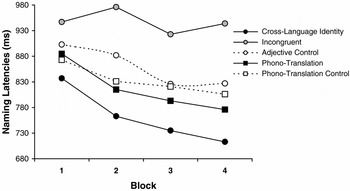
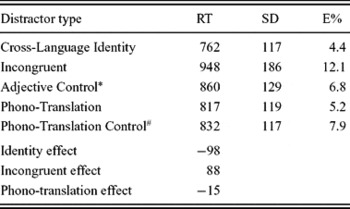
In the analyses of naming latencies, the main effect of the variables “Type of Distractor” (F (4, 156)=53.19, MSE=13948.55; p<.001) and “Block” were significant (F (3, 117)=27.18, MSE=8924.14; p<.001). The interaction between the two variables was significant (F (12, 468)=2.84, MSE=6876.17; p<.01). A closer look at the results (see Figure 2 and Table 2) revealed that naming latencies were 98 ms faster in the Cross-Language Identity Condition (762 ms) than in the Adjective Control Condition (860 ms) (F (1, 39)=67.55; p<.01). This effect did not interact with the factor “Block” (p>.15), and was significant in all Blocks (all ps<.01). Also, naming latencies were 88 ms slower in the Incongruent Condition (948 ms) than in the Adjective Control Condition (860 ms) (F (1, 39)=30.18; p<.01). This effect was modulated by “Block” as revealed by the significant interaction (F (3, 117)=2.62; p<.05). The magnitude of the effect was marginally significant in the first block (p<.06) and significant in all the rest (all ps<.01).
Naming latencies (ms) broken by “Type of Distractor” and “Block” in Experiment 2. The cross-language identity effect can be assessed by comparing naming latencies between the Cross-Language Identity Condition and the Adjective Control Condition, while the presence of a phono-translation effect is reflected by the differences between the Phono-Translation and Phono-Translation Control Conditions. The Stroop effect is revealed by the differences between the Incongruent and Adjective Control Conditions.

Mean naming latencies (RT in ms), standard deviations (SD) and error percentages (E%) for each condition collapsed over blocks in Experiment 2.

*Control Condition used to calculate the cross-language identity and the Stroop effects.
#Control Condition used to calculate the phono-translation effect.
Importantly, naming latencies in the Phono-Translation Condition were faster (817 ms) than in the Phono-Translation Control Condition (832 ms), although this difference was marginally significant (F (1, 39)=3.46; p<.07). The interaction between this variable and “Block” was not significant (see Figure 1). However, the phono-translation effect only reached significant levels in the last Block.Footnote 2
The results of the present experiment replicated the two main effects observed in Experiment 1: a) a Stroop interference effect, and b) a cross-language identity facilitation effect. Also, and more importantly, phono-translation distractors did not interfere more than unrelated control distractors. In fact, if anything there was a tendency towards faster naming latencies in the Phono-Translation Condition, although this effect only reached significant levels in the last block of the experiment.
General discussion
The main goal of the experiments presented here was to assess the reliability and generalizability of two experimental effects (the cross-language identity effect and the phono-translation effect) that have been used to inform models of speech production about the existence of lexical competition across languages during bilingual speech production. As described in the Introduction, the cross-language identity effect refers to the faster naming latencies observed when the distractor word corresponds to the target's translation than when it is an unrelated word. In contrast, the phono-translation effect refers to the slower naming latencies observed when the distractor is phonologically related to the picture name's translation (see Figure 3).
Summary of the magnitude of the effects observed in the two experiments broken by “Block”. The magnitude of the facilitation or interference effects compared to their respective Adjective or Phono-Translation Control Conditions is plotted on the Y axis. (Panel A: Experiment 1; Panel B: Experiment 2).

The results of the two experiments reveal that the cross-language identity facilitation effect observed in the picture–word interference paradigm is a reliable effect present also in the Stroop task. However, the phono-translation interference effect does not seem to be present in this paradigm. In Experiment 1, this effect was not significant, while in Experiment 2, the phono-translation effect was, if anything, facilitatory rather than inhibitory. This pattern of results reveals that while the cross-language identity effect is reliably found in the Stroop task, the phono-translation effect is absent from this task. This raises an interesting question: why do the picture–word interference and the Stroop task lead to different results for the phono-translation effect but not for the cross-language identity effect?
One could hypothesize that some properties of the design used in our experiments are responsible for the lack of a phono-translation effect. For example, the absence of the effect in the present task may stem from a lack of experimental power, given that the number of experimental trials per condition was relatively small. If that were to be the case, one should expect the magnitude of the other effects observed in our experiment to be smaller than that obtained with the picture–word interference paradigm. However, this was not the case either for the Stroop effect or the cross-language identity effect. On the contrary, the magnitude of both effects was more than the double of what is usually found in the picture–word interference paradigm (semantic interference effects are about 30 ms and cross-language identity effects, about 25 ms). Furthermore, note that although an increase of the number of items in Experiment 2 in comparison to Experiment 1 led to an increase of the magnitude of the cross-language identity effects, the predicted interference in the Phono-Translation Condition was still absent.Footnote 3
Despite these considerations, one could still argue that a reduced set of responses may affect the presence of the cross-language identity and the phono-translation effects in different manners. Assume that lexical and semantic effects are affected differentially by a reduced response set. That is, a small response set may have the consequence of diminishing the lexical competition created by a distractor word while affecting minimally the semantic effects produced by such distractors (see La Heij, Reference La Heij1988; La Heij and Van den Hof, Reference La Heij and van den Hof1995; Caramazza and Costa, Reference Caramazza and Costa2000, Reference Caramazza and Costa2001; and Roelofs, Reference Roelofs2001 for a discussion of how response set and repetitions may affect the interference and facilitation produced by related distractors). Following this assumption, the lexical competition exerted by the phono-translation distractors would be minimal and consequently hard to detect. In contrast, the cross-language identity effect (assuming that such an effect has its origin at the semantic level) would still be present.
However, in our Experiment 2, the Phono-Translation Condition not only does not produce an interference effect but rather produces, if anything, a benefit in processing times (although it only reached significant values in Block 4). Why is this the case? There are two possible explanations for this surprising result. First, it is possible that the phono-translation effect is actually a mixture of two independent effects: facilitation at the semantic level and interference at the lexical level. That is, a phono-translation word would activate the target's translation leading to lexical competition, but also activate the word's corresponding concept and consequently produce semantic facilitation. Thus, the polarity of the effects created by phono-translation distractors (whether one observes facilitation or interference) would depend on the relative magnitude of these two effects in a given experimental setting. Now, consider the possibility that the magnitude of the lexical competition exerted by a distractor word depends, to some extent, on the size of the response set, such magnitude being larger when the response set is also larger. In such a scenario, the lexical competition exerted by a phono-translation distractor would be relatively weak when the response set is small (as in the current experiments), hence increasing the chances of detecting a facilitatory phono-translation effect produced by semantic facilitation. In contrast, when the response set is large (as in the case of the experiments conducted with the picture–word interference paradigm) the lexical competition exerted by the distractor word may be larger than the semantic facilitation, resulting in the phono-translation interference effect.Footnote 4 This explanation, advanced already by Hermans (Reference Hermans2004), assumes the existence of cross-language interference at the lexical level, and consequently can only be implemented in those models of bilingual language production that assume that lexical selection is language-non-specific.
Another possible explanation is that in some percentage of the trials participants misread the distractor word, and consequently the phono-translation distractor would act as an identity distractor. Although, in principle, these confusions should also apply to the picture–word interference experiments, the fact that the modality of the distractors' presentation in such experiments is auditory may have reduced the chances of mistaking the phono-translation distractor with an identity distractor.
Regardless of the precise origin of these contrasting results between tasks, which certainly deserves further research, the lack of a phono-translation effect in the Stroop task raises doubts about the usefulness of the homologous effect in the picture–word interference paradigm when theorizing about lexical access in bilingual speech production. Admittedly, the lack of clear understanding of the contrasting effects of phono-translation distractors in these two tasks also compromises, to some extent, the interpretation of the cross-language identity effect. Nevertheless, given the important role played by the phono-translation effect in supporting the notion of lexical competition across languages, its instability should be taken into consideration when drawing strong theoretical conclusions. This does not necessarily mean that the notion of lexical competition across languages should be dropped, since other results may still argue in favour of such a hypothesis (e.g., Poulisse, Reference Poulisse, de Groot and Kroll1997; Lee and Williams, Reference Lee and Williams2001). Rather, what it shows is that we need further research to understand the actual origin of such an effect (and the factors behind its instability), in order to draw strong conclusions regarding the presence of lexical competition across languages.
Appendix A: Materials employed in Experiment 1

F=Lemma frequency (appearances per million); L=Length (number of letters).
Appendix B: Materials employed in Experiment 2

F=Lemma frequency (appearances per million); L=Length (number of letters).