1 Introduction
The proliferation of 3D virtual worlds and massively multiplayer online (MMO)-based simulation games across the globe in many different languages offers computer-assisted language learning (CALL) researchers an opportunity to examine how language learning occurs in such virtual environments. Within the context of contemporary CALL, much of the earlier work follows an exploratory approach, identifying gaming prototypes or a pilot implementation into a classroom (Peterson, Reference Peterson2010). In addition, despite the ongoing advancement of 3D virtual worlds and MMO-based simulation games today, system applications into language learning classrooms generally follow the form of ad hoc, extracurricular activities to boost student motivation and engagement.
Although an examination of affective elements of virtual world language learning is certainly fundamental to understanding contemporary CALL today, it is argued that there is a relative dearth of research that focuses more on how exactly virtual worlds are used for language learning and teaching (Sadler & Dooly, Reference Sadler and Dooly2013) and that there are few research studies that provide a more diversified, ecological view of how language is acquired from a second language acquisition (SLA) point of view (Chapelle, Reference Chapelle1997, Reference Chapelle2009; Levy & Stockwell, Reference Levy and Stockwell2006; Yamazaki, Reference Yamazaki2014). Because there is generally a lack of consistent understanding about “sociotechnical infrastructure” of contemporary CALL application among many scholars today (Thomas, Reinders & Warschauer, Reference Thomas, Reinders and Warschauer2013: 2), some may treat technology as the mainframe, drawing on whatever theory is available to explain potential utilization of CALL practices (Chapelle, Reference Chapelle2009). This has ultimately resulted in a lack of strong theoretical and empirical evidence regarding how participants acquire target language in the given CALL environment (Levy & Stockwell, Reference Levy and Stockwell2006), as well as the practical implication as to how stand-alone contemporary CALL tools like virtual worlds and simulation games can be successfully integrated into language classrooms with promising learning outcomes.
In an attempt to address these issues, the present study investigates an instantiation of a 3D virtual world–based blended Japanese learning curriculum within the context of a Japanese as a foreign language (JFL) classroom. In particular, the study proposes a new instructional approach called computer-assisted learning of communication (CALC), derived from Warschauer’s (Reference Warschauer2004) integrative CALL framework (Yamazaki, Reference Yamazaki2014). The primary objective of the study is to ascertain how JFL students engage in a semester-long (15-week) 3D virtual world–based Japanese course, examining whether or not the CALC environment promotes successful target language acquisition and how such acquisition may occur in the given context.
2 Contemporary CALL and language learning outcomes
Among the past decade of contemporary CALL research involving the use of 3D virtual worlds and MMO-based simulation games, there are several studies that particularly examined students’ learning outcomes from SLA perspectives. When delving into the methodological ways in which researchers measured students’ learning outcomes within these studies, two approaches appeared prevalent: (1) a psycholinguistic or cognitive CALL framework, and (2) a sociocultural or interactionist CALL framework, depending on the ways in which researchers view language learning in the given CALL environment.
Researchers who are interested in examining the effectiveness of contemporary CALL and its instruction from cognitive perspectives have tended to exploit experimental designs by providing a statistical evidence of students’ language learning outcomes and progression. For instance, Miller and Hegelheimer’s study (Reference Miller and Hegelheimer2006) as well as its replicate study by Ranalli (Reference Ranalli2008) focus on the students’ language learning outcomes in regard to the increased acquisition of grammar and vocabulary, arguing that The Sims gameplay can be pedagogically beneficial to university-level learners of English as a second language, especially when combined with supplemental materials. In addition, Canto, Jauregi and van den Bergh’s study (Reference Canto, Jauregi and van den Bergh2013) also suggests that the Spanish as a foreign language participants who engaged in projects collaboratively with native Spanish speakers using video-web communication or Second Life experienced a significant communicative growth (oral) compared to the control group who received no computer-assisted collaboration opportunities.
On the other hand, CALL researchers who promote an interactionist account of language acquisition tend to use a qualitative method of analysis, providing descriptive evidence of significant events in a contemporary CALL collaborative environment (e.g. Peterson Reference Peterson2011, Reference Peterson2012a, Reference Peterson2012b, Reference Peterson2012c, Reference Peterson2013; Rama, Black, van Es & Warschauer, Reference Rama, Black, van Es and Warschauer2012; Reinders & Wattana, Reference Reinders and Wattana2012; Zheng, Young, Wagner & Brewer, Reference Zheng, Young, Wagner and Brewer2009). In this approach, researchers are more interested in determining the detailed characteristics of interactions between the participant(s) and interlocutors, examining how participants learn to communicate in the given virtual environment. As seen in Peterson’s study with Allods Online (Peterson, Reference Peterson2011), Second Life (Peterson, Reference Peterson2012a), Ninerift (Peterson, Reference Peterson2012b), and Wonderland (Peterson, Reference Peterson2012c, Reference Peterson2013), as well as Zheng et al.’s study (2009) with Quest Atlantis and Rama et al.’s study (2012) with World of Warcraft, qualitative modes of data collection, such as discourse analysis of in-game interactions as well as interviews and post-study surveys, were used to elicit participants’ learning process and perceptions toward gameplay. Within the spectrum of qualitative study, researchers also use a case study method to collect varieties of evidence to evaluate the effectiveness of the CALL program and its associated learning outcomes, as seen in deHaan’s study (Reference deHaan2005) with the Nintendo 64 video game Jikkyo Powerfuru Puro Yakyu. Using the case study method, researchers engaged in in-depth analyses of how the virtual immersion helps learners attain target language based on multiple sources of data.
3 Research method
Taking both sociocultural and cognitive accounts of contemporary CALL integration, the present study takes a qualitatively driven mixed-method case study approach to examine the participants’ natural acquisition of Japanese in a 3D virtual environment, conducting a semester-long study that documents participants’ learning process, outcomes, and various communicative capacities in an MMO-based 3D virtual world. In the present study, four sources of data from 11 university-level JFL students (n=11) were collected and analyzed to evaluate the learning outcomes. This method was utilized in order to solicit a triangulation of data to provide corresponding evidence and validity to the research findings. In order to elicit a comprehensive outlook on the effectiveness of CALC, the present study particularly examines two phenomena: the acquisition of incidentally encountered vocabulary during the 15 weeks of virtual world immersion, as well as the participants’ manifestations of successful communicative behaviors specific to the context. The research questions are
1. Does the CALC program facilitate an acquisition of Japanese?
2. What evidence indicates JFL students’ acquisition of Japanese in the CALC environment?
3.1 Research context: CALC environment and instruction
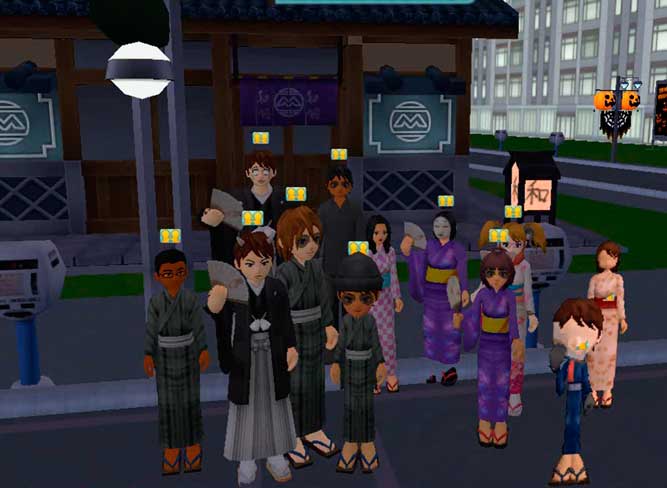
The present study takes a new instructional approach, CALC, derived from the experiential and integrative CALL framework (Yamazaki, Reference Yamazaki2014; Warschauer, Reference Warschauer2004). The proposed CALC program utilized Meet-Me (MM), a Japanese 3D virtual world developed by Co-Core, Inc. Since MM offers 3D renderings of Tokyo with authentic transportation systems, it is designed to be realistic, relevant, and relatable to players’ lives (see Figure 1).
Group picture taken in front of Wafuku Store in Shinjuku, Tokyo

MM also provides carefully designed supplemental materials (see Figure 2) along with parallel sensory input to be received in MM. The CALC instruction is designed to provide what Jones (Reference Jones1982) called “the reality of function”, where participants “step inside the function mentally and behaviorally, and do the best they can to carry out their duties and responsibilities in the situation in which they find themselves” (4).
Workbook utilized in the CALC program (Lesson 3)

As the purpose of the CALC instruction is to promote the acquisition of communicative skills (i.e. procedural knowledge) rather than knowledge about language (i.e. declarative knowledge), the CALC instruction does not feature any explicit grammatical lessons, translations, or isolated vocabulary lessons. Rather, the CALC instruction focuses on the experiential, task-based acquisition of particular actions or behaviors through virtual world explorations (e.g. using transportation, learning to shop, learning to drive, making friends, etc.), facilitating the use of context-specific communication among learners and other game users online.
The 15-week CALC curriculum consists of three developmental stages: Orientation Phase (Weeks 1–6), Exploration Phase (Weeks 7–10), and Activity Phase (Weeks 11–15). The Orientation Phase provided students with the opportunities to get accustomed to the MM environment, while gaining familiarity with the virtual residence, neighborhood, and basic life chores. Once students got used to their virtual life, students then explored different districts of Tokyo (Exploration Phase), and later took part in various advanced activities such as playing soccer, cruising, and intensive fishing (Activity Phase).
In addition, all 20 lessons in the CALC curriculum followed a simulation-based lesson format, with each 75-minute lesson consisting of (1) briefing, (2) action, and (3) debriefing sessions. During the briefing session, the instructor provided a demonstration in action, in line with the themes of the lesson planned for the week. For instance, when the lesson was about using means of transportation, students were shown step by step, contextualized instructions on how to take trains, ranging from buying a ticket, choosing the right kind of train, going through kaisatsu (automatic ticket examination stand), getting off at the targeted station, and choosing the right kind of exit that is closer to the target destination. After the students were introduced to new contextualized communicative tasks associated with using transportation, they then took part in the action stage where they virtually rode trains and buses to get to their target destinations. At the end of the lesson, students participated in the debriefing session to reflect on what they had learned through various interactive activities such as show-and-tell, questions and answers, and speedwriting exercises, summarizing their in-game/in-class experiences.
All the activities associated with briefing, action, and debriefing sessions were pre-planned by the instructor, with lessons navigated in tandem with the use of a highly visualized workbook as supplemental material (see Figure 2), which also serves as a gaming manual for students to accomplish their assignments outside of the class, known as Weekly Game Logs (WGLs). In these assignments, students are required to log into MM for at least 60 minutes to perform similar communicative tasks to reinforce what they have learned during the week. Week 10 WGL, for instance, requires students to find a friend and go fishing together, and Week 12 requires students to find a friend and go for a drive on the Shuto Kōsoku (expressway). In all WGL assignments, students are required to take screenshots of their in-game interactions and write post-event/post-conversation reflections in Japanese and submit them as WGL reports.
3.2 Participants
The participants of this study were 11 undergraduate JFL students (N=11) enrolled in a semester-based (15-week) advanced conversation course at a public university. All 11 students had previously completed four semesters of the prerequisite elementary and intermediate Japanese courses for approximately 210 contact hours, and some of them had finished, or were jointly taking, third- and fourth-year JFL courses. Although most participants were regular users of digital games outside the class, none of them had any prior experience of a virtual world in Japanese, including MM, which was used in the present study.
3.3 Data collection and analysis
During the 15-week course of study, the data compiled consisted of the following:
1. Screen captures of virtual world participation;
2. Video recordings of in-class interaction;
3. Weekly pre- and post-vocabulary tests;
4. Collection of target language outputs from the in-class assignments such as WGL, Tokyo Tour Guide (TTG), and reflective writing.
Once the semester officially ended, screen captures and video recordings were transcribed for thematic analysis.
In order to examine the occurrence of incidental vocabulary acquisition, the present study administered 12 sets of weekly vocabulary pre- and post-tests among 11 participants throughout the semester (a total of 132 collected test pairs), except for Week 6 and 8, during which the class focused on non-research-related tasks such as writing workshops and one-on-one conferences. Each weekly test included five kanji pronunciation items (item #1–5) and five vocabulary interpretation items (item #6–10), which had frequently appeared in the lessons of the week. In order to examine the participants’ acquisition of incidentally encountered vocabulary, the pre-test was administered at the beginning of the week (pre-instruction) and the post-test was administered at the end of the week (post-instruction).
All the weekly pre- and post-vocabulary tests were taken up to the end of the semester using only pseudonyms. Once all tests were collected, all kanji pronunciation items (multiple choice) were scored by a single rater, whereas all the vocabulary interpretation items (short answer) were scored by two raters in order to avoid possible biases. The pre- and post-test vocabulary interpretation items were blindly scored by each rater individually, using a grading rubric that was established in advance. The grading rubric included three levels of a scoring system for vocabulary interpretation: (1) 1 point for an accurate answer; (2) 0.5 points for an answer that was similar, related, but not accurate; in other words, the answer was within the breath of association of a word/expression; and (3) 0 points for a completely off, inaccurate answer or no answer. Out of 244 tests scored individually by the two raters, overall inter-rater reliability was 98.69%. After the semester officially ended, all 132 test pairs were entered into SPSS for statistical analyses.
4 Results and findings
Based on both the interpretative and statistical analysis of the data, the major finding of the present study was that the participants, when immersed in the 3D virtual world of Tokyo, acquired contextualized communicative competence. More specifically, quantitative analyses revealed statistically significant improvement in the participants’ acquisition of incidentally encountered vocabulary, in particular, kanji pronunciation and vocabulary interpretation. Qualitative analyses revealed participants’ acquisition of various communicative competencies specific to the context, including persuasive talk, concept of audience, and collaborative communication.
4.1 Acquisition of incidentally encountered vocabulary
Based on the results of the test of normality, the present study utilized the Wilcoxon signed-rank test to compare two matched pre- and post-test samples of all participants (132 test pairs). The results of Wilcoxon signed-rank test indicated that the median post-test score, Mdn=6.50, was statistically significantly higher than the median pre-test score, Mdn=4.0 (Z=–8.516, p=.000), and the increase was large (r=–.56). This would indicate that the semester-long CALC program elicited a statistically significant gain in the students’ scores of vocabulary post-tests, compared to the scores of vocabulary pre-tests (see Table 1).
Wilcoxon signed-rank test results for weekly vocabulary pre- and post-tests (total)

Note. *Significant at p<.05. **Significant at p<.01. ***Significant at p<.001.
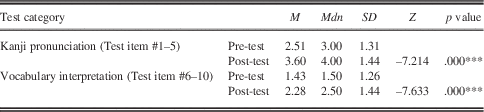
When examining the participants’ performance on the two test categories, kanji pronunciation (item #1–5) and vocabulary interpretation (item #6–10) respectively, the Wilcoxon signed-rank test indicated similar results, showing that the semester-long CALC program yielded a statistically significant gain in both test categories (see Table 2).
Wilcoxon signed-rank test results for weekly vocabulary pre- and post-tests per test category (kanji pronunciation and vocabulary interpretation)

Note. *Significant at p < .05. **Significant at p < .01. ***Significant at p < .001.
Furthermore, the study analyzed participants’ learning progression over the semester by calculating the median scores of weekly vocabulary pre- and post-test difference per week (i.e. the score increase). The results indicated a statistically significant score increase from Week 3 to Week 15; however, the amount of increase appeared to begin escalating from Week 10 through Week 15 (see Figure 3).
Median score of test difference per week

This might indicate that, within the population, the more the semester progressed, the more their learning growth was pronounced, possibly implying the amplifying progress of the participants’ vocabulary acquisition throughout the CALC program.
4.2 Acquisition of communicative competence
To examine the effectiveness of CALC from communicative perspectives, the present study conducted a discourse analysis of three sets of data: (1) screen-capture recordings of gameplay, (2) video recordings of in-class interactions, and (3) the collection of target language outputs. The analysis of the transcripts finds some supporting evidence of the participants’ exemplifications of various discourse patterns specific to the context, such as persuasive talk, awareness of audience, and collaborative communication. Although participants’ target language outputs were transcribed and represented as qualitative evidence throughout this section, it should be noted that the excerpts are presented without editing errors, fillers, or JFL-specific language markers. This was done in order to show the JFL students’ true process of target language development, recognizing a variety of JFL learners’ communicative traits retrieved from raw data. In addition, some of the information in the excerpts was concealed and replaced with alternative symbols for non-confidential disclosure purposes.
4.2.1 Persuasive talk
Once the exploration phase began in Week 7, the focus of the CALC program shifted from recognition to a production stage, in which the participants were encouraged to give directions and provide an oral tour guide to their fellow classmates. This was known as the Tokyo Tour Guide (TTG) assignment. As the exploration phase followed a virtual study abroad format, all participants were given the opportunity to provide a guided tour of an assigned district in Tokyo, describing some of its highlights for tourists. Based on the discourse analysis of data retrieved from the transcripts of all TTG presentations and the tour flyers, the present study found some significant features that indicate participants’ communicative outcomes specific to persuasive navigation, such as guiding, elaborating, and engaging the audience. As each participant was required to plan a trip, prepare a tour flyer, and virtually take all fellow classmates to the locations advertised in the flyer, it became apparent that tour conductors were expected to engage fellow classmates to provide improved tour experiences. Furthermore, each tour conductor received a peer evaluation from their fellow participants, and was assessed on realistic communicative traits such as whether or not participants felt convinced to visit such places, or whether they felt engaged during the tour sessions.
When examining the students’ TTG transcriptions, the study indicates that many tour conductors (i.e. participant representatives) utilized a variety of persuasive techniques to provoke fellow classmates’ interest and curiosity. In particular, participants who received higher peer evaluations tended to use these techniques more frequently than those who received lower peer evaluations. For instance, consider Excerpt 1 from Student J’s TTG presentation. As a tour conductor, Student J took participants to one of the first tour attractions, introducing the location to describe the characteristics of the place from the participant’s point of view. This was done by using the expression of ~がありますね (there are~, aren’t there?) in line 1 of Excerpt 1, where the speaker (Student J) establishes a common ground with the fellow classmates to maintain interactive involvement, using the ね(ne) sentence-ending particle.
Excerpt 1.
1. Student J: ここはハロウィンカフェです。たくさん、ハロウィーンのデコレーションがありますね。二階も見て下さい。(This is Halloween café. There are many Halloween decorations, aren’t there? Please look upstairs, too.)
[All participants going upstairs]
2. Student K: 先生、ケーキがあります!(Sensei, there is a cake!)
3. Instructor: みなさんこのカフェには何がありますか? (Everyone, what do you see in this café?)
4. Student E: かぼちゃ?(Pumpkin?)
[Participants exploring the building]
5. Student J: 外に出て下さい。(Please go outside.)
6. Student J: じゃあここから、宝物を探しましょう。わかりますか?宝物はトレジャーですね。そう、宝物さがしはトレジャーハンティングです。(Okay, now let’s do treasure hunting. Do you understand? Takaramono is a treasure. So, Takaramono Sagashi is treasure hunting.)
7. All: おぉ~ (Ohh!) [Participants showing expressions of being impressed]
8. Student J: じゃあ、行きましょう。(Well, let’s go.)
9. Student C: お金がありますか?(Is there money?)
10. Student J: ん?(Huh?)
11. Instructor: お金がかかりますか?フリーですか?(Does it cost [to do a treasure hunting]? Is it free?)
12. Student J: 無料です。(It is free.)
[Participants moving forward with their avatars]
[Arriving at the next destination]
13. Student J: 宝物はここですよ。カフェの中に、宝物を探しましょう。(Treasures are here. Let’s look for treasures in this café.)
[Participants entering the building]
14. Instructor: みなさん、このレストランには何がありますか?どんな食べ物がある (Everyone, what do we have in the restaurant? What kind of food do we have?)
15. Student A: トースト! (Toast!)
16. Student E: ハンバーガー。(Hamburger.)
[Participants explore the house. Participants start getting treasures.]
17. Student J: 見つけましたか?誰か見つけましたか?(Did you find some [treasures]? Who found some?)
[Student K found a treasure]
18. Student J: 見つけましたか?(Did you find it?)
[Student J starts to show some of the hidden tricks]
19. Student J: ここですよ!(Here it is!)
20. All: え!?(What!?) [Participants showing an expression of being surprised]
[Student J, Student F, Student A, and Student C gradually arrive in a hidden room. Eventually everyone arrives.]
21. Student J: 今見つけましたか?(Did you find it now?)
As shown in lines 6 and 8 of Excerpt 1, Student J additionally used the polite volitional expression of ~ましょう (let’s~) to elaborate attendants’ participation. This was by far one of the most frequently observed expressions across all TTG presentations; among the 11 participants, eight used this expression at least once during their tour guide presentations.
Furthermore, in line 6, Student J also asked a question to check on the participants’ status of comprehension, clarifying what Student J intended to do in the following activity. While line 7 indicates the general reaction of the fellow participants, Student C asked a question in line 9 to clarify whether or not there would be a fee for participating in the “treasure hunt” activity. Initially, Student J did not understand Student C’s question as Student C phrased the question incorrectly; however, the instructor-researcher in line 11 intervened and rephrased the question to support the conversation between Student J and C. In line 12, Student J answered Student C’s question, clarifying the cost of participation. Student J then encouraged all participants to participate in the treasure hunt, constantly monitoring the status of their task completion by asking 見つけましたか? (Did you find it?) in line 17, 18, and 21 of Excerpt 1, thus maintaining shared goals and subjective states among participants.
According to Peterson, this type of collaborative interaction indicates the maintenance of “intersubjectivity” (2012a: 32), and such collaborative acts among participants are essential to facilitating task understanding and collective completion of tasks. In this case, Student J’s constant questioning works as a “continuer” (Peterson, Reference Peterson2012a: 30; Peterson, Reference Peterson2012c: 373) to elicit participants’ target language utterances, asking other participants a task-specific question to check the status of their performance-based outcomes. Although utterances vary intermittently, the student responses confirm evidence of intersubjectivity, which is consistent with the results of Peterson’s study (2012a, 2012c).
In addition to elaborative accounts of communicative traits, many TTG facilitators elicited the participants’ curiosity and excitement by taking them to a location that would capture the audience’s attention. Since the purpose of TTG is to provide an effective and engaging guided tour for fellow classmates, most TTG conductors gathered relevant information in advance, preparing audience-centered TTG content, with extensive descriptions of particular tourist attractions that are rare, unique, and specific to the tour location. The persuasive descriptions in TTG refer to the participants’ ability to select trendy attractions that do not appear in regular MM activities, offering more detailed information about the items through a show-don’t-tell approach.
An instance of this can be seen in Excerpt 2, when Student E provided a tour in Roppongi, taking all the participants to an accessory store that does not exist in their neighborhood. As shown in Excerpt 2, Student E walked around the store and individually showed the rare items and their prices to all the fellow participants.
Excerpt 2.
1. Student E: えっと、あ~、これで、アクセサリーの店に行く。(Um, ah, we will go to an accessory store from now on.)
[Running down the street]
2. Student E: 宝石。(Jewelry.)
[Entering the store]
3. Student E: たくさん、高い物いるよ [あるよ]。腕時計とか、イヤリングとか、指輪もいる [ある]。あと、一番高いのは、えっと、かんむり。一番ほしいのは、この四つ葉のネックレス。(There are many expensive things [in this store]. Watch, earrings, and rings. Also, the most expensive thing is, well, the crown. The thing I want the most is this clover necklace.)
Another example can be shown in Excerpt 3, when Student H provided a TTG presentation in Odaiba. After visiting the first tourist attraction, Student H navigated a group down to a sports shop to purchase swimwear so that they could later visit Odaiba Seaside Park to swim. In Excerpt 3, once Student H and fellow participants arrived and entered the sports shop, Student H was able to guide the participants and showed each of the store items described in line 4.
Excerpt 3.
1. Student H: スポーツクラブに行ってます [行きます] 。(We are going to a sports shop.)
2. Student H: [Pointing at Student J] Student J: むらさき!(Student J, purple!) [laughs]
3. Student H: 行きましょう。(Let’s go.)
[Student H and classmates run down to the next destination: sports shop]
4. Student H: サッカーボールとバスケットボールと、売ります[が売っていま]。でも…あー、水着、水泳パンツ、水泳パンツを売ります。水着と水泳パンツを買います。ビーチに行きますか?([In this sports club,] they sell soccer balls and basketballs. But … ah, they [also] sell swimsuit, swim pants. We can buy swimsuits and swim pants. Do you [want to] go to the beach?)
[Looking at the instructor]
5. Instructor: ビーチはあとから先生と行きましょう。(Let’s go to the beach with me later.)
6. Student H: そうそう。はい。(Oh, yes, yes.)
Not only did the TTG assignment condition all the tour conductors to make their tour performances persuasive and engaging, but TTG also accustomed conductors to take a leadership role and be responsible for helping their fellow participants to navigate in the virtual world of Tokyo. As the TTG assignment was a simulation-based activity that dealt explicitly with the “concept of audience” similar to Coleman’s study (2002), the MM 3D simulation environment allowed participants to provide simulated action in a “truly communicative sense” (Coleman, Reference Coleman2002: 219). Because TTG was a simulation of being a tour guide, it was particularly important for tour conductors to smoothly navigate their participants as a group, otherwise conductors would face a serious communicative problem, such as participants being lost virtually in the middle of the tour. Ultimately, this TTG arrangement created the reality of function: the opportunity for participants to focus on their communicative performance reflectively.
4.2.2 Awareness of audience
To examine this further, it should be noted that the CALC instruction and its associated activities allowed students to be aware of the concept of audience, and such awareness promoted a reciprocal learning opportunity in the given communicative environment. Although some of the instances of how the TTG assignment encouraged tour conductors to speak persuasively by utilizing a variety of discourse patterns, the rationales for such outcomes originate from the pragmatic desire to communicate and be a reliable tour guide who successfully guides fellow participants through virtual Tokyo. Having understood the concept of audience, tour conductors were more attentive in improving their performance to meet the needs of participants during the TTG performance. This is because tour conductors constantly received immediate feedback and reactions from their fellow participants as a result of their communicative actions. Based on the feedback being received, conductors needed to constantly accommodate their performance, while at the same time monitoring their fellow participants’ status of comprehension and their behavioral outcomes, especially after commands were given to the participants. If the fellow participants’ behavioral outcomes did not meet the expectation of the tour conductor, the conductor immediately would need to modify his or her communicative act, commands, and delivery of speech.
To provide an instance of this, Excerpt 4 contains an example of a communicative problem that occurred during Student B’s TTG presentation in Asakusa. In this instance, there was lack of clarity in regard to which train to take for the target destination. Notice the role of Student K’s negative feedback in line 5, which led to the modification of Student B’s communicative behavior immediately after.
Excerpt 4.
1. Student B: あの、ココイコパーク駅、行きましょう。あの、あー浅草。 駅、あー、出口4、うん。(Well, let’s go to Cocoiko Park Station. Um, ah, Asakusa Station, ah, Exit 4, yes.)
2. Instructor: 浅草はJR?(Is Asakusa JR?)
3. Student B: あーない。プライベート…私鉄?(Oh there isn’t [Asakusa station in JR]. Private … Shitetsu?) [Looking for the correct train line]
4. Instructor: [Speaking to the rest of class] 私鉄の浅草ね? (You mean, Asakusa as private [line]?)
[Student K was unable to follow Student B]
5. Student K: ちょっと待って~ (Hold on [wait for me]!) [Seeking help]
6. Instructor: [Calling the name of Student B] もう一度見せてあげて? (Can you show [Student K] one more time?)
[Student B gives demonstrations again]
7. Student B: 大丈夫? ([Are you all] Alright?)
8. Student B: いち、に、さん、し、ご、ろく、しち… (One, two, three, four, five, six, seven …) [Counting the number of students]
[Student B confirms that all participants are there]
9. Student B: 行きましょう。(Shall we go?)
In line 1 of Excerpt 4, Student B began a tour of Asakusa by asking his fellow participants to get to the nearby train station called Cocoiko Park Station, by their residence. Once the participants walked up to the station, Student B then asked the participants to get off at Asakusa Station, Exit 4. This was when the communication breakdown occurred, as Student B did not specify the type of train needed to get to Asakusa. Student B did not notice this until the instructor-researcher intervened in line 2. Student B then ambiguously responded in line 3, which eventually led to the loss of Student K from the group (line 5). In order to solve this communication breakdown, Student B showed the process of getting on the right train to Asakusa more precisely, while monitoring participants’ status of task completion and comprehension. When Student B eventually saw that all participants arrived at Exit 4 of Asakusa Station, Student B counted the number of participants to make sure no one was left behind (line 8). Once Student B confirmed that all participants arrived in Asakusa station, Student B moved on to resume the tour of Asakusa.
As observed in the communication breakdown example in Excerpt 4, the CALC program creates an environment where participants acquire the concept of audience through constant reflection. As the TTG assignment conditions participants in the tour conductor role to receive immediate feedback from their fellow participants, conductors monitor and modify their communicative behaviors, especially when they receive negative feedback from other participants. This type of negative feedback is not just static feedback focusing on correcting the conductor’s linguistic output, containing language markers or grammatical errors; rather, this type of negative feedback operates as a behavioral reaction that signifies communication breakdowns, prompting speakers (i.e. conductors) to take immediate action to resolve the issue through negotiation of meaning. Because Student B saw the reaction of Student K as a negative outcome deriving from Student B’s own communicative misbehavior (i.e. lack of providing on-point, detailed information regarding the train), Student B followed up on the issue by modifying his or her speech and actions and made the information clearer for fellow participants. Immediately after, Student B was more aware of his or her audience, checking to make sure that no one had been left behind (e.g. by counting the number of participants in line 8). Thus, the CALC environment provided opportunities for all participants to be aware of the audience and reflect on their communicative performance so that they can be a successful communicator in the given communicative environment.
4.2.3 Collaborative communication
In addition to the TTG assignment, the CALC curriculum included an assignment called Weekly Game Log (WGL), where participants take part in various communicative, quest-based tasks designed by the instructor to work collectively with other users online. Similar to the concept of guild in MMO role-playing games, for instance, WGL 6 asked participants to find a friend and go on a fishing trip together, and WGL 8 asked participants to find a friend to go for a drive together. In this way, the CALC program facilitates more specific conversation opportunities for participants in a shared communicative environment, obtaining purposeful interactions that are specific to task completion. Based on the analysis of the WGL reports submitted weekly by the participants, the present study found that the majority of participants were able to communicate collaboratively with other Japanese MM users, as the participants facilitated conversation specific to completing the task, fostering what McGonigal calls “mutual regard” (McGonigal, Reference McGonigal2011: 269). As an example of this, consider Excerpt 5 between Student A and MM user 2 in Week 10 WGL 6 assignment.
Excerpt 5.
1. Student A: おはようございます!(Good morning!)
2. MM user 2: おはよう!(Morning!)
3. Student A: 英語をわ[か]りますか?(Do you understand English?)
4. MM user 2: ちょっと (A little.)
5. Student A: 私はアメリカ人です。(I am an American.)
6. MM user 2: 困ったことはない?日本に住んでいるの?(Do you have anything you are troubled with? Are you [currently] living in Japan?)
7. Student A: 私は日本に旅行をしました。(I’ve traveled to Japan.)
8. MM user 2: うんうん。どこからアクセスしてるの?(Ok. Where are you logging in from?)
9. Student A: アメリカに住んでいる。○○と△△と◇◇に旅行をしました。(I am living in America [now]. I’ve been to ○○, △△, ◇◇ [in Japan].)
10. MM user 2: うんうん (Ok, ok.)
11. Student A: とても楽しかったでしたよ^^ (It was so much fun [smile emoticon].)
12. MM user 2: きゃ^^よかったです^^このゲームをさがしたの?(Aw [smile emoticon]. That’s good [smile emoticon]. Did you look up this game?)
13. Student A: うん!私は私の日本語クラスのためにこのゲームをします。(Yes! I am playing this game for my Japanese class.)
14. MM user 2: そかー^^ (Oh yeah, okay … [smile emoticon])
15. Student A: あなたは私と一緒に釣りに行きたいですか? (Do you want to go fishing with me?)
16. MM user 2: はい!どこにする?行ったことある?(Sure! Where should we go? Have you ever been [to fishing]?)
17. Student A: しらない;;; (I don’t know [sweating emoticon].)
18. MM user 2: しばうらふとう (Shibaura Futo)
19. Student A: よし~ (Okie!)
20. MM user 2: よし~~~ (Okie dokie!)
21. MM user 2: 大丈夫かな。。いこかー いこいこー (I wonder if [Student A is] okay … Let’s go, let’s go, let’s go.)
22. Student A: はい~ (Yesss)
23. MM user 2: この!(Come on!)
24. Student A: 楽しかったね^^ (It was fun [smile emoticon].)
25. MM user 2: 久しぶりに楽しかった (I haven’t had fun [like this] in a while)
26. Student A: 私は今のこしている!じゃまた!(I am keeping [the log] now. See ya soon!)
27. MM user 2: またね^^ (See you again [smile emoticon])
In Excerpt 5, Student A began the conversation by greeting MM user 2 in line 1, then quickly moved on to introduce him- or herself politely to the speaker. After Student A’s personal background as an American (non-native speaker of Japanese) was revealed, MM user 2 offered a polite, approachable attitude to Student A. Soon after the response from MM user 2, Student A expanded the conversation by talking about Student A’s personal connection to Japan, explaining why Student A is playing the game (line 13 of Excerpt 5). This strategy, called “small talk” (Peterson, Reference Peterson2011: 64; Peterson, Reference Peterson2012a: 31; Peterson, Reference Peterson2012c: 369), is used by speakers who utilize a type of politeness to establish a mutual relationship between speaker and interlocutor, obtaining a social cohesion that is necessary for successful communication.
After the small talk in the beginning, Student A asked MM user 2 to go fishing together (line 15), as this was one of the quests assigned in WGL 6. MM user 2 in turn willingly accepted to go fishing with Student A, while at the same time expanding the conversation as they mutually decided where to complete the task collaboratively. Excerpt 5 indicates that the Japanese MM user took the initiative to carry on a conversation, which resulted in guided, rather smooth collaborative communication.
In the WGL assignment, the instructor-researcher not only asked students to complete interactive tasks with other MM users online, but also asked them to keep a log of what had happened while completing the tasks. Based on the analysis of WGL reflections, some students reported a positive event where completing the task with other users eventually led to more opportunities for interactions and gameplay outside the requirement of the assignment. For instance, during the Week 12 WGL 8 assignment, participants were asked to complete three tasks: (1) find new MM friends to go for a drive, (2) go to the garage to get the car together, and (3) go for a drive on Shutokōsoku (metropolitan expressway) together with their new MM user-friends. Excerpt 6 is taken from a WGL reflection written by Student F.
Excerpt 6.
30分後に、トレードセンターに [MM user 3] さんがいきました。[MM user 3]さんに 「い[っ]しょにドライブしませんか?」と言いました。[MM user 3]さんは「ドライブ?」。「私のくるまにのりますか?」と言いました。「はい^^」
私は[Student B]さんと[MM user 3]さんとガレージに行きました。ガレージ番号と[を]言って、私の車にのりました。[Student B]は[MM user 3]と話しました。[MM user 3]さんは建築士です。それから、[MM user 3]の車を見ました。早いレースカーでした。ガズレースに行って、私は[MM user 3]さんと[Student B]と[MM user 4]さんとレースをしました。[MM user 4]さんは勝ちました。 (Student F, WGL8: 1)
After 30 minutes had passed, MM user 3 came to the Trade Center. I said to MM user 3, “Would you like to go for a drive?” MM user 3 [then] said “Drive?” [So] I said “Would you like to get in my car?” [Then MM user responded] “yes [smile emoticon]”
Student B, MM user 3, and I went to [my] garage. I told [them] my garage number, and [they] got into my car. Student B talked to MM user 3. MM user 3 is an architect. And then, we looked at MM user 3’s car. It was a fast racing car. We then went to Gazoo Racing, and MM user 3, Student B, MM user 4, and I all raced [together at Gazoo Racing]. MM user 4 won [the race]. (Student F, WGL 8:1)
Although Student F was able to complete all the tasks required for WGL 8, one of the significant findings from Student F’s reflections is Student F’s experience with MM user 3, which went beyond the requirement for that assignment. This was frequently observed in other WGL reflections, especially when participants had successful experiences in completing a collaborative task with other MM game users. As Excerpt 6 shows, Student F, while conducting an associated task requirement, was able to maintain conversation successfully with MM user 3, getting to know more about the user’s personal life, such as MM user 3’s job status and the types of cars MM user 3 owned. Eventually, a friend of MM user 3 (MM user 4) joined the team after the task completion; as a result, Student F, Student B, MM user 3, and MM user 4 all went to the other tourist site in order to participate in the additional activity called Gazoo Racing in MM.
5 Discussion
The present study utilized a qualitatively driven mixed-method case study approach compiling four sources of data to evaluate an overall curriculum application and its effectiveness for CALC. Based on both statistical and interpretative analyses of data, the present study found some evidence indicating JFL learners’ natural acquisition of Japanese. In fact, the conceptualization of CALC was influenced by a variety of contemporary CALL literature; the theoretical framework was derived from issues and trends of contemporary CALL research (Yamazaki, Reference Yamazaki2014; Warschauer, Reference Warschauer2004), and the research design was influenced by the methodological approaches used to investigate contemporary CALL applications. Taking both sociocultural and cognitive accounts of contemporary CALL research, the present study was able to provide a more in-depth and comprehensive understanding of how participants learn to communicate with and within the 3D virtual world of Tokyo.
Considering the first research question (Does the CALC program facilitate an acquisition of Japanese?), the results suggest that the acquisition of Japanese was evident in the rich environment afforded by CALC. In response to the second research question (What evidence indicates JFL students’ acquisition of Japanese in the CALC environment?), the semester-length of data collection and multi-method data analysis revealed some empirical evidence that supports the participants’ natural acquisition of Japanese. More specifically, the quantitative analysis confirmed statistically significant improvement in the participants’ natural vocabulary acquisition, and the qualitative analysis revealed participants’ acquisition of various communicative capacities specific to the context, such as persuasive talk, awareness of audience, and collaborative communication.
In addition, the present study illustrated a number of instructional strategies, sample assignments, and performance-based activities that can be implemented or even modified to fit the objectives of any virtual world–based CALL classrooms. By conducting a semester-long Japanese advanced conversation course entirely in the 3D virtual world of Tokyo, the present study illustrated a sample application of CALC, offering more situated, immersive, and experiential opportunities to teach students how to function in Japan. As CALC stands for computer-assisted learning of communication rather than language learning, the CALC instruction specifically focused on the acquisition of performance-based, procedural communicative competence (i.e. how to communicate) rather than teaching of an explicit, declarative knowledge about language (i.e. forms and mechanics). The significance of the study thus lies in the curriculum instantiation itself, in addition to providing various evidence of CALC effectiveness collected and analyzed from multiple sources of data.
6 Conclusion
As a final note, the present study investigated the use of a 3D virtual world in a JFL classroom, examining the ways in which participants learned to communicate in the proposed CALC curriculum. Results from the present study suggest several directions for future research; in particular, ideas for future studies can be generated by addressing the methodological limitations such as the issues of generalizability deriving from the research site selection (i.e. number of participants, backyard research, lack of prior assessment of the participants’ primary Japanese proficiency, etc.). Although the outcomes of the study are not conclusive to the issues of contemporary CALL research today, the present study nonetheless provided empirical evidence that supports participants’ acquisition of incidentally encountered vocabulary and other communicative competence when immersed in the 3D virtual world of Tokyo. By providing a Japan-like alternative reality where students learn to function through constant simulations, interactions, collaboration, and reflection, it can be speculated that the experiences would be as valuable as going on a study abroad, or even better in the sense that the students could be given a certain anonymity through the use of avatars to avoid social anxiety they may possibly encounter in a face-to-face situation. As the use of virtual worlds in JFL classrooms is a relatively new topic, further investigation is necessary to solidify the theory of CALC in language classrooms.
About the author
Kasumi Yamazaki is an assistant professor of Japanese at the University of Toledo, where she teaches advanced-level courses of Japanese as a foreign language (JFL) and culture. Her current research projects include the development and the use of contemporary CALL systems in JFL classrooms.