1. Introduction
The Ediacaran Period (c. 635.2–538.8 Ma) witnessed the first rise of macroscopic, mobile and biomineralizing animal life in Earth’s history (Narbonne et al. Reference Narbonne, Xiao, Shields, Gehling, Gradstein, Ogg, Schmitz and Ogg2012; Xiao et al. Reference Xiao, Narbonne, Zhou, Laflamme, Grazhdankin, Moczydłowska-Vidal and Cui2016). Ediacara-type macrofossils are primarily preserved as soft-bodied impressions in fine-grained siliciclastic rocks (Narbonne, Reference Narbonne2005). However, these lithologies offer limited opportunities for palaeoenvironmental analysis using geochemical tools. Two rare Ediacara-type macrofossil assemblages have thus far been found in well-preserved marine carbonate successions: the Khatyspyt Formation in Arctic Siberia (Fedonkin, Reference Fedonkin, Sokolov and Iwanowski1990; Knoll et al. Reference Knoll, Grotzinger, Kaufman and Kolosov1995; Grazhdankin et al. Reference Grazhdankin, Balthasar, Nagovitsin and Kochnev2008; Rogov et al. Reference Rogov, Marusin, Bykova, Goy, Nagovitsin, Kochnev, Karlova and Grazhdankin2012, Reference Rogov, Marusin, Bykova, Goy, Nagovitsin, Kochnev, Karlova and Grazhdankin2013a,Reference Rogov, Marusin, Bykova, Goy, Nagovitsin, Kochnev, Karlova and Grazhdankinb, Reference Rogov, Karlova, Marusin, Kochnev, Nagovitsin and Grazhdankin2015; Nagovitsin et al. Reference Nagovitsin, Rogov, Marusin, Karlova, Kolesnikov, Bykova and Grazhdankin2015; Cui et al. Reference Cui, Grazhdankin, Xiao, Peek, Rogov, Bykova, Sievers, Liu and Kaufman2016a) and the middle Dengying Formation (Gaojiashan or Shibantan members) in South China (Sun, Reference Sun1986; Xiao et al. Reference Xiao, Shen, Zhou, Xie and Yuan2005; Chen et al. Reference Chen, Zhou, Xiao, Wang, Guan, Hua and Yuan2014, Reference Chen, Chen, Zhou, Yuan and Xiao2018; Cui et al. Reference Cui, Kaufman, Xiao, Peek, Cao, Min, Cai, Siegel, Liu, Peng, Schiffbauer and Martin2016b; Mason et al. Reference Mason, Li, Cao, Long and She2017; Shen et al. Reference Shen, Xiao, Zhou, Dong, Chang and Chen2017). Insofar as both exhibit extraordinary fossils with exceptional preservation, these Lagerstätten provide unique windows into terminal Ediacaran ecosystems.
One of the foci of ongoing research in the Ediacaran Period is to better understand the biogeochemical conditions that may have affected the evolutionary transition of the earliest metazoans. In this regard, the terminal Ediacaran Dengying Formation at the Gaojiashan section (referred to as the DYF@GJS hereafter) can offer key insights (see details in Section 2). Although the bio- and chemostratigraphy of the DYF@GJS has been previously studied (Meyer et al. Reference Meyer, Schiffbauer, Xiao, Cai and Hua2012; Cai et al. Reference Cai, Hua, Schiffbauer, Sun and Yuan2014, Reference Cai, Xiao, Li and Hua2019; Cui et al. Reference Cui, Kaufman, Xiao, Peek, Cao, Min, Cai, Siegel, Liu, Peng, Schiffbauer and Martin2016b), no complete and integrated chemostratigraphic profiles have ever been published for the entire DYF@GJS.
In this study, we conducted a high-resolution chemostratigraphic investigation of the 631.5 m thick DYF@GJS, including the Algal Dolomite and Beiwan members that we have not investigated in detail in previous studies (Figs 1–12), in order to (1) complete its chemostratigraphic profile (Fig. 13) based on our earlier publication (H. Cui, unpub. Ph.D. thesis, Univ. Maryland, 2015; Cui et al. Reference Cui, Kaufman, Xiao, Peek, Cao, Min, Cai, Siegel, Liu, Peng, Schiffbauer and Martin2016b); (2) evaluate the impact of diagenesis on various lithofacies preserved in the succession; (3) better constrain the environmental context of the carbonate platform; and (4) explore the potential causal link between palaeoenvironmental change and early animal biomineralization during the terminal Ediacaran Period.
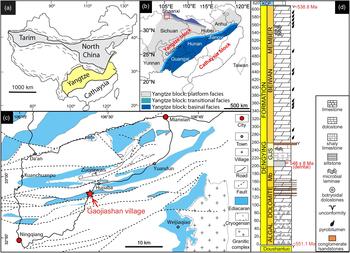
Simplified tectonic map, geological map, litho- and chemostratigraphy of the terminal Ediacaran Dengying Formation at the Gaojiashan section, South China. (a) Tectonic framework of China, with the Yangtze Craton highlighted in yellow. (b) Ediacaran depositional environments on the Yangtze Craton (Jiang et al. Reference Jiang, Kaufman, Christie-Blick, Zhang and Wu2007). Rectangle showing the location of the Ningqiang area in the northwestern margin of the Yangtze Platform. (c) Geological map of the Gaojiashan area in southern Shaanxi Province, modified after Cai et al. (Reference Cai, Hua, Schiffbauer, Sun and Yuan2014). Red star indicates the studied section at Gaojiashan village, Niqiang county, Hanzhong city, southern Shaanxi Province. (d) Simplified stratigraphy of the Dengying Formation at Gaojiashan (Cui et al. Reference Cui, Kaufman, Xiao, Peek, Cao, Min, Cai, Siegel, Liu, Peng, Schiffbauer and Martin2016b). Sources of age data: Condon et al. (Reference Condon, Zhu, Bowring, Wang, Yang and Jin2005); Cui et al. (Reference Cui, Kaufman, Xiao, Peek, Cao, Min, Cai, Siegel, Liu, Peng, Schiffbauer and Martin2016b); Linnemann et al. (Reference Linnemann, Ovtcharova, Schaltegger, Gärtner, Hautmann, Geyer, Vickers-Rich, Rich, Plessen, Hofmann, Zieger, Krause, Kriesfeld and Smith2019). Abbreviations: GJS – Gaojiashan Member; KCP – Kuanchuanpu Formation.

2. Significance the Dengying Formation
The Dengying Formation in the studied region has a number of features that may aid in a better understanding of the terminal Ediacaran ecosystems, which are summarized below.
2.a. Biomineralizing animal fossils and trace fossils
The Gaojiashan Member of the middle Dengying Formation hosts the Gaojiashan biota, including the earliest biomineralizing animal fossils Cloudina and Sinotubulites (Hua et al. Reference Hua, Chen and Yuan2007; Cai et al. Reference Cai, Hua, Xiao, Schiffbauer and Li2010, Reference Cai, Schiffbauer, Hua and Xiao2011, Reference Cai, Hua and Zhang2013, Reference Cai, Hua, Schiffbauer, Sun and Yuan2014, Reference Cai, Xiao, Hua and Yuan2015, Reference Cai, Cortijo, Schiffbauer and Hua2017), other calcareous fossils such as Protolagena (Cai et al. Reference Cai, Hua, Xiao, Schiffbauer and Li2010), non-biomineralizing tubular fossils such as Shaanxilithes, Gaojiashania and Conotubus (Cai et al. Reference Cai, Hua, Xiao, Schiffbauer and Li2010), as well as trace fossils made by mobile bilaterian animals (Lin et al. Reference Lin, Zhang, Zhang, Tao and Wang1986; Zhang, Reference Zhang1986; Ding et al. Reference Ding, Zhang, Li and Dong1992). Cloudina and Sinotubulites also extend into the overlying Beiwan Member at the Gaojiashan and nearby Lijiagou sections (Cai et al. Reference Cai, Hua, Xiao, Schiffbauer and Li2010). The first appearance datum (FAD) of biomineralizing animals has been regarded as a key datum for the definition of the Terminal Ediacaran Stage (Xiao et al. Reference Xiao, Narbonne, Zhou, Laflamme, Grazhdankin, Moczydłowska-Vidal and Cui2016; G. M. Narbonne, unpub. data, Terminal Ediacaran Stage Working Group, results of the first ballot, July 2018).
2.b. Chemostratigraphy
The dominance of well-preserved carbonates in the thick Dengying Formation enables global correlations via chemostratigraphy. For example, the carbonate carbon isotope (δ13Ccarb) profile reveals a positive excursion in the Gaojiashan Member of the Dengying Formation (Cui et al. Reference Cui, Kaufman, Xiao, Peek, Cao, Min, Cai, Siegel, Liu, Peng, Schiffbauer and Martin2016b), which is likely correlative with a similar magnitude excursion in the basal Khatyspyt Formation in Siberia (Cui et al. Reference Cui, Grazhdankin, Xiao, Peek, Rogov, Bykova, Sievers, Liu and Kaufman2016a). In addition, large isotopic fluctuations in nitrogen (δ15N), pyrite sulfur (δ34Spyrite) and uranium (δ238U) isotopes have been documented from the Gaojiashan Member of the DYF@GJS (Fig. 13) (Guo et al. Reference Guo, Deng and Yang2012; A. Gamper, unpub. Ph.D. dissertation, Freie Universität Berlin, 2014; Zhang et al. Reference Zhang, Hua and Liu2014a, Reference Zhang, Xiao, Kendall, Romaniello, Cui, Meyer, Gilleaudeau, Kaufman and Anbar2018; H. Cui, unpub. Ph.D. thesis, Univ. Maryland, 2015; Cui et al. Reference Cui, Kaufman, Xiao, Peek, Cao, Min, Cai, Siegel, Liu, Peng, Schiffbauer and Martin2016b). Individually or in unison, these secular stable isotope variations provide potential markers for chemostratigraphic correlations.
2.c. Ediacara-type macrofossils
The DYF@GJS has not yet yielded soft-bodied Ediacara-type macrofossils. However, Ediacara-type fossils such as Pteridinium, Rangea, Charniodiscus, Hiemalora and many others have been found in the equivalent Shibantan Member of the Dengying Formation in the Yangtze Gorges area (Sun, Reference Sun1986; Xiao et al. Reference Xiao, Shen, Zhou, Xie and Yuan2005; Shen et al. Reference Shen, Xiao, Zhou and Yuan2009, Reference Shen, Xiao, Zhou, Dong, Chang and Chen2017; Chen et al. Reference Chen, Zhou, Xiao, Wang, Guan, Hua and Yuan2014; Mason et al. Reference Mason, Li, Cao, Long and She2017).
2.d. Age constraints
Based on a U–Pb zircon age of 551.1 ± 0.7 Ma from a volcanic ash layer at the Doushantuo–Dengying boundary in the Yangtze Gorges area (Condon et al. Reference Condon, Zhu, Bowring, Wang, Yang and Jin2005), and a new radiometric constraint of 538.8 Ma from Namibia (Linnemann et al. Reference Linnemann, Ovtcharova, Schaltegger, Gärtner, Hautmann, Geyer, Vickers-Rich, Rich, Plessen, Hofmann, Zieger, Krause, Kriesfeld and Smith2019) for the Ediacaran–Cambrian boundary, the Dengying Formation represents the last 12.3 million years of the Ediacaran Period. In addition, a youngest detrital zircon age of 548 ± 8 Ma (interpreted as the maximum possible depositional age) was reported from the lower Gaojiashan Member of the DYF@GJS (Cui et al. Reference Cui, Kaufman, Xiao, Peek, Cao, Min, Cai, Siegel, Liu, Peng, Schiffbauer and Martin2016 b), which is consistent with the previously published geochronological framework in this region.
2.e. Accessibility
The DYF@GJS is located near the Gaojiashan village in southern Shaanxi Province of South China (Fig. 1), which is easily accessed with field vehicles. From the major city of Hanzhong the drive is ~75 km on the Jingkun Highway (G5) to Hujiaba Town, where the vehicles can continue on for an additional 5 km on unpaved road to the base of the section at the Huangjia Mountain.
In summary, we regard that the Dengying Formation in South China offers a clear window through which to view the terminal Ediacaran Period. This study builds upon an earlier study (Fig. 13) (H. Cui, unpub. Ph.D. thesis, Univ. Maryland, 2015; Cui et al. Reference Cui, Kaufman, Xiao, Peek, Cao, Min, Cai, Siegel, Liu, Peng, Schiffbauer and Martin2016b) and aims at obtaining high-resolution integrative chemostratigraphic profiles of δ13Ccarb, δ18Ocarb, δ13Corg and δ34Spyrite throughout the formation.
3. Geologic settings
The DYF@GJS is geographically located near the Gaojiashan village in southern Shaanxi Province of South China, and palaeogeographically is part of the northwestern Yangtze Block (Fig. 1a–c). It should be noted that the word ‘Gaojiashan’ has been used to refer to both the locality (e.g. Gaojiashan village, the Gaojiashan section, DYF@GJS) and the stratigraphic unit (i.e. the Gaojiashan Member).
Stratigraphically, the Dengying Formation (c. 551.1–538.8 Ma) is sandwiched between the Ediacaran Doushantuo Formation (c. 635–551 Ma) and the basal Cambrian Kuanchuanpu Formation (Fig. 1d) (Zhu et al. Reference Zhu, Zhang and Yang2007; Jiang et al. Reference Jiang, Shi, Zhang, Wang and Xiao2011). The Dengying Formation in the studied region is typically subdivided into three members including, in ascending order, the Algal Dolomite (dolostones), the Gaojiashan (limestones and calcareous siltstones) and the Beiwan (dolostones). These three members are generally correlated with the Hamajing, Shibantan and Baimatuo members, respectively, in the Yangtze Gorges area of South China (Zhou & Xiao, Reference Zhou and Xiao2007; Zhu et al. Reference Zhu, Zhang and Yang2007; Duda et al. Reference Duda, Zhu and Reitner2015).
The DYF@GJS is at least 631.5 m in thickness, with the Algal Dolostone Member measured from 0 to 202 m, the Gaojiashan Member from 202 to 257 m and the Beiwan Member from 257 to 631.5 m (Fig. 1d). The basal Algal Dolomite Member, and hence the Doushantuo–Dengying boundary, is faulted out, indicating that the Dengying Formation is probably thicker than the measured thickness of 631.5 m. The Beiwan Member of the DYF@GJS is overlain by limestones of the Kuanchuanpu Formation and then shales of the Guojiaba Formation. The Kuanchuanpu Formation in southern Shaanxi Province and northeastern Sichuan Province contains basal Cambrian small shelly fossils (Steiner et al. Reference Steiner, Li, Qian and Zhu2004) and the oldest known priapulid-like and kinorhynch-like scalidophoran animals (Liu et al. Reference Liu, Xiao, Shao, Broce and Zhang2014b; Zhang et al. Reference Zhang, Xiao, Liu, Yuan, Wan, Muscente, Shao, Gong and Cao2015; Han et al. Reference Han, Morris, Ou, Shu and Huang2017).
4. Analytical methods
In total 270 rock samples were continuously collected at high stratigraphic resolution from exposed outcrops of the DYF@GJS for systematic sedimentological and chemostratigraphic investigation. These included 45 samples from the Algal Dolomite Member, 113 samples from the Gaojiashan Member (35 samples collected during the 2009 field season and 78 samples collected during the 2014 field season) and 112 samples from the Beiwan Member. Samples were analysed for carbonate carbon (δ13Ccarb) and oxygen (δ18Ocarb) isotopes, organic carbon isotopes (δ13Corg), strontium isotopes (87Sr/86Sr) and sulfur isotopes (δ34S) of total sulfur in acidified residues. Sample preparation (including sample cutting, crushing, acidification and leaching) and geochemical analyses were conducted using standard operation procedures (e.g. Cui et al. Reference Cui, Kaufman, Xiao, Zhu, Zhou and Liu2015, Reference Cui, Kaufman, Peng, Liu, Plummer and Lee2018a) in the Department of Geology, University of Maryland.
4.a. Fabric-specific sampling strategy using micro-drills
Many samples in the Dengying Formation comprise multiple generations of diagenetic textures, which likely record isotopic signatures reflecting different sources of alkalinity. To better evaluate the impact of diagenesis on bulk rock carbonate compositions, micro-drilling was guided by petrographic fabrics so that different phases (e.g. cements, intraclasts, micritic matrix, crystal fans, microbial laminae, carbonate veins, nodules, vug fills) were sampled separately on polished slabs using a micro-drilling apparatus, in order to characterize the isotopic signatures of different stages of diagenesis. For chemostratigraphic purposes, powders for carbonate carbon (δ13Ccarb), oxygen (δ18Ocarb) and strontium (87Sr/86Sr) isotope analyses were only sampled from the least-altered and least-recrystallized phases in order to minimize the impact of post-depositional processes on geochemical signals.
4.b. Carbon and oxygen isotope analysis
Carbonate carbon and oxygen isotopes were measured by continuous flow isotope ratio mass spectrometry in the University of Maryland Palaeoclimate Laboratory using a refined method for the analysis and correction of carbon (δ13Ccarb) and oxygen (δ18Ocarb) isotopic compositions of 100 μg carbonate samples (Spötl, Reference Spötl2011; Evans et al. Reference Evans, Selmer, Breeden, Lopatka and Plummer2016). Up to 180 samples loaded into 3.7 ml Labco Exetainer vials and sealed with Labco septa were flushed with 99.999 % helium and manually acidified with 103% phosphoric acid at 60 °C. The CO2 analyte gas was isolated via gas chromatography, and water was removed using a Nafion trap prior to admission into an Elementar Isoprime stable isotope mass spectrometer fitted with a continuous flow interface. Data were corrected via automated MATLAB scripting on the Vienna Pee Dee Belemnite and LSVEC Lithium Carbonate (VPDB–LSVEC) scale (Coplen et al. Reference Coplen, Brand, Gehre, Gröning, Meijer, Toman and Verkouteren2006) using periodic in-run measurement of international reference carbonate materials and/or in-house standard carbonates, from which empirical corrections for signal amplitude, sequential drift and one or two-point mean corrections were applied. Precision for both isotopes is routinely better than 0.1 ‰ (Evans et al. Reference Evans, Selmer, Breeden, Lopatka and Plummer2016).
4.c. Organic carbon and pyrite sulfur isotope analyses
The organic carbon (δ13Corg) and total sulfur (δ34STS) isotope compositions were measured by combustion of the decalcified residues to CO2 or SO2 with a Eurovector elemental analyser in-line with a second Elementar Isoprime isotope ratio mass spectrometer. Around 15 g of bulk crushed sample was acidified with 3 M HCl to achieve quantitative removal of carbonates. These acidified residues were washed with ultra-pure Milli-Q (18MΩ) water, centrifuged, decanted and dried. The residues were packed into folded tin cups for combustion (0.1 to 0.3 mg of V2O5 were added to the sulfur samples to aid in combustion), and released CO2 and SO2 were used for the analysis of δ13Corg and δ34STS, respectively. Owing to the negligible amount of organic sulfur in the acidified residues, the dominant sulfur species is pyrite. Thus, δ34STS values are regarded as a proxy for pyrite sulfur isotope compositions (δ34Spyrite). Uncertainties for carbon and sulfur isotope measurements determined by multiple analyses of standard materials during analytical sessions are better than 0.1 ‰ and 0.3 ‰, respectively.
4.d. Strontium isotope analysis
For strontium isotope (87Sr/86Sr) analysis, only limestone samples from the Gaojiashan Member were selected for extraction and measurement. Micro-drilled powders (c. 10 mg) were leached three times in 0.2 M ammonium acetate (pH ~8.2) to remove exchangeable Sr from non-carbonate minerals, and then rinsed three times with Milli-Q water. The leached powder was centrifuged, decanted and acidified with doubly distilled 0.5 M acetic acid overnight to remove strontium from the carbonate crystal structure. The supernatant was centrifuged to remove insoluble residues, and then decanted, dried and subsequently dissolved in 200 μl of 3 M HNO3. Strontium separation by cation exchange was carried out using small polyethylene columns containing ~10 mm of Eichrom® Sr specific resin. The column was rinsed with 400 μl of 3 M HNO3 before the dissolved sample was loaded onto the column. After loading, the sample was sequentially eluted with 200 μl of 3 M HNO3, 600 μl of 7 M HNO3 and 100 μl of 3 M HNO3 to remove the Ca, Rb and rare earth element fractions; the Sr fraction adsorbs strongly to the resin in an acidic environment. The Sr fraction was removed by elution with ~800 μl of 0.05 M HNO3 and the resultant eluate was collected and dried. Approximately 200–300 ng of the dried sample was transferred onto a degassed and pre-baked (~4.2 A under high vacuum) high purity Re filament with 0.7 μl of Ta2O5 activator. Filaments were transferred to a sample carousel, heated under vacuum (~10−7 to 10−8 atm) to a temperature of between 1450 °C and 1650 °C, and analysed when a stable signal (>1.0 V) was detected on the mass 88 ion beam. The measurements were conducted on a VG Sector 54 thermal ionization mass spectrometer in the TIMS facility of the University of Maryland Geochemistry Laboratories. Approximately 100 87Sr/86Sr ratios were collected for each sample. The data have been corrected for fractionation using the standard value 86Sr/88Sr = 0.1194. The fraction of 87Sr resulting from in situ decay from 87Rb was removed by measurement of rubidium abundance at mass 85. Repeated analyses of the NBS SRM987 standard yielded an average value of 87Sr/86Sr = 0.710245 ± 0.000011 (2σ) during the analytical window.
5. Sedimentology of the Dengying Formation
Sedimentological observations of the DYF@GJS can provide direct palaeoenvironmental context for the depositional basin. Various lithofacies with distinct sedimentary textures can be identified in each of the three members of the DYF@GJS, which are summarized below.
5.a. Lithofacies of the Algal Dolomite Member
The Algal Dolomite Member (0–202 m of the DYF@GJS) is dominated by bedded dolostones (including thrombolites) with abundant karstification textures (e.g. botryoidal dolostones, carbonate breccias, authigenic carbonate crystal fans) and other post-depositional alteration (e.g. saddle dolomite cements).
5.a.1. Botryoidal dolostones
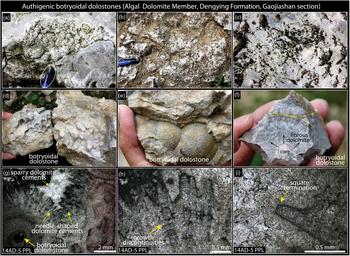
Diagnostic karst carbonates are abundant in the outcrop, including void-filling botryoidal dolostone (Fig. 2) and karst breccia (Fig. 3). Botryoidal dolostone typically shows concentric layers around a core of millimetre to centimetre scale, suggesting centrifugal precipitation (Fig. 2f, g). Based on their distinct textures, including growth discontinuities and square crystal terminations (Fig. 2g–i), it is likely that they were initially aragonite in mineralogy, and were subsequently replaced by calcite and dolomite (e.g. Ginsburg & James, Reference Ginsburg and James1976; Aissaoui, Reference Aissaoui1985; Sandberg, Reference Sandberg, Schneidermann and Harris1985). The occurrences of botryoidal aragonites are typically parallel with the primary bedding.
Field and microscopic views of the authigenic botryoidal dolostones that are typical in the lower half of the Algal Dolomite Member of the Dengying Formation at the Gaojiashan section. (a–c) Outcrops showing distinct botryoidal textures with concentric lamina. Pen for scale. (d, e) Hand samples showing the distinct botryoidal texture. Note the part and counterpart in (d). (f) Fresh fracture surface showing radial fabrics diverging from the core. (g) Microscopic images of the authigenic botryoidal dolostone showing needle-shaped crystals with growth discontinuities and square terminations. Note the needle-shaped crystals as the first-stage cements and the sparry dolomite as the second-stage cements. (h, i) Magnified views of the needle-shaped crystals with discontinuities and square terminations, indicating original aragonite mineralogy. PPL – plane polarized light.

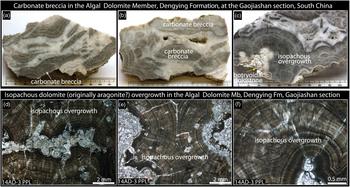
Field samples and microscopic views of the carbonate breccia and isopachous overgrowth that are typical in the lower half of the Algal Dolomite Member of the Dengying Formation at the Gaojiashan section. (a–c) Karst breccia cemented by carbonates in the vugs between breccias. Scale in millimetres. (d–f) Petrographic images of sample 14AD-3, showing isopachous void-filling carbonate cements with concentric textures (brown colour) surrounding coarse dolomite sediments (white colour). PPL – plane polarized light.

5.a.2. Carbonate breccias
Closely associated with botryoidal dolostones, carbonate breccia is abundant in the Algal Dolomite Member (Fig. 3a–c). Isopachous cements in the botryoidal dolostone were broken into centimetre-sized breccia and were then cemented after final deposition (Fig. 3). Some primary pores between the carbonate breccias are still not yet fully cemented (Fig. 3b). Petrographic observations reveal that these carbonate breccias are mostly composed of isopachous cements growing on dolomite intraclasts or botryoidal dolostone (Fig. 3d–f).
5.a.3. Authigenic carbonate crystal fans
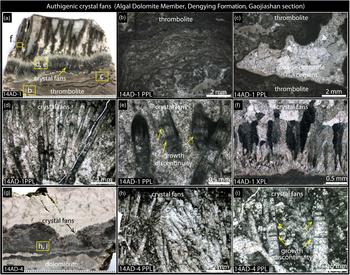
Distinct authigenic crystal fans of centimetre size have been found in the Algal Dolomite Member (Fig. 4). These crystal fans were initially misidentified as algal fossils in previous studies (Cao & Zhao, Reference Cao and Zhao1978 a,b), and then re-interpreted as inorganic carbonate precipitates (Cai et al. Reference Cai, Hua, Xiao, Schiffbauer and Li2010). The sharp square crystal terminations and growth discontinuities within the crystal fan (Fig. 4d, e, h, i) suggest that these authigenic cements were initially aragonite in mineralogy (e.g. Mazzullo & Cys, Reference Mazzullo and Cys1979; Mazzullo, Reference Mazzullo1980; Sandberg, Reference Sandberg, Schneidermann and Harris1985; Corsetti et al. Reference Corsetti, Lorentz, Pruss, Jenkins, McMenamin, McKay and Sohl2004; Pruss et al. Reference Pruss, Corsetti and Fischer2008; Loyd et al. Reference Loyd, Marenco, Hagadorn, Lyons, Kaufman, Sour-Tovar and Corsetti2013) and then converted to dolomite (no fizz in acid test) (Aissaoui, Reference Aissaoui1985; Lin et al. Reference Lin, Peng, Yan and Hou2015; Peng et al. Reference Peng, Zhang and Lin2017).
Hand samples and microscopic views of the thrombolite and authigenic aragonite (now dolomite) crystal fans that are typical in the lower half of the Algal Dolomite Member of the Dengying Formation at the Gaojiashan section. (a) Sample slab 14AD-1, showing thrombolite sediments in the lower part and two generations of crystal fans in the middle and upper parts, respectively. Scale in millimetres. (b, c) Magnified views of thrombolitic texture in labelled rectangles in (a). Note the coarse dolomite cements within a large void in the thrombolitic dolomite matrix. (d, e) Authigenic crystal fans in labelled rectangles in (a). Note the crystals with growth discontinuities (arrows). Although the entire rocks have been dolomitized, the relic fabrics of the original aragonite crystals are retained. (f) Divergent fabrics of dolomite crystals with sweeping extinction under cross-polarized light in labelled rectangles in (a). (g) Dolostone slab 14AD-4 with crystal fans growing above dolomitic sediments. Scale in millimetres. (h, i) Magnified views of crystal fans in labelled rectangles in (g), showing growth discontinuities (arrows in (i)) within the aragonite crystals. PPL – plane polarized light; XPL – cross-polarized light.

5.a.4. Thrombolites
Thrombolites with a distinct clotted texture are abundant in the Algal Dolomite Member (Figs 4b, 5a–c). The occurrence of thrombolites in the Dengying Formation (Fang et al. Reference Fang, Hou and Dong2003; Li et al. Reference Li, Tan, Zeng, Zhou, Yang, Hong, Luo and Bian2013b; Liu et al. Reference Liu, Li, Zhang, Zhou, Yuan, Shan, Zhang, Deng, Gu, Fan, Wang and Li2015; Wang et al. Reference Wang, Yang, Wen, Luo, Luo, Xia and Sun2016; Chen et al. Reference Chen, Shen, Pan, Zhang and Wang2017; Luo et al. Reference Luo, Pan and Reitner2017; Wen et al. Reference Wen, Wang, Zhang and Luo2017), along with other Ediacaran occurrences in the Ara Group of Oman (Grotzinger et al. Reference Grotzinger, Watters and Knoll2000, Reference Grotzinger, Adams and Schröder2005; Grotzinger & Al-Rawahi, Reference Grotzinger and Al-Rawahi2014) and the Blueflower Formation in the Mackenzie Mountains of Northwestern Canada (Aitken & Narbonne, Reference Aitken and Narbonne1989), suggests that thrombolites were abundant in Ediacaran shallow-marine environments.
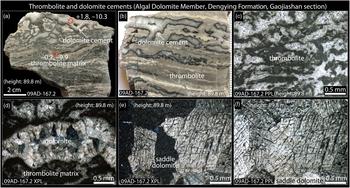
Thrombolitic dolostone and void-filling hydrothermal dolomite cements in the Algal Dolomite Member, Dengying Formation, at the Gaojiashan section. Sample 09AD-167.2 from a stratigraphic height of 89.8 m in Figure 12. (a, b) Dolostone slabs showing thrombolitic dolomite matrix with vug-filling dolomite cements. Fabric-specific δ13C (left) and δ18O (right) data are provided in (a). Scale in (b) in millimetres. (c) A magnified view of the thrombolitic dolomite matrix under plane-polarized light. (d) A magnified view of coarse dolomite cements in the thrombolitic dolomite matrix under cross-polarized light. (e, f) Magnified views of hydrothermal saddle dolomites with two distinct sets of cleavages and sweeping extinction. PPL – plane polarized light; XPL – cross-polarized light.

5.a.5. Saddle dolomite cements
Petrographic observations reveal that many late-stage void-filling cements are composed of large saddle dolomite crystals, which are characterized by a distinct cleavage and sweeping extinction under cross-polarized light (Fig. 5d–f). These saddle dolomite cements are typically interpreted as precipitates from hydrothermal fluids during deep burial (Davies & Smith, 2006; Shi etal. Reference Shi, Wang, Tian and Wang2013; Liu etal. Reference Liu, Huang, Jansa, Wang, Song, Zhang, Sun and Ma2014a; Zhu etal. Reference Zhu, Jin, Sun, Peng, Zhang and Yuan2014a), thus should be avoided in chemostratigraphic studies.
5.b. Lithofacies of the Gaojiashan Member
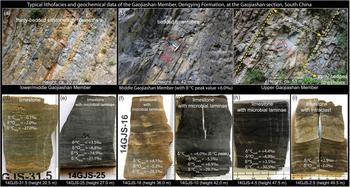
The fossiliferous Gaojiashan Member (202–257 m of the DYF@GJS) is 55 m in thickness, including a siltstone interval in the lower part, repetitious siltstone–mudstone–limestone facies with crinkly and microbially laminated limestone in the middle part, and a coarse sandstone/conglomerate interval at the top (Fig. 6) (Cai etal. Reference Cai, Hua, Xiao, Schiffbauer and Li2010; Cui et al. Reference Cui, Kaufman, Xiao, Peek, Cao, Min, Cai, Siegel, Liu, Peng, Schiffbauer and Martin2016b ). Sedimentological observations suggest that the Gaojiashan Member was mainly deposited in a subtidal marine setting between the fair weather and storm wave bases. Limestones with abundant microbial laminae (Fig. 6d–h) and intraclasts in this member (Fig. 6i) suggest sediment reworking by episodic storm events (Cai etal. Reference Cai, Hua, Xiao, Schiffbauer and Li2010).
Typical lithofacies and geochemical data of the Gaojiashan Member, Dengying Formation, at the Gaojiashan section. Stratigraphic height numbers represent the distance above the Algal Dolomite/Gaojiashan boundary. (a) Thinly bedded siltstones and silty limestones in the lower/middle transition of the Gaojiashan Member. (b) Dark-coloured thin-bedded limestones in the middle Gaojiashan Member that records a δ13Ccarb positive excursion of up to +6 ‰ (Cui et al. Reference Cui, Kaufman, Xiao, Peek, Cao, Min, Cai, Siegel, Liu, Peng, Schiffbauer and Martin2016b). (c) A conglomerate/sandstone interval in the upper Gaojiashan Member. Hammer for scale is 33 cm long. (d–i) Photographs of freshly cut slabs of samples from the Gaojiashan Member with microbial laminae and intraclasts. These slabs represent (d) greenish grey dolostone, (e–h) limestones with microbial laminae, and (i) intraclastic limestone. The numbers in the sample IDs represent distance (in metres) below the conglomerate interval in the upper Gaojiashan Member; for example, sample 14GJS-10 is 10 m below the conglomerate interval in the Gaojiashan Member. The δ13Ccarb and δ18Ocarb values of micro-drilled carbonate powders are marked on the slab. The δ34Spyrite and δ13Corg values of each slab were analysed from bulk acidified residues.

5.b.1. Bedded siltstones or silty limestones (lower Gaojiashan Member, 202–222 m of the DYF@GJS)
The lower Gaojiashan Member is mainly composed of thinly bedded siltstones or silty limestones without cross-bedding textures, suggesting a relatively deep environment. The enigmatic body fossil Shaanxilithes ningqiangensis is found in the siltstone facies of this member (Meyer et al. Reference Meyer, Schiffbauer, Xiao, Cai and Hua2012).
5.b.2. Bedded limestones or silty limestones (middle Gaojiashan Member, 222–254 m of the DYF@GJS)
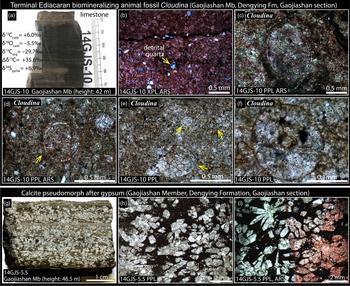
The middle Gaojiashan Member contains Conotubus hemiannulatus and Gaojiashania cyclus preserved in thin, normally graded calcisiltite-siltstone beds interpreted as distal event deposits (Cai et al. Reference Cai, Hua, Xiao, Schiffbauer and Li2010). Further up section, the first appearance of the biomineralizing animal Cloudina occurs in intraclastic limestone facies c. 40 m above the base of the Gaojiashan Member (Fig. 7a–f) (Hua et al. Reference Hua, Chen and Yuan2007; Cai et al. Reference Cai, Hua, Xiao, Schiffbauer and Li2010). Notably, Cloudina fossils at the DYF@GJS are typically associated with microbial laminae (Cai et al. Reference Cai, Hua, Schiffbauer, Sun and Yuan2014). Similar observations have also been made in the Nama Group of Namibia (Grotzinger & James, Reference Grotzinger, James, Grotzinger and James2000; Adams et al. Reference Adams, Schröder, Grotzinger and Mccormick2004; Grotzinger et al. Reference Grotzinger, Adams and Schröder2005), the Byng Formation of the Miette Group in British Columbia (Hofmann & Mountjoy, Reference Hofmann and Mountjoy2001), the Tamengo Formation of the Corumbá Group in Southwest Brazil (Becker-Kerber et al. Reference Becker-Kerber, Pacheco, Rudnitzki, Galante, Rodrigues and De Moraes Leme2017) and the Itapucumi Group in Paraguay (Warren et al. Reference Warren, Fairchild, Gaucher, Boggiani, Poire, Anelli and Inchausti2011), where intimate associations of Cloudina with microbialites have also been reported.
Fossils and gypsum pseudomorphs in the Gaojiashan Member, Dengying Formation, at the Gaojiashan section. (a) Limestone slab 14GJS-10 (collected at 42 m in Fig. 13) with the terminal Ediacaran fossil Cloudina. (b) Thin-section of 14GJS-10 stained by Alizarin Red S, confirming its limestone lithology. Note abundant detrital quartz in this sample (arrow). (c–f) Transverse cross-sections of Cloudina (arrows) in thin-sections of the sample 14GJS-10. (g) Rock slab of sample 14GJS-5.5 (collected at 46.5 m in Fig. 13), showing calcite pseudomorphs after gypsum in the Gaojiashan Member. (h, i) Magnified views of the calcite pseudomorphs after gypsum rosettes. The right half of image (i) shows a red colour after being stained by Alizarin Red S, confirming the calcite composition of the pseudomorphs. PPL – plane polarized light; XPL – cross-polarized light; ARS – stained by Alizarin Red S.

5.b.3. Gypsum (middle Gaojiashan Member, 251.5 m of the DYF@GJS)
It is notable that a distinct gypsum (now replaced by calcite) horizon (c. 20–30 mm in thickness) occurs within the limestone interval 5.5 m below the conglomerate and sandstone interval of the upper Gaojiashan Member (Fig. 7g–i). In this layer, calcite pseudomorphs with distinct gypsum crystal shapes suggest the dissolution and replacement of pre-existing gypsum. This gypsum layer, along with sedimentary structures indicative of shallow-water depositional environments, suggests an evaporative environment with high concentrations of seawater sulfate. The presence of gypsum in the DYF@GJS is also consistent with published sedimentological observations in other localities across the Yangtze Block, where evaporites, including halite, gypsum and anhydrite, have also been widely reported from the Dengying Formation (Xi, Reference Xi and Peryt1987; Siegmund & Erdtmann, Reference Siegmund and Erdtmann1994; Meng et al. Reference Meng, Ni, Schiffbauer, Yuan, Zhou, Wang and Xia2011; Lu et al. Reference Lu, Zhu, Zhang, Shields-Zhou, Li, Zhao, Zhao and Zhao2013; Duda et al. Reference Duda, Zhu and Reitner2015; Liu et al. Reference Liu, Li, Zhang, Zhou, Yuan, Shan, Zhang, Deng, Gu, Fan, Wang and Li2015; Luo et al. Reference Luo, Pan and Reitner2017).
5.b.4. Sandstones and conglomerates (upper Gaojiashan Member, 254–257 m of the DYF@GJS)
A distinct interval of coarse sandstones and conglomerates occurs in the uppermost Gaojiashan Member, suggesting an increasingly shallower depositional environment. This conglomerate and sandstone interval is dominated by pure quartz grains in the DYF@GJS, and shows large-scale cross-bedding in the nearby Shiziya section (Cai et al. Reference Cai, Hua, Xiao, Schiffbauer and Li2010).
5.c. Lithofacies of the Beiwan Member
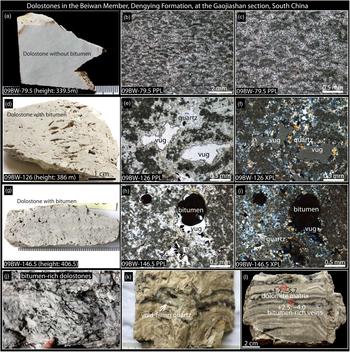
The Beiwan Member (257–631.5 m of the DYF@GJS) is dominated by thick-bedded dolostones with void-filling bitumen (Fig. 8). At the outcrop scale, bitumen-rich layers can be parallel to or cross-cut the primary bedding. Petrographic observations in thin-sections (Fig. 8) reveal that the pores in the Beiwan dolostones are often surrounded by quartz rims (Fig. 8e, f, h, i, k), suggesting that silicification in low pH conditions may have promoted the dissolution of primary dolostones and contributed to the genesis of secondary porosity. These secondary pores or vugs consequently facilitated oil migration that resulted in the infilling of bitumen in the voids.
Petrographic observations of dolostones in the Beiwan Member, Dengying Formation, at the Gaojiashan section. (a–c) Slab and petrographic photographs of sample 09BW-79.5 (collected at 339.5 m in Fig. 12) showing dolomicrite with abundant algal fabrics (?). (d–f) Slab and petrographic photographs of sample 09BW-126 (collected at 386 m in Fig. 12) showing dolostone with vugs and quartz cements. (g–i) Slab and petrographic photographs of sample 09BW-146.5 (collected at 406.5 m in Fig. 12). Note the vugs with bitumen in (h) and (i), and the quartz cements (arrows) in (f) and (i) under cross-polarized light. (j) Outcrop photograph showing dolostones (white) with abundant bitumen (black). (k, l) Photographs of hand samples showing bitumen in dissolution vugs. Note the void-filling quartz (arrow) in (k). Micro-drilling geochemical δ13C (left) and δ18O (right) data are provided in (l). PPL – plane polarized light; XPL – cross-polarized light.

5.d. A synthetic depositional model
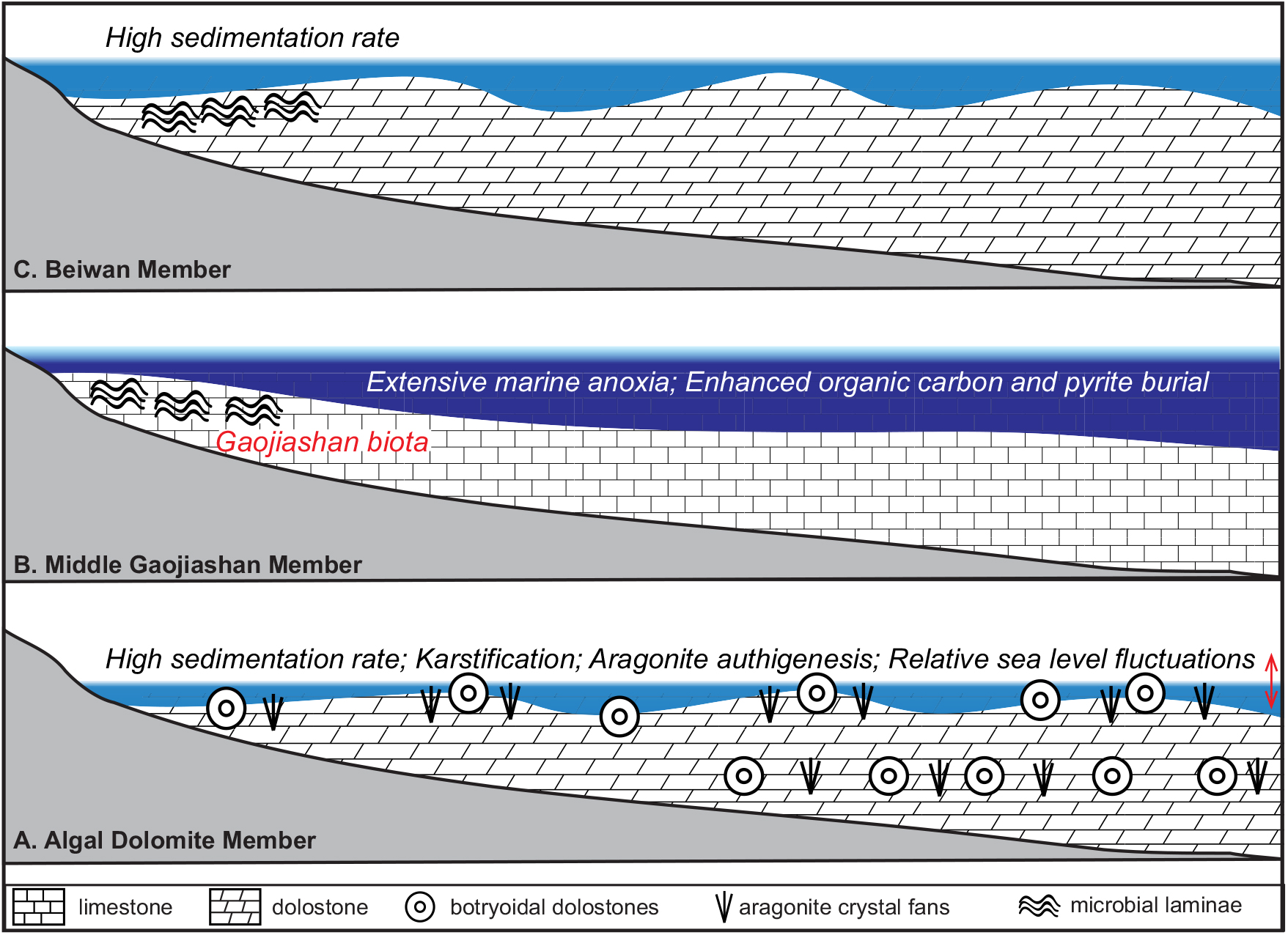
Based on the above sedimentological observations, the deposition of the DYF@GJS can be divided into multiple stages as described below (Fig. 9).
A depositional model of the terminal Ediacaran Dengying Formation based on studies of the Gaojiashan section. See main text for a detailed discussion.

5.d.1. Stage 1 (Algal Dolomite Member)
The Algal Dolomite Member of the Dengying Formation was rapidly deposited in a relatively warm peritidal environment (Fig. 9a). In light of the repeating occurrences of botryoidal carbonates in parallel with the primary bedding, sea levels were likely low and the carbonate deposits were subject to frequent subaerial exposure, so that syn-depositional or very early post-depositional karstification occurred repeatedly. The void-filling authigenic aragonite cements and crystal fans in this formation may have formed penecontemporaneously with sedimentation when sea level fluctuated and the carbonate sediments were repeatedly exposed and submerged.
5.d.2. Stage 2 (lower Gaojiashan Member)
The lower Gaojiashan Member represents deposition below storm wave base, as evidenced by the thinly bedded siltstone and silty limestones in this unit.
5.d.3. Stage 3 (middle and upper Gaojiashan Member)
Deposition mostly occurred in an environment above the storm wave base (Cai et al. Reference Cai, Hua, Xiao, Schiffbauer and Li2010) (Fig. 9b). Towards the upper Gaojiashan Member, the relative sea level dropped progressively, leading to the deposition of gypsum, carbonate intraclasts, and conglomerate and sandstones.
5.d.4. Stage 4 (Beiwan Member)
The Beiwan Member represents another period of carbonate deposition in a peritidal environment with a high sedimentation rate (Fig. 9c).
The overall shallowing trend from the Gaojiashan to the Beiwan Member may have been controlled by regional tectonic uplift (Xue et al. Reference Xue, Cao, Tang, Yin, Yu and Yang2001; Wang et al. Reference Wang, Jiang, Wang, Lu, Gu, Xu, Yang and Xu2014a; Zhu et al. Reference Zhu, Jin, Zhang, Zhang, He and Li2014b, Reference Zhu, Zhang, Li, Feng, Sun, Lin and Zhang2015; Li et al. Reference Li, Hu and Zhou2015; Yang et al. Reference Yang, Chen, Zhong, Zhu, Chen, Wen, Xu and Wu2017). The repeated karstification of the Algal Dolomite Member, on the other hand, may be related to minor sea level fluctuations in a peritidal environment.
6. Geochemical results of the Dengying Formation
6.a. Fabric-specific δ13Ccarb and δ18Ocarb data
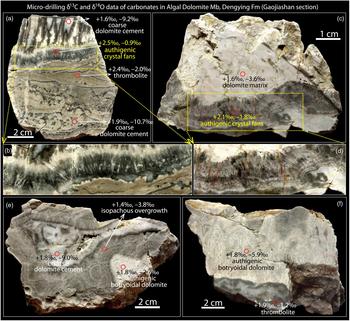
Samples in the dolostone-dominated Algal Dolomite Member and Beiwan Member typically show complex textures, including a dolomicrite matrix, large aragonite (now dolomite) crystal fans and void-filling aragonite (now dolomite) or quartz cements. Fabric-specific geochemical analysis via micro-drilling shows different isotopic signatures among individual phases (Fig. 10). It is notable that the aragonite (now dolomite) crystal fans record the highest δ18Ocarb values (–0.9 ‰ in Fig. 10a and –1.8 ‰ in Fig. 10c) among the data measured from the micro-drilled carbonates. In contrast, late-stage hydrothermal saddle dolomite cements typically show the lowest δ18Ocarb values (–10.3 ‰ in Fig. 10a).
Carbonate δ13C (left) and δ18O (right) values of micro-drilled samples from the Algal Dolomite Member, Dengying Formation, at the Gaojiashan section. (a–d) Freshly cut dolostone slabs showing authigenic crystal fans. (a) and (b) also illustrated in Figure 4a–f; (c) and (d) also illustrated in Figure 4g–i. Although all samples have been dolomitized, relic fabrics of aragonite are retained. (e, f) Freshly cut dolostone slabs showing thrombolite matrix, botryoidal dolomite, isopachous cements and late-stage dolomite cements. Note the relatively high δ18Ocarb values in the aragonite crystal fans (–0.9 ‰ in (a) and –1.8 ‰ in (c)) and the relatively low δ18Ocarb values in the late-stage coarse dolomite cements (–9.2 ‰ in (a) and –9.0 ‰ in (e)).

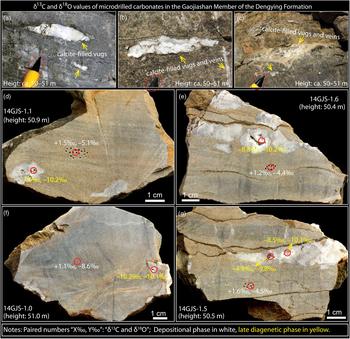
During the field investigation, multiple calcite-filled vugs and veins were found in the limestone intervals of the upper Gaojiashan Member (1–2 m below the conglomerate/sandstone interval) (Fig. 11a–c). Both the calcite veins and micritic limestone host rock were micro-drilled and analysed for δ13Ccarb and δ18Ocarb compositions (Fig. 11d–g). The data show that the δ13Ccarb and δ18Ocarb values measured from the calcite vugs and veins are consistently lower than those of the limestone host rock.
Carbonate δ13C (left) and δ18O (right) values of micro-drilled samples from the Gaojiashan Member, Dengying Formation, at the Gaojiashan section. (a–c) Calcite-filled vugs and veins (arrows) at c. 50–51 m in Figure 13. Pencil for scale. (d–g) Carbonate δ13C (left) and δ18O (right) values of micro-drilled samples from the Gaojiashan Member. Note that the δ13C and δ18O values (in yellow) of the vug-filling calcite are consistently lower than those (in white) measured from the host carbonate rocks. Numbers in sample IDs represent distance (in metres) below the conglomerate/sandstone interval of the upper Gaojiashan Member. The stratigraphic height values in (d–g) represent the distance above the Gaojiashan/Algal Dolomite boundary.

6.b. Chemostratigraphic profiles of the Dengying Formation
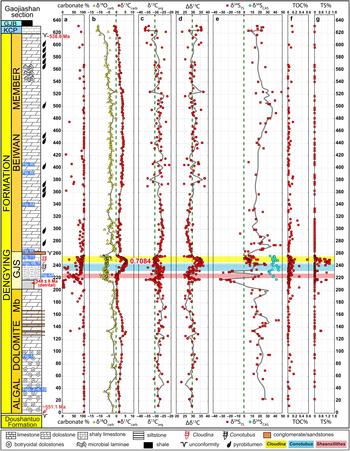
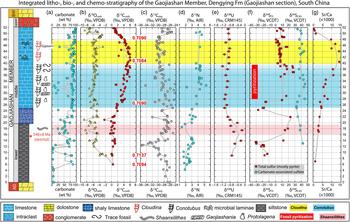
For chemostratigraphic purposes, only data measured from the least-altered micritic carbonate matrix were compiled when constructing the chemostratigraphic profiles (Figs 12, 13). Carbonate percentages (carbonate wt %) of the DYF@GJS are mostly >90 % except for a few siltstone intervals in the Gaojiashan Member (Fig. 12a). The δ13Ccarb profile of the DYF@GJS shows a positive excursion (up to +6 ‰) in the Gaojiashan Member (Figs 12b, 13b) and two broad positive excursions (up to +4 ‰) in the Algal Dolomite Member and Beiwan Member, respectively (Figs 12b, 14a). The δ18Ocarb data for the DYF@GJS mostly range between –5 ‰ and 0 ‰, with the exception of the Gaojiashan Member (down to c. –8 ‰; Fig. 13b), the uppermost Beiwan Member and the Kuanchuanpu Member (Fig. 12b). The organic carbon isotope (δ13Corg) data for the DYF@GJS mostly range between –30 ‰ and –25 ‰, with more negative values (down to c. –35 ‰) in the Gaojiashan and the Kuanchuanpu members (Figs 12c, 13c). Calculated values of carbon isotope fractionation (Δδ13C = δ13Ccarb – δ13Corg) between the carbonate carbon and organic carbon of the DYF@GJS mostly range between +25 ‰ and +35 ‰, with higher values in the Gaojiashan Member and some horizons of the Beiwan Member (Fig. 12d).
Integrated litho-, bio- and chemostratigraphy of the terminal Ediacaran Dengying Formation at the Gaojiashan section. Geochemical profiles show (a) carbonate contents, (b) carbonate carbon isotopes (δ13Ccarb, ‰ VPDB), carbonate oxygen isotopes (δ18Ocarb, ‰ VPDB), (c) organic carbon isotopes (δ13Corg, ‰ VPDB), (d) carbon isotope fractionations (Δδ13Ccarb-org), (e) pyrite sulfur isotopes (δ34STS, ‰ VCDT), carbonate-associated sulfate (CAS) sulfur isotopes (δ34SCAS, ‰ VCDT), (f) total organic carbon content (TOC) and (g) total sulfur content (TS, dominated by pyrite with trace amount of organic S) of acidified residues. The grey lines represent the five-point running average of the chemostratigraphic data. The lowest 87Sr/86Sr value (0.7084) measured from a limestone sample in the Gaojiashan Member is also marked in the δ13Ccarb profile (at 246 m in stratigraphic height). The stratigraphic positions of some figures have been marked on the lithology column. Note that δ13Ccarb and δ18Ocarb data plotted here and in Figures 13, 14 only include micro-drilled samples of the least-altered micritic carbonate matrix, whereas δ13Corg and δ34STS data were measured from bulk samples after a complete acidification of carbonates. TS and TOC data are generally low owing to significant carbonate dilutions. Source of the detrital zircon age: Cui et al. (Reference Cui, Kaufman, Xiao, Peek, Cao, Min, Cai, Siegel, Liu, Peng, Schiffbauer and Martin2016b). Abbreviations: GJS – Gaojiashan Member; KCP – Kuanchuanpu Formation; GJB – Guojiaba Formation. See online Supplementary Material Table S1 for complete data.

Integrated litho-, bio- and chemostratigraphy of the Gaojiashan Member of the middle Dengying Formation at the Gaojiashan section. Geochemical profiles show (a) carbonate contents (wt %), (b) carbonate carbon isotopes (δ13Ccarb, ‰ VPDB), carbonate oxygen isotopes (δ18Ocarb, ‰ VPDB), (c) organic carbon isotopes (δ13Corg, ‰ VPDB), (d) nitrogen isotopes (δ15N, ‰ AIR), (e) uranium isotopes (δ238U, ‰ CRM145), (f) sulfur isotopes (δ34STS, ‰ VCDT) of total sulfur (TS, dominated by pyrite with trace amount of organic S) after a complete acidification of carbonates, carbonate-associated sulfate (CAS) sulfur isotopes (δ34SCAS, ‰ VCDT), and (g) Sr and Ca concentration (in ppm) ratios (Sr/Ca). Grey lines represent the three-point running average of the chemostratigraphic data. 87Sr/86Sr values measured from limestone beds or limestone nodules in the Gaojiashan Member are also marked along the δ13Ccarb profile. Data sources: δ13C, δ18O, δ34S, Sr/Ca data (H. Cui, unpub. Ph.D. thesis, Univ. Maryland, 2015; Cui et al. Reference Cui, Kaufman, Xiao, Peek, Cao, Min, Cai, Siegel, Liu, Peng, Schiffbauer and Martin2016b), 87Sr/86Sr values (this study), δ15N data (A. Gamper, unpub. Ph.D. dissertation, Freie Universität Berlin, 2014), δ238U data (Zhang et al. Reference Zhang, Xiao, Kendall, Romaniello, Cui, Meyer, Gilleaudeau, Kaufman and Anbar2018). Modified from Cui et al. (Reference Cui, Kaufman, Xiao, Peek, Cao, Min, Cai, Siegel, Liu, Peng, Schiffbauer and Martin2016b). AD – Algal Dolomite Member; BW – Beiwan Member.

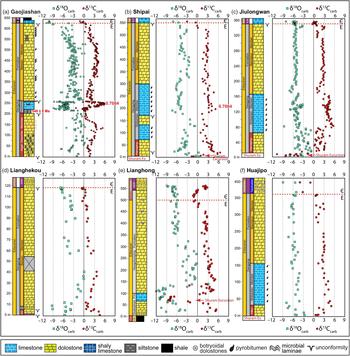
Chemostratigraphic δ13Ccarb (‰, VPDB) and δ18Ocarb (‰, VPDB) profiles of multiple terminal Ediacaran sections in South China. Data sources: (a) Gaojiashan section (this study); (b) Shipai section (Jiang et al. Reference Jiang, Kaufman, Christie-Blick, Zhang and Wu2007); (c) Jiulongwan section (Wang et al. Reference Wang, Shi, Jiang and Tang2014 b); (d) Lianghekou section (Chen et al. Reference Chen, Chu, Zhang and Zhai2015); (e) Lianghong section (Wang et al. Reference Wang, Zhou, Yuan, Chen and Xiao2012); (f) Huajipo section (Zhang et al. Reference Zhang, Chu, Zhang, Feng and Huo2004). Source of the lowest 87Sr/86Sr values (0.7084): Gaojiashan section (this study) and Shipai section (Jiang et al. Reference Jiang, Kaufman, Christie-Blick, Zhang and Wu2007). Abbreviations: AD – Algal Dolomite Member; Cam – Cambrian; ε – Cambrian; Cryog. – Crogenian Period; E – Ediacaran; G – Guojiaba Formation; GJS – Gaojiashan Member; HMJ – Hamajing Member; K – Kuanchuanpu Formation; LGL – Lieguliu Formation; MDP – Maidiping Formation; SJT – Shuijingtuo Formation; Shuram Ex – Shuram Excursion; XHP – Xihaoping Member; YJH – Yanjiahe Formation.

Given the potential impact of dolomitization, 87Sr/86Sr analysis of the DYF@GJS was only conducted for selected limestone samples from the Gaojiashan Member. Considering that 87Sr/86Sr values in carbonates typically increase during burial diagenesis owing to the influence of Rb-rich fluids (Banner, Reference Banner1995; Jacobsen & Kaufman, Reference Jacobsen and Kaufman1999), the lowest value likely better represents the primary seawater signals (e.g. Li et al. Reference Li, Ling, Shields-Zhou, Chen, Cremonese, Och, Thirlwall and Manning2013a). In this study, the lowest 87Sr/86Sr value is 0.7084 measured from the limestone sample 09GJS-11 (collected at the stratigraphic height of 246 m in the DYF@GJS; Figs 12, 13), which is consistent with the published 87Sr/86Sr data (c. 0.7084) measured from the equivalent Shibantan Member in the Yangtze Gorges area (Fig. 14b) (Jiang et al. Reference Jiang, Kaufman, Christie-Blick, Zhang and Wu2007).
Pyrite sulfur isotope (δ34Spyrite, measured from acidified residues) data for the DYF@GJS show positive values ranging between +10 ‰ and +40 ‰ through most of the section, except for two remarkable negative anomalies (down to –30 ‰) in the siltstone and silty limestone intervals of the middle and lower Gaojiashan Member (Figs 12e, 13f). The δ34SCAS data for carbonate-associated sulfate (CAS) have only been analysed for the Gaojiashan Member and have been published previously (Cui et al. Reference Cui, Kaufman, Xiao, Peek, Cao, Min, Cai, Siegel, Liu, Peng, Schiffbauer and Martin2016b).
7. Discussion
7.a. Timing of the karstification event
The bedded dolostones in the Algal Dolostone Member are mostly composed of dolomicrite matrix and multiple stages of void-filling carbonate cements (Figs 4, 5). The dolomicrite matrix is very fine grained, therefore likely formed as primary precipitates in seawater or during very early diagenesis in a dolomitic ocean (Tucker, 1982, Reference Tucker1983; Lei & Zhu, Reference Lei and Zhu1992; Wang & Xiang, Reference Wang and Xiang1999; Corsetti et al. Reference Corsetti, Kidder and Marenco2006). Notably, the Algal Dolomite Member of the DYF@GJS shows abundant karstification textures. The occurrence of botryoidal dolostones, carbonate breccia and distinct carbonate crystal fans in this member suggests pervasive karstification followed by void-filling carbonate authigenesis (Figs 2–4, 10).
Field investigations reveal that the karstification textures in the DYF@GJS are restricted to the lower half of the Algal Dolomite Member, with botryoidal aragonites in parallel with the primary bedding. Based on the stratigraphic relationship, the karstification events of the Algal Dolomite Member should have occurred relatively early, probably penecontemporaneously with the deposition of dolomite sediments in response to sea level fluctuations in a peritidal environment. Sea levels may have been subject to frequent fluctuations so that early karstification could occur repeatedly.
7.b. Origin of the authigenic aragonite cements
Although the authigenic carbonates in the Algal Dolomite Member of the DYF@GJS have already been completely dolomitized, diagnostic textures that suggest an original aragonite mineralogy are retained. Supporting evidence includes large carbonate crystal fans with discontinuities and square terminations, botryoidal carbonates and fibrous isopachous cements (Figs 4, 10), which are all distinct from typical dolomite cements formed during post-depositional diagenesis (Purser et al. Reference Purser, Tucker and Zenger2009; Tucker, Reference Tucker2009).
The origin of the authigenic aragonites in the Algal Dolomite Member remains debated. In geological records, botryoidal aragonites of both marine origin (Ginsburg & James, Reference Ginsburg and James1976; Mazzullo & Cys, Reference Mazzullo and Cys1979; Aissaoui, Reference Aissaoui1985; Jiang et al. Reference Jiang, Kennedy, Christie-Blick, Wu and Zhang2006a) and non-marine origin (Mazzullo, Reference Mazzullo1980; Aissaoui, Reference Aissaoui1985) have been reported. Proposed interpretations for the Dengying aragonites include primary syn-depositional seafloor precipitates (Zhang, Reference Zhang1980; Cao, Reference Cao2002; Zhang et al. Reference Zhang, Jones, Pan, Zhou, Qin, Hao and Wu2014b; Lin et al. Reference Lin, Peng, Yan and Hou2015; Peng et al. Reference Peng, Zhang and Lin2017), authigenic carbonates formed in meteoric waters (Wang et al. Reference Wang, Liu, Ma, Xu and Cai2010; Shi et al. Reference Shi, Liang, Wang, Hu, Tian and Wang2011), authigenic carbonates formed in marine environments (Si et al. Reference Si, Hao, Zhou, Ni and Pan2014; Hao et al. Reference Hao, Zhou, Chen, Pan, Hu and Hu2015; Mou et al. Reference Mou, Wang, Liang, Wang and Men2015; Tan et al. Reference Tan, Xiao, Chen, Li and Liu2015) and late authigenic carbonates formed during burial diagenesis (Wang et al. Reference Wang, Mu, Fang, Huang and Hou2000).
Based on multiple lines of evidence, an early authigenic marine origin for the Dengying aragonites is preferred in this study. First, the botryoidal aragonites in the Dengying Formation are mostly void-filling, distributed mostly in parallel with the primary sedimentary bedding. Therefore, a syn-depositional origin, instead of a syn-genetic (in water columns) origin, is more likely.
Second, fabric-specific δ18Ocarb values of different carbonate phases reveal that the authigenic aragonite crystal fans show higher δ18Ocarb values than the host dolostones (Fig. 10a, c). Considering that meteoric waters typically have much lower δ18O signals than seawater (Knauth & Kennedy, Reference Knauth and Kennedy2009; Bishop et al. Reference Bishop, Osleger, Montañez and Sumner2014; Oehlert & Swart, Reference Oehlert and Swart2014), the impact by meteoric waters on these authigenic cements should be minimized. Therefore, an evaporitic marine origin, instead of a karst-related meteoric water origin, is more likely.
Third, published studies show that the late Ediacaran botryoidal aragonites in the Dengying Formation (Zhang et al. Reference Zhang, Jones, Pan, Zhou, Qin, Hao and Wu2014b; Lin et al. Reference Lin, Peng, Yan and Hou2015; Mou et al. Reference Mou, Wang, Liang, Wang and Men2015; Peng et al. Reference Peng, Zhang and Lin2017), as well as correlative strata in the Nama Group of Namibia (Grant et al. Reference Grant, Knoll and Germs1991), typically show dull or non-luminescent colour under cathodoluminescence (CL), which is consistent with marine carbonates, instead of late-diagenetic carbonates that typically show bright CL colours. In addition, aragonite is unstable in meteoric or late-diagenetic fluids, so it is not likely that these aragonite cements formed through late-diagenetic processes.
Taken together, based on sedimentological and geochemical results, the botryoidal aragonite textures, aragonite crystal fans and karstification features in the Algal Dolomite Member of the DYF@GJS were formed during frequent sea level fluctuations and repeated exposure and submergence in a peritidal environment. Thus, although the botryoidal aragonite textures and aragonite crystal fans are technically early post-depositional in origin, they still appear to record seawater signals.
7.c. A high-alkalinity ocean in the terminal Ediacaran Period
If our interpretation of these authigenic aragonite (now dolomite) cements is correct, then the ocean chemistry may have witnessed the occurrence of a high-alkalinity ocean during the terminal Ediacaran Period. The existence of a high-alkalinity ocean at that time is consistent with the sedimentological observations that authigenic aragonites have also been found in the correlative terminal Ediacaran strata in Namibia (Grant, Reference Grant1990; Grant et al. Reference Grant, Knoll and Germs1991; Grotzinger et al. Reference Grotzinger, Watters and Knoll2000, Reference Grotzinger, Adams and Schröder2005; Wood et al. Reference Wood, Grotzinger and Dickson2002; Hall et al. Reference Hall, Kaufman, Vickers-Rich, Ivantsov, Trusler, Linnemann, Hofmann, Elliott, Cui, Fedonkin, Hoffmann, Wilson, Schneider and Smith2013; Penny et al. Reference Penny, Wood, Curtis, Bowyer, Tostevin and Hoffman2014; Wood, Reference Wood, Brasier, McIlroy and McLoughlin2016) and the Siberia Platforms (Wood et al. Reference Wood, Zhuravlev, Sukhov, Zhu and Zhao2017b).
Supporting evidence for a high-alkalinity ocean in the terminal Ediacaran Period also comes from the strontium concentration data. Published geochemical data show elevated concentrations of strontium in the carbonates of the Dengying Formation in South China (Fig. 13g) (Sawaki et al. Reference Sawaki, Ohno, Tahata, Komiya, Hirata, Maruyama, Windley, Han, Shu and Li2010; Cui et al. Reference Cui, Kaufman, Xiao, Peek, Cao, Min, Cai, Siegel, Liu, Peng, Schiffbauer and Martin2016b) and the Nama Group of Namibia (Grant et al. Reference Grant, Knoll and Germs1991; Ries et al. Reference Ries, Fike, Pratt, Lyons and Grotzinger2009). Considering that strontium has a crystal ionic radius larger than that of Ca2+ and thus prefers the more open octahedral crystal structure of aragonite over the smaller hexagonal structure of calcite (Wray & Daniels, Reference Wray and Daniels1957; Lorens, Reference Lorens1981), the precipitation of aragonites in a high-alkalinity ocean during deposition could account for the enrichment of strontium concentrations in marine carbonates during the late Ediacaran Period.
Taken together, it is likely that a high-alkalinity ocean occurred in the late Ediacaran Period. This inferred high-alkalinity ocean is evidenced by the authigenic aragonites in the Algal Dolomite Member and high Sr concentrations in the Gaojiashan Member of the Dengying Formation.
7.d. Evaluating the impact of authigenesis
Given the significant heterogeneity of carbonates in the studied samples, fabric-specific δ13Ccarb and δ18Ocarb analysis of different phases and textures of the DYF@GJS was adopted as the sampling strategy. Guided by detailed sedimentological observations, we evaluated the impact of authigenesis for each of the three members.
7.d.1. Authigenesis of the Algal Dolomite Member
Authigenic aragonite (now dolomite) crystal fans from the Algal Dolomite Member have been investigated for δ13Ccarb and δ18Ocarb values by micro-drilling analysis (Fig. 10). The δ18Ocarb values of the dolomitized crystal fans (–0.9 ‰ in Fig. 10a and –1.8 ‰ in Fig. 10c) are notably enriched in 18O compared with other carbonate phases, suggesting high-alkalinity evaporative conditions during precipitation (Ufnar et al. Reference Ufnar, Gröcke and Beddows2008; Gomez et al. Reference Gomez, Kah, Bartley and Astini2014; Guo & Chafetz, Reference Guo and Chafetz2014; Horton et al. Reference Horton, Defliese, Tripati and Oze2015; Leleu et al. Reference Leleu, Chavagnac, Delacour, Noiriel, Ceuleneer, Aretz, Rommevaux and Ventalon2016). On the contrary, isotope data for the late carbonate cements, particularly the hydrothermal saddle dolomite, show much lower δ18Ocarb values (c. –10 ‰) than early crystal fans and dolomitic matrix, which is consistent with a high-temperature origin during deep burial. Similar observations of hydrothermal dolomite in the Dengying Formation in the Sichuan Basin (Shi et al. Reference Shi, Wang, Tian and Wang2013; Liu et al. Reference Liu, Huang, Jansa, Wang, Song, Zhang, Sun and Ma2014 a; Jiang et al. Reference Jiang, Tao, Gu, Wang, Qiang, Jiang, Lin and Jiang2016) suggest that the occurrence of saddle dolomite in the Dengying Formation may result from a basin-scale geothermal event during deep burial.
7.d.2. Authigenesis of the Gaojiashan Member
Multiple calcite-filled vugs and veins were found in the limestone intervals of the upper Gaojiashan Member (1–2 m below the conglomerate/sandstone interval) (Fig. 11a–c). We micro-drilled and analysed the δ13Ccarb and δ18Ocarb values of both the calcite veins and micritic limestone phases in order to evaluate the impact of diagenesis (Fig. 11d–g). The δ13Ccarb and δ18Ocarb values of the calcite veins show more negative values compared with the host limestone rocks (Fig. 11). Two interpretations could possibly explain this observation: (1) these calcite veins may be early authigenic carbonates formed by microbial sulfate reduction in pore waters (e.g. Campbell et al. Reference Campbell, Farmer and Des Marais2002; Jiang et al. Reference Jiang, Kennedy and Christie-Blick2003, Reference Jiang, Kennedy, Christie-Blick, Wu and Zhang2006a,Reference Jiang, Shi and Zhangb; Schrag et al. Reference Schrag, Higgins, Macdonald and Johnston2013; Zhou et al. Reference Zhou, Guan, Cui, Ouyang and Wang2016; Cui et al. Reference Cui, Kaufman, Xiao, Zhou and Liu2017a), or (2) these calcite veins may result from intrusions of late-diagenetic fluids (e.g. Bristow et al. Reference Bristow, Bonifacie, Derkowski, Eiler and Grotzinger2011; Lin et al. Reference Lin, Wang, Feng, Liu and Chen2011). Based on the sharp contact between these white calcite phases and the host carbonates, which sometimes cut across the primary sedimentary bedding, a late diagenetic origin for these calcite phases is preferred in this study.
Recently, largely based on a newly discovered δ13Ccarb negative excursion in the upper Gaojiashan Member, Gamper et al. (Reference Gamper, Struck, Ohnemueller, Heubeck and Hohl2015) placed the Ediacaran–Cambrian boundary in the middle Dengying Formation. However, it should be noted that this δ13Ccarb negative excursion occurs in the conglomerate/sandstone interval of the uppermost Gaojiashan Member, which more likely reflects late-diagenetic signals instead of primary seawater signals. Therefore, Gamper et al.’s (Reference Gamper, Struck, Ohnemueller, Heubeck and Hohl2015) placement of the Ediacaran–Cambrian boundary should be treated with caution. Our observation of late-diagenetic calcite veins with negative δ13Ccarb values around this interval casts doubt on the fidelity of the proposed δ13Ccarb negative excursion and its relationship with the Ediacaran–Cambrian boundary.
7.d.3. Authigenesis of the Beiwan Member
Bitumen-bearing dolostones in the Beiwan Member have also been tested to evaluate the impact of bitumen on the δ13Ccarb and δ18Ocarb values. Potential oxidation of the bitumen may have caused a significant decrease in δ13Ccarb values (e.g. Bristow et al. Reference Bristow, Bonifacie, Derkowski, Eiler and Grotzinger2011). However, no strongly negative δ13Ccarb values have been found in the bitumen-bearing samples (Fig. 8l), suggesting little impact of bitumen on the δ13Ccarb compositions. That being said, it is notable that the δ13Corg data in the Beiwan Member show large variations (Fig. 12c), which may be caused by the influence of bitumen in the dolostone samples.
In summary, the texture-specific micro-drilling method employed in this study demonstrates that coupled petrographic and isotope analysis is an informative tool for the evaluation of diagenetic influences in chemostratigraphic studies. Late-diagenetic signatures should be identified and treated with caution in palaeoenvironmental interpretations.
7.e. Biogeochemical carbon cycles
The chemostratigraphic δ13Ccarb profile of the DYF@GJS shows a positive excursion of up to +6 ‰ in the Gaojiashan Member (Figs 1d, 12b, 13b). Comparisons of the δ13Ccarb profile with other Dengying or equivalent sections at regional and global scales show both similarities and differences (Fig. 14). In the Yangtze Block, similar δ13Ccarb positive excursions have also been reported from correlative Ediacaran sections at Shipai (Jiang et al. Reference Jiang, Kaufman, Christie-Blick, Zhang and Wu2007), Jiulongwan (Wang et al. Reference Wang, Shi, Jiang and Tang2014b), Lianghekou (Chen et al. Reference Chen, Chu, Zhang and Zhai2015), Lianghong (Wang et al. Reference Wang, Zhou, Yuan, Chen and Xiao2012) and Huajipo (Zhang et al. Reference Zhang, Chu, Zhang, Feng and Huo2004) (Fig. 14). The difference in the chemostratigraphic δ13Ccarb profiles of these sections may result from a difference in local redox conditions, sedimentation rates, stratigraphic hiatus or sampling resolutions. Regardless, most of the sections show a δ13Ccarb excursion of up to +6 ‰.
Viewed at a global scale, the finding of a δ13Ccarb excursion of up to +6 ‰ in the Dengying Formation is also consistent with published chemostratigraphic profiles of the roughly correlative terminal Ediacaran strata in Namibia (Saylor et al. Reference Saylor, Kaufman, Grotzinger and Urban1998; Wood et al. Reference Wood, Poulton, Prave, Hoffmann, Clarkson, Guilbaud, Lyne, Tostevin, Bowyer, Penny, Curtis and Kasemann2015; Tostevin et al. Reference Tostevin, He, Turchyn, Wood, Penny, Bowyer, Antler and Shields2017) and Arctic Siberia (Knoll et al. Reference Knoll, Grotzinger, Kaufman and Kolosov1995; Pelechaty et al. Reference Pelechaty, Kaufman and Grotzinger1996b; Cui et al. Reference Cui, Grazhdankin, Xiao, Peek, Rogov, Bykova, Sievers, Liu and Kaufman2016a; Vishnevskaya et al. Reference Vishnevskaya, Letnikova, Vetrova, Kochnev and Dril2017) where δ13Ccarb positive excursions with similar magnitude (up to +6 ‰) have also been reported.
Two hypotheses may be able to explain this δ13Ccarb positive excursion. First, canonical models of the global carbon cycle suggests that δ13Ccarb positive anomalies likely result from an enhanced organic carbon burial rate because organic carbon is strongly enriched in 12C (Broecker, Reference Broecker1970; Hayes et al. Reference Hayes, Strauss and Kaufman1999). Alternatively, a δ13Ccarb positive excursion can also result from the mixing of high δ13Ccarb authigenic carbonates during early diagenesis. This is possible if residual carbon after fermentation (methanogenesis) led to the formation of authigenic carbonates (Claypool & Kaplan, Reference Claypool, Kaplan and Kaplan1974; Irwin et al. Reference Irwin, Curtis and Coleman1977; Talbot & Kelts, Reference Talbot and Kelts1986; Meister et al. Reference Meister, McKenzie, Vasconcelos, Bernasconi, Frank, Gutjahr and Schrag2007; Wehrmann et al. Reference Wehrmann, Risgaard-Petersen, Schrum, Walsh, Huh, Ikehara, Pierre, D’hondt, Ferdelman, Ravelo, Takahashi and Zarikian2011; Birgel et al. Reference Birgel, Meister, Lundberg, Horath, Bontognali, Bahniuk, De Rezende, Vasconcelos and Mckenzie2015; Pierre et al. Reference Pierre, Blanc-Valleron, Caquineau, März, Ravelo, Takahashi and Alvarez Zarikian2016). Such processes may have been particularly prevalent in the Precambrian ocean where the seawater was mostly anoxic and therefore may promote authigenic carbonate precipitation on the seafloor (Higgins et al. Reference Higgins, Fischer and Schrag2009; Schrag et al. Reference Schrag, Higgins, Macdonald and Johnston2013).
Based on multiple lines of evidence, we prefer the former hypothesis (i.e. enhanced organic carbon burial) for this δ13Ccarb positive excursion. First, no extremely high or low δ13Ccarb signals that are indicative of the existence of methane have been found based on our detailed geochemical analysis of micro-drilled samples. Therefore, there is no supporting evidence for the occurrence of methane generation or oxidation in the DYF@GJS. Second, the presence of a gypsum layer near the height of the δ13Ccarb positive excursion in the middle Gaojiashan Member of the DYF@GJS suggests that the sulfate concentration was high during the δ13Ccarb excursion. Considering that methanogens are typically outcompeted for substrates (e.g. lactate and acetate) by sulfate reducers in sulfate-rich environments (Jørgensen & Kasten, Reference Jørgensen, Kasten, Schulz and Zabel2006), methanogenesis would not have played a considerable role in generating this δ13Ccarb positive excursion. Third, the recent investigations of N and U isotopes (Fig. 13) suggest that extensive oceanic anoxia occurred during the late Ediacaran Period (Wei et al. Reference Wei, Planavsky, Tarhan, Chen, Wei, Li and Ling2018; Zhang et al. Reference Zhang, Xiao, Kendall, Romaniello, Cui, Meyer, Gilleaudeau, Kaufman and Anbar2018). This oceanic anoxia event may have promoted organic carbon burial and led to the δ13Ccarb positive excursion.
In summary, a δ13Ccarb excursion up to +6 ‰ has been found in the Dengying Formation and many other correlative terminal Ediacaran sections. Based on multiple lines of evidence, we regard that enhanced organic carbon burial may have caused this excursion.
7.f. Biogeochemical sulfur cycles
Sulfur isotope chemostratigraphy of the DYF@GJS shows overall positive δ34Spyrite values ranging between +20 ‰ and +30 ‰ through most of the section, except for two episodes of anomalous negative excursions down to c. –30 ‰ in the lower and middle Gaojiashan Member (Figs 12e, 13f). The occurrence of highly positive δ34Spyrite values in the terminal Ediacaran strata has also been reported from the roughly equivalent strata in Oman (Fike & Grotzinger, Reference Fike and Grotzinger2008), Namibia (Ries et al. Reference Ries, Fike, Pratt, Lyons and Grotzinger2009; Tostevin et al. Reference Tostevin, He, Turchyn, Wood, Penny, Bowyer, Antler and Shields2017), Arctic Siberia (Cui et al. Reference Cui, Grazhdankin, Xiao, Peek, Rogov, Bykova, Sievers, Liu and Kaufman2016a) and Newfoundland (Canfield et al. Reference Canfield, Poulton and Narbonne2007; Hantsoo et al. Reference Hantsoo, Kaufman, Cui, Plummer and Narbonne2018), suggesting a global phenomenon. The origin of the low δ34Spyrite signals in the Gaojiashan Member has been fully discussed in our earlier paper (Cui et al. Reference Cui, Kaufman, Xiao, Peek, Cao, Min, Cai, Siegel, Liu, Peng, Schiffbauer and Martin2016b); we will mainly focus on the overall high δ34Spyrite signals below.
Four hypotheses can be proposed to explain the overall positive δ34Spyrite signals in the studied section. They are discussed below.
7.f.1. Thermochemical sulfate reduction (TSR)
The high δ34Spyrite values may result from Rayleigh fractionations during thermochemical sulfate reduction (TSR) of hydrothermal fluids in post-depositional processes. Such a scenario has recently been proposed for the Cryogenian Datangpo Formation, where extremely high δ34Spyrite values (up to +70 ‰) have been found (Cui et al. Reference Cui, Kitajima, Spicuzza, Fournelle, Ishida, Denny, Zhang and Valley2017b, Reference Cui, Kitajima, Spicuzza, Fournelle, Denny, Ishida, Zhang and Valley2018b,Reference Cui, Kitajima, Spicuzza, Fournelle, Denny, Ishida, Zhang and Valleyc). However, our field observations revealed no clear evidence for a significant impact by hydrothermal fluids. Moreover, assuming a seawater δ34Ssulfate value of +40 ‰ for the late Ediacaran ocean based on gypsum or CAS analyses (Fike & Grotzinger, Reference Fike and Grotzinger2008; K. D. Bergmann, unpub. Ph.D. thesis, California Institute of Technology, 2013; Cui et al. Reference Cui, Kaufman, Xiao, Peek, Cao, Min, Cai, Siegel, Liu, Peng, Schiffbauer and Martin2016b), these δ34Spyrite values, though positive, can still be explained by microbial sulfate reduction with normal (rather than reversed) fractionations (i.e. Δ34Ssulfate-pyrite = δ34Ssulfate – δ34Spyrite > 0). Therefore, a TSR origin for the overall high δ34Spyrite values in the DYF@GJS is not preferred in this study.
7.f.2. Low sulfate concentrations of seawater
The positive δ34Spyrite values may reflect limited S isotope fractionation in seawaters with very low concentrations of sulfate (Habicht et al. Reference Habicht, Gade, Thamdrup, Berg and Canfield2002; Loyd et al. Reference Loyd, Marenco, Hagadorn, Lyons, Kaufman, Sour-Tovar and Corsetti2012). However, given the presence of gypsum in the Dengying Formation across the Yangtze Platform and the overall shallow and evaporative environments inferred from the lithofacies, seawater sulfate concentration should not be a limiting factor for microbial sulfate reduction. Therefore, this hypothesis is not favoured here.
7.f.3. Higher proportions of pyrite burial
The overall positive δ34Spyrite signals in the late Ediacaran Period may be caused by enhanced rates of pyrite burial. This scenario has been proposed based on an earlier study of the terminal Ediacaran strata in Oman (Fike & Grotzinger, Reference Fike and Grotzinger2008). More recent studies of the Dengying Formation have shown notably high δ15N signals and low δ238U signals (Fig. 13) indicative of a significant ocean anoxic event with enhanced denitrification and U removal from the ocean into the sediments (A. Gamper, unpub. Ph.D. dissertation, Freie Universität Berlin, 2014; Wei et al. Reference Wei, Planavsky, Tarhan, Chen, Wei, Li and Ling2018; Zhang et al. Reference Zhang, Xiao, Kendall, Romaniello, Cui, Meyer, Gilleaudeau, Kaufman and Anbar2018). This inferred ocean anoxic event at that time may have promoted organic carbon and pyrite burial, leading to the high δ34Spyrite signals.
7.f.4. High sedimentation rates
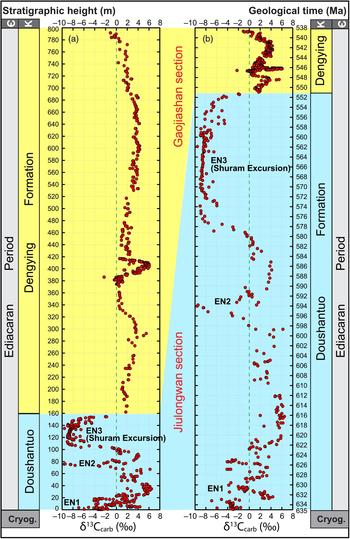
It is also possible that enhanced sedimentation rates may have contributed to the overall positive δ34Spyrite signals in the studied section. It has been found that higher sedimentation rate could cause higher δ34Spyrite in marine sediments (Pasquier et al. Reference Pasquier, Sansjofre, Rabineau, Revillon, Houghton and Fike2017; Liu et al. Reference Liu, Fike, Li, Dong, Xu, Zhuang, Rendle-Bühring and Wan2019). Although karstification may have eroded the Algal Dolomite Member, compared with the well-studied Doushantuo Formation in the Yangtze Block (Zhou & Xiao, Reference Zhou and Xiao2007; Zhu et al. Reference Zhu, Zhang and Yang2007, Reference Zhu, Lu, Zhang, Zhao, Li, Yang, Zhao and Zhao2013; McFadden et al. Reference McFadden, Huang, Chu, Jiang, Kaufman, Zhou, Yuan and Xiao2008; Jiang et al. Reference Jiang, Shi, Zhang, Wang and Xiao2011; Cui et al. Reference Cui, Kaufman, Xiao, Zhu, Zhou and Liu2015), the Dengying Formation is remarkably thick (Fig. 15). The general thickness of the Doushantuo Formation (c. 635.2–551.1 Ma) is <300 m in thickness for over 80 million years (Condon et al. Reference Condon, Zhu, Bowring, Wang, Yang and Jin2005; Zhou & Xiao, Reference Zhou and Xiao2007; Zhu et al. Reference Zhu, Zhang and Yang2007), while the studied DYF@GJS (c. 551.1–538.8 Ma) is >630 m in thickness for only ~12.3 million years (Fig. 15). Given the exceptionally high sedimentation rate of the Dengying Formation compared with the underlying Doushantuo Formation, it is likely that high sedimentation rate may have also played a role in generating the positive δ34Spyrite signals.
δ13Ccarb (‰, VPDB) chemostratigraphic data for the Ediacaran Period in South China plotted against (a) stratigraphic height and (b) estimated geological time. Data sources: Doushantuo Formation at the Jiulongwan section (Jiang et al. Reference Jiang, Kaufman, Christie-Blick, Zhang and Wu2007; McFadden et al. Reference McFadden, Huang, Chu, Jiang, Kaufman, Zhou, Yuan and Xiao2008); Denging Formation at the Gaojiashan section (H. Cui, unpub. Ph.D. thesis, Univ. Maryland, 2015; Cui et al. Reference Cui, Kaufman, Xiao, Peek, Cao, Min, Cai, Siegel, Liu, Peng, Schiffbauer and Martin2016b). Abbreviations: K – Kuanchuanpu Formation; ε – Cambrian; Cryog. – Crogenian Period; EN – Ediacaran δ13Ccarb negative excursions. See the main text for detailed discussion.

Taken together, based on multiple lines of sedimentological and geochemical evidence, we regard that enhanced rates of pyrite burial may be the main cause of the overall positive δ34Spyrite values. High sedimentation rates may have also contributed to the high δ34Spyrite values, but more information is needed to specifically test this hypothesis.
7.g. Implications for early metazoan evolution
The contrasting thickness between the Dengying Formation and the underlying Doushantuo Formation can provide useful insights into the changing environment. This sharp contrast suggests that the depositional environment during the late Ediacaran Period has been subject to significant change, which is possibly characterized by overall shallower water depth, higher alkalinity and higher accommodation space. Such conditions are suitable for continuous production and accumulation of marine carbonates.
Sedimentological observations suggest that the karstification events of shallow carbonate platforms may be widespread in the late Ediacaran Period. Notably, similar karstification textures of carbonate breccia, aragonite crystal fans and botryoidal aragonites have also been found from other correlative sections, including the other Dengying sections in South China (Zhang, Reference Zhang1980; Cao & Xue, Reference Cao, Xue and Peryt1983; Siegmund & Erdtmann, Reference Siegmund and Erdtmann1994; Xiang et al. Reference Xiang, Cheng and Zhang2001; Wang et al. Reference Wang, Liu, Ma, Xu and Cai2010, Reference Wang, Zhou, Yuan, Chen and Xiao2012; Shi et al. Reference Shi, Liang, Wang, Hu, Tian and Wang2011; Liu et al. Reference Liu, Yang, Wang, Zhuo and Du2012; Mo et al. Reference Mo, Wang, Leng, Lin, Xiong, Xie and Zhou2013; Zhang et al. Reference Zhang, Jones, Pan, Zhou, Qin, Hao and Wu2014b; Lin et al. Reference Lin, Peng, Yan and Hou2015; Mou et al. Reference Mou, Wang, Liang, Wang and Men2015; Lian et al. Reference Lian, Qu, Tan, Li, Jin, Zeng, Ren, Hu and Liu2016, Reference Lian, Ren, Qu, Tan, Li, Zeng, Hu and Liu2017), the Qigebulake Formation in the Tarim basin in Northwestern China (Qian et al. Reference Qian, He, Li, Chen, Jin, Sha and Li2017), the Buah Formation in Oman (Gorin et al. Reference Gorin, Racz and Walter1982; Cozzi & Al-Siyabi, Reference Cozzi and Al-Siyabi2004; K. D. Bergmann, unpub. Ph.D. thesis, California Institute of Technology, 2013), the K3 and K4 units of the Katakturuk Dolomite succession in Arctic Alaska (Macdonald et al. Reference Macdonald, McClelland, Schrag and Macdonald2009) and the Turkut Formation in the Siberia Platform (Knoll et al. Reference Knoll, Grotzinger, Kaufman and Kolosov1995; Pelechaty et al. Reference Pelechaty, Grotzinger, Kashirtsev and Zhernovsky1996a; Nagovitsin et al. Reference Nagovitsin, Rogov, Marusin, Karlova, Kolesnikov, Bykova and Grazhdankin2015; Rogov et al. Reference Rogov, Karlova, Marusin, Kochnev, Nagovitsin and Grazhdankin2015; Cui et al. Reference Cui, Grazhdankin, Xiao, Peek, Rogov, Bykova, Sievers, Liu and Kaufman2016a). These observations suggest widespread karstification of shallow carbonate platforms on a global scale.
The overall shallow-marine environment may be caused by regional tectonic uplift in the depositional basin (Xue et al. Reference Xue, Cao, Tang, Yin, Yu and Yang2001; Wang et al. Reference Wang, Jiang, Wang, Lu, Gu, Xu, Yang and Xu2014a; Zhu et al. Reference Zhu, Jin, Zhang, Zhang, He and Li2014b; Li et al. Reference Li, Hu and Zhou2015; Zhu et al. Reference Zhu, Zhang, Li, Feng, Sun, Lin and Zhang2015 Yang et al. Reference Yang, Chen, Zhong, Zhu, Chen, Wen, Xu and Wu2017). The extensive karstification of shallow carbonate platforms during the late Ediacaran Period was probably triggered by fluctuations of relative sea level at that time. This scenario is in agreement with an overall increase in seawater 87Sr/86Sr and decrease in seawater Nd isotopes through the Proterozoic–Phanerozoic transition (Halverson et al. Reference Halverson, Dudás, Maloof and Bowring2007, Reference Halverson, Wade, Hurtgen and Barovich2010; Peters & Gaines, Reference Peters and Gaines2012; Cox et al. Reference Cox, Halverson, Stevenson, Vokaty, Poirier, Kunzmann, Li, Denyszyn, Strauss and Macdonald2016). The break-up of the Rodinia supercontinent and assembly of the Gondwana supercontinent may have profoundly reshaped the Earth surface’s lithosphere and hydrosphere and triggered the evolutionary innovation of the biosphere.
Although the precise mechanism is still unclear, the geochemistry of the late Ediacaran oceans may have played a role in early animal biomineralization (Cui et al. Reference Cui, Kaufman, Xiao, Peek, Cao, Min, Cai, Siegel, Liu, Peng, Schiffbauer and Martin2016b). Considering that the skeletons of the late Ediacaran biomineralizing animals are mostly composed of aragonite or high-Mg calcite (Grant, Reference Grant1990; Fedorov & Zhuravlev, Reference Fedorov and Zhuravlev1993; Grotzinger et al. Reference Grotzinger, Watters and Knoll2000; Zhuravlev & Wood, Reference Zhuravlev and Wood2008; Zhuravlev et al. Reference Zhuravlev, Liñán, Vintaned, Debrenne and Fedorov2012), the occurrence of a high-alkalinity ocean – evidenced by authigenic aragonite cements – may have influenced the composition of the earliest biominerals of early animals. It is likely that the high concentration of alkalinity and nutrient influx in the ocean may have caused the supersaturation of marine carbonates and facilitated early animal biomineralization in this critical period (Zhuravlev & Wood, Reference Zhuravlev and Wood2008; Peters & Gaines, Reference Peters and Gaines2012; Cui et al. Reference Cui, Kaufman, Xiao, Peek, Cao, Min, Cai, Siegel, Liu, Peng, Schiffbauer and Martin2016b; Wood et al. Reference Wood, Ivantsov and Zhuravlev2017a).
8. Conclusions
An integrated sedimentological and chemostratigraphic study was conducted for the terminal Ediacaran Dengying Formation at the Gaojiashan section (DYF@GJS), Ningqiang County of southern Shaanxi Province, South China. Multiple types of lithofacies and diagenesis have been identified and summarized based on detailed field observations, petrographic studies and isotope measurements of micro-drilled spots.
(1) The DYF@GJS was deposited in a largely shallow-marine platform with dynamic sea level changes and overall high accommodation space, though the lower Gaojiashan Member may represent a temporarily deeper and more anoxic environment. Sedimentological evidence suggests that extensive karstification of shallow-marine platforms occurred soon after the deposition of the lower part of the Algal Dolomite Member.
(2) We propose that the finding of authigenic aragonites in the Algal Dolostone Member may have significant implications on the Ediacaran ocean chemistry. The micro-drilling δ18Ocarb data for the authigenic aragonites (now dolomites) suggest that meteoric waters had little impact on the genesis of these authigenic aragonites. Instead, the Dengying authigenic aragonites may have formed in marine environments during repeated sea level fluctuations in a peritidal environment, which resulted in karstification features being formed during subaerial exposure, followed by void-filling aragonite botryoids being formed during submergence. These Dengying authigenic aragonites reflect the existence of a high-alkalinity ocean at that time.
(3) Geochemical analysis of micro-drilled samples reveals different compositions among depositional, early authigenic and late-diagenetic components. The post-depositional phases should be excluded when constructing chemostratigraphic profiles.
(4) Chemostratigraphic data show a δ13Ccarb positive excursion (up to +6 ‰) in the Gaojiashan Member and overall positive δ34Spyrite values in most of the Dengying Formation. Based on multiple lines of sedimentological and geochemical evidence, enhanced burial of organic matter and pyrite in shallower environments is proposed for the studied basin. High concentrations of seawater alkalinity and nutrients may have facilitated the evolutionary innovation of early metazoan biomineralization.
Supplementary material
To view supplementary material for this article, please visit https://doi.org/10.1017/S0016756819000293
Author ORCIDs
Huan Cui 0000-0003-0705-3423, Shuhai Xiao 0000-0003-4655-2663, Rebecca Plummer 0000-0002-6089-7791, Alan J. Kaufman 0000-0003-4129-6445
Acknowledgements
This study was started when the first author HC was a Ph.D. graduate student at the University of Maryland. It was progressively improved during HC’s first post-doctoral position at the NASA Astrobiology Institute, University of Wisconsin–Madison and HC’s second post-doctoral position at Vrije Universiteit Brussel, Belgium. HC would like to thank the UMD Geology Department, the NASA Astrobiology Institute at UW-Madison, the ET-HOME (Evolution and Tracers of the Habitability of Mars and Earth) Astrobiology Research Consortium in Belgium and the Analytical, Environmental and Geo- Chemistry research group at VUB for support.
The authors would like to thank Mike Evans, Yongbo Peng, Zhengting Wang, Brittney Gaeta and Elizabeth Lee for their assistance in the UMD Palaeoclimate Laboratory; and Xiao Min from Northwest University and Fazhi Li from Gaojiashan village for their assistance in field work. The authors would also like to thank three anonymous reviewers, whose constructive comments have significantly improved the clarity of this manuscript.
This research is funded by the American Association of Petroleum Geologists (AAPG) Grants-In-Aid Program Marilyn Atwater Memorial Grant to HC, the Explorers Club Washington Group grant to HC, the open research grant (193107) of the State Key Laboratory of Palaeobiology and Stratigraphy, Nanjing Institute of Geology and Palaeontology, Chinese Academy of Sciences to HC, the NASA Exobiology grant (NNX12AR91G to AJK and 80NSSC18K1086 to SX), the NSF Sedimentary Geology and Palaeontology grant (EAR0844270 to AJK; EAR1528553 to SX) and the Young Scientists Fund of Shaanxi Province (No. 2015KJXX-26) to YC.