Introduction
Psychiatric morbidity is increasingly being understood in terms of a continuous phenotype measurable in both healthy and ill individuals (Kendler et al. Reference Kendler, Gallagher, Abelson and Kessler1996; van Os et al. Reference van Os, Linscott, Myin-Germeys, Delespaul and Krabbendam2009), as well as in ‘high-risk’ populations (Demjaha et al. Reference Demjaha, Valmaggia, Stahl, Byrne and McGuire2012). Approximately 25% of children born before 32 weeks (i.e. very preterm) have persisting neuropsychiatric concerns, which are characterized by inattention, anxiety, socio-emotional difficulties, and internalizing problems (Johnson & Marlow, Reference Johnson and Marlow2011; Treyvaud et al. Reference Treyvaud, Ure, Doyle, Lee, Rogers and Kidokoro2013). Prevalence rates of emotional and behavioural problems range between 8% and 39%, depending on gestational age, with the most immature children being at greatest risk of impairment (Arpi & Ferrari, Reference Arpi and Ferrari2013). This ‘behavioural phenotype’ results in increased rates of sub-threshold symptomatology that at the furthest end of the distribution, become clinically significant (Hack et al. Reference Hack, Taylor, Schluchter, Andreias, Drotar and Klein2009; Johnson & Marlow, Reference Johnson and Marlow2011). Very preterm children are thus at higher risk than controls of developing autism spectrum disorder, attention deficit hyperactivity disorder (ADHD) and anxiety disorder (Botting et al. Reference Botting, Powls, Cooke and Marlow1997; Pinto-Martin et al. Reference Pinto-Martin, Levy, Feldman, Lorenz, Paneth and Whitaker2011; Somhovd et al. Reference Somhovd, Hansen, Brok, Esbjorn and Greisen2012). In adult life, preterm born individuals report elevated levels of psychological distress (Wiles et al. Reference Wiles, Peters, Leon and Lewis2005), continue to be vulnerable to mental health problems (Hack et al. Reference Hack, Youngstrom, Cartar, Schluchter, Taylor and Flannery2004; Van Lieshout et al. Reference Van Lieshout, Boyle, Saigal, Morrison and Schmidt2015; Pyhälä et al. Reference Pyhälä, Wolford, Kautiainen, Andersson, Bartmann and Baumann2017) and are between 2.5 and 7.4 times at greater risk of being hospitalized with a range of psychiatric disorders compared with controls, as indicated by our previous population-based work (Nosarti et al. Reference Nosarti, Reichenberg, Murray, Cnattingius, Lambe and Yin2012). However, it is likely that the clinical presentation of very preterm individuals may extend across the standard diagnostic boundaries (Johnson & Marlow, Reference Johnson and Marlow2014) and therefore may be overlooked in prevalence studies. Indeed, individuals who were born very preterm often show qualitative differences in their psychiatric presentation (Johnson & Wolke, Reference Johnson and Wolke2013). For instance, children who were born preterm with a diagnosis of ADHD tend to predominantly display inattentive and not hyperactive symptomatology (Hack et al. Reference Hack, Taylor, Schluchter, Andreias, Drotar and Klein2009; Johnson et al. Reference Johnson, Hollis, Kochhar, Hennessy, Wolke and Marlow2010). Furthermore, unlike those observed in the general population, preterm children do not show a typical ADHD male prevalence (Elgen et al. Reference Elgen, Sommerfelt and Markestad2002; Indredavik et al. Reference Indredavik, Vik, Evensen, Skranes, Taraldsen and Brubakk2010). These findings suggest that preterm-born individuals have a different aetiological risk and symptom profile from that seen in the general population. The study of vulnerable individuals with elevated psychiatric symptomatology without a clinical diagnosis represents an unrecognized public health concern as they ‘suffer in silence’ reporting a lower quality of life (Carta & Angst, Reference Carta and Angst2016) and distress-impairment (McLaughlin et al. Reference McLaughlin, Koenen, Friedman, Ruscio, Karam and Shahly2015).
Based on existing evidence suggesting that very preterm individuals have an increased risk of both sub-threshold psychiatric symptomatology and clinical disorders, the aim of this study was to utilize a dimensional approach to examine whether adults who were born very preterm would demonstrate elevated levels of psychopathology compared with controls, and secondly, to explore the specific characteristics of their symptom profile.
Materials and methods
Study population
Individuals who were born before 33 weeks’ gestation between 1979 and 1984 and were admitted to the neonatal unit of University College Hospital London within 5 days of birth were recruited for this study. Participants were then entered into a follow-up study and were reassessed periodically throughout their lives from age one until age 30 (Stewart et al. Reference Stewart, Costello, Hamilton, Baudin, Townsend and Bradford1989; Froudist-Walsh et al. Reference Froudist-Walsh, Karolis, Caldinelli, Brittain, Kroll and Rodriguez-Toscano2015; Nam et al. Reference Nam, Castellanos, Simmons, Froudist-Walsh, Allin and Walshe2015). Neonatal variables collected at birth included: birth weight, gestational age, and severity of perinatal brain injury, based on neonatal cranial ultrasound classification summarized as (a) normal, no-periventricular haemorrhage (no-PVH), (b) uncomplicated periventricular haemorrhage without ventricular dilatation (PVH), and (c) periventricular haemorrhage with ventricular dilatation (PVH + DIL) (Nosarti et al. Reference Nosarti, Walshe, Rushe, Rifkin, Wyatt and Murray2011).
For the most recent follow-up, 152 very preterm individuals aged 30 were recruited, representing 69% of the sample seen at 14 years. Very preterm individuals who were assessed at the current follow-up did not differ significantly from those who were not assessed in terms of their birth weight (assessed at 30: 1305.83 grams, not assessed at 30: 1371.75 g, t = −1.78, df = 450, p = 0.075), however, those who were assessed were born at a slightly younger gestational age than those who were not (assessed at 30: mean gestational age = 29.18 weeks, not assessed at 30: mean gestational age = 29.67, t = −2.23, df = 451, p = 0.026). Similarly, the returning cohort did not differ from those who did not return in terms of neonatal cranial ultrasound classification (χ2 = 4.83, df = 2, p = 0.089). There was a higher proportion of males in the returning cohort (assessed at 30: 62% male, not assessed at 30: 48% male, χ2 = 7.19, df = 1, p ⩽ 0.01).
The term-born controls consisted of 96 individuals recruited from advertisements in the local community. Inclusion criteria were full-term birth (38–42 weeks) and birth weight >2500 g. Exclusion criteria were a history of neurological conditions including meningitis, head injury, and cerebral infections.
The study was undertaken with the understanding and written consent of each subject, with the approval of the appropriate local ethics committee and in compliance with national legislation and the Code of Ethical Principles for Medical Research Involving Human Subjects of the World Medical Association (Declaration of Helsinki).
Socio-demographic, cognitive and behavioural assessment
Participants’ socio-economic status (SES) was assessed with Her Majesty's Stationary Office Standard Occupational Classification Information (Her Majesty's Stationary Office, 1991). SES was collapsed into two groups: a high SES category consisted of professional and managerial roles (levels 1–2); a low SES category comprised all other occupations (levels 3–5 and included missing variables).
IQ was measured using the Wechsler Abbreviated Scale of Intelligence (WASI; Wechsler, Reference Wechsler1999).
Psychiatric symptomatology was assessed with the Comprehensive Assessment of At-Risk Mental States (CAARMS; Yung et al. Reference Yung, Yuen, McGorry, Phillips, Kelly and Dell'Olio2005). The CAARMS is an interviewer-rated, semi-structured tool measuring current rates of psychopathology on the following subscales: positive and negative symptoms, cognitive problems, emotional disturbance, behavioural changes, motor/physical changes and general psychopathology. General psychopathology included depression, anxiety, mania, and mood swings. Each scale was rated on a 0–6 severity scale (‘0–Never/absent’ to ‘6–Extreme’). A Total Psychopathology score was calculated by summing up all subscale scores. Inter-rater reliability was assessed by comparing ratings for all subscales for three very preterm individuals who were assessed by both study raters and a ‘gold-standard’ rater (an experienced psychiatrist). Intra-class correlation coefficients were 0.89 between study raters PJB and JK and 0.90 and 0.86 between raters PJB and JK and the gold-standard rater, respectively. These values represent ‘Almost Perfect’ agreement (Landis & Koch, Reference Landis and Koch1977).
Statistical analysis
Matlab version R2016a (Mathworks, MA, USA) and SPSS for Macintosh version 22.0 (IBM, Armonk, NY) were used for statistical analyses. Group differences in socio-demographic measures were examined using independent t test or χ2 test, with significance set at p < 0.05.
Part 1: Group differences in symptomatology
Between-group differences on each CAARMS subscale were explored using Mann–Whitney U test. Spearman correlation was used to examine the association between IQ and Total Psychopathology.
A CAARMS score greater than or equal to the 90th percentile score of controls was used to define individuals at risk of clinically significant problems. This group, containing both controls and individuals born very preterm, will be referred to as ‘high-risk’ in the text.
In order to test the null hypothesis that individuals born very preterm and controls were equally likely to fall into the low- and high-risk categories on each CAARMS subscale, Fisher's Exact Tests were used. Odds ratios were calculated describing the relative odds of an individual born very preterm (compared with a term-born control) of falling into the high-risk category for each CAARMs subscale, and for Total Psychopathology. Motor symptoms were excluded from the analyses as very few controls scored above zero on this scale. Multiple comparison corrections were performed using false discovery rate (FDR) correction (Benjamini & Hochberg, Reference Benjamini and Hochberg1995).
Part 2: Specificity of symptom profile
A principal component analysis (PCA) was performed on the CAARMS subscales to provide a dimensional overview of the pattern of psychiatric symptoms. A skree plot was used to identify the number of components that parsimoniously described the variance in psychopathology data. Once the best number of principal components was found, k-means clustering was performed, in order to group individuals according to their symptom distribution. In order to analyze whether very preterm born individuals were more likely to experience a certain cluster of symptoms compared with controls, a χ2 test was used. Pairwise Fisher's Exact Tests were performed to test the null hypothesis that controls and individuals born very preterm were equally likely to belong to the low-psychopathology cluster as to each of the other three clusters.
Results
Demographic details
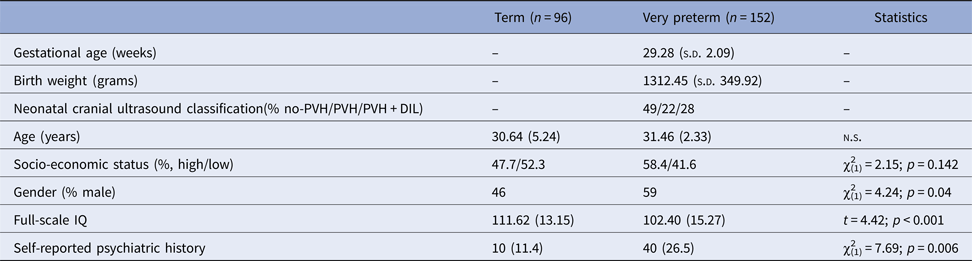
Neonatal, socio-demographic, cognitive variables, and psychiatric history are presented in Table 1. There were more males than females in the very preterm group compared with controls. Very preterm individuals had a significantly lower IQ and were more likely to report a lifetime psychiatric history compared with controls.
Neonatal, socio-demographic, cognitive variables, and psychiatric history for term-born and very preterm participants

no-PVH, normal neonatal cranial ultrasound; PVH, uncomplicated periventricular haemorrhage without ventricular dilatation; PVH + DIL, periventricular haemorrhage with ventricular dilatation. Means and standard deviations (s.d.) are presented, unless specified.
Socio-economic status is listed as per cent in each category (I–II – Professional & Intermediate; III – Skilled manual & Non-manual; IV–V –Semi-skilled & Unskilled manual).
CAARMS results
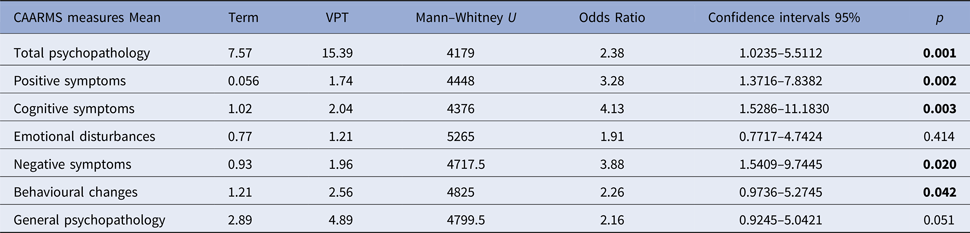
Very preterm participants had significantly elevated levels of positive, negative, cognitive and behavioural symptoms compared with controls (Table 2), and all results survived FDR correction with the exception of behavioural changes. However, there were no significant between-group differences in emotional disturbances. Differences in general psychopathology reached borderline levels of significance.
CAARMS scores for very preterm and term-born participants

CAARMS: Comprehensive Assessment of At-risk Mental States. Total psychopathology score is the sum of all subscales.
Note: means are reported instead of medians due to the high proportion of participants without any symptomatology; the medians would be 0 or close to 0 and therefore not informative to report.
Motor symptoms were excluded from the analyses as very few controls scored above zero on this measure. Bold signifies significant at p < 0.05.
In the whole sample, higher total psychopathology scores were significantly associated with lower full-scale IQ (Spearman's r = −0.268, p < 0.001); however, within group analyses showed that this association was significant in the very preterm group (r = −0.259; p = 0.003), but not in controls (r = −0.187; p = 0.114). The difference between these two correlation coefficients was not statistically significant (Fisher's z = −0.51, p > 0.05).
‘High-risk’ symptomatology
Very preterm individuals were significantly more likely than controls to score above the ‘high-risk’ threshold for total symptomatology (p = 0.044), as well as for positive (p = 0.002), cognitive (p = 0.002), and negative (p = 0.014) symptoms. There were no significant between-group differences on the emotional disturbance (p = 0.596), behavioural (p = 0.057), or general psychopathology (p = 0.101) scales, as described in Fig. 1. After FDR correction, significant between-group results remained on the positive, cognitive, and negative scales.
Odds ratio for being at ‘high-risk’ in adults born very preterm compared with controls (the reference group).

Symptom clustering
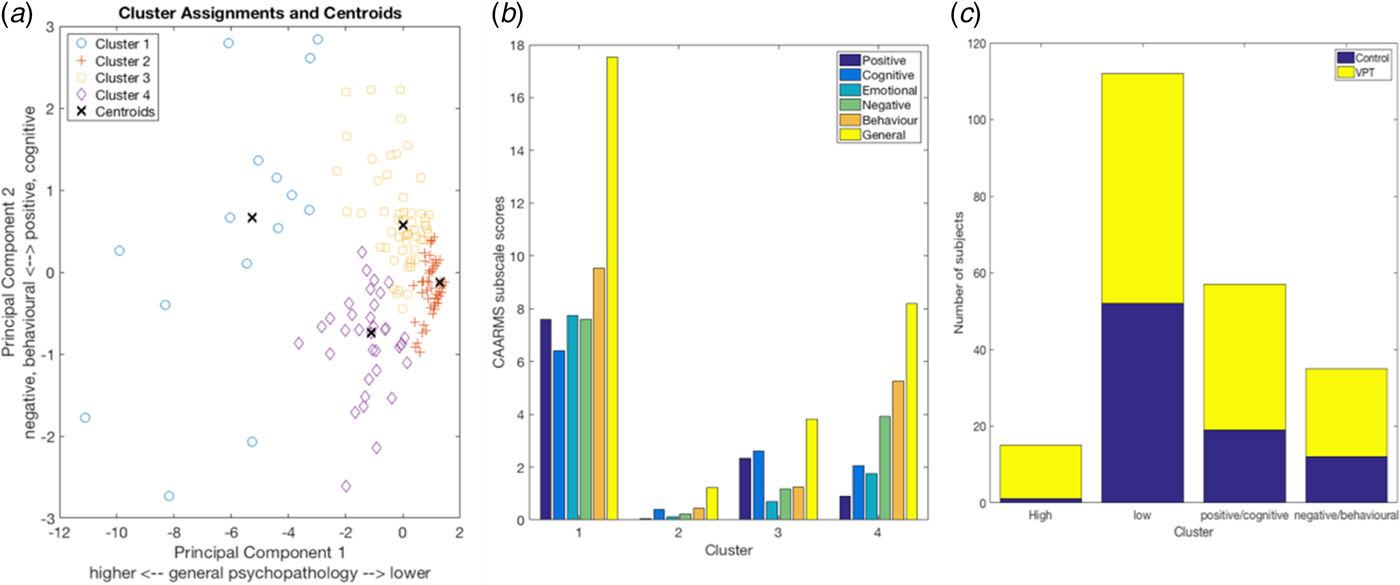
Principal components analysis revealed two components that explained 77.44% of the variance on the CAARMS scales (principal component 1 (PC1) = 67.08%, principal component 2 (PC2) = 10.36%). PC1 had negative weights of a similar size (between −0.38 and −0.43) for each CAARMS subscale, indicating a non-specific psychopathology dimension. PC2 had large positive weightings on positive and cognitive subscales (0.57, 0.56) and relatively large negative weightings on the negative and behavioural subscales (−0.32, −0.45), indicating a variance in symptomatology along a positive-to-negative symptom axis (Fig. 2a).
Symptom clustering. (a) Principal Components Analysis revealed two major components. The first component separated individuals with high and low non-specific psychopathology. The second component accounted for variance along a positive/cognitive to negative/behaviour symptom axis. (b) K-means clustering of participants’ loadings on the two components shown in (a) identified four psychopathology clusters. Cluster 1: high non-specific psychopathology; Cluster 2: low non-specific psychopathology; Cluster 3: high positive and cognitive symptoms; Cluster 4: high negative and behavioural symptoms. (c) Group composition by cluster.

In order to investigate if very preterm birth was likely to be a risk factor for a specific psychiatric dimension, K-means clusters (k = 4) were used to separate the study sample into clusters that differed on their loadings on both the non-specific psychopathology axis, and the positive-to-negative symptom axis. Specifically, Cluster 1 contained individuals who scored high on non-specific psychopathology. Cluster 2 contained individuals who scored low on non-specific psychopathology. Both Clusters 3 and 4 contained individuals who exhibited only mild overall symptoms but were separated on the positive-to-negative axis, with those in Cluster 3 tending to have more positive and cognitive symptoms, and those in Cluster 4 tending to have more negative and behavioural symptoms (Fig. 2a, b).
The distribution of the groups within each cluster is shown in Table 3 and Fig. 2c. A χ2 test indicated significant between-group differences in their distribution into clusters (χ2 = 10.31, p = 0.016). Results of a series of pairwise Fisher's Exact Tests indicated that preterm individuals were more likely to belong to the high non-specific psychopathology cluster than controls, but this was not found for the positive/cognitive or the negative/behavioural cluster (Table 3).
Distribution of controls and adults born very preterm within psychopathology clusters. The low-psychopathology cluster is used as a reference cluster

Discussion
The current study found that adults who were born very preterm demonstrated elevated psychiatric symptomatology compared with controls. As well as displaying increased total psychopathology, they showed increased positive, cognitive, and negative symptoms. Individuals who were born very preterm were also between one- to three-fold more likely than controls to belong to a ‘high-risk’ group (defined by CAARMS scores above the 90th percentile of control scores) on several symptom scales. These results are in line with previous research, indicating higher rates of psychiatric symptomatology in very preterm children, adolescents, and young adults (Hack et al. Reference Hack, Youngstrom, Cartar, Schluchter, Taylor and Flannery2004; Johnson et al. Reference Johnson, Hollis, Kochhar, Hennessy, Wolke and Marlow2010; Healy et al. Reference Healy, Reichenberg, Nam, Allin, Walshe and Rifkin2013).
Although the CAARMS was designed to explore subclinical psychopathology believed to indicate an imminent development of first-episode psychosis, it covers wider psychopathological domains and in this respect our results could be comparable with population-linkage studies that reported a significant association between very preterm birth and a number of psychiatric disorders such as depression, anxiety, schizophrenia, and bipolar affective disorder (Lund et al. Reference Lund, Vik, Skranes, Brubakk and Indredavik2011; Nosarti et al. Reference Nosarti, Reichenberg, Murray, Cnattingius, Lambe and Yin2012; D'Onofrio et al. Reference D'Onofrio, Class, Rickert, Larsson, Langstrom and Lichtenstein2013). Hence, the findings presented here suggest the existence of a major, yet poorly appreciated, psychiatric burden in adults who were born very preterm.
Participants’ clinical profile
In the current assessment, very preterm individuals scored higher on the majority of CAARMS sub-scales compared with controls, which may suggest a non-specific risk (Nosarti et al. Reference Nosarti, Reichenberg, Murray, Cnattingius, Lambe and Yin2012). Nonetheless, several of the symptoms that have been previously described as characterising a ‘preterm behavioural phenotype’ in childhood (Johnson & Marlow, Reference Johnson and Marlow2011) and that are included in the CAARMS continued to be prevalent in our very preterm sample in adult life and these included attention and concentration difficulties, social withdrawal, cognitive changes, alogia, anhedonia, a decreased ability to perform adult roles, apathy, and depression/anxiety. In this sense, such symptom profile may transcend current diagnostic boundaries. Although emotional difficulties are widely described in preterm populations (Burnett et al. Reference Burnett, Davey, Wood, Wilson-Ching, Molloy and Cheong2014), the fact that we did not observe a significant between-group difference on the CAARMS emotional disturbances scale could be due to the type of CAARMS items that make up the scale: subjective emotional changes, blunted and inappropriate affect. These items may not represent the commonly described emotional difficulties preterm individuals report.
One challenge in understanding the psychiatric profile of adults who were born very preterm is to disentangle their behavioural and cognitive problems, such as IQ and executive function deficits, which are thought to underlie social and behavioural problems (Anderson & Doyle, Reference Anderson and Doyle2004; Aarnoudse-Moens et al. Reference Aarnoudse-Moens, Smidts, Oosterlaan, Duivenvoorden and Weisglas-Kuperus2009; Delobel-Ayoub et al. Reference Delobel-Ayoub, Arnaud, White-Koning, Casper, Pierrat and Garel2009). Considering the significant association between IQ and psychiatric symptomatology, we are tempted to speculate that preterm adults may represent an aetiologically and prognostically distinct subgroup characterized by cognitive impairments (Fusar-Poli et al. Reference Fusar-Poli, Deste, Smieskova, Barlati, Yung and Howes2012). Moreover, prospective studies indicate that in populations at risk of developing psychiatric disorders, deficits in social cognition and executive function, along with emotional and behavioural disturbances, may arise in childhood (van Os & Kapur, Reference van Os and Kapur2009) and continue into adulthood, when symptom expression may change in magnitude and character to reflect age-related changes (Hudziak et al. Reference Hudziak, Achenbach, Althoff and Pine2007).
Indeed, a study conducted in a partially overlapping subsample of the current cohort in mid-adolescence reported elevated scores on the ‘Social Problems’ scale of the parent-rated Child Behaviour Checklist (Healy et al. Reference Healy, Reichenberg, Nam, Allin, Walshe and Rifkin2013), made up of items such as ‘does not get along with peers’, ‘gets teased’ and ‘too dependent’. Similarly, at age 18, this cohort was found to have increased levels of psychiatric ‘caseness’ according to the Clinical Interview Schedule – Revised (Walshe et al. Reference Walshe, Rifkin, Rooney, Healy, Nosarti and Wyatt2008), with the most common diagnoses being mood and anxiety disorders. It may be, therefore, that these results represent a continuum of psychiatric risk from mid-adolescence through to adulthood, albeit highlighted with different instruments.
Neurodevelopmental origin of psychiatric risk
The current findings support the notion of a neurodevelopmental origin of psychiatric disorder (Cannon et al. Reference Cannon, Rosso, Hollister, Bearden, Sanchez and Hadley2000; Howes & Murray, Reference Howes and Murray2014). However, the precise pathway linking very preterm birth and psychopathology remain unclear. We previously proposed a theoretical framework, which considered both biological and environmental contributions (Montagna & Nosarti, Reference Montagna and Nosarti2016). According to this model, very preterm birth leads to long-lasting structural and functional brain alterations in socio-emotional and cognitive networks (Fischi-Gomez et al. Reference Fischi-Gomez, Vasung, Meskaldji, Lazeyras, Borradori-Tolsa and Hagmann2014; Karolis et al. Reference Karolis, Froudist-Walsh, Brittain, Kroll, Ball and Edwards2016; Papini et al. Reference Papini, White, Montagna, Brittain, Froudist-Walsh and Kroll2016). These may increase an individual's vulnerability to psychopathology, including enhanced stress sensitivity and aberrant salience (Reininghaus et al. Reference Reininghaus, Kempton, Valmaggia, Craig, Garety and Onyejiaka2016). The lack of specificity in outcome suggests that preterm birth may represent a risk factor for various types of psychopathology, possibly due to developmental alterations in whole brain connectivity and neurotransmission, preferentially affecting corticostriatal and thalamocortical connections (Fischi-Gomez et al. Reference Fischi-Gomez, Vasung, Meskaldji, Lazeyras, Borradori-Tolsa and Hagmann2014; Ball et al. Reference Ball, Pazderova, Chew, Tusor, Merchant and Arichi2015) and dopamine transmission (Froudist-Walsh et al. Reference Froudist-Walsh, Bloomfield, Veronese, Kroll, Karolis and Jauhar2017), which has also been described in psychiatric conditions with a neurodevelopmental component (Friston & Frith, Reference Friston and Frith1995; Howes & Kapur, Reference Howes and Kapur2009; Catani et al. Reference Catani, Dell'Acqua, Budisavljevic, Howells, Thiebaut de Schotten and Froudist-Walsh2016). Furthermore, structural brain alterations are observed in individuals who are at high risk of developing a psychiatric disorder and even in those individuals who do not subsequently receive a clinical diagnosis (Takahashi et al. Reference Takahashi, Wood, Yung, Soulsby, McGorry and Suzuki2009).
In addition to neural alterations, very preterm individuals may be particularly susceptible to bullying, social defeat, and internalizing symptoms, which have also been studied as risk factors for psychopathology (Nierop et al. Reference Nierop, Os, Gunther, Zelst, Graaf and Have2014; Valmaggia et al. Reference Valmaggia, Day, Kroll, Laing, Byrne and Fusar-Poli2015; Wolke et al. Reference Wolke, Baumann, Strauss, Johnson and Marlow2015). Within this theoretical framework, a psychiatric disorder may represent the endpoint of a risk pathway that beings at birth (Dutta et al. Reference Dutta, Greene, Addington, McKenzie, Phillips and Murray2007). Hence our findings highlight the importance of collecting perinatal data as part of routine psychiatric assessments, of monitoring possible antecedents to psychiatric disorder in preterm born individuals and of developing preventative interventions early in life. Moreover, further studies are required to examine the generalizability of the current results to other high-risk populations, such as those with obstetric complications other than very preterm birth and those at genetic risk for psychopathology.
Limitations
The current study has several limitations. Participants were born in the late 1970s and early 1980s and may not be representative of very preterm cohorts born in more recent years. Similar to other longitudinal studies, attrition is a critical limitation; participants studied here were a subset of the original cohort recruited at birth. A previous study found a bias in selective dropout, where those individuals with the worst outcomes did not return for assessment (Wolke et al. Reference Wolke, Waylen, Samara, Steer, Goodman and Ford2009); however, this would potentially result in decreased psychiatric symptomatology in those who returned for assessment, indicating our results may be underestimating participants’ current psychiatric problems. Regarding the current sample size, there was only one control in the high-risk cluster group, which may limit the interpretability of the findings. Further studies are required to replicate the results presented here. Another limitation due to sampling selection is that the control group was recruited from advertisements in the local community, and may not represent the general population. The preterm and control groups were not matched in terms of sex. Sex differences in the prevalence of psychiatric disorders are observed in epidemiological samples, while most studies examining preterm populations report no significant differences in psychiatric outcomes between males and females (Johnson et al. Reference Johnson, Hollis, Kochhar, Hennessy, Wolke and Marlow2010; Burnett et al. Reference Burnett, Davey, Wood, Wilson-Ching, Molloy and Cheong2014).
We further acknowledge that a major limitation of this study is the use of one assessment tool, which was originally designed to evaluate attenuated symptomatology in individuals at risk of psychosis. Considering the overlap between these symptoms and other disorders (Prata et al. Reference Prata, Mechelli, Fu, Picchioni, Kane and Kalidindi2009) the findings presented here may be secondary in nature to the neurocognitive and behavioural difficulties often described in preterm populations. Finally, the very preterm participants were selected according to their gestational age and other factors such as low birthweight and being born small for gestational age (Hack et al. Reference Hack, Taylor, Schluchter, Andreias, Drotar and Klein2009; Lund et al. Reference Lund, Vik, Lydersen, Lohaugen, Skranes and Brubakk2012; Lærum et al. Reference Lærum, Reitan, Evensen, Lydersen, Brubakk and Skranes2017), which may also be risk factors for later symptomatology were not considered in the current analyses.
Conclusion
Our findings highlight the impact of very preterm birth on mental health, lending support to the notion of a neurodevelopmental origin of psychopathology. These results further suggest that very preterm birth is a risk factor across a number of symptom domains and may not be limited to standard diagnostic boundaries. Further studies should focus on the investigation of known antecedents of psychopathology in very preterm children, such as emotion regulation problems (Treyvaud et al. Reference Treyvaud, Doyle, Lee, Roberts, Lim and Inder2012; Woodward et al. Reference Woodward, Lu, Morris and Healey2017). These results further suggest that early preventative interventions should extend to target individuals born very preterm.
Acknowledgements
We thank our study participants for their continuing help. We also thank the National Institute for Health Research (NIHR) Biomedical Research Centre at South London and Maudsley NHS Foundation Trust. The study was funded by the Medical Research Council, UK (ref. MR/K004867/1).
Declaration of Interest
The authors have no financial relationships relevant to this paper to disclose.