Loading conditions in the functionally univentricular heart are chronically abnormal and vary through the sequential stages of Fontan palliation. In addition to chronic cyanosis and abnormal volume loading, adverse ventriculo-arterial coupling has also been demonstrated.Reference Senzaki 1 Resultant abnormalities in both systolic and diastolic function are well documented,Reference Cheung, Penny and Redington 2 with the latter being particularly important for pulmonary blood flow in the Fontan circuit.Reference Garofalo 3 , Reference Graham and Johns 4 Elevated ventricular filling pressures are a contraindication for Fontan completion.
Angiotensin-converting enzyme inhibitors have been used in children with single ventricle physiology, despite a paucity of evidence supporting their efficacy in this population. Numerous trials have demonstrated that angiotensin-converting enzyme inhibitors reduce mortality and symptoms, reverse ventricular hypertrophy, and improve both systolic and diastolic function in adults with heart failure. 5 – Reference Kim 11 In contrast, the effectiveness of angiotensin-converting enzyme inhibitors in children with either biventricular or univentricular circulations has yielded conflicting results.Reference Mori 12 – Reference Kouatli 16 Given the lack of evidence in this patient group, our objective was to determine the effect of anti-heart failure therapy using these medications on ventricular filling pressures in patients with single ventricle circulations.
Methods
Study design
We performed a single-centre, retrospective review of patients with single ventricle physiology who underwent multiple cardiac catheterisations for elevated filling pressure between January, 1991 and December, 2013. Patients were identified if they received escalation of medical treatment between assessments – in the form of either commencement of angiotensin-converting enzyme inhibitors or an uptitration in the existing dose of an angiotensin-converting enzyme inhibitor. Exclusion criteria were those patients who underwent catheter or surgical interventions that influenced loading conditions between haemodynamic assessments – for example, relief of coarctation, atrioventricular valve repair, or a bidirectional cavopulmonary connection. The Human Research Ethics Committee of the Royal Children’s Hospital approved the study.
All catheterisations were performed under general anaesthesia with a fraction of inspired oxygen between 0.21 and 0.30. Pressure data were acquired using fluid-filled catheters connected to an external pressure transducer calibrated to atmospheric pressure and zeroed to mid-chest level using a spirit level. Haemodynamic data were obtained before contrast angiography in all cases. Ventricular end-diastolic pressure was averaged over 15 consecutive cycles and corresponded to the ventricular pressure at the R-wave of the electrocardiogram or the ventricular pressure immediately before the rapid upstroke in the ventricular pressure trace.
Patient medical records were reviewed and the following data immediately before catheterisation were recorded: current medications, weight-for-age z-scores, and qualitative assessment of ventricular function or degree of atrioventricular valve regurgitation on echocardiography. Chest x-rays performed at the time of catheterisation were also reviewed and the cardiothoracic ratio was measured. Patient weights were converted to World Health Organisation z-scores. 17 Short-to-medium term outcomes were also recorded and included symptoms, failure to proceed to Fontan completion, cardiac transplantation, or death.
The team at the Royal Children’s Hospital would generally consider a ventricular end-diastolic pressure of <10 mmHg to be acceptable for Fontan completion. An end-diastolic pressure between 10 and 12 mmHg is considered a borderline elevated result, and above 12 mmHg an elevated result that is suggestive for diastolic dysfunction and a poor candidate for Fontan completion. Elevated pre-operative pulmonary artery pressures are a known independent risk factor for hospital mortality,Reference d’Udekem 18 and the team at Royal Children’s Hospital would consider the benefits of medical management of diastolic dysfunction before re-consideration for Fontan completion versus the risks of proceeding for surgery.
The usual time-frame that patients are referred for pre-catheterisation work-up followed by Fontan completion in our institution is generally between 3 and 5 years. In a population-based study of the Fontan procedure in Australia, published in 2007, the median age at Fontan palliation was 5 years,Reference Iyengar 19 and a recent publication capturing Australian and New Zealand patients in the Fontan registry reported the median age at Fontan completion as 4.8 years (interquartile range 3.9–6.0 years).Reference Iyengar 20
Statistical analysis
Statistical tests were performed using GraphPad Prism version 5.0 for Mac (GraphPad Software, San Diego, California, United States of America). The Wilcoxon signed-rank test was used where appropriate for related samples. Spearman’s rank correlation co-efficient was used to assess correlations between variables. Values are expressed using median values with interquartile ranges for variables without normal distributions, or absolute numbers with percentages as appropriate. A p-value of <0.05 was considered statistically significant.
Results
Subjects
A total of 17 patients satisfied inclusion criteria. There were 11 (64.7%) patients pre-Fontan and six (35.3%) patients post-Fontan completion. There were 11 (64.7%) male patients and 8 (47.1%) patients had a systemic right ventricle. The median age and weight at the time of the first catheterisation was 42 months (interquartile range 28–88 months) and 15.5 kg (interquartile range 10.9–28.5 kg), respectively. Baseline characteristics of the patients are presented in Table 1.
Baseline characteristics of study population.

Values are expressed as median (IQR=interquartile range), absolute numbers (fraction, percentages) as stated
* Weight-for-age z-scores were derived using World Health Organisation (WHO) child growth standards
Catheterisation procedures
The median interval between the bi-directional cavopulmonary shunt and first catheterisation in the pre-Fontan group was 2.2 years (interquartile range 1.4–4 years). The median interval between cardiac catheter assessments was 9.4 months (interquartile range 7.3–19.1 months). Clinical indications for repeat haemodynamic assessment included re-assessment of previous abnormal haemodynamics, consideration of transcatheter intervention, and evaluation of Fontan circuit anatomy. There were no significant changes to their clinical profile between assessments.
Medications
Angiotensin-converting enzyme inhibitors were commenced in 11 (64.7%) patients and optimised in six (35.3%) patients in response to elevated ventricular filling pressure during initial catheter assessment. Medical therapy changes were made over a median interval of 9.1 months (interquartile range 7.1–16.8 months) before repeat haemodynamic assessment.
A total of three different angiotensin-converting enzyme inhibitors were used: enalapril (n=9, 52.9%), lisinopril (n=6, 35.3%), and captopril (n=2, 11.8%). The median peak dose of enalapril was 0.28 mg/kg/day (range 0.2–0.78 mg/kg/day), lisinopril 0.25 mg/kg/day (range 0.17–0.37 mg/kg/day), and captopril 0.94 mg/kg/day (range 0.9–0.97mg/kg/day). Of the six patients who were already on an angiotensin-converting enzyme inhibitor at the time of the initial assessment, the dose was doubled in four patients and tripled in two patients. Carvedilol was commenced in two patients in the post-Fontan group with a median peak dose of 0.45 mg/kg/day (range 0.36–1.14 mg/kg/day).
Both angiotensin-converting enzyme inhibitors and carvedilol were well tolerated in our patient group. There were no sustained adverse effects such as renal failure or significant hypotension that required a reduction in dose or change in medication. One patient on enalapril developed a cough, but did not require a change in medication.
At the time of initial catheterisation, all pre-Fontan patients were on low-dose aspirin, two were on frusemide, and one patient was on atenolol for supraventricular tachycardia. In the post-Fontan group, all patients were maintained on warfarin, one patient was on frusemide and spironolactone, and one patient was on atenolol due to atrial flutter. By the time of the second catheterisation, frusemide was ceased in one patient in the pre-Fontan group and halved in the post-Fontan group patient, with cessation of spironolactone. There were no other medication changes between interval assessments.
Echocardiographic and chest x-ray findings
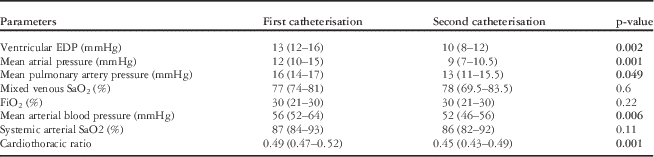
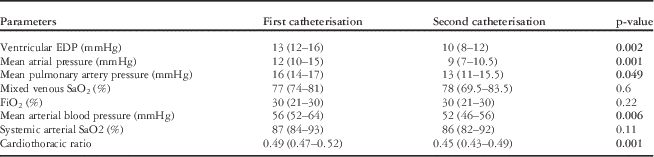
On echocardiography, 15 (88.2%) patients had good ventricular systolic function at the time of initial study, and two (11.8%) patients had mildly decreased systolic function. Atrioventricular valve regurgitation was no more than mild in 16 (94.1%) patients. One patient (5.9%) with hypoplastic left heart syndrome had moderate tricuspid regurgitation. There was no significant change in ventricular systolic function or valvar regurgitation between assessments. A routine pre-admission chest x-ray was performed before each cardiac catheterisation, and a reduction in cardiothoracic ratio from 0.49 (interquartile range 0.47–0.52) to 0.45 (interquartile range 0.43–0.49) was observed between assessments (p=0.001).
Haemodynamics
All patients underwent cardiac catheterisation under a general anaesthetic with a median inspired oxygen fraction of 0.30 (interquartile range 0.21–0.30). There was no significant difference in delivered oxygen levels or baseline systemic arterial saturations during assessments. Baseline mean arterial blood pressure lowered from 57 to 53 mmHg at re-assessment (p=0.006). This finding is expected in the setting of therapeutic levels of angiotensin-converting enzyme inhibitors±carvedilol between assessments (Table 2). Given the potential confounding effect of afterload reduction reflected by the fall in mean blood pressure between assessments, a Spearman’s rank correlation co-efficient was performed. There was no significant correlation between the change in mean arterial blood pressure and end-diastolic pressure between catheterisations.
Comparison of haemodynamic parameters.
EDP=end-diastolic pressure
Values are quoted as median (interquartile range). FiO2: fraction inspired oxygen; SaO2: oxygen saturation
p-values in bold are statistically significant
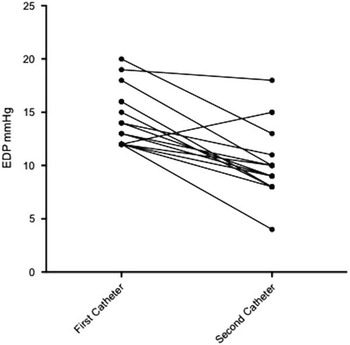
There was a statistically significant reduction in ventricular end-diastolic pressure between catheterisations from 13 (interquartile range 12–16 mmHg) to 10 mmHg (interquartile range 8–12 mmHg) (p=0.002) (Fig 1). There was also an overall reduction in mean atrial pressure from 12 (interquartile range 10–15 mmHg) to 9 mmHg (interquartile range 7–10.5 mmHg) (p=0.001). Mean pulmonary artery pressure reduced from 16 (interquartile range 14–17 mmHg) to 13 mmHg (11–15.5 mmHg) (p=0.049) between assessments. Cardiac output was not measured, but there was no difference in mixed venous saturations between assessments (p=0.6) (Table 2).
Line graph demonstrating the observed changes in end-diastolic pressure (EDP) between first and second catheterisations following treatment with angiotensin-converting enzyme inhibitors.

Clinical outcomes
Of the 11 patients, nine (9/11 81.8%) patients in the pre-Fontan group, who were found to have an elevated end-diastolic pressure at initial assessment, underwent successful Fontan completion after a period of medical treatment and reduction in end-diastolic pressure. Of the remaining patients, one developed a chronic chylothorax and was treated with takedown of the bi-directional cavopulmonary connection and reversion to a Blalock–Taussig shunt four months after surgery. The other patient underwent tricuspid valve repair and will be re-assessed for Fontan completion.
There were no patient deaths during the study period. Among all, one patient underwent orthotopic cardiac transplant five years after Fontan completion because of protein-losing enteropathy – this patient had a decrease in ventricular end-diastolic pressure from 12 to 9 mmHg between assessments. A further post-Fontan patient who had an improvement in filling pressures between catheterisations later developed systemic left ventricular dysfunction and is being evaluated for cardiac transplantation. Successful re-synchronisation therapy was performed in a patient in the pre-Fontan group, who developed severe ventricular dysfunction with new intraventricular conduction delay after Fontan completion. All other patients remain well at median follow-up after 31 months (interquartile range 15.1–71.2 months) following second catheterisation.
Discussion
Our study demonstrated a reduction in ventricular end-diastolic pressure, mean pulmonary artery pressure, and atrial pressures in patients with functionally univentricular circulations with elevated filling pressure following treatment with angiotensin-converting enzyme inhibition. These favourable changes were also reflected in a reduction in cardiothoracic ratio on chest x-ray. This improvement in haemodynamic parameters enabled the majority to meet our institution’s selection criteria for Fontan completion.
Ventricular end-diastolic pressure
Ventricular diastolic function is an important determinant of optimal flow in the Fontan circulation.Reference Cheung, Penny and Redington 2 , Reference Mair 21 Although we did not use more sophisticated measures of diastolic function, the measurement of end-diastolic pressure is the standard clinical measure employed in assessing suitability and function of the Fontan circuit. Ventricular end-diastolic pressure of <8 mmHg is regarded as a normal filling pressure in biventricular physiology,Reference Ommen 22 and it is generally accepted that a ventricular end-diastolic pressure of <10 mmHg is optimal in a single ventricle circulation.Reference Mair 21
Elevated end-diastolic pressure is a known risk factor for failure of Fontan palliation.Reference Cheung, Penny and Redington 2 , Reference Garofalo 3 , Reference Menon, Gray and Tani 23 Our institution has also previously published our experience with Fontan palliation and reported that elevated pre-operative pulmonary artery pressures were an independent risk factor for hospital mortality.Reference d’Udekem 18 Some factors resulting in elevation of ventricular filling pressures are amenable to catheter or surgical intervention – for example, aortopulmonary collaterals, significant atrioventricular regurgitation, or systemic outflow obstruction. In the absence of these, intrinsic myocardial dysfunction may be the limiting factor. We observed that patients treated with angiotensin-converting enzyme inhibitors had a reduction of ventricular filling pressures at the time of catheterisation re-assessment. In some of our patients, this led to them becoming suitable for Fontan completion having previously not fulfilled local haemodynamic criteria.
Pharmacological therapy
Patients with single ventricle physiology are often empirically treated with angiotensin-converting enzyme inhibitors, despite the lack of evidence supporting efficacy in this subset of patients. The use of angiotensin-converting enzyme inhibitors in paediatric heart failure has been extrapolated from adult trials that infer a long-term survival benefit in patients with both asymptomatic and severe left ventricular dysfunction. 5 , 6 The mechanism of action is multi-factorial, and in part because of its positive effects on endothelial function, modulation of the renin-angiotensin system, and consequent afterload reduction. Reductions in left ventricular wall mass and ventricular volumes have been demonstrated in adult patients with heart failure treated with long-term angiotensin-converting enzyme inhibition.Reference Pouleur 7
Several non-randomised studies of angiotensin-converting enzyme inhibitors in children with biventricular circulations and associated volume overload have reported beneficial effects on ventricular re-modelling, reduction of ventricular hypertrophy and volume, and improvement of ventricular function.Reference Mori 12 , Reference Calabro 13 In a randomised controlled trial in infants with single ventricle circulations, enalapril, however, failed to demonstrate a beneficial effect on medium-term somatic growth, ejection fraction on echocardiography, or heart failure severity.Reference Hsu 15 The majority of these patients had normal ventricular function at baseline, were younger than our cohort, and no assessment of diastolic function was performed.
Enalapril administration over 10 weeks in a group of adult patients post-Fontan was not found to improve exercise capacity, resting cardiac index, or diastolic indices on echocardiographyReference Kouatli 16 ; however, the ability of echocardiography to accurately quantify diastolic function in single ventricle circulation is uncertain. A recent study only found a modest correlation between invasively measured end-diastolic pressure and more sophisticated echocardiographic parameters than those used in the study by Kouatli.Reference Menon, Gray and Tani 23
Limitations
Our study has several important limitations. First, being an observational study, we were limited to a heterogeneous group of patients with differing burdens of co-morbid illness and at different stages of single ventricle palliation. The power of the study is limited by small patient numbers. In addition, the type of angiotensin-converting enzyme inhibitor and dosing regimen varied considerably between patients, and two patients in the post-Fontan group were also managed with carvedilol. All patients underwent catheterisation under a general anaesthetic with low inspired oxygen concentrations; however, small differences in loading conditions due to hydration status and vasodilatory effects of the anaesthetic agents could not be excluded. Nevertheless, the catheterisations were comparable with no significant differences in inspired oxygen or systemic saturation levels between assessments. Although the mean arterial blood pressure was lower between assessments, there was no correlation with end-diastolic pressure. In addition, although the reduction in filling pressures appears to correspond with commencement or optimisation of medical therapy, in some cases, there may also have been an inherent gradual improvement in ventricular performance with time following cardiopulmonary bypass. It would not be possible to determine the size of this effect without a randomised, controlled trial. Conversely, it may not be ethically acceptable to perform such a trial if it meant precluding Fontan completion in some children due to adverse haemodynamics.
Given the small size of our study and the heterogeneity of the patient group, we were not able to translate the observed beneficial changes in haemodynamics directly with clinical outcomes such as exercise capacity. It would be difficult, however, to obtain reliable data in this age group of patients.
Conclusion
Our study demonstrated positive haemodynamic changes in patients with a single ventricle circulation that correlated with institution or optimisation of angiotensin-converting enzyme inhibitors. This may have important implications for the management of this patient group. We would advocate for large prospective trials to study the effects of these standard anti-heart failure therapies on haemodynamic parameters and correlation with clinical outcomes in patients with single ventricle physiology.
Financial Support
The Heart Research Group is supported by RCH 1000, RCH Foundation and Big W. The MCRI is supported by the Victorian Government's Operational Infrastructure Support Programme. Yves d’Udekem is a Career Development Fellow of The National Heart Foundation of Australia (CR 10M 5339).
Conflicts of Interest
None.