The concept of the ‘fiscal-military state’ has become very familiar to historians of eighteenth-century Britain, and beyond, since the publication of John Brewer's extremely influential study The sinews of power in 1989.Footnote 1 Brewer demonstrated that Britain's vastly increased military involvement (and successes) in Europe and the expansion of her global trading and imperial interests could not have happened without concurrent substantial increases in taxation, improvements in public administration, and innovations in deficit financing. Brewer's work, while hugely significant in its own right, built on the foundations of the pioneering work of Peter Dickson on the financial revolution and the ground-breaking work of Patrick O'Brien and Peter Mathias on English taxation.Footnote 2 If Brewer's work sketched out the grand narrative, other historians have been keen to add detail and to challenge some of his findings. In doing so, they have extended the boundaries, both geographically and chronologically, of the British fiscal-military state.Footnote 3 Significant in this regard has been the extension of the ‘fiscal-military state’ model to encompass not just England, but also other parts of the British Isles.Footnote 4 This article further expands our understanding of the British fiscal-military state through an analysis of the tax-gathering apparatus of the eighteenth-century Irish state. Central to this analysis is the contention that Ireland was an integral but yet separate part of the eighteenth-century British imperial or fiscal-military state. Chronologically, this article examines the period from the culmination of the Williamite wars in Ireland at the Treaty of Limerick in 1691 to the instigation of major reforms in the administration and governance of Ireland during the viceroyalty of Lord George Townshend in the late 1760s. Townshend's attempts to reorganize the Irish revenue board and the contemporaneous, and linked, augmentation of the army on the Irish establishment in 1769 make this an appropriate point to conclude this analysis.Footnote 5
Determining the status of the Irish state in the eighteenth century is in itself a complicated historiographical issue. Ireland's complicated constitutional status, whether it was a separate kingdom or a colony, has generated much debate, and while it has often generated more heat than light this debate is germane to any discussion of the eighteenth-century Irish state.Footnote 6 Some modern scholars have followed J. A. Froude who argued that Ireland's dependent colonial status meant that she failed any test of statehood.Footnote 7 The subordinate nature of the eighteenth-century Irish parliament, the dominance of British-appointed English-born officials in the top posts in the ‘Irish’ administration, and of course the exclusion of the majority of the population from the political nation on the grounds of religion have all been seen as reasonable grounds to argue for the non-existence of an Irish state in this period.Footnote 8
This interpretation has its attractions, particularly for those scholars who wish to see Ireland through a colonial or post-colonial lens, but it is not the only possibility.Footnote 9 Developments in the historiography of eighteenth-century Ireland since the 1970s have fundamentally revised the Froude- and Lecky-inspired image of Ireland between the 1720s and the winning of legislative independence in 1782 as a historical backwater.Footnote 10 The products of this sustained research activity have allowed a more nuanced picture of eighteenth-century Ireland to appear, which has done much to revise earlier dominant frameworks.Footnote 11 In an important if rather neglected 1995 article, Thomas Bartlett, drawing on Brewer's work as well as Patrick McNally's doctoral work on early Hanoverian Irish politics, explicitly argued for the existence of an Irish state in the eighteenth century.Footnote 12 Questioning Tom Garvin's contention that Ireland in the eighteenth century ‘was scarcely governed at all’, Bartlett's account made a convincing argument for evidence of a growing and expanding state through the eighteenth century.Footnote 13 Central to this argument was an emphasis on the role of parliament, the successful raising of taxes, and the maintenance of a standing army. The complicated constitutional status of the Irish parliament and the exclusion of the Catholic population from full participation in the state are acknowledged, but he shows that, as the century went on, these issues became less problematic, leading to a more powerful state that in turn created new problems at an imperial level. Subsequent research by an increasing number of historians on the Irish parliament (especially its legislative function), the legal system, the army, and the national debt and public finances in Ireland has served to strengthen this argument.Footnote 14
These explorations of some of the most significant Irish institutions of government still, however, leave some questions unanswered. Notable amongst them is where Ireland fits within the wider British context, and whether it is possible to speak of a separate Irish state? One possible answer is to follow Julian Gwynn's approach to colonial Massachusetts, where he argued, while acknowledging Massachusetts's colonial status, that it was possible to treat it as a state for fiscal purposes considering its separate fiscal structures.Footnote 15 This formulation is superficially attractive but his argument rests partly on his equation of Massachusetts with German states like Hesse-Kassel and Wurtemburg, which likewise received subsidies from the British government to support them financially. Ireland, unlike Massachusetts or Hesse-Kessel or indeed pre-Union Scotland, was not, however, a subsidy state, but instead was able to raise sufficient taxes and loans to support her civil and military establishments.Footnote 16 It is therefore perhaps best to see Ireland as a separate, albeit dependent, kingdom within a wider British composite state. Such a formulation allows for the otherwise seeming ‘paradox of dependency on England but independency in most day to day activities’.Footnote 17 This model works well for fiscal matters, whereby taxation was regulated by Irish parliamentary legislation, and collected by Irish revenue commissioners, yet the same parliament and revenue board were subject to the controls of the English/British privy council and treasury respectively. In each case, most of the mundane regular operations were in practice rarely subject to interference from London. Hitherto, the application of the composite state framework to the Irish case has concentrated on the role of parliament, but it also has a broader application not least in the areas of financial and military organization and administration.Footnote 18 Indeed, it is arguable that this is the most appropriate framework for understanding the Irish contribution to the fiscal-military state.
I
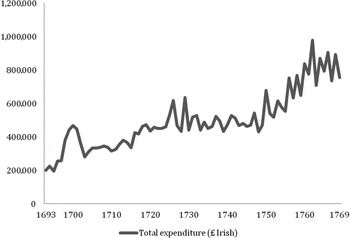
Ireland made a vital contribution to the British fiscal-military state, something that is increasingly being recognized by historians.Footnote 19 Ireland's contribution to the expansion of British imperial interests, at least in the period covered in this article, came not predominantly in the form of manpower – that would come later. Official restrictions on the recruitment of Irish Protestants into the lower ranks, and on Catholics into all ranks, meant that Ireland's bountiful reserves of manpower remained largely ‘a weapon of war untried’ at least until the American War.Footnote 20 If armed service, outside of the officer corps, was not to be the Irish contribution to the fiscal-military state, what was? Ireland's major role was to act as a self-funding garrison for a significant portion of the British standing army. Following the conclusion of the Nine Years War in 1697, the army, which had expanded massively during King William's wars, needed to be reduced. A compromise also needed to be reached between two opposing positions: the king's belief that he needed to maintain a standing army and the long-standing English opposition to such a standing army. The eventual solution was to maintain a 12,000-strong force on the Irish establishment where they would be paid for by Irish taxpayers. The numerical strength of the force supported by the Irish taxpayer would remain at 12,000 until 1769 when, after protracted debates in the Irish parliament, it was raised to 15,235 men.Footnote 21 They would also provide a degree of security to the Irish Protestant population, who shared few of the English qualms about standing armies.Footnote 22 Concerns about security rather than abstract ideas about liberty were to the forefront of the Irish Protestant elite's minds in the decades after the Williamite wars. Maintaining the army on the Irish establishment, and building the country-wide network of barracks to house them, necessitated maximizing the financial resources of the Irish state to meet the growing demands of government expenditure as displayed in Figure 1.Footnote 23 Central to meeting these obligations was increasing the revenue yielded by taxation so as to meet the commitments of the Irish polity to the imperial project.
Irish net expenditure, 1693–1769. Source: This graph is based on the figures found in Accounts of net public income and expenditure of Great Britain and Ireland, 1688–1800 (British Parliamentary Papers, xxxv (1868–9), pp. 227–53) (hereafter 1869 report). The figures have, however, been converted from English pounds to Irish pounds. The official exchange rate was set at 13d (Irish) = 1s (English) by proclamation in 1701.

The necessary revenues could not be raised solely by taxation, although as we shall see this would be the primary source of government income through the century. Public credit structures, just as in Britain, had also to be developed with a separate Irish national debt first instituted in 1716. This debt took the form of a national loan of £50,000 largely raised from within Dublin's parliamentary and administrative circles.Footnote 24 The proximate cause for this development was the raising of thirteen new regiments, eight of which were dispatched to Scotland, and four to England upon the outbreak of the Jacobite rebellion in 1715.Footnote 25 A second loan of £150,000 would be raised in 1729 to meet growing army pay arrears. This loan was secured upon specific tax revenues or ‘appropriated duties’, a practice continued with all subsequent loans.Footnote 26 The regular meeting of parliament and efficient collection of the parliament-sanctioned taxation thus became crucial to preserving the state's credit, something recognized by contemporaries.Footnote 27 The next two sections examine how the Irish government managed to develop efficient revenue-raising mechanisms to meet their financial obligations in the decades after the Williamite revolution.
II
The impact of the Glorious Revolution on the financial development of the British state has been a subject of vociferous academic debate. Older whiggish interpretations, which stressed the ushering in of a new dawn in 1688, have been challenged, although these interpretations remain in vogue amongst scholars who approach this question from other disciplinary backgrounds, notably economics.Footnote 28 Other scholars working on the restoration and commonwealth periods have, however, shown how many of the innovations associated with the post-1688 era had deeper roots.Footnote 29 The constitutional settlement and the more regular meeting of parliament after 1689, it has been argued, accelerated rather than initiated the process of change. A similar story can be told about Ireland. The roots of the financial developments witnessed in the 1690s can be found in the previous three decades. The origins of the modern Irish taxation system, like that in England, can be traced back to the introduction of the excise by the Commonwealth regime in the 1650s.Footnote 30 Following the restoration of the monarchy in 1660, politicians and policy-makers across the three kingdoms looked back to these Cromwellian innovations when they began to consider new methods to raise revenue to meet the increased demands of Charles II's state and court. In Dublin, as in London, existing customs duties were consolidated and codified by the Irish parliament, while new excise legislation was introduced.Footnote 31
These 1662 legislative measures would form the basis of Irish taxation until the beginning of the nineteenth century. Regressive taxation in the form of customs duties and excise charged on alcohol and other consumables would provide the bulk of Irish government income through the seventeenth and eighteenth centuries. Unlike in England, land taxes did not become regular instruments of taxation policy. No Irish land tax was introduced after 1698, when a two-year experiment ended, although the imposition of a new land tax was occasionally rumoured, much to the alarm of the Irish gentry.Footnote 32 Other forms of property taxes were utilized in Ireland, notably crown and quit rents and the hearth tax. Crown rents and quit rents formed an important part of the Irish ordinary revenue alongside older impositions like tonnage and poundage (incorporated into customs in 1662), lighthouse duties, ale and wine licences, and alnage duties.Footnote 33 Most of these taxes yielded very little revenue for the Irish exchequer. Quit rents, which were charged on properties previously forfeited during the mid-seventeenth-century rebellions, however, brought in a steady stream of income throughout the eighteenth century, averaging about £60,000 per annum.Footnote 34 They were notoriously difficult to collect, and receipts were often in arrears. The hearth tax, a tax on all fireplaces, remained in Ireland throughout the eighteenth century despite its abolition in England and Wales in 1689. It was arguably the most pervasive of all Irish taxes, affecting as it did the majority of the population, and its collectors regularly met with opposition in their rounds, especially in remote regions. These difficulties and an increasingly lax departmental administration from the 1750s onwards meant that its yields did not keep up with expanding population numbers, leading to its eventual reform in the 1790s.Footnote 35 Like the quit rents, it provided a steady stream of income, rising from c. £30,000 to c. £53,000 per annum in the period 1700–69.Footnote 36 These taxes, while providing regular government income, offered little prospect for dramatic expansions in revenue.
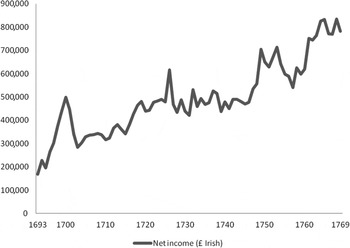
For such expansion, Irish politicians and policy-makers needed to look to the customs and excise legislation introduced in 1662 and to the short-term supply legislation passed by the Irish parliament in each session from 1692 onwards.Footnote 37 Passing the ‘money bills’ became the most important responsibility of the Irish parliament and helped make its transition from being an ‘event’ to becoming an ‘institution’ in this period.Footnote 38 The money bills determined the levels of the parliamentary additional duties and the goods upon which they were charged. These taxes, raised first by the customs and excise acts and then by the additional duties voted by parliament, increased throughout the eighteenth century as the population expanded, government demand increased, and the tax-collecting bureaucracy improved. As shown in Figure 2, tax receipts were initially slow to recover their pre-1688 levels at the beginning of the 1690s due to the continuing impact of the bloody conflict of 1689–91 on the Irish economy, but by the conclusion of the Nine Years War, noticeable improvements were visible.Footnote 39
Irish net revenue receipts, 1692–1769 (£ Irish). Source: This graph is based on the figures in the 1869 report. See Fig. 1 above.

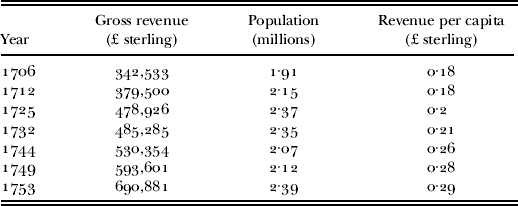
By 1695, net tax receipts were already higher than the highest levels recorded in the 1680s, and by 1698 they amounted to just over £350,000 sterling or 1·5 times the average yield for the period 1682–8. Revenues would continue to climb, averaging over £350,000 per annum during the War of Spanish Succession and over £520,000 during the War of Austrian Succession. By the Seven Years War they would yield on average £700,000 a year, double the yield in the 1690s. It is worth considering these figures within a comparative perspective so as to understand their relationship with revenue yields in other parts of the British Isles. In absolute terms, Irish revenue lagged behind Britain, with British taxes already yielding over ten times Irish net revenues in the 1690s, a ratio that would continue to be maintained into the 1770s.Footnote 40 This is not surprising considering the different population distributions and economic structures of the two islands. A more useful comparative perspective can be reached by considering revenue yields relative to population. The normal caveats with regard to population estimates apply. Nevertheless, per capita figures are indicative of the relationship between population and taxation revenue in Ireland (see Table 1).
Irish gross revenue per capita, 1706–53
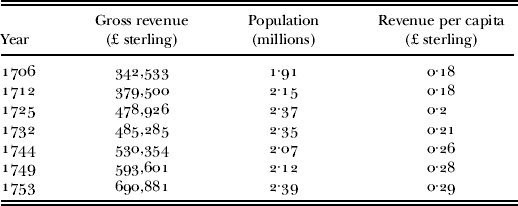
Source: Gross revenue figures have been calculated from the figures for annual revenue receipts presented each session to the Irish parliament. The figures have been adjusted so that all years reflect the state of the accounts at 25 Mar., the end of the accounting year. CJI, ii, appendix, pp. iv, xxxii, cviii, cxxi, cxlvi, cxlviii, clxxviii, ccxi, ccxl, and cclxiv; iii, appendix, pp. v, civ, cliv, cxcii, ccxxxiv, cclxxxix, cccxxviii, and ccclxi; iv, appendix, pp. ii, xx, l, lxxi–lxxii, ciii–civ, cxxxvii–cxxxviii, clv–clvi, ccxlvi–ccxlvii, and cclxxiii–cclxxiv; v, appendix, pp. iii–iv, xxix–xxx, ccxlvii–ccxlviii, and cclxvii–cclxviii; vi, appendix, pp. iii–iv and clxx–clxxi; vii, appendix, pp. ix–x and cxxxvi–cxxxvii. Per capita revenue figures have been calculated using the modern population estimates found in Dickson, Ò'Gràda, and Daultey, ‘Hearth tax, household size and Irish population change, 1672–1821’, passim. Mean population figures based on their upper and lower band estimates have been used for clarity. I am grateful to David Dickson for helpful advice on this point.
Comparing these figures with those for Britain is complicated by the lack of a comparable series of gross revenue figures. Nevertheless, some comparisons can be made. In 1706, on the eve of the Scottish Union, the per capita gross revenue figures for England and Wales and Scotland respectively were £1·04 and £0·10 respectively. Irish taxpayers were thus paying approximately one fifth of what their English and Welsh counterparts paid, but double what their Scottish counterparts paid at this juncture. By the mid-1750s, the gap between Ireland and Scotland had closed, although the Irish population continued to be more heavily taxed. Comparing customs and excise receipts for the two jurisdictions, it appears that Irish taxpayers paid £0·24 per head while their Scottish counterparts paid £0·17. While the Irish per capita tax burden remained greater than Scotland's, it continued to be dwarfed by figures for England and Wales. English and Welsh taxpayers in 1755 paid £0·59 per capita in excise taxes compared to £0·30 in 1708.Footnote 41 Their total tax burden therefore was much higher than that of their Irish (and Scottish) counterparts. This is not surprising, considering the greater burden of the British national debt, the cost of which was borne by the British taxpayer, or indeed the more buoyant and urbanized commercial economy in England and Wales, which both increased the incidence of taxation and made it easier to collect.
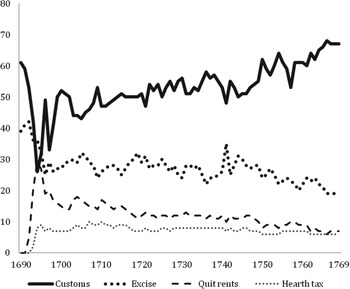
John Brewer has highlighted how taxation on consumption through excise taxes increasingly made up the greater proportion of tax revenues in England.Footnote 42 In Ireland, things were different; excise was the poor relation. Customs made up a greater proportion of Irish revenue, making revenue yields dependent on foreign trade. Dividing the tax receipts between customs and excise is, however, complicated by the presence of what was known as import excise amongst the excise figures. This tax on various imported goods was in practice levied at the port of entry, rather than the point of sale. It was therefore collected by customs officers in the ports and was regarded by contemporaries as part of the customs receipts. The trends shown in Figure 3 should therefore be treated as indicative rather than precise calculations. The reliance in Ireland on customs revenue also militated against dramatic rises in revenue. Instead, it could lead, especially during wartime, to reduced revenues, as a majority of total revenue depended on customs levied on foreign trade. This dependence on customs duties for so much of the kingdom's revenue also points to the perilous state of the domestic economy, giving credence to some of the rather gloomy contemporary pronouncements on Irish economic affairs.Footnote 43
Percentage contribution of the four principal taxes, 1690–1769. Source: This graph is based on the figures for annual revenue receipts presented each session to the Irish parliament as cited in the source to Table 1. Import excise has been included in the figure for customs. This follows contemporary Irish practice; see the volume entitled ‘Gross customs receipts, 1728–1747’, PRONI, Foster-Massareene papers, D1618/18/3.

III
Collecting tax revenue posed a potentially significant administrative burden on any early modern state, and Ireland was no different. The 1662 legislation provided for a combined revenue and excise bureaucracy, overseen by a board of seven commissioners. All seven commissioners were to be commissioners of the customs while only five were charged with overseeing the excise. In practice, all business relating to the two sections was carried out together. This was different to the situation in England, and indeed post-Union Scotland, where there were two separate administrations, one for customs and one for excise. In 1772, a brief experiment with two separate boards on the English model was introduced as part of Lord Townshend's attempts to remodel the government of Ireland, but his successor Lord Harcourt reconstituted the two boards as one upon assuming office as lord lieutenant in 1773. It would not be until 1806 that the two boards were permanently divided.Footnote 44 Initially in the 1660s the task of collecting revenue was not even entrusted to the revenue commissioners but was instead farmed out to private consortia. The farmers provided upfront advances to the exchequer, which were based on anticipated revenues, and then took on the burden of collection themselves. Tax farming, while useful in terms of passing on administrative costs, proved to be somewhat troublesome and allegations of corruption and mismanagement eventually led to the end of the ‘farms’ and the establishment of a permanent tax-collecting bureaucracy in 1681.Footnote 45
The year 1681 therefore marks a key date in the history of the development of the Irish fiscal-military state. The new permanent tax-collecting bureaucracy required a marked expansion in the numbers employed by the state, with over 600 revenue officers added to the revenue establishment.Footnote 46 This collection service was divided into thirty-eight districts, each overseen by a collector.Footnote 47 Sixteen of these, mostly covering inland areas, were solely excise collections with the remaining districts containing both customs and excise officials.Footnote 48 Dublin and Cork as the two largest cities had two revenue establishments, one for collecting excise taxes, and one for collecting customs duties. This reflected the volume of business passing through these ports and it is noticeable that the port collectors in both instances earned a higher salary than their counterparts in other ports. Cork was the most substantial port outside Dublin, and great emphasis was always put on getting the best qualified candidate as collector, as unlike in Dublin he would not be under the watchful eye of the commissioners. The high salary also, however, made the Cork collectorship attractive, and fierce battles were fought between the commissioners and the patrons of would-be collectors. Such vanquished patrons even included on one occasion Sir Robert Walpole,Footnote 49 though at other times the commissioners lost out, as in 1750 when Sir Richard Cox was imposed as collector by the government despite the commissioners' resistance and support of the incumbent John Love.Footnote 50 Cox's term as collector would prove to be detrimental to the city's revenue, which suggested that the commissioners' concerns, although partly motivated by political considerations, had some validity.Footnote 51
Beneath the collectors the inferior officers in coastal ports included riding officers, tide surveyors, tidewaiters, and boatmen, while gaugers and surveyors, who inspected breweries, stills, and alehouses throughout the countryside, staffed the excise districts. Each of these positions had carefully delineated duties, and checks and balances were included in the system to prevent, at least theoretically, frauds and neglect.Footnote 52 There was also an ever-growing staff who worked in the Custom House in Dublin, whose job it was to manage the money and information coming in from the outlying districts.Footnote 53 Overseeing the whole bureaucracy were the seven commissioners who made up the revenue board. They too had a hands-on role, with those actually present in Dublin meeting six days a week to make decisions on cases and petitions brought before them. In reality, much of their business devolved upon the resident Irish commissioners (usually three in number), with the rest attending more sporadically.Footnote 54 Regular attempts to increase the number of resident commissioners proved extremely difficult.Footnote 55 By the 1720s, it had already become the expected practice that the ‘English’ commissioners were not expected to attend regularly, while their Irish counterparts had to account for their absences and could be recalled from their private business in Dublin or London.Footnote 56 This led not only to an increased workload for those commissioners who did attend regularly, but also to an amplification of their influence over the board's proceedings in both matters of patronage and policy.Footnote 57
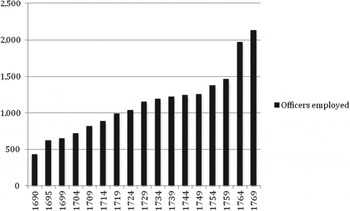
Together, all of these officials made up a formidable bureaucracy, one which increasingly penetrated further and further into Irish society as the eighteenth century went on, becoming in the words of one historian ‘the most pervasive agency of central government in Ireland’.Footnote 58 This is clear from the rising numbers of officers employed in the service, as well as their increasing geographical spread. By the 1720s, the numbers had almost doubled from those on the establishment in 1692, and they would double again by the late 1760s as Figure 4 demonstrates.
Numbers employed on the revenue establishment, 1690–1769. Source: These figures are calculated from the establishment books for the years 1690–1769, TNA, CUST20/56–137.

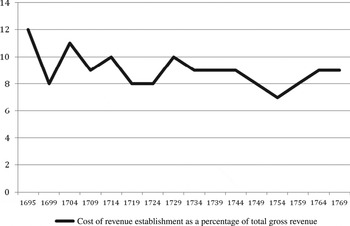
This great expansion in the number of officers employed correlates with the increasing levels of revenue collected and the growing number of additional duties that needed to be collected. Taking the cost of collection and revenue income figures together, as outlined in Figure 5, it is clear that the collection charge remained fairly consistent throughout the century, ranging between 8 and 11 per cent of gross revenue. These figures are higher than the equivalent figures for Britain where the collection charge fell from 15 per cent to 5 per cent over the course of the century, giving some credence to the complaints of contemporaries about the failure to increase efficiencies.Footnote 59
Cost of revenue establishment as a percentage of total gross revenue, 1695–1769. Source: The cost of the revenue establishment has been calculated from the establishment books for the years 1690–1769, TNA, CUST20/56–137.

Contemporary critiques frequently described the revenue administration as inefficient and corrupt, although assessments, like those made by one-time chief secretary George Macartney, need to be viewed within their rhetorical and political contexts.Footnote 60 Similar care needs to be taken when considering the issue of patronage and the influence of politics on the appointment of revenue officials, a question that has exercised a number of scholars.Footnote 61 Historians have long recognized the political potential that a seat on the revenue board provided – it was after all a crucial element in the success of the careers of some of the most notable Irish political figures of the period including William Conolly, Henry Boyle, and John Ponsonby. Questions remain, however, over the impact of such political appointments on the development of a professional bureaucracy.
Revenue positions were used to reward loyal supporters, and MPs were keen to secure the appointment of clients within their own sphere of influence. This is clear from the correspondence of individual commissioners, with Conolly, for instance, regularly intervening in the distribution of offices within his own political heartland of north-west Ulster.Footnote 62 One of his successors at the Custom House, Marmaduke Coghill, meanwhile, was especially keen to serve the interests of his friend Edward Southwell at Kinsale and Downpatrick, telling him on one occasion that he had ‘received a list of your demands on the Revenue which shall be answered as opportunity offers’.Footnote 63 Answering these demands had, however, to be reconciled with the development of a more professional service, especially from the 1720s onwards.Footnote 64 Candidates for appointment to the revenue offices had to demonstrate their aptitude for the position, with prospective officials stressing their experience and knowledge in their supplicatory letters to would-be patrons. Meanwhile, political clients who failed to do their duty adequately were liable to be removed from the service regardless of the protestations of their connections. Southwell, even with Coghill's support, was unable to save his friend and client, John Baillie, who was dismissed from his position as collector of Donaghdee in 1730, while some of his political supporters at Kinsale suffered a similar fate in 1733 and 1735.Footnote 65 The expansion of the numbers employed in the revenue service in the 1760s may have allowed greater potential for political appointments during the commissionership of speaker John Ponsonby, but this period also saw a rise in revenue collected and an expansion in the number of duties to be collected.Footnote 66 The distribution of political patronage was accompanied by a desire to create a more professional, efficient bureaucracy. Politicization of appointments had to work within the context of the revenue service's administrative duties, in particular its ability to raise the taxes necessary to support the Irish military and civil establishments.
In order fully to understand the Irish revenue service, and the validity or not of the accusations levelled at its management and officers, it is necessary to explore in detail the extant records, most notably the revenue board's minute books, which survive in an almost complete series of over 400 volumes in the British National Archives at Kew, a happy result of the merging of the British and Irish revenue administrations in 1823.Footnote 67 The destruction by fire during the Irish civil war in 1922 of so many of the archives of the eighteenth-century Irish state makes them an even more valuable source than they would be already.Footnote 68 These minute books provide a detailed day-by-day account of the proceedings of the revenue commissioners and their subordinate officers throughout the eighteenth century. They thus allow a more complete picture of activity to be assembled than that provided by parliamentary or other contemporary printed sources, which were often produced for some polemical purpose. They are, of course, not an unbiased source, reflecting as they do the perspectives of the revenue commissioners and their inferior officers. The processes behind decisions arrived at are not always revealed, nor are the differing influences of individual commissioners, although these were clearly important. Nevertheless, these minute books provide great insights into the revenue administration, provided they are handled with due care and occasionally scepticism. The commissioners' voluminous records do tell us some familiar stories. There were corrupt, drunken, and otherwise unsuitable officers. There were those that connived with smugglers, those that entered into close relationships with brewers and ale-sellers, and there were some who defaulted on their accounts and defrauded the revenue. There were also officers who were appointed because of their political connections; some were good at their jobs, some were fast-tracked for unsuitable promotions, and some never turned up.
All of these cases existed, and multiple examples can be brought forward, but they were not typical of the average revenue officer. It would be mistaken for instance to focus on atypical cases like that of Sir John Eccles, the collector of Dublin, dismissed in 1720 for peculation, or Jones Cust, the collector of Armagh, dismissed in 1760 for running up huge arrears as a result of confusing (intentionally) his personal accounts with those of the revenue.Footnote 69 Such cases raised serious questions but extensive reading of the commissioners' minutes across the whole period suggests that they were also exceptional and need to be understood as such. We also know about them precisely because their activities were reported to the board and were subsequently investigated. Of course, it is possible further cases were never reported to the board, while some cases reported to the commissioners were deemed not to be worth investigating, including some instances where they regarded the accusations of malpractice to be driven by local or national political considerations.Footnote 70
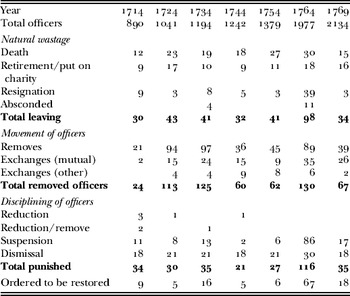
As a result of investigations ordered by the commissioners, and usually carried out by the surveyors general, some officers were dismissed, others were suspended, while still others were reprimanded or transferred to another district. Table 2 shows just how small a proportion of officers were disciplined in each year, and also how the numbers dismissed or suspended rarely exceeded those departing the service due to natural wastage. It was only in the 1760s that the numbers disciplined began to surpass those who departed the service for other reasons, something that probably reflected the increased numbers employed in the service rather than any new policy. It is, however, perhaps noteworthy that significantly fewer officers were dismissed in 1769 than in 1764. Indeed, 1764 stands out as a particularly busy year for the board in the data presented below, suggesting that there was some variation in their efforts to control inferior officers over time. Many but not all of those who were suspended from their positions were also ‘restored’ to their station after successfully petitioning the board; indeed, this seems to been the standard practice regarding the reinstatement of such officials. Also included in this table are the numbers of officers ‘removed’ or ‘exchanged’ during the years surveyed. Such ‘removals’, which involved the uprooting of an officer and his family (a process for which he was usually granted tw0 to three weeks’ leave), were as perennially unpopular in Ireland as they were in Britain but were deemed as being ‘for the benefit of the revenue’.Footnote 71 Some such ‘removes’ or ‘exchanges’, however, came at the request of the officers themselves, especially following occasions of conflict with local trading interests. It is crucial to note that both customs and excise officers in Ireland were subject to the same disciplinary processes, and customs officials could be and were transferred or removed to new ports. This differed from the English situation where such removals were much less common in the customs service than they were in the excise service, despite occasional attempts to implement a wider policy of ‘removes’ or ‘rolling’.Footnote 72 The object of such ‘removes’ and ‘exchanges’ was to prevent officers developing close relationships with those with whom they interacted on a daily basis, and were perhaps especially important in the excise division. This is borne out by the surviving records, which are replete with references to gaugers becoming too close to the brewers they surveyed. Hostile interests also, on occasion, made misrepresentations to the board about their local gaugers. Such reports were usually, therefore, as a matter of practice, investigated by a superior officer, either the collector or the provincial surveyor general. In 1764, for instance, an excise officer at Tullow, Co. Carlow, was reported to ‘live on the brewers of this town, and receive many presents from them’. It was also reported that ‘he is a surgeon and apothecary of the town and county and keeps a shop in town by which means his time is entirely taken up on his own business and the revenue business is totally neglected’. However, an investigation made by his collector, which included an audit of his accounts, exonerated him and described him as ‘vending a few drugs’, something that was not deemed ‘prejudicial to the revenue’.Footnote 73 Close familial relationships with brewers and distillers were, however, frowned upon, while running up ale-house debts was a regular cause for dismissal. Indeed, this had clearly become a significant problem by 1736, as a general letter of that year issued to all excise officers warned them to settle all debts to those within their survey. This did not bring an end to this issue, and in 1744 one officer was reprimanded for living in a public house, while another was dismissed for ‘entertaining an idle woman and drinking with her in shebeen houses’.Footnote 74 These appear to have been comparatively rare cases.
Natural wastage, removals, and punishment of revenue officers, 1714–69

Source: This table is based on the revenue commissioners minute books for 1714–64, TNA, CUST1/11, 17–18, 25–6, 37–9, 52–3, 55, 79–84, and 105–10. One volume from 1754 is missing so use has been made of data from 1753 to make up a year, allowing suitable comparisons to be made. The removes made in 1734 may have been exceptional as many were made following the recommendations of a detailed survey of the Munster and South Leinster districts by one of the commissioners, Edward Thompson.
The commissioners' minutes also tell us about the conscientious officers who made regular seizures, who occasionally risked life and limb to take on smugglers, and who made long and arduous journeys across often-difficult terrain to collect taxes and ensure compliance with the laws.Footnote 75 They tell us about the officers who wrote to the commissioners suggesting improvements to the service, such as John Ballard, a gauger in Co. Longford, for instance, who wrote a guide to the art of gauging entitled ‘Gauging unmasked’ which he submitted to the commissioners for publication so his knowledge could be passed on to other officers.Footnote 76 Publications like these were crucial for dispersing knowledge through the ranks, and it was the responsibility of senior officials to educate their subordinates, especially following the introduction of new legislation or practices. Such training was aided by the dispersal of printed texts, which included compendiums of legislation, of which the veritable bible was William Edgar's A collection of several statutes and clauses of acts made and passed in this kingdom, and in Great-Britain, relating to his majesty's revenue of Ireland printed in Dublin in 1720, as well as practical guides to the often-complex mathematical calculations needed to carry out a gauger's job. It is possible to glean how such texts were used from the commissioners' records, with the solution to many requests from the provinces being to consult Edgar's book or the revenue acts.Footnote 77 Inferior officers, especially collectors and surveyors, who demonstrated their ignorance were also admonished, giving an indication of how seriously the board took their duties.Footnote 78
The board's minutes also reveal the officers who risked threats from their local communities to appear in court in order to testify against smugglers, rioters, and other tax evaders. In 1724, for instance, threats were issued against the collector and surveyor of Loughrea district for carrying on a prosecution against some unlicensed brewers. The chief witness in the same case fared much worse. He had his eyes cut out, his tongue cut off, and one ear removed for informing against the same brewers. This was not an isolated instance either. Ten years later a witness for the crown was scalped outside Kinsale courthouse, while assaults on customs and excise officers were not uncommon, although fatalities were very rare.Footnote 79 The majority of fatal injuries suffered during the exercise of duty were the product not of hostile action but of accidents, with drowning the most common cause.Footnote 80 The picture that emerges from a detailed analysis of the minute books is, in other words, a complicated one. It is a picture of a working bureaucracy with all the faults and advantages that that confers.
IV
The revenue commissioners' minute books give a very useful insight into not just how taxation was collected, and how the bureaucracy worked – they also allow the historian to consider the question of tax evasion. Historians of British taxation have noted how tax collection became less efficient the further one travelled from London, and that, even taking this into account, Scotland remained a special case.Footnote 81 Similar patterns have been identified in Ireland, although they must remain impressionistic in the absence of detailed local studies.Footnote 82 Contemporaries liked to highlight the difficulties of collecting taxes from the ‘popish’ inhabitants of the west of Ireland, or what one hearth money collector described in 1724 as a ‘stubborn refractory people’.Footnote 83 The final section of this article examines the problem of tax evasion and looks at the state's responses to it, highlighting the tension between the need to raise revenue to pay for the fiscal-military state, while at the same time employing the resources of that state to collect the same revenue.
Contemporaries frequently decried the ill effects of smuggling on the Irish economy, and the detrimental impact this had on the revenue.Footnote 84 The evils of the ‘clandestine trade’ were a feature of Irish economic writing during this period, and these contemporary analyses were adopted in an almost unquestioning manner by earlier generations of historians. It was not until the pioneering researches of Louis Cullen in the 1960s that a more nuanced picture began to develop.Footnote 85 His research showed that smuggling rates varied across the century with the periods of greatest illegal activity, unsurprisingly, coinciding with the periods in which the highest customs duties were imposed. As the weight of duties levied on different products was varied, so did the attractions for smugglers, explaining why wool and brandy were in time replaced by tobacco as the most commonly smuggled goods.Footnote 86 Cullen's conclusions echoed the results of scholarship on other jurisdictions, and suggested therefore that smuggling was less endemic in Ireland than had previously been imagined. Nevertheless, at its height, smuggling, particularly of wool, brandy, rum, and tobacco, had a detrimental effect on the Irish economy, particularly in the period c. 1730 – c. 1763.
The 1730s saw some of the greatest incidences of wool and brandy smuggling but the same decade also saw the introduction of more effective measures to combat it. These measures included a detailed inspection of the Munster outports by one of the revenue commissioners, Edward Thompson, in 1733, and the detailing of an increased number of naval ships to patrol the Irish coastline.Footnote 87 The impetus for both of these measures came from London, and should be seen within the context of both the lobbying activities of a powerful English woollen interest, and Walpole's more general determination to reform the customs and excise departments.Footnote 88 Indeed, Jonathan Swift tangentially connected Thompson's report to Walpole's contemporaneous, and infamous, excise scheme, claiming that Thompson had written a government-sponsored pamphlet in support of Walpole's scheme, and that he wished to implement something similar in Ireland.Footnote 89 It seems, however, that in this case Thompson, an Englishman who had made his career in Ireland, was following orders from the British Treasury, which was becoming increasingly concerned with the levels of illegal trade off the Irish coast.Footnote 90 These concerns also lay behind the decision to increase naval activity, with up to ten ships operating off the Irish coast, the largest peacetime complement hitherto ordered to this station. The revenue commissioners had been calling for increased naval support for some time, but it has been suggested that this change of policy owed much to Walpole's determination to clamp down on smuggling and evasion across the British Isles in this period.Footnote 91
Certainly from that point onwards there was a continuous naval presence off the Irish coast charged partly with assisting the revenue officers, as well as with other duties including defence against foreign privateers and recruitment. Ship's captains, and occasionally their officers, were given commissions as revenue officers first by special request, and then as a matter of course.Footnote 92 This system was attractive to the captains who stood to benefit from the king's bounty in the event of successful seizures, while the revenue commissioners were happy to have extra assistance alongside their own relatively small, though expanding, fleet.Footnote 93 The increased naval presence did not bring about immediate results. In 1735, a speaker in the British House of Commons complained that
the garde de coast ships lately ordered to prevent running from Ireland have made no prizes, neither can they be answerable to the great expense they put the nation to because of the multitude of creeks in that Kingdom, which are so many that the whole fleet of England if employed that way could do nothing
while the Admiralty court-martialled the six captains stationed on the Irish coast in 1738 for failing to yield significant results.Footnote 94 Not all six captains were found guilty, and naval ships continued to co-operate with the revenue commissioners along the Irish coast through the remainder of the century. It is important to note here that until 1782 Ireland did not pay any contribution towards the costs of the ‘Irish station’; instead, these costs, unlike other Irish military costs, were subsumed into the British treasury's expenditure.Footnote 95 Nevertheless, the expenditure on naval activities in Irish coastal waters was small, and was partly offset by the very successful recruitment activities of the vessels stationed on the Irish coasts, who generally proved themselves more adept at recruitment and impressment than at preventing the ‘running trade’.Footnote 96
Returning to Thompson's report, the second Whitehall-inspired initiative of the 1730s: it followed an extensive two-month inspection tour of all the ports and excise districts in the southern half of Ireland, and provided information on the collection service both for Thompson's fellow members of the revenue board in Dublin and for the British treasury who had commissioned it.Footnote 97 The treasury had commissioned a report on the ports, continuing their policy of prioritizing the reduction of illicit coastal activity, but Thompson included a detailed analysis of the inland excise.Footnote 98 His final report offers an excellent insight into the revenue service at this particular juncture, and the commissioner's areas of concern. Particular attention for instance was paid to the quality of instruments and horses possessed by individual officers, as well as the location of their place of residence, issues that came up again and again in the minute books. Following the completion of his tour of duty, several recommendations were made to the board and the minute books for the following year are replete with decisions made on the foot of ‘Mr. Thompson's report’.Footnote 99 These decisions together with the detail included in the report indicate the increasing professionalizing instincts of the revenue board in this period.
In 1736, Thomas Bacon would appeal to such sentiments when he presented his A Compleat system of the revenue of Ireland to the commissioners, a publication that was strongly supported by the ‘Gentlemen of the Dublin Society’, Ireland's leading agents of economic improvement.Footnote 100 Sponsoring and encouraging such publications were but one way that the commissioners engaged with the improving instincts of members of the local political, economic, and social elite. They supported private individuals and groups who were willing to combat smuggling within their own neighbourhoods, as was the case with the activities of Samuel Bindon, a local MP and prominent merchant, in Counties Clare and Limerick, and the merchants of Coleraine and Derry who formed themselves into an anti-smuggling association.Footnote 101 In a similar vein, proposals for new custom houses and ports were encouraged and supported, pointing to the negotiations necessary for the permeation of the state's institutions into the provinces.Footnote 102 Responding therefore to local conditions and the ideas of improving landowners and merchants helped to drive policy as much as the expansion of Walpole's British revenue policies did.
The customs was not the only revenue branch to suffer from the problem of evasion. Unlike in England, as shown above, the inland excise was the poor relation in Ireland. The greatest components of the excise revenues were the taxes levied on beers and spirits. These had to be collected from thousands of small producers spread across the country, whose brewing and distilling establishments were rudimentary at best, and ephemeral at worst. Their diffusion across the country and their frequent establishment in remote, inaccessible areas (despite legislative prohibitions on such establishments) made revenue collection more difficult. Markets and fairs thus became important venues for the collection of excise duties, but such occasions also brought their own problems, notably large crowds and increased alcohol consumption, which made tax collection at times a difficult and even perilous activity.Footnote 103 Other excise collectors preferred to use a quota system known as ‘compounding’ where they collected set amounts from producers rather than inspecting their stills and breweries on a regular basis. This practice, although common, was condemned by the commissioners and singled out as a significant problem in Thompson's report.
The commissioners' records provide an excellent insight into the challenges faced by excise officers, with regular references to ‘rescues’ made during seizures, as well as to ‘riots’ and assaults on officers. Collectors in their correspondence with the board often frequently referred to the ‘lawlessness’ endemic in their districts and called for a greater military presence to deter those who evaded excise duties. Such petitions came not just from those regions traditionally outside the reach of the state along the western seaboard, or in the hill country of south Ulster, but also from excise officials in more economically and socially developed regions like Queens County and County Meath.Footnote 104 The regular calls for, and use of, military assistance demonstrate that the Irish army was more than just a defence force or ‘an army for empire’.Footnote 105 Its dispersal across the kingdom in approximately one hundred barracks allowed it to be used as an adjunct to the civil power, either through formal action or through its mere presence. In the case of the revenue, military assistance could only be used in special, carefully delineated, circumstances. Special permission had to be sought from either the commander of the forces in Ireland or the lord lieutenant, with the request travelling from the district or port collector to the revenue board and then on to Dublin Castle, before the commands passed back down the chain to the local military command. This slow and cumbersome process was relaxed as the century went on, with general orders being issued to local garrisons to assist in specific areas.
Whether because of the speeding up of the deployment process or because of increased demand for military assistance, and the surviving records would suggest the latter, detachments of the army were used with increasing regularity by the revenue officers. Between November 1736 and October 1739, the army were called out to assist at least ten times, while, in 1764 alone, thirty-three instances of the army assisting the revenue officers were recorded.Footnote 106 Most of these cases, which were spread right across the country, involved the seizure of illegal whiskey stills, but the army were also used in port towns or during busy market periods. The number of soldiers involved in seizures varied, but most cases involved twelve men – one sergeant, one corporal, and ten private men – though one action in Co. Longford involved four sergeants, four corporals, and forty-eight men.Footnote 107 Assisting the revenue officers could be a hazardous business with opposition from mobs armed with stones and clubs a regular feature, even if the use of deadly force was a rarity. The rewards were, however, good, with all soldiers who participated sharing in the bounty awarded to the seizing officers.
The increased use of the army also led to calls for new barracks to be erected in areas where tax collection was difficult, such as Eyrecourt in Co. Galway.Footnote 108 Troops, especially cavalry, were also sought for short-term billets in areas that were deemed by their local collectors as particularly lawless. This increased reliance on the army as an aid to the revenue, and their regular deployment upon such duties suggests that the army played a more significant role as an aid to the civil power than some historians have allowed, although this remains a rather tentative conclusion.Footnote 109
V
This discussion of the problems of tax evasion, both within the customs and excise branches, and the solutions employed to combat it, demonstrates the difficulties faced by the revenue commissioners in the eighteenth century. Nevertheless, it is clear, as this article has demonstrated, that they were able, as the century went on, to extract increasing levels of revenue from an increasing proportion of the population. This was achieved through the development and expansion of a more professional, more efficient bureaucracy, which gradually extended its sinews into even the most remote regions along the western seaboard. Its success in raising ever-increasing amounts of government income through taxation justifies David Dickson's description of the revenue service as ‘the most pervasive agency of central government’ in eighteenth-century Ireland.
The success of the revenue bureaucracy, together with parliament's related ability to raise significant loans, allowed the Irish fiscal state to provide for its own civil and military establishment, as well as to make an important imperial contribution. The main agents of this contribution were the approximately 12,000 (increased to 15,325 in 1769–72) troops paid for by Irish taxes. Paradoxically, these troops, together with the small naval detachment operating on the Irish coast, also made a significant contribution to the collection of these revenues, acting in concert with the civil powers. This dual role demonstrates the complexities inherent in the Irish contribution to the fiscal-military state, itself a product of the fluid status of the Irish polity within the wider British/Hanoverian composite state. Ireland's contribution to the empire came both in money and men. This marked Ireland out as different to other subordinate component parts of the imperial state.
Post-Union Scotland supported much of its own residual civil establishment from local taxes, and remitted further small sums to the treasury in London. It did not, however, pay for its own military establishment – these costs were largely borne by English taxpayers. Similarly, English taxpayers contributed the majority of the money expended on regiments stationed in colonial North America, where even nominal ‘fiscal states’ like the Colony of Massachusetts were subsidized from London. In this manner, such British possessions or territories differed little from the German principalities that supplied manpower to the Hanoverian armies in this period. Ireland was different. It was not a subsidy state; instead, its peacetime military establishment was supported by Irish taxes, allowing Ireland to become a net contributor to the British imperial state. This wider imperial role owed much to developments in the institutional infrastructure of the Irish fiscal state, including, as this article has demonstrated, an efficient, professional, country-wide revenue bureaucracy. It provided the money that paid for the men who defended British and Irish interests at home and abroad, until the twin crises of international war and domestic rebellion in the late 1790s prompted dramatic constitutional and fiscal changes.