Introduction
Rice is a major grain crop produced worldwide and is a primary food source for much of the world’s population (USDA ERS 2017). Therefore, as with other cropping systems, effective weed management is critically important. Today, rice producers in the mid-southern United States face many challenges. Among these is control of the troublesome grass weed barnyardgrass (Echinochloa crus-galli L.) (Norsworthy et al. Reference Norsworthy, Bond and Scott2013). Barnyardgrass is historically one of the most problematic weeds in the world and is currently the most problematic weed in Arkansas rice (Holm et al. Reference Holm, Plucknett, Pancho and Herberger1997; Norsworthy et al. Reference Norsworthy, Bond and Scott2013). Barnyardgrass, a member of the Poaceae family, is a summer annual that reproduces through seed and is capable of producing over 39,000 seeds per plant (Bagavathiannan et al. Reference Bagavathiannan, Norsworthy, Smith and Neve2012). It can be difficult to achieve effective control of barnyardgrass, because its C4 photosynthetic pathway allows the weed to proliferate in the high-light and high-temperature environments commonly found in rice-producing regions (Mitich Reference Mitich1990).
With the exception of barnyardgrass, other problematic weeds in rice are red rice (Oryza sativa L.), northern jointvetch, smartweed (Polygonum spp.), sprangletop (Leptochloa spp.), broadleaf signalgrass, yellow nutsedge, groundcherries (Physalis spp.), hemp sesbania [Sesbania hederacea (P. Mill.) McVaugh.], crabgrass (Digitaria spp.), morningglory (Ipomoea spp.), and Palmer amaranth (Norsworthy et al. Reference Norsworthy, Bond and Scott2013).
To combat these weeds in rice, herbicides may be applied at various applications and timings during the production season, including PRE, delayed PRE (DPRE), early POST (EPOST), pre-flood (PREFLD), and POST flood (POSTFLD) (Hardke Reference Hardke2014). Currently, clomazone (WSSA group 13), quinclorac (WSSA group 4), thiobencarb (WSSA group 8), pendimethalin (WSSA group 3), and imazethapyr (WSSA group 2) are soil-applied herbicides available for rice. Bispyribac (WSSA group 2), cyhalofop (WSSA group 1), fenoxaprop (WSSA group 1), penoxsulam (WSSA group 2), propanil (WSSA group 7), and quinclorac are registered to be applied POST for barnyardgrass control (Hardke Reference Hardke2014). In imidazolinone-resistant rice (Clearfield®, trademark of BASF, Research Triangle Park, NC), imazamox and imazethapyr (WSSA group 2) are also registered for use POST (Hardke Reference Hardke2014). In total, seven sites of action (SOAs) are available for use in US rice, and of these, barnyardgrass has evolved resistance to at least four in Arkansas alone: propanil, quinclorac, clomazone, and acetolactate synthase (ALS)–inhibiting herbicides (Lovelace et al. Reference Lovelace, Talbert, Skulman and Scherder2002; Norsworthy et al. Reference Norsworthy, Scott, Smith, Still, Estorninos and Bangarwa2009; Wilson et al. Reference Wilson, Norsworthy, Johnson, Scott and DeVore2011; Heap Reference Heap2016).
Prior to 1990, herbicide-resistant weeds were not known to occur in rice. Since propanil’s introduction in 1959, rice farmers have used it extensively; in 1990, barnyardgrass resistant to propanil was confirmed (Baltazar and Smith Reference Baltazar and Smith1994). Furthermore, since the evolution of propanil-resistant barnyardgrass, the number of weeds that have been confirmed resistant to propanil, as well as other herbicides, has grown exponentially (Heap Reference Heap2016). Rotating herbicide SOAs is a widely recommended practice to mitigate herbicide resistance (Norsworthy et al. Reference Norsworthy, Ward, Shaw, Llewellyn, Nichols, Webster, Bradley, Frisvold, Powels, Burgos, Witt and Barrett2012). The high level of competiveness and ever-present risk for evolution of herbicide resistance makes barnyardgrass in particular concerning (Mitich Reference Mitich1990; Bagavathiannan et al. Reference Bagavathiannan, Norsworthy, Smith and Neve2012).
In rice, as is the case with other crops, two or more herbicides are often combined and applied together in a tank mixture to broaden the spectrum of control or provide multiple effective SOAs for some of the most resistance-prone weeds in a field. Combinations of two or more herbicides provide an opportunity for an interaction to occur that could be greater than (synergistic) or less than (antagonistic) an expected response (Colby Reference Colby1967; Fish et al. Reference Fish, Webster, Blouin and Bond2015, Reference Fish, Webster, Blouin and Bond2016). For example, Lanclos et al. (Reference Lanclos, Webster and Zhang2002) reported an antagonistic response when glufosinate was mixed with bensulfuron or triclopyr, resulting in reduced barnyardgrass control. Conversely, a synergistic effect was observed for barnyardgrass control when tank-mixing propanil with quinclorac, thiobencarb, or pendimethalin (Baltazar and Smith Reference Baltazar and Smith1994). With the announcement of florpyrauxifen-benzyl being developed in US rice (LoyantTM with RinskorTM active, Dow AgroSciences LLC, Indianapolis, IN), research is needed to determine the spectrum of activity of this new herbicide and its tank-mix capability with other commonly applied herbicides in rice. The objectives of the present research were to (1) evaluate florpyrauxifen-benzyl efficacy on broadleaf, grass, and sedge species in rice, and (2) determine the compatibility of florpyrauxifen-benzyl to be tank-mixed with commonly applied herbicides in rice.
Materials and Methods
Florpyrauxifen-benzyl Spectrum-of-Activity Experiment
A greenhouse experiment was conducted during the spring of 2015 and repeated during the fall of the same year at the University of Arkansas–Altheimer laboratory located in Fayetteville, AR (40.741895° N, 73.989308° W). Three separate studies were conducted over numerous monocot, dicot, and sedge species commonly observed in US rice production. The same experimental arrangement was utilized for each of the three experiments, with herbicide treatments varying based on weed species (i.e., grass, broadleaf, or sedge). For a complete list of weeds and herbicides used in these experiments, refer to Tables 1, 2, and 3.
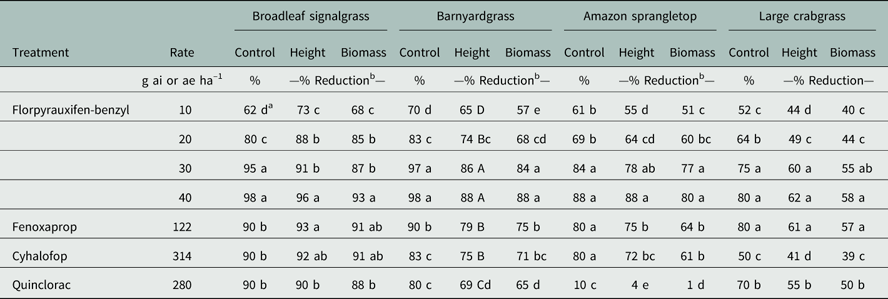
Greenhouse evaluation of florpyrauxifen-benzyl versus common rice herbicides on visible control, plant height, and biomass of broadleaf signalgrass, barnyardgrass, Amazon sprangletop, and large crabgrass 14 d after application, averaged over experimental runs.Footnote a

a Means within a column followed by the same letter are not significantly different according to Fisher’s protected LSD (α=0.05).
b Reduction relative to the nontreated control. Height and biomass of nontreated: broadleaf signalgrass (19.2 cm, 6.2 g), barnyardgrass (21.4 cm, 6.4 g), Amazon sprangletop (18.7 cm, 7. 1 g), large crabgrass (16.9 cm, 5.2 g).
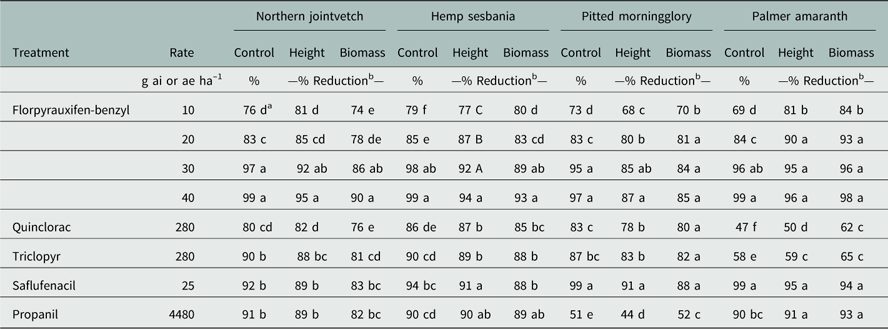
Greenhouse evaluation of florpyrauxifen-benzyl versus common rice herbicides on visible control, plant height, and aboveground biomass of northern jointvetch, hemp sesbania, pitted morningglory, and Palmer amaranth 14 d after application, averaged over experimental runs.Footnote a

a Means within a column followed by the same letter are not significantly different according to Fisher’s protected LSD (α=0.05).
b Reduction relative to the nontreated control. Height and biomass of nontreated: northern jointvetch (16.5 cm, 3.8 g), hemp sesbania (18.4 cm, 3.2 g), pitted morningglory (10.2 cm, 2.9 g), Palmer amaranth (20.8 cm, 7.7 g).
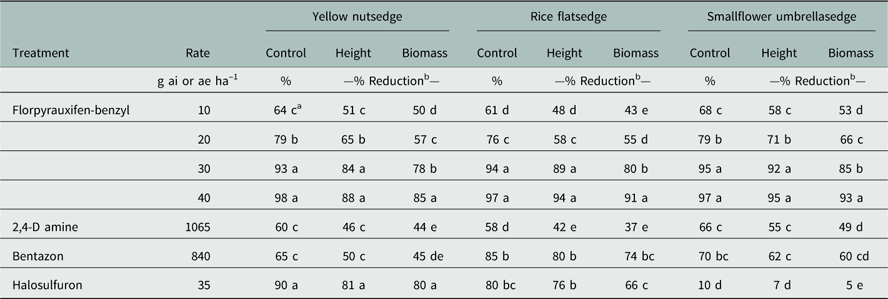
Greenhouse evaluation of florpyrauxifen-benzyl versus common rice herbicides on visible control, plant height, and aboveground biomass of yellow nutsedge, rice flatsedge, and acetolactate synthase–resistant smallflower umbrellasedge 14 d after application, averaged over experimental runs.Footnote a
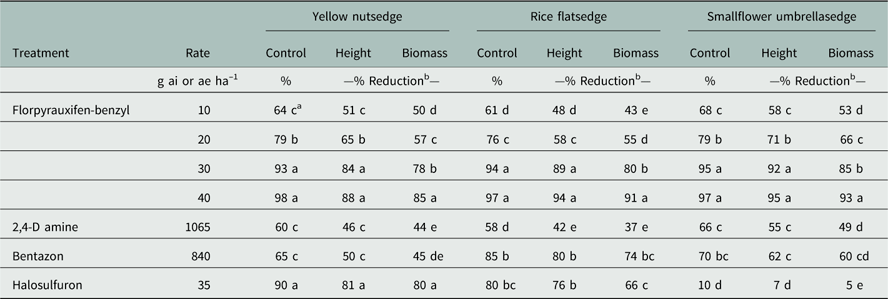
a Means within a column followed by the same letter are not significantly different according to Fisher’s protected LSD (α=0.05).
b Reduction relative to the nontreated control. Height and biomass of nontreated: yellow nutsedge (13.5 cm, 4.1 g), rice flatsedge (15.1 cm, 3.2 g), smallflower umbrellasedge (12.6 cm, 3.4 g).
Seed/tubers from each species were sown in potting media in individual pots (6-cm diameter) in a greenhouse with 32 C/22 C day/night temperatures. Once the plant had reached the two-leaf growth stage, plants were thinned to one plant per pot. The experiment was arranged as a completely randomized design with six replications per species, and herbicide treatment and the experiments were repeated. To simulate a realistic size of plants during the PREFLD application timing, herbicide treatments were applied to three- to four-leaf seedling plants that were approximately 10 to 16 cm tall (depending on species). Applications were carried out inside a stationary spray chamber with a two-nozzle boom track sprayer fitted with flat-fan 800067 nozzles (TeeJet Technologies, Springfield, IL) calibrated to deliver 187 L ha–1 at 276 kPa. All herbicide treatments also contained 2.5% v/v methylated seed oil concentrate (MSO concentrate with LECI-TECH, Loveland Products, Loveland, CO). Plant mortality was determined 14 d after treatment (DAT) on a scale of 0 to 100%, with 0 representing no control and 100% representing complete control. Plant height and aboveground biomass were also collected at 14 DAT with the procedure described above. Data from each field study were subjected to ANOVA using the MIXED procedure in JMP (JMP Pro 12, SAS Institute Inc., Cary, NC), with replication and run considered as a random effect. Data were combined over experimental runs, as there was no significant treatment-by-run interaction. Means were separated using Fisher’s protected LSD (α=0.05).
Tank-Mix Experiment
In 2014, a field experiment was conducted at the University of Arkansas–Rice Research and Extension Center near Stuttgart, AR (34.5003748° N, 91.552628099° W), and repeated in 2015. The soil was a DeWitt silt loam (fine, smectitic, thermic Typic Albaqualfs) composed of 8% sand, 75% silt, 17% clay with 1.8% organic matter and a pH of 5.0. Each plot measured 1.8 by 5.2 m. Rice (CL152 in 2014 and CL111 in 2015) was drill-seeded to a dry seedbed using a tractor-mounted drill calibrated to deliver 77 seeds m–1 row at a depth of 1.3 cm. In both years, a single row of barnyardgrass, hemp sesbania, and yellow nutsedge were planted across the plots in a perpendicular fashion. To evaluate all possible tank-mix interactions, the field experiment was divided into a contact study and a systemic study. Both were treated similarly and were located adjacent to one another. For a complete list of the herbicide treatments utilized in each experiment, refer to Tables 4 and 5.
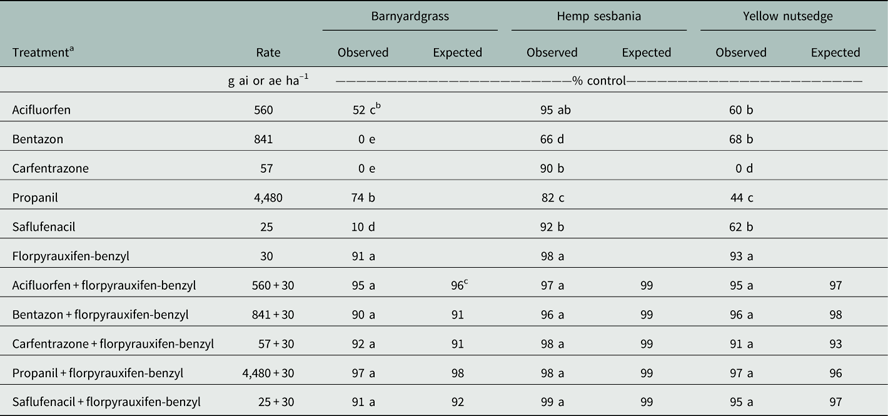
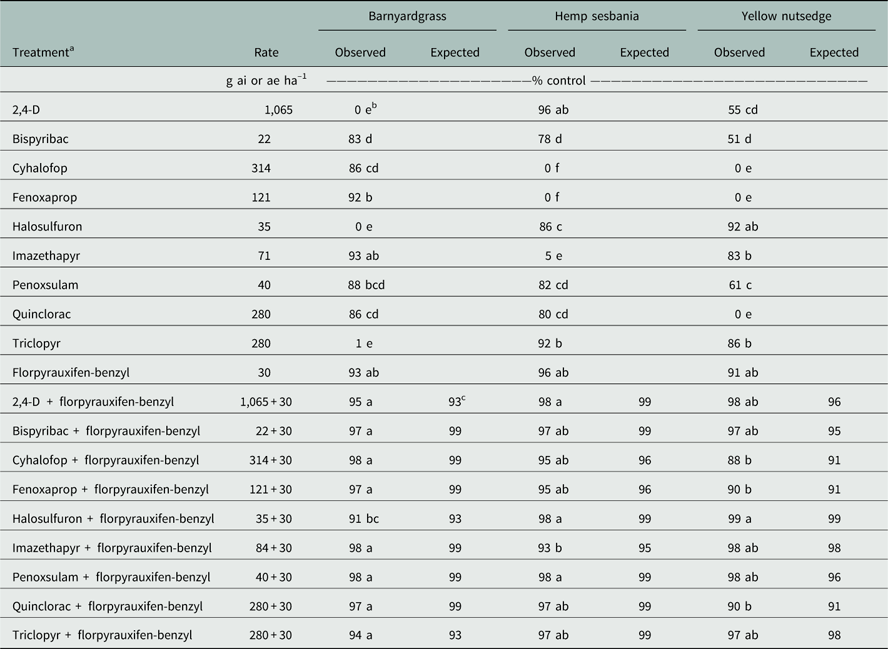
Field experiment conducted near Stuttgart, AR, on effect of POST application of commercially available contact rice herbicides alone or in combination with florpyrauxifen-benzyl on observed and expected control of barnyardgrass, hemp sesbania, and yellow nutsedge 14 d after treatment, average estimated over years combined.
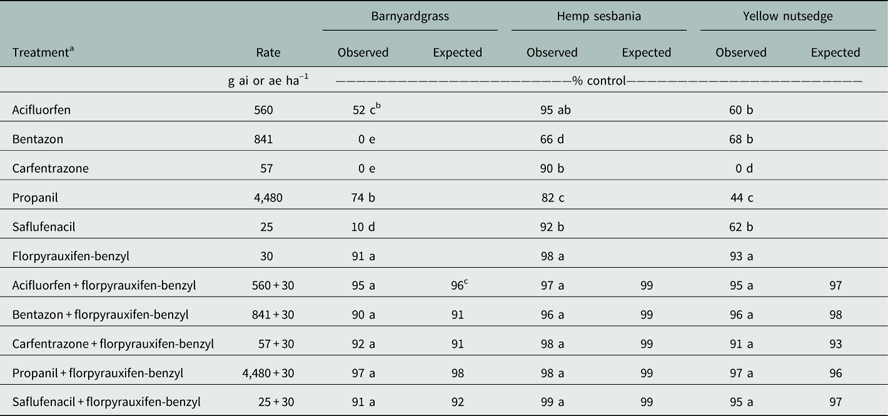
a All treatments contained 2.5% v/v methylated seed oil.
b Means within a column followed by the same letter are not significantly different according to Fisher’s protected LSD (α=0.05)
c Expected responses are based on Colby’s equation, E=X + Y – (XY)/100.
Field experiment conducted near Stuttgart, AR, on effect of POST application of commercially available systemic rice herbicides alone or in combination with florpyrauxifen-benzyl on observed and expected control of barnyardgrass, hemp sesbania, and yellow nutsedge 14 d after treatment, average estimated over years combined.
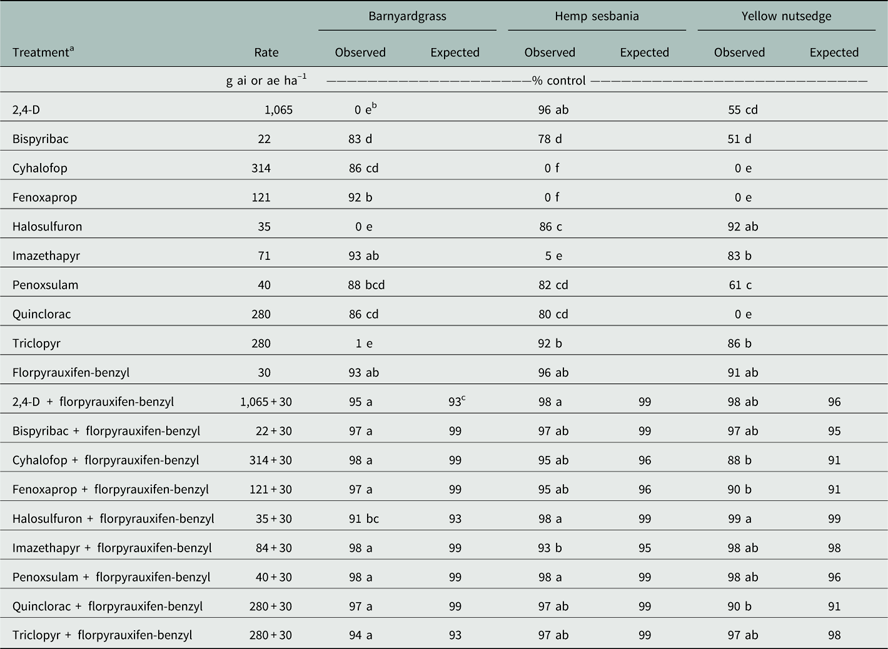
a All treatments contained 2.5% v/v methylated seed oil.
b Means within a column followed by the same letter are not significantly different according to Fisher’s protected LSD (α=0.05).
c Expected responses are based on Colby’s equation, E=X + Y – (XY)/100.
For both studies, the experiment was arranged as a randomized complete block design with four replications. Florpyrauxifen-benzyl (LoyantTM with Rinskor™ active, Dow AgroSciences, Indianapolis, IN) was applied at 0 or 30 g ha–1 alone and in combination with currently registered contact or systemic herbicides available for use in US rice. Treatments were applied POST at the three- to four-leaf stage of all weed species to simulate an EPOST or PREFLD application timing in rice. Applications for both studies were applied on the same day in each year and were performed on May 15, 2014 and May 26, 2015 with air temperatures at 16 C and 24 C and relative humidity at 58% and 69% in 2014 and 2015, respectively. All treatments were applied using a CO2-pressurized backpack sprayer fitted with 110015 AIXR flat-fan nozzles (Teejet Technologies, Springfield, IL) calibrated to deliver 140 L ha–1 at 4.8 km h–1. Visible estimates of weed control were rated on a 0 to 100% scale, with 0 representing no control and 100% representing complete control. Plant heights were collected from five randomly selected plants per plot for each weed species at 14 DAT.
Data from each field study were subjected to ANOVA using the MIXED procedure in JMP (JMP Pro 12, SAS Institute Inc., Cary, NC), with replication considered as a random effect. Data were combined over years, as there was no significant treatment-by-year interaction (P≥0.05). Herbicide combinations were determined to be antagonistic, synergistic, or additive through Colby’s method:
 $$E\,{\equals}\,X{\plus}Y-XY\,/\,100$$
where X and Y are the percentage control of herbicide A and B alone, and E is the expected response when herbicide A and B are combined (Colby Reference Colby1967). Combinations were determined to be antagonistic, synergistic, or additive by comparing expected and observed responses using Fisher’s protected LSD (α=0.05).
Results and Discussion
Florpyrauxifen-benzyl Spectrum-of-Activity Experiment
Monocots
Characteristically, auxin herbicides are more typically efficacious on broadleaf weeds and rarely display activity in grass species. Quinclorac, an auxin-type herbicide currently registered for use in rice, can however be utilized for control of susceptible barnyardgrass and broadleaf signalgrass (Scott et al. Reference Scott, Boyd, Smith, Selden and Norsworthy2016). In addition, florpyrauxifen-benzyl represents another auxin herbicide capable of controlling grass weeds. When grass weed species are exposed to full rates of florpyrauxifen-benzyl they typically swell near the base, have reduced growth, and ultimately turn chlorotic and necrotic (MR Miller, personal observation). In terms of broadleaf signalgrass and barnyardgrass, florpyrauxifen-benzyl at 30 and 40 g ha–1 provided the highest level of control at 14 DAT (Table 1). In comparison, cyhalofop, fenoxaprop, and quinclorac provided less control but similar height and aboveground biomass reduction as florpyrauxifen-benzyl at 30 g ha–1.
For Amazon sprangletop and large crabgrass, florpyrauxifen-benzyl did not achieve >88% control, even with the highest rate of 40 g ha–1 (Table 1). Even so, cyhalofop, fenoxaprop, and quinclorac failed to outperform florpyrauxifen-benzyl at 30 or 40 g ha–1 for any of the parameters evaluated for these two grass weed species. Amazon sprangletop and large crabgrass are the second and tenth most problematic weeds of Arkansas and Mississippi rice (Norsworthy et al. Reference Norsworthy, Bond and Scott2013), thereby highlighting the difficulty in controlling these species. Overall, florpyrauxifen-benzyl appeared to be less efficacious on Amazon sprangletop compared to more susceptible species such as barnyardgrass and broadleaf signalgrass.
Dicots
When broadleaf weed species are exposed to full rates of florpyrauxifen-benzyl, symptomatology is typically displayed as blistering, leaf and stem epinasty, reduced growth, and necrosis (MR Miller, personal observation). At 14 DAT, broadleaf weed control ranged from 47% to 99%, across all weed species and herbicide treatments evaluated (Table 2). Northern jointvetch control was the highest, with florpyrauxifen-benzyl at 30 and 40 g ha–1 (97% and 99%, respectively) and proved to be significantly superior to other treatments. A similar trend was observed with hemp sesbania 14 DAT, with florpyrauxifen-benzyl at 30 and 40 g ha–1 providing 98% to 99% control. In addition, the herbicide was the most effective at reducing plant height and aboveground biomass compared to other commercially available rice herbicides evaluated. This range of herbicide efficacy as outlined above is encouraging, given the immense pressure these weeds currently place on rice production systems. In a recent survey, Arkansas crop consultants listed northern jointvetch as the third most problematic weed and overall the number one broadleaf weed in Arkansas and Mississippi rice (Norsworthy et al. Reference Norsworthy, Bond and Scott2013). The same survey also listed hemp sesbania as the seventh most problematic rice weed. Northern jointvetch is typically less responsive to most POST herbicides labeled in rice compared to hemp sesbania (Scott et al. Reference Scott, Boyd, Smith, Selden and Norsworthy2016). Therefore, the ability of florpyrauxifen-benzyl to achieve effective control of these species will be beneficial.
Pitted morningglory and Palmer amaranth were two other broadleaf weeds evaluated. Although florpyrauxifen-benzyl at 40 g ha–1 provided 97% control of pitted morningglory (Table 2), the tenth most problematic rice weed, that level of control was similar to saflufenacil (99%) (Norsworthy et al. Reference Norsworthy, Bond and Scott2013). The proposed 1X rate (30 g ha–1) of florpyrauxifen-benzyl also provided a similar level of pitted morningglory control. Pitted morningglory height reduction was the greatest with the three treatments just listed, but all treatment options (with the exception of propanil and florpyrauxifen-benzyl at 10 g ha–1) effectively reduced aboveground biomass. Palmer amaranth, ranked fifth most problematic, has become an increasingly difficult weed to manage in rice, probably as a result of the widespread infestation of herbicide-resistant Palmer amaranth in soybean, a crop commonly rotated with rice (Wilson et al. Reference Wilson, Runsick and Mazzanti2010; Norsworthy et al. Reference Norsworthy, Bond and Scott2013). Currently, effective control options for Palmer amaranth in rice are limited to 2,4-D, carfentrazone, propanil, and saflufenacil (Scott et al. Reference Scott, Boyd, Smith, Selden and Norsworthy2016). Furthermore, documentation and spread of protoporphyrinogen oxidase–resistant Palmer amaranth, will probably further limit the available herbicide options in rice (Heap Reference Heap2016). Florpyrauxifen-benzyl at 30 and 40 g ha–1 provided a high level of Palmer amaranth control (96% and 99%, respectively), which was similar to that from saflufenacil (99%). Other auxin herbicides provided less control. Quinclorac (47%) and triclopyr (58%) were less effective at reducing height and aboveground biomass.
Sedges
For all sedge species evaluated, florpyrauxifen-benzyl at 30 g ha–1 provided high levels of control (93% to 95%), which was similar to or greater than the current industry standard, halosulfuron (Table 3). However, with the increasing reports of ALS-resistant yellow nutsedge in Arkansas, use of previously effective control options such as halosulfuron becomes limited (Techranchian et al. Reference Tehranchian, Norsworthy, Nandula, McElroy, Chen and Scott2014). The results herein indicate that applications of florpyrauxifen-benzyl could prove to be an effective alternative in situations where ALS-resistant yellow nutsedge persists. Though not as problematic as yellow nutsedge, rice flatsedge and smallflower umbrellasedge also threaten rice production systems (Norsworthy et al. Reference Olsen and Nalewaja2013). These results indicate that florpyrauxifen-benzyl is as effective as the other currently available rice herbicides at controlling and reducing growth of each of these two sedge species.
Tank-Mix Experiment
Contact Herbicides
At 14 DAT, florpyrauxifen-benzyl at 30 g ha–1 controlled barnyardgrass 91% and was superior to the contact herbicides evaluated (Table 4). The same was also observed for hemp sesbania (98%) and yellow nutsedge (93%). With respect to barnyardgrass, findings were consistent with the effective barnyardgrass control options provided by Scott et al. (Reference Tehranchian, Norsworthy, Nandula, McElroy, Chen and Scott2016). Although propanil was an effective option for many years, the evolution of propanil-resistant barnyardgrass has rendered this herbicide ineffective on a large number of populations (Baltazar and Smith Reference Baltazar and Smith1994). More importantly, the addition of contact herbicides to florpyrauxifen-benzyl neither antagonized nor synergized barnyardgrass control 14 DAT. The same result also occurred for the other two weed species (hemp sesbania and yellow nutsedge), where the addition of florpyrauxifen-benzyl to the contact herbicides neither antagonized nor synergized efficacy. It is important, however, to note that although control of the weed species did not significantly increase, it is advisable to apply these mixtures rather than the herbicides alone, so as to expose the weeds to multiple effective SOAs and delay the onset of resistance (Norsworthy et al. Reference Norsworthy, Bond and Scott2012).
Systemic Herbicides
Similar to the contact experiment, florpyrauxifen-benzyl at 30 g ha–1 provided a high level of barnyardgrass (93%), hemp sesbania (96%), and yellow nutsedge (91%) control 14 DAT (Table 5). For each of the weed species, florpyrauxifen-benzyl alone performed equal to, or better than, any of the systemic herbicides applied alone or in combination with florpyrauxifen-benzyl. However, as mentioned previously, it would be beneficial to tank-mix and utilize multiple SOAs to delay resistance evolution. An additional similarity to the previous experiment was that no antagonism or synergism was observed for any of the tank-mixes. This is a particularly beneficial characteristic of florpyrauxifen-benzyl, considering that antagonistic interactions have been observed between other auxin herbicides combined with various SOAs (Barnwell and Cobb Reference Barnwell and Cobb1994). Young et al. (Reference Young, Hart and Wax1996) reported an antagonistic interaction when sethoxydim, a group 1 graminicide, was mixed with 2,4-D. Similar research also reported antagonism when auxin herbicides such as dicamba, MCPA, or 2,4-D were mixed with diclofop-methyl (Olsen and Nalewaja Reference Olsen and Nalewaja1981). In addition, with the adoption of the imidazolinone-resistant rice system and the anticipated launch of rice with resistance to acetyl CoA carboxylase–inhibiting herbicides, florpyrauxifen-benzyl would serve as a useful addition to these systems by additively combining with quizalofop (MR Miller, personal observation), cyhalofop, imazethapyr, penoxsulam, and quinclorac. The commercialization of pre-mixes containing cyhalofop or penoxsulam would also seem beneficial to maximize the spectrum of control.
Conclusions and Practical Implications
This research highlights the broad-spectrum activity of florpyrauxifen-benzyl as well as its flexible use in various tank-mixes. Therefore, we conclude that florpyrauxifen-benzyl will provide effective control of many of the problematic weeds in rice and would be a suitable tank-mix partner with numerous rice herbicides. Although not all possible herbicides were included in the greenhouse experiment nor were all possible tank-mixes evaluated, these studies aim to serve as a starting point in the understanding of the capabilities and versatility of this new herbicide. It is also important to note that adjuvant use for tank-mixes may change depending on label requirements of the individual products selected for mixing, and methylated seed oil was selected for use in this system because it is preloaded in the formulation of florpyrauxifen-benzyl evaluated. Future research should focus on the development of rice herbicide programs utilizing florpyrauxifen-benzyl alone and in combination with the herbicides evaluated to determine the most effective options. Additionally, research should specifically focus on placing this new herbicide in a program with a residual partner such as pendimethalin or clomazone so as to achieve PRE and POST control.
Acknowledgments
Funding for this research was provided by the Arkansas Rice Promotion Board and Dow AgroSciences.