Introduction
The lichen genus Pyrgillus described by Nylander (Reference Nylander1857) is represented by four species worldwide, of which P. indicus (Kremp.) Aptroot and P. javanicus (Mont. & Bosch) Nyl. are known from India (Singh & Sinha Reference Singh and Sinha2010). Tibell (Reference Tibell1984, Reference Tibell1996) and Aptroot (Reference Aptroot1991) provided detailed accounts of the taxa. Lumbsch et al. (Reference Lumbsch, Mangold, Lücking, García and Martín2004) carried out molecular studies and strongly supported the placement of Pyrgillus in the family Pyrenulaceae. The genus is characterized by a crustaceous thallus with Trentepohlia as photobiont; sessile, solitary, black, widely exposed mazaedioid ascomata with carbonized exciple; non-inspersed, I− hamathecium with simple paraphyses; 8-spored asci without an ocular chamber and broadly ellipsoid, brown, distoseptate to euseptate, 1–3 trans-septate ascospores. While studying lichen collections from Arunachal Pradesh in Eastern Himalaya, India, an interesting new species of Pyrgillus has been discovered, which is described here as P. tibellii.
Material and Methods
Specimens collected from Arunachal Pradesh and deposited in ASSAM and BSA were examined. Morphological observations were made using a stereomicroscope (Nikon SMZ 1500). Thin hand-cut sections of thalli and ascomata were mounted in water, 10% KOH and Lugol's iodine solution. All anatomical measurements were made in water mounts and examined under a compound microscope (Digi 2, Nikon Eclipse 50i). Lichen substances were identified by thin-layer chromatography (TLC) using solvent A (180 Toluene: 60 dioxane: 8 acetic acid) following White & James (Reference White and James1985).
The Species
Pyrgillus tibellii Kr. P. Singh & Pushpi Singh sp. nov.
MycoBank No: MB800275
Distinguished from its congeners by a combination of tall ascomata (1·7–2·3 mm) and larger, 3-septate ascospores.
Type: India, Arunachal Pradesh, Papumpare district, Sankei view, on bark, alt. c. 340 m, 12 January 1997, K. P. Singh 9616 (ASSAM—holotype; BSA—isotype).
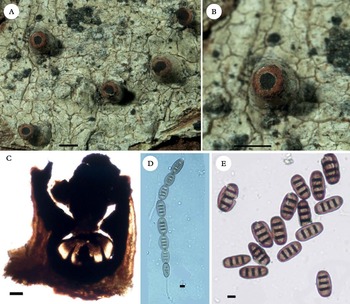
(Fig. 1)
Pyrgillus tibellii. A & B, mature ascomata; C, vertical section of ascoma; D, a cylindrical ascus; E, mature ascospores. Scales: A & B=1 mm; C=200 µm; D & E=5 µm. In colour online.

Thallus crustose, corticolous, epiphloeodal, 7–10 cm across, 0·20–0·25 mm thick; surface pale yellow to yellowish brown, continuous, thick, smooth to cracked, rimose, some places black spotted, corticate, lacking a distinct prothallus; cortex 30–40 µm thick, without any crystals; photobiont layer 40–65 µm thick, photobiont Trentepohlia; cells 13–16×5·5–6·8 µm; medullary layer irregular, hyphae penetrating in the bark tissue of the host.
Ascomata perithecioid, mazaedioid, scattered, sessile, conical, 1·7–2·3 mm high, partly immersed in the substratum, covered by thick thalline margin. Upper part of ascoma funnel-shaped containing the mazaedium, 0·9–1·4 mm wide and protruding 1·0–1·3 mm high. Excipulum of the upper compartment strongly carbonized, 215–290 µm thick. Lower compartment spherical or pyriform, 0·9–1·1 mm high and 0·8–1·4 mm wide, containing one to two locules producing asci and paraphyses; locules individually enclosed by a 10–12 µm thick carbonized wall inside, the outer 150–250 µm thick, strongly carbonized wall of the ascoma. In the lower compartment, as many as 4–5 locules may be formed due to intrusion of ascomatal wall in the hamathecium from below. Ascospores produced in the lower locules are connected to the upper compartment by a narrow canal, through which mature ascospores are delivered and accumulate in the upper part of the ascoma forming a mazaedium. Margin of the excipulum with orange-reddish pruinose rim, K+ reddish violet. Ostiole apical, obconical. Hamathecium not inspersed with oil globules, I−; paraphyses simple; periphyses absent. Asci 8-spored, becoming evanescent later, cylindrical, with uniseriate and periclinally arranged ascospores, 140–190×10–12 µm. Ascospores dark brown, broadly ellipsoid, 3-septate, smooth, thick-walled, distoseptate, with darker strands indicating euseptate, (15·3–)16·0–20·0 (–22·8)×7·5–10·0 µm.
Chemistry. Thallus K−, C−, KC−, Pd−; UV+ brilliant yellow, containing lichexanthone. Ascomata TLC – brown and orange-pink unidentified substances found at Rf class 4 and Rf class 7, respectively. Excipular margin of ascomata orange-reddish, pruinose rim reacting K+ reddish violet.
Etymology. It is our pleasure to name this species in honour of Professor Leif Tibell, whose name has long been associated with calicioid lichens and who has made remarkable and valuable contributions to the taxonomy of this group.
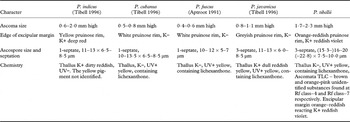
Remarks. This new species is clearly distinguished from other known species of the genus by its large (1·7–2·3 mm high) mazaediate, perithecioid ascomata, excipular margin with orange-reddish pruinose rim reacting K+ reddish violet and large [(15·3–) 16·0–20·0(–22·8)×7·5–10·0 µm] ellipsoidal, 3-septate ascospores. In ascospore morphology and septation of ascospores, Pyrgillus tibellii closely resembles P. javanicus which has a greyish pruinose excipular rim, K−, and smaller (11–13×6·0–8·5 µm) ascospores. Morphologically and anatomically, P. indicus also resembles the new species but differs in having 1-septate ascospores. A comparison of some selected characters of different species of Pyrgillus is shown in Table 1.
Comparison of characters of Pyrgillus species

The authors thank Professor Leif Tibell, Uppsala University, Uppsala, Sweden for reading the manuscript and for his valuable suggestions; the Director, Botanical Survey of India, Kolkata for providing facilities and Scientist in-charge, Botanical Survey of India, Central Regional Centre, Allahabad for encouragement. One of the authors (PS) is also grateful to the Ministry of Environment & Forests, New Delhi for financial assistance under AICOPTAX.