Introduction
Over the past half century, disasters have seen a sharp upward trend, resulting in millions of victims and economic losses.Reference Guha-Sapir, Hoyois and Below 1 Most internal crises require external support,Reference Burkle, Nickerson and von Schreeb 2 and this is especially true for global public-health emergencies.Reference McQueen, Parmar and Kene 3 , Reference Salama, Spiegel and Talley 4 However, data and experience gained from recent disasters suggest that humanitarian medical responders are not sufficiently competent in disaster response.Reference Griinewald, Binder and Griinewald 5 Indeed, health aid workers and international organizations have recently launched a call for further professionalization in humanitarian assistance.Reference Walker and Russ 6 , Reference Burkle, Lyznicki and James 7
Globally, several medical specialties have been involved in disaster response.Reference Zhang, Liu and Li 8 , Reference Kreiss, Merin and Peleg 9 Nevertheless, most humanitarian workers fall short in providing proper medical support due to their limited training and field experience in resource-constrained settings.Reference Griinewald, Binder and Griinewald 5 , Reference Chu, Stokes and Trelles 10 Separate from their specialist skills, health professionals are required to gain a broader understanding about the specific context in which the humanitarian crisis occurs;Reference Brennan and Nandy 11 moreover, they should be familiar with the humanitarian core competencies,Reference Johnson, Idzerda and Baras 12 , Reference Burkle 13 the humanitarian aid sector,Reference Burkle, Lyznicki and James 7 the World Health Organization (Geneva, Switzerland) Health Cluster,Reference Bradt and Drummond 14 and international humanitarian law.Reference Burkle, Lyznicki and James 7 , Reference Schultz, Koenig and Whiteside 15
Recently, several researches have highlighted the growing interest in international humanitarian rotations voiced by trainees in different disciplines,Reference Dey, Grabowski and Gebreyes 16 - Reference Matar, Trottier and Balaa 19 and, in parallel, recent disasters have been characterized by the deployment of young and inexperienced humanitarian aid workers.Reference Burkle, Lyznicki and James 7
During the last three years, the Research Center in Emergency and Disaster Medicine and Computer Science Applied to Medical Practice (CRIMEDIM; Novara, Italy) 20 of the Università del Piemonte Orientale 21 implemented a pilot course (based on distance learning and apprenticeships in the field) aimed to develop the professional skills of residents in anaesthesia in low-resource environments. Results from a qualitative self-evaluation questionnaire documented that residents improved their technical and nontechnical skills as a result of their participation in the course.
Building on the encouraging outcomes derived from the pilot project in a single center and the increasing commitment of anesthetists in humanitarian crises,Reference Rossler, Marhofer and Hupfl 22 the authors’ purpose will be to expand this course to the entire population of residents in Anesthesia and Critical Care Medicine in Italy.
However, preliminary data on residents’ global interest in humanitarian assistance and perceived need of being prepared as humanitarian responders are not available. The purpose of this poll was to conduct a baseline assessment by polling residents on their interest in humanitarian aid and their opinion about the professionalization of humanitarian workers.
Methods
Poll, Population, and Administration
In Italy, anesthesia and critical care disciplines are combined in a common residency program covering a training curriculum recently extended to five years. At the date of the poll, the fifth year had not yet been activated, so the poll data refers only to the first four years. From September through October 2012, all the Directors of the 39 accredited anesthesia residency programs in Italy were contacted by e-mail and written consent was obtained to administer the questionnaire among the residents enrolled in their respective programs.
Sequentially, an electronic poll was distributed to the residents using the online commercial software Surveymonkey 23 (Palo Alto, California USA). The e-mail invitation included a brief presentation of the study, the informed consent form, a link to the online questionnaire, and a link for withdrawal from the poll. In the presentation e-mail, the term professionalization was defined as the process that provides humanitarian workers with the appropriate knowledge, skills, and attitudes to perform a task with a high level of competence, proficiency, and devotion. Each participant could answer the poll only once. A maximum of five reminder e-mails were further forwarded to nonresponders from October 2012 through March 2013. A retrieval rate of 30% was expected by using a web-based poll request with a reminder e-mail.Reference Kaplowitz, Hadlock and Levine 24
The participation in the questionnaire was voluntary, anonymous, and independent. Confidentiality of information was ensured and no financial incentive to participate in the study was offered. Informed consent was obtained and the participants could withdraw from the poll at any time. Since all data were deidentified and reported in aggregate, the evaluation was deemed exempt from institutional review approval by the local Ethics Committee (Comitato Etico Interaziendale, Novara, Italy; study number 014.04.29).
Survey Contents
A cross-sectional poll consisting of 14 questions was used. Questions were categorized in six different sections to collect information about: (1) demographics; (2) interest in humanitarian assistance; (3) residents’ awareness of the humanitarian aid rotations offered by their training programs; (4) perceived need of professionalization in humanitarian assistance; (5) prior experience; and (6) career intentions.
A panel of experts composed of five faculty members from CRIMEDIM and of the faculty of the European Master in Disaster Medicine (EMDM; Novara, Italy) 25 reviewed the questionnaire content for accuracy and provided appropriate modifications to ensure validity of the poll. All five experts were anesthetists with broad prior experience in disaster management, humanitarian aid missions, and training in humanitarian courses, nationally and internationally.
Statistical Analysis
Frequencies were used to describe respondent characteristics. Data analysis was conducted using Microsoft Office Excel 2007 (Microsoft Corporation; Redmond, Washington USA) and GraphPad Prism v.5. (GraphPad Software; San Diego, California USA). Chi-squared tests were used to compare residents’ year of training and residents’ gender with items of interest. A P value less than .05 was considered as statistically significant.
Results
Globally, 29 (74%) of the residency programs contacted agreed to participate in the poll. Nine hundred twenty-four out of the 1,362 residents returned the questionnaire, yielding a response rate of 67.8%. Thirty-one declined participation and eight e-mail invitations were electronically returned unanswered. The margin of error estimated for the poll results based on the number of nonresponses that occurred with 95% CI was 1.8% (66.0-69.6).
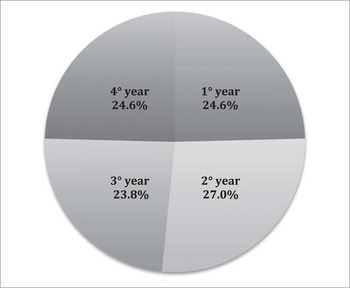
Most of the participants were female (61.7%) and respondents were homogeneously distributed among all the training years (Figure 1). Median age of the participants was 29 (28-31) years (median IQR = 25-75).
Frequencies of Respondents Distributed by Training Year At the moment of survey, the 5th year of training was not implemented yet at national level due to the recent change in the Italian residency school's regulation.

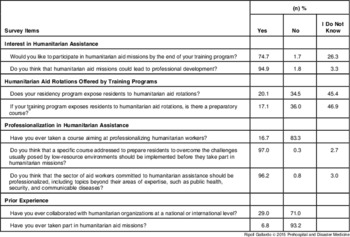
A total of 74.7% of the respondents were interested in taking part in humanitarian missions by the end of their training programs. Almost 95% believed that such experiences could positively lead to improved professional development.
Only 154 (16.7%) of respondents had attended some instruction courses to enhance professionalization of humanitarian workers. However, 97% of them affirmed that a formal course addressed to prepare residents for the challenges posed by low-resource environments should be implemented; such necessity was also supported by 97.4% of residents with prior experiences in humanitarian aid missions. More than 96% of the respondents considered that humanitarian aid assistance should be professionalized beyond an individual's area of expertise, and all the respondents with prior experiences favored this.
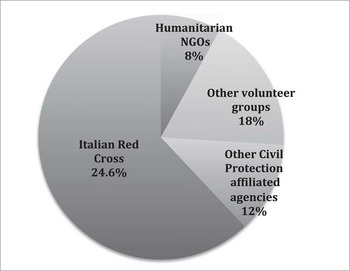
Approximately 29% of the respondents had collaborated with humanitarian organizations (Table 1). Most had collaborated with the Italian Red Cross (Rome, Italy), Emergency Medical Services volunteer groups, civil-protection-affiliated agencies, and humanitarian nongovernmental organizations (Figure 2). Prior participation in humanitarian missions for national and international crisis was confirmed by only 6.8% of the participants.
Frequencies of Respondents Categorized by Prior Experience in Humanitarian Assistance, Interest in Humanitarian Missions, Awareness of the Humanitarian Aid Rotations Offered by Their Training Programs, and Opinion About the Professionalization of the Humanitarian Aid Sector

aPercentages are referred only to the residents (n = 186) who were exposed to humanitarian aid rotations by their respective training programs.
Collaboration of Residents with National or International Humanitarian Organizations in the Field Abbreviation: NGO, nongovernmental organization.

Finally, 69 (7.5%) planned to pursue a career in humanitarian or disaster medicine upon completion of the residency, and 389 (42.1%) would have liked to see a specific pathway implemented within their training programs. Nationally, women and junior residents (first and second training year) were more interested than other demographic descriptors in pursuing a career in humanitarian assistance in their future (P < .05).
Discussion
To the best of the authors’ knowledge, the poll results represent the first attempt to assess the current interest of residents in anesthesia (for this case, in Italy) in humanitarian assistance and their perception of the need to enhance professionalization in this specific sector.
This poll suggests that anesthesia/critical care trainees are clearly interested in humanitarian aid rotations. However, compared with overseas residents in other disciplines, Italian anesthesia trainees engage much less in humanitarian aid missions.Reference Dey, Grabowski and Gebreyes 16 - Reference Matar, Trottier and Balaa 19 A plausible explanation for these results might be self-funding requirements, lack of organization, and time constraints.Reference Matar, Trottier and Balaa 19 - Reference King, Liu and Talley 26
Most of the respondents, particularly those with prior experience, believe that participation in humanitarian missions can contribute to professional development. Accordingly, Drain et alReference Drain, Primack and Hunt 27 published a detailed description of the role that humanitarian aid rotations play in the professional development of medical students through strengthening clinical, decision-making skills, and problem-solving skills. Additionally, performing in poor-resource environments enables physicians to identify promptly crucial comorbidities rarely found in developed countries, appreciate cross-cultural collaboration, attach less importance to instrumental tests, and enhance cost awareness. The authors of this study support the statement that these benefits lead to more qualified physicians, even in their home institutions.
Anesthesiologists working in disaster and humanitarian settings are required to perform high-quality anesthesia in challenging conditions and must be prepared to perform unfamiliar tasksReference Rossler, Marhofer and Hupfl 22 with limited access to resources. Unfortunately, a recent study has demonstrated that anesthesiologists deployed in complex emergencies still lack important preparedness before deployment.Reference Rossler, Marhofer and Hupfl 22
This poll indicates that only a few residents have attended courses to enhance their professionalization in humanitarian aid topics. Conversely, Anspacher et alReference Anspacher, Frintner and Denno 18 reported that 43% of the pediatric trainees surveyed received preparation for working in underserved countries during their residency. Since working in low-resource settings differs from home institutionsReference Slepski 28 , Reference Marchbein 29 due to different socio-political contexts, cultural communication, care standards, and epidemiology, residents should receive specific instruction before taking part in humanitarian missions. Interestingly, while this request seems to be well-recognized and supported by the poll respondents (97.2%), Dey and colleaguesReference Dey, Grabowski and Gebreyes 16 reported that only 60% of the emergency medicine trainees surveyed considered additional training as necessary. Of note, in both cases, this number was higher only when residents with prior humanitarian health experiences, and therefore, greater awareness about the challenges posed by resource-poor or constrained environments were considered.
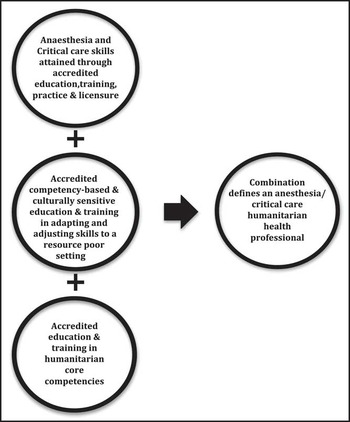
The majority of respondents, supporting previous research,Reference Walker and Russ 6 , Reference Burkle, Lyznicki and James 7 , Reference Chu, Stokes and Trelles 10 , Reference Brennan and Nandy 11 asserted that aid workers should be professionalized beyond their specific field of expertise, covering domains such as public health, security, epidemiology, project management, and international humanitarian law (Figure 3). This is aligned with communities’ and decision makers’ demands of a professionalized generation of crisis providers, especially those in health. Unfortunately, recent crises still revealed challenges for emergency health response, such as improved quality assurance, coordination, and resource allocation.Reference Van Hoving, Wallis and Docrat 30 , Reference Redmond, Mardel and Taithe 31
A Graphic Depiction of the Pathway to Professionalization within Anesthesia and Critical Care Specialties

Only a small percentage of respondents had prior experience in humanitarian missions. However, it is considered crucial that 97% of all polled residents perceived as relevant the early professionalization process to work in low/poor-resource environments. This must be taken into consideration by residency program designers since some of these future specialists will take part in actual humanitarian missions, even in the early stage of their career, as already documented.Reference Burkle, Lyznicki and James 7
In comparison with other studies,Reference Anspacher, Frintner and Denno 18 the percentage of the respondents who definitively plan to address their professional career to the humanitarian health assistance sector was higher. An intuitive explanation for these findings might be that, at the basis of the medical career, there is the genuine desire to help others. Humanitarian medicine provides an ideal opportunity to satisfy this desire by going to an area where good care is not available, providing services that can make a huge difference in the health and welfare of fellow human beings, and providing this service freely and without personal gain.Reference Welling, Ryan and Burris 32
A total of 42.1% would appreciate it if a dedicated formal pathway in this field was available within their training programs. Of note, the implementation of a humanitarian subspecialty has already been proposed.Reference Scott, Carson and Greenwell 33 , Reference Angelini, Arora and Kurkure 34 Well-prepared and motivated residents would: (1) supply an additional workforce in systems struck by povertyReference Powell, Casey and Liewehr 17 with a broadly recognized need for anesthesiologists;Reference Marchbein 29 (2) be more qualified to effectively provide care to victims of disasters; and (3) contribute to establish new research projects in underserved areas.Reference Angelini, Arora and Kurkure 34
This poll represents the first attempt to provide a baseline assessment of the interest among anesthesia/critical care residents in humanitarian assistance and to learn of their opinions about the professionalization process of the humanitarian aid sector at the residency program level. Respondents would like to see more exposure to humanitarian work during residency and were overwhelmingly in support of being professionalized as humanitarian responders in the early stage of their career. Since anesthetists are always at the forefront in humanitarian crises, this interest should serve as a motivation for the development of an early, academically supported, professionalization pathway that promptly would provide future anesthesia/critical care physicians with the knowledge, skills, and attitudes to ensure high-quality humanitarian assistance during their first deployment.
By outlining the poll method and results, the authors further recommend that reproducible research be carried out in other countries in order to assess whether similar attitudes on professionalization in the early phase of training exists among anesthesia/critical care physicians.
In forthcoming research, CRIMEDIM plans to better define how to increase the professionalization of future anesthetists and how to evaluate the specific competencies that this professionalization process will guarantee to the trainees.
Limitations
This poll has several limitations. While a return rate of 30% for a web-based poll was considered acceptable,Reference Kaplowitz, Hadlock and Levine 24 the results have to be interpreted carefully, and the conclusions cannot be extrapolated to every anesthesia/critical care resident in Italy. In addition, even though the questionnaire was internally validated based on consensus of the experts, it was never tested for reliability.
Residency programs in which Directors didn't approve the diffusion of the survey were not included in the study; undoubtedly, the responses of residents enrolled in these programs would have supplied additional data. However, this study covered 74% of the training programs in Italy, and therefore, provided data from the majority of residents.
A selection bias cannot be excluded; residents who were more interested in the topic were probably more likely to reply. However, the authors obtained a high response rate in comparison with similar studies.Reference Dey, Grabowski and Gebreyes 16 - Reference Matar, Trottier and Balaa 19
Only a small percentage of respondents had prior experience in humanitarian missions. Nevertheless, the objective of the poll was to explore the interest and to detect opinions of a population of physicians in the early stage of their career.
Additionally, the authors recognize that the participation in humanitarian missions might be interesting in the abstract. The poll did not address in which type of missions residents would be more interested; also, additional factors, such as the specific hazards presented by the host country and the potential extension of their residency to account for lost rotations, might have influenced their answers.
Conclusions
The poll results suggest that interest among Italian anesthesia/critical care residents in humanitarian assistance is high. At the time the study was conducted, few among the respondents had participated in humanitarian aid missions. Generally, trainees considered humanitarian aid experiences as an opportunity for professional development and favored the global professionalization of the humanitarian aid sector. An early professionalization process formally implemented within residencies would be appreciated by trainees, arguably the starting point for a discussion on how to proceed with a relevant, accessible, and feasible training program to increase their professionalism in the humanitarian aid sector.