Introduction
The use of chemical weapons in terrorist attacks, though rare, remains a significant challenge and concern due to their ability to inflict mass casualties. Reference Tin, Pepper, Hart, Hertelendy and Ciottone1 While gaps in education have been recognized and recent publications in chemical toxidrome recognition and civilian medical guidelines on responses to chemical warfare agents have done much to aid training on this topic, chemical attacks remain a topic of interest for Disaster Medicine (DM) and Counter-Terrorism Medicine (CTM) specialists and are clearly an area in need of enhanced preparedness. Reference Ciottone2–Reference Tin, Hart, Hertelendy, Kallenborn and Ciottone4
This study aims to provide an epidemiological description of all terrorism-related attacks using chemical agents as a primary weapon, sustained from 1970 - 2019. These data will be useful in the development of education programs in CTM and provide an insight into how best to prepare for potential attacks in the future.
Methods
Data collection was performed using a retrospective database search through the Global Terrorism Database (GTD). 5 This database is open access with publicly available data collection methodology utilizing artificial intelligence that identifies events from news media around the world and confirms them through human examination by the National Consortium for the Study of Terrorism and Responses to Terrorism (College Park, Maryland USA). 6 The GTD defines terrorist attacks as: “the threatened or actual use of illegal force and violence by a non-state actor to attain a political, economic, religious, or social goal through fear, coercion, or intimidation.” The GTD does not include acts of state terrorism and links specific event summaries to open-source news articles. Summary of incidents, where provided by the GTD, were reviewed to determine the type of chemical used.
The GTD was searched using the internal database search functions for all events using chemical weapons as a primary attack method from January 1, 1970 - December 31, 2019. Years 2020 and 2021 were not yet available at the time of the study. The GTD also details the specific chemical used, when known, in the summary of incidents.
Results were exported into an Excel spreadsheet (Microsoft Corp.; Redmond, Washington USA) for analysis. Ambiguous events (this field is only systematically available with incidents occurring after 1997) were excluded when there was uncertainty as to whether the incident met any of the criteria for GTD inclusion as a terrorist incident. Attacks met inclusion criteria if they fulfilled the following three terrorism-related criteria, as set by the GTD. These criteria are determined within the database and not by the authors:
-
Criterion I: The act must be aimed at attaining a political, economic, religious, or social goal.
-
Criterion II: There must be evidence of an intention to coerce, intimidate, or convey some other message to a larger audience (or audiences) than the immediate victims.
-
Criterion III: The action must be outside the context of legitimate warfare activities (ie, the act must be outside the parameters permitted by international humanitarian law, particularly the admonition against deliberately targeting civilians or non-combatants).
Results
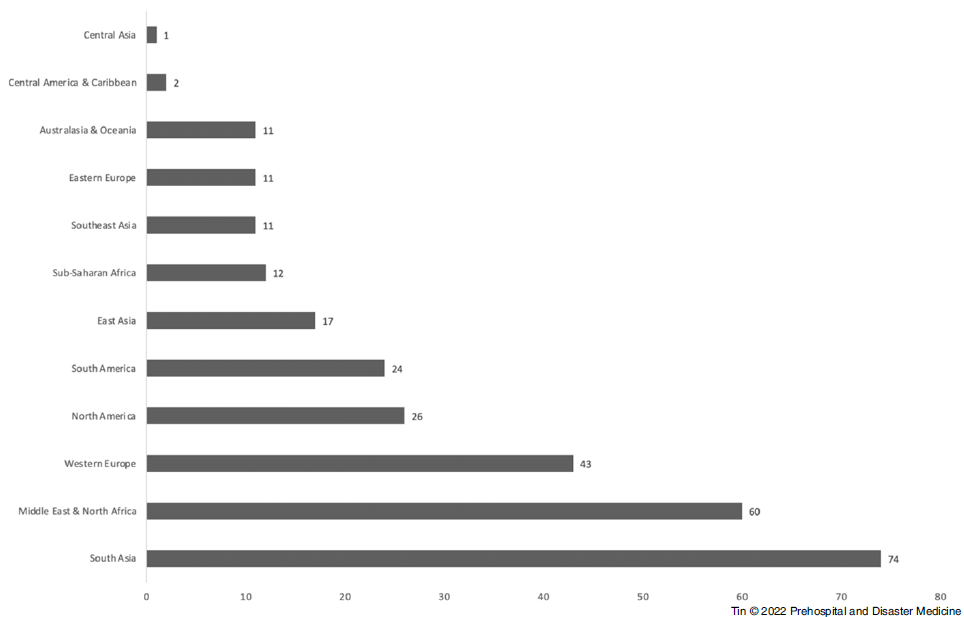
A total of 292 terrorist attacks involving chemical agents as a primary attack method were recorded from 1970 - 2019, registering 284 deaths and 13,267 injuries. South Asia recorded the most chemical attacks (74), followed by the Middle East and North Africa (60), and Western Europe (43). Afghanistan (53), Iraq (38), and the United States (22) recorded the three highest number of chemical attacks by country (Table 1 and Figure 1). It is worth noting that, as per the GTD’s codebook, incidents occurring in both the same geographical and temporal point are regarded as a single incident, but if either the time of occurrence of incidents or their locations are discontinuous, the events are regarded as separate incidents. 7
Number of Chemical Attacks by Country

Breakdown of Reported Terrorist Events Involving Biological Agents, by Region.

Of these reported terrorist attacks involving chemical agents, the top three targets were private citizens and property (81), educational institutions (45), and government organizations (31 [Figure 2]).
Breakdown of Reported Terrorist Events Involving Chemical Agents, by Target Type.
Abbreviation: NGO, nongovernmental organization.

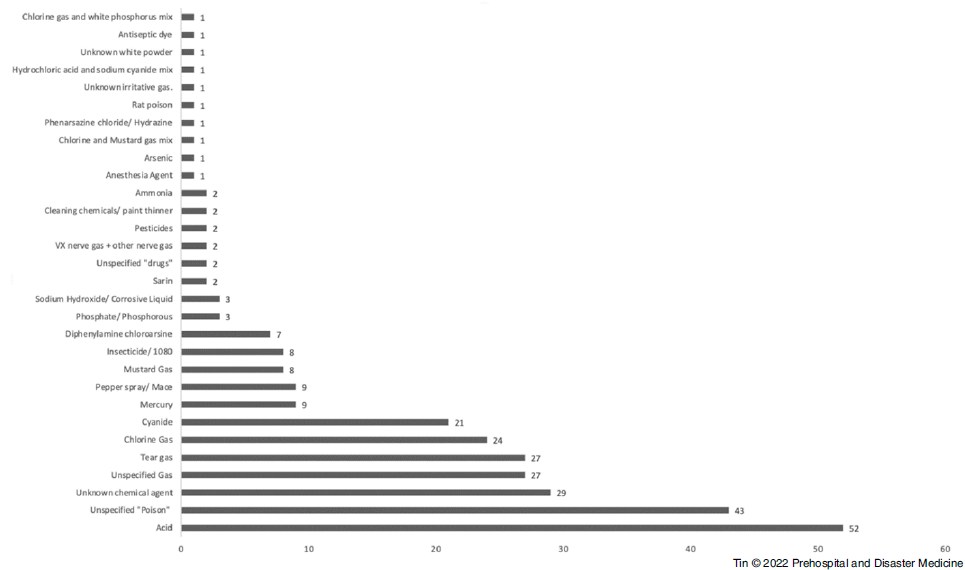
Acid (52) was the most commonly used chemical agent, followed by “unspecified poison” (43), “unknown chemical agents” (29), “unspecified gas” (27), tear gas (27), chlorine gas (24), cyanide (21), mercury (9), pepper spray or mace (9), mustard gas (8), insecticide or 1080 (8), diphenylamine chloroarsine (7), phosphate or phosphorous (3), sodium hydroxide or corrosive liquid (3), sarin (2), “unspecified drugs” (2), VX nerve gas and other nerve gas (2), pesticides (2), cleaning chemicals/paint thinner (2), ammonia (2), anesthesia agent (1), arsenic (1), chlorine and mustard gas mix (1), phenarsazine chloride (1), rat poison (1), unknown irritative gas (1), hydrochloric acid and sodium cyanide mix (1), unknown white powder (1), antiseptic dye (1), and chlorine gas and white phosphorous mix (1 [Figure 3]).
Breakdown of Chemical Agents Used in Terrorist Attacks.

The most lethal attack occurred in 2000 in Uganda after 200 followers of the Movement for the Restoration of the Ten Commandments of God were killed after drinking tea tainted with an unknown chemical. The Tokyo Sarin gas attack of 1995 injured the largest number of people (5,500), followed by the 2016 mustard gas attack in Kirkuk, Iraq which injured 1,500.
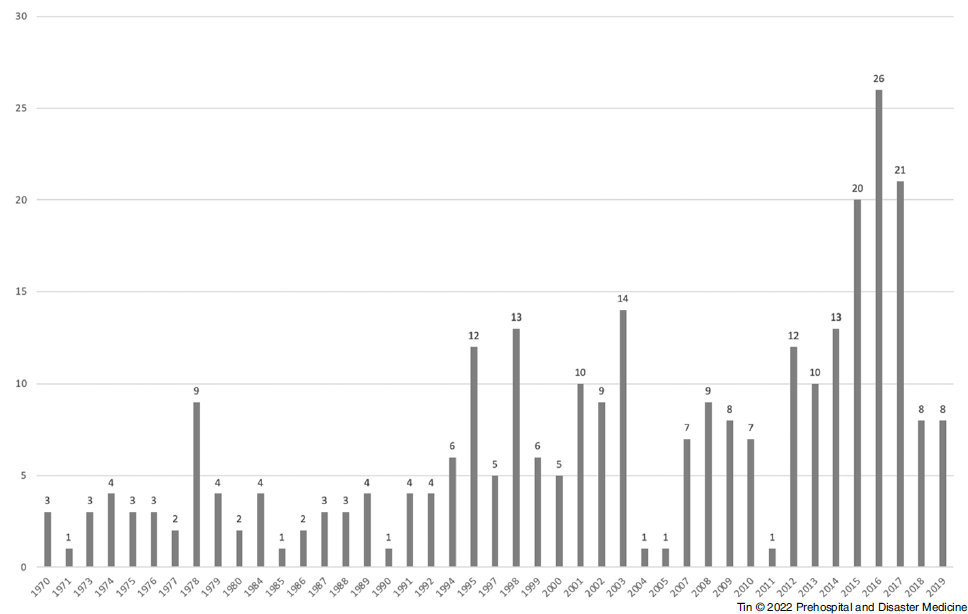
The year 2016 recorded the most events with 26 attacks, followed by 21 attacks in 2017 and eight attacks in both 2018 and 2019 (Figure 4).
Number of Chemical Attacks, by Year.

Discussion
The Organization for the Prohibition of Chemical Weapons (OPCW; The Hague, Netherlands) administers the Chemical Weapons Convention (CWC) which prohibits the large-scale use, development, production, stockpiling, and transfer of chemical weapons and their precursors (except for very limited purposes such as research, medical, pharmaceutical, or protective uses). As of March 2021, 193 states are parties to the CWC. Four United Nations member states are not party: Egypt, Israel, North Korea, and South Sudan. 8
The CWC further categories chemicals into three distinct schedules: 9
-
Schedule 1: Chemicals which can be used directly as chemical weapons or used in the manufacture of chemical weapons and which have no, or very limited, uses outside of chemical warfare. This includes sarin, soman, tabun, VX, sulfur mustards, lewisite, nitrogen mustards, saxitoxin, ricin, and novichok agents. 10 Production of Schedule 1 chemicals above 100 grams per year for the purposes of research, medical, pharmaceutical, or chemical weapons defense testing must be declared to the OPCW with restrictions on the total allowable amount to be produced.
-
Schedule 2: Chemicals that can either be used directly as chemical weapons or used in the manufacture of chemical weapons but have small-scale applications outside of chemical warfare so can be legitimately manufactured in small quantities. Examples include thiodiglycol, which is used as a solvent in inks but also used in the manufacture of mustard agents, and Amiton (also known as VG or Tetram), a chemical previously investigated as an insecticide and used in the agriculture industry, but also classified as a nerve agent with toxicity similar to sarin. 11,Reference Keyes, Benitez and Vezel-Daubon12 Production of Schedule 2 chemicals is subject to declaration to OPCW and may not be exported to countries that are not party to the CWC. 13
-
Schedule 3: Chemicals which can be either used as toxic chemical weapons or used in the manufacture of chemical weapons but which also have legitimate large-scale industrial uses. 14 This includes phosgene, used in the production of plastics, and triethanolamine, which is commonly used in cosmetics and medicines but also used in the manufacture of nitrogen mustard. Production of more than 30 tons of Schedule 3 chemicals per year must be declared and inspected.
It is worth noting that chlorine remains unscheduled and production is neither controlled nor limited, but its use as a chemical weapon is prohibited. Reference Zanders15,16
The use of chemical agents as a terrorist attack methodology, though rare, has a high potential to inflict mass casualties. Reference Tin, Margus and Ciottone17,Reference Tin, Granholm, Hart and Ciottone18 Chemicals can be produced, stolen, or acquired and industrial chemical plants or vehicles used to transport chemicals could be sabotaged and cause local damage. Chemicals in liquid and vapor forms have higher potential for mass exposure and toxic plumes can likely spread over large areas. The duality and availability of widely used industrial chemicals such as hydrogen cyanide remain a concern, especially in countries without the infrastructure or capability to monitor CWC adherence. Of note, tear gas is a chemical weapon banned in war but legal for law enforcement purposes. Reference Sadeghi19,20
Both DM and CTM specialists have warned of the use of drones as a novel chemical weapon dispersion platform and, given its growing popularity in the civilian setting and potential for re-purposing, have called on hardening potential targets such as hospitals against terrorist attacks. Reference Tin, Hart and Ciottone21,Reference Tin, Kallenborn, Hart, Hertelendy and Ciottone22 This conceivable mass-delivery modality combined with the escalating number of chemical attacks seen in the last 15 years (Figure 4) may be harbingers of potential mass-casualty attacks utilizing chemical weapons. Enhancing civilian preparedness for such events must be a health care imperative.
Limitations
The GTD is a comprehensive record of documented global terrorist events. It is maintained by the National Consortium for the Study of Terrorism and Responses to Terrorism and is the basis for other terrorism-related measures, such as the Global Terrorism Index. Reliance wholly on the GTD is partially mitigated by confirmation with other lay sources and searches for other online searches, but if there are incidents not reported in the GTD, this could limit the veracity of the findings. Furthermore, the lack of a universally agreed-upon definition of the term terrorism can create inconsistencies between databases in the labelling of such events. Clear and detailed documentation of terrorist events is further hindered by restrictions on reporting, the lack of independent corroboration, and the lack of transparency within certain government sources. Infrastructure needed to report, detect, and identify chemical agents is likely lacking in many parts of the world, leading to potential under-reporting of events. Event descriptions as provided by the GTD rely mostly on grey literature sources and as such, accuracy is only limited to those sources. Finally, the use of pre-existing databases such as the GTD as a data source inherently introduces potential challenges such as miscoding or data entry errors and a reliance on the accuracy of open-source information.
Conclusion
The use of chemical weapons in warfare, though prohibited by the CWC, remains a rare but concerning terrorist attack methodology. In recent years, there have been more instances where potentially deadly chemicals have been used in civilian settings. Dual use industrial chemicals, in particular, pose a significant concern. Acid was the most commonly used chemical weapon in 52 attacks. Tear gas, chlorine, and cyanide were each used in over 20 attacks. Both DM and CTM specialists have raised concerns over drones as potential chemical attack delivery platforms and continue to advocate for better preparedness and response training for intentional events in civilian settings.
Conflicts of interest/funding
The authors declare no conflicts of interest and no financial disclosures.