Implications
The increased incidence of drought because of climate change is a major threat to the survival of resource poor farmers in semi arid areas who depend on indigenous chickens for their livelihoods. Breeds of indigenous chickens that are adapted to drought conditions are not known. Changes in blood composition are useful proxies to predict potential resistance of livestock to environmental, nutritional and pathological stresses. Identification of indigenous chicken breeds that maintain a frugal water economy during periods of water scarcity is important for ensuring household food security and selection of breeds that should be prioritized for in-situ conservation in drought-prone communal production systems.
Introduction
Indigenous chickens play an important role in sustaining livelihoods of many indigent communities living in drought-prone and semi-arid areas of Southern Africa (Muchadeyi et al., Reference Muchadeyi, Sibanda, Kusina, Kusina and Makuza2004). Most of these chickens are exposed to various sub-optimal husbandry conditions and stress provoking situations that negatively affect their productivity. The climatic conditions that prevail for most of the year are hot and dry and coincide with peak periods of water and feed scarcity. Owing to limited water and succulent foraging resources, birds in such regions are prone to dehydration. However, it is not clear whether these chickens have developed adaptations to these harsh conditions.
The effects of hydric stress occasioned by water restriction on haematological and biochemical parameters of broilers and layers have been studied extensively (Mmereole, Reference Mmereole2009; Ahmed and Alamer, Reference Ahmed and Alamer2011). Changes in haematological and serum biochemical parameters have been used as proxies to predict potential resistance of livestock to environmental, nutritional and pathological stresses (Kral et al., 2000). Drought-resilient chickens are expected to manifest the least changes in haematological and biochemical parameters when subjected to stressful situations relative to those under optimal production conditions (Takei et al., 1988).
Water restriction results in haemoconcentration reflected by increases in packed cell volume (PCV; Iheukwumere and Herbert, Reference Iheukwumere and Herbert2003; Mushi et al., 1999), and elevated levels of total proteins (TPs), albumin (ALB) and globulin (GLOB; Cork and Halliwell, Reference Cork and Halliwell2002). Continued water deprivation also leads to increased serum uric acid (UA) and creatinine (CREAT) because of impaired renal function (Lumeij, Reference Lumeij1987). Peebles et al. (Reference Peebles, Burnham, Walzem, Branton and Gerard2004) reported increased serum triglycerides (TGAs) and cholesterol levels in water-restricted Single Comb White Leghorn hens and attributed it to increased fat mobilization for metabolic water production. In addition, tissue and organ damage because of water restriction in broilers was associated with elevated enzyme activities of alkaline phosphatase, alanine transaminase (ALT) and aspartate transaminase (Fasina et al., Reference Fasina, Ologhobo, Ayoada, Adeniran and Adeyemi1999).
The Ovambo (OVB) and Naked Neck (NNK) are important chicken ecotypes kept for various functions and purposes in communal areas of Southern Africa. The OVB chicken is a multi-coloured, aggressive, light to medium breed that reaches sexual maturity at 143 days of age with males and females weighing about 2.16 kg and 1.54 kg, respectively (Van Marle-Köster and Nel, Reference Van Marle-Köster and Nel2000). The NNK is also a multi-coloured, light-weight, dual-purpose breed kept for meat and eggs for home consumption. The birds reach sexual maturity at 155 days of age, with males weighing about 1.95 kg and females 1.4 kg (Van Marle-Köster and Nel, Reference Van Marle-Köster and Nel2000). NNK chickens exhibit superior heat tolerance than OVB chickens because of possession of a major gene that causes reduced plumage cover (Cahaner et al., Reference Cahaner, Deeb and Gutman1993). Reduced plumage cover facilitates rapid heat dissipation and is regarded as an effective adaptation to minimize heat stress in chickens (Deeb and Cahaner, Reference Deeb and Cahaner2001). Preliminary investigations have suggested that the bulk of the chickens in communal production systems receive between 20% and 70% of their water requirements (Rwanedzi, Reference Rwanedzi2010). However, haematological and biochemical responses of these indigenous chicken genotypes to dehydration induced by water restriction are not known. Information on these responses is useful, not only in assessing bird welfare and developing management strategies that minimize stress, but also in identifying chicken genetic resources that should be prioritized for in-situ conservation in drought-prone communal production systems.
The objective of the study was to compare the haematological and biochemical responses of NNK and OVB chickens to graded levels of water restriction. It was hypothesized that there was no difference in haematological and biochemical responses to water restriction between OVB and NNK chickens.
Material and methods
Study site
The study was conducted during the hot dry season (January and March 2012) at Cedara College of Agriculture which is located in the upland savanna zone of South Africa on latitude 29.53°S and longitude 30.27°E at altitude 613 m. The average environmental temperature was 27.1°C, and relative humidity was moderate at an average of 65.8%.
Birds, water restriction levels and management
Fifty-four 8-week-old female birds of each strain with an initial average individual BW of 641 ± 10 g per bird were randomly assigned to three water restriction levels with three replications, each having six birds. Thus, nine experimental pens (230 × 143 × 120 cm; length × width × height) per strain were used in total. A complete randomized design was used. Water-restricted birds were given 70% and 40% of the amount that the ad libitum group consumed the previous day. The water restriction levels were chosen to represent optimum, moderate and severe water restriction, respectively, which the birds usually encounter under natural conditions. The experiment was conducted over 60 days. The experimental pens were housed in an open-sided house with cement floor and deep littered with wood shavings. The resulting stocking density was 3.5 birds/m2. Birds were acclimated to the pen environment for 10 days prior to commencement of the experiment. During this period, all birds were allowed water ad libitum and finisher pellets (160 g CP/kg dry matter (DM) and 12.3 MJ metabolizable energy (ME)/kg DM) was gradually introduced. Thereafter, depending on the water restriction level, water was supplied from 4 l plastic founts, in one installment daily at 0900 h for 8 weeks until the birds were 16 weeks old. All the birds were fed on the same finisher pellets containing 160 g CP/kg DM and 12.3 MJ ME/kg DM until they were 16 weeks old. Feed was provided ad libitum and given from tube feeders made of standard gutter materials measuring 30 cm long × 12 cm wide × 9 cm deep. Wood shavings were used as bedding and were changed on a weekly basis. Water founts were cleaned daily. The experiment was approved by the University of KwaZulu-Natal Animal Ethics Sub-Committee (Ref 048/12/Animal). After completion of the experiment, the birds were monitored for a week to ensure absence of any side effects because of water restriction and released to join the demonstration flock kept at the institution.
Blood collection
On the last day of a 60-day experimental period, two sets of blood samples were taken from four of six randomly selected birds of each strain in each treatment via brachial venipuncture using 5 ml syringes and 22 gauge needles. One set of the blood samples (3 ml) was collected into purple top 5 ml ethylene diamine tetra-acetic acid (EDTA)-coated vacutainer tubes for determination of haematological parameters. The other set of blood samples (3 ml) was collected into 5 ml red top anti-coagulant free vacutainer tubes, allowed to coagulate at room temperature and centrifuged for 15 min at 3500 revolutions per minute using a Hettich Zentrifugen (MIKRO 200) centrifuge. The supernatant sera were then stored in a freezer at −20°C for subsequent biochemical analysis.
Haematological parameters
PCV was measured by the microhaematocrit method. Blood in EDTA coated tubes was mixed by gentle rocking and transferred to a microhaematocrit capillary tube. One end of the tube was sealed and then centrifuged for 3 min (Autocrit Ultra 3 Microhaematocrit Centrifuge, Becton, Dickinson and Co. New Jersey, USA). The PCV was estimated using a Haematocrit reader. Erythrocyte (RBC) and leucocyte counts (WBC) were measured by an automatic cell counter at the Onderspoort Veterinary Institute, Pretoria, South Africa within 24 h of blood collection. Mean corpuscular volume (MCV) was calculated from RBC and PCV values, as described by Jain (Reference Jain1986). The following formula was used:
 $${\rm{MCV}}\,{\rm{(fl)}}\,{\rm{ = }}\,{\rm{10}}\,\times \,{\rm{PCV}}\,{\rm{(\% )/RBC}}\,{\rm{count}}\,{\rm{(millions/\mu l)}}$$
Biochemical parameters
Serum lipid profile, TP and ALB, serum UA and CREAT, liver-function enzymes: aspartate transaminase and ALT and alkaline phosphate were measured using an automated chemistry analyzer (LabmaxPlenno, Labtest, Lagoa-Santa, Brazil) at the School of Biochemistry, Genetics and Microbiology, University of KwaZulu-Natal (Westville Campus, Durban, South Africa). All reagents were purchased from Capital Lab Supplies, Durban, South Africa and were of analytical grade. Plasma GLOB was calculated as the difference between the plasma TP and plasma albumin. Low-density lipoprotein cholesterol (LDLC) was calculated from total cholesterol (TC), triglyceride (TGA) and high-density lipoprotein cholesterol (HDLC) according to Friedewald et al. (Reference Friedewald, Levy and Fredrickson1972) as
 $$ {\rm{LDLC}}\,{\rm{(mg/dl)}}\,{\rm{ = }}\,{\rm{TC - HDLC - TG/5}} $$
Statistical analysis
Haematological and serum biochemical parameters were analyzed using the General Linear Model procedure of SAS software (SAS, 2004) under a 2 × 3 factorial arrangement of treatments (strain and water restriction level). The model used was
 $${{Y}_{ijk}}\,{\rm{ = }}\,{\rm{\mu }}\,{\rm{ + }}\,{{B}_i}\,{\rm{ + }}\,{{T}_j}\,{\rm{ + }}\,{{{\rm{(}}B\,{\rm{\times }}\,T{\rm{)}}}_{ij}}\,{\rm{ + }}\,{{{\rm{{\epsilon}}}}_{ijk}}$$
where Yijk is the response variable, μ the overall mean, Bi the bird strain effect of the jth strain, with j = NNK and OVB; Tj the water restriction effect of ith restriction level, with i = ad libitum, 70% and 40% of ad libitum; (B × T)ij the interaction of the ith strain of bird and the jth level of water restriction; εijk the random error term assumed to be normally and independently distributed with mean 0 and variance equal to σ 2.
Differences among means were evaluated using the PDIFF procedure of SAS (2004). Statistical significance was considered at the 5% level of probability.
Results
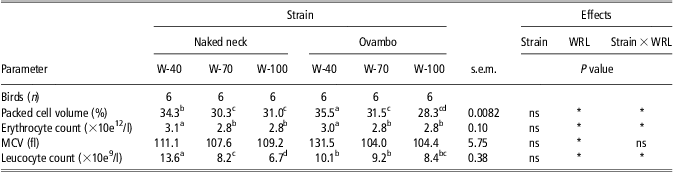
There was a significant interaction between strain and water restriction level on PCV, erythrocyte and leucocyte counts, except for MCV (Table 1). The NNK had a higher PCV than OVB chickens at ad libitum water consumption, but PCV values of the two strains were similar at 70% and 40% of ad libitum water access. The PCV of NNK birds fed 70% and 40% of ad libitum were about 2% and 11% higher than those on ad libitum water, respectively, while those of OVB chickens were 11% and 25% higher than of birds on ad libitum water intake. The erythrocyte counts of NNK and OVB chickens on 40% of ad libitum water was 9% and 11% higher than the ad libitum groups but not significantly different from those on 70% of ad libitum water consumption. MCV did not differ between OVB and NNK chickens, but was significantly affected by water restriction such that MCV averaged over strains was higher in birds fed 40% of ad libitum intake (121.3 ± 4.07 fl) than 70% of ad libitum (105.8 ± 4.06 fl) and ad libitum water intake (106.8 ± 4.07 fl). NNK had high and low leucocyte counts at 40% and 70% of ad libitum water restriction levels, respectively, than OVB chickens at the same restriction levels.
Effect of water-restriction level on haematological parameters of Naked Neck and Ovambo chickens
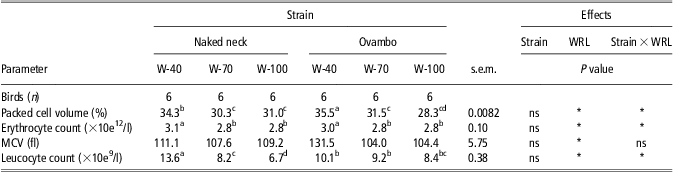
WRL = water restriction level; MCV = mean corpuscular volume.
Values of each parameter in a row with different superscript differ significantly (P < 0.05); W-40: 40% of ad libitum water consumption; W-70: 70% of ad libitum water consumption; W-100: ad libitum water consumption; s.e.m., standard error of mean; ns: not significant at P < 0.05; *P < 0.05.
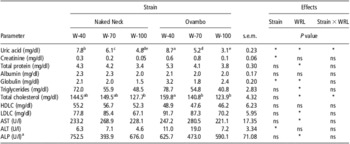
A significant interaction was observed between strain and water restriction level on serum UA concentration (Table 2). Serum UA concentration was higher in NNK than OVB chickens only at ad libitum and 70% of ad libitum water consumption. CREAT concentration was higher (P < 0.05) in OVB (0.5 ± 0.04 mg/dl) than NNK (0.2 ± 0.04 mg/dl) chickens. No significant effects of water restriction levels or interaction between strain and water restriction level were observed for this parameter (Table 2).
Effect of water restriction level on serum biochemical parameters of Naked Neck and Ovambo chickens

WRL, water restriction level; HDLC = High density lipoprotein cholesterol; LDLC = Low density lipoprotein cholesterol; AST = aspartate transaminase; ALT: alanine transaminase; ALP, alkaline phosphatase.
Values of each parameter in a row with different superscript differ significantly (P < 0.05); W-40: 40% of ad libitum water consumption; W-70: 70% of ad libitum water consumption; W-100: ad libitum water consumption; s.e.m.: standard error of mean; ns: not significant at P < 0.05; *P < 0.05.
TP and GLOB content were significantly influenced by water restriction level (Table 2). TP content was higher (P < 0.05) in birds on restricted water intake than those with free access to water, while GLOB content was higher (P < 0.05) at the most severe water restriction than at 70% of ad libitum and ad libitum water intake. No significant effect of strain or interaction between strain and water restriction level was observed on both parameters. ALB concentration was not affected by strain and water restriction level.
Water restriction level had a significant influence on TGAs and low-density lipoprotein concentration (Table 2). TGA concentration increased with each increment in water restriction (Table 2). Similarly, LDLC increased with increasing water restriction, but there were no differences (P > 0.05) between birds on 70% and 40% of ad libitum intake (Table 2). Water restriction level had no effect (P > 0.05) on serum HDLC. A significant interaction was noted between strain and water restriction level for TC (P < 0.05). TC increased with increasing water restriction from ad libitum to 40% of ad libitum in OVB chickens, but such a response was seen only up 70% of ad libitum water restriction in NNK (Table 2). Strain and water restriction had no effect on HDLC and there was no interaction between strain and water restriction level.
There was no significant difference (P > 0.05) between the strains for aspartate transaminase and alkaline phosphatase (ALP) activity (Table 2). However, ALT activity showed significant differences between strains. ALT concentrations were significantly higher in OVB than NNK chickens (Table 2). Conversely, the activities of AST and ALP showed significant differences among water restriction levels (Table 2). AST concentrations were higher (P < 0.05) in birds fed 70% of ad libitum compared with the rest of the other water restriction levels, which were similar. In contrast, the lowest (P < 0.05) ALP concentrations were recorded in birds fed 70% of ad libitum, compared with the rest of the water restriction levels.
Discussion
Analysis of normal haematocrit values of indigenous chickens is fundamental in diagnosing various pathological and metabolic disorders. The observed increase in PCV with severity of water restriction suggests a depletion of plasma water that, consequently, reduced plasma volume and leading to possible haemoconcentration (Woerpel and Rosskopf, Reference Woerpel and Rosskopf1984). The observation that the PCV of birds exposed to 70% of ad libitum water intake was similar to those of birds with free access to water suggests that normal plasma volume was maintained. Similar findings were reported for White Leghorn pullets which were shown to maintain a constant plasma volume during dehydration, probably by drawing water from extravascular spaces to buffer any losses of vascular water (Arad et al., Reference Arad, Horowitz, Eylath and Marder1989).
The observation that erythrocyte counts for NNK and OVB chickens increased with increasing severity of water restriction is likely a consequence of haemoconcentration and agrees with Maxwell et al. (Reference Maxwell, Robertson, Spence and Mccorquodale1990), who reported increases in erythrocyte concentration in water-restricted broilers. In contrast, Pires et al. (Reference Pires, Malheiros and Boleli2007) and Iheukwumere and Herbert (Reference Iheukwumere and Herbert2003) observed reduction in erythrocyte counts of water-restricted broilers, indicating that the intensity of the erythrocytic response elicited in a bird depends, to a large extent, on the breed and degree of water restriction to which a bird is subjected. The erythrocyte counts of NNK and OVB birds with free water access and those on restricted water intake were, however, lower than the 3.36 to 4.46 (×10e12/l) range reported for Nigerian Naked Neck and 3.72 to 4.12 (×10e12/l) for normal feathered ecotypes (Ladokun et al., 2008). Erythrocyte counts aid in the characterization of anaemia and serve as useful indices of bone marrow capacity to produce red blood cells (Awodi et al., Reference Awodi, Ayo, Atodo and Dezende2005). Thus, the observed low erythrocyte counts recorded for birds in the different water restriction levels indicate a likely high susceptibility to anaemia-related disease conditions. This is corroborated by the fact that chickens in the current study had higher MCV than the range of 88 to 94fl reported for Nigerian native chickens, which could be attributed to release of immature red blood cells into the blood system (Peters et al., Reference Peters, Ikeobi, Ozoje and Adebambo2002).
The finding that leukocyte counts were elevated in severely restricted birds agrees with Maxwell et al. (1992), who showed that immune status of birds change with the intensity and type of stress to which they are exposed. Nutritional and environmental stresses induce leucocytosis and lymphopenia (Maxwell, Reference Maxwell1993).The leucocyte counts of NNK and OVB chickens on ad libitum water intake were higher than the range of values of 5.56 and 5.66 (×10e9/l) in normal feathered and Naked Neck chickens in Nigeria, respectively (Peters et al., Reference Peters, Ikeobi, Ozoje and Adebambo2002). High leucocyte counts might be an adaptation of NNK and OVB chickens to chronic stress and diseases (Campbell and Coles, Reference Campbell and Coles1986). Shaniko (Reference Shaniko2003) reported that leucocytes in avian species serve a phagocytic role and are responsible for defending the body against infections, and, as such, are routinely used as indicators of stress responses and sensitive bio-makers of immune functions.
Differences in UA concentration between OVB and NNK chickens at the most severe water restriction level may be attributed to possible variation in the rate of glomerular filtration rate between the two breeds. According to Ahmed and Alamer (Reference Ahmed and Alamer2011, the increase in blood UA in water restricted birds is largely a result of greater water uptake by the kidneys and decreased blood flow towards the urinary apparatus that causes a reduction of urine and increased blood urea concentration. Water restriction to 40% of ad libitum in OVB may have elicited greater water conservation mechanisms, which resulted in reduced excretory moisture in relation to NNK chickens. In this context, higher UA levels in OVB than NNK chickens at the most severe water restriction imply that the former are more adapted to water scarce environments. The higher UA concentration in OVB than NNK chickens could also be explained by changes in urea excretion and reabsorption as suggested by Skadhauge (Reference Skadhauge1981) who reported a substantial reabsorption of filtered urea, facilitated by low urine flow, leading to a rise in the serum level of this metabolite.
The elevated CREAT concentrations in water-restricted birds relative to birds on ad libitum water in both strains could be attributed to muscle wasting and increased CREAT phosphate catabolism during periods of water insufficiency (Bell et al., Reference Bell, Esmilie-Smith and Patterson1972). The observation that OVB chickens had higher CREAT concentration than NNK at the most severe water restriction level can be attributed to greater protein catabolism for metabolic water production as an adaptive attribute during periods of water insufficiency. Creatinine content in blood has been reported to vary with the quantity and quality of protein supplied in the diet (Iyayi and Tewe, Reference Iyayi and Tewe1998). This reason, however, cannot be advanced for the variation observed in this study where all birds were exposed to the same diet and environmental conditions. Therefore, the observed variation could only be because of strain differences and water restriction level.
TP, ALB and GLOB concentrations are often used to assess the hydration status of birds, with high levels indicating dehydration, because of concentration in a reduced volume of plasma (Cork and Halliwell, Reference Cork and Halliwell2002). Serum TP and GLOB concentrations were significantly elevated in water-restricted birds. The increase in serum TP values may also have been caused by an increased protein breakdown to maintain physiological functions during periods of water insufficiency (Katanbaf et al., Reference Katanbaf, Jones, Dunnington, Gross and Siegel1988). The lack of increase in ALB concentrations in water-restricted birds could be attributed to ALB depletion because of reduced feed intake (Iheukwumere and Herbert, Reference Iheukwumere and Herbert2003). Similarly, Arad et al. (Reference Arad, Arnason, Chadwick and Skadhauge1985) found that there were no alterations in ALB in Sinai and White Leghorn hens with 48 h of water deprivation under severe hot conditions.
The increase in TGAs and TC levels with increasing water restriction can be attributed to increased fat mobilization for metabolic water production (Ahmed and Alamer, Reference Ahmed and Alamer2011). The observation that OVB had higher TC levels at the most severe water restriction than NNK reflects a greater capacity of the former to mobilize body fat reserves to obtain metabolic water. However, the low TC levels of NNK than OVB chickens under severe water restriction could be a reflection of a more frugal use of body water and hence superior adaption to water scarcity. The observed increase in LDLC with increased severity of water restriction, irrespective of strain, is undesirable and puts birds at greater risk of heart attack because of arteries narrowed by atherosclerosis (Peebles et al., 2004). Excess LDLC forms plaques on the inner walls of arteries which slow down blood flow to the heart leading to anthrosclerosis or hardening of arteries.
The observation that water restriction levels of 40% of ad libitum and ad libitum resulted in equal concentrations of aspartate transaminase is difficult to explain. A similar trend was observed for ALP activity except that the levels were significantly depressed at 70% of ad libitum water consumption. Aspartate transaminase concentrations have been shown to increase with increasing severity of water restriction in broilers indicating possible liver, heart or skeletal muscle damage (Fasina et al., Reference Fasina, Ologhobo, Ayoada, Adeniran and Adeyemi1999). The observation that water restriction did not alter ALT and alkaline phosphatase concentrations shows that the integrity of the liver was preserved, since elevated values for these parameters are associated with cellular necrosis of this organ. Similar findings were reported by Iheukwumere and Herbert (Reference Iheukwumere and Herbert2003) who found no effect of water restriction on the activities of these enzymes in severely water-restricted Anak broilers.
Conclusions
The elevation of PCV, erythrocyte and leucocyte counts in NNK chickens only occurred at 40% of ad libitum intake, indicating a greater capacity of the breed to withstand moderate water restriction than OVB. The high UA concentration in OVB than NNK at the most severe water restriction might suggest a decline in excretion rate of urea. Lower serum CREAT levels in NNK than OVB at the most severe water restriction indicates a reduced mobilization of muscle CREAT phosphate for metabolic water production, which suggests an enhanced capacity to withstand severe water restriction than the latter. Irrespective of strain, water restriction led to haemoconcentration. The high TC concentration in OVB suggests a greater capacity to mobilize body fat reserves to obtain metabolic water than NNK chickens, however, the low TC levels of NNK chickens at the most severe water restriction level could be a reflection of a more frugal use of body water, and hence superior adaption to water scarcity compared with OVB chickens. The high low-density lipoprotein levels at the most severe water restriction level, in both strains is undesirable and puts birds at greater risk of atherosclerosis. ALT activity indicated that liver function was not affected in both breeds. It is likely that NNK chickens could be more reliant on metabolic water to maintain homeostasis than OVB birds.
Acknowledgements
The authors wish to thank the National Research Fund (NRF), South Africa for funding the study and staff at Cedara College of Agriculture Poultry Unit for the technical assistance rendered.