There has been increasing interest in recent years in the examination of Gene × Environment interactions in the context of developmental risk for psychiatric outcomes in humans. Based on the differential susceptibility hypothesis, individuals are differentially affected by experiences or qualities of the environment that they are exposed to over the course of development, due to preexisting heightened biological sensitivity factors (Belsky, Reference Belsky1997; Belsky, Bakermans-Kranenburg, & van Izendoorn, Reference Belsky, Bakermans-Kranenbur and van IJzendoorn2007). The differential susceptibility hypothesis goes beyond the description of individuals and biological variables as fixed risk factors (e.g., diathesis–stress model), instead adopting the concepts of sensitivity (Boyce & Ellis, Reference Boyce and Ellis2005) and susceptibility factors (Belsky et al., Reference Belsky, Bakermans-Kranenbur and van IJzendoorn2007) to describe complex developmental interactions among them. In addition, recent development in this model has begun to redefine “environment” as not only a range of factors originating from the external environment (Caspi et al., Reference Caspi, McClay, Moffitt, Mil, Martin and Craig2002, Reference Caspi, Moffitt, Taylor, Craig and Harrington2003; Fox et al., Reference Fox, Nichols, Henderson, Rubin, Schmidt and Hamer2005; Rutter, Moffitt, & Caspi, Reference Rutter, Moffitt and Caspi2006) but also factors arising from the individual's endogenous environment, which are considered to play an equally important role in human behavior (e.g., Schmidt, Fox, Perez-Edgar, & Hamer, Reference Schmidt, Fox, Perez-Edgar and Hamer2009).
There is increasing scientific consensus to suggest that brain mechanisms involved in the manifestation of various psychopathologies may be mediated by complex interactions associated with otherwise normal variations in genes that code for neurotransmitter systems, neurotrophic factors, or neural plasticity (e.g., Duman, Heninger, & Nestler, Reference Duman, Heninger and Nestler1997; Manji, Drevets, & Charney, Reference Manji, Drevets and Charney2001; Nestler et al., Reference Nestler, Barrot, DiLeone, Eisch, Gold and Monteggia2002). One of the most commonly studied of these is the serotonin transporter linked polymorphic region (5-HTTLPR) single nucleotide polymorphism (SNP), which is the promoter region of the serotonin transporter (5-HT) gene. This region is characterized by pairs of short and long alleles (i.e., short/short [S/S], long/short [L/S], long/long [L/L]; Lesch et al., Reference Lesch, Bengel, Heils, Sabol, Greenberg and Petri1996). Although the long and short polymorphisms produce the same protein, the short allele has been associated with an approximately three times lower basal activity than the long allele (Hariri et al., Reference Hariri, Mattay, Tessitore, Kolachana, Fera and Goldman2002; Lesch et al., Reference Lesch, Bengel, Heils, Sabol, Greenberg and Petri1996).
Early accounts based on the diathesis–stress model observed that the presence of the short allele on 5-HTTLPR moderated the depressogenic effects of stressful events (Caspi et al., Reference Caspi, Moffitt, Taylor, Craig and Harrington2003). In contrast, recent evidence has suggested that children with at least one long allele manifest behavioral resilience against affective disorders, whereas children homozygous for the 5-HTTLPR short allele appear to be more susceptible to the depressogenic effects of stress (L/S, L/L; Bogdan, Agrawal, Gaffrey, Tillman, & Luby, Reference Bogdan, Agrawal, Gaffrey, Tillman and Luby2014; Caspi et al., Reference Caspi, Moffitt, Taylor, Craig and Harrington2003 Hankin et al., Reference Hankin, Nederhof, Oppenheimer, Jenness, Young and Abela2011; Pluess, Belsky, Way, & Taylor, Reference Pluess, Belsky, Way and Taylor2010; for a meta-analysis, see also Karg, Burmister, Shedden, & Sen, Reference Karg, Burmeister, Shedden and Sen2011; but see also Risch et al., Reference Risch, Herrell, Lehner, Liang, Eaves and Hoh2009). Furthermore, the results of a recent meta-analysis also support the hypothesis that individuals carrying the less efficient, short allele of the 5-HTTLPR exhibit higher amygdala reactivity when exposed to negative or arousing environmental stimuli (Munafo et al., 2008; Murphy et al., Reference Murphy, Norbury, Godlewska, Cowen, Mannie and Harmer2013; Pezawas et al., Reference Pezawas, Meyer-Lindenberg, Drabant, Verchinski, Munoz and Kolachana2005).
Simultaneous to research on normal variation in 5-HTTLPR as a genetic susceptibility marker for later psychopathology, frontal electroencephalography (EEG) asymmetry has similarly been evaluated as a putative marker for endogenous susceptibility for affective disorders (e.g., Schmidt et al., Reference Schmidt, Fox, Perez-Edgar and Hamer2009; for a recent discussion, see Schmidt & Moscovic, Reference Schmidt and Miskovic2013). Lateralized differences in electrocortical activity were recorded over the dorsolateral prefrontal cortex with a frequency of 8 to 13 Hz in adults, defined as alpha band activity, where lower alpha power is believed to be associated with more activity in underlying cortical brain regions (Coan & Allen, Reference Coan and Allen2003; Davidson, Jackson, & Kalin, Reference Davidson, Jackson and Kalin2000). The most extensively investigated and reliable correlate of frontal activity is found in the frontal asymmetry difference score, which reflects the difference between homologous measures of EEG alpha power measured over left and right frontal electrode sites (Allen & Kline, Reference Allen and Kline2004; Coan & Allen, Reference Coan and Allen2003; Davidson, Reference Davidson2004; Schaul, Reference Schaul1998). This frontal EEG asymmetry measure has been used extensively as an index in a variety of populations, suggesting the existence of a reliable neural signature of cognitive and behavioral tendencies (Davidson, Ekman, Saron, Senulis, & Friesen, Reference Davidson, Ekman, Saron, Senulis and Friesen1990). Specifically, approach-related behaviors and positivity have been associated with leftward frontal asymmetry, whereas rightward frontal asymmetry has been associated with withdrawn behaviors and negative affectivity (for a review, see Coan & Allen, Reference Coan and Allen2003; see also Dawson et al., Reference Dawson, Klinger, Panagiotides, Lewy and Castello1995; Nusslok et al., Reference Nusslock, Shackman, Harmon-Jones, Alloy, Coan and Abramson2011; Tomarken, Dichter, Grber, & Simien, Reference Tomarken, Dichter, Garber and Simien2004).
In addition to associations with approach/withdrawal tendencies, early accounts have suggested an association between patterns of frontal EEG asymmetry and children's levels of internalizing and externalizing behaviours that have been observed as early as toddlerhood (Calkins & Dedmon, Reference Calkins and Dedmon2000; Feng, Shaw, & Silk, Reference Feng, Shaw and Silk2008; Fox Reference Fox1991, Reference Fox1994; Smith & Bell, Reference Smith and Bell2010). Based on the approach–withdrawal model, greater right frontal asymmetry (i.e., greater relative right frontal activation) has been hypothesized to be associated with internalizing symptomatology and greater left frontal asymmetry associated with a lack of ability to control approach behaviors, which might lead to externalizing behaviors (Davidson, Reference Davidson1993; Fox, Reference Fox1991).
Aiming to provide a greater specification on how resting EEG asymmetry moderates outcomes of psychopathology, two main theoretical hypotheses for the role of EEG asymmetry have been developed: (a) EEG asymmetry as an afferent filter or state marker, and (b) EEG asymmetry as an efferent filter or trait marker (for a review, see Coan & Allen, Reference Coan and Allen2003). The most common method for distinguishing trait versus state markers in this area of research has been to expose participants to different experimental contexts or conditions, such as negative versus neutral stimuli, and to assess whether frontal EEG patterns and relationships are affected by this experimental manipulation of participant “state” or, instead, are a consistent “trait” of the participant across these state manipulations (for a review, see Coan & Allen, Reference Coan and Allen2003). However, evidence suggests that the most reliable practice for the field would be to consider both the state and the trait indices of frontal EEG asymmetry (Jackson et al., Reference Jackson, Mueller, Dolski, Dalton, Nitschke and Urry2003).
Despite the clear similarities and overlap in the EEG and 5-HTTLPR areas of research, there is currently very limited research on the putative relationship between the 5-HTTLPR genotypes and frontal EEG asymmetry. Only the results of one recent EEG study of adult participants have suggested an advantage of 5-HTTLPR long allele carriers compared to S/S homozygotes when exposed in negative emotion cues exhibiting an approach related leftward frontal activation. However, unlike the vast majority of EEG asymmetry research, which has focused on the frontal asymmetry as a positivity/negativity trait (vs. state) marker, this study reported that effects were only evident when participants were exposed to a video containing traumatic content, and not during the observation of a neutral visual display (Papousek et al., Reference Papousek, Reiser, Schulter, Fink, Holmes and Niederstätter2013). One additional study has reported a small impact of 5-HTTLPR on frontal EEG asymmetry during rest in sites F7/F8 in adults, as well as an interaction between 5-HTTLPR and major depressive disorder in frontal activation over the areas F1/F2 (Bismark et al., Reference Bismark, Moreno, Stewart, Towers, Coan and Oas2010). In addition, in the same study, an interaction between the serotonin receptor HTR1a high uptake genotype and lifetime major depressive disorder status was evident in predicting more relative left asymmetry in the F1/F2 regions. It is interesting that, in line with this evidence, recent developmental functional magnetic resonance imaging (fMRI) studies have shown associations between age, cortical thickness over the right ventral PFC, and affective symptomatology (Ducharme et al., Reference Ducharme, Albaugh, Hudziak, Botteron, Nguyen and Truong2013). Given the developmental nature of existing models of risk/resilience for childhood psychopathology (Pluess & Belsky, Reference Pluess and Belsky2009), studying relationships between different susceptibility factors in children is critical to furthering our understanding of the developmental pathways to the manifestation of affective disorders. However, developmental studies that directly examine the mechanisms via which these genetic and environmental factors interact are notably absent from the extant literature.
In the current investigation, we will examine the role of state versus trait characteristics in frontal EEG asymmetry and behavior and its associations with normal variation in genetic SNP genotypes by placing participants into two state contexts: social video watching and nonsocial video watching. Extensive, robust evidence has shown that social stimuli are of critical value and importance for humans from birth through the full life span (for a review, see Grossmann & Johnson, Reference Grossmann and Johnson2007; Ronald, Happe, & Plomin, Reference Ronald, Happe and Plomin2005). Thus, if frontal EEG asymmetry associations with genotype vary according to social versus nonsocial video context, then this will suggest that the relationships observed are state dependent. Alternatively, if frontal EEG asymmetry associations with genotype are robust to the social versus nonsocial video context, then this will suggest that the relationships observed are trait dependent.
We recorded EEG alpha power over left and right prefrontal cortex (F1–F2, F3–F4) while 70 children aged between 4 and 6 years watched videos of people (social) versus objects (nonsocial). Due to the documented sparse connections between the dorsal areas of the frontal lobe (F3–F4) and the amygdala (McDonald, Reference McDonald1998) and the evidence suggesting a direct modulation of the amygdala from the orbitofrontal cortex (F1–F2; Ochsner & Gross, Reference Ochsner and Gross2008), here we include the pair area F1–F2 of the frontal lobe, aiming to uncover the previously documented serotonin genotype effects related to these frontal regions (Bismark et al., Reference Bismark, Moreno, Stewart, Towers, Coan and Oas2010). Given the putative link among the 5-HTTLPR long allele, high serotonin availability, and positive affectivity, we grouped our participants in three genotype groups according to homozygocity for the long allele (L/L; N = 24), heterozygotes (L/S; N = 33), and those homozygous for the short allele (S/S; N = 13). As a comparison control analysis, participants were also genotyped for the catechol-O-methyltransferase (COMT) Val158Met polymorphism, which is involved in the metabolism of prefrontal cortex dopamine (Bruder et al., Reference Bruder, Keilp, Xu, Shikhman, Schori and Gorman2005) with the methionine variant reported to be three to four times less active than the valine variant, resulting in less efficient COMT degradation for methionine allele carriers (e.g., Lachman et al., Reference Lachman, Papolos, Saito, Yu, Szumlanski and Weinshilboum1996; Shehzad, DeYoung, Kang, Grigorenko, & Gray, Reference Shehzad, DeYoung, Kang, Grigorenko and Gray2012; Tunbridge, Harrison, & Weinberger, Reference Tunbridge, Harrison and Weinberger2006).
Aiming to investigate possible associations between frontal EEG asymmetries and early affective symptomatology we hypothesized that the negativity patterns of greater right activation during the viewing of the social videos (state utilization of frontal EEG) will be associated with early affective manifestation, specifically internalizing symptomatology, as recorded by parent reports. Moreover, we hypothesized that there would be a selective relationship between the 5-HTTLPR genotype and state-dependent (social vs. nonsocial videos) frontal EEG asymmetry, with the presence of two copies of the short allele associated with a negative pattern of relatively greater right frontal asymmetry during social but not nonsocial processing. The existence of neurobiological mechanisms that may determine protection versus resilience against psychopathology early in life, may act as reliable indexes for better and worse outcomes later in life. The results of the study are supportive of the second hypothesis of the study, showing a selective association between the 5-HTTLPR genotype and trait-specific (independent of the social vs. nonsocial condition) approach/withdraw patterns of frontal activation (Vuga, Fox, Cohn, Kovacs, & George, Reference Vuga, Fox, Cohn, Kovacs and George2008).
Methods
Participants
Data from a total of 70 children aged between 4 and 6 years contributed to this study (mean age = 60.70 months, SD = 11.79; N = 38 males). Participants were recruited through a local community research participation advertisement/outreach program as part of the ongoing procedure at the Infant and Child Laboratory at the University of Birmingham. The parents or guardians of all participants reported that the child had no history of a neurological or psychiatric disorder and that they had normal or corrected to normal vision. Exclusion criterion included if participants scored below a certain range (IQ < 75) on the British Ability Scales (BAS II; Elliot, Smith, & McCulloch, Reference Elliot, Smith and McCulloch1996), a standardized assessment of intelligence/developmental age. Finally, because of the documented variations of serotonin genotype across studies using populations with higher short allele frequencies evidence in Asian samples compared to Western European samples (e.g., Kato et al., Reference Kato, Ikenaga, Wakeno, Okugawa, Nobuhara and Fukuda2005), and aiming to avoid stratification effects, all children in the sample were from Western European/White British ancestry.
Behavioral measures
For the assessment of children's cognitive ability the BAS II Early Years was employed (Elliot et al., Reference Elliot, Smith and McCulloch1996). BAS II is an age-standardized cognitive ability test, normed on UK children between 2 years, 6 months and 7 years, 11 months of age. BAS II has three main subscales that are employed to assess the most significant aspects of development, following particular scoring procedures: verbal reasoning, nonverbal reasoning, and spatial abilities. Mean age standardized T score values for BAS subscales have a mean of 100 and a standard deviation of 15. The scores of each ability cluster are combined to give an overall general conceptual ability, which is equivalent to IQ score.
For the assessment of children's emotional regulation abilities, the Child Behavior Checklist (CBCL) scales (Achenbach & Rescorla, Reference Achenbach and Rescorla2001) were completed by parents. The CBCL includes two different versions: the Early Years version (for children between 1.5 and 5 years of age) and the School Age version (children and adolescents aged 6–18 years). Both versions were used in the present study. The CBCL has been reported to have good psychometric properties and has a robust procedure for classifying symptoms in each subdomain (Achenbach & Rescorla, Reference Achenbach and Rescorla2001). Both the Early Years and the School Age versions' items are on a 3-point scale, ranging from not true to very true/often true, including open-ended items for describing additional problems. The scale has two main subscales that are structurally independent from each other (Achenbach & Rescorla, Reference Achenbach and Rescorla2001), which map externalizing and internalizing symptoms.
For the assessment of autism symptomatology, the Social Communication Questionnaire—Lifetime Edition (SCQ) was completed by parents (Rutter, Bailey, & Lord, Reference Rutter, Bailey and Lord2003). The SCQ is a valid and well-standardized screening assessment, completed by a parent or other primary caregiver. The SCQ is based on the Autism Screening Questionnaire (Berument, Rutter, Lord, Pickles, & Bailey, Reference Berument, Rutter, Lord, Pickles and Bailey1999), and in the Lifetime Form are included 40 yes/no questions that aim to measure aspects of the child's developmental history. A total score is provided after the administration that is interpreted based on the measure's cutoff criteria (total score > 15). The cutoff score indicates that a child may have an autism spectrum disorder and suggests that further clinical assessments may need to be conducted. The SCQ has been reported to have good psychometric properties, with the reliability coefficient for the total scale reported as α = 0.90, suggesting excellent internal consistency (Berument et al., Reference Berument, Rutter, Lord, Pickles and Bailey1999).
EEG assessment
EEG data were collected while children watched videos of social stimuli (adults speaking nursery rhymes) and nonsocial stimuli (dynamic computer-generated objects moving with contingent sounds). Similar stimuli have previously been used in infant and child EEG studies on temperament and emotion regulation (Marshall, Bar-Haim, & Fox, Reference Marshall, Bar-Haim and Fox2002). The videos were in the Windows Media Video format. They were recorded using a digital camera with a resolution of 720 × 576 color pixels and a frame rate of 25 frames/s on a video monitor at a viewing distance of approximately 70 cm, and therefore subtended a visual angle of 22.6° horizontal by 13.5° vertical (Graham, Reference Graham2014). The following parameters were used for all of the video recordings: data rate of 768 kilobytes per second (kbps), total bit rate of 89 kbps, frame rate of 25 frames/s, audio bit rate of 128 kbps, stereo audio samples rate of 44 kHz. Videos were presented with an average volume of 68 dB recorded at the child's head, using 2.1-Hz audio speakers. All video clips corresponded to a total duration of 30 s. Each condition lasts overall 6 min, with 20 different videos presented in each condition. Social and nonsocial conditions were counterbalanced both within and between participants, and each video was played once during the experiment, for a total of 12 min of data collection (6 min social videos, 6 min nonsocial videos).
Analysis of behavioral data
For the measures of cognitive abilities (BAS II) mean standardized IQ scores were assessed and compared between groups according to genotype. The CBCL 1½–5 and 6–18 versions provide raw values that can be converted to age-adjusted t scores if needed. All children in this study had t scores of less than 60 (below subclinical threshold). Raw scores from the two clusters of symptomatology (i.e., internalizing and externalizing symptoms) were used for statistical analysis following the authors' guidelines (Achenbach & Rescorla, Reference Achenbach and Rescorla2001, p. 89). Higher total scores in each CBCL subscale suggest the existence of more problematic behaviors. Autism symptomatology (SCQ) mean sum scores were calculated on the basis of raw scores. All children had an SCQ mean sum score of 12 or less.
Analysis of EEG data
EEG was recorded continuously using a 128-channel Hydrocel Geodesic Sensor Net (Electrical Geodesics, Inc., Eugene, OR), referenced to a single vertex electrode, Cz (sample rate = 500 Hz), using Net Station 4.3 data acquisition software. The stimuli were presented using E-Prime 2.0 software (Psychology Software Tools, Inc., Sharpsburg, PA).
EEG recordings were processed offline using Net station 4.5.1 software. The data were filtered offline with a high-pass filter at a cutoff frequency of 0.1 Hz and with a 50-Hz Notch filter prior to processing. Each data file was processed with a clinical segmentation tool, which segregated the EEG according to condition. Consistent with previous frontal EEG asymmetry research, after the overall inspection of the recording during which bad electrodes were identified, portions of data containing artifacts, including eye blinks, and participant movement were manually identified and removed for each condition separately (e.g., Forbes, Shaw, Silk, Feng, & Kovacs, Reference Forbes, Shaw, Silk, Feng and Kovacs2008; Smit, Posthuma, Boomsma, & de Geus, Reference Smit, Posthuma, Boomsma and de Geus2007). During this procedure, up to 12 bad electrodes were identified per participant, and the data from bad channels were replaced using a spherical spline interpolation algorithm (Srinivasan, Nunez, Tucker, Silberstein, & Cadusch, Reference Srinivasan, Nunez, Tucker, Silberstein and Cadusch1996). Similarly to previously published research utilizing the same EEG system that was utilized in the current experiment, the algorithms utilized are effective at replacing data in up to 10% of EEG electrode channels (e.g., Srinivasan et al., Reference Srinivasan, Nunez, Tucker, Silberstein and Cadusch1996), which would be 12 electrodes out of the 128 utilized in the current experiment. Therefore, segments with more than 12 bad channels were eliminated from further analysis. In the case that a considerable proportion of bad channels were located in the areas of interest (>3), the segment was also eliminated from further analysis. However, no participant had more than 3 bad electrodes in the areas of interest, and therefore no participant's partial or entire EEG data set was excluded based on this criterion, or due to poor EEG data. The remaining, artifact-free only, data were combined for each condition and participant and average referenced. To assess EEG power spectral density (PSD) asymmetry, the EEG data were exported in RAW format for use in a purpose-built Matlab-based program for data analysis. The MATLAB Version 7.1.0 program split the EEG data into 1-s epochs. Fast Fourier transforms were then calculated for each epoch using a 500-ms window with 60% overlap. The PSD in the alpha band was logged and averaged across epochs for each electrode group, in preparation for statistical analyses. Based on inspection of the power distribution at the midfrontal sites and previous developmental findings (Marshall et al., Reference Marshall, Bar-Haim and Fox2002), the alpha band was defined as 7–11 Hz for our 4- to 6-year-old participants. The research assistants who analyzed the EEG data were systematically trained and were experimentally blinded to participant genotype throughout the analysis process.
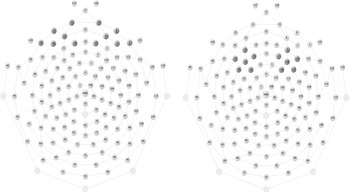
Clusters of left/right hemisphere electrodes (6 on each hemisphere) were used corresponding to positions F3 (electrode number 24) and F4 (electrode number 124) on the EGI index of coordinates, as well as additional clusters of left/right hemisphere electrodes (6 left and 6 right) over the positions F1 (electrode number 22) and F2 (electrode number 9; equivalent to the international 10–10 EEG coordinate system; see Luu, & Ferree, Reference Luu and Ferree2000; see Figure 1). To further investigate if the 5-HTTLPR genotype effects where specific to the frontal region, additional clusters of electrodes over the P3 (electrode numbers 47, 51, 52, 53, 59, 60) and P4 (electrode numbers 85, 86, 91, 92, 97, 98) parietal areas where selected for analyses. In accordance with long-standing practice, frontal asymmetry was computed as the power in the right hemisphere minus the power in the left hemisphere, which indexes the relative activation of left (over right) midfrontal sites (Coan & Allen, Reference Coan and Allen2003; Davidson et al., Reference Davidson, Jackson and Kalin2000). Thus, a negative asymmetry index score represents rightward EEG frontal alpha asymmetry (increased activity in the right frontal region), while a positive index score represents the left EEG frontal alpha asymmetry (increased activity in the left frontal region).
Electrode layout of left/right hemisphere electrodes over the (right) dorsolateral prefrontal cortex region and (left) orbitofrontal cortex region. Data were collected using a Geodesic Sensor Net Hydrocell 128-channel pediatric medium, large, and adult small sizes, based on standard sizing procedures for head circumference (Electrical Geodesics, Eugene, OR).

Genotyping
Genomic DNA was extracted from saliva samples using the Oragene OG-500 self-collection kit (Oragene, DNA Genotek Inc., Canada), according to the manufacturer's recommendations. DNA concentrations ranged from 65 to 962 ng/μl and the 260/280 ratio was between 1.8 and 2 for all samples. Genotyping results were successfully obtained for all 70 subjects.
5-HTTLPR genotyping
Direct bidirectional sequencing was used to genotype the 5-HTTLPR polymorphism. The region containing the 43 base pair (bp) insertion polymorphism was amplified using primers described by Hu et al. (Reference Hu, Lipsky, Zhu, Akhtar, Taubman and Greenberg2006) producing a 528-bp amplification product from the long allele and a 485-bp product from the short allele. A polymerase chain reaction (PCR) was performed using Megamix PCR solution (Microzone UK Ltd) in a total volume of 25 µl, containing 25 pmol of each primer and 3 µl of betaine. An initial denaturation step at 95 °C for 5 min was followed by 30 cycles of PCR (95 °C 1 min, 58 °C 1 min, 72 °C 1 min) and then a final extension at 72 °C for 10 min. PCR products were purified using Exonuclease I and Shrimp Alkaline Phosphatase (according to manufacturer's instructions). Then 10 µl sequencing reactions were generated containing 0.25 µl BigDye Terminator (v3.1, Applied Biosystems), 1.9 µl molecular grade water, 3 pmol forward or reverse primer, and 1 µl purified 5-HTTLPR PCR amplicon (diluted 1 in 2). Cycle conditions for sequencing included an initial denaturation step at 95 °C for 5 min followed by 30 cycles of 95 °C for 30 s, 50 °C for 10 s, and 60 °C for 4 min. The reaction products were purified using CleanSEQ® beads (Agencourt) in a 1:1 ratio as described by the manufacturer. Products were resuspended in 70 µl molecular grade water and analyzed on a 3730 Genetic Analyser (Applied Biosystems).
Allele frequencies across participants for 5-HTTLPR were n = 59 (42.1 %) for the short allele and n = 81 (57.9%) for the long allele. 5-HTTLPR genotype frequencies were in Hardy–Weinberg equilibrium, χ2 (1) = 0.077, p = .780, as calculated with a reliable online tool (available from http://www.tufts.edu/~mcourt01/Documents/Court%20lab%20-%20HW%20calculator.xls). We classified three groups of participants: one with homozygous for the short allele (18.6%; N = 13), one with heterozygotes (47.1%; N = 33), and one with participants homozygous for the long allele (L/L; N = 24). In follow-up analyses taking into account the variation in group classification in 5-HTTLPR studies, for example, the S/L group being classified differently in different studies (Hariri et al., Reference Hariri, Mattay, Tessitore, Kolachana, Fera and Goldman2002; Lee & Ham, Reference Lee and Ham2008), and aiming to provide a greater theoretical precision to the moderating effects of 5-HTTLPR gene variation (Walsh et al., Reference Walsh, Dalgleish, Dunn, Abbott, St Clair and Owens2012), we excluded S/L participants and compared the groups of homozygotes, for example, S/S (N = 13), L/L (N = 24).
COMT Val158Met genotyping
Direct bidirectional sequencing was used to genotype the SNP within the COMT gene (rs4680). PCR primers were designed to flank the polymorphism producing a 250-bp amplification product. Sequences of the primers are as follows: forward GGGCCTACTGTGGCTACTCA and reverse GGGTTTTCAGTGAACGTGGT. PCR was performed using Megamix PCR solution (Microzone UK Ltd) in a total volume of 25 µl containing 25 pmol of each primer. An initial denaturation step at 95 °C for 5 min was followed by 30 cycles of PCR at 95 °C for 1 min, 58 °C for 1 min, and 72 °C for 1 min, and then a final extension at 72 °C for 10 min. PCR products were purified and sequenced as described above for 5-HTTLPR genotyping.
Allele frequencies for the COMT Val158Met was n = 71 (50.7%) for valine alleles and n = 69 (49.3%) for methionine alleles, respectively. Following a similar strategy with the 5-HTTLPR genotype grouping that allowed direct comparisons between SNPs, we also generated three genotype groups for the COMT Val158Met polymorphism, that is, Met/Met (N = 14), Val/Met (N = 41), and Val/Val (N = 15). COMT Val158Met genotype frequencies were in Hardy–Weinberg equilibrium, χ2 (1) = 2.06, p = .150. Consequently, aiming to provide a greater theoretical precision to the moderating effects of the COMT Val158Met gene variation in follow-up analyses, heterozygous participants were excluded to compare the two homozygous groups, for example, Val/Val (N =15) and Met/Met (N =14).
Statistical analysis
Our analysis is based on 70 children between 4 and 6 years of age from Western European/White British ancestry. Descriptive statistics were conducted in order to describe the sample's demographic characteristics, including gender, age, and distribution of cognitive abilities. Raw data from the behavioral and cognitive scales were examined for normality using Kolmogorov–Smirnov tests. CBCL subscales did not meet criteria for normal distributions (Kolmogorov–Smirnov, p < .05). Therefore, to further examine possible correlations among age, gender, IQ, and scores on the behavioral measures, Spearman rho nonparametric correlations coefficients tests were also performed. Further correlation analyses were conducted to investigate possible correlation between raw EEG recording and asymmetry ratios, with participants' demographic characteristics. Pearson correlation analyses were conducted to determine if a correlation among demographic characteristics or cognitive performance and genotype group was evident. Further one-way analyses of variance (ANOVAs) were conducted to investigate possible correlations between 5-HTTLPR or COMT Val158Met genotypes and demographic, cognitive, and affective symptomatology in the sample. Moreover, correlation analyses between asymmetry group (left vs. right asymmetry) and demographic characteristics were also conducted. In addition, Spearman rho correlations were conducted between the two clusters of internalizing and externalizing symptomatology and the PSD and ratio values from the EEG data for each condition and hemisphere separately.
Moreover, to examine if the amount of artifact-free EEG data was systematically differ among the 5-HTTLPR and COMT Val158Met genotype groups, separate one-way ANOVAs were conducted. Furthermore, to assess if the amount of excessive frontal or parietal artifact (i.e., number of bad electrodes in the areas of interest) systematically differed among the three 5-HTTLPR and COMT Val158Met genotypes, additional one-way ANOVAs were conducted.
We conducted three-way ANOVAs with Condition (social, nonsocial), Hemisphere (left, right), and Region (F1–F2, F3–F4) as within factors and Sex (female, male) and Genotype (L/L vs. L/S vs. S/S) as between-groups factors. For an initial analysis, the PSD were studied. As a control analysis, we also conducted a two-way ANOVA with Condition (social, nonsocial) and Hemisphere (left, right) using PSD data from parietal regions (i.e., P3–P4). We then followed this initial omnibus ANOVA up with analysis of EEG asymmetry scores, by conducting t tests for each SNP using an average asymmetry ratio calculated for each participant. When the data did not satisfy Kolmogorov–Smirnov tests for normality, Mann–Whitney U or Kruskal–Wallis tests were performed instead of t tests. Finally, in order to evaluate the specificity of the 5-HTTLPR effect, this same analysis process was repeated for the COMT Val158Met polymorphism, as a control analysis.
Results
Demographic characteristics
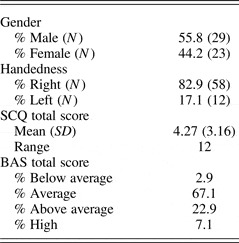
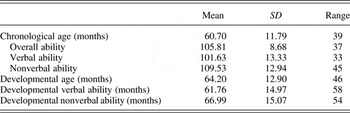
Participants included 70 children (n = 38 males) between 4 and 6 years of age. Tables 1 and 2 demonstrate participants' main demographic characteristics, such as gender, age, and cognitive abilities. One-way ANOVAs showed no significant correlations between 5-HTTLPR or COMT Val158Met genotypes and demographic and cognitive characteristics (see online-only supplemental Tables S.3–S.6). Similarly, one-way ANOVAs showed no significant correlations between 5-HTTLPR or COMT Val158Met genotypes and affective symptomatology. Moreover, asymmetry groups did not differ on demographic characteristics. Finally asymmetry frequencies did not differ between 5-HTTLPR or COMT genotype groups (see online-only supplemental Table S.2).
Sample size and demographic characteristics of sample (N = 70)

Participants general and age equivalent cognitive ability

Furthermore, Spearman rho correlation analyses showed a significant positive correlation between internalizing and externalizing symptoms (r = .350, p = .11). Co-occurrence between internalizing and externalizing clusters has previously been reported on the CBCL scales original standardization (Achenbach & Recorla, Reference Achenbach and Rescorla2001) as well as in a range of other studies (e.g., Card & Little, Reference Card and Little2006; Dietz, Jennings, Kelley, & Marshal, Reference Dietz, Jennings, Kelley and Marshal2009; Marsee & Frick, Reference Marsee and Frick2007).
Emotion regulation and EEG alpha activation/asymmetries
Spearman rho analyses did not revealed any significant correlation between children's internalizing and externalizing scores and frontal EEG activation.
A one-way ANOVA showed that the time of artifact-free EEG data did not differ systematically among the three 5-HTTLPR genotype groups (see also online-only supplemental Table S.1) for the social, F (2) = 1.65, p = .199, or for the nonsocial condition, F (2) = 0.96, p = .385. In a similar vein, amount of artifact-free EEG data did not differ systematically among the three COMT Val158Met genotype groups for the social, F (2) = 0.298, p = .744, or for the nonsocial condition, F (2) = 0.426, p = .655. Moreover, an additional one-way ANOVA showed that the number of electrodes of interest that were marked as bad channels did not systematically differ among the three 5-HTTLPR genotypes for the frontal, F (2) = 1.74, p = .182, and the parietal, F (2) = 0.63, p = .850, selected areas of interest. Similarly, no systematic difference was observed for the COMT Val158Met genotype groups for the frontal, F (2) = 0.019, p = .981, or the parietal, F (2) = 1.39, p = .254, selected areas of interest.
5-HTTLPR genotype group differences in frontal alpha asymmetry
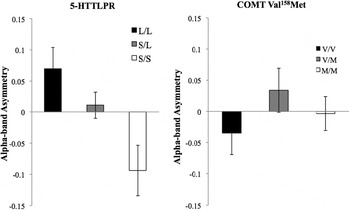
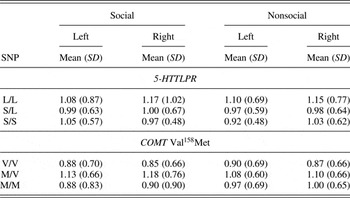
The ANOVA revealed a main effect of region, F (1, 64) = 35.50, p < .001, ηp 2 = 0.35, with less alpha activity (more activation) evident over the F1–F2 region compared with the F3–F4, as well as a two-way Hemisphere × Condition interaction, F (1, 64) = 5.08, p = .028, ηp 2 = 0.07, whereby higher activations were evident for the social condition over the right hemisphere (see Table 3). In addition, an interaction between hemisphere and 5-HTTLPR genotype, F (2, 64) = 5.69, p = .005, ηp 2 = 0.15, was observed, indicating differential frontal activation among the 5-HTTLPR genotype groups (see Table 3 and Figure 2).
Mean asymmetry index for (left) 5-HTTLPR and (right) COMT allelic variants. The data were collapsed across social/nonsocial condition. The frontal asymmetry was computed as the alpha power in the right hemisphere minus that in the left hemisphere. The error bars denotes one standard error of the mean. The bar chart supports the significant effect of 5-HTTLPR genotype group on frontal EEG asymmetry ratios (p = .005) described in the text, where long allele carriers consistently exhibited a positive pattern of leftward asymmetry, whereas children homozygous for the short allele are exhibiting a more withdrawn pattern of right asymmetry (negativity).

Means (standard deviations) of the logged alpha power spectral density in the frontal region among 5-HTTLPR and COMT Val158Met genotype

Note: The mean power spectral densities were consistently lower for the short-allele carriers than the long-allele homozygotes. This difference is more pronounced over the right hemisphere, suggesting a more withdrawn pattern of brain activation in participants with the homozygous short allele.
Specifically, a group with carriers of the 5-HTTLPR long allele (i.e., L/L; L/S) exhibited more leftward frontal activation, where S/S homozygotes manifested a more rightward frontal alpha activity pattern (see Table 3). No main effects or further interactions were observed. In order to evaluate the specificity of a link between frontal EEG activation patterns and 5-HTTLPR genotypes, the same analyses were repeated for the COMT Val158Met polymorphism, comparing the Met/Met and Val/Met and Val/Val genotypes. No significant COMT Val158Met genotype by hemisphere activation was observed when comparing the three COMT genotypes (i.e., M/M vs. M/V vs. V/V), F (1, 64) = 0.086, ηp 2 = 0.030, p = .373. Because a Kolmogorov–Smirnov test revealed that the PSD data used in this analysis, as well as the asymmetry ratio data, were not normally distributed (p < .05), this analysis was followed up with complementary nonparametric tests using the left/right asymmetry ratios, described earlier. A Kruskal–Wallis test was performed to further investigate the mean frontal asymmetry score ratio differences by the genotype (i.e., S/S, L/L, and S/L). This analysis revealed a significant effect of genotype group on the frontal EEG asymmetry ratios (p = .013), providing confirmatory support for the statistical interaction between hemisphere and genotype (see Figure 2 and Tables 3) observed in the initial ANOVA.
Furthermore, taking into account the variations in the classification methods for the 5-HTTLPR genotypes (e.g., in some studies, the long allele is recategorized as a short because when it is present alongside the G-allele of rs25531 SNP, it behaves like the short allele; Hu et al., Reference Hu, Lipsky, Zhu, Akhtar, Taubman and Greenberg2006; Wendland, Martin, Kruse, Lesch, & Murphy, Reference Wendland, Martin, Kruse, Lesch and Murphy2006; Zalsman et al., Reference Zalsman, Huang, Oquendo, Burke, Hu and Brent2006), and aiming to achieve a better understanding of the moderating effects of 5-HTTLPR gene variation (Walsh et al., Reference Walsh, Dalgleish, Dunn, Abbott, St Clair and Owens2012), the heterozygotes participants were excluded (i.e., L/S), and the initial analysis was repeated by comparing the two groups of homozygotes, for the 5-HTTLPR (i.e., L/L, N = 24; S/S, N = 13). The same analyses were also conducted using the homozygous groups of the COMT Val158Met genotypes (e.g., Val/Val N = 15 and Met/Met N = 14). Kolmogorov–Smirnov tests for these subgroups' data revealed that the PSD and asymmetry ratio data met criteria for a normal distribution (p > .05). Consistent with the initial classification results, the results of this follow-up ANOVA confirmed a two-way interaction between 5-HTTLPR genotype group and hemisphere, F (1, 33) = 8.32, p = .007, which was absent for the COMT Val158Met genotype (p > .05). Furthermore, consistent with the initial results, a t test revealed significantly higher frontal EEG asymmetry scores (leftward asymmetry) in the L/L compared with the S/S 5-HTTLPR group (p = .005).
Finally, in order to further investigate the specificity of the effects of 5-HTTLPR genotype to the frontal region, we conducted an additional two-way ANOVA with condition (social, nonsocial) and hemisphere (left, right) using alpha band PSD data recorded over left and right parietal regions (i.e., P3–P4 region). The results of this ANOVA did not reveal any 5-HTTLPR by parietal hemisphere activation, F (1, 66) = 0.284, ηp 2 = 0.004, p = .596, or other main or interaction effects.
Discussion
The present study was designed to examine the relationship between 5-HTTLPR genotypes and frontal EEG activity in young children. Consistent with our hypothesis, the results of this study indicated that normal variation in the 5-HTTLPR genotype was differentially associated with frontal lobe hemispheric activations in young children such that children homozygous for the short allele exhibited rightward (negative) frontal EEG hemispheric asymmetries, whereas those who carried the long allele exhibited leftward (positive) frontal EEG asymmetries. In contrast, normal variation in another genotype, the COMT Val158Met polymorphism, was not related to frontal EEG asymmetries in the current study (see Papousek et al., Reference Papousek, Reiser, Schulter, Fink, Holmes and Niederstätter2013). Furthermore, these relationships were not observed in data collected over the left/right parietal cortex, suggesting specificity of the observed relationships of 5-HTTLPR and EEG activity to the frontal cortex. The current results provide evidence for the existence of a neurobehavioral protection-related mechanism in individuals carrying the long allele of the 5-HTTLPR polymorphism that may act as a context-specific protective factor against later psychological maladjustment and withdrawal-related behavior patterns for young children. Consistent with recent evidence in adults, the current study results provide support for the involvement of multiple frontal regions in the pattern of more leftward activation (Bismark et al., Reference Bismark, Moreno, Stewart, Towers, Coan and Oas2010). To this end, the study provides supportive evidence for a synergy between serotonin levels and frontal activation in dorsolateral (F3–F4), but also in more ventral (F1–F2), regions of the frontal lobe, and associated withdrawal/negativity versus approach/positivity tendencies that have been found to be related to susceptibility for later psychopathologies.
An additional aim of the study was to investigate putative associations between early affective internalizing/externalizing symptomatology and frontal EEG activation in response to social and nonsocial videos. Somewhat inconsistent with previous research, no significant correlation between measures of early affectivity and trait or state-specific frontal EEG activation in response to social videos was evident. A possible explanation for this null effect might be that the variation in the children of our sample were in the normal range on internalizing and externalizing symptomatology. Compared to previous studies with youths, where significant behavior by frontal EEG associations were evident in children with a particular set of symptoms or traits, such as anxiety or shyness (e.g., Santesso, Becker, Schmidt, & Segalowitz, Reference Santesso, Becker, Schmidt and Segalowitz2006), the normal range of internalizing/externalizing symptomatology of our particular sample may explain the results of the study. However, it is worth mentioning at this point that research has shown that EEG frontal asymmetry is more directly associated with approach/withdrawal tendencies than with measures of internalizing/externalizing symptomatology (for a review, see Coan & Allen, Reference Coan and Allen2003). Furthermore, a recent meta-analysis determined that patterns of frontal EEG activation were not a strong predictor of emotional or behavioral problems in children (Peltola et al., 2014). Instead, the authors found that greater right frontal asymmetry was strongly associated with the presence of familiar stressors (Peltola et al., 2014). Therefore, future research is needed in order to further examine and understand the links between early behavioral neurophysiological patterns associated with approach versus withdrawal tendencies and putative links with behavioral and emotional problems during development.
The results of the current study open up the possibility that one of the key mechanisms via which homozygosity for the 5-HTTLPR short allele generates susceptibility for later affective-related psychopathologies is through reduced serotonin mediating rightward frontal cortex activity, which has been associated with cognitive and behavioral tendencies for withdrawal and negative affectivity. In contrast, the long allele’s association with approach-related tendencies in cognition and behavior, affective positivity, as well as some level of protective resilience against later affect-related psychopathologies, may be through serotonin-based mediation of leftward versus rightward frontal cortex activity. Taken together, the present evidence is consistent with previous neurofunctional evidence suggesting reduced gray matter volume in both the amygdala and the perigenual cingulate cortex, in individuals homozygous for the short allele, compared with high serotonin uptake long allele carriers (Pezawas et al., Reference Pezawas, Meyer-Lindenberg, Drabant, Verchinski, Munoz and Kolachana2005). Thus, the long allele appears to be associated with increased mediation of activity in a critical limbic structure (amygdala) by a paralimbic (cingulate cortex) region of the frontal cortex that is involved in emotion processing, goal seeking, and motivation (Munafò et al., Reference Munafò, Freimer, Ng, Ophoff, Veijola and Miettunen2008; Murphy et al., Reference Murphy, Norbury, Godlewska, Cowen, Mannie and Harmer2013; Pezawas et al., Reference Pezawas, Meyer-Lindenberg, Drabant, Verchinski, Munoz and Kolachana2005). Therefore, through these mechanisms and under a disadvantageous context, this genotype may influence the individual toward an increase in approach-related motivations and increased positive affectivity that characterize individuals with the neurophysiological signature of leftward frontal EEG asymmetries (Coan & Allen, Reference Coan and Allen2003; Dawson et al., Reference Dawson, Klinger, Panagiotides, Lewy and Castello1995; Tomarken et al., Reference Tomarken, Dichter, Garber and Simien2004).
The current findings are consistent with previous research that suggests that the presence of at least one 5-HTTLPR long allele may serve as a protective factor against negative affectivity and associated susceptibility for affective psychopathologies (Bogdan et al., Reference Bogdan, Agrawal, Gaffrey, Tillman and Luby2014; Hankin et al., Reference Hankin, Nederhof, Oppenheimer, Jenness, Young and Abela2011; Pluess et al., Reference Pluess, Belsky, Way and Taylor2010). Together, the current and previous findings suggest a novel cognitive/behavioral mechanism underlying this putative protection, which is that cognitive and behavioral approach tendencies associated with leftward frontal EEG patterns might be protective against the withdrawal and negative affectivity associated with affective psychopathologies. It is interesting that behavioral and cognitive–behavioral intervention approaches targeting behavioral engagement have been found to be effective in treating affect-related disorders, including anxiety disorders and major depression (Beck, Reference Beck2008; Dimidjian, Barrera, Martell, Munoz, & Lewinsohn, Reference Dimidjian, Barrera, Martell, Munoz and Lewinsohn2011; Dobson et al., Reference Dobson, Hollon, Dimidjian, Schmaling, Kohlenberg and Gallop2008). Moreover, recent studies have shown that 5-HTTLPR long allele homozygotes are less influenced by both negative and positive environmental changes, whereas 5-HTTLPR short allele carriers have been found to be more affected by external environmental influences and events (e.g., Belsky et al., Reference Belsky, Bakermans-Kranenbur and van IJzendoorn2007, Reference Belsky, Jonassaint, Pluess, Stanton, Brummett and Williams2009; for a meta-analysis, see van IJzendoorn, Belsky, & Bakermans-Kranenburg, Reference van Ijzendoorn, Belsky and Bakermans-Kranenburg2012). However, it is acknowledged that relatively greater right asymmetry may not act as a moderator of susceptibility alone. It is interesting that recent evidence has shown that individuals with greater right asymmetry in their early 20s with extreme low and normal birth weight exhibited moderate symptomatology of behavioral problems in their early 30s, whereas individuals with extreme low birth weight with left asymmetry at their early 20s reported significantly elevated attention and withdrawn-related symptoms (Fortier et al., Reference Fortier, Van Lieshout, Waxman, Boyle, Saigal and Schmidt2014). This evidence highlights the possibility that greater left instead of right frontal asymmetry may also act as a biological susceptibility construct under specific contexts. In a similar vein, a proportion of studies have failed to replicate the role of the short 5-HTTLPR allele as a vulnerability factor for affective disorders, suggesting that the documented effects may be moderated by additional effects of the individual's social environment (Kaufman et al., Reference Kaufman, Yang, Douglas-Palumberi, Houshyar, Lipschitz and Krystal2004) or gender factors (e.g., Eley et al., Reference Eley, Sugden, Corsico, Gregory, Sham and Craig2004). Taken together, although there is a plethora of evidence highlighting the role of 5-HTTLPR genotype (e.g., Caspi et al., Reference Caspi, Moffitt, Taylor, Craig and Harrington2003) and frontal asymmetry (for a recent meta-analysis, see Peltola et al., Reference Peltola, Bakermans-Kranenburg, Alink, Huffmeijer, Biro and van IJzendoorn2014), in placing an individual for susceptibility for negative versus positive affectivity, the documented synergy between these two susceptibility variants as documented in the present study and their reliability in predicting outcomes in the later life requires further investigation.
In the present study, our hypothesis involved a directional prediction for the relationship between the 5-HTTLPR SNP variants and frontal EEG activity asymmetry that is firmly grounded in the extant literature. This research design and method represents a recently established approach to understanding genetic mediation of brain mechanisms that may shape human behavior (e.g., Wiggins et al., Reference Wiggins, Bedoyan, Peltier, Ashinoff, Carrasco and Weng2012). In this regard, the current study utilizes a larger sample relative to most previous developmental neuroimaging genetic studies that employed fMRI (Stollstorff et al., Reference Stollstorff, Foss-Feig, Cook, Stein, Gaillard and Vaidya2010; Wiggins et al., Reference Wiggins, Bedoyan, Peltier, Ashinoff, Carrasco and Weng2012) or EEG/event-related potential (Althaus et al., Reference Althaus, Groen, Wijers, Mulder, Minderaa and Kema2009; Bertoletti, Zanoni, Giorda, & Battaglia, Reference Bertoletti, Zanoni, Giorda and Battaglia2012). The direction of the current results is similar to that of previous state-dependent EEG evidence in adults reporting an association between frontal EEG activity in response to observing aversive film scenes (Papousek et al., Reference Papousek, Reiser, Schulter, Fink, Holmes and Niederstätter2013). The present findings are also consistent with previous evidence from fMRI studies with older children reporting that the activity of the superior medial frontal cortex during rest is particularly sensitive to 5-HTTLPR variations (Wiggins et al., Reference Wiggins, Bedoyan, Peltier, Ashinoff, Carrasco and Weng2012). The relationship between 5-HTTLPR and frontal activation at rest in early childhood observed in the current study may help to bridge an existing gap between the previously reported structural and fMRI evidence on the effects of the 5-HTTLPR genotype and neural structures with lateralization of activity in the frontal lobe. Compared to recent evidence in adults reporting small (Bismark et al., Reference Bismark, Moreno, Stewart, Towers, Coan and Oas2010) or absent effects (Papousek et al., Reference Papousek, Reiser, Schulter, Fink, Holmes and Niederstätter2013) of 5-HTTLPR in frontal EEG during rest, the present findings may be attributable to the fact that the current sample consists of unaffected young children who are in an early developmental and neurobiological maturation stage of emotion regulation where, compared to adults, approach–withdraw related patterns of brain activation may be less affected by environmental influences. Future cross-sectional and longitudinal research in which the same experimental paradigms and procedures are used with groups of individuals at different ages will shed critical light on the role of 5-HTTLPR genotypes in influencing state and trait indices of frontal EEG asymmetry, across developmental time.
In sum, the results of the current study suggest that normal variation in 5-HTTLPR genotype is associated with frontal EEG hemispheric asymmetry patterns in young children. Previous research has found that both rightward frontal EEG asymmetry and the 5-HTTLPR short allele are associated with withdrawn cognitive/behavioral patterns and negative affectivity, whereas leftward frontal EEG asymmetry and the 5-HTTLPR long allele have been associated with cognitive/behavioral approach tendencies and positive affectivity. Furthermore, this normal variation in both 5-HTTLPR genotype and frontal EEG asymmetries has been associated with risk/resilience for later affective psychopathologies in young children. The current findings provide support for the hypothesis that these mechanisms are interrelated, and further suggest that the risk/resilience for later affective psychopathology associated with the 5-HTTLPR short versus long alleles may be related to variation in approach/withdrawal tendencies in cognition and behavior starting in early childhood.
Supplementary Materials
The supplementary materials for this article can be found online at http://dx.doi.org/10.1017/S0954579415000413.