Introduction
At around 8am on 18 February 1870, while heading to the post office in Dera Ismail Khan to collect letters, Private Felix Desnap was grabbed by the neck from behind and stabbed in the back with a dagger, just below the shoulder blade. Desnap's assailant then threw him to the ground, and attempted to stab him again. As the attacker plunged the dagger towards him, Desnap managed to seize it by the blade using both of his hands, cutting his left thumb to the bone and inflicting serious cuts to his right hand in the process. A struggle ensued and, with the help of a crowd of onlookers, Desnap was able to subdue his would-be assassin.Footnote 1 The individual responsible for the attack was a young Pashtun man named Ikhlas. According to his own testimony, Ikhlas had ‘wanted to kill an infidel’. ‘I had been looking out the last three days for an Englishman to kill,’ Ikhlas stated, and when ‘I got alongside the European soldier I drew my dagger and made a stab at him.’Footnote 2 Within hours of his arrest, Ikhlas was tried, sentenced, and executed. The lieutenant-governor of Punjab, D. F. McLeod, later wrote to Lieutenant-Colonel S. F. Graham, the commissioner of Derajat, commending him on the swift execution of ‘justice’ in this matter.Footnote 3
The law that enabled such a swift execution of justice in this case was Act XXIII of 1867, more popularly known as the ‘Murderous Outrages Act’.Footnote 4 First proposed as a response to a series of murders and attempted murders of British officials and their subordinates along the frontier, the Murderous Outrages Act granted colonial officials wide-ranging powers to prosecute individuals identified as ‘fanatics’ in Punjab, and later, Baluchistan and the North-West Frontier Province.Footnote 5 Under the articles of this law, any fanatic convicted of the murder or attempted murder of a European or those working in their employ was liable to death or transportation for life, with all their property being forfeited to the state.Footnote 6 No juries were allowed for these cases. Instead, the accused was tried by a tribunal consisting of a commissioner and two other executive officers with full magisterial powers.Footnote 7 Sentences were to be carried out immediately, with no need for review, and no appeals whatsoever being granted.Footnote 8 Court officers were even allowed to wilfully ignore evidence and witnesses if these were believed to have been ‘offered for the purpose of vexation or delay’.Footnote 9 Offenders tried under the Murderous Outrages Act were almost invariably executed, usually within a day or two of their arrest and trial (sometimes even on the same day, as in the case of Ikhlas).
In terms of its authoritarian and draconian provisions, the Murderous Outrages Act shares obvious linkages with earlier forms of highly coercive colonial legislation, such as the well-known Thuggee Act of 1836.Footnote 10 Another more direct harbinger of the Murderous Outrages Act was the Act for the Suppression of Outrages in the District of Malabar (Act XXIII of 1854), also known as the ‘Moplah Act’. Enacted in response to a series of violent attacks against non-Muslims, this law granted the colonial state extensive powers to detain, prosecute, and inflict extremely harsh punishments against members of Malabar's purportedly ‘fanatical’ Mappila community.Footnote 11 The Thuggee Act and Mappila Act were both remarkable pieces of legislation in that they were created by a British Indian government that claimed to be deeply concerned with the rule of law.Footnote 12 What makes the Murderous Outrages Act perhaps even more remarkable in comparison, however, is that it was passed during the height of the codification era, a period when India was gradually being placed under a new set of standardized legal codes. In addition to its renewed and vigorous emphasis on the rule of law, one of the main goals of codification was to ensure that colonial authorities adhered to a uniform procedure when administering the law.Footnote 13 The Murderous Outrages Act, however, gave officials sweeping authority to transgress these new judicial codes, based on claims that the exigencies of colonial governance along the North-West Frontier were somehow ‘different’ from the rest of India.Footnote 14 By empowering colonial officers to effectively overturn these laws and exercise such an extraordinary degree of personal authority, the Murderous Outrages Act seemed to fly in the face of these cherished British ideals about due and uniform judicial process—a point that was later readily seized upon by its Indian critics.Footnote 15 It is this tension that forms the focus of this article.
A great deal of recent scholarship has been devoted to the study of how the enaction of zones and moments of legal exclusion and exception across different colonial and imperial spaces enabled the violent operation of sovereign power.Footnote 16 Frontiers—as geographically remote, physically inaccessible regions populated by supposedly ‘backward’, ‘jungly’, and ‘tribal’ peoples who historically resisted the encroachment of imperial politiesFootnote 17—were especially conducive to the creation of regimes of legal exception. Colonial Bengal's North-East Frontier, for example, was home to a highly exceptional legal-political regime that relied heavily on the use of military force and coercion to subdue its so-called ‘tribal’ peoples.Footnote 18 The legacies of this particular colonial regime have since given rise in post-colonial India to what Sanjib Baruah has described as a deeply authoritarian and militarized political system that operates well beyond the normative ideals of Indian democratic institutions.Footnote 19 Frontiers, therefore, are both crucially physical and also abstract: physical in that they become geographically demarcated zones of corporeal violence, but abstract in that they are also the site of conceptual debates over the nature of imperial sovereignty and its attendant legal and political structures. It is through these debates, this article argues, that we can often glimpse the innermost workings of the different ‘logics’ that informed notions of imperial and colonial sovereignty.
As zones of exception, frontiers were regions where colonial power was stripped bare of its hallowed trappings; here, a much more brute and overt aspect of colonialism asserted itself. Thus, far from being merely anomalous blips that existed only at the peripheries of empire, these regimes of frontier governance can actually tell us a great deal about the priorities that underpinned colonial power at the centre. In the case of the Murderous Outrages Act, this article argues that this law—while shaped in part by the unique exigencies of governance along the North-West Frontier—actually drew upon and enabled a much more pervasive and widespread legal-political culture in British India: one which sought to maintain ‘illimitable’ forms of sovereignty and executive authority, but under the auspices of a ‘universal’ rule of law.Footnote 20 As we shall see, this was an idea that not even India's most prolific lawmakers and codifiers, including Henry Maine and James Fitzjames Stephen, really ever challenged. For them, the imposition of the rule of law did not necessarily entail the elimination of powerful executive authority. Instead, the first duty of law was to vouchsafe the security of the colonial regime. Rather than being a ‘lawless law’ inconsistent with British values of justice, many administrators, including Maine, came to view the Murderous Outrages Act as the precise opposite: as a law that was the pre-eminent signifier of the prevailing legalism of British colonial rule and its devotion to the rule of law. However, with its emphasis on the need for British officials to maintain the ‘sovereign’ authority to punish and kill wayward colonial subjects, this article argues that these conceptions of law and authority also possessed what might be characterized as a deeply ‘warlike’ quality to them as well. As such, this article also contributes to the wider debate taking place at the moment regarding the ways in which self-proclaimed liberal imperial powers reconciled values of universal rights and civilizational uplift with inequality, force, and violence in order to operate as deeply illiberal, coercive, and, in the case of the Murderous Outrages Act, as an essentially militaristic regime.Footnote 21
Colonialism, law, and ‘lawfare’
When the Murderous Outrages Act was enacted in 1867, India was in the midst of a sea change. This was the high tide of the codification movement, a period when British legislators were systematically re-imagining the entire basis of Indian jurisprudence. Although the need for legal codification had initially been accepted under the Charter Act of 1833, and a law commission under T. B. Macaulay had even been convened in 1834 to begin drafting legislation towards this end, codification in India made little headway until after the Indian Uprising of 1857. Between 1859 and 1872 successive law commissions enacted an array of sweeping legislation, including the Code of Civil Procedure (1859), the Indian Penal Code (1860), the Code of Criminal Procedure (1861), and the Evidence Act (1872). Codification was significant because it opened up the possibility of a new form of ‘scientific jurisprudence’ through the creation of substantive legal codes.Footnote 22 It also provided a renewed, and much-needed, moral justification for British imperial rule following the Uprising. This revamped legal project, it was reckoned, would finally liberate India from the tyranny of despotism, custom, and superstition by providing it with standardized, rational legal codes.Footnote 23 As Karuna Mantena puts it, by the end of the nineteenth century, ‘the rule of law had become . . . a de facto byword for the justification of British rule’ and was considered to be the ‘supreme gift imparted by imperial rule’.Footnote 24
However, while codification may have been widely championed in some circles, it was also viewed with equal suspicion and trepidation in others. Many of India's administrators in the 1860s and 1870s were quite wary of any form of substantive, institutionalized law, and were reluctant to openly embrace what promised to be a profound shift in the way India was governed. As Sandra den Otter has pointed out, these administrators believed that the extension of the rule of law was inimical to vigorous government, since it not only regulated the conduct of its colonial subjects, but also placed limits on the executive authority of colonial officials.Footnote 25 This was an especially difficult idea to sell in the wake of the nearly catastrophic Uprising of 1857, when it was widely believed that unrestrained despotism was the best form of rule for India.Footnote 26 As James Fitzjames Stephen, the law member for India between 1869 and 1872 and one of the staunchest proponents of codification, once remarked: ‘Nothing has struck me more forcibly in India than the almost inveterate prejudice in the minds of many district officers that law . . . is a sort of mysterious enemy to them which . . . will prevent all vigorous executive action.’Footnote 27 Viceroy John Lawrence (1864–69), whose term in office coincided with the drafting and enactment of the Murderous Outrages Act, was certainly sympathetic to the opponents of codification. As one of the architects of the so-called ‘Punjab school’,Footnote 28 Lawrence was one of the strongest advocates of the need for ‘patriarchal’, authoritarian governance which was not weighed down by regulations or excessive interference from superiors.Footnote 29 If the Uprising taught colonial officials one lesson, it was that colonial justice needed to be swift, severe, and exemplary if they were going to be able to keep their subjects in check and prevent a similar catastrophe from occurring again.Footnote 30
The codification debate, therefore, drew battle lines between two seemingly irreconcilable positions: those, like Lawrence, who supported the preservation of exceptional individual powers of discretionary authority, and those, like Stephen, who believed that British authority needed to be rooted in the rule of law. As this article will demonstrate, however, these two positions were never mutually exclusive.Footnote 31 Although the rule of law in colonial India after 1857 always involved a fine balancing act between these two positions, it was ultimately weighted more towards the exercise of executive authority. In this sense, then, British conceptions of colonial legality following the Uprising continued to be strongly shaped by the same sorts of debates and tensions that had characterized them during the preceding decades. Laws such as the Murderous Outrages Act or the Criminal Tribes Act of 1871 found their forerunners in earlier legislation like the Thuggee Act and the Moplah Act, and old debates over the relative merits of ‘non-regulation’ versus ‘regulation’ governance in India remained very much alive. It is quite telling, for instance, that in his seminal 1872 Minute on the Administration of Justice in British India, Stephen actually looked to the ‘almost unlimited discretionary power’ of Punjab's famous non-regulation system as a sort of ‘model’ for his own brand of codification.Footnote 32 Codification was thus never meant to erode executive power and weaken the position of India's ‘ruling race’; it was meant to bolster, strengthen, and reinforce it. This was a point that was made abundantly clear by Stephen himself, who argued that ‘the best possible security for executive vigour is to define precisely by express law thrown into the clearest and shortest form the amount of discretionary power to be given to judicial and executive officers’.Footnote 33 This article explores how the Murderous Outrages Act was deeply rooted in this idea of using law to actually bolster executive prerogative, rather than limiting it. Keeping in mind that it is problematic to talk about and analyse colonialism and colonial law as singular, monolithic categories,Footnote 34 it argues that the Murderous Outrages Act was therefore less a truly ‘exceptional’ piece of legislation than it was simply a signal example of a particular conception of law and order that pervaded British India both prior to and following 1857.
Recent work by Elizabeth Kolsky has demonstrated how colonial law upheld and excused quotidian forms of violence in India.Footnote 35 What this article would like to explore, however, are the ways in which law itself was used as a form of violence against the colonized. Designed as a ‘legal’ response to what was, in fact, viewed by many as a type of ‘frontier warfare’—an idea that will be elaborated upon later—the Murderous Outrages Act was a law that permitted colonial officials to assume the violent power of sovereignty on a regular basis, without recourse to any formal declaration of war, martial law, or any other state of emergency. As such, it was a signal example of what John and Jean Comaroff have referred to as ‘lawfare’—the use of legal codes, charters and warrants, administrative regulations, and states of emergency—to ‘impose a sense of order upon its subordinates by means of violence rendered legible, legal, and legitimate by its own sovereign word’.Footnote 36 The concept of lawfare provides an interesting way of approaching questions about the relationship between colonial law and the violence that was so often perpetrated by colonial statesFootnote 37 by enabling us to think about how, even when at its most violent and ‘criminal’, colonialism often sought to steep itself in the language of legitimacy and law. It also raises interesting questions about whether we might not be able to usefully invert Clausewitz's famous maxim—that war is a continuation of politics by other meansFootnote 38—and to start thinking about law, and the colonial political-legal regimes it buttressed, as the continuation of a type of warfare against the colonized.Footnote 39
In the case of the Murderous Outrages Act, this was a law that relegated those charged under its articles to a space where all legal rights and norms ceased to exist, and where the sovereign power to decide was essentially converted into the power to kill. It is in this guise, I would also like to argue, that sovereignty takes on a distinctly warlike quality, since it is ultimately based on destroying an enemy—either internal or external—who poses a perceived existential threat to society and the very foundations of political-juridical order. In the context of the Murderous Outrages Act and Punjab's North-West Frontier, this was a world in which every colonial official became a sort of front line ‘soldier’ against an endlessly insurrectionary colonial adversary, and where any means were justifiable in order to preserve the state against this enemy.
Protecting the Europeans of the frontier
Punjab's North-West Frontier was a region that was intimately associated with violence and turbulence throughout the British period. Between 1851 and 1867, a total of 703 murders were reported to have been committed in the Peshawar district alone.Footnote 40 This high incidence of violent crime and murder was largely attributed to the ‘character’ of the Pashtun inhabitants of the region, who were believed by the British to be socialized into violence and murder from birth. Like many other groups who operated at the margins of or within the interstices of the colonial regime,Footnote 41 the Pashtuns of the frontier were often portrayed by the British as a hereditary criminalized, ‘predatory’ community, prone to murder, theft, rapine, and pillaging.Footnote 42Pashtunwali, the ‘code of honour’ that governed various tribal practices and behaviour,Footnote 43 was seen by many British observers as little more than ‘a code which teaches that an unavenged injury is their deepest shame, a blade, well steeped in blood, their proudest badge’.Footnote 44 As G. R. Elsmie, the additional commissioner and sessions judge for Peshawar in 1873, put it, ‘there is evidently something in the air of the frontier which rouses brutality in every Mahomedan’.Footnote 45
The earliest British officials to govern this region were certainly no strangers to violence. Many of these individuals were military officers, and were specifically chosen to govern the frontier because of its strong reputation for turbulence and lawlessness. The types of violence they encountered here, however, were often quite different from the sorts of pitched battles and other ‘orderly’ confrontations to which they were accustomed. Raiders who attacked outposts and villages had little regard for formal declarations of war (usually retreating as suddenly as they appeared), and family disputes, agnatic rivalries, and personal blood feuds tended to take on a life of their own.Footnote 46 The seemingly quotidian nature of violent conflict in this region once led Herbert Edwardes to quip that the Pashtuns of Bannu ‘were literally never at peace unless they were at war!’Footnote 47 For the most part, this type of violence was relatively inconsequential to the British (aside from it being a blemish on their record of being able to enforce law and order), since it was restricted predominantly to the local Pashtun population. Violence directed against British personnel (European and non-European alike), however, was an altogether different matter, and elicited a strong reaction from colonial officials.
During his settlement of Bannu between 1848 and 1849, Edwardes was the target of two separate assassination attempts.Footnote 48 Both Reynell Taylor and John Nicholson also experienced similar attempts on their lives during their respective tenures in Bannu.Footnote 49 Between 1849 and 1867, a total of 16 Europeans and their servants were killed or wounded in similar sorts of attacks, which came to be known as ‘murderous outrages’.Footnote 50 On the afternoon of 28 February 1866, a particularly shocking episode of murderous outrage occurred when the wife of Lieutenant Ashton Brandreth, the executive engineer of Kohat, was shot at close range with a pistol while being carried in her jampan (a closed litter) near the Kohat cantonment bazaar. Mrs Brandreth was shot in the collarbone, and the bullet passed straight through the front of her neck. The injury was not fatal, and her attacker, an Afridi man named Summad, was quickly arrested by a group of nearby sepoys.Footnote 51 Summad readily admitted to the crime. Under section 307 of the Indian Penal Code, the highest punishment permitted for attempted murder was transportation for life, but in light of the fact that this was the third such attack in the span of about a year, Colonel J. R. Becher, the commissioner of Peshawar, resolved that it was ‘necessary to adopt more than ordinary measures to prevent an evil so grave and so fraught with political consequences’ from reoccurring.Footnote 52
Becher took the bold decision to recommend to the Punjab government that Summad be summarily executed, knowing full well that this would require him to exceed his judicial authority and violate the Indian Penal Code. The punishment for such a ‘cruel and cowardly crime’, he argued, ‘should be signal and swift for the sake of example’, and he insisted that such a course of action was both ‘right and expedient’.Footnote 53 The Punjab government granted Becher the approval he sought, and on 3 March, just a day after his trial, Summad was executed by hanging.Footnote 54 The attack on Mrs Brandreth had sparked fury among frontier officials, and their desire for revenge was palpable. Captain G. Shortt, the deputy commissioner of Kohat and arresting officer, for example, noted with ‘regret’ how Summad had been apprehended unharmed.Footnote 55 The extraordinary lengths that both Becher and the Punjab government went to in order to secure a speedy execution for Summad are particularly revealing of how notions of ‘justice’, in this case, amounted to little more than the ability to inflict a swift and terrible reprisal—a ‘blood for blood’ mentality.
In obtaining their pound of flesh, both Becher and the Punjab government had violated the laws of India. However, instead of reprimanding or criticizing them for this, the Government of India not only retroactively indemnified them against prosecution, but agreed with the Punjab government that ‘special legislation’ was needed to deal with similar offences, ‘more severely and promptly . . . than is authorised by the Indian Penal Code and Code of Criminal Procedure’.Footnote 56 In a subsequent letter to the Government of India, the lieutenant-governor of Punjab, D. F. McLeod, argued that such laws were necessary for the ‘special protection’ of the ‘ruling race’ in parts of India where these types of crimes were commonplace.Footnote 57 As he elaborated:
There can, I think, be no doubt in the mind of anyone that this class of offences wholly differs in character from ordinary outrages, and should be dealt with differently from them . . . In Great Britain and Ireland, where happily the causes which give rise to such acts can rarely arise, resort is had to Martial Law, or suspension of the Habeas Corpus Act . . . But in this country, where he [sic] relations between the Rulers and the ruled are so widely different, and more especially in those parts inhabited by turbulent or excitable races, such acts may at any time occur . . . [and] would not . . . be adequately met by such special action.Footnote 58
The man who was tasked with the creation of this new ‘special’ legislation was none other than the influential jurist, Henry Maine. Maine's complicity in the drafting and enaction of one of the most brutal-minded laws ever passed in colonial India is deeply revealing about the priorities and logic that lay at the heart of British colonial legality. During his seven-year stint as law member of the Governor-General's Council between 1862 and 1869, Maine worked tirelessly both to help bring India under a unified code of procedural law, and to ensure that British administrators abided by these new laws. Maine believed that Indian administrators had ‘been too much used to do as they pleased’ when it came to the interpretation and application of the law.Footnote 59 It is interesting to note that, in Maine's view, this desire to maintain unchecked forms of executive authority derived from an essentially ‘military mania’ that prevailed in India.Footnote 60
Maine, therefore, was often deeply suspicious of preserving ‘exceptional’ forms of executive authority throughout India, insisting that the powers of colonial officers needed to be rooted in the rule of law, rather than arbitrary sovereignty and personal discretion. He was a staunch and outspoken critic of the so-called ‘Punjab school’ of governance, in particular, claiming that its unique concentration of revenue, police, and judicial powers in individual officers represented a ‘warlike’ form of government.Footnote 61 In a Minute from March of 1864, Maine called for a separation of these powers, and urged the Punjab administration to conform to the more procedural and institutionalized forms of India's regulation provinces. ‘There will be no real security for the prompt and accurate discharge of judicial duties,’ he wrote, ‘until the special qualities and special knowledge required for those duties are recognized by appointing separate officers to perform them in all the higher grades.’Footnote 62
The Punjab government's stubborn resistance in adhering to India's new judicial codes was an especially contentious issue for Maine. In January of 1864, Maine admonished the Punjab government for its attempts to obtain an exemption from the Indian Penal Code and the Code of Criminal Procedure in its administration of the valley of Spiti and other areas they deemed too ‘backward’ for regular law and administration.Footnote 63 Maine insisted that it did not matter what type of law a people—‘either civilized or savage’—lived under, and that these types of arguments were based less on the actual existence of truly exceptional circumstances than on the Punjab government's simple unwillingness to adhere to any sort of law at all.Footnote 64 ‘I think it might be as well to remind the Punjab government,’ he wrote, ‘that the difficulty does not arise from anything in the people, but from the want of agency sufficient to carry out even one of the simplest of written laws.’Footnote 65
Aside from his general contempt for the arbitrary authoritarianism of the Punjab system, Maine was concerned about enacting any sort of blanket legislation that would enable cases of attempted murder to be tried as capital offences.Footnote 66 He noted, for instance, that the Punjab government's proposed amendments to an early draft of the Murderous Outrages bill, submitted in June 1866, amounted to ‘little less than a proposal to suspend all regular law throughout the Punjab in a very large number of cases of murder and attempted murder’.Footnote 67 In his opinion, ‘It sets all law aside, for our Code of Criminal Procedure has no application to such a Court and system as this. And, further, it seems to me to afford no security against wholesale and hasty executions.’Footnote 68 Instead, Maine urged caution, pointing out how this law, perhaps more than most, needed careful consideration before it was enacted, and should not be a knee-jerk reaction, inspired by passions. As he saw it, ‘the danger of the Bill arose from the probability of its being applied somewhat under the influence of panic, and therefore, it was desirable that the utmost reasonable time for reflection and enquiry should be secured’.Footnote 69
Based on his abiding legalism, Maine seems quite an unlikely candidate to be the man who drafted the Murderous Outrages Act. The great irony of all this is that what eventually swayed him into putting his full support behind this law was the fact that it would finally provide legal sanction and a clearly defined procedure for practices that had actually hitherto been considered ‘criminal’. Though it may have been the straw that broke the camel's back, Becher's illegal execution of Mrs Brandreth's assailant was actually just one of several instances in which frontier officials had taken the law into their own hands in order to deal with these types of criminals. Up until this point, the Government of India had always been content to retroactively pardon officers who committed these infractions—and it is interesting to note that even the Home government back in Britain was aware of and supported these practices.Footnote 70 In the wake of the sensational imperial scandal surrounding Governor Eyre's brutal suppression of the Morant Bay Uprising of 1865 in Jamaica, however, colonial officials were increasingly wary of the perils involved in transgressing legal boundaries.Footnote 71
Together with the renewed emphasis that codification placed on adherence to the rule of law, even the most inveterate champions of executive authority found themselves urging caution when it came to dealing with these types of frontier attacks. In October of 1866, for example, Viceroy John Lawrence stressed how it was necessary to ensure that frontier officials were able to deal with these types of crimes ‘legally’.Footnote 72 The injurious effect of officers overstepping their legal authority, as well as the connection to Eyre, was made abundantly clear by J. E. L. Brandreth (no relation to Mrs Brandreth). During the Legislative Council debates over the drafting of the Murderous Outrages Act he pointed out that Becher had been, ‘in a legal and technical point of view, as much guilty of murder as any one [sic] who could be guilty of any offence under the Penal Code’.Footnote 73 Yet, Brandreth continued,
this act had been approved of and considered morally justifiable. Surely such a disagreement between the legal and moral sense should not be suffered to continue any longer. It was not right to lay on the District Officer the responsibility of thus ignoring the law in order to check these crimes. If a District Officer were a less determined man, he might be deterred by the fear of a prosecution such as the late Governor of Jamaica is at present threatened with.Footnote 74
Aside from their own officers taking matters into their own hands, British officials were equally worried that similar sorts of attacks directed against their non-European subordinates would incite the latter to take action outside the bounds of the law as well. Though it may have been attacks against Europeans that had prompted the creation of the Murderous Outrages Act, the targets of these types of crimes were hardly confined to the white population. Sikh soldiers and police, in particular, seem to have been popular targets for assassins.Footnote 75 According to Charles Mansfield, the commander-in-chief, ‘Nothing was more certain, than that, if we did not give our officers and our agents the means of immediately striking down such crimes as those contemplated by this Bill, our officers would ultimately not be able to prevent their soldiers and Police, and possibly the population, from taking the law into their own hands.’Footnote 76 As Maine put it, ‘if this sort of outrage had been committed in the most civilised portions of the world—let us say in the cities of London or Paris. . . the murderer would have run much risk of being torn to pieces by the mob’.Footnote 77 For Maine and many other colonial officials, then, the Murderous Outrages Act was seen as both an absolutely essential way of checking these types of frontier attacks, as well as a way of regulating the conduct of their own personnel.
Thus, at a time when both Indian and wider imperial developments were making it increasingly taboo and dangerous for colonial officers to exceed their legal authority, the Murderous Outrages Act presented a crucial opportunity for officials in India, Maine foremost among them, to rein in and regulate admittedly illegal practices that had long prevailed along the frontier. Recognizing the sheer sense of fear, acrimony, and desire for revenge these sorts of attacks inspired in the local British population along the frontier,Footnote 78 the authorities chose to channel these sentiments and rehabilitate them through legislation. In a sense, then, the law really was being used to legitimize a pervasively criminal culture of colonial punishment along the frontier: the Murderous Outrages Act literally did legalize lawlessness. One of the quintessential features of lawfare, as John and Jean Comaroff have pointed out, is that it ‘always seeks to launder brute power in a wash of legitimacy, ethics, propriety’.Footnote 79 Maine himself perhaps expressed this sentiment best during the Legislative Council debates over the Murderous Outrages Act. ‘The Bill,’ he argued, ‘was not so much a Bill permitting officers on the trans-Indus frontier to order summary execution, as a Bill recognizing the fact that summary trial and execution were occasionally unavoidable in the trans-Indus territory, but placing the practice under regulation and restraint.’Footnote 80
Frontier war and frontier fanatics
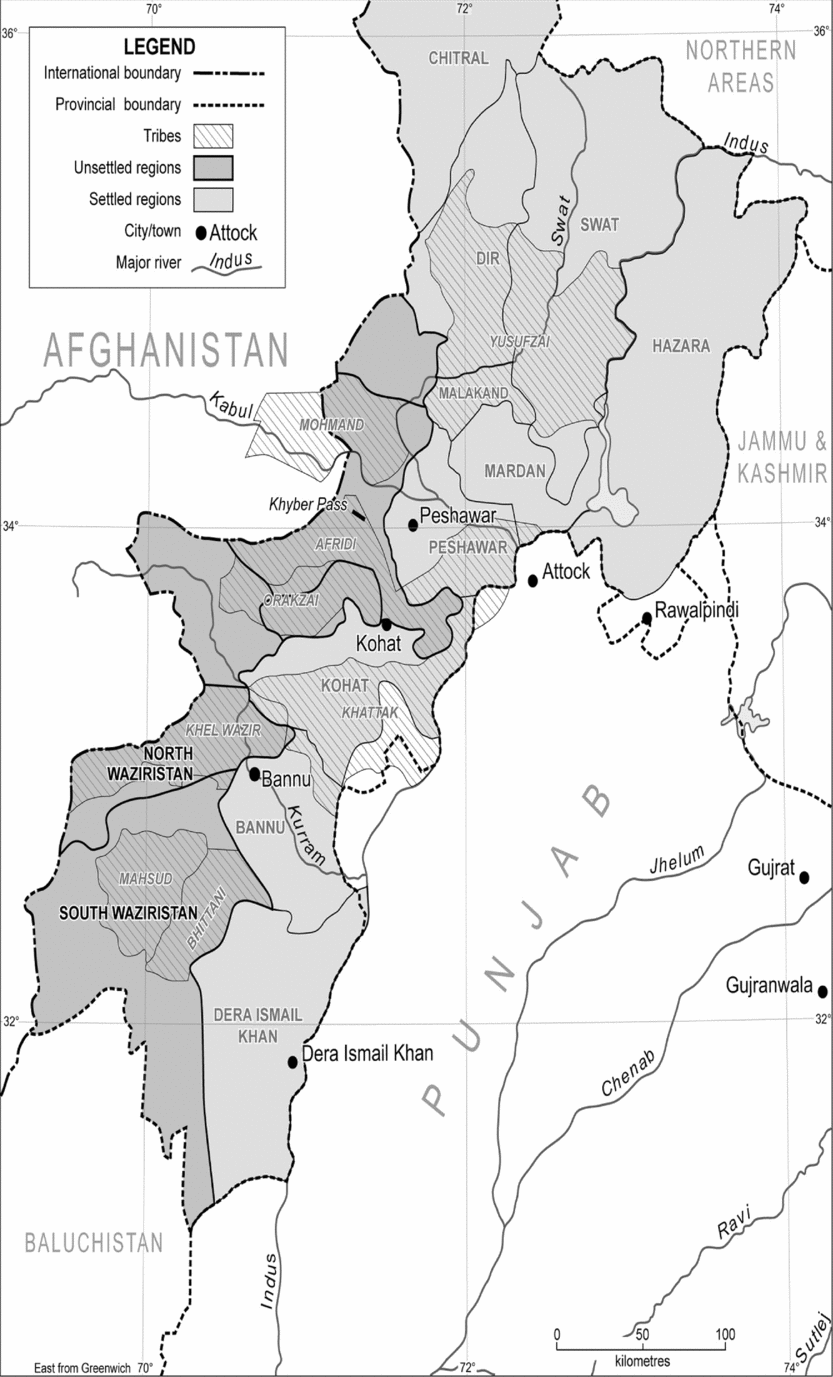
The Murderous Outrages Act was ultimately based on a very specific set of claims about the purportedly ‘exceptional’ character of the frontier that made it necessary to place this region outside the bounds of the regular legal order. One of the most powerful and pervasive of these claims was the assertion that the frontier existed in a perpetual state of warfare. As we have seen above, the frontier was a region that was fundamentally associated with danger and violence. This was a place considered by many to be one of the most violent and turbulent parts of the entire British empire.Footnote 81 Moments of peace were seen to be few and far between, and most years were, in fact, characterized by minor border skirmishes and sometimes even larger military campaigns, referred to as ‘punitive expeditions’,Footnote 82 launched against the independent Pashtun ‘tribes’Footnote 83 who inhabited the hilly, or ‘unsettled’, districts beyond the border of the British-administered ‘settled’ districts (see Figure 1).Footnote 84
The North-West Frontier, circa 1901. Source: The author.

Punitive expeditions, as well as other coercive measures—including blockades (bandish) and hostage-taking—were part of a concerted British effort to ‘quarantine the disorder of the tribal areas’.Footnote 85 As Major G. J. Younghusband put it, ‘On every tribe and clan, on every pass and trade route along this immense extent of frontier, the Indian Army has to keep its steadiest watch and ward. . . . For against the solid wall of British rule the sea of outer barbarism beats ever restlessly.’Footnote 86
In a scathing critique of frontier affairs from 1876, the governor of Bombay and former chief commissioner of Sind, Bartle Frere, remarked that the Pashtuns ‘are in a position quite unlike anything known either to European or Indian diplomacy. We are neither at peace or war with them—an armed truce would perhaps be the nearest description of any similar state elsewhere.’Footnote 87 Frere's pronouncements echoed those made by Henry Durand nearly a decade earlier during the debates over the drafting of the Murderous Outrages Act in order to justify the creation of such a law. ‘[W]e might be said to be in a chronic truce,’ argued Durand, ‘a watchful truce with hostility ever impending; and maintained towards frontier tribes notorious for the blood-feuds which raged among themselves.’Footnote 88 Commander-in-Chief Charles Mansfield took this even one step further by describing frontier policy towards the Pashtuns as ‘one of armed repression’ in which the British ‘did not condescend to a truce, but enforced peace by putting down border crimes’.Footnote 89 According to this logic, attacks against British personnel were not merely ‘breaches of the peace’, or ‘crimes’, but rather they were ‘acts of war against the British empire’, committed by ‘enemies of the Queen from beyond the border’.Footnote 90 Within this formulation, the distinction between judicial action and military action ceased to exist altogether, and the law became a tool for the extension of the killing function of war. This conflation of judicial action with military action, moreover, was one that was often made on a regular basis by the Punjab government in justifying punitive expeditions against the Pashtuns.Footnote 91
As British officials saw it, they were men ‘under siege’, and this justified the use of any means necessary to protect the lives of the ‘ruling race’ along the frontier. This was a point that was argued particularly forcefully by Mansfield. He accused those who opposed the bill of being ‘so beset by the necessity of strictly adhering to law as administered in peaceable districts . . . that they had hardly been able to imagine the real state of things on the Panjáb frontier’. They
could not conceive, what it was to live in the midst of a population in which English gentlemen could not return from mess to their own houses without arms; where the whole cantonment, as at Pesháwur, was girdled with sentries and watched by mounted patrols. Chief Commissioners had been struck down in their own verandahs; commanding officers had been murdered in their own lines; a lady had been struck down at Kohat: such a state of things was not conceivable in a civilized country, and could only be considered to be a feature of but half-suppressed war and flagrant hostility.Footnote 92
One of the most disturbing features for the British about this unremitting frontier ‘war’ was that it appeared to be motivated, in large part, by ‘fanaticism’. Although the term ‘fanatic’ was adopted by the British shortly after they assumed control of the frontier in the 1840s, it did not acquire its overwhelmingly pejorative meaning until after the Uprising of 1857.Footnote 93 During the virulent anti-Muslim climate of the 1860s and 1870s,Footnote 94 the term was increasingly used to brand individuals who were believed to be part of an endemic culture of Muslim criminality and conspiracy.Footnote 95 Since their earliest encounters with the Pashtuns, British frontier officers, including Edwardes, Taylor, and James Abbott, had portrayed the Pashtuns as an endemically ‘priest-ridden’ and ‘fanatical’ community.Footnote 96 Following the malignant transformation of the term in the wake of 1857, descriptions of Pashtun fanaticism were increasingly used to signify their ‘barbarity’ and ‘cruelty’. One highly influential report from 1865 summed it up as follows: ‘Mohamedanism, as understood by them, is no better, or perhaps is actually worse, than the creeds of the wildest races on earth. In their eyes the one great commandment is blood for blood, and fire and sword for all infidels . . . for all people not Mahomedans.’Footnote 97 The attacks that occurred against British officers along the frontier, therefore, were viewed by many as ‘but another form, another exhibition of that spirit of fanatical vengeance which prevailed among the tribes’.Footnote 98
During his trial for the shooting of Mrs Brandreth, Summad claimed that he had been fulfilling ‘God's will’ by attacking a European, and that he had been told this was a ‘meritorious action’ by a mullah (religious leader).Footnote 99 Based on this, Becher had confidently concluded that this ‘savage’ crime had been motivated by ‘religious fanaticism’.Footnote 100 However, despite Becher's ability to discern a ‘fanatical’ attack when he saw one, the precise definition of what constituted a ‘fanatic’ or a ‘fanatical’ attack was much more ambiguous and elusive. In their initial correspondence petitioning for the creation of this new law, the Punjab government had referred to these types of criminals almost exclusively as ghazis.Footnote 101 Both Maine and Durand, however, objected to the use of this term, since, according to them, it still retained an ‘honorific’ sense, and its use might be considered offensive to Muslims.Footnote 102 It was also considered inexpedient to single out Muslims, since Sikhs and Hindus had also been known to commit similar types of ‘fanatical’ crimes.Footnote 103 In light of this, the Select Committee in charge of revising the Murderous Outrages bill suggested replacing the term ghazi with the expression ‘political or religious fanatic’, but this too proved contentious, as officials were divided over whether it was either possible or desirable to separate political from religious motivations in these attacks. In the end, the Legislative Council finally settled on the simplified and more all-encompassing term of ‘fanatic’, largely at the insistence of Maine and Durand. As Mansfield put it, ‘it would be a matter of regret were the Council to encumber a somewhat anomalous procedure with a too nice definition’.Footnote 104 Nevertheless, the term ghazi (or ‘ghazee’ as it often appears in the records) remained a popular one among colonial officials, so much so that the Government of India was even compelled to issue an official ban against the use of the term in official correspondence in 1900.Footnote 105
The most effective punishment that was to be meted out to these fanatics was another issue that proved deeply controversial during debates over the drafting of the Murderous Outrages Act. In his judgment in the case of Mrs Brandreth, Becher had justified the use of extraordinary methods to execute Summad on the grounds that fanaticism represented an existential threat to British officials along the frontier. ‘The fierce fanaticism directed against the lives of the ruling race of India is a special danger of this frontier,’ he wrote, ‘and one which requires to be taken into account in determining punishment.’Footnote 106 However, whereas Becher was content merely to execute Summad summarily, other officials insisted that even this type of punishment was insufficient when dealing with these types of fanatical crimes. A culturally specific punishment that cut to the heart of these attacks was, in the words of John Lawrence, required to instil ‘a just terror in the would be murderer.’Footnote 107 For Lawrence, the punishment most ‘calculated to strike terror’Footnote 108 into the hearts of these individuals entailed burning their bodies following execution. The idea of burning the body of a fanatic was one which derived largely from the ‘Moplah Act’.Footnote 109 Since Muslims bury their dead, burning was designed to exploit what the British believed was a deeply entrenched ‘superstition’ among Muslims that this would destroy the soul, and therefore prevent the fanatic from ascending to Heaven as a reward for their actions.Footnote 110 Though not explicitly alluded to during the debates over the drafting of the Murderous Outrages Act, the practice of physically destroying the body of criminals and rebels by strapping them to the mouths of cannon, as was done with the ‘mutineers’ of 1857, was another British practice that was used both before and after the Uprising as a means of denying individuals access to the afterlife.Footnote 111 In addition to its deterrent effect, the destruction of the body also had another benefit in that it would prevent the grave of the convicted from being converted into a ziarat (shrine) and becoming a site of reverence and inspiration for similar fanatical acts.Footnote 112
Durand, for one, was a firm believer in the efficacy of burning, arguing that, ‘With the masses it enhances the effect of the punishment.’Footnote 113 Most of the other officials consulted at the time of the drafting of the Murderous Outrages Act, however, were deeply opposed to Lawrence's proposal to burn the bodies of Muslims, pointing to the fact that this would actually serve only to engender even greater hatred towards the British.Footnote 114 Though the issue never came up officially during the Legislative Council debates, the strong opposition against this measure ensured that the provision explicitly permitting the body of the convicted to be burned was ultimately struck from the Murderous Outrages Act. Instead, at the insistence of Lieutenant-Governor McLeod and Viceroy John Lawrence, both of whom strongly supported burning,Footnote 115 the wording of the section that covered the disposal of bodies was left purposefully vague, empowering the commissioner who passed the sentence to use their own discretion in the matter.Footnote 116
Although legislators were uneasy about burning, most of the frontier officers actually disposing of these cases had no such qualms, and, over the next three decades, frequently seized upon the opportunity to burn the bodies of convicted fanatics.Footnote 117 An official enquiry by the Government of India into the incidence of burning found that between 1883 and 1895, the bodies of at least 17 convicted fanatics had been burned in Punjab and Baluchistan, leading to the conclusion that ‘it has been almost the invariable practice to burn the bodies of Ghazis’.Footnote 118 Lieutenant-Governor Dennis Fitzpatrick (1892–97), a strong opponent of burning, was deeply disturbed by the evidently widespread prevalence of this practice, believing that it served only to ‘create a feeling of disgust against us in the minds of loyal Mussalmans’.Footnote 119 On 20 February 1896, at the insistence of Fitzpatrick, the Government of India therefore issued a formal ban against the practice of burning without their express permission, and only in ‘extreme and exceptional cases when there may be good reason to believe that such a measure will check, or put a stop to, what might be called an epidemic of assassination of fanatics’.Footnote 120
For the next nine years, burnings remained relatively rare along the frontier. Viceroy Lord Curzon (1899–1905), however, took an altogether different stance on the subject of burning than his predecessor, Lord Elgin (1894–1899). In a speech delivered at a durbar in Quetta on 12 April, 1900, Curzon forcefully announced his intention to use any means necessary to put a stop to these sorts of attacks once and for all. ‘I wish you to cherish no illusions,’ he stated, but ‘I am determined, so far as lies in the power of Government, to put a stop to these abominable crimes. I shall shrink from no punishment, however severe.’Footnote 121 True to his word, Curzon made the war against frontier fanaticism one of his top priorities, and set about contemplating new ways to make the punishment for these types of crimes even more severe.Footnote 122 In 1905, Curzon officially reversed his predecessor's decision to prohibit burnings, and actually called for an expansion of the practice, stating that it ‘should be adopted as a general rule’.Footnote 123 However, although this certainly pleased a number of frontier officials who had been deeply distressed by the Government of India's decision to ban burning in 1896,Footnote 124 it ultimately did not prove effective in stopping these types of attacks.
The Murderous Outrages Act was conceived of as a response to what was believed to be a very special type of frontier crime and, as such, it was always meant to be applied only in the most extreme and truly ‘exceptional’ of circumstances. Initially, colonial officials seem to have taken this charge very seriously, applying the law sparingly in just five different cases between 1867 and 1877.Footnote 125 The following two decades, however, saw a drastic reversal of this relative self-restraint. Following the extension of the Murderous Outrages Act to Baluchistan in 1881, the frequency with which the law was invoked increased dramatically. Between 1881 and 1905, a total of 93 different cases of fanatical outrage were recorded in Baluchistan alone. At least 40 individuals were tried and executed in these cases (not including those who either died or committed suicide before their trial or execution); another 16 were killed outright during the attacks before they could be apprehended; and only 11 were spared capital punishment and sentenced to either rigorous imprisonment or transportation.Footnote 126 In all likelihood, however, these numbers were actually even greater. In addition to the alarming propensity of certain frontier officers towards burning—a punishment that was itself meant to be reserved only for the most heinous Murderous Outrages Act cases—the Government of India's 1896 inquiry also found that there were a number of instances where officers had either improperly or only ‘casually’ reported Murderous Outrages Act cases.Footnote 127 Such lax and spotty reporting makes it difficult to obtain an exact picture of the frequency with which this law was used, and raises questions about how many other cases were either lost in the bureaucratic shuffle or even never reported in the first place. Together with an apparent willingness on the part of officers to employ the law in cases where its applicability was dubious at best and even sometimes technically illegal,Footnote 128 it is clear that frontier officers were abusing the extraordinary latitude and discretion that had been entrusted to them by this law.Footnote 129
Conclusion
On 3 February 1925, the eminent Indian jurist and nationalist leader, V. J. Patel, introduced a bill to the Legislative Assembly of India for the repeal of laws that were deemed ‘repressive’. The laws included such draconian legislation as the Bengal, Madras, and Bombay Regulations (1818, 1819, 1827); the State Prisoners Act (1850); and the Seditious Meetings Act (1911).Footnote 130 All of these laws, Patel argued, had one thing in common: they armed the executive with an alarming set of powers that could be used to deprive people of their elementary rights. When the Assembly met again several weeks later to discuss the details of Patel's bill, one of its supporters proclaimed that ‘the days of Regulations and Ordinances are long past, and they are anachronism in all civilised systems of jurisprudence’.Footnote 131 Yet not everyone in the Assembly shared this view. Diwan Bahadur T. Rangachariar rose to oppose the bill, pointing out that it proposed to strip the government of so many of its executive powers and prerogatives that it would never pass the Council of State. Such powers, Rangachariar argued, were sometimes necessary for a government (whether it be British or Swarajist) to protect the lives of their people, and he therefore urged Patel to amend his bill so as to omit from repeal those laws and powers which were deemed absolutely necessary for the security and ‘defence’ of India.Footnote 132 One law, in particular, was singled out for exemption from repeal by Rangachariar: the Murderous Outrages Act.Footnote 133
When Patel first introduced his bill, the home member, Alexander Muddiman, had questioned his choice to include in it the Murderous Outrages Act, and accused him of potentially endangering the lives of British officials by attempting to ‘withdraw such little protection as the law can give to those officers of Government who daily and hourly are risking their lives for the safety of India, in India's passes in the north, liable at any moment, at any moment I say, to murder’.Footnote 134 During the subsequent debate over the bill, Rangachariar, who had himself visited the frontier, echoed this sentiment and claimed that it would actually be a ‘crime’ to repeal the Murderous Outrages Act.Footnote 135 Following Rangachariar's statement, Muddiman then read out an account of a recent and brutal assault committed at the Peshawar Cantonment railway station in which a ‘Ghazi’ had repeatedly stabbed the station master as well as his wife and seventeen-year-old son.Footnote 136 After he finished, even the stalwart constitutionalist, Muhammad Ali Jinnah, rose in support of exempting this law from repeal. Although it was against his ‘ideas of justice that any accused person should be tried in the summary manner which this Act provides’, Jinnah conceded that because the Murderous Outrages Act was confined to only a few frontier districts, was so restricted in its application to ‘fanatics’, and was so ‘necessary’ for the protection of the British along the frontier, that it should stand ‘on a very different and special footing’.Footnote 137 Confronted with this mounting opposition, Patel grudgingly agreed to strike the Murderous Outrages Act from the bill. Patel's amended bill was subsequently passed by Assembly in a vote of 71 to 40. It was never adopted by the Council of State, and more than ten years later, Indian legislators were still trying (without much success) to repeal the Murderous Outrages Act.Footnote 138
The ability of even staunch nationalists, such as Rangachariar and Jinnah, to support a law that was seen by many as expressive of the tyranny of colonialism and its attendant ideologies is significant. Aside from the obvious cynicism they both displayed in recognizing that a bill proposing such a radical dismantling of British executive prerogative stood little chance of passing the Council of State, these leaders also appear to have been willing to buy into the claim that the Murderous Outrages Act represented an acceptable compromise to normal ideas of justice because it was so specific and restricted in its scope that it could hardly be a threat to the security and liberties of ordinary Indians. Rangachariar's statement about how strong executive powers would be required even by a Swarajist government is particularly revealing about how notions of sovereignty—whether rooted in colonial conquest, as in the case of the British, or upon claims about the consent of the people in the case of the nationalist movement—retained a strong emphasis on compulsion. Indeed, in the case of post-colonial Pakistan, where this law remains in the statute books, the ‘excesses’ of colonial legislation have actually been processed into modern forms of statecraft.Footnote 139 This is a striking illustration of both the entrenched persistence of that state's own autocratic tendencies, as well as the enduring trope of the ‘frontier fanatic’ which still pervades contemporary discourse, particularly in discussions surrounding the so-called ‘war on terror’.
Despite its relatively limited application to the North-West Frontier, the Murderous Outrages Act must be seen as much more than a merely peripheral piece of legislation. This was a law that cut to the heart of the ideas and debates that helped define British colonial conceptions of law and order during the nineteenth century. In addition to the types of exceptional legal-political regimes that were established along both the North-West and North-East frontiers, India's hinterland was also regularly subject to states of emergency that granted colonial officials extraordinary executive powers, all in the name of maintaining law and order.Footnote 140 The rule of law in colonial India was never about restraining executive authority or weakening the ability of the British to punish recalcitrant colonial subjects. Rather, it was about finding new ways of regulating and making the exercise of sovereign power more uniform and respectable. It was about couching the colonial state's iron fist in a velvet glove.Footnote 141 Once again, it was Maine himself who perhaps best expressed this sentiment. In responding to criticisms that the law was an illustration of ‘the extreme readiness of the Indian Government to license lawlessness’, he countered by arguing that the precise opposite was the case: that it was, in fact, a ‘signal example of the tenderness of this Government for law and legality’.Footnote 142
Maine's friend and successor as law member, James Fitzjames Stephen, was one who certainly viewed this as the purpose of laws like the Murderous Outrages Act, and indeed colonial law more generally. The necessity for colonial officials to be able to ‘punish’ their subjects was paramount for Stephen. In his view, ‘The exercise of criminal jurisdiction is both, in theory and in fact, the most distinctive and most easily and generally recognized mark of sovereign power. All the world over the man who can punish is the ruler.’Footnote 143 As a staunch imperialist, Stephen was always a firm believer in the need for the British to maintain their prestige as India's ‘ruling race’ through the preservation of their executive authority.Footnote 144 ‘I shall not be suspected of undervaluing my own profession,’ he once wrote, ‘but I must say I can hardly imagine a greater calamity for British India than the undue preponderance of the legal over the executive element.’Footnote 145
The idea of colonial law possessing a certain warlike quality to it is also brought forth quite strongly in Stephen's writings. Stephen once claimed that colonial officials governing ‘turbulent and primitive’ districts, such as the North-West Frontier, were like ‘a highly civilized and carefully selected military force on active service, and the laws which they administer are their orders and articles of war ’Footnote 146 Stephen's analogy weds law and war together, so that one fulfils the other, and vice versa. Indeed, far from being incommensurable, force and justice were merely different sides of the same coin for Stephen. In one of his more famous analogies, he compared British rule in India to ‘a vast bridge over which an enormous multitude of human beings’ were passing from a ‘dreary land’ of brute violence, superstition, and ‘cruel war’ into a more peaceful, orderly, and industrious existence. This bridge, he argued, rested on the twin pillars of ‘military power’ and ‘justice’. ‘Neither force nor justice will suffice by itself,’ Stephen insisted. ‘Force without justice is the old scourge of India, wielded by a stronger hand than old. Justice without force is a weak aspiration after an unattainable end.’Footnote 147 For Stephen, although military power remained one of the key pillars of British rule, it could not support it alone. A colonial rule of law which imbued officials with strong powers of executive authority was the natural complement to this. In this sense, then, law was simply an extension of military power through other means, since it was ultimately meant to overawe and pacify India's supposedly wayward and turbulent inhabitants.Footnote 148 As he wrote several years later, law could provide ‘a moral conquest more striking, more durable, and far more solid, than the physical conquest which renders it possible’.Footnote 149
In August of 1881, as officials considered extending the Murderous Outrages Act to Baluchistan following an attack on two sepoys in the Quetta bazaar, one official expressed his irritation at how the British tended to tie their hands with laws. ‘It seems to me that it is rather a pity,’ he wrote, that ‘any reference should have been made to Government about the mode of procedure in the case. Quetta is not British territory; and if the man had been hanged or shot at once, either by the Civil or Military authorities, there would have been no law under which any exception could have been taken.’Footnote 150 This same officer was eventually to find solace in the Murderous Outrages Act, as it provided for ‘a rough-and-ready procedure better adapted to wild frontier lands than the more regular Penal and Criminal Procedure Codes’.Footnote 151 The Murderous Outrages Act represented a bare-knuckles approach to colonial governance. It was a bald and overt expression of a distinct logic of colonial legality maintaining that colonial power and the prestige of the ‘ruling race’ needed to be preserved at all costs. In so doing, it drew a direct connection between the need for colonial officials to be able to wield the sovereign power to punish and kill, but with a veneer of respectability granted through claims about the law. In this respect, it was the ultimate ‘warlike’ law, in that it enabled the killing function of war to be enacted on a regular basis by frontier officers in court martial-style trials, and in a region of British India that was itself assumed to exist in a perpetual state of war. The ultimate purpose of colonial law for Maine, Stephen, and many other colonial officials was to temper the steel of colonial rule, not to dull it. In this sense, laws such as the Murderous Outrages Act simply became yet another sort of ‘weapon’ that could be used to wage an endless war against the colonized.