

This brief survey gives an overview of the research on Japanese financial and monetary history based on the records of the Bank of Japan Archives. We briefly describe the Bank of Japan's organizational history, the activities of the Archives, their history and the classification of documents preserved in the Archives. We finally survey the recent research in Japanese economic history from the viewpoint of materials in the Archives.
I
The Bank of Japan (BOJ) was established under the Bank of Japan Act (promulgated in June 1882) and began operating on 10 October 1882 as the nation's central bank. One of the purposes for the establishment of the BOJ at that time was to launch the convertible note system and a modern credit system.
The BOJ was reorganized on 1 May 1942 in line with the Bank of Japan Act (hereafter ‘the Act of 1942’) promulgated in February 1942. The Act of 1942 was amended several times after World War II and was revised completely in June 1997 under the two principles of ‘independence’ and ‘transparency’. The revised Act came into effect on 1 April 1998.Footnote 2
Under the Act, the BOJ's missions are to achieve price stability and to maintain the stability of the financial system, thereby laying the foundations for sound economic development. To fulfill these two objectives, the BOJ issues and manages banknotes; implements monetary policy; provides settlement services; ensures the stability of the financial system; manages operations related to government securities and the treasury; conducts international activities; compiles data, and carries out economic analysis and research.Footnote 3
The BOJ has a long track record of archival activities. For instance, it started compiling its ‘Manuals and Rules of the Bank of Japan's Operations’ (Nihon Ginko Enkaku-shi) for internal use in the year of its foundation in 1882. The Bank also produced two historical reconstructions of its activities: ‘The Bank of Japan: The Eighty Years’ (Nihon Ginko Hachijunen-shi) and ‘The Bank of Japan: The First Hundred Years’ (Nihon Ginko Hyakunen-shi). Since October 1982, the Institute for Monetary and Economic Studies (IMES) at the BOJ disclosed about 3,700 records of historical relevance. Later on these records were taken over by the Archives, established in 2002. As of May 2010, their catalogue lists nearly 70,000 records.
The records of the Archives consist of two categories: ‘Books, vouchers and contracts’ and ‘Documents’ (literature other than ‘books, vouchers and contracts’). They are recorded in a variety of media, such as papers, microfilms, optical disks, photographs and videotapes, although most of them are recorded in the form of papers or microfilms. Most records are written in Japanese, and some of them are handwritten in cursive script.
Some records are subject to limited (full or partial) availability in case they include personal information, sensitive information about corporations and other associations, or information posing a potential threat to the national security, and when they are in poor physical condition or risk being damaged if handled.
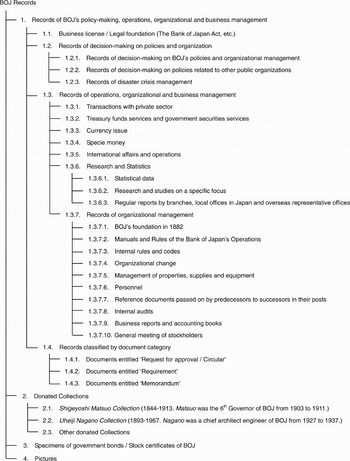
The catalogue consists of five types of records: (1) documents of the head office; (2) documents of branches and local offices in Japan; (3) books and vouchers (including contracts) of the head office; (4) books and vouchers (including contracts) of branches and local offices in Japan; (5) donated documents.Footnote 4
Chart 1 gives an overview of the BOJ Archives' records before the amendment of the Bank of Japan Act in 1942. Most existing research in monetary and financial history based on the Archives' materials deals with this period. Basically, this classification coincides with the BOJ's functions and operations, although some groups of records are categorized by document type and are related to a wide range of business activities. Donated collections, specimen certificates and pictures are classified as independent categories rather than by the functions and operations of the BOJ, regardless of the contents of each document.
For details of the necessary procedures for visiting the Archives, please visit the website cited in footnote 1.
BOJ Archives' records; before the amendment of the Bank of Japan Act in 1942

II
By making its archival records available, and especially after the establishment of the Archives in 2002, the BOJ has critically contributed to enhance research on the monetary and financial history of Japan. In this section we survey recent studies based on the Bank's documents. Scholars have focused mainly on three broad areas of research: financial stability, monetary and foreign exchange policies, and the development of the financial market.
Financial stability. How central banks should react to financial crises has become a popular research topic in Japan during the recent financial turmoil and the ensuing policy debate. The historical record of the BOJ as a lender of last resort (LLR) has emerged as a natural focal point for this new stream of research. The work by Tetsuji Okazaki, mainly based on the examination of contracts between the BOJ and private banks, argues that the Bank's action as LLR, far from reckless, was selective and disciplined.Footnote 5 By concentrating its lending on banks with an established transaction relationship, the Bank succeeded in guaranteeing the stability of the financial system without incurring the moral hazard problems that the supply of last resort liquidity naturally engenders. A case study by Masanao Ito,Footnote 6 focusing on the failure of the Fujita Bank in the 1920s, sheds light on the use of special loans by the BOJ to manage the liquidation of a crisis bank. Ito finds that the BOJ was aware of the Fujita Bank's financial situation and took it seriously due to its bad loans. The whole process of the liquidation took 22 years, even though the BOJ tried to call in special loans much earlier.
Other case studies explore the management of regional banks during the interwar period of financial crises. Kanji IshiiFootnote 7 traces back the impact of financial crises on local banks by comparing movements in the deposit volume at regional level with the qualitative information available on bank runs. Makoto KasuyaFootnote 8 uses financial reports by the BOJ branches to study local banks' portfolios; he suggests that securities holding had a positive impact on the probability to survive the crises. Other case studies by Hatsu Nishimura,Footnote 9 Kazuo Ikegami,Footnote 10 Kanji IshiiFootnote 11 and Kozaburo KatoFootnote 12 make use of reports by BOJ's branches on the financial and monetary situation at regional level, as well as detailed reports and governors' speeches on the BOJ's special loans to private banks.
Some studies focus on the role of banking supervision, which was activated in the light of the financial turmoil of the 1920s. Eiji HotoriFootnote 13 analyses the roles played by the inspections conducted by monetary authorities, and especially by the Ministry of Finance (MOF). By examining the details of the inspection process jointly carried out by the MOF and the BOJ, and allocation of resources, Hotori concludes that the supervision by the MOF was strengthened while the bad loan problem was being cleared up after the late 1930s.
Yurio MukaiFootnote 14 examines the process of bank amalgamation triggered by the financial crises and its strong impact on the local banks. Masanori SatoFootnote 15 finds that the amalgamation of private banks in the 1940s, whose objective was to improve the banks' financial situation, was a combination of the BOJ's policy and the private banks' survival strategy. The materials used by these scholars are local financial reports by the BOJ's branches, and documents stating the BOJ's views on amalgamation and special loans.
Monetary and foreign exchange policy. The experience of Japan during the Great Depression of the 1930s has been mainly investigated for its analogies with, and its implications for, the economic difficulties of the Japanese economy since the 1990s. According to the existing literature, the gold standard was a key factor in the origination and transmission of the Great Depression. Masato Shizume,Footnote 16 who examines the contemporary policymakers' views using the minutes of the branch managers' meetings of the BOJ, concludes that the gold standard had an enduring influence on Japanese policymakers, even after the abandonment of the gold standard in 1931. In Lever of Empire,Footnote 17 Mark Metzler describes the monetary and fiscal policy of Japan before World War II. Using the correspondence between Benjamin Strong of the Federal Reserve Bank of New York and Junnosuke Inoue of the BOJ, he explores how Anglo-American pressures and domestic ambitions led to economic policies that pushed the Japanese economy into a series of severe depressions culminating in the great crisis of 1929–31. From Foot Soldier to Finance Minister, Takahashi Korekiyo, Japan's Keynes,Footnote 18 by Richard Smethurst, describes the history of the Japanese economy before Word War II through Korekiyo Takahashi's biography. Takahashi is considered to have been ‘Japan's Keynes’ in terms of fiscal and monetary policies, and contributed to Japan's recovery from the Great Depression. Smethurst, who uses Takahashi's correspondence with BOJ Governor Matsuo, Finance Minister Sone and Prime Minister Katsura, stresses that Takahashi's policy was influenced by his unusual background, unique talents and singular experiences as a charismatic and cosmopolitan financial statesman.
Masanori SatoFootnote 19 studies BOJ's monetary policy during World War II and suggests that the Bank, while forced to supply credit to the war industries, at the same time took measures to avoid inflation, such as selling government bonds. His assessment, based on the governor's speeches on private banks' operations, is therefore that the BOJ managed to achieve conflicting targets. The study by Yoshio Asai,Footnote 20 based on documents related to consultations with the IMF, suggests that the interaction between domestic and international events largely determined Japanese monetary policy after World War II. As for Japan's relationship with other international organizations, Kazuhiko Yago uses the BOJ's reports on the BIS meetings and the correspondence between the BIS and the BOJ to examine the relation between the BIS and Japan, focusing on the activities of key personalities such as Tetsusaburou Tanaka from the early 1900s to the 1960s.Footnote 21
Financial market development. The work of Mari Ohnuki on the role played by the BOJ in the integration of the domestic financial marketFootnote 22 reveals that the facilitation of money transfers through the establishment of the BOJ branches contributed to the nationwide convergence of the lending interest rate by using the applications to the MOF to increase branches. A companion study by Ohnuki and Kris James Mitchener,Footnote 23 using data for 47 prefectures, discusses the timing and determinants of interest rate convergence in Japan in the period 1884–1925. They argue that market integration was accelerated by technological innovations such as telegraph networks and institutional change, specifically, the expansion of the BOJ's branch network. They also uncover an inverse relationship between the money transfers through the Bank's branches (reconstructed on the basis of the BOJ's periodical business report and materials for their preparation) and lending interest rates. A previous paper by Masayoshi Tsurumi,Footnote 24 based on the BOJ's reports on the situations of small and middle-sized banks and the development of the interbank market, sheds light on the relationship between the latter and the role of the BOJ. He concludes that the crises brought into light a number of existing distortions in the interbank market and provided an opportunity for its development and reform, including a more active involvement of the BOJ in the market. As far as the marketing of public debt is concerned, Akira EhiroFootnote 25 emphasizes the importance of the establishment of an official government bond markets in the stock exchanges in 1920 and the role played by the BOJ in its reform.
Apart from the three main research areas surveyed above, there are a number of historical studies on the economic policy of Japanese governments, generally related to current policy issues and debates. A study by Mariko Hatase and Mari Ohnuki contributes to the discussion on reserve currency composition today by using data on foreign reserves reconstructed from the accounting ledgers of the BOJ to explore the reserves policy of the Bank in the interwar period.Footnote 26 They reveal that the competition between the British pound and the US dollar as leading reserve currencies became increasingly keener, with the dollar reaching a dominant position by 1939. The authors conclude that trade volumes and the size of the debt service were essential determinants of the Bank's choice of reserve currency, although additional factors may have played a role, such as the relative stability of the two currencies, the introduction of foreign exchange controls and restrictions on financial activities, and taxation. In a previous paper, Haruhito TakedaFootnote 27 examines the relationship between foreign reserves held by the government and the BOJ and fiscal problems, concluding that the foreign reserves accumulated during World War I were eventually used to finance fiscal deficits. Using similar data, Makoto KishidaFootnote 28 studies the impact of debt services and other factors on the movements of foreign reserves.
As fiscal deficits in Japan have expanded over the past two decades, the debt management policy of the government – similar to past experiences of excess issue of government bonds – has attracted the interest of researchers.
Exploring the relationship between the Ministry of Finance and the BOJ, Eisaku Ide examines the Bank's policy towards purchases of newly issued government bonds through the minutes of ‘The Joint Research Committee of the MOF and the BOJ for Improving the BOJ System’.Footnote 29 Challenging a traditional interpretation that emphasized how the BOJ had been forced by the government to buy a pre-assigned share of public debt, Ide finds that the Bank agreed to underwrite government bonds as an instrument to improve monetary control through open market operations and increase its influence over financial institutions. In a similar vein, Keishi Shiratori, using the minutes of BOJ's branch managers meetings, finds that the BOJ actively committed to the process of underwriting government bonds through direct controls on regional banks, which were considered as potential holders of over-issued government bonds.Footnote 30 As for foreign bonds, Simon Bytheway's Foreign Capital and the Japanese Economy, 1858–1939 Footnote 31 uses the BOJ's report on the Japanese loans to China (called ‘Nishihara loans’) in order to show the policy background of foreign bond issues and roll-over.
Regarding other activities of the BOJ, Daisuke HayakawaFootnote 32 explains the limited effects of the opening of the BOJ's Matsuyama branch on the local area, with the fact that the timing of branch opening coincided with a period of weak credit demand and low lending by the Bank. He uses the financial reports by the BOJ's branches and application for opening the BOJ branch in Ehime. Masayoshi TsurumiFootnote 33 discusses the background of the emergence of a unified settlement system in 1943, using documents on domestic money transfers. He concludes that the unified settlement system found its roots in the wartime temporary scheme, whose efficiency led to its introduction as a permanent system.
The works mentioned here are just some examples of the rich body of research conducted inside and outside the Bank. Records of the Archives have been, and will be, essential for the development of research on Japanese monetary and financial history.