Introduction
Emergency department (ED) crowding is a multifaceted problem with cascading effects on both prehospital and hospital systems. As the number of patients presenting to EDs across the United States continues to increase, the associated reduction in ED bed capacity impacts both patients bringing themselves to an ED and patients arriving by ambulance. Reference Cooney, Millin, Carter, Lawner, Nable and Wallus1,Reference Morley, Unqin, Peterson, Stankovich and Kingsman2 Ambulance patients who are unable to be quickly transferred to an ED bed because of over-crowding represent a key contributing factor to the extended time from ambulance arrival at the hospital to the time that patient care is transferred to the ED staff, known as ambulance offload delay (AOD). Reference Cooney, Millin, Carter, Lawner, Nable and Wallus1,Reference Silvestri, Sun, Gutovitz, Ralls and Papa3,Reference Li, Vanberkel and Carter4 When patient care is unable to be transitioned to ED teams in a timely manner, ambulances are often forced to wait at the hospital for extended periods of time, reducing their availability for subsequent emergency calls. Reference Cooney, Millin, Carter, Lawner, Nable and Wallus1,Reference Bost, Crilly, Wallis, Patterson and Chaboyer5 The trend of increasing ED crowding and associated AOD is multifactorial and it has been further exacerbated at times by infectious disease outbreaks such as influenza and the coronavirus disease 2019 (COVID-19) pandemic. For example, increasing numbers of COVID-19 patients requiring isolation, compounded by patients with routine complaints, pose an added challenge for those patients who present to EDs via ambulance. Reference Schull, Mamdani and Fang6,Reference Baugh, Yun and Searle7
This AOD has been associated with negative effects on several components of Emergency Medical Services (EMS) systems, including patient safety and outcomes. Reference Li, Vanberkel and Carter4,Reference Bost, Crilly, Wallis, Patterson and Chaboyer5 For EMS agencies, the direct impact of AOD results in a decreased ability to respond to the next emergency call, leading to prolonged response times and reduced EMS system efficiency. Reference Li, Vanberkel and Carter4,Reference Cooney, Wojcik, Seth, Vasisko and Stimson8,Reference Almehdawe, Jewkes and He9 A position statement from the National Association of EMS Physicians (NAEMSP; Overland Park, Kansas USA) states that AOD may lead to a delay in definitive care and that there is “reasonable concern that ambulance offload delay will compromise patient safety.” Reference Cooney, Millin, Carter, Lawner, Nable and Wallus1 This assertion is supported by previous research which has found that extended AOD leads to deleterious effects to both the EMS system and patient outcomes, with delays longer than 30 minutes leading to worse patient outcomes. Reference Li, Vanberkel and Carter4,Reference Crilly, Keijzers, Tippett, O’Dqyer and Lind10
In the current paradigm, the ED shoulders much of the responsibility for reducing ambulance offload times (AOTs), and a paucity of literature exists on how EMS systems can drive solution efforts in this area. As such, opportunity exists for evaluation of novel initiatives to address AOD. The knowledge gained from such experiences will help better understand how EMS and hospital systems can work to streamline ambulance offload procedures while improving patient outcomes. The aim of this study was to determine if AOTs could be reduced by assigning an EMS clinician, working on behalf of the EMS system, in the ED with the responsibility of expediting patient transfer and providing real-time feedback regarding ED bed capacity to crews in the field.
Program Strategy and Implementation
Howard County, Maryland (USA) is situated in the middle of the Baltimore-Washington corridor and has a population of approximately 325,000 residents. Howard County General Hospital (HCGH; Columbia, Maryland USA) is a member of Johns Hopkins Medicine (Baltimore, Maryland USA) and is the sole hospital in Howard County. The 243-bed comprehensive and acute-care medical center is an accredited Stroke and Primary Coronary Intervention Center that saw more than 68,000 ED visits in 2020. The EMS in Howard County is provided through the Howard County Department of Fire and Rescue Services (HCDFRS; Marriottsville, Maryland USA), which is a combined career-volunteer department with nearly 900 career and volunteer personnel. The department employs a combination of Advanced Life Support (ALS) and Basic Life Support (BLS) transport ambulances to respond to over 30,000 emergency service requests per year.
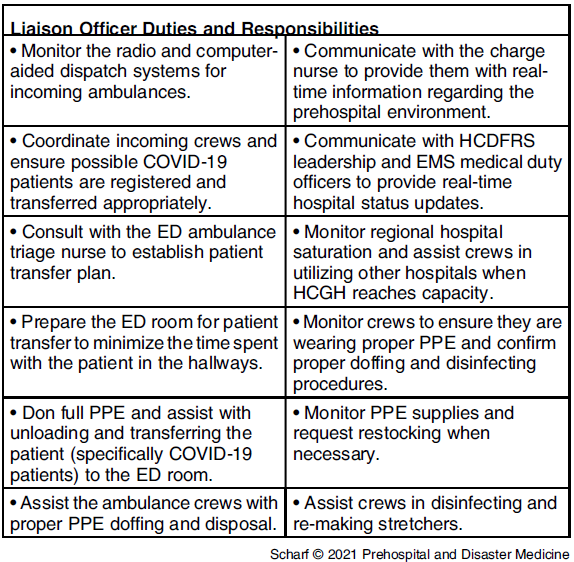
The Howard County Hospital Liaison Program (HLP) was initiated on March 26, 2020 in response to the rapidly evolving nature of the COVID-19 pandemic. The program model utilizes HCDFRS EMS clinicians assigned to the HCGH ED to facilitate patient care transitions. The initial program strategy included staffing seven days a week during the peak hours of 7:00am-7:00pm, although staffing was quickly increased to 24-hours a day based on the demand for the liaison services in the weeks following implementation. The HLP model integrates fire department EMS personnel directly into the ED with the goal of helping to expedite patient transfer upon arrival at the ED. The hospital liaisons worked directly with ED staff to determine bed assignments and establish estimated wait times for transport units as they arrived. As the EMS unit arrived at the ED, the liaison initiated the patient transfer process. Once patient transfer was completed, the liaison would also assist the ambulance crew with personal protective equipment (PPE) doffing and disposal. A detailed outline of the liaison officer’s duties and responsibilities is included in Table 1.
Hospital Liaison Officer Duties and Responsibilities

Abbreviations: COVID-19, coronavirus disease 2019; ED, emergency department; PPE, personal protective equipment; HCDFRS, Howard County Department of Fire and Rescue Services; HCGH, Howard County General Hospital; EMS, Emergency Medical Services.
Methods
Study Design
This retrospective pre/post study consisted of secondary analysis of operational transport data for all EMS incidents that were transported to HCGH six months before and six months after the HLP implementation. The goal of this preliminary evaluation was to assess the initial project outcomes and the potential impact of the HLP on AOT. Access to the EMS transport data was granted by the HCDFRS. Data were extracted directly from EMS incident records and informed by the National Emergency Medical Services Information System (NEMSIS; Salt Lake City, Utah USA) 3.5.0 data dictionary. Data obtained included the incident priority, the ambulance response level designation (ALS or BLS), the hospital destination, the times of the day when the liaison officer was on and off duty, and AOTs for all transported incidents of adults 18 years of age or older from September 2019 through September 2020. The HCGH ED saw 29,276 adult patients in the pre-intervention time period (September 26, 2019 – March 25, 2020) and 21,365 patients in the post-intervention time frame (March 26, 2020 – September 26, 2020).
The data were cleaned by removing duplicate incidents, correcting structural errors including typos and variable naming conventions, evaluating and adjusting for missing data, and finally validating the final dataset for accuracy. Categorical variables for incident priority and response level were recoded as binary dummy variables for analysis. Incidents that were directly transferred to the ED, such as those that had a transfer of care time less than one minute (73 incidents), and incidents where no AOT was recorded (48 incidents) were excluded. Further, to better isolate the impact of the liaison program in the “after” group, incidents that occurred when the liaison was not on duty were excluded from the final sample (212 incidents). This study was approved by the Johns Hopkins University Institutional Review Board (IRB00287501; Baltimore, Maryland USA).
Outcome Measures
The primary outcome measure was the AOT in the six months before and after the program implementation. Offload times were measured in minutes as the time from when the ambulance arrived at the hospital destination to the transfer of care to the ED staff. Patient transfer times were further divided into five 30-minute interval categories for descriptive analysis. Time data for this study were recorded using synchronized time stamps from the computer-aided dispatch system and a patient transfer button in the electronic patient care report system which records the transfer times. Secondary measures included the ambulance response level designation and the incident priority (Priority 1 through Priority 4). Priority 1 calls are defined as critically ill or injured persons requiring immediate attention or unstable patients with life-threatening injury or illness; Priority 2 calls are classified as patients with less serious conditions yet potentially life-threatening injury or illness, requiring emergency medical attention but not immediately endangering the patient’s life; Priority 3 calls are non-emergent conditions, requiring medical attention but not on an emergency basis; and Priority 4 calls are those that do not require medical attention. 11
Analysis
Statistical analyses were performed using Stata 15 (StataCorp LP; College Station, Texas USA). An α = 0.05 level of significance was used for all analyses. Frequency tabulations, proportional significance tests, and descriptive statistics were used to assess program performance metrics. Additionally, t-tests were performed to evaluate the mean difference in overall offload times as well as offload times stratified by priority and ambulance designation before and after the program implementation. Finally, multiple regression analysis was performed to assess the relationship between decreased AOT, program implementation, incident priority, and the ambulance response level. A log transformation of the AOT variable was utilized in the regression analysis to normalize the distribution of the AOT data.
Results
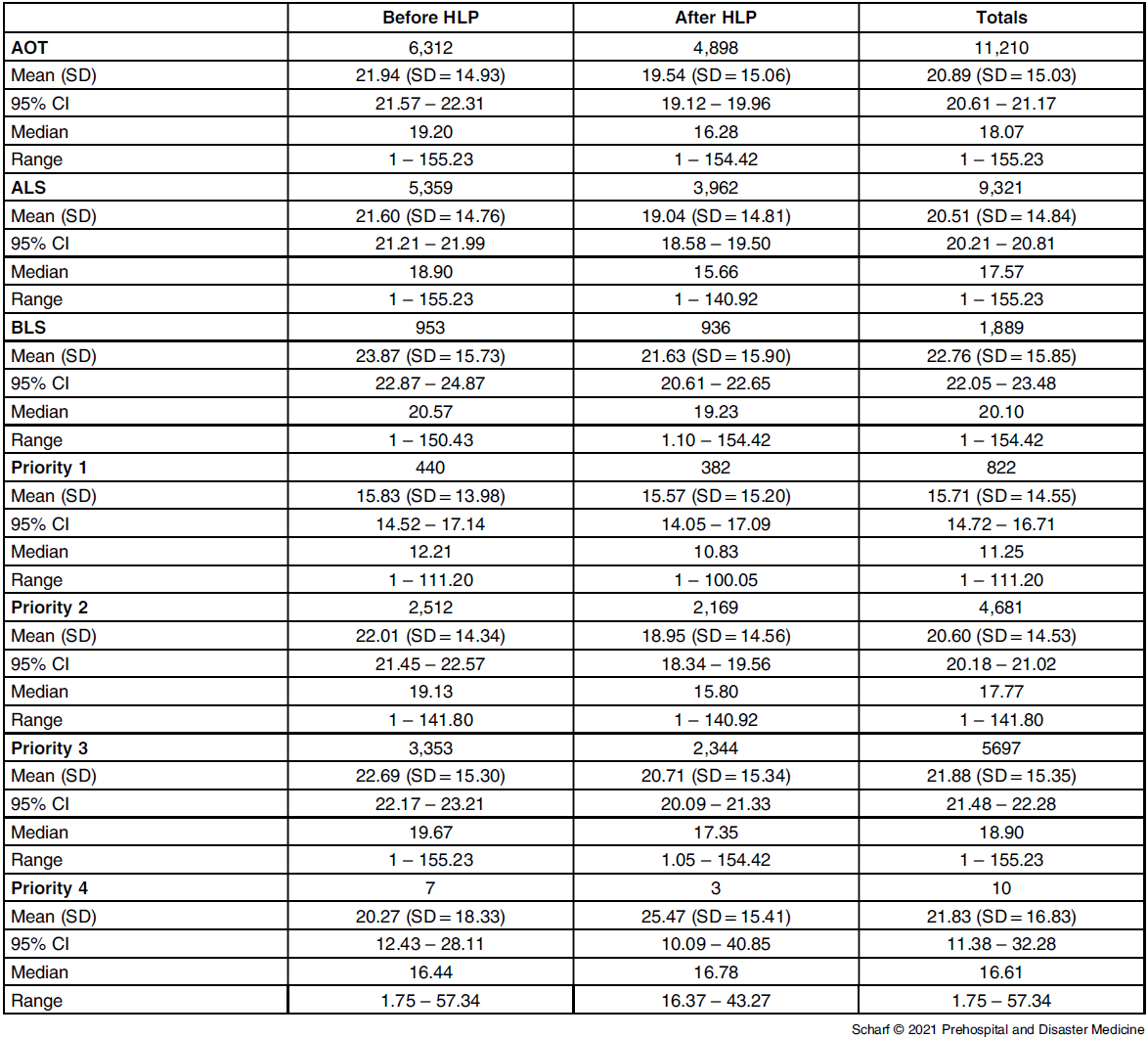
The initial sample consisted of 11,543 transported incidents, and 333 incidents were removed based on the study exclusion criteria, resulting in a final sample of 11,210 incidents transported to HCGH from September 2019 through September 2020; 4,898 before the program implementation and 6,312 after the program implementation. The overall mean offload time at HCGH was 20.89 minutes (SD = 15.03) and ranged from one minute to 155.23 minutes. The full sample contained 822 Priority 1 calls (7.33%), 4,681 Priority 2 calls (41.76%), 5,697 Priority 3 calls (50.82%), and 10 Priority 4 calls (0.09%). Over 9,300 calls transported to HCGH were ALS (9,321; 83.15%) while 1,889 (16.85%) were BLS incidents. Descriptive statistics stratified by program implementation status are further summarized in Table 2.
Ambulance Offload Time Descriptive Statistics Stratified by Program Implementation Status

Abbreviations: AOT, Ambulance Offload Time; ALS, Advanced Life Support; BLS, Basic Life Support; HLP, Hospital Liaison Program.
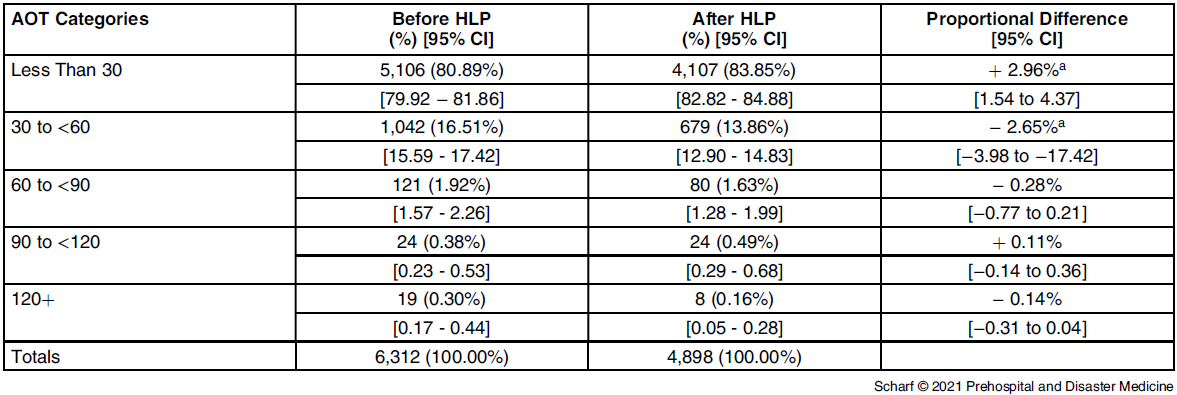
As illustrated in Table 3, when stratified by 30-minute AOT categories, proportional tests of significance found a statistically significant increase in the proportion of incidents in the zero to <30 minutes category after the program implementation (+2.96%; P <.01; 95% CI, 1.54 - 4.37). This test also revealed a commensurate statistically significant decrease in the proportion of incidents in the higher 30 to <60 minutes category (−2.65%; P <.01; 95% CI, −3.98 to −17.42). While the proportional differences in the other categories were not statistically significant, the 60 to <90 minutes category experienced a 0.28% decrease (95% CI, −0.77 to 0.21), the 90 to <120 minutes group saw a 0.11% increase (95% CI, −0.14 to 0.36), and the 120+ minutes category saw a 0.14% proportional decrease (95% CI, −0.31 to 0.04).
Proportion of Incidents in Each Ambulance Offload Time Category by Intervention Status

Abbreviations: AOT, ambulance offload time; HLP, Hospital Liaison Program.
a Statistically significant difference, P <.01.
Ambulance Offload Times T-Test Results
A t-test analysis was conducted to determine if there was a statistically significant mean difference in AOTs at HCGH before and after program implementation. The results showed that mean offload times were lower after program implementation (M = 19.54; SD = 15.06) compared to before the hospital liaison program (M = 21.94; SD = 14.93) and revealed a statistically significant difference of -2.40 minutes (95% CI, −2.96 to −1.84; t [11208] = −8.42; P <.001). T-test analyses stratified by the ambulance response level found a statistically significant decrease in AOT of 2.55 minutes (95% CI, −3.16 to −1.95; t [9319] = −8.24; P <.001) among ALS calls at HCGH after the program implementation (M = 19.04; SD = 14.91) as compared to the AOT for ALS calls before the HLP program (M = 21.60; SD = 14.76). T-tests of BLS incidents also revealed a statistically significant reduction in AOT of 2.24 minutes (95% CI, −3.67 to −0.81; t [1187] = −3.08; P <.01) after program implementation (before: M = 23.87; SD = 15.73 and after: M = 21.63; SD = 15.90).
Additional t-test analyses stratified by incident priority were performed to assess if a statistically significant mean difference in offload times was present in Priority 1, Priority 2, and Priority 3 calls after the liaison program implementation. Priority 4 calls were excluded as these only accounted for 10 incidents and included deceased patients whose offload times are unlikely to be affected by the liaison program. Priority 1 calls experienced a reduction of 0.27 minutes; however, this difference was not statistically significant (P >.05). Among Priority 2 calls, the t-test results revealed a statistically significant reduction of 3.06 minutes (95% CI, −3.89 to −2.23; t [4679] = −7.23; P <.001) in offload time after program implementation (before: M = 22.01; SD = 14.34 and after: M = 18.95; SD = 14.56). Among the less urgent Priority 3 calls, the analysis showed a statistically significant reduction of 1.97 minutes (95% CI, −2.77 to −1.16; t [5695] = −4.78; P <.001) in offload time after program implementation (before: M = 22.68; SD = 15.30 and after: M = 20.72; SD = 15.34).
Multiple Regression Analysis
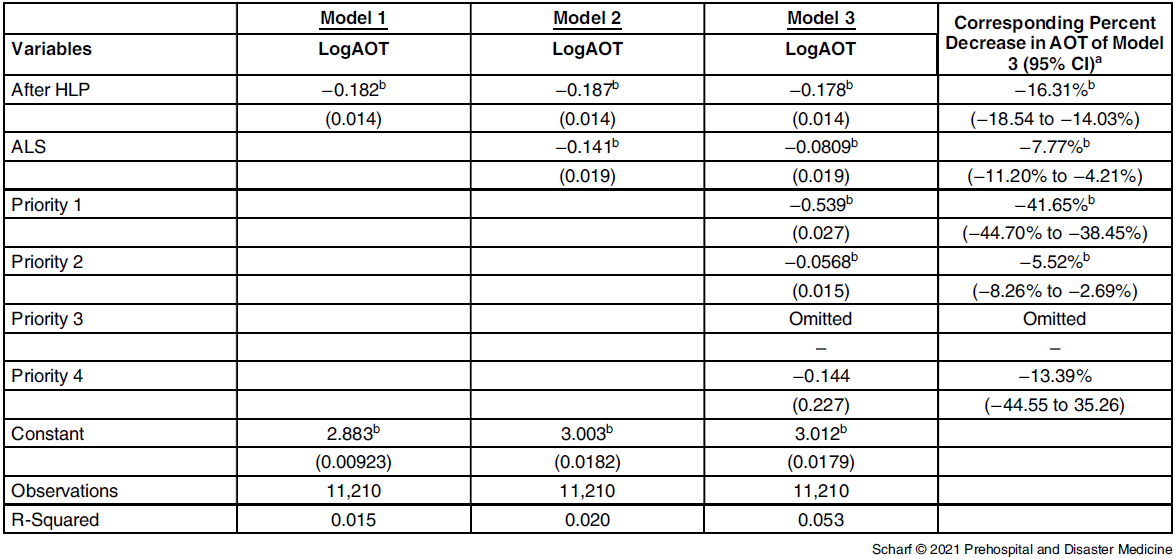
Stepwise multiple regression analysis was conducted to evaluate the association between offload times at HCGH, program implementation, ambulance response level, and incident priority. Table 4 summarizes the regression results. Implementation status, ambulance response level, and Priority 1 and Priority 2 levels were statistically significantly associated with AOTs. Further, the fully adjusted model indicated that the association between AOT and program implementation status remained significant, controlling for other variables in the model.
Stepwise Multiple Regression Analysis of Log AOT and Corresponding Percent Change in the Fully Adjusted Model

Abbreviations: AOT, Ambulance Offload Time; ALS, Advanced Life Support; HLP, Hospital Liaison Program.
a The percent decrease in the natural (non-transformed) AOT associated with each predictor is calculated by exponentiating the regression coefficient from the linear regression model (when the dependent variable is log transformed) and subtracting 1.
b Standard errors in parentheses; P < .01.
Patients transported to HCGH after the HLP program was implemented experienced offload times 16.31% (95% CI, −18.54% to −14.03%; P <.001) faster than patients transported before the program was in place, holding all other variables constant. The ALS patients at HCGH experienced offload times 7.77% (95% CI, −11.20% to −4.21%; P <.001) faster than the BLS patients, controlling for all other variables. Further, Priority 1 patients and Priority 2 patients saw offload times 41.65% (95% CI, −44.70% to −38.45%; P <.001) and 5.52% less, respectively, than lower acuity Priority 3 patients, holding all other variables constant. Priority 4 incidents were not statistically significant in the model.
Discussion
This study illustrates how EMS agencies can help reduce AOTs at EDs. The results of this analysis indicate that patients transported to HCGH after the HLP program was implemented and when the hospital liaison was on duty experienced a 16.31% reduction in mean offload times compared to offload times in the six months prior to program implementation. When offload times are reduced, EMS units can return to service more quickly, thus improving EMS system efficiency and increasing their availability to respond to the next emergency. These findings support previous research by Silvestri, et al which concluded that an ED paramedic staffing model can improve ambulance turn-around times and increase ambulance availability for service. Reference Silvestri, Sun, Gutovitz, Ralls and Papa3 Additionally, higher severity calls experienced reduced AOTs compared to lower acuity patients in the study period, signifying the effectiveness of the hospital liaison officer in facilitating rapid triage and transfer to definitive ED care.
Novel approaches to reduce offload delays have been implemented by local hospital systems with varying amounts of success. Reference Li, Vanberkel and Carter4,Reference Amin, Alqurashi and Perry12–Reference Greaves, Mitchell, Zhang and Crilly15 Ambulance diversion policies have been the most frequently utilized approach, however, the evidence of their effectiveness in reducing AOD is mixed and in some cases controversial. Reference Li, Vanberkel and Carter4 Other studies have explored the effects of implementing a dedicated ambulance offload nurse to initiate rapid triage and prompt offloading of patients arriving by ambulance. These studies found the offload nurse role was associated with modest improvements in multiple outcome categories, including AOTs. Reference Amin, Alqurashi and Perry12,Reference Crilly, Johnston and Wallis13,Reference Greaves, Mitchell, Zhang and Crilly15 While several studies explored the effects of an ambulance offload nurse, only a single study has examined the utilization of hospital employed paramedics in the ED to reduce offload times. The authors concluded that an ED paramedic staffing model can improve ambulance turn-around times and increase ambulance availability for service. Reference Silvestri, Sun, Gutovitz, Ralls and Papa3
The proportional increase in the number of EMS offload times in the zero to <30-minute time category and corresponding decrease in the proportion if incidents in the 30 to <60 minute, 60 to <90 minute, and 120+ minute groups in this analysis indicate that patients were being transferred to definitive care faster in the time period after the program was implemented. Though this may not be directly causally linked to the HLP, they illustrate a trend of decreasing offload delays after the program was in place despite the increasing burden of the COVID-19 pandemic on hospital EDs. Moreover, previous research has found that patients with offload times less than 30 minutes have significantly better outcomes than those with longer AOTs while patients with extended ambulance delays have a higher likelihood of prolonged ED stays and higher rates of hospital admissions. Reference Crilly, Keijzers, Tippett, O’Dqyer and Lind10,Reference Crilly, Johnston and Wallis13
This proportional trend is further supported by the t-test analysis which found a statistically significant mean decrease of 2.40 minutes in AOT after the program was implemented compared to the offload times at HCGH in the six months prior to program implementation. These reductions were present when stratified by the covariates demonstrating that the average AOTs were lower for ALS and BLS calls as well as Priority 1, Priority 2, and Priority 3 incidents after the program was implemented compared to the six months before the liaison program was in place. Currently, HCDFRS transports over 76% of their EMS calls to HCGH each year, and while the mean difference per incident may seem small, the impact of the reduction on EMS unit turn-around time and availability can be substantial when compounded over all the patients who are transported each day. Thus, programs of this nature have the potential to reduce AODs, facilitate smooth patient transitions between EMS and the ED staff, and assist with rapid triage and treatment of high-acuity patients.
One of the challenges in mitigating the COVID-19 pandemic was providing EMS clinicians with up-to-date information on rapidly changing policies and protocols while minimizing operational impact. Prehospital infectious disease control education requires regular repetition and consistent messaging from leadership. The hospital liaison model also provided a novel avenue to regularly reiterate departmental policy changes, assist department members in becoming proficient with doffing procedures, and simultaneously ensure adherence to hospital protocols for the transfer of potential COVID-19 patients. This program not only aimed to shorten the AOT at the hospital, but also to maintain a formal sustainable process to control the distribution of critical PPE. Further, the enhanced doffing oversight process worked to lessen the overall exposure of EMS clinicians by delegating that activity to the specially trained hospital liaison. The HLP represents an innovative approach to reducing AOTs while ensuring the safety and well-being of the EMS crews, patients, and hospital staff during the COVID-19 pandemic and beyond.
Limitations
There are several limitations that must be considered in the interpretation of these results. First, this study examined incidents transported to a single hospital where the HLP was implemented and thus are not generalizable to a larger population. Future studies could benefit from exploring the differences in offload times compared to hospitals that do not have a liaison program in place. Additionally, this dataset contains only one year of data (six months before and six months after), thus future research that explores the impacts of this program over a longer time period may be warranted. The intervention phase of the study period occurred during the COVID-19 pandemic, and as such, these results must be interpreted with this context in mind. This study is primarily retrospective and descriptive in nature and does not speak to the direct causal effect of the HLP on AOTs. Lastly, although these results are encouraging, as a retrospective study, the findings of this study are helpful for generating future hypotheses and are not hypothesis testing. Further research to explore the causal link between the liaison program and decreases in offload times, as well as other outcome measures, is necessary.
Conclusion
The HLP is an innovative initiative that constitutes a novel pathway for EMS and hospital systems to synergistically enhance ambulance offload procedures. The greatest effect was demonstrated in patients exhibiting potentially life-threatening symptoms, with a reduction of approximately three minutes. While small, this outcome was a statistically significant decrease from the pre-intervention time period. The clinical significance remains to be elucidated, and further research is required to determine effects on patient outcomes, EMS unit availability, and hospital flow. Ultimately, the HLP represents an additional strategy to complement existing approaches to mitigate AOD.
Conflicts of interest/funding
This research did not receive any specific grant from funding agencies in the public, commercial, or not-for-profit sectors. The authors report no conflicts of interest.