Introduction
The “hide and bide” policy of Deng Xiaoping (taoguang yanghui 韬光养晦) seems to belong to a memory of the past, replaced by Xi Jinping’s more assertive policy of the China Dream of “Great Rejuvenation” (weida fuxing 伟大复兴) and a strategy of striving for achievement.Footnote 1 According to the official statements, after its so-called “Century of Humiliation” (bainian guochi 百年国耻), China is finally retaking its rightful place in the world as one of its leading powers and is increasingly at the center of global politics. This shift is reflected in the PRC's greater spending on its military capabilities, the launch of the Belt and Road Initiative (BRI) in 2013, and its increased assertiveness in international institutions.Footnote 2 Although no single characterization of the China Dream (Zhongguo meng 中国梦) exists, one striking feature shared by many definitions is the strong reference to history, as seen in the conflicting debates among academics and political elites. Regardless of whether these historical representations portray the reality or not, this nostalgia for the past revamps the present quest for strength and power domestically and internationally. The memory of the past, as will be discussed, is constructed and adjusted according to the political message that political leaders want to promote both as a way to unite the Chinese nation and as a way to create a global narrative for China that helps support its new status as a global power. The memory of a great Chinese past becomes a useful vehicle and a master narrative in the current time of uncertainty and transformation. It helps to unite the Chinese nation in the name of its being part of a five-thousand-year-old civilization, legitimizing China's new global role in the name of its millennial civilization. Recalling past Chinese splendor as a precedent and creating a collective memory of it is a self-legitimizing act through which the current Chinese leadership can justify and strengthen its authority in a way that seems in natural continuity with dynastic history.
Collective memory and nostalgia – given their complex, almost impossible to quantify, and multidimensional nature – have been difficult to study in a scientific or systematic way, and they still do not fit squarely within any particular academic discipline. International Relations (IR) studies have long neglected the role of memory and identity, privileging broader realist perspectives that looked at international society more systematically in terms of power politics. In the past decades, with the emergence of constructivism, this has changed, and collective memory and how it affects foreign policy has increasingly become a topic of study. Constructivism places importance on the study of identity, believing that behavior is socially constructed, historically determined, and culturally contingent.Footnote 3 One of the earliest studies on collective memory is by Maurice Halbwachs. In his On Collective Memory of 1992, he argued that “the past is not preserved but is reconstructed on the basis of the present.”Footnote 4 Later studies looked at memory in its relationship to politics and IR.Footnote 5 One of the major discoveries was that collective memory influences identities and values, which themselves contribute to shaping a country's foreign policy, becoming relevant for IR studies.Footnote 6 However, while many more studies have addressed the link between memory and IR – due to theoretical limitations related to the elusive nature of the very concept of memory – studying memory and how it defines politics or looking at memory as an independent variable in IR literature remains challenging.Footnote 7 This article, while not providing theoretical or methodological answers on how memory influences foreign policy, contributes to these debates by making the case for the importance of a top-down constructed memory in shaping Chinese national identity and its foreign policy. Specifically, it looks at how Xi Jinping's rhetoric of the China Dream of Great Rejuvenation is creating a collective memory that ignites and complicates China's international relations. By evoking memories of the past, the traumas of the century of humiliation, the glories of Chinese millennial tradition, and utilizing amnesia for certain events of Chinese history, the rhetoric of the China Dream of Great Rejuvenation contributes in shaping the way political actors and people interpret and understand the world – justifying certain attitudes, needs, and responses.
How, then, did the new construction of the dream of Great Rejuvenation come about, and how does it differ from previous formulations? What history is taken as an example, and what are the objectives that the current Chinese leadership wants to achieve through a politicized nostalgia for the past? This article, through an analysis of Xi Jinping’s new rhetoric of the China Dream of Great Rejuvenation, provides insights into the uses of history and the creation of collective memory as an asset for the future and for China's foreign policy. It links China’s natural progress as a global power with a selective re-reading of its millennial history. The article, after having introduced the emergence of the Chinese official rhetoric of Great Rejuvenation and its evolution, looks specifically at the role of memory and the instrumental use of history. It deconstructs the key interconnected and overlapping components that form the Great Rejuvenation's historical reinvention, namely the chosen trauma, glory, and amnesia. It concludes with some general remarks and the risks that such rhetoric can have for China's nationalism and the present Chinese foreign policy. Zheng Wang has looked at China's dream relying on Johan Galtung's three forces of chosenness (the idea of being a people chosen by transcendental forces), trauma, and myths that combine to form a country's Chosenness–Myths–Trauma (CMT) complex.Footnote 8 While the notion of the “chosenness” of Chinese people as proud citizens of the “Middle Kingdom” and the modern achievements of the Chinese nation is an important part of CMT and the construction of collective memory, here, I refer instead to the chosen amnesia. The chosen amnesia is a key component for the construction of the China Dream of Great Rejuvenation, referring to episodes of Chinese history that have been selectively forgotten from collective memory. The chosen trauma refers to a Chinese national self-identity of historical victimization due to the humiliation caused by foreign powers’ encroachment on Chinese sovereignty over the course of the nineteenth and twentieth centuries. The chosen glories refer to cases selected from Chinese millennial history that emphasize Chinese splendors of the past millennia.
The three elements that support the Great Rejuvenation are defined as “chosen” in order to emphasize the politics of the history behind it, and the role of agency in selecting arbitrarily parts of the historical past to create a collective memory that is not organic, but imposed top-down. The China Dream of Great Rejuvenation is clearly not about historical accuracy. It is about selecting parts of the past in order to create a mythologized history of China that is consciously forward-looking. History serves the future and helps legitimize the power of Xi and the CCP, rather than finding universal laws in the past that repeat themselves. In this sense, the truthfulness of the history and the past is not a concern. Instead, history becomes a tool to create memory, justify the power of the CCP, and support its foreign policy. In this sense, following the German historian Reinhart Koselleck's distinction between different kinds of understanding of history, in the current use of history, the horizon of expectation has expanded to the point of annihilating the space of experience (that is, the memory of the past), and this reading of history has provided legitimacy for ruling elites. What matters is the future, as well as a historical trajectory that goes in a meaningful direction, not the truthfulness of the past. In this reading of history, besides being used as a toolkit of examples to support and justify present policies and future trajectories, history per se cannot teach anything and has no value. Therefore, the main concern of this article is not the historical accuracy of the China Dream of Great Rejuvenation, but the politics of history, or the “historical discourse” behind it.Footnote 9 According to the French philosopher Roland Barthes, historical discourse is a form of ideological elaboration that presupposes the assumption that it might not be problematic to distort and falsify history, to imprint subjective opinions and handy interpretations on the popular imagination.Footnote 10 History and memory can quickly become a field and a tool of political manipulation, a “playground on which to exercise ideological and social power.”Footnote 11 Records of historical experience and historical denial are inextricably bound to power structures, institutional dynamics, ebbs and flows of globalization, social dreams, and personal desires, including the one promoted by Xi Jinping and CCP political elites.
The Politics of History: The Past Serves the Future
Xi’s current rhetoric of the China Dream of Great Rejuvenation uses history as an asset for the future, linking its natural progress as a global power with a selective re-reading of its millennial history. The rhetoric embraces a nostalgia for the past that selects among the Chinese endless historical repertoire in order to support whatever case it wants to make, and relying on the so-called “Century of Humiliation” as its catalyzer. The political use of history in China is not something new or unique.Footnote 12 History in different forms has always played a vital role in the legitimization of the governing elites of China, as they saw their rule as inevitably linked to the dynastic continuity. However, the main difference with the current rhetoric of Great Rejuvenation and previous uses of the past is that history is no longer seen as cyclical and as magistra vitae (able to teach us lessons with its universal laws), but has instead become a linear process concerned more with an expectation for the future, as a way to strengthen domestically the Chinese nation and “naturalize China's new [central] place within a shifting global time-space.”Footnote 13
The French sinologist Léon Vandermeersch argued, in an article written in 1983 discussing the notion of “revolution” in Chinese thought, that the importance of history for political legitimization is related to the fact that in pre-1911 China, the philosophy of dynastic history tended to represent the historical fact as a natural phenomenon privileging a cyclical interpretation of history rather than a linear one. In such a vision of the world, where social and political activities were considered the extension of natural movements, the fundamental mechanisms of change did not, in principle, transform. For Vandermeersch, in China, “a state apparatus … that voluntarily questioned the fundamental principles of the political organization of the society did not make sense. The idea that a variety of forms of government could exist had never crossed the mind of any Chinese author.”Footnote 14 This was, for instance, reflected in the idea of wuwei 無為, non-action, of the Chinese sovereign, that is, precisely that of the emperor who restores the natural order of things. It was not thus about his autonomy or self-legitimation, but rather about the spontaneity ziran 自然 of the integration between the human sphere and the normality/morality of the universe. Vandermeersch continued arguing that “the revolution, understood in the West as total liberation of man, it seems to the eyes of a Chinese puerile nonsense ignoring the true status of man in society and in the universe.”Footnote 15 The radical changes of the geming 革命 in the Mencian usage were meant to restore the just, moral, and natural order; they were not revolutions in the modern sense of substantial structural change.Footnote 16
Greatly simplifying the history of China, it would be only in the 1880s and 1890s that the tragic events of the First Sino-Japanese War (1894–1895) set up the ideological foundations for the Xinhai revolution of 1911 and the creation of the first Chinese Republic. According to Vandermeersch, it is from the collapse of the imperial order and the establishment of the Zhonghua minguo 中华民国 that China immersed itself in the flux of modernity. Its trajectory started to be projected into the future rather than back to the past, although there were great waves of intellectuals who continued to call for restoration in the Republican period. From a strictly historical perspective, selecting the year 1911 as marking a transition from a more cyclical vision of history to one that is more linear is arbitrary. Such a transformation was possible, in fact, because in the decades before intellectuals such as Liang Qichao and two other generations of Qing scholars at the end of the nineteenth century already started to articulate a more linear vision of history.Footnote 17 Now, this is not to create cultural essentialism portraying China with a cyclical vision of history incapable of a lineal vision before 1911 against a Western modern linear vision. It is not that the Chinese were previously incapable of linear visions of history. Rather, using a cyclical vision of history was helpful in pushing new policies, as there was nothing more effective than pretending that they were old and legitimized by time. The difference that gradually emerged between a pre- and a post-1911 time is that history started to be inserted within a linear trajectory and, even when evoked to justify new policies, was more about the expectation for the future, as will be discussed further below. In this sense, Xi Jinping's China Dream of Great Rejuvenation, while evoking and relying on ancient Chinese splendor, is more about the future than the historical past.
The transformation in how the past was perceived at the end of the Qing is in line with the modern notion of “revolution” that was fully embraced by Chinese leaders of the PRC. In Western tradition the term “revolution” originally belonged to a physical-political order, in which “the naturalistic metaphor of political ‘revolution’ as in traditional China, lived on the assumption that historical time was itself of uniform quality, contained within itself and repeatable.” Accordingly, it was possible to conceive history and its always-valid paradigmatic examples, as magistra vitae (or as “life's teacher,” according to which the study of the past should serve as a lesson for the future).Footnote 18 However, with the French Revolution, the term started to be separated from its natural origin, becoming the “fond mobile de la science humaine,” leading “forward to the unknown future.”Footnote 19 Modern revolution, while interrupting (usually through violence) the political normality defined by a set of rules and values, modifies once and for all the relationship between what Koselleck identified as space of experience or the memory of the past (Erfahrungsraum), and the horizon of expectation or the expectation of the future (Erwartungshorizont). These are meta-historical categories that, in their constant intertwining, have always defined history and, in their changing relationship, have characterized different epochs. With modernity, for Koselleck, something new happened; the horizon of expectation expanded to the point of annihilating the space of experience, that is, the memory of the past. The future was from then on conceived always in favorable terms as the horizon of perfectibility, in which history as magistra vitae cannot play any role. This sets free the “historia humana, which turned away from sacral history, and [leads to] the legitimation of a modern state capable of subduing salvation oriented religious factions.”Footnote 20 If the revolution was legitimized by nature, in that it was related to astronomic phenomena, with modernity, it became a self-legitimizing act.Footnote 21
Usually, China’s clash with Western powers in the nineteenth century is believed by many historians to be the event that triggered the process of Chinese modernization. The revolution of 1911 marked a paradigmatic shift in China, which generated a rupture from the historical, uniform quality that defined Chinese institutions under the cosmological ritual kinship framework for millennia.Footnote 22 In line with the paradigmatic shift from the late Qing Dynasty, there was a strong desire to break with the past, which culminated in the iconoclastic and anti-traditional May Fourth Movement in 1919. This sentiment continued with the founding of the PRC in 1949, when Chairman Mao had Confucius denounced as one of the “Four Olds,”Footnote 23 a vestige of feudalism preventing China from launching itself into the modern era as a great nation-state. During the Cultural Revolution (1966–1976), Confucius and its doctrine were seen as a limit to modernization, to the point that CCP Red Guards tore through Confucius’ hometown of Qufu in Shandong province and vandalized his gravesite.Footnote 24 At the same time, leaders from the Republican Periods such as Sun Yat-sen and Yuan Shikai, and from the PRC, including Jiang Zemin and Hu Jintao and most recently Xi Jinping, continued to use the past as a currency for self-legitimation of the CCP and for legitimizing the bright future of China and its new place in the world. Already in the 1980s, the Party has started to actively promote the study of Chinese history and Confucianism to re-sinicize China, and the Chinese Academy of Social Sciences established an Academy of Chinese Culture aimed at finding Chinese cultural elements in the past that could help China's modernization and development.Footnote 25 After its 2007 sponsorship of the worship of Confucius on his birthday in a nationwide broadcast on CCTV, the Party began to frame the goals of a “rural rejuvenation” program for provinces like the northeastern Heilongjiang in Confucian terms.Footnote 26 While the current rhetoric of rejuvenation, nested in previous attempts to rejuvenate, restore, reinvigorate, and regenerate China, mimics the cyclical vision of history, it is now detached from the natural and cosmic dimension that used to be part of the traditional Chinese vision of history. Xi’s Great Rejuvenation aims at strengthening the rule of the Chinese Communist Party (CCP) and has little to share with the Chinese historical past if not for an instrumentalized nostalgia for its mythicized historical glories and traumas. But there is no real cyclicity in the history narrated, and there is no concern for its truthfulness. It is about the linear trajectory toward a better future for the Chinese nation, possible, according to the official rhetoric, only under the leadership of the CCP.
Xi Jinping's Dream of Great Rejuvenation
While in the Western world the beginning of this century was characterized by a certain amount of pessimism due to 9/11, the Iraq War, and the financial crisis, the climate in China was more optimistic following decades of continuous double-digit growth that started with Deng Xiaoping's reform and opening up of the 1970s. The twenty-first century has often been perceived by Chinese people and elites as a century in which China was entering a new phase of “Peace and Prosperity” (taiping shengshi 太平盛世) not only domestically but also globally.Footnote 27 The notion of a “China Dream,” already in use in the 2000s and encapsulated in the Olympic Games’ slogan “One World One Dream” (tongyi shijie tongyi mengxiang 同一个世界同一梦想) has been further fueled with grandeur and optimism by Xi Jinping and his China Dream of Great Rejuvenation, described by Chinese foreign minister Wang Yi as Xi’s key conceptual innovation in international affairs.Footnote 28 On November 28, 2012, just after he became General Secretary of the Chinese Communist Party, Xi launched the new rhetoric of the “China Dream” that corresponds to the Great Rejuvenation of the Chinese nation during his visit to an exhibition in Beijing entitled “The Road to Revival.”Footnote 29 In 2013, he called upon young people “to dare to dream, work assiduously to fulfill the dreams and contribute to the revitalization of the nation.”Footnote 30 Ever since, he has used the term in different speeches, and it has become a common term in the media, in policy, and in academic commentaries that have often focused on the “Chineseness of the dream” vis-à-vis other dreams like the American one.Footnote 31 For the various scholars participating in the international academic symposium “China Dream: Modern Social Changes and the Great Rejuvenation of the Chinese Nation” in 2013 in Beijing, Xi’s China Dream “is condensing, developing, and sublimating the spirit of the Eighteenth National Congress of the CPC, and it is a contemporary and philosophical subject with world significance. It is about the direction China is taking in its future.”Footnote 32
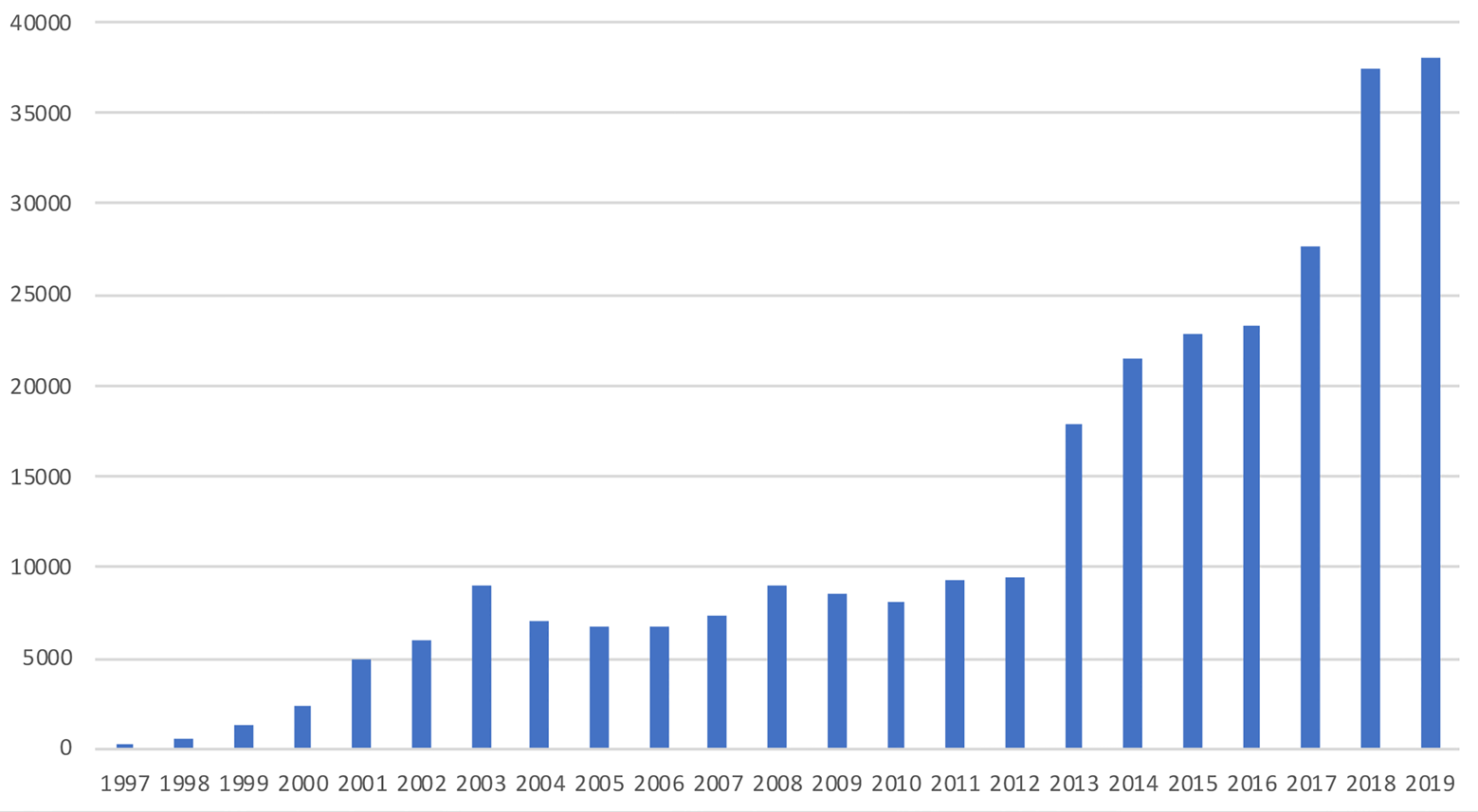
The terms “China Dream” and “Great Rejuvenation of the Chinese Nation” were used before by academics and political elites, but Xi Jinping's new use of the China Dream understood as a great national rejuvenation, places China in a new phase of its modernization and development as well as in a new phase of internationalization increasingly tied to his figure. Previously, the Great Rejuvenation of the Chinese Nation was a name used to refer to China's integration with the world and its modernization after the century of humiliation, in conjunction with the economic reforms of Deng Xiaoping.Footnote 33 From 2013, the use of the term skyrocketed (Figure 1) and started to be increasingly associated with the person of Xi Jinping and with a China that more assertively is re-taking its rightful place in the world. In order to legitimize his power, Xi, through a moral master narrative that sees China rising from the ashes and restored to its just central position in the world, linked it even more closely to the nation's rejuvenation and strength.Footnote 34 It also started to increasingly refer to a millennial history of China, rather than just the recent history of the PRC. The China Dream continues to be vaguely defined, and as Peter Ferdinand has noted, it is a “plastic term,” leading to multiple interpretations of its meaning, just as any dream or imaginary is ultimately in the eye of the beholder, and for this very reason is contested.Footnote 35 For some, it has been used as a justification to call for reforms, both on the political or environmental level.Footnote 36 The China Dream has also been understood as a Chinese version of the American Dream,Footnote 37 China achieving sustainable development,Footnote 38 either as a form of national renewal that goes through military and cultural rejuvenation,Footnote 39 or as an individual dream of liberalism and constitutionalism.Footnote 40 Despite the term's vagueness, aspirational, and open-ended nature, which makes it attractive but also questionable, if one reads Xi Jinping's various speeches, there is some degree of coherence and content specificity.Footnote 41 Moreover, it seems that its content is dictated from the top-down rather than emerging from the population or a more organic construction of collective memory, and the result is more concise and unitary.
Articles with the Term “中华民族伟大复兴” since 1997

Overall, the Great Rejuvenation that Xi is promoting points to the glory and splendor of five thousand years of Chinese civilization, providing a historical narrative according to which the splendor was illegitimately stolen during the century of humiliation in the nineteenth and twentieth century, and how the country is now rejuvenating itself and flourishing once again after the enormous suffering and sacrifices of its people, and is taking back its rightful place in history thanks to CCP leadership.Footnote 42 According to Xi, “the Chinese people never surrendered, and continued to struggle, finally grasped their own destiny, began the great process of building their own country, and fully demonstrated the great national spirit centered on patriotism.”Footnote 43 The dream is to transform China into a rich and powerful country (qiangguo 强国), revitalizing the nation and enhancing the well-being and wealth of the people (minsheng 民生, fumin 富民).Footnote 44 It is described as achieving a set of goals, advanced by Xi after the 18th National Congress of the Communist Party of China held in 2012, which are known as the Two Centenaries (liang ge yi bai nian 两个一百年): the material goal of China becoming a “moderately well-off society” by 2021, the hundredth anniversary of the CCP, and the modernization goal of China becoming a developed nation around the time of the hundredth anniversary, in 2049, of the founding of the People's Republic of China.Footnote 45 An essential aspect of Xi's dream of the Great Rejuvenation is that the move from a constructed humiliating past to a chosen glorious future was only possible through the leadership of the CCP under Xi. This is how he justified the abolition of his term limits. To realize the China Dream, the Chinese nation must keep the Chinese way (zou zhongguo daolu 走中国道路), advance the Chinese spirit (hongyang zhongguo qingshen 弘扬中国精神) in a way that corresponds to patriotism and innovation, and consolidate Chinese power (ningju zhongguo liliang 凝聚中国力量) through the unity and struggle of the Chinese people.Footnote 46 The Chinese way ultimately means upholding and developing socialism with Chinese characteristics that will enable the country to become rich and powerful.Footnote 47
However, who is the target for such rhetoric? The China Dream of Great Rejuvenation has both a domestic and international connotation. It is intended for Chinese people who experienced the transformation of China over the past forty years directly. The dream gives them patriotic hope about the future and provides a master narrative of order and a trajectory of their country at a time of uncertainty.Footnote 48 It is a meta-narrative that helps to foster the patriotism and nationalism of the Chinese nation.Footnote 49 Steve Tsang has observed that many Chinese do not necessarily have a good understanding of their history. They are prone to accept the narrative of the century of humiliation and a China now ready to take back its place in the world under the leadership of CCP, legitimized by its five thousand years of uninterrupted history.Footnote 50 However, due to the ambiguity of the term, the individual audience for the China Dream might interpret the Dream differently from the center, and this might lead to tensions in the future, especially in a context in which central government seems reluctant to tolerate other visions of the China Dream.Footnote 51 Another question is whether the Great Rejuvenation of the Chinese nation (Zhonghua minzu weida fuxing 中华民族伟大复兴) targets only those Chinese people (Zhonghua minzu) in Mainland China or adopts a broader understanding of nationality that encompasses all Chinese people in the world, including the large diaspora population.Footnote 52 At the moment, possible underlying expansionist implications for the use of Zhonghua minzu in the context of the China Dream of Great Rejuvenation seem an exaggeration, and it is more likely that in the light of China's national policy, the Zhonghua minzu refers to Chinese people in Mainland China rather than the large diaspora population.
While it is a narrative that fosters domestic modernization, appealing emotionally to Chinese people that have been engaged by the nationalist messageFootnote 53 and the promise of development, enrichment, and international recognition of their country, the target is also external and helps China’s internationalization through the construction of alternative histories and models of development to Western ones.Footnote 54 As Xi Jinping explains, the China Dream “not only enriches the Chinese people. But also benefits the people of the world.”Footnote 55 The rhetoric, in this sense, is also meant for an international audience that has witnessed a changing China and has been as equally destabilized as Chinese nationals by such rapid transformation. It helps to create a reassuring narrative of China as a great power playing a more significant role in the world. It had already started with the use of the Olympic motto “One World One Dream,” which was seen as a way of replacing, or at least creating, an alternative to the American Dream, thereby establishing a China Dream in the global context.Footnote 56 The reason for targeting a foreign audience is to express the new leadership's aspirations for China to become a great power and establish a new great power relationship (xinxing daguo guanxi 新型大国关系) with the US.Footnote 57 At the same time, one of the objectives is to cultivate a favorable international environment without raising too much concern, on the grounds that China is merely “rejuvenating” itself peacefully and harmoniously, as opposed to officially “rising.”Footnote 58 Accordingly, China is not seeking hegemony, but rather has a dream of “peace, development, win-win and cooperation.”Footnote 59 In this sense, the idea of peaceful rejuvenation while continuing the rhetoric of China being fundamentally a peaceful power departs from Hu Jintao's notion of China as peacefully rising (heping juequi 和平崛起), placing even more emphasis on the fact that China's rejuvenation should not be a source of concern to foreign countries and that China – instead of being a revisionist power – is a status quo power that relies on its old history in order to simply “rejuvenate.” Moreover, the emphasis on rejuvenation highlights China's return to greatness as coming from and legitimized by history rather than as a rise from nothing.Footnote 60
However, the fact that the China Dream is also about creating a “strong country” (Zhongguo meng qiangguo meng 中国梦强国梦), and that it has increased its military expenditure and strengthened its position in the South China Sea, leaves the international audience far from reassured about its intention. China has not only strengthened its military, with the intention of becoming a strong maritime power (18th Party Congress of CCP), it has also strengthened its relations with neighboring countries through the diplomacy of the periphery (zhoubian waijiao 周边外交), its strategy of striving for achievement that aims at creating solid strategic credibility in international society, and launched in 2013 one of the most extensive developmental plans not seen in decades: the Belt and Road Initiative.Footnote 61 Despite this new positioning, China is not yet a global power, and its “new assertiveness” under Xi Jinping has more to do with the way other powers perceive it than with an actual radical change in its foreign policy, as, for the most part, it shows a great deal of continuity with Chinese foreign policy of previous decades. Nevertheless, its economic transformation and its increasing integration with the global market will have repercussions on China's international presence. It seems that China is, so far, acting within the international legal order and is hesitant about becoming a “revolutionary state” as that will lead to isolation in the international system, as in the 1960s and 1970s.Footnote 62 However, how China will position itself in the future, and how nostalgia for the past will shape its foreign relations, is not a given, and so international society cannot be reassured that it will remain a status quo power.
Reinventing History and Constructing Nostalgia
Part of the appeal and logic of Xi's Dream of Great National Rejuvenation that helps grant the party and regime legitimacy domestically and attempts to create strategic credibility internationally is not just the economic development and achievements of the CCP of the past forty years. Another key aspect is its appeal to the CCP's historical mission that relies on what Callahan has called “nostalgic futurology,” a way to look back to key events in the PRC history like the Great Leap Forward, in order for China to be able to move forward in the twenty-first century. However, the history that Xi's Great Rejuvenation looks at is not limited to the PRC. The historic repository is grounded on China's five thousand years of glorious history (huihuang shengshi 辉煌盛世), when China was a leading power during the Qin, Han, Tang, Song, Yuan, Ming, and Qing dynasties, and on the development of an autochthonous civilization, expressed, for instance, in the Confucian tradition.Footnote 63 Xi Jinping visited Confucius’ birthplace in Qufu, Shandong, and criticized the excesses of the Cultural Revolution that significantly damaged China's cultural legacy.Footnote 64 The Chinese way, according to Xi, “emerged from the great practice of more than 30 years of reform and opening up. It is the result of continuous exploration for more than 60 years since the founding of the People's Republic of China…. It emerges from 5000 years cultural heritage of the Chinese people. It has deep historical origins and a broad realistic foundation…. We have created a great Chinese civilization.”Footnote 65
History in the context of the China Dream of Great Rejuvenation is used to construct a series of mutually reinforcing narratives about the present and future of the Chinese nation. While the reference is the glorious past of China, the narrative is how China under the previous leadership failed to resist the various humiliations and stand up against Western powers in the nineteenth and twentieth centuries, but as the test of history shows, this century under the new CCP leadership is different: China nation will be once again glorious. The century of humiliation, a notion that emerged in the 1920s, is a fundamental part of its politics and history. It is the chosen trauma, as will be discussed below, that helps justify the current leadership and its optimism for the future, based on the current success of hosting the 2008 Olympic Games, the 2010 World Expo, and leading the BRI. History and the longevity of Chinese civilization help to focus on the stability of Chinese civilization preserved by the CCP, especially in times of huge transformation. It also contributes to the focus on the “Chineseness” of a culture and civilization which gave rise to Chinese nativism before Western imperialism. As Ford has observed, the appeal to history and Confucianism helps combat the “spiritual pollution” emanating from the West, and increases the CCP's legitimacy through a positive ideal and implicit re-sinicization of China that is explicitly anti-democratic or anti-constitutional.Footnote 66 History, in this sense, has been used politically by Chinese elites, and it assists the state-building process while further legitimizing the CCP. Through what the political scientist Maximilian Mayer has defined as “China historical statecraft,” the diversity of historical memories and nostalgia used by Chinese leadership also helps in creating deviant historical frames that destabilize master progressive narratives of the West. In such narratives, China is not only at the center – as it had been in past millennia before the West hegemony dominated – but it also leads humankind in a trajectory of progress.Footnote 67 If China is one of the powers that boasts a long and uninterrupted civilization, the historical repertoire that the CCP uses in order to justify and promote the rejuvenation of the nation is quite limited, disparate and syncretic and selected according to the particular political needs of the present. The historical reinvention operates mainly through three factors: a chosen trauma, a chosen glory, and a chosen amnesia. These three components of the Chinese historical reinvention are equally important and co-constitutive of the China Dream of Great Rejuvenation. They all have an overtly instrumentalist quality and can be considered a reflection of each other. They also reflect how the China Dream of Great Rejuvenation has both an international and domestic connotation that inseparably feed into each other.
The Chosen Trauma
An aspect of Chinese national self-identity that emerges in official and academic discourse is one of historical victimization due to the humiliation caused by foreign powers’ encroachment on Chinese sovereignty and its people over the course of the nineteenth and twentieth centuries, which resulted in chaos and rebellion.Footnote 68 The sense of colonial trauma supports a foreign policy in which the country needs to be acknowledged as a victim in the international system. This obsession is articulated through the rhetoric of the “century of humiliation” that stretched from 1839 to 1949, and which still weighs down Chinese memory and its most recent history.Footnote 69 Due to the CCP's partial loss of legitimacy after the Tiananmen Square crisis in 1989, the launch of the “Patriotic Education Campaign” in 1991 was aimed at ideologically reeducating people by replacing the classical Marxist-Leninist narrative of class struggle with a patriotic one based on the chosen trauma of historical humiliations.Footnote 70 According to the official guochi narrative, the century of humiliation began in 1839 at the beginning of what came to be known as the First Opium War, when British warships destroyed a Chinese blockade of the Pearl River estuary at Hong Kong and compelled Chinese rulers to open their ports and markets to the opium trade, previously deemed illegal by the Qing court. The Qing’s defeat in the First Opium War (1839–1842) showcased the Qing’s military and diplomatic weakness in the face of Western power and forced China into the first direct and sustained exposure to Western powers.Footnote 71
The official narrative sustains the belief that from this defeat followed a series of unequal treaties, the first of which was the Treaty of Nanjing with Great Britain, signed on August 29, 1842. The treaty forced China to cede in perpetuity the territory of Hong Kong as well as open five more treaty ports to commerce, fix the tariff, and allow customs to gradually come under the control of the British. The British Supplementary Treaty of the Bogue established extraterritoriality and allowed British citizens to be tried in British courts, alongside granting Britain “most favored nation” status, awarding it any rights China might grant to other countries. The Qing empire and Republican China was thus humiliated by Western powers’ unequal treaties and colonial exploitation, internal rebellions, state collapses, Japanese occupation, and civil war. In the current official narratives, the lost imperial greatness of China was recovered only when Mao Zedong founded the People's Republic of China on October 1, 1949. It is only when the CCP and the Red Army won the Chinese Civil War against Chiang Kai-shek’s Kuomintang that the century of humiliation came to an end. According to the CCP's guochi narrative, the loss of territory was one of three sufferings and injustices, along with the loss of control over its internal and external environment and loss of international standing and dignity that China experienced during the century of humiliation, all of which must be rectified.Footnote 72 The struggle to reunite the country is one of the most pressing tasks that the CCP has yet to fully complete, accelerated by the sense of victimhood derived from the century of humiliations. In particular, one of the most non-negotiable of these is the return of Taiwan to Mainland China, which Xi Jinping placed as a top priority in his dream of Great Rejuvenation of the Chinese Nation.
Although there are different interpretations among present-day Chinese elites about what the lessons learned from the century of humiliation mean for the future trajectory of China in the global arena, a collective pain of losing the ancient splendor is kept alive in the national memory, and the chosen trauma is used as a catalyzer for the Great Rejuvenation. Mayer argued that the victimization discourse has been increasingly de-emphasized in Chinese rhetoric, and the narratives and memories of the century of humiliations have been slowly replaced by the history of Chinese glorious past in order to recast China's global role.Footnote 73 However, here it is argued that the century of humiliation remains a key component of the construction of the historical nostalgia that ignites the China Dream of Great Rejuvenation. In a way, the century of humiliation works as an antithesis to China rejuvenation, yet it remains important because it further legitimizes the CCP as the only one able to put an end to the humiliation and lead China toward a brighter future. The chosen trauma is incorporated in national identity, transmitted to the next generation, as it symbolizes the group's “deepest threats and fears through feelings of hopelessness and victimization.”Footnote 74 The chosen trauma also becomes a tool for interpreting the contemporary successes of the CCP and strengthening Chinese people vis-à-vis Western powers.Footnote 75 Moreover, since the 1990s, the CCP has started justifying the development of its army, its nuclear arsenal, and space aviation, in light of the century of humiliation and a need for redemption and justice that, in the official narratives, can only be achieved by the CCP and its capacity to keep the nation united and strong. This, as Steve Tsang has argued, gives rise to a problematic nationalism based on xenophobia, which views the outside world as hostile to China and the West as continually greedy in comparison to a peace-loving China.Footnote 76
The Chosen Glory
The other aspect of the Great Rejuvenation is the chosen glories that contribute to support Chinese reemergence as a global power. The chosen glories help see the glorious future of China as a natural and inevitable reenactment of its glorious past. If part of Chinese self-identity is one of the experienced humiliation, the other is the great Chinese millennial history, which is treated, as the IR scholar William Callahan has pointed out, as a toolbox from which the Party selects the cases that best fit its present and future needs.Footnote 77 Chinese people believe that China is the oldest continuous civilization in the world, with a recorded history that extends uninterrupted for five thousand years. As discussed earlier, Xi sees Chinese current civilization emerging from five thousand years of the cultural heritage of the Chinese people, uniting in a syncretic manner a series of historical events and cultural elements that range from Confucianism, Buddhism, Taoism, Communism, Socialism, Marxism, etc. One of the underlying logics in play is the assumption of causal continuity with the past. Historically, China was a great power up until the end of the eighteenth century, and it is now time to restore its wealth and power. As seen in the books of both Liu Mingfu and Martin Jacques, China's decline of the mid-nineteenth and twentieth centuries would only be a parenthesis in the long history of Chinese dominance.Footnote 78 However, history is not treated as magistra vitae by the CCP; it is simply an instrument that per se has no value if it is not legitimizing the CCP in its task of making China wealthy and powerful in the twenty-first century. In this sense, the history of China is no longer cyclical, but linear, heading toward a better future for the Chinese nation and increasingly also the world.
As part of the chosen glory, Chinese scholars have started to draw upon the resources of China’s past to reframe the international order. This is the case for the BRI, an invention of the twenty-first century that aims to create connectivity and promote a global value chain through Asia, with China at the center. The Initiative in an “evocative topography of history” reflects newfound Chinese trade ambitions that aim at replacing the transatlantic center with a Eurasian one, and forgets, as part of the chosen amnesia, not only episodes of violence, invasion, and bloodshed, but also the plurality of visions and imaginaries that the old trade routes in Central Asia evoke among different actors.Footnote 79 Also, the adoption in the current thinking of Pre-Qin era concepts, such as tianxia 天下, hexie 和谐, or datong 大同, for new regional and global orders is part of the chosen glory. For instance, tianxia, which means “all under heaven,” synthesizes the Chinese vision of the world, which has the Chinese emperor at the center of a hierarchical universal order based on the tribute system. Zhao Tingyang, one of the leading promoters of tianxia in the IR discourse, aims to write a history of the normative world order from a Chinese perspective, which rediscovers its cultural roots, and through which it will be possible to rebuild a harmonious society and world.Footnote 80 It would prompt a qualitative change in international society, ultimately leading to the replacement of the Westphalian order with an order that, beyond the ideal of a harmonious world (tianxia datong 天下大同), possibly conceals China’s imperial aspirations. But, again, a form of amnesia is necessary for these chosen glories. Tianxia justified the expansion of the Chinese empire, and the art of government promoted by it gave a concrete structure to the empire, often through the use of force and coercion. Although it became quite a popular theory among political elites, it remains vague and impractical.
Not only was the idealized tianxia order more complicated, but also – contrary to the projected “immemorial peacefulness” of its dynastic past – China has a long history of violence, which does not exclude expansionist and imperialistic behaviors and policies as mentioned earlier.Footnote 81 This is the reason why scholars like Zhao and Xu argued that China today is following a realist approach, and that the rhetoric of a harmonious world rooted in its historical tradition soon vanishes when Chinese profits and interests are involved. The authors are skeptical about China's peaceful rise. When China becomes a hegemon, instead of observing the principles of the harmony it preaches, it will likely use coercive means.Footnote 82 According to the authors, when it is materially strong, China acts like a realist power; when it is weak, it takes a more defensive stand. The complex and vast Chinese historical past can enlighten us today in seeing how both the present and the future behaviors of China and its position in the world cannot be taken for granted on the ground of a constructed and imposed and univocal history. This has never been the case for China.
Another author who contributed indirectly to give substance to the chosen glory of the dream of Great Rejuvenation of China is senior colonel Liu Mingfu. In his “China Dream,” he argues that China's peaceful rise must include a military rise. He also evoked history, not only by referring to the classics of the Kingly Way and Sunzi's Art of War, but also by looking at the more recent history of the PRC for examples of deterrence that can be used as a model by China moving forward.Footnote 83 Due to the interconnectedness of the chosen glory and trauma, he also repeats the narrative of struggle and humiliation that describe the Chinese people’s fight for their country’s century. For Liu, the nation can be rejuvenated only by revitalizing its martial spirit, focusing more on military power than economic power. Xi Jinping's national rejuvenation also sees the world-class army as a critical component, and in 2010 the People's Liberation Army had already started revising key concepts related to military strategy and operations in support of the pursuit of national rejuvenation.Footnote 84
The Chosen Amnesia
One last factor – probably the most important for the operation of the rhetoric of China’s rejuvenation, which is necessary for the other two elements to operate – is the chosen amnesia. The official historical narratives are not only very selective, but are also filled with lacunae and distortions that ultimately constitute a sort of amnesia of history.Footnote 85 This is the case for certain periods of PRC history, including the Tiananmen protests, the Cultural Revolution, the Great Leap Forward, and the Great Famine, which the central government has continually attempted to erase from the collective memory. But also for Hui, one fundamental amnesia of the central government, going back as far as 1911, is about constitutionalism.Footnote 86 For the implications it has on China foreign policy, a vital aspect of the Dream of the Great Rejuvenation is that it takes for granted that China, as the Middle Kingdom, was historically powerful yet peaceful toward its neighbors for five millennia. In order to assure the world that China is a status quo power, official rhetoric is predicting China's rise in a collective self-image of pacifism that is immemorial. This is well summarized by Dai Bingguo, a State Councilor, who, in a piece written in 2010, argued:
In terms of history, China has no culture or tradition of seeking expansion or hegemony. Throughout our history of thousands of years, benevolence and harmony are at the heart of our political and cultural tradition, which values harmony, good-neighborliness and friendship with all. China never sought expansion or hegemony even in its heyday centuries ago, when it accounted for 30 percent of the world's GDP…. In the height of the Tang Dynasty, what Japan got from China was not a threat but prosperity. China's territory has been what it is today since the Western Han Dynasty (206 BC–AD 24).Footnote 87
The idea of a historically peaceful China often refers to ideas of harmony that rely on the Book of the Great Harmony (Datong shu 大同书), written by Kang Youwei, who, at the turn of the twentieth century, used the ancient concept of harmony to solve problems within current society.Footnote 88 In the PRC's time, Mao Zedong saw the Great Harmony as a political goal. In 1962, Guo Moruo wrote a short story that created a hypothetical discussion between Marx and Confucius on their shared utopian goal of shared harmony.Footnote 89 It was a way for them to see how the Great Harmony could be combined with Marxism. In the 1980s, Deng Xiaoping said that China would never seek hegemony. This peaceful portrait of China was further elaborated upon by Hu Jintao’s promotion from 2005 of the ‘harmonious world’ (hexie shijie 和谐世界) concept that remains popular in academic journals and official foreign policy documents.Footnote 90 However, the harmonious society that Hu had in mind, expressed in a White Paper titled “China's Peaceful Development Road,” is still vague despite efforts to define it, and it seems like an attempt to justify the central state's top-down control.Footnote 91 China’s peaceful rise (heping jueqi 和平崛起), coined in 2006 by the CCP scholar Zheng Bijian to calm the concerns of Western countries faced with the prospect of China's rise, was replaced by strategies for peaceful development, a harmonious world, and rejuvenation (fuxing 复兴), which should be reflected in China’s emphasis on the Five Principles of Peaceful Coexistence in its foreign policy.Footnote 92
According to Xi, the rejuvenation of China will be peaceful, in continuity with the alleged immemorial peacefulness of a benign Chinese empire. A historical character often used for this purpose is the legendary figure of Zheng He, the Chinese Muslim explorer and diplomat who traversed oceans in various expeditions. According to the official narrative, when Zheng He dealt with African leaders, he did so in terms of equality, and after fostering some trade, left African states and societies alone without trying to exploit their resources. Zheng is commonly portrayed as a symbol of China's openness to the world, an envoy of peace and friendship. As Dai Bingguo remarked, “Zheng He, a great Chinese navigator, led the world's strongest fleet to the Western Seas on seven voyages, taking with him not bloodshed or war, pillage or colonization but porcelain, silk and tea.”Footnote 93 This symbol has also been adopted by a number of Southeast Asian countries, especially overseas Chinese in places like Malaysia, for purposes of tourism and fostering pro-Chinese ties. Although this article is not interested in evaluating the truth of such claims, Zheng operated more as an agent of Chinese expansionism, as he was someone who did not hesitate to use force when countries he visited refused to recognize Chinese hegemony.Footnote 94 China's neighbors would moreover think otherwise about Chinese pacifism, and the Chinese century of humiliation in Vietnam corresponds to “1000 years of Chinese domination.” Looking at Chinese history, moreover, Hui observes that besides the fact that there was not one single China, and that the Middle Kingdom was often fragmented rather than unitary, it was far from being pacifist, taking into consideration, for instance, the preponderance of civil wars and armed rebellions, and that Qianlong himself was an expansionist.Footnote 95
Conclusion: Deconstructing Memory and Nostalgia
In the constructed historical memory that supports Xi Jinping's China Dream of Great Rejuvenation, the historical veracity of the facts loses importance, instead becoming part of a unilaterally constructed historical narrative.Footnote 96 The chosen trauma, glories, and amnesia contribute to the reconstruction of both Chinese national identity and to the definition of foreign policy in an attempt to remodel the world to accommodate China's ascendancy as a global power, as part of the new strategy of striving for achievement that replaced that of keeping a low profile, or “hide and bide.”Footnote 97 Many authors have discussed national identities in terms of myths. For Benedict Anderson, national identities are “conscious constructions of myths,” or “imagined communities,” in which history plays a crucial role in creating bonds between individuals and states.Footnote 98 National myths per se create and decide what constitutes objective history, who are its subjects, what is its territory, its symbols, and its values. The rejuvenation of China serves to foster a sense of nationhood among people, and one of its characteristics is the chosen amnesia, which harkens back to philosophical issues. For some philosophers, the cultivation of the truth is a necessary purification process that has to do with historical justice.Footnote 99 There are other authors, however, who question the need for memory as a form of justice, arguing that the moral demand and the possible social cost of memory sometimes outweigh those of amnesia.Footnote 100 There certainly exists a risk for the CCP in recognizing the self-inflicted traumas of the Cultural Revolution, the Great Leap Forward, and the Tiananmen protests. In their eyes, amnesia is essential to preserve legitimacy. The issue is that historical amnesia, and with it the historical toolbox promoted in the official Chinese rhetoric, might become toxic for China's national identity and its foreign policy, especially when its new foreign strategy aims at creating “a solid strategic credibility” in international society.Footnote 101 The Party is trying, in the case of the BRI, to reduce the complexity and diversity of the Chinese past, and also of the Eurasian past, to one paradigm, one motto, one slogan, and one history that is dictated from the top-down and does not allow for much contestation. For instance, the memory of the century of humiliation and the ever-present sense of fear of the possible encroachment of Chinese territorial unity and sovereignty boosts economic and social development. However, it also fosters nationalism and “anti-foreigners” sentiment, justifying a more aggressive non-compromising and non-negotiable belligerent behavior, in which territorial and maritime claims correspond to Chinese national identity claims. While the state often has to negotiate with different factions that present conflicting views about history, the Chinese state has been attempting to construct its present and future relying on its own reconstructed history of China, and without leaving much space for debate.
Since time immemorial, political elites have used historical memory to legitimize their rule, and the CCP remains no exception to this trend. As Georg Gadamer suggested, “History is only present to us in light of our futurity” and it is constantly reconstructed in the light of the concerns and needs of the present and future.Footnote 102 It is the use one makes of it that matters, and how this is re-crafted and processed through collective memory and national identity. Selected historical events can be useful for the politics of history that the current leadership is promoting in order to foster a sense of nationalism and patriotism among Chinese people and legitimize its rule. However, especially after having discussed how the current rhetoric of Great Rejuvenation has been constructed, China's future is not determined by its past. Instead, the future is written in the present by the Chinese people and its elites. If China wants to become a global leader, the future of its global leadership is written having taken into account other countries’ historical narratives and their own nostalgia and aspirations for the future.
The main risk in historical amnesia and the CCP's manipulation of history with its chosen trauma and glories is, ultimately, the distortion of national identity and the failure of its foreign policy strategy of winning new friends and creating an international society more accommodating to the centrality of China. The instrumental use of history and collective memory in the context of the Great Rejuvenation of the Chinese nation shapes Chinese national identity in a way that is fixed and fixated. This, for instance, can transform specific territorial claims into assertions of Chinese identity, which then per se become non-negotiable. This will have severe consequences for any national interests promoted in future Chinese policymaking because agenda items will become increasingly non-negotiable. Moreover, if China promotes itself to the outside world as a leader of globalization that will guide countries to prosperity in a new multipolar order, it is unclear whether the central government's unilaterally selected historical narratives will be able to accommodate the plurality of historical narratives, nostalgias, and visions for the future of countries it wants and needs as allies. Xi Jinping's global aspiration for his country depends on the credibility of China in the international arena. The China Dream of Great Rejuvenation, in order to help China's strategy of striving for achievement, must be inclusive and pluralistic and should open its historical narratives to contestation. Although the domestic and international aspects of the China Dream of Great Rejuvenation are interrelated and complementary, they operate differently, and what can persuade and appeal to Chinese people's nationalistic emotions is ineffective, and even counterproductive, when the target is international society.