Long-term central venous catheters (LT-CVC) are important tools in the management of cancer patients. Reference Lebeaux, Fernández-Hidalgo and Chauhan1 It has been well established that LT-CVCs have lower infection rates compared to short-term central venous catheters. However, LT-CVC–associated infections have high morbidity and mortality and often lead to delays in oncological therapy. Reference Pinelli, Cecero and Degl’Innocenti2
Reported rates of bloodstream infection (BSI) associated with LT-CVC are between 0.2 and 2.8 per 1,000 catheter days. However, published data are heterogeneous regarding the denominator used (catheter days or days of use of the catheter), the follow-up period, surveillance methods, and the definitions used to identify these infections. Reference Touré, Vanhems and Lombard-Bohas3–Reference Wang, Der and Chen9
Although LT-CVC BSIs have a huge impact on cancer patients, few studies have investigated strategies for the identification and surveillance of these infections. Most criteria are derived from the experience with surveillance of short-term central lines.
One of the most important pitfalls for surveillance of infections associated with LT-CVC is that most of these infections occur in outpatients under chemotherapy because most patients are not hospitalized during treatment. Outpatient infection surveillance adds difficulty to the identification of infections and to obtaining reliable denominators.
In that way, identifying surveillance methods that are suitable for this population is necessary and will be the first step toward understanding the epidemiology of LT-CVC infections, creating a benchmark, and designing prevention strategies.
In this study, we describe the first results of a surveillance system for infections associated with LT-CVC in patients under outpatient chemotherapy. We evaluated the application of BSI definitions in this population and correlated high BSI rates with service characteristics.
Methods
In this prospective study, we described the first results after the implementation of a surveillance system for BSIs associated with totally implantable venous access ports and semi-implantable catheters in patients under treatment and follow-up at outpatient chemotherapy clinics.
The study started in April 2019 and rates were consistently reported and analyzed from January 2020 to May 2021, initially including 6 outpatient clinics located in hospitals with intense activity in cancer care. After January 2021, 2 other clinics were added to the surveillance project. The infection control services of these hospitals were invited to participate in this study by the Division of Infection Control of the State of São Paulo Surveillance Agency (CVE-SP).
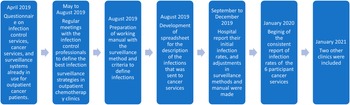
An initial questionnaire was answered by the hospitals to characterize their infection control department, cancer service, and to describe infection surveillance systems already used for outpatient cancer patients. Subsequently, regular meetings including the representatives of the services occurred to discuss and define the best infection surveillance strategies in outpatient chemotherapy clinics.
A working manual with the surveillance method and criteria for defining infections was written and approved by all the members of the group. We developed an Excel spreadsheet for denominators and numerators and another Excel spreadsheet for the description of the infections. Starting in January 2020, all clinics reported their rates monthly to the government agency (CVE-SP) (Fig. 1).
Flowchart on the creation of the surveillance program for long-term central venous access–associated infections in outpatient chemotherapy services.

Surveillance method
The surveillance included exclusively patients who attended outpatient chemotherapy clinics and had a totally implantable or semi-implantable catheter.
Denominators
We defined the denominator as the number of days in which the LT-CVC was manipulated in the outpatient chemotherapy clinic in each month. The denominator was collected daily by the assistant nurse of the outpatient clinic. For patients who went home with a portable chemotherapy infuser, all days in which the patient remained with the infuser were included in the denominator. Denominators were collected separately for peripherally inserted central catheter (PICC), totally implantable, and semi-implantable CVCs. The days during which the catheter was present but not accessed were not counted. We defined as catheter manipulation any procedure involving infusion or aspiration of any vehicle through the LT-CVC.
Numerators
The following infections were reported: bloodstream infections associated with LT-CVC (LT-CVC BSI), pocket and/or tunnel infection, and infection at the exit site of the CVC. We used the following infection definitions.
LT-CVC BSI was defined according to the following National Health Safety Network (NHSN) criteria:
-
1. One or more blood cultures preferentially obtained from peripheral blood, and the pathogen was not related to an infection at another site.
-
2. Or at least 1 of the following signs or symptoms: fever (>38°C), tremors, or hypotension (systolic pressure ≤90 mmHg), and the symptoms were not related to an infection at another site.
-
3. Plus 2 or more positive blood cultures (in different punctures with a maximum interval of 1 calendar day) with skin contaminants (eg, Corynebacterium spp, Bacillus spp, Propionibacterium spp, coagulase-negative staphylococci including S. epidermidis, viridans group streptococci, Aerococcus spp, Micrococcus spp, Rhodococcus spp) and the signs and symptoms and positive culture results occurred within the infection window period. 10
Also, we used the definitions of “infection window period” and “repeat infection timeframe” outlined by the NHSN. 10
A LT-CVC BSI was associated with an outpatient chemotherapy clinic if the last manipulation of the LT-CVC before the infection occurred in the outpatient chemotherapy clinic, regardless of the length of time between the manipulation and the diagnosis of the infection.
We secondarily compared NHSN criteria for LT-CVC BSI to definitions outlined by IDSA to define catheter-related LT-CVC BSI as follows Reference Mermel, Allon and Bouza11 :
-
1. The same microorganism was isolated from at least 1 peripheral blood culture and the CVC tip/or CVC system.
-
2. Or the same microorganism was isolated from peripheral blood and blood collected through the catheter, with culture time differential between culture sites ≥ 2 hours later for the peripheral blood.
-
3. Or the same microorganism was isolated from blood cultures taken from 2 catheter lumens, and the culture taken from 1 lumen had a 3 times greater colony growth than from the other lumen.
We also evaluated mucosal barrier injury (MBI)–related infections as a subgroup of LT-CVC BSI using the definition for MBI as the presence of 1 of the 3 following conditions:
-
1. An absolute neutrophil count of <500 cells/mm Reference Touré, Vanhems and Lombard-Bohas3 on 2 separate days, within 3 days of the diagnosis of the BSI
-
2. A hematopoietic stem cell transplantation within 1 year of the positive blood culture with grade 3 or 4 gastrointestinal graft-versus-host disease, or
-
3. Severe diarrhea of ≥1 L within the previous 7 days of the positive blood culture. 10
Criteria used to define local catheter infections were those of the Infectious Diseases Society of America. Reference Mermel, Allon and Bouza11 Briefly, local complicated infections were defined as an infection of the tunnel or port pocket with extended erythema or induration (>2 cm), purulent collection, skin necrosis, and spontaneous rupture and drainage. Exit site infections were defined as those without systemic signs of infection, positive blood culture results, or purulence.
The following pathogens were considered multidrug-resistant organisms (MDROs): carbapenem-resistant or extended-spectrum β-lactamase–producing Enterobacteriales, carbapenem-resistant Pseudomonas aeruginosa, carbapenem-resistant A. baumannii, methicillin-resistant Staphylococcus aureus, and vancomycin-resistant Enterococcus spp. Reference Magiorakos, Srinivasan and Carey12
Data analysis
We calculated the infection rates using as the numerator the number of infections associated with LT-CVC aggregated or split by type of infection (BSI, local complicated infection, and exit site infection) and type of CVC. The denominators were the number of CVC days of use (aggregate or split by type of CVC) multiplied by 1,000.
We compared the infections based on the type of catheter used dividing them into 3 groups: PICC, semi-implantable, and totally implantable catheters. For this analysis, we used χ2 for dichotomous variables and Kruskal-Wallis for continuous variables.
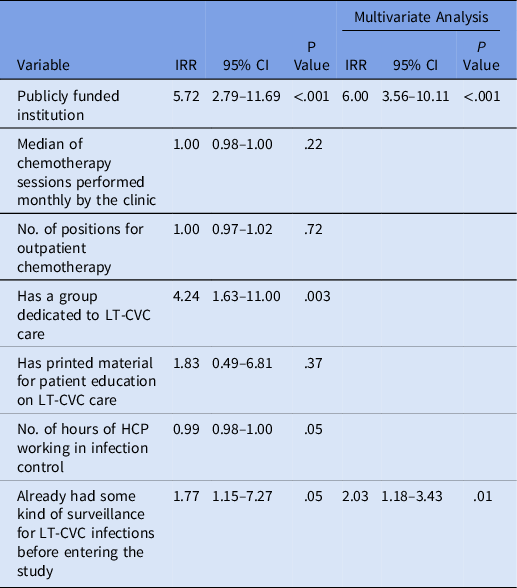
We also evaluated the factors that were associated with bloodstream infection rates using the aggregate rate of LT-CVC BSI during the study period as the outcome variable. Univariate and multivariate analyses were performed using Poisson regression. The criteria for including variables in the multivariate initial model was P < .10. Variables that reduced the −2 log-likelihood value or showed a value of P < .05 were retained in the final model.
Results
Characteristics of the chemotherapy clinics
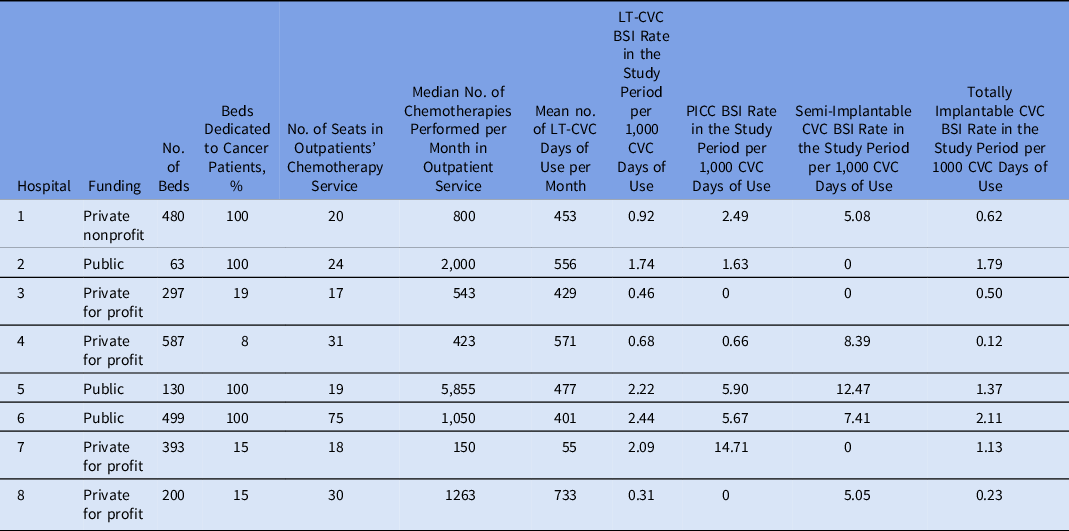
All 8 clinics were located within hospitals, of which 3 were in hospitals completely dedicated to cancer care. Also, 3 hospitals were publicly funded, 1 was nonprofit private, and 4 were private for profit. Their median number of seats and/or beds for outpatient chemotherapy was 22 (range, 17–75), and they performed a median of 925 (range, 150–5,855) chemotherapy sessions per month. All hospitals reported that >50% of patients receiving outpatient chemotherapy had a LT-CVC. The median number of hours of healthcare workers dedicated to infection control in these hospitals was 146 hours per week for nurses and 32 hours per week for physicians (Table 1). Also, 4 (50%) clinics already did some kind of surveillance for LT-CVC infections in outpatients, and 3 clinics already used CVC day of use as the denominator.
Characteristics of Cancer Services and Rates of Infection Among 8 Hospitals That Participated in Long-Term Central Venous Catheter Infection Surveillance

Infections
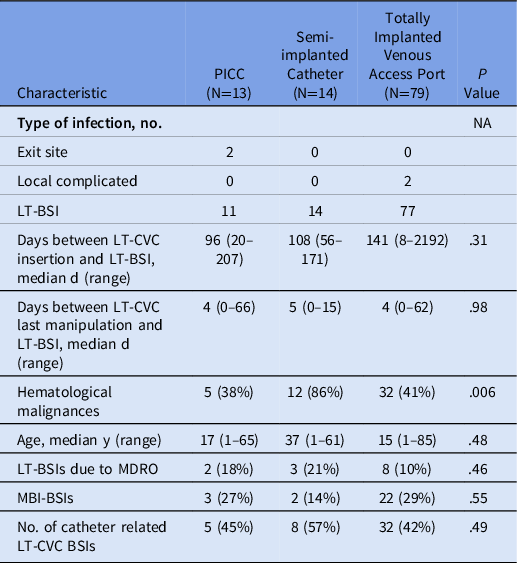
Over the 26-month study period, 107 infections were reported: 2 exit-site infections; 2 local complicated infections; and 102 LT-BSIs. Among all BSIs, 77 (76%) were associated with totally implantable CVCs, and 49 patients (48%) had hematological malignancies. The median length of time between infection and the last LT-CVC manipulation was 4 days (range, 0–66 days), and the median length of time between infection and LT-CVC implantation was 116 days (range, 8–2,192 days). (Table 2)
Characteristics of the Infections Associated With Long-Term Catheter Separated By Type of Catheter in Outpatient Chemotherapy Clinics

Note. PICC, peripheral inserted central venous catheter; NA, not applicable; LT-CVC, long-term central venous catheter; LT-CVC BSI, bloodstream infections associated with LT-CVC; MDRO, multidrug-resistant microorganism; MBI-BSI, mucosal barrier injury laboratory confirmed bloodstream infection.
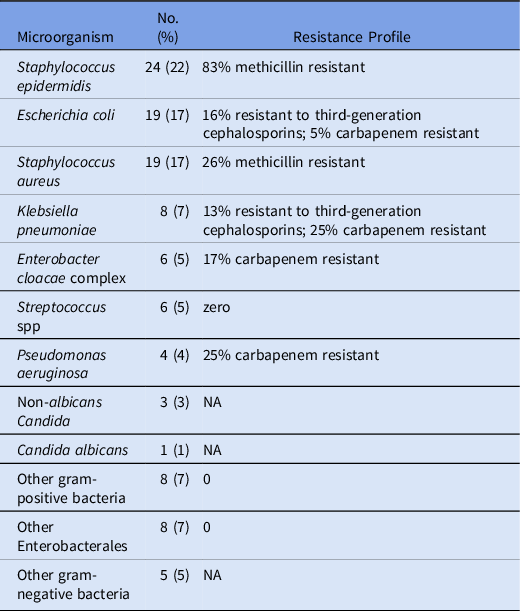
In addition, 7 LT-CVC BSIs (6.9%) were polymicrobial. The most frequent microorganisms causing BSI were gram-positive bacteria, 57 of 111 (51%); followed by Enterobacterales, 41 (37%); nonfermentative gram-negative rods 8 (7%); and Candida spp 4 (4%). Methicillin resistance was reported in 26% of S. aureus. K. pneumoniae strains presented 25% of carbapenem resistance (Table 3). As expected, when only LT-CVC BSIs were analyzed, gram-positives corresponded to 65% of isolated pathogens, followed by 12 Enterobacterales (24%), 4 nonfermentative gram-negative isolates (8%), and 2 Candida spp (4%). Among MBI-BSIs, the most isolated pathogen was E. coli (n = 11, 37%), followed by K. pneumoniae (n = 4, 13%) and Streptococcus spp (n = 4, 13%).
Microorganisms Isolated From 102 Bloodstream Infections Associated With Long-Term Catheters Among Patients of Outpatient Chemotherapy Clinics

Note. NA, not applicable.
Initial results of the LT-CVC infection surveillance
The accumulated rates for exit-site infections and local complicated infections were 0.04 per 1,000 CVC days of use for each. The accumulated rate of LT-CVC BSI was 1.94 per 1,000 CVC days of use. LT-CVC BSI monthly rates ranged from 0.71 to 3.92. When MBI-BSI infections were excluded from LT-CVC BSI rates, the accumulated rate was 1.43 per 1,000 CVC days of use, and monthly rates ranged from 0.48 to 3.21.
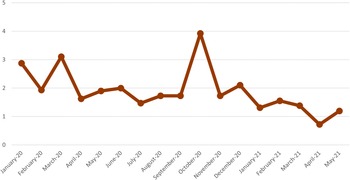
Totally implantable catheters were the most frequent type of catheter used, accounting for 84% of the days of CVC use, followed by PICC (13%); and semi-implantable CVC (3%). The total accumulated rates were 1.60 per 1,000 CVC days of use for PICCs, 1.75 for totally implantable CVCs, and 8.71 for semi-implantable CVCs. Monthly rates of LT-CVC BSI in totally implantable CVC users ranged from 0.38 to 3.98 per 1,000 CVC days of use (Table 1 and Fig. 2)
Incidence of bloodstream infection associated with totally implantable venous catheter in outpatient chemotherapy.

In the multivariate analysis for factors associated with higher rates of LT-CVC BSI, public clinics had higher infection rates (IRR, 6.00; 95% CI, 3.56–10.11; P < .001) compared to clinics with other types of funding. Hospitals that had previously instituted any kind of surveillance for outpatient LT-CVC infections also had higher infection rates (IRR, 2.01; 95% CI, 1.18–3.43; P < .01) (Table 4).
Factors Associated With High Rates of Bloodstream Infection Associated With Long Catheters (LT-CVC BSI) in Outpatient Chemotherapy Clinics

Note. IRR, incidence rate ratio; CI, confidence interval; LT-CVC, long-term central venous catheter; TIVAP, totally implanted venous access port; HCP, healthcare professionals.
Catheter-related and mucosal barrier injury BSI
In total, 27 LT-CVC BSIs (27 of 102, 26.5%) met the criteria for MBI-BSI. The only MBI-BSI criterion identified was neutropenia on 2 separate days, within 3 days of bacteremia diagnosis. Also, 45 (44%) catheter-related LT-CVC BSI occurred: 26 (58%) had differential positivity time in paired blood cultures >2 hours, and 19 (42%) had the same microorganism isolated from blood and LT-CVC tip. Furthermore, 3 cases fulfilled both definitions: MBI-related and catheter-related bloodstream infection.
Discussion
In this study, we reported the preliminary results of a LT-CVC infection surveillance system in clinics for outpatient chemotherapy. We propose an applicable system with a reliable denominator, CVC-days of use, that was sustainable even during the COVID-19 pandemic. We observed that LT-CVCs were widely used among patients in chemotherapy, predominantly totally implantable CVCs. LT-CVC BSI was the most frequent infection, and a considerable proportion (13%) was due to multidrug-resistant microorganisms.
Cancer patients are susceptible to infections that are associated with high morbidity and mortality. Reference Zakhour, Chaftari and Raad13 Therefore, specific surveillance systems need to be more widely studied and implemented. Reference Pinelli, Cecero and Degl’Innocenti2 These patients have unique features, such as afebrile infections, multiple causes for leucopenia or leukocytosis, and a wide range of pathogens, Reference Raad and Chaftari14 that make infection definitions used in standard hospital surveillance systems unsuitable. Definitions require adjustment and validation for surveillance in oncology.
During the preparatory phase of this study, the centers brought up important issues regarding surveillance: (1) Which was the best strategy for denominator collection? (2) What is the ideal definition of LT-CVC BSI? And (3) should infections other than LT-CVC BSIs be included in the surveillance system?
One of the first difficulties in LT-CVC outpatient surveillance is the denominator collection once the patients attend the chemotherapy service intermittently. In our study, we chose to use CVC days of use as the denominator, which was more feasible, and we believe more accurate. In the retrospective cohorts of LT-CVC BSI, CVC days were counted as days from the moment of CVC insertion to CVC removal or patient death. Reference Jiang, Li, Pan and Yu15 Cancer patients usually remain with their LT-CVC in place for long periods, even after the end of chemotherapy and during the interval between different cycles of chemotherapy. However, the higher risk for LT-CVC infection occurs during periods of treatment and neutropenia. Additionally, patients under cancer treatment are frequently hospitalized, and CVC days mix periods in which the patients are hospitalized and in which they are outpatients, making interpretation difficult.
The major disadvantage of using CVC days of use is the comparability of data with other studies because the use of CVC days artificially decreases the LT-CVC infection rates. In the present study, we identified a cumulative BSI rate of 1.94 per 1,000 CVC days of use. In the literature, rates of BSI associated with LT-CVC are usually reported by CVC days and are commonly described as <1 per 1,000 CVC day. Reference Yoshida, Ishimaru, Kikuchi, Matsubara and Asano4,Reference Jiang, Li, Pan and Yu15 In a study that used CVC days of use, the LT-CVC BSI rate for totally implantable CVCs was 2.81 per 1,000 CVC days of use. Reference Freire, Pierrotti and Zerati6,Reference Mollee, Okano and Abro16
Regarding definitions, we decided to use the NHSN BSI criteria, which are wide ranging. Subsequently, all cases were reviewed considering the IDSA criteria for CVC-related BSI to evaluate whether these criteria effectively excluded MBI-BSI. In our preliminary results, we observed good discrimination between catheter-related BSI and MBI-BSI; only 3 LT-CVC BSIs fulfilled the criteria for both types of infection. Other studies reported that MBI-BSI corresponded to an important proportion of BSI among patients with hematological malignancies, ranging from 44% to 71%. Reference Mollee, Okano and Abro16,Reference Kato, Hagihara and Kurumiya21–Reference Torres, González and Loera23 We also observed that when MBI-BSIs were excluded, the LT-CVC BSI rate was reduced by 26%. Because of these results, we believe that MBI-BSI artificially inflates the rates of LT-CVC BSI. MBI-BSI probably should be excluded from the surveillance of infections associated with LT-CVCs because they are not susceptible to preventive measures directed toward the CVCs. Furthermore, more specific criteria may benefit patients regarding measures to manage catheter-associated infections such as removal or lock therapy. Reference Fares, Khalil and Chaftari24
Additionally, we observed that 32% of the LT-CVC BSI did not fulfil the criteria either for MBI-BSI or for LT-CVC-BSI–related infections. This finding suggests that using only the definition of LT-CVC–related LT-BSI underestimates the rates of LT-CVC BSI. Furthermore, the laboratory workup of defined LT-CVC-BSI–related infection, such as systematic culturing of CVC tips and correct catheter blood culturing (ie, timing and blood volume), can affect the surveillance results. Thus, the use of criteria that report all BSIs as associated with CVC if a patient did not have other identified site of infection is probably more sensitive and adequate.
Regarding types of infection that should be included in surveillance, most infections in our study were LT-CVC BSIs. Another study that performed surveillance of totally implantable CVCs also reported a low proportion of local infections, 14%. Reference Vermeulin, Lucas and Marini25 We believe that the explanation for this finding is that tunnel, pocket, and exit-site infections usually occur in the first 30 days after CVC insertion, and patients may have started chemotherapy after this period. Furthermore, early infections after CVC implantation usually correspond to a small proportion of the total number of LT-CVC infections. Reference Lebeaux, Fernández-Hidalgo and Chauhan1,Reference Pinelli, Cecero and Degl’Innocenti2,Reference Lecronier, Valade and Bigé26,Reference Freire, Pierrotti and Zerati27
In our study, we also observed that a high proportion of LT-CVC BSIs occurred in hematological patients, and these patients more often had infections in semi-implantable CVCs. Several studies reported hematological patients as at high risk for LT-CVC infections. Reference Lebeaux, Fernández-Hidalgo and Chauhan1,Reference Pinelli, Cecero and Degl’Innocenti2,Reference Mollee, Okano and Abro16–Reference Chang, Hsuan, Kee and Kiu19,Reference Viana Taveira, Lima, de Araújo and de Mello28 Hematological patients usually have long periods of neutropenia and more severe mucositis. Moreover, higher BSI rates have been reported in semi-implantable CVCs and PICCs compared to totally implantable CVCs, probably associated with the exposure of the device and flaws in CVC care. A meta-analysis including 26 studies reported that the risk of BSI in semi-implantable CVCs is almost 3 times higher than in totally implanted CVCs. Reference Jiang, Li, Pan and Yu15,Reference Id, Wu, Lin, Li and Kuang20
Clinics that had in place any kind of previous surveillance system for LT-CVC infections and publicly funded hospitals had higher infection rates. Hospitals with previous surveillance may have had better expertise and methods for detecting infections. Conversely, they may have had obvious infection problems, which motivated the early implementation of a surveillance system. Publicly funded hospitals have higher ratios of patients per health worker and have usually fewer resources destined for prevention. A Brazilian study showed that adherence to hand hygiene and contact precautions was lower in public hospitals compared with private hospitals. Reference da Silva Gama, Saturno Hernández and Reis de Freitas29
This study had several limitations. First, we analyzed secondary data, which implies a certain imprecision in the details of each infection. To minimize this bias, all centers received training for collecting and reporting infections and rates, and a surveillance guideline was created and used by all centers. Additionally, although we tried to include hospitals with different characteristics, such as funding, pediatric and/or adult patients care, and teaching and general hospitals, all centers in our study were large. Other studies are necessary to evaluate this system in smaller cancer services.
In conclusion, we successfully implemented an infection surveillance system for chemotherapy outpatient clinics. Infections in LT-CVC, especially bloodstream infections in totally implantable catheters, have a significant incidence in this scenario with a considerable proportion of infections caused by multidrug-resistant microorganisms. Additionally, MBI-BSI caused a great proportion of these infections and probably should be excluded from LT-CVC BSI rates. We also believe that the preferred denominator for this population is catheter days of use. This study should be viewed as an initial step for the development of detection and prevention strategies for LT-CVC BSI in cancer patients, especially in outpatient settings.
Acknowledgments
Financial support
This research did not receive any specific grant from funding agencies in the public, commercial, or not-for-profit sectors.
Conflicts of interest
All authors have indicated that they have no conflicts of interest regarding the content of this article.