

Introduction
Rates of panic disorder (PD) in veteran populations are higher than in the general public (Barrera et al., Reference Barrera, Graham, Dunn and Teng2013). Cognitive behavioural therapy (CBT) is the recommended treatment for PD and emphasizes the role of thoughts (e.g. negative interpretation of symptoms) and behaviours (escape/avoidance) in the aetiology and maintenance of PD (Craske et al., Reference Craske, Barlow and Meadows2000). A large literature supports pre- to post-treatment symptom changes in CBT treatments for panic; however, little research has explored mechanisms underlying these changes. To our knowledge, no studies have examined whether gaining knowledge about the processes underlying panic attacks and PD during treatment influences symptom changes. We posit that a patient’s ability to comprehend treatment-related information plays an important role in determining whether he/she can effectively apply what is learned in treatment and, subsequently, experience symptom reduction (for review of the competency model, see Bryan et al., Reference Bryan, Wertenberger, Wilkinson, Breitbach, Bruce and Rudd2012). Using competency to assess outcomes can also improve efficacy because it establishes a feedback mechanism to both the therapist and patient to help individualize elements of treatment.
For this study, knowledge of the key domains in PD (catastrophic misinterpretation, escape/avoidance behavioirs and self-efficacy; Cho et al., Reference Cho, Smits, Powers and Telch2007) were identified within a larger measure of PD-related knowledge questions. Next, data were analysed to determine whether patients (1) mastered therapy-related information, and (2) whether the degree of change in knowledge over the course of treatment had an impact on symptom severity at follow-up. We predicted that, after an intensive 2-day panic treatment, participants would evidence increases in knowledge across domains and that knowledge would predict symptom severity at follow-up. Furthermore, we conducted a secondary analysis to assess the relative contribution of each domain of knowledge to predict panic severity. Our rationale was to explore whether panic treatment in an intensive therapy format has impacts on the domains of PD equally.
Method
Participants
This study involved secondary data analyses of thirty-nine Veterans from all recent war eras (e.g. Vietnam, Persian Gulf, Afghanistan/Iraq) who participated in an open trial of a 2-day course of intensive panic control treatment (IPCT; Teng et al., Reference Teng, Barrera, Hiatt, Chaison, Dunn and Peterson2015) at a large Veterans Affairs (VA) hospital. The mean age of this sample was 39.4 years (SD = 13.31). Most of the sample was male (n = 31; 80%); 46% were African American, 41% were Caucasian and 13% were Hispanic. Inclusion criterion for the study was a current diagnosis of PD. Veterans with current substance dependence, active suicidality or psychosis were excluded.
Treatment
IPCT (Teng et al., Reference Teng, Barrera, Hiatt, Chaison, Dunn and Peterson2015) was adapted from panic control treatment (PCT), an empirically supported, cognitive behavioural treatment for PD (Craske et al., Reference Craske, Barlow and Meadows2000). Components of PCT are typically delivered across 12 weeks in either an individual or group format. Content includes psychoeducation regarding the cycle of panic including physiological changes, cognitive restructuring techniques focus on reducing catastrophic misinterpretations of panic attacks, and behavioural exercises include breathing retraining, interoceptive exposures, and in vivo exposures. Participants undergoing IPCT receive all components of PCT during two 6-hour treatment sessions on consecutive days. IPCT has demonstrated significant reductions in anxiety sensitivity, panic attack frequency, and panic attack fear, similar to PCT (Teng et al., Reference Teng, Barrera, Hiatt, Chaison, Dunn and Peterson2015).
Measures and procedure
The Knowledge Assessment (KA) was adapted for use in the current study and has not been tested in its original format. Items on the instrument were selected from the Mastery of Anxiety and Panic Manual (MAP-Manual; Barlow and Craske, Reference Barlow and Craske1994) ‘self-assessment’ items. Sixty-seven true-or-false items assess patient knowledge of panic symptoms, symptom management and beliefs about ability to manage symptoms. KA scores are based on accurate responses to items (i.e. 1 for each correct response and 0 for each incorrect response). Scores range from 0 to 67, with higher scores indicating higher levels of comprehension and knowledge. Veterans completed KA questionnaires on the first day of treatment and at the end of the second day of treatment. Veterans also completed Panic Records (Barlow and Craske, Reference Barlow and Craske1994) during the 7 days preceding the first day of treatment and the 7-day period prior to the 3-month follow-up assessment, to include the number of panic attacks and peak level of fear, using a scale from 0 (minimum fear) to 8 (extreme fear). For more details on validity of measures and procedures, please refer to the Extended Report online.
Data analytic plan
Four study clinicians evaluated items from the KA and identified conceptual themes or categories. Catastrophic misinterpretations (CM), self-efficacy (SE) and behaviours (BE) were the consensus categories and are consistent with the literature on the CBT model for PD (Cho et al., Reference Cho, Smits, Powers and Telch2007). Clinicians first independently evaluated each of the 67 items followed by a group meeting to reach consensus. Items were assigned to one designated category when high consensus was attained. Next, each item was correlated with its assigned category to test for correlation with the overall scale. Items with low correlation were eliminated from the subscale. Internal consistency was calculated for the remaining items within each subscale.
Pre- to post-treatment changes for the KA total and the three subscales were assessed using paired t-tests. Change in PA severity was examined using a paired t-test. Residualized change scores were calculated from pre- to post-treatment for the KA total and subscale scores. To assess the effects of change in knowledge on PA symptoms, a simple regression was performed to assess the association between residualized KA total scores and PA severity at the 3-month follow-up. Following this first analysis which examined changes in the KA overall, a multiple linear regression model was used to assess the relative contribution of each KA subscale (i.e. CM, SE, BE) on symptom severity.
Results
Scale development
Using data from the pre-treatment administration of the KA (n = 35 Veterans), we retained 65 of the 67 items in the overall scale because they capture the overall construct of general knowledge. Two items were eliminated from the total score due to wording and clarity problems. Clinicians initially identified 48 items that corresponded to the following subscales: catastrophic misinterpretation (CM, 18 items), self-efficacy (SE, 10 items), and behaviours (BE, 20 items). After removing items with low correlation with the overall scale (r < .30), the following number of items were retained in the final scale: 13 items in the CM scale, eight items in the SE scale, and seven items in the BE scale. Each scale was re-assessed, and all yielded adequate internal consistency, α ≥ .73.
Changes in knowledge from pre- to post-treatment
Participants demonstrated a significant increase in total knowledge from pre- to post-treatment (t = 5.91, p < .001). Statistically significant increases in knowledge occurred from pre- to post-treatment on all KA subscales with all changes significant at or below p = .05. The KA total and BE subscale showed large effect-size increases in knowledge from pre- to post-treatment whereas the CM and SE subscales showed medium effect sizes (see Extended Report online).
Changes in symptoms from pre-treatment to 3-month follow-up
We examined change in PA severity from pre-treatment to 3-month follow-up using a paired t-test. Participants demonstrated a significant decrease in PA severity from pre-treatment (mean = 4.6, SD = 2.4) to 3-month follow-up (mean = 1.7, SD = 2.6); t (18) = –3.56, p = 0.002.
Relationship between knowledge and changes in symptoms
We first conducted a simple linear regression to examine the predictive value of residualized change in KA total scores from pre- to post-treatment on PA severity measured at the 3-month follow-up assessment. Results showed that residualized KA total change scores significantly predict PA severity at follow-up, R 2 = .261, F (1,19) = 6.70, p = .018 (see Table 1). Each 1-point increase in the residualized KA total change scores leads to a 1.48 decrease in PA severity.
Regression models using residualized KA total and subscale change scores to predict PA severity at follow-up
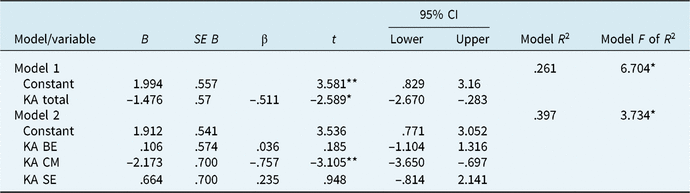
N = 21. *p < .05, **p < .01.
To further elucidate the impact of KA scores on symptom severity, we conducted a multiple regression model including each of the three subscales as predictors. The overall regression model was statistically significant, R 2 = .397, F (3,17) = 3.73, p = .031 (see Table 1). However, examination of each KA subscale indicated that only CM subscale change scores (p = .006) significantly predicted PA severity at follow-up; change in the BE (p = .856) and SE (p = .357) subscales did not add to the prediction of PA severity. The results show that each 1-point increase in the residualized CM subscale change score leads to a 2.173 decrease in PA severity.
Discussion
Findings from this study point towards important mechanisms of change underlying cognitive behavioural treatments for panic disorder and provide a rationale and methodology for assessing knowledge acquisition during the course of treatment. Consistent with the competency model, which specifies that knowledge acquisition is associated with positive treatment outcome and long-term symptom change, the current study demonstrated associations between CM (which decreased by the end of IPCT) and PA severity at follow-up.
Several explanations are offered for the inconsistencies observed between Veteran performance on the pre-treatment knowledge measure and self-reported catastrophic thinking and low self-efficacy when facing panic attacks. These include (a) lack of emotional activation during measure completion, and (b) objective knowledge when calm versus emotion-laden cognitions that occur during the panic attack. Implications for this measure include the importance of teaching the patient to access knowledge at times when anxiety is acute. This can be reinforced during exposure activities such as interoceptive exposure exercises during the treatment session.
An interesting finding of the study was that only change in knowledge relating to catastrophic misinterpretations, and not change in knowledge relating to behaviours or self-efficacy, predicted PA severity. This finding is supported by the cognitive model, which recognizes the important role of automatic thoughts in the intensification and exacerbation of panic symptoms. Treatments that can effectively modify such beliefs, especially in compressed protocols, are critical. Our analyses showed that each of these knowledge domains might play a role in preventing PA from occurring. However, in compressed treatment formats changes in catastrophic misinterpretations are particularly salient. It is possible that increases in knowledge of self-efficacy and behaviour may require coaching and extended support following the compressed treatment. Future studies would do well to compare change in knowledge and its subsequent impact on functioning between standard and compressed delivery methods.
Future directions for this research would be to validate the psychometric properties of the instrument with a larger, representative sample. A factor analysis could strengthen the measure by evaluating specific items for editing or removal. More work is needed to elucidate how changes in knowledge affect specific PA symptoms. Implications of this study include support for the wider use of knowledge and other competency measures of patient comprehension, particularly during brief but intensive treatments such as IPCT. Incorporating such measures may better inform and enhance the overall effectiveness of cognitive behavioural treatments.
Supplementary material
To view supplementary material for this article, please visit https://doi.org/10.1017/S135246581900002X
Acknowledgements
The authors wish to thank the Veterans who participated in this study.
Financial support
This material is based upon work supported in part by the Department of Veterans Affairs and the VA HS R&D Houston Center for Innovations in Quality, Effectiveness and Safety (CIN13-413). The views expressed in this article are those of the authors and do not necessarily reflect the views, position or policy of the Department of Veterans Affairs, the South Central MIRECC, Baylor College of Medicine or the United States government.
Conflicts of interest
Drs Grubbs, Broussard, Hiatt, Beason-Smith and Teng have no conflicts of interest with respect to this publication.
Ethical statement
The authors have abided by the APA Ethical Principles of Psychologists and Code of Conduct. Approval to conduct this study was approved by the VA Research and Development Committee and Baylor College of Medicine.




Comments
No Comments have been published for this article.