Introduction
Filarioids (order Spirurida) are vector-borne parasitic nematodes that reside in various organs and tissues of all vertebrate classes, other than fish. There are around 80 genera of filarioids, which can be transmitted by a variety of haematophagous arthropods (Anderson, Reference Anderson2000). Among these, a major veterinary and public health concern has been raised for mosquito-borne Dirofilaria spp., in particular the zoonotic species Dirofilaria immitis and D. repens, which typically infect domestic dogs, but have been reported in a variety of other animal species (Otranto et al., Reference Otranto, Dantas-Torres, Brianti, Traversa, Petrić, Genchi and Capelli2013). While in carnivores the first is associated with a severe cardio-pulmonary disease (i.e. heartworm disease), the latter often causes a non-pathogenic subcutaneous infection, but is the most frequently implicated in human infection throughout the Old World (Capelli et al., Reference Capelli, Genchi and Baneth2018). In humans, the parasite localizes subcutaneously in various regions of the body, or it reaches the eyes and becomes visible through the subconjunctiva (Capelli et al., Reference Capelli, Genchi and Baneth2018).
In the Republic of Uzbekistan, the occurrence of D. repens in domestic and wild carnivores has recently been re-addressed and updated, indicating the endemic status of this species of filarioid (Safarov et al., Reference Safarov, Akramova, Azimov, Mihalca and Ionică2021, Reference Safarov, Mihalca, Park, Akramova, Ionică, Abdinabiev, Deak and Azimov2022). The parasite was found to be distributed in all the investigated regions of the country, with a prevalence ranging between 3.1% and 21.5% in domestic dogs. Moreover, 25 of the examined wild carnivores (9.3%), belonging to four species (golden jackals, grey wolves, red foxes and jungle cats), were also found to be infected (Safarov et al., Reference Safarov, Akramova, Azimov, Mihalca and Ionică2021). In contrast, the actual prevalence and distribution of cases of human infection with this parasite are still unknown.
The present report describes a case of autochthonous recurrent infection with D. repens in a patient with no travel history, living in Uzbekistan.
Materials and methods
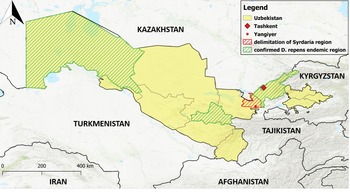
The patient, a 35-year-old woman with no history of chronic diseases, lives in a rural area in the Yangiyer district of the Sirdaryo Region of Uzbekistan (fig. 1). The place of residence has a canal around the household and several ditches in proximity. The patient owns livestock animals (cattle and sheep) and has two dogs which have access inside the house. The travel history revealed no international travelling, just occasional short-term displacement to other regions of the country. Although the patient lives with an extended family, no other members experienced filarioid infections.
Map of Uzbekistan, indicating the position of the Sirdaryo Region and the residence of the patient (red dot).

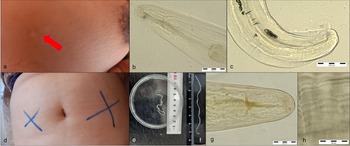
The first episode occurred in 2019, and was initially suspected to be a tumour of the left breast, until surgical removal and morphological identification of the encysted D. repens male nematode (fig. 2a–c; Safarov et al., Reference Safarov, Akramova, Azimov, Mihalca and Ionică2021). On the 30th March 2022, the same patient was admitted to Tashkent City Oncological Dispensary. The anamnesis indicated that during the month prior to examination, the patient had been experiencing redness, occasional swelling and persistent itching in the umbilical region of the abdomen. The patient also declared feeling movement under the skin, over an extended area (fig. 2d) and having a general state of weakness and somnolence. The described symptoms had also been present in 2019. The ultrasound examination of the abdomen revealed the presence of a small and highly mobile hyperechoic linear object, consistent with a helminth, in the subcutaneous tissue. Hence administration of anthelmintic medication was initiated. The patient was administered a single dose of ivermectin (150 μg/kg) and received albendazole, 400 mg/day, orally, for seven days. The nematode was then surgically removed, placed in vial with formalin and transported to the Laboratory of General Parasitology of the Institute of Zoology of the Academy of Sciences of the Republic of Uzbekistan, for identification.
(a) surgical scar following the first surgery (red arrow); (b, c) anterior (b) and posterior (c) extremities of the nematode removed during the first surgery; (d) delimitation of the perceived area of movement of the nematode; (e, f). Dirofilaria repens following surgical removal, at the hospital (e), and at the laboratory (f) – the small fragments visible in (e) were not preserved; (g) anterior extremity; and (h) longitudinally striated cuticle (detail).

Results and discussion
The nematode, although incomplete (fig. 2e), was long and slender, the available fragment having a length of approximately 8 cm (fig. 2f) and a maximum width of 600 μm. The cuticle was white, with distinct longitudinal striations throughout the entire body length (fig. 2h). On microscopical examination, it was noted that the anterior extremity was intact, rounded, having a small circular oral opening (fig. 2g). The vulva was situated at 1.6 mm from the anterior extremity and no microfilariae were present in the uterus. Based on this, the nematode was identified as a female D. repens (Demiaszkiewicz et al., Reference Demiaszkiewicz, Polańczyk, Osińska, Pyziel, Kuligowska and Lachowicz2011). At the follow-up consultation, six months following the surgical intervention, the patient declared having no symptoms consistent with the presence of subcutaneous nematodes.
Worldwide, in recent years, the total number of human D. repens infections seems to be increasing. Before 1995, a total of 410 cases were documented, while between 1995 and 2000, a total of 372 new cases were reported (Pampiglione & Rivasi, Reference Pampiglione and Rivasi2000). In Europe, between 1997 and 2017, the number of case reports exceeded 3500 (Genchi & Kramer, Reference Genchi and Kramer2017). In the former Union of Soviet Socialist Republics, 264 cases were registered between 1915 and 2001 (Capelli et al., Reference Capelli, Genchi and Baneth2018), but a more recent survey indicates that between 1997 and 2013, a total of 1192 cases were reported in the Russian Federation alone (Kartashev et al., Reference Kartashev, Tverdokhlebova, Korzan, Vedenkov, Simón, González-Miguel, Morchón, Siles-Lucas and Simón2015).
Data regarding human dirofilariosis in Uzbekistan is scarce, with only four cases documented in patients, between 1928 and 1961 (Mizkevic & Leontieva, Reference Mizkevic and Leontieva1961; Avdiukhina et al., Reference Avdiukhina, Supriaga, Postnova, Kuimova, Mironova, Murashov and Putintseva1997). In all four cases, the parasites had an ocular localization. Following the case report from 1961, no further literature data were available until recently (Safarov et al., Reference Safarov, Akramova, Azimov, Mihalca and Ionică2021). The surprisingly low number of known human cases may be a result of under-reporting, lack of communication between medical practitioners and the scientific community and, in the case of subcutaneous nodules, the lack of awareness and reluctance of infected patients to present for a medical consultation due to minimization of the condition. In the present case, the patient underwent a recurrence of autochthonous D. repens infection, three years following the first one, which was initially suspected to be breast cancer. The time elapsed between the two episodes may suggest a re-infection. However, a concurrent infection, with parasites developing and becoming visible at different time points, as was described for one case from Romania (Lupșe et al., Reference Lupșe, Mircean, Paștiu, Cavași, Mihalca and Briciu2015), cannot be excluded.
Although in some human cases the source of infection may be suspected based on proximity of confirmed infected animals (Pupić-Bakrač et al., Reference Pupić-Bakrač, Pupić-Bakrač, Beck, Jurković, Polkinghorne and Beck2021), in the present case, the exact source and location where infection(s) occurred, remain unknown. The patient's house is located in an area favourable for the development of mosquito vectors and the infection status of the owned dogs had never been assessed. Furthermore, although no recent studies were performed on carnivores within the Sirdaryo Region, its contingency to an area known to be endemic for D. repens (Tashkent) is highly suggestive for implicit endemicity (fig. 1). Nevertheless, acquiring the infection while traveling to a different region of the country is also a valid hypothesis.
Generally, the parasites migrate subcutaneously and eventually become encysted, followed by formation of a granuloma around the moribund or dead specimens (Brattig et al., Reference Brattig, Racz, Hoerauf and Büttner2011). In a study based on 266 patients infected with D. repens, the nematode was encapsulated in 56.4% of cases, while in the rest an active migration was observed, in some cases over long distances (Ermakova et al., Reference Ermakova, Nagorny, Pshenichnaya, Ambalov and Boltachiev2017). Although the development and long-term survival of the nematodes plead for the existence of immune evasion mechanisms, they remain unknown to date. One study showed that D. repens favour a hyporeactive status in the infected tissue (Brattig et al., Reference Brattig, Racz, Hoerauf and Büttner2011), while in a different study, it was shown that the levels of two pro-inflammatory eicosanoids were significantly higher in patients presenting with nodules as compared to those having unencapsulated worms (Morchón et al., Reference Morchón, Carretón, García, Zueva, Kartashev and Simón2019). In our patient, the clinical presentation differed between the two episodes: during the first one, the parasite was encysted, while during the second one it was freely migrating in the abdominal subcutaneous tissues, which suggests a weaker immune response during recurrence. In contrast, in experimentally infected dogs, it was suggested that a certain degree of specific immunity is gained during the first infection, which negatively affects the development to adult stage of worms acquired during later infections (Genchi et al., Reference Genchi, Solari Basano, Bandi, Di Sacco, Venco, Vezzoni, Cancrini, Sol and Knight1995).
Conclusion
The present case report suggests the possibility of human re-infection with D. repens and further underlines the necessity of raising public awareness and implementation of efficient control strategies in carnivores.
Acknowledgements
The authors thank Professor Abdurakhim Kuchbayev and Dr Oybek Amirov.
Financial support
The work of AMI, VTB and AI was supported by a grant agency of the Ministry of Research, Innovation, and Digitization, CNCS-UEFISCDI, project number PN-III-P1-1.1-TE-2021-0519, contract TE49/2022, within PNCDI III.
Conflicts of interest
None.
Ethical standards
The authors assert that all procedures contributing to this work comply with the ethical standards of the relevant national and institutional committees on human experimentation and with the Helsinki Declaration of 1975, as revised in 2008. The patient provided a written consent form, allowing the authors to use all information regarding the case and all produced photographic data for the purpose of scientific publications. No procedures or investigations were carried out outside of the regular hospital protocols, for the purpose of the present paper.