Introduction
The success of augmentative biological control depends on the efficacy of the released beneficial organisms but also on suitability of the hosting agro-ecosystem, which could be an unfavourable environment due to high levels of disturbance or adverse climatic conditions (Landis et al., Reference Landis, Wratten and Gurr2000; Hatherly et al., Reference Hatherly, Pedersen and Bale2008). Therefore, to evaluate the potential of a biological control agent (BCA), in addition to its effectiveness in pest population control (acceptability of the pest, developmental times, reproduction fitness, etc.), its capacity to establish itself in a given agro-ecosystem (crop species, abundance of natural host plants surrounding the crop, thermal requirements, photoperiod, etc.) should also be carefully considered for optimal performance. Its ability to feed and survive on alternative nutritional sources, such as plant material, may be an advantage in stabilizing natural enemy population dynamics (Lalonde et al., Reference Lalonde, McGregor, Gillespie and Roitberg1999). This characteristic is well represented in generalist predator mirid bugs belonging to the tribe Dicyphini (Hemiptera: Miridae) (Perdikis & Lykouressis Reference Perdikis and Lykouressis2000; Perdikis et al., Reference Perdikis, Fantinou and Lykouressis2011; Biondi et al., Reference Biondi, Zappalà, Di Mauro, Tropea Garzia, Russo, Desneux and Siscaro2016; Naselli et al., Reference Naselli, Urbaneja, Siscaro, Jaques, Zappalà, Flors and Pérez-Hedo2016).
Among these generalist predators, the Palaearctic Dicyphus errans (Wolff) is widespread throughout Europe (Kerzhner & Josifov, Reference Kerzhner, Josifov, Aukema and Rieger1999), living omnivorously on various host plants (over 150 species) and preying on a wide range of small arthropods (Voigt, Reference Voigt2005), characteristics that endow it with a high potential for successful establishment in an agro-ecosystem. In NW Italy it occurs naturally in tomato crop [Solanum lycopersicum L. (Solanaceae)], where organic or integrated pest management (IPM) are applied, located in complex agro-ecosystems, preying upon several pests such as whiteflies, mites and thrips (Tavella & Goula, Reference Tavella and Goula2001; Ingegno et al., Reference Ingegno, Pansa and Tavella2009). Due to both morphological and behavioural adaptations to pubescent surfaces (Voigt et al., Reference Voigt, Gorb and Gorb2007), this mirid prefers hairy plants, including crop plants, such as tomato, eggplant (Solanum melongena L.), potato (Solanum tuberosum L.) (Solanaceae), courgette (Cucurbita pepo L.) (Cucurbitaceae) and pot marigold (Calendula officinalis L.) (Asteraceae) and non-crop plants, such as European black nightshade (Solanum nigrum L.) (Solanaceae), Geranium spp. (Geraniaceae), Stachys sylvatica L. (Lamiaceae) and Urtica dioica L. (Urticaceae) (Arzone et al., Reference Arzone, Alma and Tavella1990; Calabrò & Nucifora, Reference Calabrò and Nucifora1993; Tavella & Goula, Reference Tavella and Goula2001; Voigt, Reference Voigt2005; Ingegno et al., Reference Ingegno, Goula, Navone and Tavella2008). Considering its wide host plant range and its large distribution, probably, this species gets a flexible odour-coding system, which allows it to adapt to environmental changes (Bruce & Pickett, Reference Bruce and Pickett2011), relying on ubiquitous compounds for the identification of host plants instead of using specific compounds, as already reported for other dicyphine species, i.e. Macrolophus pygmaeus (Rambur) and Macrolophus melanotoma (Costa) (Ingegno et al., Reference Ingegno, La-Spina, Jordan, Tavella and Sanchez2016).
Recently, D. errans has proven to be a suitable BCA against the exotic tomato borer Tuta absoluta (Meyrick) (Lepidoptera: Gelechiidae), which is responsible for severe yield losses in tomato crops in the Mediterranean area (Ingegno et al., Reference Ingegno, Ferracini, Gallinotti, Alma and Tavella2013; Zappalà et al., Reference Zappalà, Biondi, Alma, AL-Jboory, Arnò, Bayram, Chailleux, EL-Arnaouty, Gerling, Guenaoui, Shaltiel-Harpaz, Siscaro, Stavrinides, Tavella, Vercher, Urbaneja and Desneux2013). Native to South America, this multivoltine pest, characterized by cryptic habits and high pesticide resistance, has rapidly invaded Europe since its accidental introduction into Spain in 2006 (Desneux et al., Reference Desneux, Wajnberg, Wyckhuys, Burgio, Arpaia, Narvaez-Vasquez, Gonzalez-Cabrera, Catalán Ruescas, Tabone, Frandon, Pizzol, Poncet, Cabello and Urbaneja2010; Tropea Garzia et al., Reference Tropea Garzia, Siscaro, Biondi and Zappalà2012). Both sexes of the mirid prey actively on the eggs and 1st-instar larvae of the tomato borer (Ingegno et al., Reference Ingegno, Ferracini, Gallinotti, Alma and Tavella2013) as reported in other dicyphine species, such as M. pygmaeus and Nesidiocoris tenuis (Reuter) (Urbaneja et al., Reference Urbaneja, Monton and Mollá2009; Mollá et al., Reference Mollá, Biondi, Alonso-Valiente and Urbaneja2014). Compared with this latter species in Europe D. errans has a wider distribution (Kerzhner & Josifov, Reference Kerzhner, Josifov, Aukema and Rieger1999). In NW Italy, it is the most abundant species (Ingegno et al., Reference Ingegno, Goula, Navone and Tavella2008) even in tomato crops where other BCAs (e.g. M. pygmaeus) have been released (Ingegno et al., Reference Ingegno, Frati and Tavella2014). Moreover, this indigenous mirid seems to share many host plants with the exotic tomato borer. In fact, in addition to tomato, T. absoluta has been reported on potato, eggplant and various wild solanaceous species, such as the European black nightshade, datura (Datura stramonium L.) and Nicotiana glauca Graham (Tropea Garzia et al., Reference Tropea Garzia, Siscaro, Biondi and Zappalà2012). In terms of conservation biological control, knowledge of the host plant species shared by D. errans and T. absoluta could be exploited using various techniques of habitat modification (Messelink et al., Reference Messelink, Bennison, Alomar, Ingegno, Tavella, Shipp, Palevsky and Wäckers2014) in order to enhance the presence of spontaneously occurring indigenous natural enemies of the exotic pest in agro-ecosystems. In fact, at the end of the growing season, predatory bugs are compelled to abandon the cropped area and search for food and shelters, consequently, new releases of BCAs have to be applied at the beginning of the following crop cycle. This migration could be substantially avoided using companion plants suitable to attract and maintain natural enemies (Perdikis et al., Reference Perdikis, Fantinou and Lykouressis2011) or intercropping, winter shelters, field borders, landscape diversification, etc. (Ingegno & Messelink, Reference Ingegno and Messelink2016).
Therefore, to improve our knowledge on the correct management of the exotic pest, an in-depth analysis on the most promising plants to grow in consociation with and/or surrounding tomato crop for the control of T. absoluta and the enhancement of D. errans was carried out. Biological and behavioural aspects of this predator-prey system, with particular regard to shared host plants, were investigated. In particular, the preference, survival rate and developmental times of both the predator and prey were compared on different plant species, crop and non-crop plants usually grown in agro-ecosystems in NW Italy. Furthermore, the role of a crop plant and a non-crop plant to use in tomato cultivation in consociation or as a companion plant, respectively, to manage pest outbreaks was assessed in laboratory conditions.
Materials and methods
Insect and plant rearing
Colonies of D. errans were started from individuals collected on European black nightshade in different localities in Piedmont (NW Italy) and reared on European black nightshade, tomato cv Marmande and tobacco Nicotiana tabacum L. (Solanaceae) inside insect cubic cages, 47.5 cm edge (BugDorm, MegaView, Taiwan). Individuals were fed with eggs of Ephestia kuehniella Zeller (Lepidoptera: Pyralidae) (Bioplanet s.c.a., Cesena, Italy) and with dehydrated and decapsulated cysts of Artemia salina (L.) (Anostraca: Artemiidae) (La Mangrovia, Ostuni, Italy). Mass rearing was carried out in climatized chambers, at 24 ± 1°C, 65 ± 5% RH, with a L 16:D 8 photoperiod.
Colonies of T. absoluta were established from individuals provided by Bioplanet laboratories (Bioplanet s.c.a., Cesena, Italy). Continuous mass rearing was maintained on tomato plants in net cages (150 cm W × 150 cm L × 110 cm H) consisting of a stainless steel frame structure supporting an insect-proof net (mesh 0.23 × 0.23 mm2). Mass rearing was carried out in an experimental greenhouse at 27 ± 3°C and 55 ± 23% RH.
The following ten plant species were selected among the most common hosts and non-hosts of D. errans and T. absoluta, in tomato crop environments in Piedmont, and used in laboratory assays: tomato cv Marmande, potato cv Villastellone, eggplant cv Bellezza nera, pepper cv Quadrato d'Asti, datura, European black nightshade, courgette cv Nero di Milano, herb Robert Geranium robertianum L. (Geraniaceae), common bean Phaseolus vulgaris L. cv Borlotto and broad bean Vicia faba L. cv Aguadulce Supersimonia (Fabaceae). Seeds from seed companies were used, except seeds of European black nightshade and herb Robert that were collected from wild plants grown in Turin area. Seeds were sown in plastic pots (⌀14 cm), watered daily and fertilized. All the plants were grown in an experimental heated greenhouse and used in the experiments when they reached approximately 25–40 cm in height with a similar leaf area.
Host plant selection
The host plant selection experiments were set up as multi-choice assays and performed separately with the predator D. errans or the pest T. absoluta. Potted plants of each of the ten selected plant species were randomly placed in a net cage (150 cm W × 150 cm L × 110 cm H) with a stainless steel frame structure supporting the insect-proof net (mesh 0.23 × 0.23 mm2), together with predator or prey individuals. All the experiments were conducted in a heated experimental greenhouse at 27 ± 3°C and 55 ± 23% RH.
The predator D. errans
To assess the preference of D. errans adults toward the ten tested plant species, two potted plants of each species were randomly placed inside a net cage in the experimental greenhouse. Two 1-week-old females and one male were released per plant (a total of 40 females and 20 males per cage) at the centre of the cage. After 72 h, each plant was inspected to count the surviving adults. The plants were then singly isolated in Plexiglas cylinders (⌀12 cm, height 50 cm), placed in climatized chambers at 24 ± 1°C, 65 ± 5% RH and L 16:D 8 and checked for nymph emergences every 48 h until no nymphs were found for 1 week. All emerged nymphs were removed and counted. The plant preference was expressed as the proportion of nymphs emerged from each plant species per cage. Seven repetitions were conducted.
The pest T. absoluta
To assess the oviposition preference and generated offspring on the ten tested plant species, three potted plants of each species were placed inside a net cage in the experimental greenhouse. Four adult T. absoluta were released per plant (a total of 120 adults per cage) at the centre of the cage. After 48 h, the adults were removed and each plant was inspected to count the eggs. The plants were then singly isolated in Plexiglas cylinders (⌀12 cm, height 50 cm) and after 1 week they were checked for egg hatching and larval emergence. Five repetitions were conducted.
Survival rate and development time
The survival rate and development time of the predator D. errans and of the pest T. absoluta were evaluated on six plant species selected from the most promising ones for future field applications. All the bioassays were carried out in climatized chambers at 24 ± 1°C, 65 ± 5% RH and L 16:D 8.
The predator D. errans
To estimate the embryonal development time of D. errans on the tested plants, the number of days between the exposure of each plant species to the predator females and the first nymph emergence was recorded. For this purpose, the plants coming from the host plant selection experiment or other plants specifically set, if the number of nymphs was not high enough, were used. Newly emerged nymphs (<1 day old) were placed individually on leaf disks (⌀25 mm) from each plant species in single cells of 12-well tissue culture plates (Falcon™ Tissue Culture Plates, Corning, NY, USA) on wet Gypsum plaster to maintain humidity, and provided with A. salina cysts (about 0.02 g). The cells were then closed with Parafilm®. For each plant species, 20 nymphs were observed during their development until adulthood or death. Moulting, evidence of the presence of the exuvia or death of a nymph were recorded daily and used to determine the duration and survival rate of each nymphal instar. All the emerged adults were sexed, measured (from the head vertex to the end of the hemelytra) under a stereomicroscope and weighed with a precision (0.01 mg) balance (ABS 120–4, Kern & Sohn GmbH, Germany) after 1 min of cold anaesthesia.
The pest T. absoluta
For each plant species, 15 fresh eggs (less than 48 h) of the tomato borer were gently transferred to a healthy potted plant. Each plant was placed separately inside a Plexiglas cage (20 × 20 × 30 cm) with two sides, a lid of fine gauze (30/10 net) and a mesh sleeve inserted in the middle of one side (⌀ 11 cm). All the emerged adults were counted. Six repetitions were conducted.
Role of a crop plant and a non-crop plant on the pest T. absoluta
On the basis of the results obtained in the host selection and developmental trials, the plants resulting to be interesting for their possible field application to manage T. absoluta in tomato cultivation, in consociation with and/or as companion plants, were further tested. In particular, three plant species (tomato, a crop plant and a non-crop plant) were used in: (i) dual choice experiments on leaves and on entire plants to evaluate the preference by the tomato borer; (ii) a field simulation laboratory trial to assess the effects of three tomato field conditions on the pest. All the experiments were carried out in climatized chambers at 24 ± 1°C, 65 ± 5% RH and L 16: D 8.
Dual choice experiments with the pest T. absoluta
In dual choice experiments on both leaves and entire potted plants, the following six comparisons were performed: (1) tomato vs. tomato, (2) tomato vs. crop plant, (3) tomato vs. non-crop plant, (4) crop plant vs. crop plant, (5) non-crop plant vs. non-crop plant, (6) crop plant vs. non-crop plant.
Dual choice experiments on leaves were carried out in Petri dishes (⌀9 cm), half-filled with agar 2%, on which leaves of the two plants in comparison were equally distributed to cover the entire surface. A glass cylinder (⌀8 cm, height 15 cm), covered with a fine net on the top to prevent insect escaping, was placed on each Petri dish. Five individuals of T. absoluta were inserted in each cylinder and removed after 24 h. Leaves were then inspected to count the eggs. At least ten repetitions were conducted for each comparison.
Dual choice experiments on entire potted plants were carried out to evaluate, besides the number of laid eggs, also the number of hatched larvae and of emerged adults. A pair of plants (one per each plant in comparison) was placed in an insect cubic cage, 47.5 cm edge (BugDorm, MegaView, Taiwan), in which ten T. absoluta adults were inserted. After 48 h, the adults were removed and each plant was inspected to count the eggs. The plants were then singly isolated in Plexiglas cages (20 × 20 × 30 cm), and checked for larval hatching after 1 week, and then every 2 days for adult emergence. Five repetitions were conducted for each comparison.
Field simulation laboratory trial with the pest T. absoluta
To evaluate the effects of three tomato field conditions (i.e., monoculture, crop consociation, companion planting), the following three comparisons were performed: (1) tomato vs. tomato, (2) tomato vs. crop plant, (3) tomato vs. non-crop plant. The laboratory trial was carried out in insect cubic cage, 47.5 cm edge (BugDorm, MegaView, Taiwan), in which six plants (three per each plant in comparison) were placed in two opposite rows. The plants were infested introducing 12 adults of T. absoluta (two adults per plant) in each cage. After 2 weeks, the adults were removed and the plants were inspected to count the larvae, and then checked every 2 days to monitor adult emergence. Four repetitions were conducted for each comparison.
Statistical analyses
In the host plant selection experiment on D. errans, the percentages of nymphs that emerged from each plant species in each cage (repetition) were arcsine square root transformed, checked for homogeneity of variance (Levene test) and normality (Shapiro–Wilk test) and compared using a one-way analysis of variance (ANOVA); in the case of significant differences the means were separated by a Tukey's test. In the host plant selection experiment on T. absoluta, the percentages of laid eggs and of emerged larvae for each plant species in each cage were compared using Kruskal–Wallis analysis and, in the case of significant differences, the means were separated using a Mann–Whitney U test, as they were not homogeneous. After testing them for homogeneity of variance (Levene test) and normality (Shapiro–Wilk test), developmental time data for D. errans and T. absoluta were analyzed using a one-way ANOVA and, in the case of significant differences, the means were separated using a Tukey's test. Data on the weight and length of D. errans that emerged in the developmental trials were compared using Kruskal–Wallis analysis and the means were separated using a Mann–Whitney U test if the assumptions of an ANOVA were not met, otherwise the means were separated using a Tukey's test. In the dual choice experiments and field simulation laboratory trial with the pest T. absoluta, data were expressed as percentage of laid eggs, hatched larvae or emerged adults per plant species on the total number of laid eggs, hatched larvae or emerged adults per comparison; then, they were arcsine square root transformed and tested for normality. When data were normally distributed, a Student's t-test pairwise comparison was applied to test the hypothesis that the distribution deviated from a null model in which plant sources were chosen with equal frequency. Otherwise, if data were not normally distributed, the non-parametric Wilcoxon test was performed. Moreover, in the field simulation laboratory trial to compare the mean number of larvae and of adults emerged in each comparison, because of non-homogeneity of variances, raw data were analysed with Kruskal–Wallis analysis and, in the case of significant differences, means were separated by Mann–Whitney U test. The statistical analyses were performed using SPSS v21.0 (SPSS Inc., Chicago, IL, USA).
Results
Host plant selection
The predator D. errans
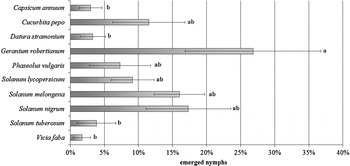
In the multi-choice experiment D. errans females laid eggs on all ten tested plant species. The six species showing the most abundant offspring were, in decreasing order, herb Robert, European black nightshade, eggplant, courgette, tomato and common bean (fig. 1). The least favourite plant species was the broad bean from which only three nymphs out of 142 emerged. The mean proportion of emerged nymphs was significantly higher on herb Robert than on broad bean, pepper, datura and potato (ANOVA, DF = 9, 69, F = 3.194, P = 0.003) (fig. 1).
Mean percentage (±SE) of total emerged nymphs (no. = 142) of Dicyphus errans on ten plant species tested in the multi-choice experiment. Bars followed by different letters are significantly different (Tukey's test, P < 0.05). Data are shown before transformation for easier interpretation.

The pest T. absoluta
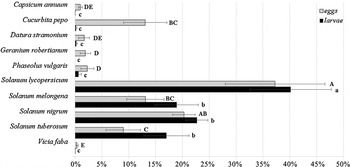
In the multi-choice experiment, T. absoluta females laid eggs on all ten offered plant species but mostly, in decreasing order, on tomato, European black nightshade, eggplant, courgette and potato (fig. 2). Nevertheless, newly emerged larvae were found almost exclusively on species of the genus Solanum (fig. 2). The mean proportions of eggs and larvae were significantly higher on plants belonging to this genus than any other genera (Kruskal–Wallis: eggs, DF = 9, χ2 = 94.307, P < 0.001; larvae, DF = 9, χ2 = 115.438, P < 0.001) (fig. 2). In particular, tomato was the favourite species for both oviposition (1500 out of 3572 eggs) and larval emergence (1054 out of 2445 larvae). Although numerous eggs were found on courgette (392) only six hatched and no larvae developed.
Mean percentage (±SE) of total eggs (no. = 3572) and emerged larvae (no. = 2445) of Tuta absoluta on ten plant species tested in the multi-choice experiment. Bars followed by different letters (upper and lower case refer to eggs and larvae, respectively) are significantly different (Mann-Whitney U test, P < 0.05). Data are shown before transformation for easier interpretation.

Survival rate and developmental time
The predator D. errans
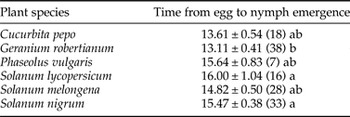
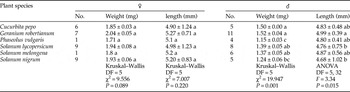
The interval from exposure of the plant to the females to the first nymph emergence ranged from 13.1 ± 0.4 days to 16.0 ± 1.0 days on herb Robert and tomato respectively, showing a shorter embryonal development of D. errans on herb Robert (ANOVA, DF = 5, F = 4.68, P < 0.001) (table 1). The interval from nymph emergence to adulthood ranged from 14.7 ± 0.4 days on European black nightshade to 17.3 ± 0.3 days on eggplant and was significantly different between these two plants (ANOVA, DF = 5, 66, F = 2.625, P = 0.032) (table 2). Moreover, significant differences were found in the developmental times of each instar between plant species without a constant order (table 2). Rate of adult emergence was significantly higher on herb Robert and tomato than on common bean and eggplant (table 2). No significant differences were observed in sex ratio of newly emerged D. errans from different plant species (table 2). Within the sexes, females reared on different plant species showed no significant differences in either weight or length; males were significantly heavier when reared on courgette and herb Robert than on bean and longer when reared on herb Robert compared with tomato and European black nightshade (table 3).
Developmental time in days (mean ± SE, no. of individuals) occurring from eggs to nymph emergence of Dicyphus errans on six plant species.

Means followed by different letters are significantly different (Tukey's test, P > 0.05).
Developmental time in days (mean ± SE, no. of individuals) occurring for each nymphal instar of Dicyphus errans on six plant species, adult emergence rate, and sex ratio [no. of females/(no. of females + no. of males)].

In columns, means followed by different letters are significantly different.
Mean weight (±SE) and length (±SE) of newly emerged females and males of Dicyphus errans on different plant species.

In columns, means followed by different letters are significantly different.
The pest T. absoluta
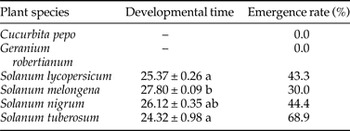
In the developmental trials, no adult of T. absoluta emerged from courgette and herb Robert, showing a 100% mortality, significantly higher than that on the other plant species (Kruskal–Wallis, DF = 5, χ2 = 27.341, P < 0.001) (table 4). Preimaginal developmental time was significantly shorter on tomato and European black nightshade than on eggplant, (ANOVA, DF = 3, 164, F = 7.040, P < 0.001) (table 4). Overall, newly emerged larvae took less than 20 days to reach adulthood.
Developmental time in days (mean ± SE) from egg to adult and emergence rate of Tuta absoluta on different plant species.

In columns means followed by different letters are significantly different (Tukey's test, P > 0.05).
Role of a crop plant and a non-crop plant on the pest T. absoluta
On the basis of the results obtained in the host selection and developmental trials, courgette and herb Robert were selected among the crop and non-crop plants, respectively, to assess their suitability as crop plants and/or companion plants to grow in consociation with and/or surrounding tomato crop.
Dual choice experiments with the pest T. absoluta
In the dual choice experiment on leaves, the tomato borer oviposited on all the tested plant species, however showing a preference toward the leaves of tomato when offered together with leaves of courgette (Wilcoxon test: Z = −2.536; P = 0.011) or of herb Robert (Wilcoxon test: Z = −3.051; P = 0.002) (table 5). On the contrary, no significant difference were found between leaves of courgette and herb Robert (Wilcoxon test: Z = −0.090; P = 0.928), as well as when the same plant species was offered in the arena (Wilcoxon test: tomato, Z = −0.161; P = 0.872; courgette, Z = −1.156; P = 0.248; herb Robert, Z = −1.675; P = 0.098) (table 5).
Mean number (±SE) of laid eggs of Tuta absoluta in the dual choice experiment on leaves of the three plant species in comparison.

Wilcoxon test tested the hypothesis that the tomato borer distribution deviated from a null model in which plant sources were chosen with equal frequency for oviposition (P < 0.05). Data are shown before transformation for an easier interpretation.
*P < 0.05; **P < 0.01; ***P < 0.001.
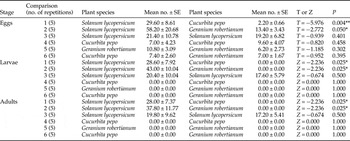
Also, in the dual choice experiment on entire plants, T. absoluta oviposited on all the tested plant species. Similarly, for oviposition tomato was preferred to courgette (Student's t-test: DF = 4; t = 5.976; P = 0.004) and herb Robert (Student's t-test: DF = 4; t = 2.772; P = 0.050) (table 6). Moreover, no significant difference was found between courgette and herb Robert (t = −0.952; P = 0.395), as well as when plants of the same species were offered in the cage (Student's t-test: courgette, DF = 4; t = −0.820; P = 0.458; herb Robert, t = 1.185; P = 0.302; tomato, t = −0.939; P = 0.401) (table 6). The larval hatching and adult emergence on tomato varied from 85.3 ± 8.6 to 97.7 ± 1.4% and from 68.8 ± 9.7 to 96.7 ± 2.2%, respectively, whereas despite the presence of eggs, no larvae and consequently no adults of the tomato borer emerged from courgette and herb Robert (table 6).
Mean number (±SE) of laid eggs, hatched larvae and emerged adults of Tuta absoluta in the dual choice experiment on entire plants of the three plant species in comparison.

Student's t-test pairwise (T) or Wilcoxon test (Z) tested the hypothesis that tomato borer distribution deviated from a null model in which plant sources were chosen with equal frequency (P < 0.05). Data are shown before transformation for an easier interpretation.
*P < 0.05; **P < 0.01; ***P < 0.001.
Field simulation laboratory trial with the pest T. absoluta
No larvae and consequently no adults of T. absoluta emerged from courgette and herb Robert, therefore numbers of both larvae and adults were significantly different between tomato and courgette (Wilcoxon test: larvae, Z = −2.000; P = 0.046; adults, Z = −2.000; P = 0.046) and between tomato and herb Robert (Wilcoxon test: larvae, Z = −2.000; P = 0.046; adults, Z = −2.000; P = 0.046) (table 7). No differences were found when tomato was the only plant species offered for both larva hatching and adult emergence (Wilcoxon test: larvae, Z = −0.365; P = 0.715; adults, Z = −1.095; P = 0.273) (table 7). Moreover, even if the mean number of larvae or adults of T. absoluta emerged in each comparison was variable, no significant differences were found on tomato plants (U Mann–Whitney test; P > 0.05) (table 7).
Mean number (±SE) of larvae and adults of Tuta absoluta emerged on the three plants of each plant species tested in the trial.

In column, mean numbers of larvae and of adults followed by different letters are significantly different (U Mann–Whitney test, P < 0.05). Wilcoxon pairwise test tested the hypothesis that the tomato borer emergence deviated from a null model in which plant sources were chosen with equal frequency (P < 0.05). Data are shown before transformation for easier interpretation.
*P < 0.05; **P < 0.01; ***P < 0.001.
Discussion
Habitat management may occur at different levels, i.e. within-crop, within-farm or at landscape levels, to improve the availability of the resources required by natural enemies (Landis et al., Reference Landis, Wratten and Gurr2000). Focusing on the within-crop level, in organic and IPM farming systems the use of pest resistant cultivars, pest repellent plants, pest trapping plants or predator attractive companion plants might preserve crop production from pest attacks (Parker et al., Reference Parker, Snyder, Hamilton, Rodriguez-Saona and Soloneski2013). In our study, we investigated shared hosts in order to identify crop plants and/or companion plants to grow in consociation with and/or surrounding tomato crops.
In this study, among the tested crop plants, tomato, eggplant and potato were the most attractive to T. absoluta, whereas eggplant, courgette and tomato were the most preferred by D. errans. Therefore, tomato was confirmed as the favourite crop plant of the exotic pest for both oviposition and preimaginal development. In fact, all the epigeal plant parts are suitable for moth development (Tropea Garzia et al., Reference Tropea Garzia, Siscaro, Biondi and Zappalà2012) and fecundity on this host is twofold higher than on potato and European black nightshade (Bawin et al., Reference Bawin, Dujeu, De Backer, Fauconnier, Lognay, Delaplace, Francis and Verheggenet2015). Tomato was also one of the favourite hosts of D. errans in both the multi-choice and developmental experiments, showing an adult emergence rate of 85%. This crop plant is potentially even more attractive to the predator when attacked by the tomato borer (Ingegno et al., Reference Ingegno, Ferracini, Gallinotti, Alma and Tavella2013), as also reported for other dicyphines, M. pygmaeus and N. tenuis (Ingegno et al., Reference Ingegno, Pansa and Tavella2011; Lins et al., Reference Lins, van Loon, Bueno, Lucas-Barbosa, Dicke and van Lenteren2014).
Eggplant and potato were attractive to T. absoluta, confirming the previously reported high capacity of the pest to develop on these crops (Tropea Garzia et al., Reference Tropea Garzia, Siscaro, Biondi and Zappalà2012; Megido et al., Reference Megido, Brostaux, Haubruge and Verheggen2013). Indeed, the preimaginal developmental time on potato did not differ from that observed on tomato, contrary to the results previously reported by Bawin et al. (Reference Bawin, Dujeu, De Backer, Fauconnier, Lognay, Delaplace, Francis and Verheggenet2015) where it was found to develop faster in different experimental conditions (i.e., on excised plant leaves). By contrast, only eggplant, not potato, even though it has been reported as a host (Goula & Alomar, Reference Goula and Alomar1994), was found to be among the favourite hosts of D. errans in a multi-choice experiment, even though the developmental time and emergence rate were longer and lower respectively than on the other host plants.
Although courgette was selected by moth females for oviposition in all the experiments, it did not result in larval development of T. absoluta. To our knowledge, this is the first report of developmental inhibition in the tomato borer on this crop plant. Such inhibition could be due to morphological plant features or defence mechanisms in response to the presence of the eggs. Therefore, further investigations on the inhibition properties of courgette, such as analyses of the plant's chemical profile, which may include some repellent substances, are needed. In the field simulation trial, despite the same number of T. absoluta adults inserted into the cages, larva and adult emergence was considerably lower in the comparison tomato vs. courgette than in the one tomato vs. tomato. Besides possible inhibition properties of the courgette, such reduction could be also due to the intrinsic limit of tomato plants to tolerate high pest density that should be further investigated. On the other hand, beside courgette, D. errans has already been observed on several cucurbits (Voigt et al., Reference Voigt, Gorb and Gorb2007; Balzan & Moonen, Reference Balzan and Moonen2014). Moreover, in the field this mirid species is frequently found in large numbers inside courgette flowers (personal observations). However, field experiments should be carried out to validate our results in order to recommend a consociation of tomato and courgette for both controlling the tomato borer and enhancing the mirid predator.
The three non-crop plants tested in our study revealed different levels of attractiveness for both prey and predator. Datura, even though it has been reported as a host plant of the tomato borer (Tropea Garzia et al., Reference Tropea Garzia, Siscaro, Biondi and Zappalà2012), was unattractive to T. absoluta, as already observed by Bawin et al. (Reference Bawin, Dujeu, De Backer, Fauconnier, Lognay, Delaplace, Francis and Verheggenet2015), and D. errans, showing no apparent advantage for pest management. However, European black nightshade was highly attractive for both prey and predator in the multi-choice experiment. Indeed, D. errans developed faster on this host than on the other tested plant species, showing also an adult emergence rate of 70%, not significantly lower than the one on tomato (85%). Hence, the role of this plant species in the agro-ecosystem should be carefully evaluated as it could act as a reservoir or as a source. In fact, during winter, in the absence of tomato crops, the predator may take refuge and carry on its pest control activity on European black nightshade. However, both prey and predator could move from this plant to the tomato crop in spring, thwarting its advantages as a predator winter reservoir.
Finally, herb Robert was the favourite host plant for D. errans in terms of attractiveness and suitability, as it was unattractive to T. absoluta. In fact, moth females laid few eggs on this plant and no larvae were found or developed. These characteristics make herb Robert a potentially promising companion plant. Moreover, in the field simulation trial, in the comparison tomato vs. herb Robert, a high reduction of larval and adult emergence of T. absoluta was observed. As previously reported for the comparison tomato vs. courgette, this reduction should be further investigated to assess the causes, such as possible inhibition properties of herb Robert and/or intrinsic limits of tomato plants to tolerate high pest density. This plant species has a wide ecological amplitude covering the whole distribution range of the predator (Kerzhner & Josifov, Reference Kerzhner, Josifov, Aukema and Rieger1999); it has spread everywhere in world temperate zones, including Europe, the Americas, northern Africa and western Asia (Tofts, Reference Tofts2004). Therefore, in terms of habitat management, herb Robert could be used in plant strips next to vegetable cultivations to enhance early crop colonization by the predatory mirid. In fact, a prior to pest establishment of D. errans in cropping systems should be considered to prevent high pest populations and to contribute to effective and stable pest control strategies in organic greenhouses. For this purpose, field experiments, like those performed using marigold in tomato crops to enhance the presence of D. errans and M. pygmaeus (Lambion, Reference Lambion2010), should be carried out to evaluate their efficacy as BCAs.
In conclusion, our outcomes underline the potential role of some crop and non-crop plants (e.g. a consociation of courgette and tomato and/or herb Robert as a companion plant) for the correct management of this prey-predator system to keep pest densities below the economic threshold. Moreover, based on our results, as well as on the great plasticity of mirids in exploiting food sources (Biondi et al., Reference Biondi, Zappalà, Di Mauro, Tropea Garzia, Russo, Desneux and Siscaro2016), the omnivorous and widespread D. errans could be a key predator of the exotic pest T. absoluta. Its ability to survive in various environments may result in a high encounter probability with the tomato borer on several cultivated and non-cultivated plant species and a more successful pest control.
Acknowledgements
This research was supported by the project ‘Insects and globalisation: sustainable control of exotic species in agro-forestry ecosystems (GEISCA, PRIN 2010–11)’, financed by the Italian Ministry for Education, University and Research.