Introduction
Dry bean is a valuable crop grown in certain regions of North America. In 2015, Ontario growers produced dry beans on 53,000 ha, with an annual production of 115,000 Mg, valued at $93 million (Mailvaganam Reference Mailvaganam2018). Dry bean is extremely sensitive to weed interference. In a study completed by the WSSA Weed Loss Committee, the potential yield loss due to weed interference across North America in dry bean was 71% (Soltani et al. Reference Soltani, Dille, Gulden, Sprague, Zollinger, Morishita, Lawrence, Sbatella, Kniss, Jha and Sikkema2018). In Ontario, dry bean yield loss due to weed interference was 55%, compared to 49% and 35% in corn and soybean, respectively (Soltani et al. Reference Soltani, Dille, Gulden, Sprague, Zollinger, Morishita, Lawrence, Sbatella, Kniss, Jha and Sikkema2018). At this level of weed loss, dry bean growers in Ontario would have lost more than $50 million in 2015 if no weed management practices had been implemented. Growers in Ontario have primarily utilized conventional tillage and, to a much lesser degree, reduced- and no-tillage cropping systems to grow dry bean.
In recent years, some growers have been implementing a strip-tillage cropping system instead of reduced- and no-tillage cropping systems out of concerns for the adverse effects of conventional-tillage cropping systems on soil structure, soil health, water infiltration, and wind and water erosion (Deibert Reference Deibert1995). Strip-tillage allows dry bean growers to remove in-row crop residues without disturbing the soil in other areas of the field, while helping to maintain some beneficial effects of a no-tillage cropping system, such as building soil structure and soil health as well as addressing environmental and regulatory concerns (Bottenberg et al. Reference Bottenberg, Masiunas and Eastman1999). Removing in-row residues will also provide some of the beneficial effects of a conventional-tillage cropping system such as soil warming and drying, as well as the ability to place fertilizers within the row area if needed (Godsey et al. Reference Godsey, Kochenower and Taylor2018; Licht and Al-Kaisi Reference Licht and Al-Kaisi2005).
Glyphosate-resistant (GR) weeds such as horseweed are spreading rapidly throughout Ontario (Budd Reference Budd2016; Byker et al. Reference Byker, Soltani, Robinson, Tardif, Lawton and Sikkema2013). GR horseweed has been confirmed in 30 counties across Ontario (Budd et al. Reference Budd, Soltani, Robinson, Hooker, Miller and Sikkema2016). GR horseweed is a much greater concern in no-, reduced-, and strip-tillage than in conventional-tillage cropping systems. Currently, there are no strategies to control GR horseweed in dry bean production. Growers need efficacious, cost-effective weed management options for GR horseweed control in dry bean in strip-tillage and no-tillage production systems.
Currently, saflufenacil, metribuzin, saflufenacil+metribuzin, 2,4-D ester, flumetsulam, cloransulam-methyl, and chlorimuron-ethyl applied preplant are being utilized to control GR horseweed in soybean in Ontario (Budd et al. Reference Budd, Soltani, Robinson, Hooker, Miller and Sikkema2016; Byker et al. Reference Byker, Soltani, Robinson, Tardif, Lawton and Sikkema2013; Soltani et al. Reference Soltani, Brown and Sikkema2017). Currently, these herbicides are not registered for use in dry bean crops. Few studies have collectively compared the sensitivity of dry beans to commonly used herbicides for the control of GR horseweed prior to seeding.
The objective of this study was to determine the response of kidney, small red, and white bean to saflufenacil, metribuzin, saflufenacil+metribuzin, 2,4-D ester, flumetsulam, cloransulam-methyl, and chlorimuron-ethyl applied approximately 1 wk prior to seeding.
Materials and Methods
During 2016 and 2017, four field trials (two in each year) were established at the University of Guelph Huron Research Station, Exeter, ON (43.19° N, 81.30° E). The seedbed was established using a four-row Orthman 1tRIPr (Orthman Mfg., 75765 Road 435, Lexington, NE, USA) strip-tillage implement. During the fall prior to trial establishment, the strip-tillage implement was used to make tilled strips into which the bean rows were then planted the following spring. The strip-tiller used a heavy coulter and a set of trash management disks to cut and clear the strip of crop and weed residue. Behind the disks was an adjustable shank that lifted and broke the soil in a narrow band. The shank was run approximately 18 cm deep and lifted and fractured the soil, causing it to move up and out. Behind the shank, coulters on each side of the strip were installed on an angle that moved the soil back onto the strip and left approximately a 20-cm strip that was loose with a slight berm. Behind the coulters was a basket harrow that firmed the strip lightly, leaving the soil in the strip slightly higher than the undisturbed soil around it.
The trial was established in a split-plot design with four replications. The main factor was herbicide treatment, and the split-plot factor was dry bean market class. Treatments included an untreated control, saflufenacil (50 g ai ha–1), metribuzin (800 g ai ha–1), saflufenacil+metribuzin (50+800 g ai ha–1), 2,4-D ester (1,064 g ai ha–1), flumetsulam (140 g ai ha–1), cloransulam-methyl (70 g ai ha–1), and chlorimuron-ethyl (18 g ai ha–1). The herbicide rates represented twice the recommended rate for GR horseweed control in soybean to simulate a spray overlap in the field. Within each plot were three rows of dry bean (one row of each market class) spaced 0.75 m apart in rows that were 10 m long. Kidney, small red, and white beans were planted 5 cm deep at a rate of approximately 190,000, 220,000, and 250,000 seeds ha–1, respectively.
A CO2-pressurized backpack sprayer calibrated to deliver 200 L ha–1 at 240 kPa was used to apply the herbicides 7 d before seeding. The boom was 1.5 m long with four ultra-low drift ULD120-02 nozzles (VeeJet® Ultra low-drift 12002 nozzles, Spraying Systems Co., P.O. Box 7900, Wheaton, IL 60189-7900) spaced 0.5 m apart. All plots were maintained weed-free with hand weeding during the growing season.
Visible injury was evaluated 1, 2, 4, and 8 wk after crop emergence (WAE) using a scale of 0 to 100%, with 0 indicating no visible dry bean injury and 100% indicating total dry bean plant death. At 3 WAE, dry bean plant stand (counts at 1 m row–1) and dry bean biomass (g plant–1) were determined. At 6 WAE, dry bean height was assessed by measuring the height of 10 randomly selected plants for each market class of dry bean in each plot. Different market classes of dry beans were harvested at their respected maturity stage using a small-plot combine. Final yields were adjusted to 18% moisture content.
The GLIMMIX procedure in SAS (Ver. 9.4, SAS Institute Inc., Cary, NC) was used for data analysis along with the Laplace estimation method (SAS Institute Inc. 2016). The experimental design was used to construct an initial model, which was then refined by comparing the most plausible random variable combinations. The final model was selected based on the best-fit statistics and studentized residual plots, and contained the fixed effects of HERB, TYPE, as well as their interaction. Random effects consisted of environment (location–year combinations), environment by HERB by TYPE interaction, and HERB by replication within environment interaction. The significance of fixed and random effects was tested using the F-test and likelihood ratio tests, respectively. For each parameter, different distributions were assessed on the model scale, and once the best distribution was confirmed, least square means (LSMEANS) were calculated on the data scale using the inverse link function. Tukey’s adjustment was applied to pairwise comparisons to determine differences among treatment means at a significance level of 0.05. The Poisson distribution and log link best described percent visible injury; each data point had a value of one added prior to analysis, because positive integer values are required for this distribution and the final LSMEANS were adjusted by subtracting one. A negative binomial distribution (log link) was used for dry bean biomass per meter of row, and a gamma distribution (log link) was used for dry bean biomass per plant and percent moisture at harvest. Plant stand, average plant height, and dry bean yield were analyzed using a Gaussian distribution and the default identity link. Differences for main effects (HERB and TYPE) were determined if the HERB by TYPE interaction was negligible; when the interaction was non-negligible, only differences among simple effects were determined (Stroup Reference Stroup2012). For percent visible dry bean injury, the untreated control was assigned a value of zero and was thus excluded from the analysis because it had zero variance. However, the LSMEANS output provides a comparison of each treatment least square mean with the value zero. This information was used to identify differences between the treatments included in the analysis and the excluded control treatment.
Results and Discussion
Main Effect of Herbicide
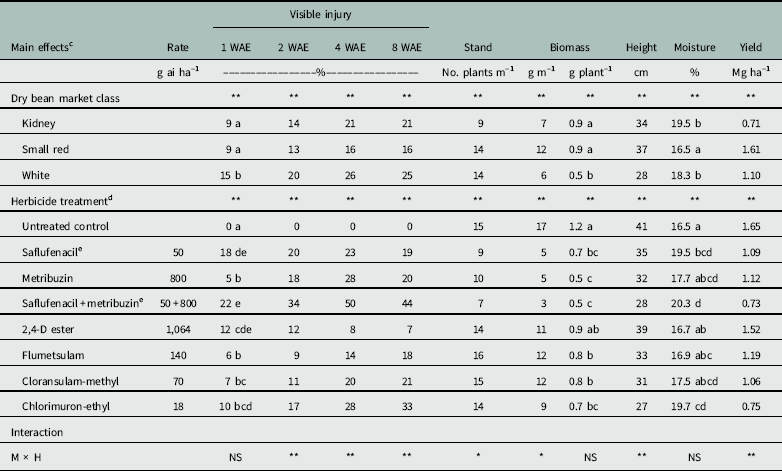
At 1 WAE, visible injury to dry bean from saflufenacil was 18%, from metribuzin 5%, saflufenacil+metribuzin 22%, 2,4-D ester 12%, flumetsulam 6%, cloransulam-methyl 7%, and chlorimuron-ethyl 10% (Table 1). Reductions in dry bean biomass per plant were 42% for saflufenacil, 58% for metribuzin, 58% for saflufenacil+metribuzin, 33% for flumetsulam, 33% for cloransulam-methyl, and 42% for chlorimuron-ethyl. There was no decrease in dry bean biomass treated with 2,4-D ester 1 wk prior to seeding (Table 1). At harvest time, dry bean seed moisture content was 3%, 3.8%, and 3.2% greater than the untreated control with saflufenacil, saflufenacil+metribuzin, and chlorimuron-ethyl, respectively. There was no delay in maturity with other herbicide treatments (Table 1).
Significance of main effects and interaction for visible injury, stand count, aboveground biomass (dry weight) per meter of row and per plant, plant height, moisture, and yield of three dry bean market classes treated with various preplant herbicides in a strip-tillage system at Exeter, ON, from 2016 to 2017.Footnote a Footnote b

a Abbreviations: H, herbicide treatment; NS, not significant at P=0.05 level; M, dry bean market class; WAE, wk after crop emergence.
b Means followed by the same letter within a column are not significantly different according to a Tukey-Kramer multiple range test at P<0.05. Means for a main effect were separated only if the interaction involving the main effect was negligible.
c Significance at P<0.05 and P<0.01 levels denoted by * and **, respectively.
d All herbicide treatments were tank mixed with glyphosate (1,800 g ae ha–1).
e Included Merge (1.0 L ha–1).
Visible Injury
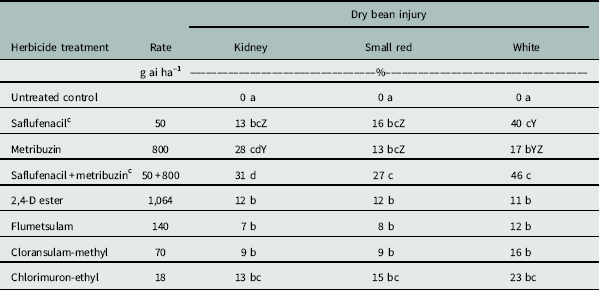
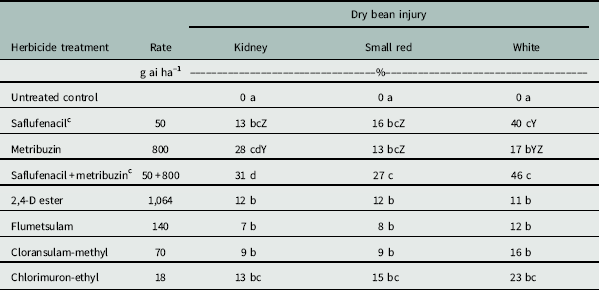
Injury symptoms seen with herbicides evaluated included delayed emergence, reduced stand, decreased growth, necrosis, and chlorosis of dry beans. At 2 WAE, injury from saflufenacil, metribuzin, saflufenacil+metribuzin, 2,4-D ester, flumetsulam, cloransulam-methyl, and chlorimuron-ethyl ranged from 7% to 46% in the three market classes (Table 2). Visible injury in white bean was greater than kidney or small red bean with saflufenacil. In contrast, metribuzin injury was greater in kidney bean than small red bean. There was no difference in injury with the other herbicides.
Visible injury 2 WAE for three dry bean market classes treated with various preplant herbicides in a strip-tillage system at Exeter, ON, from 2016 to 2017.Footnote a , Footnote b
a Abbreviations: WAE, wk after crop emergence application.
b Means followed by the same letter within a column (a–c) or row (Y–Z) are not significantly different according to a Tukey-Kramer multiple-range test at P<0.05. Rows without an uppercase letter have no cultivar differences.
c Included Merge (1.0 L ha–1).
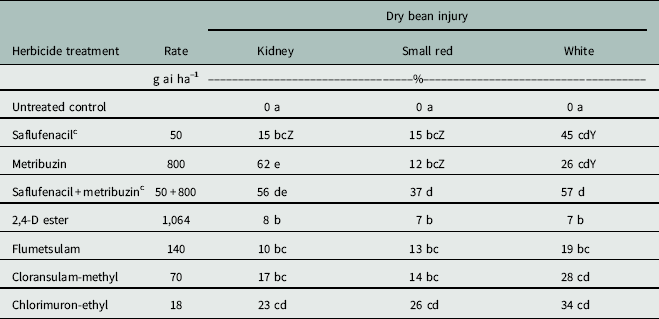
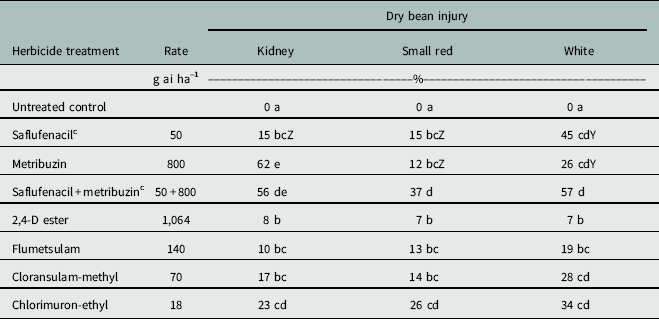
At 4 WAE, injury, among the three market classes, from saflufenacil, metribuzin, saflufenacil+metribuzin, 2,4-D ester, flumetsulam, cloransulam-methyl, and chlorimuron-ethyl ranged from 10% to 62% (Table 3). Saflufenacil caused greater injury in white bean than the kidney and small red bean. Metribuzin injury was greatest with kidney bean (62%) compared to white bean and small red bean. There was no difference in injury levels with the other herbicides.
Visible injury 4 WAE for three dry bean market classes treated with various preplant herbicides in a strip-tillage system at Exeter, ON, from 2016 to 2017.Footnote a , Footnote b
a Abbreviations: WAE, wk after crop emergence application.
b Means followed by the same letter within a column (a–e) or row (X–Z) are not significantly different according to a Tukey-Kramer multiple-range test at P<0.05. Rows without an uppercase letter have no cultivar differences.
c Included Merge (1.0 L ha–1).
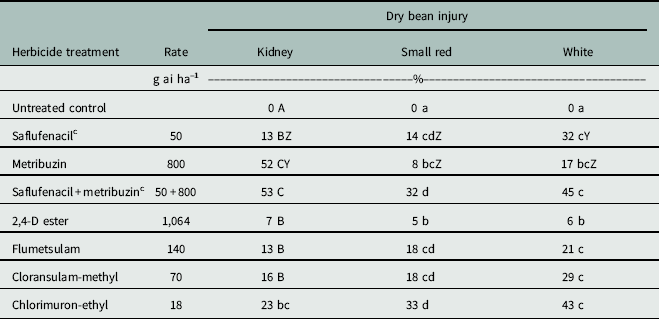
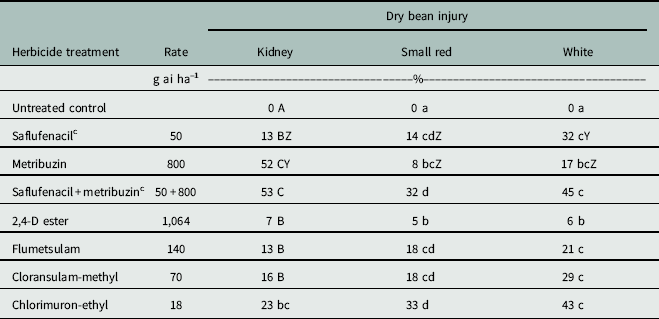
At 8 WAE, dry bean injury with various herbicides persisted (Table 4). As observed at 2 and 4 WAE, 2,4-D ester caused the least visible injury among herbicides at 8 WAE. Dry bean injury with saflufenacil, metribuzin, saflufenacil+metribuzin, 2,4-D ester, flumetsulam, cloransulam-methyl, and chlorimuron-ethyl ranged from 5% to 53% . Similar to 4 WAE, saflufenacil injury was greater in white than kidney and small red bean. In contrast, metribuzin injury was greater in kidney bean than the small red bean and white bean. There was no difference in injury levels with other herbicides.
Visible injury 8 WAE for three dry bean market classes treated with various preplant herbicides in a strip-tillage system at Exeter, ON, from 2016 to 2017.Footnote a , Footnote b
a Abbreviations: WAE, wk after crop emergence application.
b Means followed by the same letter within a column (a–d) or row (Y–Z) are not significantly different according to a Tukey-Kramer multiple-range test at P<0.05. Rows without an uppercase letter have no cultivar differences.
c Included Merge (1.0 L ha–1).
These results are consistent with other studies in which saflufenacil applied PRE at 50 g ai ha–1 caused 20% to 31% visible injury in dry bean (Soltani et al. Reference Soltani, Shropshire and Sikkema2014). Flumetsulam applied PPI at 140 g ai ha–1 caused 13% visible injury in pinto and small red bean in one study (Soltani et al. Reference Soltani, Nurse, Robinson and Sikkema2008). In contrast, flumetsulam applied PRE at 140 g ai ha–1 in another study caused minimal visible injury in pinto and small red bean (Sikkema et al. Reference Sikkema, Robinson, Nurse and Soltani2008). Cloransulam-methyl applied PRE at 70 g ai ha–1 has been shown to cause 9% to 13% visible injury in dry bean (Soltani et al. Reference Soltani, Shropshire and Sikkema2010).
Plant Stand
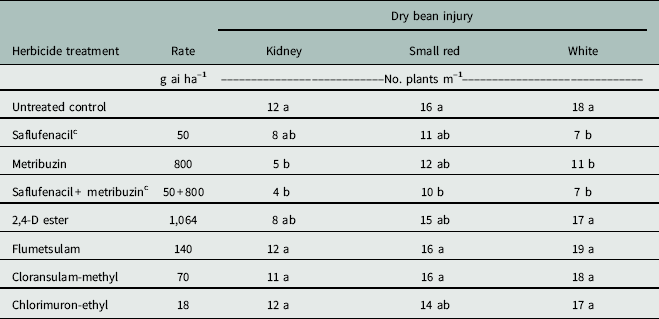
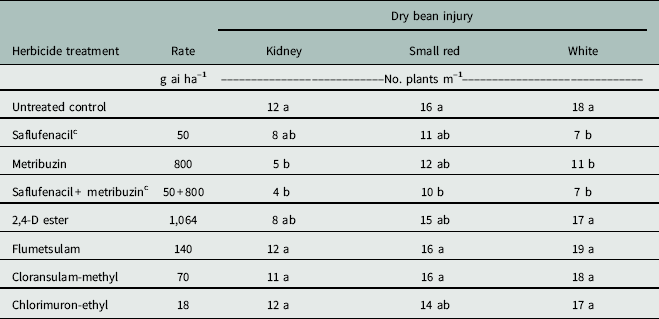
At 3 WAE, saflufenacil decreased white bean stand 61%, metribuzin decreased kidney bean stand 58% and white bean stand 39%, and saflufenacil+metribuzin decreased kidney, small red, and white bean stand 67%, 38%, and 61%, respectively (Table 5). Dry bean stand count was not adversely affected with other herbicides evaluated. These results are consistent with other studies in which saflufenacil applied PRE at 50 g ai ha–1 reduced plant stand 23% to 67% in dry bean (Soltani et al. Reference Soltani, Shropshire and Sikkema2014).
Plant stand 3 WAE for three dry bean market classes treated with various preplant herbicides in a strip-tillage system at Exeter, ON, from 2016 to 2017.Footnote a , Footnote b
a Abbreviations: WAE, wk after crop emergence application.
b Means followed by the same letter within a column (a–b) are not significantly different according to a Tukey-Kramer multiple-range test at P<0.05. Rows without an uppercase letter have no cultivar differences.
c Included Merge (1.0 L ha–1).
Biomass
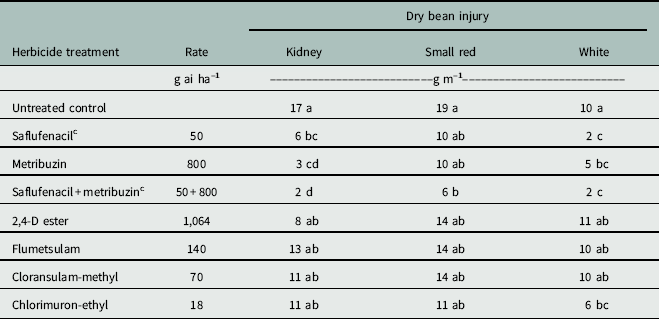
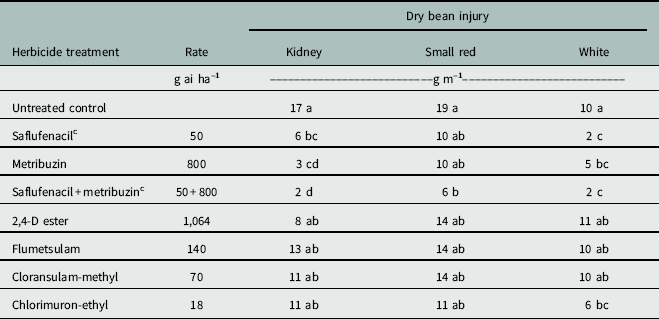
Saflufenacil decreased kidney bean biomass 65% and that of white bean 80% (Table 6). Metribuzin decreased kidney bean biomass 82% and that of white bean 50%. Saflufenacil+metribuzin decreased kidney bean biomass 88%, 68% in small red bean, and 80% in white bean. Chlorimuron-ethyl decreased white bean biomass 40%. There were no differences in dry bean biomass with other herbicides. Results are consistent with other studies that have shown similar biomass reduction in dry bean with saflufenacil (Soltani et al. Reference Soltani, Shropshire and Sikkema2014), flumetsulam (Soltani et al. Reference Soltani, Nurse, Robinson and Sikkema2008), cloransulam-methyl (Soltani et al. Reference Soltani, Shropshire, Cowan and Sikkema2004, Reference Soltani, Shropshire and Sikkema2010), and chlorimuron-ethyl (Sikkema et al. Reference Sikkema, Soltani, Shropshire and Cowan2004).
Crop biomass 3 WAE for three dry bean market classes treated with various preplant herbicides in a strip-tillage system at Exeter, ON, from 2016 to 2017.Footnote a , Footnote b
a Abbreviations: WAE, wk after crop emergence application.
b Means followed by the same letter within a column (a–d) are not significantly different according to a Tukey-Kramer multiple-range test at P<0.05. Rows without an uppercase letter have no cultivar differences.
c Included Merge (1.0 L ha–1).
Height
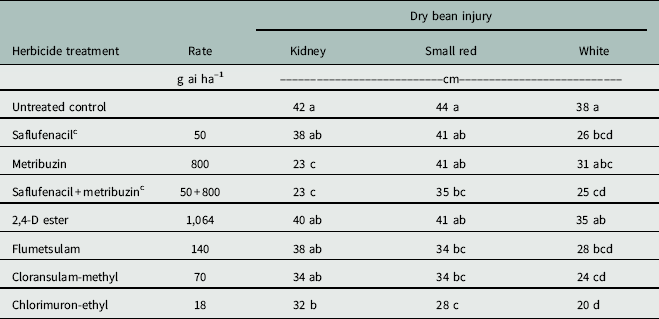
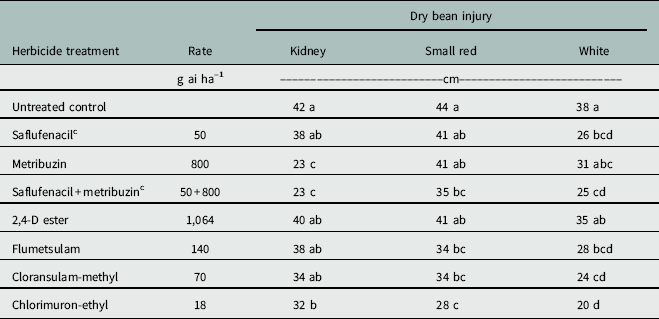
The impact on dry bean height 6 WAE depended on herbicide and dry bean market class. Metribuzin, saflufenacil+metribuzin, and chlorimuron-ethyl reduced kidney bean height 45%, 45%, and 24%, respectively (Table 7). Saflufenacil+metribuzin, flumetsulam, cloransulam-methyl, and chlorimuron-ethyl reduced small red bean height 20%, 23%, 23%, and 36%, respectively. Saflufenacil, saflufenacil+metribuzin, flumetsulam, cloransulam-methyl, and chlorimuron-ethyl reduced white bean height 32%, 34%, 26%, 37%, and 47%, respectively. 2,4-D ester was the only herbicide that consistently had no effect on height. Similar plant height reduction has been reported in dry bean with saflufenacil (Soltani et al. Reference Soltani, Shropshire and Sikkema2014), flumetsulam (Soltani et al. Reference Soltani, Nurse, Robinson and Sikkema2008), cloransulam-methyl (Soltani et al. Reference Soltani, Shropshire, Cowan and Sikkema2004, Reference Soltani, Shropshire and Sikkema2010), and chlorimuron-ethyl (Sikkema et al. Reference Sikkema, Soltani, Shropshire and Cowan2004).
Average height 6 WAE for three dry bean market classes treated with various preplant herbicides in a strip-tillage system at Exeter, ON, from 2016 to 2017.Footnote a , Footnote b
a Abbreviations: WAE, wk after crop emergence application.
b Means followed by the same letter within a column (a–d) are not significantly different according to a Tukey-Kramer multiple-range test at P<0.05. Rows without an uppercase letter have no cultivar differences.
c Included Merge (1.0 L ha–1).
Seed Yield
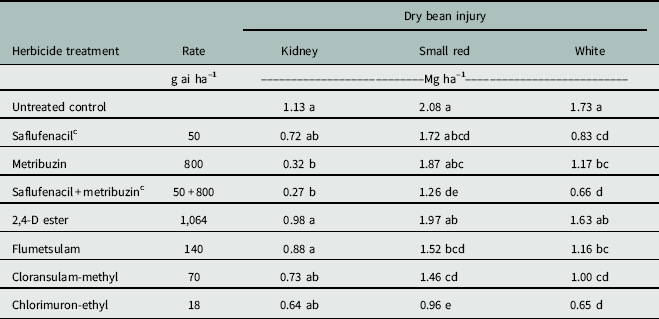
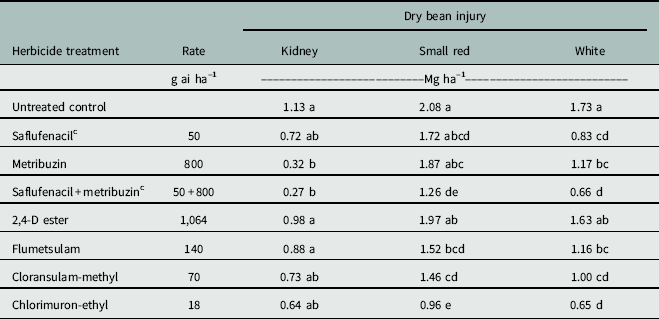
Seed yield of the three dry bean market classes treated with various preplant herbicides in a strip-tillage system was variable depending on herbicide evaluated (Table 8). Metribuzin and saflufenacil+metribuzin reduced kidney bean seed yield 72% and 76%, respectively. Saflufenacil+metribuzin, flumetsulam, cloransulam-methyl, and chlorimuron-ethyl reduced small red bean seed yield 39%, 27%, 30%, and 54%, respectively. Saflufenacil, metribuzin, saflufenacil+metribuzin, flumetsulam, cloransulam-methyl, and chlorimuron-ethyl reduced white bean seed yield 52%, 32%, 62%, 33%, 42%, and 62%, respectively. 2,4-D ester consistently had no significant effect on the seed yield of kidney, small red, and white bean. In other studies, saflufenacil applied PRE at 50 g ai ha–1 reduced seed yield 40%, 54%, and 22% in black, white, and kidney bean, respectively (Soltani et al. Reference Soltani, Shropshire and Sikkema2014). Flumetsulam applied PPI or PRE at 140 g ai ha–1 did not reduce seed yield in pinto and small red bean (Sikkema et al. Reference Sikkema, Robinson, Nurse and Soltani2008; Soltani et al. Reference Soltani, Nurse, Robinson and Sikkema2008). Seed yield reductions in this study with cloransulam-methyl are similar to those seen in other studies in which cloransulam-methyl applied PRE at 70 g ha–1 decreased seed yield of cranberry, black, and white bean 43% to 54% (Soltani et al. Reference Soltani, Shropshire, Cowan and Sikkema2004, Reference Soltani, Shropshire and Sikkema2010).
Yield of three dry bean market classes treated with various preplant herbicides in a strip-tillage system at Exeter, ON, from 2016 to 2017.Footnote a , Footnote b
a Abbreviations: WAE, wk after crop emergence application.
b Means followed by the same letter within a column (a–e) are not significantly different according to a Tukey-Kramer multiple-range test at P<0.05. Rows without an uppercase letter have no cultivar differences.
c Included Merge (1.0 L ha–1).
In conclusion, the potential herbicides for GR horseweed control including saflufenacil, metribuzin, saflufenacil+metribuzin, flumetsulam, cloransulam-methyl, and chlorimuron-ethyl applied 1 wk prior to seeding can significantly injure dry bean. Saflufenacil generally caused greater visible injury in white bean than the kidney and small red dry bean market classes. However, metribuzin generally caused more visible injury in kidney bean compared to the small red and white bean. This study demonstrates that saflufenacil, metribuzin, saflufenacil+metribuzin, flumetsulam, cloransulam-methyl, and chlorimuron-ethyl when applied 1 wk prior to seeding do not have an adequate margin of crop safety for use in dry bean under a strip-tillage cropping system for the control of GR horseweed. Among the herbicides evaluated, 2,4-D ester caused the least crop injury with no effect in dry bean seed yield. Further research is needed to determine the sensitivity of dry beans to 2,4-D applied at various rates and application intervals prior to dry bean seeding for the control of GR horseweed under strip-tillage production systems in Ontario.
Acknowledgments
No conflicts of interest have been declared. This research was funded by the Ontario Bean Growers (OBG).