1 Introduction
A well-known feature of Icelandic is what are known as transitive expletive constructions (TECs), exemplified by (1) from Bobaljik & Jonas (Reference Bobaljik and Jonas1996: 196).
(1)


Here, the expletive það is followed by a finite transitive verb, which is followed by an adverb and the notional subject, or associate, as it is standardly known. According to Bobaljik & Jonas, TECs are also found in Faroese, German, Dutch, Yiddish and Frisian. In a recent paper, Henry & Cottell (Reference Henry and Cottell2007) (henceforth H&C) argue that Belfast English (BE) also has TECs, citing examples like the following (where (*) means that an example is not grammatical in Standard English and H&C's example number is indicated):Footnote 2
(2)
(3)
Both contain expletive there and a transitive verb. It looks, then, as if the label TEC may be appropriate. H&C do not in fact say what they understand by a TEC, but they suggest that the difference between BE and Standard English (SE) is that the former has TECs while the latter does not, and they sketch an analysis embodying this idea.
In this article, I will look at the data H&C present and the analysis they sketch. I will argue that both their characterization of the data and the analysis they base on it are problematic. I will then argue that a lexical approach is possible within Head-driven Phrase Structure Grammar (HPSG) which provides a more satisfactory account of the data.
2 H&C's discussion and analysis
The examples in (2) and (3) are ungrammatical in SE. Hence, BE and SE are different in this area. A further difference is that BE, like many nonstandard varieties of English, allows a singular verb with a plural associate. The following illustrate:
(4)
One consequence of this is that both of the following are possible as alternatives to (2):
- (5)
(a) There has lots of people passed the test.
(b) There's lots of people passed the test.
Alison Henry informs me (p.c.) that the second is better because contraction is expected in colloquial speech.
There are also differences between BE and Icelandic. An obvious difference between the BE examples in (2) and (3) and the Icelandic example in (1) is that the former contain a finite auxiliary whereas the latter contains a finite lexical verb. There are no BE examples with a finite lexical verb. Neither of the following is possible:
(6) *There read lots of students this book.
(7) *There lots of students read this book.
As one might expect, Icelandic has examples with a finite auxiliary such as the following, from Bobaljik & Jonas (Reference Bobaljik and Jonas1996: 209).
(8)
However, H&C (p. 281) note that Icelandic only allows the associate after the first, finite auxiliary. In contrast BE allows the associate to appear after any member of a sequence of auxiliaries. The following from H&C illustrate:
(9)
But not all associate positions are the same. H&C (2007: 280) highlight the following contrast:
(10)
Alison Henry informs me that the contrast is between associates following be and associates in other positions. Only the former may be a nonquantified DP.
H&C's central claim (p. 289) is that the difference between BE and SE is that the latter only has there and an associate with unaccusatives and passives, whereas BE has there with transitives as well. This claim faces two problems.
The main problem is that there are a number of types of examples which are confined to BE but which do not seem to be TECs. Consider first the examples in (9). The first of these is grammatical in SE. This suggests that it is not a TEC, and the fact that it contains a passive verb also suggests that it isn't. But, of course, the other examples also contain a passive verb. It looks, then, as if they are not TECs either. However, if they are not, we cannot simply say that BE has TECs while SE does not. Rather we must say that BE has certain expletive + associate sentences which SE lacks, and some are TECs while others are not.
Further examples which point to the same conclusion are the following from H&C (p. 289):
(11)
(12)
Neither example contains a transitive verb and hence presumably neither is a TEC. Alison Henry informs me that examples like (11) are not acceptable for all speakers but that they are acceptable for some.Footnote 3 Again, then, we have examples which are possible in BE but not SE which are not TECs.
A final set of examples that are relevant here are the following:
(13)
(14)
Neither example is acceptable in SE although they contain an unaccusative verb. Instead the associate must appear after the verb, as in the following:
(15) There may arrive some men.
(16) There have arrived some men.
Both (13) and (14) are acceptable in BE. Again, then, we have examples which are not TECs but are only acceptable in BE.
A second problem is that there are examples in SE which are TECs on the obvious definition. Consider the following:
(17)
(18) There was a man mowing the lawn.
(17) is only acceptable in BE, but (18) is acceptable in both BE and SE. Both contain a transitive verb. Hence, if a TEC is a sentence containing expletive there and a transitive verb, both are TECs. Claudia Felser has pointed out to me (p.c.) that mowing the lawn in (18) could be a modifier within a complex NP. This might suggest that such sentences are not relevant here. However, Huddleston & Pullum (Reference Huddleston and Pullum2002: 1395) argue that while they may involve a single complex NP, they may also involve two separate postverbal constituents. They note, for example, that it is possible to extract from the participial phrase, which one would not expect if it could only be a modifier within a complex NP. The following illustrates:
(19) This is the lawn on which there was a man sitting.
It seems, then, that such sentences are relevant. Hence, we must either propose some other definition of TECs or conclude that SE has certain TECs.
The preceding discussion suggests that it is unsatisfactory to say that BE has TECs and SE does not. On the one hand, there are examples confined to BE which are not TECs, such as (9b), (9c), (11), (12), (13), (14) and (17). On the other, there are examples in SE which are TECs on the obvious definition, such as (18).
H&C outline an analysis which predicts that BE but not SE allows there with a transitive verb. They assume the fairly standard minimalist view of clause structure in (20).
(20)
On standard assumptions, subjects appear in Spec TP on the surface and agentive subjects originate in Spec vP. H&C propose that expletive there is introduced in Spec vP in SE but in Spec TP in BE. It follows that expletive there cannot co-occur with an agentive subject in SE but can co-occur with an agentive subject in BE. Since a transitive verb has an agentive subject it follows that expletive there cannot co-occur with a transitive verb in SE but can in BE.
Before we consider the empirical adequacy of this analysis, there is one theory-internal problem that we should note. This is that the idea that expletive there is introduced in Spec TP in BE is problematic within minimalist assumptions. The problem is highlighted by an example like the following:
(21) There seems to be a fly in the soup.
Here, on transformational assumptions, there has been moved from Spec TP in the complement of seem to Spec TP in the main clause. Within minimalism, A-movement presupposes Agree. Here, then, Agree must have applied to the main clause T and there. To undergo Agree there must have some uninterpretable feature. If it does, it must always undergo Agree, not just in an example like this but also in a simple example. Agree, however, requires c-command. It follows that there must be introduced within the complement of T and cannot be introduced in Spec TP.Footnote 4 However, there is no real problem if there is some structure between T and vP. One could simply assume that the expletive can be introduced somewhere within that structure.
I turn now to the empirical adequacy of H&C's analysis. Since their description of the data is problematic, it is only to be expected that the analysis they base on it will also face problems. The main problem is that the distribution of associates is largely unaccounted for. Examples with an associate between an auxiliary and a transitive verb such as (2) and (3) are unproblematic. However, H&C have no real account of cases where the associate is higher than its original position. SE has examples of this kind such as (9a) and (10b). Both are passives where the associate originates on transformational assumptions as the object of the passive participle. BE has a wider range of examples. In (9b) and (9c) the associate is in higher positions than in (9a), positions in which it cannot appear in SE. (11) and (12) are similar. SE allows the following, in which the associate is probably in its original position.
(22) There might seem to be lots of mice in the cupboard.
In (11) and (12) the associate is in higher positions, where it cannot appear in SE. (13) and (14) are similar.
H&C do not offer any explicit account of the distribution of associates. They note (p. 291) that their distribution is rather like that of floated quantifiers, illustrated by the following:
(23) The students might (all) have (all) been (all?) arrested. (H&C: 91)
They also note, following Bobaljik (Reference Bobaljik, Cheng and Sybesma2003), that fully quantified DPs can occupy much the same positions.
(24) They could (most of them) have (most of them) been successful. (H&C: 97)
However, it is not clear how floated quantifiers could be relevant. On fairly standard transformational views, e.g. Sportiche (Reference Sportiche1988), the latter are left behind by movement of their complement. There is no obvious way to treat associates in a similar fashion. Moreover, as we will see, there is one important difference between associates and floated quantifiers.
An important restriction on the associate in BE is that it may not appear in a sentence with no auxiliary or seem. Hence, neither (6) nor (7) is grammatical. The ungrammaticality of (6) can be attributed to the assumption that lexical verbs do not move to T in English. The ungrammaticality of (7) seems more problematic. H&C assume, following Lasnik (Reference Lasnik2000), that a finite T is affixal when it does not contain an auxiliary and that it must be attached to the following verb. They propose that this affixation is blocked if an associate intervenes between the two elements. Hence ungrammaticality results unless do is inserted to produce the following:
(25) There did lots of students read this book. (*) (H&C: 112)
A problem with this idea is that various other items do not block the affixation of T to V. This includes adverbs, floated quantifiers and quantified DPs. The following illustrate:
(26) The students carefully answered the questions.
(27) The students all asked that question.
(28) We all of us asked that question.
H&C note that adverbs do not block affixation and suggest that floating quantifiers do not block affixation because they too are adverbial (p. 295). Presumably they would say the same of quantified DPs. However, it is not clear what is meant by adverbial. The one clear example apart from an associate of an element which blocks the affixation of T to V is not. (29) illustrates:
(29) *Lots of students not read this book.
It seems, then, that an associate behaves like not in this area and not like adverbs, floated quantifiers and quantified DPs. It is not clear why this should be.
It is also not clear how the possibility of examples like (18) in SE should be accounted for within H&C's analysis. The obvious suggestion is that this has something to do with be. One might propose that this is an unaccusative V taking inter alia a vP complement.Footnote 5 On this view, (18) would have the following structure in SE:
(30) [TP there was [vPthere was [VPwas [vP a man [VP mowing the lawn]]]]]
Here, a man remains in the lower Spec vP and there is introduced in the higher Spec vP (and moved to Spec TP). Thus, it is possible to reconcile an example like (18) with the idea that there is introduced in Spec vP in SE. However, it would be just as easy to reconcile an example like (17) with this idea. It is plausible to suppose that have too is an unaccusative V taking a vP complement. This would allow the following structure for (17):
(31) [TP there has [vPthere has [VPhas [vP a man [VP mowed the lawn]]]]]
One might try to exclude examples like (17) by proposing that have is introduced in T. On this view, (32) would have the structure in (33), where Kim has moved from Spec vP to Spec TP.
(32) Kim has mowed the lawn.
(33) [TP Kim has [vPKim [VP mowed the lawn]]]
Given such an approach to have, a sentence containing have will only have one Spec vP position, and this will not be available for the introduction of there if the verb is transitive. However, an example like the following suggests that this approach is untenable:
(34) Kim may have mowed the lawn.
Here, may is in T on fairly standard assumptions. Hence, have must be somewhere else. It is fairly clear that the difference between (17) and (18) has something to do with the difference between have and be, but it is not clear what form this difference should take within H&C's approach.
It seems, then, that H&C's analysis is quite problematic. This is not surprising given that it is based on the untenable assumption that the difference between BE and SE is that the former has TECs while the latter does not. The data discussed in the preceding pages show that it is not the verb that follows the associate but the element which precedes it that is crucial. Whereas SE allows an associate immediately after be, BE also allows an associate immediately after a number of auxiliaries and also immediately after seem.
One might wonder whether H&C's approach could be modified to incorporate this observation. On their analysis, we have structures like the following, where X is an auxiliary or seem:
(35)
Within Government-Binding theory, one might propose that the associate must be governed by an auxiliary or seem. However, such an approach is not available in Minimalism, which bans the notion of government. Moreover, if the expletive must originate below its superficial position, as argued above, it is not clear that auxiliary or seem would in fact govern the associate. Thus, it is not obvious how H&C's approach could incorporate the link between the associate and a preceding auxiliary or seem.
3 An HPSG approach
In this section I will develop a lexical analysis in which certain elements license an associate simply because they take an associate as one of their complements. I will assume structures of the following form, where X is an auxiliary or seem:
(36)
It might be possible to develop an analysis of this kind within a number of frameworks, but I will develop an analysis within HPSG building on ideas in Pollard & Sag (Reference Pollard and Sag1994).Footnote 6 All that is required is a certain sort of lexical description for auxiliaries and seem.
Pollard & Sag propose that be allows either an ordinary subject, as in (37), or an expletive subject and a following associate, as in (38), because it has two different lexical descriptions.
(37) A fly was in the soup.
(38) There was a fly in the soup.
I will outline their approach and then show how it can be extended to accommodate the BE data.
In HPSG linguistic expressions have a complex feature makeup encoding their syntactic, phonological and semantic properties. In the present context phonological and semantic properties are not important because the pairs of lexemes will have the same phonological properties and very similar semantic properties. Within most versions of HPSG, syntactic properties include the features HEAD, which indicates whether a sign is nominal, verbal, etc., SUBJ, which indicates what kind of subject it requires, and COMPS, which indicates what complements it takes.Footnote 7 Within this framework the standard use of be in (37) will have the partial lexical description in (39):
(39) Standard be
Here the value of the feature HEAD identifies be as an auxiliary verb. The bracketed integers or ‘tags’ indicate that subject of be is also subject of the complement. In other words, be is analysed as a kind of raising verb. Finally, the value of COMPS encodes the fact that it takes a [PRED +] phrase as its complement. This includes not only a PP, as in (37), but also an AP, an NP, a progressive VP and a passive VP. The following illustrate these other possibilities:
- (40)
(a) Kim was clever.
(b) Kim was a linguist.
(c) Kim was sleeping.
(d) Kim was arrested.
Given (39), (37) will have the following structure:Footnote 8
(41)
I have spelled out the categories of the verb, verb phrase and the clause fairly fully. (The clause is a verbal constituent – one that does not require a subject or a complement.) The tags indicate that the subject and complement satisfy the subject and complement requirements of the verb.
For the use of be with an expletive there subject as in (38), we can propose the lexical description in (42), a slightly revised version of the description in Pollard & Sag (Reference Pollard and Sag1994: 147) (without the semantics):
(42) There-subject be (SE)
For HPSG, expletive there is an NP with a special expletive index represented here by the there subscript. Thus, the SUBJ feature indicates that be in this use takes expletive there as its subject. The COMPS feature indicates that it takes two complements, the first an NP and the second a predicative phrase. It also indicates that the first complement is the subject of the second complement. Thus, be in this use resembles a raising to object verb. For HPSG, person, number and gender features are the properties of an index. Here, then, the two NUM features ensure that that expletive there agrees in number with its associate. Within HPSG, this is necessary in an example like the following:
(43) There are likely to be storms in the channel.
Here the expletive is much higher than the associate and if agreement is a local matter, as is assumed in HPSG, are must agree with the expletive and not with the associate. Hence, the expletive must agree with the associate.
Given (42), (38) will have the following structure:
(44)
The lexical description in (42) needs to be extended in some way to restrict both the associate and the ordinary complement. As is well known, the associate is normally indefinite. However, as Huddleston & Pullum (Reference Huddleston and Pullum2002: 1397–1401) emphasize, definite associates of certain kinds are also acceptable. I will not try to decide how exactly the observed restrictions should be imposed. As for the ordinary complement, it must denote a potentially transient property, excluding examples like the following from Sag, Wasow & Bender (Reference Sag, Wasow and Bender2003: 337, fn.5):
- (45)
(a) *There was a vase blue.
(b) *There was a unicorn the winner of the Kentucky Derby.
I will not try to impose this restriction. However, there is no reason to think that it is any harder to accommodate the facts in this framework than it is in any other framework.
The lexical description in (42) is appropriate for formal varieties of SE, but is not quite what is required for BE and less formal varieties of SE, in which, as noted earlier, the verb can be singular when the associate is plural. To accommodate this we need to allow the expletive to be singular even when the associate is plural. The following description, in which the NUM feature on the expletive either has the same value as the first complement or is singular, does this:
(46) There-subject be (BE)
SE also allows more complex examples than (38), in which the expletive and the associate are further apart, such as the following:
- (47)
(a) There may be a fly in the soup.
(b) There has been a fly in the soup.
(c) There may have been a fly in the soup.
Such examples are expected if modals and have are raising verbs taking a subject which is also the subject of their complement. (48) is a lexical description for a modal and (49) a description for have.
(48) Standard modal
(49) Standard have
These are like the description for the standard use of be except that (48) is [VFORM fin], reflecting the fact that modals only have finite forms, and indicates that the complement is a base VP, and (49) indicates that the complement is a past participle VP. Given (48), (47a) will have the structure in (50).
(50)
(47b) will have a similar structure. (47c) will have a similar but slightly more complex structure.
I turn now to examples such as (2), (3), (9b), (9c), (11), (12), (13), (14) and (17), which are only grammatical in BE. To accommodate such examples, we simply need to assume that have, modals and seem also have a second description in which they take expletive there as a subject and an extra nominal complement with which the subject optionally agrees. Here are the necessary descriptions for modals and have:
(51) There-subject modal
(52) There-subject have
These descriptions will give the following schematic structures for the examples in (2) and (3):Footnote 9
(53)
(54)
The lexical descriptions in (51) and (52) do not say anything about the valence of the verb in the VP complement. Thus, they allow examples in which the verb is transitive, such as (2) and (3), and examples in which it is not, such as (13) and (14). SE will not have these lexical descriptions and hence will not allow either sort of example.
We turn now to seem. In an example like (55) seem will have the lexical description in (56).
(55) Lots of mice might seem to be in the cupboard.
(56) Standard seem
This is like the descriptions for the standard use of modals and have in (48) and (49) except that it is [AUX –] and the complement is an infinitival VP. To accommodate an example like (11), we need the following description for seem:
(57) There-subject seem
This will give the following structure for (11):
(58)
This is very similar to the structure in (50). Speakers who do not allow examples like (11) will not have the lexical description in (57). This will of course include SE speakers.
We have now provided analyses for the distinctive BE expletive there sentences. Within this analysis BE allows an associate not just immediately after be but also immediately after modals, have and for some speakers seem, because all these items allow an associate as a complement. An associate cannot appear in examples with no auxiliary or seem such as (6) and (7) because they contain no element which licenses an associate. There is no need to assume an operation attaching T to a following V blocked by some intervening elements but not others.Footnote 10
As noted earlier, the analysis needs to be extended to place certain restrictions on the associate and the following predicate. We also need an additional restriction on the associate with verbs other than be to exclude a nonquantified DP. I will return to this matter shortly.
An anonymous referee has suggested that this analysis just shows how H&C's analysis ‘can be encoded in HPSG’. I think this is wrong for two reasons. First, H&C do not have a full analysis. As I have emphasized, they leave the distribution of associates largely unaccounted for. Second, the two analyses involve different assumptions about the structure of the crucial examples. In the present analysis, unlike in H&C's, the associate is a complement of the preceding verbal element. It is this that makes it easy to capture the fact that associates are licensed by the preceding element. Thus, this analysis is different in important ways from H&C's. It needs, however, to be developed further.
SE allows an expletive there subject and an extra complement not just with be but also with an unaccusative verb in what is often known as a presentational sentence (Aissen Reference Aissen1975). (15) and (16) illustrate, as do the following:
- (59)
(a) There appeared before me a dwarf.
(b) There stood in the corner a tall dark man.
At least normally, however, the associate is in clause-final position in a presentational sentence. Moreover, as an anonymous referee has pointed out to me, presentational sentences have related sentences with a fronted PP such as the following:
- (60)
(a) Before me appeared a dwarf.
(b) In the corner stood a tall dark man.
It seems, then, that presentational sentences are a somewhat separate phenomenon. Therefore, I will not try to integrate them into the analysis.
If we set presentational sentences aside, it is just be that has an extra lexical description allowing an expletive subject and an extra complement in SE, but a number of words have an extra description in BE. For some speakers, it seems to be all auxiliaries that have an extra description. For others, ordinary raising verbs like seem also have an extra description. Alison Henry has informed me that speakers who allow an associate after an ordinary raising verb also allow an associate after raising adjectives such as likely, as in (61).
(61) There is/are likely lots of mice to be in the cupboard.
It looks, then, as if some speakers have an extra description with all subject-raising predicates. There are clearly generalizations here which need to be captured.
One way to capture the generalizations is with a lexical rule of the following form, applying to auxiliary verbs for some speakers and to all raising predicates for others:
(62)
The symbol ⊕ here stands for concatenation. The rule replaces the subject NP in the basic lexical description with expletive there and adds an NP with the same index and hence the same interpretation to the beginning of the COMPS list. It also requires there to have the same number as the extra NP or to be singular. Such a rule will derive (46), (51) and (52) from (39), (48) and (49), respectively, and if it applies to raising predicates it will derive (57) from (56). Recall, however, that the associate needs to be restricted to quantified DPs with predicates other than be. This poses a problem for a lexical rule. If we require the associate to be a quantified DP, we will get the facts wrong with be, but if we don't impose this restriction, we will get the facts wrong with the other predicates.
A solution to this problem is available within an alternative approach to multiple lexical descriptions developed especially in Warner (Reference Warner and Borsley2000). On this approach, multiple descriptions are the result of alternative ways of fleshing out a basic underspecified description. Within HPSG, words have a feature ARG-ST (ARGUMENT-STRUCTURE), whose value encodes its basic combinatorial properties. Normally the first item in the ARG-ST list of a verb is the single item in its SUBJ list and the remaining items form its COMPS list. In other words, we normally have the following situation:
(63)
We can propose that either auxiliaries or all subject-raising predicates may have a different relation between ARG-ST and SUBJ and COMPS in BE.
To implement this idea we need a number of lexical types. Much HPSG work assumes that lexemes are classified in terms of their argument-selection properties and their part of speech. We can propose that the argument-selection classification includes the following types:
(64)
Here we have a subject-raising-lexeme type with two subtypes, a standard-subject-raising-lexeme type and a there-subject-lexeme type, and the there-subject-lexeme type has a standard-there-subject-lexeme subtype. We can also propose that the part of speech classification includes the following types:
(65)
Here, lexeme has the subtypes verb-lexeme and adjective-lexeme among others, and verb-lexeme has the subtypes auxiliary-lexeme and lexical-verb-lexeme.
These types will be subject to certain constraints, implicational statements imposing restrictions on linguistic objects. For the subject-raising-lexeme type we can propose the following:
(66)
This ensures that a subject-raising lexeme has a subject which is the subject of its complement. The standard-subject-raising type will have the normal relation between ARG-ST and SUBJ and COMPS specified in (63). For the there-subject type we need the following constraint:
(67)
This ensures that a there subject lexeme has expletive there as its subject and what would normally be its subject as its first complement, and that the former either agrees with the latter or is singular. The standard-there-subject type will be subject to a further constraint requiring the associate to be a quantified DP. I won't try to decide what form this constraint should take. For the part-of-speech types we can propose the following simplified constraints:Footnote 11
- (68)
(a) verb-lexeme → [HEAD verb]
(b) adjective-lexeme → [HEAD adj]
(c) auxiliary-lexeme → [HEAD [AUX +]]
(d) lexical verb-lexeme → [HEAD [AUX –]]
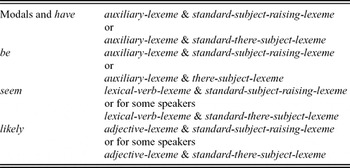
To account for the data we need to assign the crucial items to appropriate types and to provide the basic underspecified lexical descriptions which encode their unpredictable properties. We can propose the type assignments listed in table 1.
Type assignments

These assignments indicate that modals, have and be have two different sets of syntactic properties and that for some speakers this is true of seem and likely as well. For modals, have, seem and likely the second set of properties includes those of a standard-there-subject-lexeme. This means that they allow a there subject and an associate as an extra complement and require the associate to be a quantified DP. For be the second set of properties includes those of a there-subject-lexeme but not those of a standard-there-subject-lexeme. This means that it allows a there subject and an associate as an extra complement but does not require the associate to be a quantified DP.
We can propose the following basic underspecified lexical descriptions for the crucial items:Footnote 12
(69) Modal
(70) have
(71) be
(72) seem and likely
Since I am ignoring phonology and semantics, seem and likely have the same lexical description. All these descriptions consist just of partial specifications for the feature ARG-ST. We do not need to specify the values of HEAD, SUBJ and COMPS since they are all predictable. We also do not need to specify that the first member of the ARG-ST list is the subject of the second member since this follows from the fact that all these items are subject-raising verbs.
The system of types and constraints outlined above will allow the lexical descriptions presented earlier to be derived from (69)−(72). (48) and (51) can be derived from (69), (49) and (52) from (70), (39) and (46) from (71), and (56) and (57) from (72), where it is the lexical description for seem. Where (72) is the basic description for likely, it will be possible to derive descriptions like (56) or (57) but with adj as the value of HEAD. Importantly, (51), (52), (57) and the counterpart of (57) for likely will require the associate to be a quantified DP. (46) will not impose this requirement.
We have now outlined an account of the BE data which not only gets the facts right but also captures generalizations which would be lost if the pairs of lexical descriptions provided earlier were simply listed in the lexicon. This, then, is the analysis that I would propose.
4 Concluding remarks
I have argued here that H&C's characterization of the BE data is unsatisfactory and that the analysis they base on it is not very successful. More precisely, I have argued that it is not what follows the associate that is important but what precedes it. It is not that BE unlike SE allows an associate with a following transitive verb. Rather, whereas SE only allows an associate immediately after be, BE allows an associate after modals and have, and for some speakers seem and other raising predicates as well. I have developed a fairly detailed lexical analysis within HPSG which embodies this idea.
It has been suggested by an anonymous referee that the analysis has a ‘brute force’ character. The idea is presumably that it involves more stipulations than necessary. This could, of course, be true, but the only way to establish that it is would be to provide an analysis that covers the same ground with fewer stipulations. In the absence of such an analysis we have no good reason to think that the analysis involves more stipulations than necessary. Counting stipulations is not a simple matter. I would argue, however, that the analysis involves no more stipulations than H&C's. H&C stipulate that there is introduced in a higher position in BE than SE. I have stipulated that a class of items have the extra combinatorial properties in BE which only be has in SE. As I have noted above, the crucial stipulation can be expressed as an option to flesh out basic underspecified lexical descriptions in a nonstandard way and I have developed this approach in some detail. I think, then, that the approach outlined here is no more stipulative than H&C's approach. However, it is considerably more successful. It is, of course, possible that someone else will be able to develop a superior approach to the BE data. I would suggest, however, that the approach outlined here represents a real step forward.