Cognitive deficits are a core component of psychiatric disorders, including schizophrenia, schizoaffective disorder and bipolar disorder. These cognitive deficits are diffuse, span most cognitive domains, and are generally large in magnitude (McCleery & Nuechterlein, Reference McCleery and Nuechterlein2019). Moreover, the cognitive deficits associated with schizophrenia and bipolar disorder have been suggested to worsen over time (Fett et al., Reference Fett, Velthorst, Reichenberg, Ruggero, Callahan, Fochtmann and Kotov2020), and may reflect a form of accelerated aging (Bergh et al., Reference Bergh, Hjorthoj, Sorensen, Fagerlund, Austin, Secher and Nordentoft2016; Shahab et al., Reference Shahab, Mulsant, Levesque, Calarco, Nazeri, Wheeler and Voineskos2019; Van Rheenen et al., Reference Van Rheenen, Lewandowski, Bauer, Kapczinski, Miskowiak, Burdick and Balanza-Martinez2020). There is emerging evidence that telomere shortening, a marker of cellular senescence, may be associated with an increased risk for developing schizophrenia and bipolar disorders (Powell, Dima, Frangou, & Breen, Reference Powell, Dima, Frangou and Breen2018; Russo et al., Reference Russo, Prinzi, Proietti, Lamonaca, Frustaci, Boccia and Bonassi2018), and, more specifically, with cognitive impairments in people diagnosed with these disorders (Czepielewski et al., Reference Czepielewski, Massuda, Panizzutti, Grun, Barbé-Tuana, Teixeira and Gama2018; Powell et al., Reference Powell, Dima, Frangou and Breen2018).
Telomeres are composed of repeated nucleotide sequences that cap the end of chromosomes, protecting them from damage and promoting chromosomal stability (Moyzis et al., Reference Moyzis, Buckingham, Cram, Dani, Deaven, Jones and Wu1988). Telomere length typically shortens over time because of incomplete cell replication and oxidative stress. There is inter-individual variability in the rate of telomere shortening, and determinants of telomere length include genetic factors as well as non-genetic factors, such as sociodemographic factors and life stress (Entringer & Epel, Reference Entringer and Epel2020; Epel et al., Reference Epel, Blackburn, Lin, Dhabhar, Adler, Morrow and Cawthon2004). Hence, telomere length and attrition have been postulated as a marker of cell senescence or biological aging (that may be beyond chronological aging) that incorporates genetic and environmental influences.
A relationship between shortened telomere length and diminished cognitive ability has been reported in healthy, community samples (Hagg et al., Reference Hagg, Zhan, Karlsson, Gerritsen, Ploner, van der Lee and Pedersen2017; Valdes et al., Reference Valdes, Deary, Gardner, Kimura, Lu, Spector and Cherkas2010; Yaffe et al., Reference Yaffe, Lindquist, Kluse, Cawthon, Harris and Hsueh2011; Zhan et al., Reference Zhan, Clements, Roberts, Vassilaki, Druliner, Boardman and Hagg2018) as well as clinical populations such as Alzheimer's disease (Scarabino, Broggio, Gambina, & Corbo, Reference Scarabino, Broggio, Gambina and Corbo2017). However, findings are not consistent, with several studies failing to support a relationship between telomere length and cognition (Kaja, Reyes, Rossetti, & Brown, Reference Kaja, Reyes, Rossetti and Brown2019; Scarabino et al., Reference Scarabino, Broggio, Gambina and Corbo2017; Zhan et al., Reference Zhan, Clements, Roberts, Vassilaki, Druliner, Boardman and Hagg2018) and other studies suggesting a nonlinear relationship between telomere length and cognition (Roberts et al., Reference Roberts, Boardman, Cha, Pankratz, Johnson, Druliner and Petersen2014). Studies specifically examining associations between telomere length and cognition in bipolar-schizophrenia spectrum disorders are limited. One study has linked shorter telomere length to poorer immediate verbal memory performance in a schizophrenia sample (Czepielewski et al., Reference Czepielewski, Massuda, Panizzutti, Grun, Barbé-Tuana, Teixeira and Gama2018) and another has reported a positive association between telomere length and verbal memory in a bipolar disorder sample (Powell et al., Reference Powell, Dima, Frangou and Breen2018).
Bipolar-schizophrenia spectrum disorders are marked by biological and clinical heterogeneity; however similar cognitive symptoms are often observed across this spectrum (Bora, Reference Bora2016). While cognitive symptoms are generally less severe in bipolar disorder, there is qualitative overlap in the pattern of cognitive impairments that are present in patients with bipolar disorder, schizoaffective disorder and schizophrenia. The lack of diagnostic specificity of cognitive symptoms in individuals with bipolar and schizophrenia spectrum disorders has led many studies to cluster patients into subgroups on the basis of cognition. Transdiagnostic data-driven cluster analysis that can identify more homogenous cognitive subgroups may enable a clearer understanding of neurobiological and aetiological factors that contribute to cognitive dysfunction (Karantonis et al., Reference Karantonis, Rossell, Carruthers, Sumner, Hughes, Green and Van Rheenen2020; Lewandowski, Baker, McCarthy, Norris, & Öngür, Reference Lewandowski, Baker, McCarthy, Norris and Öngür2018; Van Rheenen et al., Reference Van Rheenen, Lewandowski, Tan, Ospina, Ongur, Neill and Burdick2017).
The number of cognitive clusters identified within bipolar-schizophrenia spectrum disorder studies varies from two (Fernandez-Linsenbarth et al., Reference Fernandez-Linsenbarth, Planchuelo-Gomez, Diez, Arjona-Valladares, de Luis, Martin-Santiago and Molina2020; Wenzel et al., Reference Wenzel, Haas, Dwyer, Ruef, Oeztuerk and Antonucci2021) to four (Lewandowski, Sperry, Cohen, & Ongur, Reference Lewandowski, Sperry, Cohen and Ongur2014), with a recent systematic review in schizophrenia spectrum disorder only concluding that three cognitive clusters are most commonly identified: relatively intact, intermediate and severely impaired (Carruthers, Van Rheenen, Gurvich, Sumner, & Rossell, Reference Carruthers, Van Rheenen, Gurvich, Sumner and Rossell2019) (no such large scale comparison has been completed include bipolar patients). Initial studies have indicated that the cognitive subgroup associated with the most marked cognitive impairments, across both current and premorbid cognitive function, is associated with prominent structural brain abnormalities, potentially representing a greater impact of neurodegenerative processes or reflecting a process of accelerated aging (Van Rheenen et al., Reference Van Rheenen, Cropley, Zalesky, Bousman, Wells, Bruggemann and Pantelis2018). Other markers associated with neurodegenerative processes, such as oxidative stress and inflammation have also been associated with cognitive impairments in schizophrenia (Cruz et al., Reference Cruz, de Campos-Carli, de Oliveira, de Brito, Garcia, do Nascimento Arifa and Salgado2021) (although analysis in this study was not based on data-driven cognitive subgroups).
Telomere length and attrition provide a potential marker of accelerated biological aging and no previous studies have examined associations between telomere length and cognitively impaired subgroups of bipolar-schizophrenia spectrum patients. The aim of the current study was, therefore, to explore the relationship between telomere length and cognitive subgroups in people with bipolar-schizophrenia spectrum disorders as compared to a healthy control sample. We hypothesised that data-driven cluster analysis would identify at least two cognitive subgroups (including one impaired subgroup) and that the cognitively impaired subgroup would be associated with shorter telomere length, relative to the healthy controls.
Method
Participants
Participants included a transdiagnostic group across the bipolar-schizophrenia spectrum; n = 73 (n = 15 schizophrenia; n = 11 schizoaffective disorder; n = 36 Bipolar Disorder I and n = 11 Bipolar Disorder II) and 113 healthy controls. The sample was obtained from the Cognitive and Genetic Explanations of Mental Illnesses (CAGEMIS) bio-databank. All participants had given prior informed consent for the analysis of their stored data. Psychiatric diagnosis and healthy control eligibility were confirmed using the MINI-International Neuropsychiatric Interview (Sheehan et al., Reference Sheehan, Lecrubier, Sheehan, Amorim, Janavs, Weiller and Dunbar1998). All participants were fluent in English, the majority (83.3%) of participants identified as Caucasian and were aged between 18 and 65 years old, and had an estimated premorbid IQ >70. Participants with significant visual or verbal impairments, a known neurological disorder and/or current substance/alcohol abuse or dependence were excluded. The Positive and Negative Symptom Syndrome Scale (PANSS) was used to measure the severity of positive, negative and general psychopathology symptoms (Kay, Fiszbein, & Opler, Reference Kay, Fiszbein and Opler1987) in the participants with schizophrenia/schizoaffective diagnoses and the Brief Psychiatric Rating Scale (BPRS; (Overall & Gorham, Reference Overall and Gorham1962)) was used to measure the severity of psychiatric symptoms in the participants with bipolar diagnoses.
Cognitive assessment materials
The Measurement and Treatment Research to Improve Cognition in Schizophrenia (MATRICS) Consensus Cognitive Battery (MCCB) (Nuechterlein et al., Reference Nuechterlein, Green, Kern, Baade, Barch, Cohen and Marder2008), was used to assess cognitive function in seven domains of attention/vigilance, working memory, reasoning and problem solving, speed of processing, verbal learning, visual learning and social cognition. Raw MCCB test scores were converted to age- and gender-corrected domain t-scores. Premorbid IQ was estimated using the Wechsler Test of Adult Reading [WTAR; age standardised UK equivalents (Wechsler, Reference Wechsler2001)].
DNA extraction and telomere length analysis
Genomic DNA (gDNA) was extracted from whole blood, according to manufacturer's recommendations (QIAamp DNA Mini Kit, QIAGEN). Quality and quantity of gDNA were verified using the Nanodrop 2000 spectrometer (Thermo Scientific). The concentration of extracted gDNA was based on absorbance at 260 nm, and purity of the ratio of absorbance at 260 and 280 nm (A260/280). All gDNA extractions used to ascertain telomere length yielded a 260/280 ratio between 1.9 and 1.85.
The relative telomere length in gDNA was measured using a quantitative PCR-based method that compares telomere repeat sequence copy number (T) to single-copy gene number (36B4) (S) in a given sample (Cawthon, Reference Cawthon2002). Comparing the telomere repeat sequence copy number to 36B4 served as an internal control to normalise the amount of DNA analysed. The calculated T/S ratios are proportional to the relative telomere length of an individual. Briefly, all PCRs were run on an Applied Biosystems™ (ABI) 7500 Real-Time PCR System in a 384-well format and each sample was run in triplicate. gDNA samples were amplified by PCR reactions comprising of 5 ng genomic DNA, 1 × Quantitect Sybr Green Master Mix (QIAGEN) and either 270 nM of telomere-specific primers (Tel-1 Primer: GGTTTTTGAGGGTGAGGGTGAGGGTGAGGGTGAG GGT; and 900 uM of the Tel2 primer TCCCGACTA TCCCTATCCCTATCCCTATCCCTATCCCTA; or 300 nM of the 36B4U forward primer (CAGCAAGTGGGAAGGTGTAATCC) primer and 500 nM of the 36B4D reverse primer (CCCATTCTATCATCAACGGGTACAA). The thermal cycling conditions included one cycle at 95 °C for 5 min, followed by 40 cycles at 95 °C for 15 s and either 54 °C for 2 min (tel-1 and tel 2 primers) or 58 °C for 1 min 10 s (36B4 primers). Each qPCR experiment included negative controls. Standard curves were performed as part of the optimisation process to assess the efficiency of the PCRs. A serial dilution of DNA was performed at a 1:2 ratio and the resultant dilutions ranged from 50–3.125 ng. Data were plotted as the log-transformed DNA v. Ct value. A scatter plot with a trendline was plotted in excel. The correlation coefficients for both primer sets were 0.99 (online Supplementary Figs S8a and S8b). A melt curve was performed with each PCR to ensure that there was only one amplicon in the reactions. The reaction conditions for the melt curve were as follows: 95 °C for 15 s, followed by 40 cycles at 60 °C for 1 min, and 95 °C for 15 s. The melt curve was produced by the ABI software.
For telomere length quantification, the cycle threshold (Ct) for each telomere and control gene (36B4) PCR reaction was calculated using the ABI software algorithm. A mean T/S ratio was calculated according to the following formula: T/ SRatio = (2telomeerCt 236B4 Ct)−1 = 2−ΔCt, where this value (T/S) reflects the size of telomere for each sample.
Data analysis method
Cognitive cluster analysis
Cluster analyses were performed in NbClust, fpc and cluster packages in R version 3.5.1 (R project). The seven MCCB cognitive domain T scores were used for the cluster analysis (attention/vigilance, working memory, reasoning and problem solving, speed of processing, verbal learning, visual learning and social cognition). The correlation matrix of the seven T scores was inspected to ascertain whether there was collinearity prior to inclusion in the clustering process (online Supplementary Material: Table 1). Clusters were based on k-means partitioning algorithm, which aims to minimise the average distance within each cluster and group participants with maximum score similarity into the same cluster. The k-means was chosen because, unlike hierarchical clustering, k-means cluster analysis is iterative. That is, observations that have been clustered at initial iterations can be reshuffled into another cluster if it is deemed a better fit (Mandara, Reference Mandara2003). T score variables were not standardised or scaled prior to k-means clustering because they were corrected for age and gender. Given the varying number of clusters identified in previous studies, k-means runs were performed with several values of k. Four techniques were used to determine the optimal number of clusters: (1) elbow method where the within sum of squares (wss) is plotted for each k against the number of clusters and the location of the bend (knee), indicates the optimal number of clusters. (2) the Average Silhouette method where the optimal number of clusters is determined by k that maximised the average silhouette width. (3) The majority rule method among all validation indices (30 indices, NbClust package (Charrad, Ghazzali, Boiteau, & Niknafs, Reference Charrad, Ghazzali, Boiteau and Niknafs2014)), and (4) the Gab statistic method where the total within-cluster variation for each k is compared to Monte Carlo simulated reference values of no clustering (Tibshirani, Walther, & Hastie, Reference Tibshirani, Walther and Hastie2001).
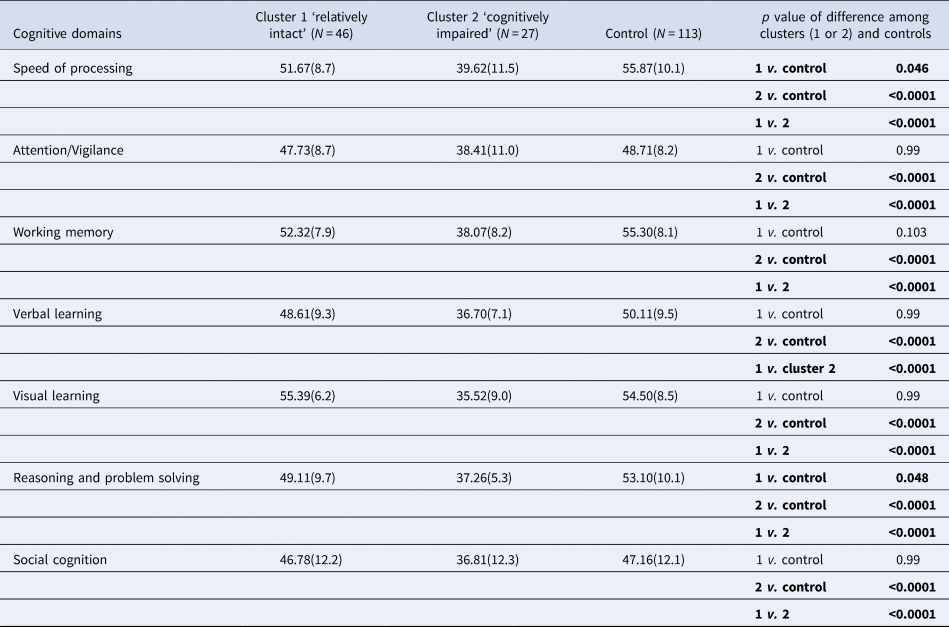
Means (s.d.) for T score cognitive domains across clusters and control groups

Note: Bold indicates statistical significance.
To assess the goodness of fit of the clustering process, we used internal clustering validation measures: Dunn index (DI, should be maximised), defined as the ratio between the smallest or minimal distance between subjects not in the same cluster to the largest within cluster distance and the silhouette width index, which ranges from −1 (poor cluster solution) to 1 (perfectly separated and dense clusters). Overall, we sought clusters with high within-cluster and low between-cluster similarities.
Cluster-wise stability was assessed through resampling (nonparametric bootstrap) of the variables 1000 times and estimating the Jaccard similarities to the initial or original cluster. As a rule, stable clusters tend to produce a Jaccard mean above 0.75 (Hennig, Reference Hennig2007). Clusters were labelled by inspecting their variable means.
One-way analyses of variance (ANOVA) with Bonferroni corrections for multiplicity were used to test group (each of two patient clusters against each other and the control) differences in the following sample variables; WTAR, age, gender, psychopathology and the seven cognitive domain scores used in the clustering. Thus, determining whether there was a difference in cognitive performance between the identified clusters.
Telomere analysis
SAS version 9.4 (SAS institute, Cary NC) was used to fit a multilevel model where we predicted telomere length (Yij, for ith subject and jth ‘age’) by a combination of two equations: one at the participant level (level 1) and another at participants' age variable level (level 2). For level 1, Yij is written as the sum of the intercept for the participants' age and a random error. For level 2, the ‘age’ intercept term is written as a sum of the grand mean and the random deviations from this mean. We then included cluster membership (dummy coded cluster 1 and cluster 2 variables) as fixed effect predictors. The covariance option for the model was unstructured (UN). The alpha level was set at 0.05.
Results
Cognitive cluster analysis
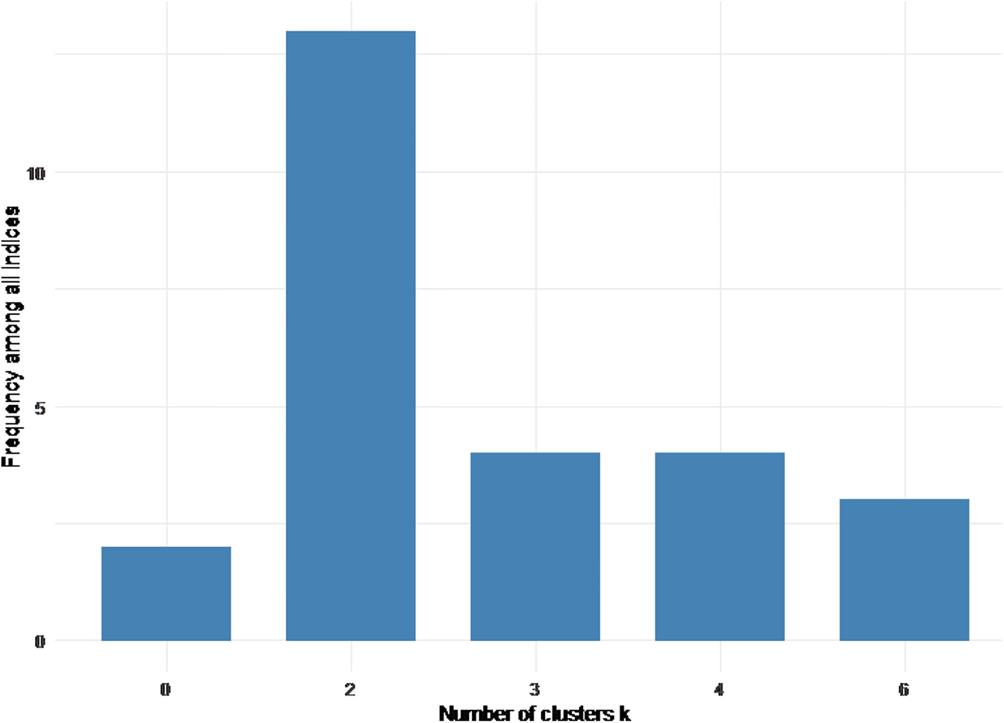
Two to six cluster solutions were explored with the k-means iterations. The optimal number of stable clusters was two as proposed by the elbow, average silhouette and the majority rule methods among all validation indices (Charrad et al., Reference Charrad, Ghazzali, Boiteau and Niknafs2014) (see Fig. 1, Fig. 2 and online Supplementary Figs S1–S3). The Gap statistics method suggested a one-cluster solution (see online Supplementary figure 3). However, the difference in the calculated gap statistic between one and two cluster solutions was small. Further, the two stable clusters yielded a Jaccard bootstrap means of 0.96, 0.98, a number of dissolved clusters of 3, 2, and a number of recovered clusters of 991, 996 (close to the 1000 bootstraps, for cluster 1 and 2, respectively). The average silhouette width (see online Supplementary Figs S4 and S5) is 0.28 and the Dunn index is 0.23.
Frequency among all indices, demonstrating the optimal number of clusters is 2.

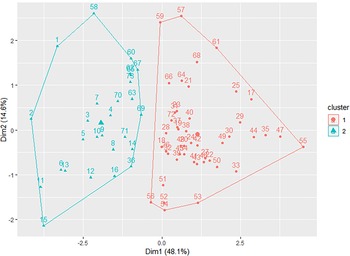
Cluster plot: based on the principal component analysis (PCA), the first two principal components or dimensions (Dim1 and Dim2) from the PCA accounted for 62.7% (Dim1 = 48.1 + Dim 2 = 14.6) of the point variability or variance.

Table 1 presents the means and standard deviations of the seven cognitive domains for each cluster, with the results of one-way ANOVAs and multiple comparison tests. As shown in Table 1, Cluster 1 represents a ‘relatively intact’ cognitive subgroup that did not differ significantly from healthy controls on any cognitive domains (although performance on the speed of processing and reasoning domains were below healthy controls at a statistical trend level). Cognitive performances for Cluster 2 across all cognitive domains were significantly lower than both Cluster 1 (‘relatively intact’ group) and the Control group; hence this group can be defined as the ‘cognitively impaired’ group.
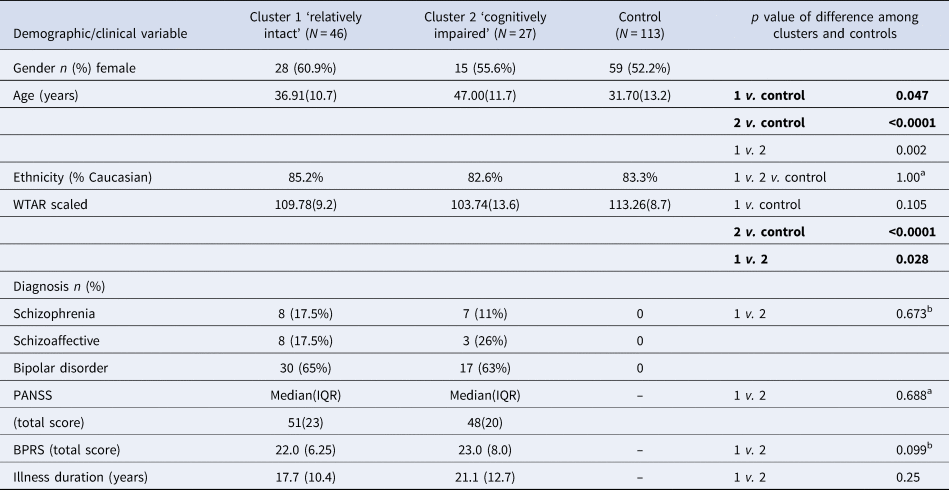
Table 2 presents demographics including age and gender and clinical characteristics including diagnostic distribution, psychopathology (total PANSS or total BPRS), and illness duration across clusters and controls, alongside the results of the one-way ANOVAs and Fisher-exact test. As demonstrated in Table 2, age differed significantly between clusters. The cognitively impaired cluster was significantly older than both the relatively intact and control clusters. The cognitively impaired cluster also had significantly lower estimated premorbid intelligence (WTAR score) than both the relatively intact and control clusters. Illness duration and illness severity (psychopathology) did not differ between the clusters. Data displaying telomere length according to diagnosis is provided in the online Supplementary material.
Demographic and clinical variables across clusters

Results presented for one-way ANOVAs; PANSS, Positive and Negative Syndrome Scale; BPRS, Brief Psychiatric Rating Scale; WTAR, Wechsler test of adult reading; illness duration is years since first self-reported symptoms.
a Fisher-exact Test.
b Independent-samples Kruskal-Wallis.
Telomere analysis
Table 3 shows the output for the multilevel model for telomere length predicted by clusters. The p value (0.008) for the cognitively impaired cluster provides evidence against the null hypothesis of no difference in telomere length between the cognitively impaired cluster and control group (the standardised coefficient depicts a difference of −0.56 standard deviation in telomere length). However, the relatively intact cluster p value (0.14) shows the observed data agree with the null hypothesis of no difference between the relatively intact cluster and the control group).
Mixed procedure output for Telomere length prediction by clusters

Age is modelled as level 2 (i.e. random) variable. Degree of freedom (174) method is Between-Within (BW). †Beta standardised regression coefficient, s.e. standard error. F F statistic. AIC Akaike information criterion, BIC Bayesian information criterion. Cluster variables are dummy coded.
Discussion
This study explored the relationship between telomere length and cognitive subgroups in people with bipolar-schizophrenia spectrum disorders compared to a group of healthy controls. Two cognitive clusters were identified within the bipolar-schizophrenia spectrum group; a cognitively impaired subgroup and a relatively intact cognitive subgroup. Telomere length was significantly shorter in the cognitively impaired subgroup relative to healthy controls, with telomere lengths for the relatively intact subgroup not significantly different from a healthy control group.
This study extends previous research demonstrating the potential for using data-driven cognitive clustering that span diagnostic boundaries to derive more homogenous phenotypic subgroups (Green, Girshkin, Kremerskothen, Watkeys, & Quide, Reference Green, Girshkin, Kremerskothen, Watkeys and Quide2020). Two cognitive clusters were identified within the bipolar-schizophrenia spectrum disorders cohort, one described as ‘cognitively impaired’, whereby scores across all cognitive domains were significantly lower than both the ‘relatively intact’ group and the healthy control group. The cognitively impaired cluster also had a significantly lower score on a test of premorbid intelligence than both healthy controls and the ‘relatively intact’ group. The ‘relatively intact’ subgroup did not differ significantly from healthy controls on any cognitive domains (although performance on the speed of processing and reasoning domains was below healthy controls at a statistical trend level). Previous studies using data-driven approaches to derive cognitive clusters across bipolar- schizophrenia spectrum patients have also demonstrated two cognitive cluster solutions (Fernandez-Linsenbarth et al., Reference Fernandez-Linsenbarth, Planchuelo-Gomez, Diez, Arjona-Valladares, de Luis, Martin-Santiago and Molina2020; Wenzel et al., Reference Wenzel, Haas, Dwyer, Ruef, Oeztuerk and Antonucci2021); although, three cluster solutions are more commonly identified (Carruthers et al., Reference Carruthers, Van Rheenen, Gurvich, Sumner and Rossell2019) and some studies have identified four cluster solutions (Lewandowski et al., Reference Lewandowski, Sperry, Cohen and Ongur2014). In keeping with previous studies, our study identified a low and a high-performing cognitive subgroup; however, unlike other studies with three- and four- cluster solutions, our study did not identify a cluster of patients with an ‘intermediate’ cognitive phenotype. This could be related to sample size differences or different methods for clustering. The current findings provide support for distinct cognitive subgroups that cut across diagnostic groupings (Vaskinn et al., Reference Vaskinn, Haatveit, Melle, Andreassen, Ueland and Sundet2020). In contrast to some previous research (Green et al., Reference Green, Girshkin, Kremerskothen, Watkeys and Quide2020; Van Rheenen et al., Reference Van Rheenen, Lewandowski, Tan, Ospina, Ongur, Neill and Burdick2017), the current study observed a similar distribution of diagnoses (i.e. bipolar disorder, schizoaffective or schizophrenia) across cognitive subgroups.
Our finding that telomere length, a proposed marker of cellular aging, was significantly shorter in the cognitively impaired bipolar-schizophrenia spectrum subgroup compared to healthy controls is novel and adds to previous studies that have associated telomere length with cognitive performance (Linghui et al., Reference Linghui, Shi, Chi, Xiaolei, Lixing, Zhiliang and Birong2020), as well as studies more specifically linking shorter telomere length to cognitively impaired neurological conditions, such as Alzheimer's disease (Hackenhaar et al., Reference Hackenhaar, Josefsson, Adolfsson, Landfors, Kauppi, Hultdin and Pudas2021). Our findings also extend the very limited literature exploring telomere length and cognition in bipolar and schizophrenia spectrum disorders, whereby previous studies have linked shorter telomere length to poorer immediate verbal memory in a schizophrenia sample (Czepielewski et al., Reference Czepielewski, Massuda, Panizzutti, Grun, Barbé-Tuana, Teixeira and Gama2018) and poorer verbal memory in a bipolar disorder sample (Powell et al., Reference Powell, Dima, Frangou and Breen2018).
The pathway linking peripheral blood telomere length to cognitive impairment remains elusive. Shorter telomeres in peripheral whole blood serve as a proxy for telomere length in cognitively relevant brain tissue, with previous studies demonstrating positive correlations between telomere length among different tissues, including correlations between whole blood and brain telomere length (Demanelis et al., Reference Demanelis, Jasmine, Chen, Chernoff, Tong, Delgado and Pierce2020). Telomere length shortening is thought to contribute to genetic instability of cells, lower levels of cell proliferation and apoptosis. This may lead to neuronal vulnerability, neurodegeneration, and cognitive deficits (Ferron et al., Reference Ferron, Marques-Torrejon, Mira, Flores, Taylor, Blasco and Farinas2009; Hsiao et al., Reference Hsiao, Bedi, Gomez, Khan, Meciszewski, Aalinkeel and Mahajan2021; Palmos et al., Reference Palmos, Duarte, Smeeth, Hedges, Nixon, Thuret and Powell2020). An indirect pathway between peripheral telomere length and cognitive function may also occur via inflammatory processes. While inflammation and oxidative stress may drive the shortening of telomere length (Epel et al., Reference Epel, Blackburn, Lin, Dhabhar, Adler, Morrow and Cawthon2004), short telomeres can also initiate and maintain inflammatory processes, including stimulating the production and secretion of inflammatory cytokines, such as Interleukin-6 (IL-6) and tumour necrosis factor alpha (TNF-a) (Chakravarti, LaBella, & DePinho, Reference Chakravarti, LaBella and DePinho2021). Higher levels of peripheral inflammatory cytokines have been associated with alterations to neural processes as well as cognitive impairments across the schizophrenia spectrum disorders (North et al., Reference North, Bruggemann, Cropley, Swaminathan, Sundram, Lenroot and Shannon Weickert2021; Poletti et al., Reference Poletti, Mazza, Calesella, Vai, Lorenzi, Manfredi and Benedetti2021). Hence, mechanisms linking shorter telomere length in peripheral blood to cognition may include direct and/or indirect processes, potentially involving activation of inflammatory pathways, neurodegeneration and alterations to neural pathways underpinning cognition.
One key limitation of the current study was the small sample size and the lack of an external validation sample for the clustering analysis. Furthermore, the cross-sectional design enabled us to only infer an association between shorter telomere length and cognitive impairment. While telomere length is largely inherited (Broer et al., Reference Broer, Codd, Nyholt, Deelen, Mangino, Willemsen and Boomsma2013), a complex interaction of biological, environmental and lifestyle factors may modify telomere length across the lifespan of an individual (Muezzinler, Zaineddin, & Brenner, Reference Muezzinler, Zaineddin and Brenner2013). Lifestyle factors such as exposure to stress and disease, diet, smoking and degree of physical activity, may exert their effects on telomere length via increased levels of oxidative stress and inflammation (Epel et al., Reference Epel, Blackburn, Lin, Dhabhar, Adler, Morrow and Cawthon2004; Muezzinler et al., Reference Muezzinler, Zaineddin and Brenner2013) (Chakravarti et al., Reference Chakravarti, LaBella and DePinho2021; von Zglinicki, Reference von Zglinicki2002). Large-scale genome-wide association studies have supported a causal role of telomere length shortening and increased Alzheimer's disease risk (Gao et al., Reference Gao, Wei, Zhu, Wang, Chen, Luo and Yu2019). Longitudinal research in community samples has also suggested that telomere length at baseline is associated with later life cognitive ability (Pudas et al., Reference Pudas, Josefsson, Nordin Adolfsson, Landfors, Kauppi, Veng-Taasti and Degerman2021; Zhan et al., Reference Zhan, Clements, Roberts, Vassilaki, Druliner, Boardman and Hagg2018). Future longitudinal research in bipolar-schizophrenia-spectrum disorders is needed to help determine the relationships between telomere length at baseline (ideally birth), telomere attrition rates during childhood, adolescence and adulthood, alongside repeat cognitive testing to provide cognitive trajectories, as well as including larger samples to enable analysis of medication effects.
Another substantial limitation is that our cognitively impaired subgroup was significantly older (by approximately 10 years) than both our ‘relatively intact’ and healthy control subgroups. While this was statistically accounted for in our analysis model, it is relevant to highlight given the associations between age and telomere attrition (Chakravarti et al., Reference Chakravarti, LaBella and DePinho2021). Of note, the association between age and telomere attrition rate may vary across the lifespan, with some studies suggesting that age appears to have a stronger association with telomere attrition in younger (<20 years) and older age brackets (e.g. 50–70 years) (Epel et al., Reference Epel, Blackburn, Lin, Dhabhar, Adler, Morrow and Cawthon2004; Iwama et al., Reference Iwama, Ohyashiki, Ohyashiki, Hayashi, Yahata, Ando and Shay1998). Inter-individual variation in telomere length in adulthood (e.g. between the ages of 20 and 50), corresponding to the age bracket of the majority of participants in the current study, is likely to reflect telomere length at birth, telomere attrition that occurs during the first 20 years of life (Benetos et al., Reference Benetos, Kark, Susser, Kimura, Sinnreich, Chen and Aviv2013), as well as exposure to disease, oxidative stress, childhood trauma and different environmental and lifestyle factors (Aas et al., Reference Aas, Elvsashagen, Westlye, Kaufmann, Athanasiu, Djurovic and Andreassen2019; Epel et al., Reference Epel, Blackburn, Lin, Dhabhar, Adler, Morrow and Cawthon2004; Rizvi, Raza, & Mahdi, Reference Rizvi, Raza and Mahdi2014). A further limitation is the lack of data available in the current study on lifestyle factors and levels of inflammation at the time of testing. For example, it is possible that the cognitively impaired subgroup may also be less likely to engage in healthy lifestyles. Future research is needed to better understand how the progression of cognitive change over time relates to telomere length as a marker of cellular aging.
In sum, the findings from this study suggest that the cognitive impairment subgroup is associated with shorter telomere length. This supports the growing number of studies that advocate for using transdiagnostic data-driven subgroups to identify more homogenous phenotypic targets, cognition in the current study, that might be associated with a more common neuropathology. Future longitudinal, large-scale research is needed to develop a better understanding of how telomere length maps to different cognitive trajectories in both bipolar and schizophrenia spectrum disorders.
Supplementary material
The supplementary material for this article can be found at https://doi.org/10.1017/S0033291722002148.
Financial support
This work was supported by the National Health and Medical Research Council (CG, grant number 546262), (SR, grant number 1154651) and the Rebecca L. Cooper Medical Research Foundation (CG, grant number PG2019407).
Conflicts of interest
None to declare.