INTRODUCTION
Basking shark, Cetorhinus maximus (Gunnerus, 1765) is an epipelagic species that is widely distributed in the Atlantic and Pacific Oceans, from boreal to warm temperate regions (Compagno, Reference Compagno2001). It occurs in shallow coastal waters as well as in the open ocean (Francis & Duffy, Reference Francis and Duffy2002; Gore et al., Reference Gore, Rowat, Hall, Gell and Ormond2008). Recent satellite tagging studies have demonstrated that C. maximus undertakes both transatlantic and transequatorial migrations and may dive to over 1200 m depth (Gore et al., Reference Gore, Rowat, Hall, Gell and Ormond2008; Skomal et al., Reference Skomal, Zeeman, Chisholm, Summers, Walsh, McMahon and Thorrold2009). In the southern hemisphere, they occur in New Zealand, are rarely recorded in Australian waters, and are apparently absent in the Indian Ocean (Compagno, Reference Compagno2002; Last & Stevens, Reference Last and Stevens2009). In the south-east Pacific, C. maximus is found in Ecuador, Peru and Chile (Compagno, Reference Compagno2001). However, there is a scarcity of current records of C. maximus along the south-east Pacific region.
Over-exploitation of the species in the northern hemisphere has resulted in C. maximus being listed as vulnerable by the IUCN Red List of Threatened Species (Fowler, Reference Fowler2000), and listed in Appendices I & II of the Convention on the Conservation of Migratory Species of Wild Animals (CMS, 2005) and Appendix II of the Convention on International Trade in Endangered Species of Wild Fauna and Flora (CITES, 2002). Cetorhinus maximus is protected in the United Kingdom, USA, Mediterranean Sea, Malta and New Zealand at national and multilateral levels (Martin & Harvey-Clark, Reference Martin and Harvey-Clark2004).
Recently, the capture and sale of C. maximus, Carcharodon carcharias and Rhincodon typus was also prohibited in Chilean waters (D. Ex. No. 81-2009). There are no target fisheries for C. maximus in Chile , nor is there evidence of the export of C. maximus products from Chile (ProChile database, Ministry of Foreign Affairs) (Lamilla et al., Reference Lamilla, Acuña, Araya, Kong, Oliva, Hernández, Villarroel, Concha, Vögler, Pequeño and Mutschke2005). However, C. maximus products (liver and fins) were used in the Chilean industrial oil market, for human consumption and as bait for crab traps (Mann, Reference Mann1954; Antezana, Reference Antezana1979). As information regarding the biology, fisheries and market of C. maximus in the south-east Pacific is scarce and fragmentary we review the occurrence and distribution of C. maximus in Chilean waters based upon 20 historical records and data obtained from ten recent by-catch events.
MATERIALS AND METHODS
Historical data were obtained from Schneider (Reference Schneider1943), Yáñez (Reference Yáñez1948), Mann (Reference Mann1954), De Buen (Reference De Buen1958), Antezana (Reference Antezana1979), Guzman (Reference Guzmán1978), Pequeño (Reference Pequeño1979), Torres-Mura (Reference Torres-Mura1991), Meléndez & Clément (Reference Meléndez and Clément1996) and Brito (Reference Brito2000). The new records were obtained opportunistically from fishermen who informed us about these findings. Morphological methods follow Compagno (Reference Compagno1984). Genetic methods follow Magnussen et al. (Reference Magnussen, Pikitch, Clarke, Nicholson, Hoelzel and Shivji2007). One specimen, an 860 cm TL mature-male (IZUA-PM 3274), was deposited intact in the Ichthyology Collection of the Universidad Austral de Chile (UACH).
RESULTS
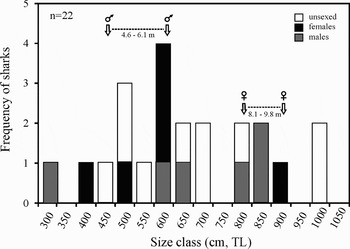
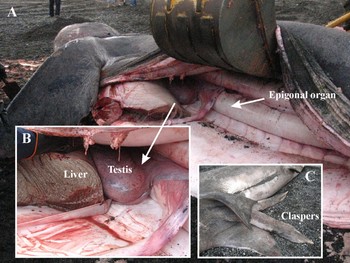
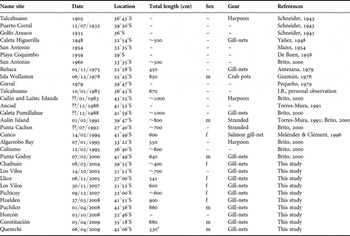
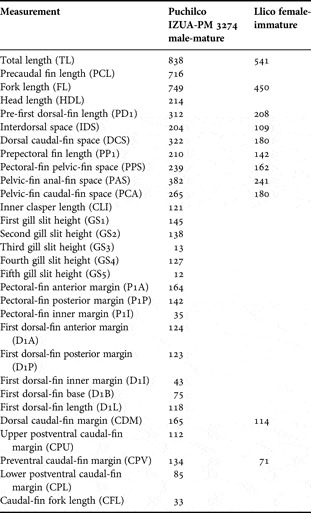
Twenty historical records and ten recent records have established the occurrence and distribution of C. maximus in Chilean waters from 1905 to 2009. Size, sex, method, location and date of capture data are presented in Table 1. Morphometric data for two specimens landed at Llico and Puchilco are presented in Table 2. Total length (TL) ranged from 400 cm to 1000 cm. The majority of specimens (60%) were unsexed, among those that were sexed the ratio of females to males was 1:1 (N = 12). The highest percentage (83.3%, N = 5) of males were sexually mature (Figure 1). For example, the individual deposited in the UACH collection was a mature male that showed fully calcified claspers (121 cm length, Table 2), no sign of semen and the testis was developed (Figure 2). By contrast, most of the females were immature (Figure 1).
Size–frequency distribution of Cetorhinus maximus. The arrows show the ranges of sexual maturity sizes from females and males.

Mature male, 860 cm total length, recorded from Puchilco. (A) General view of the internal cavity from the first third of the trunk; (B) zoom-in of photograph A; (C) lateral view of the calcified claspers.

Cetorhinus maximus recorded from Chilean waters, 1905–2009.

Sex: m, male; f, female; *, precaudal fin length.
Morphometric measurements of Cetorhinus maximus from Chile.

Most of the current records were of individuals taken as by-catch in artisanal gill-net fisheries for Merluccius gayi (Guichenot, 1848), Cilus gilberti (Abbot, 1899) and Callorhinchus callorhynchus (Linnaeus, 1758) (Table 1). Only three can be considered as target catches (harpoon); the most recent of these was a specimen of 550 cm TL taken in Algarrobo Bay during 1995 (Brito, Reference Brito2000; Table 1).
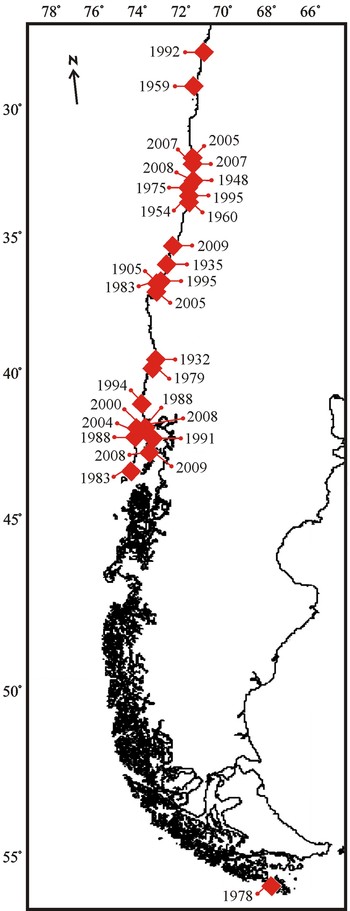
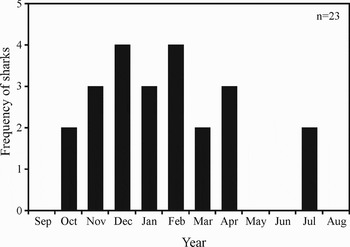
According to the distribution of the records, the concentration of sightings ranged from 31° to 33°S, 35° to 38°S and 41° to 43°S (Figure 3). Only one shark was recorded further south (55°S), which is the most boreal sighting of this species in the south-east Pacific (Figure 3). Approximately 78.3% of C. maximus were recorded during the spring and summer, mainly between November and February (Figure 4).
Distribution of reported captures and strandings of Cetorhinus maximus in Chilean waters.

Histogram summarizing the number of Cetorhinus maximus sightings per month.

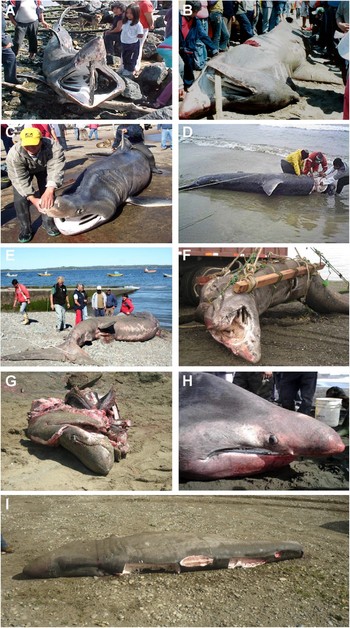
Ten recent by-catch reports of C. maximus are presented, one specimen was caught incidentally in March 2004 from Chaihuín (39°55′S) and another in October 2005 from Los Vilos (31°52′S), both sharks were tangled in gill-nets and then carried to a beach for public exhibition. Unfortunately, in these two cases there was no scientist to take biological data from the sharks. However, we obtained some photographs (Figure 5A, B) and a tissue sample of the caudal fin from these two sharks. One month later, a 541 cm TL immature-female C. maximus was caught in Llico (37°S) by gill-nets targeting M. gayi (Figure 5C). Morphometric measurements are available from this shark (Table 2). Also, a female was caught in gill-nets in Los Vilos, which was released. However, it then appeared to have stranded in Playa Amarilla (31°52′S, 71°29′W) the next day. The shark was almost buried in the sand after two weeks. Another C. maximus was incidentally caught by a small-scale M. gayi fishery near Pichicuy (32°S) in December 2007. However, we were able to get pictures and a tissue sample from the shark's remains on the beach (Figure 5D). From this information we estimated the TL and the sex of the shark (Table 1). Two sharks were tangled in Callorhynchus callorhynchus gill-nets in Chiloé Island (41°S) during April 2008. One female of 900 cm TL was captured nearby at Huelden (Figure 5E) and after a week, an 860 cm male (Figure 5F) was captured at Puchilco, 80 km south of Huelden. During October of 2008, one C. maximus specimen was caught by gill-nets targeting M. gayi nearby Horcón but no measurements were taken (Figure 5G). This shark was rapidly slaughtered and only the head and guts were left behind on the beach. The same procedure was also documented in Constitución (35°S) and Quemchi (42°S) during April 2009, where two males of C. maximus were captured by gill-nets targeting bonefish; both sharks were landed, finned and marketed (Figure 5H, I).
Recent examples of Cetorhinus maximus by-catch in Chilean coastal gill-net fisheries: (A) 400 cm total length/TL female, Chaihuín, 8 March 2004; (B) 700 cm TL, Los Vilos, 14 October 2005; (C) 541 cm TL female, Llico, 6 November 2005; (D) 600 cm TL female, Pichicuy, 9 December 2007; (E) 900 cm TL female, Hueldén, 27 March 2008; (F) 860 cm TL male, Puchilco, 1 April 2008; (G) discarded head, Horcón, 3 October 2008; (H) 680 cm TL male, Constitución, 5 April 2009; (I) 330 cm precaudol fin length male, Quemchi, 6 April 2009.

Photographs and genetic identification of the specimens from Pichicuy, Conchalí Bay and Llico revealed that the individuals recorded were C. maximus. The ITS2 multiplex PCR assay produced two species diagnostic amplicons of approximately 1100 and 900 bp, which confirm the genetic identity of the three sharks.
DISCUSSION
The complete latitudinal distribution range of C. maximus within the south-east Pacific still remains uncertain. Nevertheless, the latitudinal range covered by this species in Chilean waters was reconstructed in the present study. It was established from 27°40′S (Punta de Cachos, Bahía Salado) to 55°45′S (Cabo de Hornos). Moreover, it is not known if C. maximus can be considered abundant in Chilean waters. Thirty records only represent a small by-catch when compared with several hundred of C. maximus reported by Francis & Duffy (Reference Francis and Duffy2002) as by-catch from midwater trawl fisheries in New Zealand. However, despite the small number of sexed individuals (N = 12) the records displayed the presence of juvenile-females and adult-males of C. maximus. This preliminary result may suggest a segregation of C. maximus by groups of sex–size in Chilean waters. In this way, our results could indicate that the south-east Pacific represents an important area to understand the structure and population dynamics of C. maximus.
Chilean records of C. maximus revealed that catches were mainly produced using gill-nets and that they were incidentally caught in bays (Conchalí Bay), gulfs (Arauco Gulf) or near shore (Chaihuín, Pichicuy, Huelden, Constitución and Quemchi) during spring or summer. The number of small scale artisanal boats operating at inshore waters increase during summer. Possibly, the occurrence of C. maximus and the presence of artisanal fisheries within the same areas could explain the seasonal pattern of the incidental catches in coastal waters off Chile. Moreover, there is an artisanal harpoon fishery operating in the north–central inshore waters during the summer. The target species of this fishery are Xiphias gladius (Linnaeus, 1758) and two pelagic sharks, Prionace glauca (Linnaeus, 1758) and Isurus oxyrhinchus (Rafinesque, 1810) (Lamilla et al., Reference Lamilla, Acuña, Araya, Kong, Oliva, Hernández, Villarroel, Concha, Vögler, Pequeño and Mutschke2005). However, it is still unclear whether C. maximus is currently captured by harpoon in Chilean waters. This kind of fishery is disappearing due to the predominance of commercial long-lines, trawls and gill-nets.
The behaviour and seasonal movements of C. maximus are influenced by oceanographic factors operating at different spatial scales. Cotton et al. (Reference Cotton, Sims, Fanshawe and Chadwick2005) suggested the small scale (inshore) movements of C. maximus were associated with foraging, and broad scale movements (offshore) were linked to sea surface temperature. Sims et al. (Reference Sims, Southall, Richardson, Reid and Metcalfe2003, Reference Sims, Southall, Tarling and Metcalfe2005) found that inshore movements and behaviour reflected zooplankton blooms occurring on the inner shelf during summer. Coastal upwelling and consequent planktonic productivity is highest in Chilean waters during late spring and summer (Ahumada, Reference Ahumada1989; Daneri et al., Reference Daneri, Dellarossa, Quinones, Jacob, Montero and Ulloa2000). Although the movements of C. maximus in Chilean waters are probably closely related to the dynamics of zooplankton blooms in the Humboldt Current System further research is required to confirm this. In order to achieve this goal, we recommend the implementation of a seasonal survey programme of the recurrent areas where C. maximus was sighted. Moreover, we suggest the on-board monitoring of the by-catch in fishing fleets that are operating in midwater and deepwater to improve the knowledge of C. maximus distribution in offshore areas off Chile. Such research might provide more information about the foraging behaviour and seasonal movements of C. maximus in Chilean waters at small and broad scale.
According to Martin & Harvey-Clark (Reference Martin and Harvey-Clark2004), sexual maturity occurs in males at 4.6 to 6.1 m and females at 8.1 to 9.8 m total length. Taking into account this parameter and the small global estimated effective population size (8200 basking sharks; Hoelzel et al., Reference Hoelzel, Shivji, Magnussen and Francis2006), it is important to continue to improve the biological and ecological knowledge about C. maximus in Chilean waters. Despite the protection of C. maximus in Chile we have shown that the commercial exploitation of by-catch for meat, bait and fins continues. At least three specimens were finned (Los Vilos, Horcón and Quemchi) and the fins presumably sold for the shark fin trade. Their interaction with small-scale Chilean fisheries, seasonal occurrence in inshore waters and their current distribution possibly restricted to New Zealand and Chilean waters in the southern hemisphere, makes it imperative to implement management measurements and multilateral efforts for the conservation of C. maximus in national and international waters (South Pacific basin).
ACKNOWLEDGEMENTS
To Paola Gonzalez Librarian officer of Museo Nacional de Historia Natural (NNHN, Santiago-Chile) for supporting us by scanning older reports of Cetorhinus maximus. To Ciro Oyarzún and Roberto Martínez of the Department of Oceanography, Concepción University, for their logistical support during field work carried out at Llico beach during November 2005. To Francisco Concha, Jurgen Betzhold and Jessie Gipoulou for providing additional specimen information; Angélica Alarcón, Romina Saldivia, Andrea Valenzuela and Hernán Flores from ELASMOLAB for their valuable help during field work in Puchilco. To Carlos Uribe and Marcelo Segovia from the I. Municipalidad de Puqueldón for their logistical support. We thank Rowena Johnstone for helping to improve the English of the manuscript. This contribution was supported by the Fondo de Investigación Pesquera (FIP) Nº 2008-60 and the “Programa de Conservación de Tiburones”.