Introduction
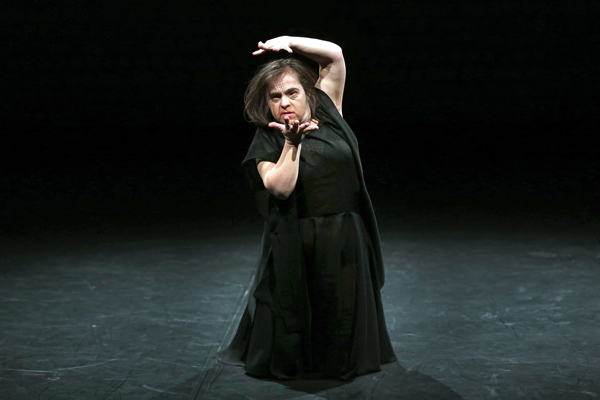
Yvonne Schmidt: A woman in a black robe is sitting on the floor of a dimly lit stage. She has crossed her arms around her knees, huddled, burying her face in her lap. Suddenly, while a drum roll is swelling, she energetically shakes her arms, cranes her neck and starts moving ecstatically. She is surrounded by eight performers sitting on stools in the dark, in an arrangement reminiscent of a dance circle, where the energy circulates simply through the physical presence of the fellow performers. This interpretation of Mary Wigman's Hexentanz (1928) by the performer Natalija Vladisavljević is the starting point of the performance Dis_Sylphide, a critical examination of body ideals both in dance and in society.
The title Dis_Sylphide combines the words ‘disabled’ and ‘sylph(ide)’ (a thin and petite young woman), and can be taken to refer to the normative and normalizing concept of the body in Western dance history. Per.Art's artistic director Saša Asentić (who also performed in the piece) proposed the idea of revisiting Wigman's Hexentanz, Pina Bausch's Kontakthof (1978) and Xavier Le Roy's Self Unfinished (1998) to examine non-normative bodies in dance history, in order ‘to point out that historically, as well as nowadays, disabled people are present through their absence in dance, just as sylphs are – the invisible bodiless beings of air, the mythological figures in literature and iconic ballets (La Sylphide, 1832; Les Sylphides, 1909)’.Footnote 2 Asentić further argues that the ‘absence of disabled people in dance points to the problem of representational structures in dance, and normative mechanisms in arts, culture and society’.Footnote 3 Dis_Sylphide stands in the tradition of choreography and dance as historiographical practices (described by the dance studies scholar Julia Wehren as ‘choreographical historiographies’Footnote 4), in which the moving body is both an archive and a tool for its investigation.
The increasing migration of artists within the disability theatre scene, and its internationalization (in the form of inclusive performing arts festivals, symposiums and other collaborations) have fostered a ‘directional turn’ in the theatre with/by learning disabled artists.Footnote 5 New models of collaborative practice in works by European learning disabled theatre- or dance-makers have provoked current debates on (co-)authorship and agency in learning disability theatre. Like other companies that include artists with learning disabilities, the ensemble members of Per.Art are involved in the creative process as (co-)authors. Vladisavljević is a company member of Per.Art with Down's syndrome. Apart from her work as a performer, Vladisavljević’s creative writing has formed the basis of previous creations by Per.Art, and has been translated into Farsi, Italian and Slovenian and published in English, German and Norwegian.Footnote 6
This attribution of authorship contrasts with the famous production Disabled Theater (2012) by Theater HORA and Jérôme Bel, a milestone in the reception of learning disability theatre which has been studied beyond disability performance scholarship.Footnote 7 Disabled Theater is presented as a re-enactment of Bel's encounter with the HORA ensemble of learning disabled actors during a workshop. Every section of the performance begins with the specific phrase ‘Jérome Bel asked …’, which alludes to Pina Bausch's way of questioning her dancers as the basis of her creation process. In the course of the performance, the HORA ensemble members are asked to present a solo piece based on their favourite music. But Asentić led with a different approach, allowing performers more creative freedom. For example, the dance of Natalija Vladisavljević (with whom he had worked for nineteen years) in Hexentanz was developed after the performer composed her own libretto, in which she described the music as a ‘choreography of screaming’. Asentić explains:
Natalija usually writes stories by taking titles of well-known performances, movies or series, and then she makes her own version. She didn't know about … [Wigman's] Hexentanz, but for me it was interesting to propose … to examine together how we can deal with dance history not in a normative way – using archives, learning from people who have a license to teach a certain technique or choreographic heritage, etc. because these are all institutionalized ways and already not accessible to disabled people/artists, which is part of the problem we are busy exploring in Dis_Sylphide.Footnote 8
One day in rehearsal, Asentić recounts, Vladisavljević was introduced to Wigman's iconic work and they analysed the connecting points between the dance and the libretto. Even though Vladisavljević would decide how the dance would be staged, the ways the body would move and what the music would be, she announced that she would be directing it together with Asentić.Footnote 9 He responded that he would support her and be guided by her. Another part of Dis_Sylphide, the piece Self Unfinished, is completely based on the ensemble member Dalibor Šandor's analysis of the original performance which Asentić then suggested that the ensemble could follow in developing the staging.
Per.Art is part of a migrating and internationalizing theatre and disability network: the No Limits festival in Berlin, the IntegrART symposium in Geneva, the Wildwuchs festival in Basel, as well as gigs in Rimini, Ljubljana, Kotor, Bonn and Skopje, are just a few places where the company has performed. Recently, in September 2018, Hexentanz (as a solo) was performed in the context of Tehran's underground dance scene. Dis_Sylphide is a collaboration with Meine Damen und Herren, an integrated company from Hamburg, Germany; the production premiered in February 2018 and has since been performed with an alternative cast (of Serbian and German performers) at Kampnagel Hamburg, in Novi Sad, and most recently, in October 2018, at Tanzhaus NRW in Düsseldorf, as well as Künstlerhaus Mousonturm Frankfurt (Fig. 1). The international collaboration makes it possible for the company to apply for international funding.Footnote 10 The necessity of mobility and international cooperation leads to the question, how do the logics of international (co-)producing govern the way in which disability art is represented internationally? Who is excluded from being part of a touring theatre or dance company, and how can festivals, conferences and other agents of a growing disability culture create other forms of participation, which are not limited to physical co-presence?
(Colour online) Natalija Vladisavljević in a (re)construction of Mary Wigman's Hexentanz as part of Per.Art's Dis_Sylphide (2018). Photograph by Anja Beutler.

In the context of this growing network around the globe, IFTR's Performance and Disability working group was initiated at the 2011 conference in Osaka and founded in 2012 in Santiago de Chile. The working group has as its goal ‘to have an international dialogue regarding disability and performance and to share scholarly work and best practices from around the world – traditions, conventions and demonstrations of how diverse physical, sensorial, developmental and psychological abilities manifest in all areas of performance’.Footnote 11 Engagement with local artists at IFTR conferences each year is an important mission of the working group, especially because the discourse in our field is still dominated by anglophone scholarship and artistic practices. We do not know much about disability arts in non-anglophone parts of the world, as these are still underrepresented within organizations such as IFTR and within academia in general. In order to extend our network and to learn about disability arts in these underrepresented regions, the shared experience of witnessing the performance as a working group opened up a space for thinking and collaboration across our individual perspectives and is the starting point for a planned book project on ‘how disability performance travels’, edited by the co-convenors. The necessity of mobility in order to fulfil our mission statement as a working group conflicts with the difficulties of accessibility, which prevent many artists from being part of an international (scholarly and artistic) community. In a similar way, the working group faces issues of accessibility when many of our members cannot travel to IFTR conferences, or if conference venues are not accessible to those with disabilities.
In the performance of Dis_Sylphide in Belgrade, this negotiation between the necessity of mobility and the challenge of access appeared as part of the theatrical setting. During the show, the performers invited the audience members to join them as co-performers onstage at several points. Some audience members were excluded from participating by the fact that the stage had no ramp. Nevertheless, one of the working group members, who uses a wheelchair, crawled up the stairs and entered the stage. By shifting the theatrical setting from a sequential to a synchronic space, the issue of who had access to the performance, and who was excluded, became part of the theatrical event.Footnote 12
The rare opportunity to attend a performance together provoked discussion on performance, disability and access as part of the migration theme of the conference: how can we, as the Performance and Disability working group, find alternative ways to collaborate, when many of our members are not able to travel, and conference venues and theatre spaces are not accessible? How does disability performance travel, and what are the costs for disabled artists to be part of our international network? Originally, when we planned to engage with Per.Art during our working-group meeting in Belgrade, we considered travelling together to Novi Sad. But because it is already an ongoing challenge for our working group to meet at conferences every year, often due to university venue inaccessibility, we decided that we could not go to another city. The working group discussions ranged far beyond the conference theme of migration, but such underlying questions about the challenges, possibilities, restrictions and responsibilities of moving together are relevant for each of the following responses to Dis_Sylphide.
Study and fugitivity
Tony McCaffrey: What is going on in Dis_Sylphide? On one level it is the encounter between Per.Art – a company with a commitment to including people with learning disabilities as ‘authors, co-authors and performers’Footnote 13 – and three major twentieth-century works of dance theatre. The company chose three choreographies that deal with the ‘Other and foreign’,Footnote 14 and subjected them to citing, hacking, and reinhabiting by the Per.Art performers. Through rehearsal and performance processes of insertion, intervention and intrusion, the performers seek ways of moving in and through, and away from, the historical and historic originals. In place of, in addition to and in opposition to the virtuosic bodies of Wigman, Bausch and Le Roy, Per.Art's Dis_Sylphide offers a form of ‘study’ undertaken by the Per.Art performers. I am using the term ‘study’ here in the sense that Harney and Moten develop it in The Undercommons: ‘Study is what you do with other people. It's talking and walking around with other people, working, dancing, suffering, some irreducible convergence of all three, held under the name of speculative practice.’Footnote 15 What emerges from this study is resistance, opposition and a creative apposition to an avant-garde exploration of otherness constructed on particular assumptions of virtuosity, on demands made of, and for, only certain, very particular, bodies.
Study as the ‘embodied practice’ of the dance studio enables the performers to inhabit, recite from and reconfigure performances that have achieved the status of avant-garde ‘institutions’.Footnote 16 Per.Art take this a step further by acknowledging and foregrounding this study in the performance itself, during which performers move between very different modes of performance and articulation. They enact versions of the original performances, inhabiting and embodying them by inserting their own distinctive ‘takes’ on these works. Between and around these dance performances they also attempt to articulate verbally, and in an extemporary mode, their own processes and the fits and misfits they have discovered between these avant-garde explorations of otherness, their own life experiences of being othered, and their non-conventional dancers’ bodies.
What is notable in the performance is that they are so easily able to shift modes, to switch between the demands of performing the dances in immediate juxtaposition to talking about the work. This exhibits a level of study, articulation and adaptability that would challenge most performers, however highly trained. It is in this going between the activities of dance performance, and talking about the work, that a different kind and level of virtuosity emerges. This going between is what is crucially and fugitively going on in Dis_Sylphide. This ease of presence in the shift between modes of performance is so much more than what Kirby has characterized as ‘nonmatrixed performance’.Footnote 17 It is a kind of non-performance that takes place in the interim, ‘in the break’, that occurs immediately prior to and after being called upon to be the dancer, or to be the person with learning disabilities talking about inhabiting dance performances designed for other bodies.Footnote 18 This interim state of ‘fugitivity’ – as ‘not only escape’ but also being ‘separate from settling’ – could not, however, have come about without the context of the whole project of study of Dis_Sylphide.Footnote 19
In this regard it is pertinent to make a direct comparison between the approaches that Saša Asentić and Jérôme Bel take to explore the possibilities of an immanently driven, undercommons, or ground-up poiesis when working with people with learning disabilities. In an interview discussing the development of his collaboration with Theater HORA actors on Disabled Theater, Bel specifically refers to a time in the process when he made them listen to his taste in music and watch Pina Bausch and Trisha Brown performances.Footnote 20
As Bel recounts, the only outcome of this was that the performers became ‘really bored’ and it was as a result of this boredom and of not wanting to alienate the performers that he proceeded to let them choose their own music and their own choreography, and to step back in his role as choreographer to the framing of those choices as the basis of the performance. Per.Art's Saša Asentić, on the other hand, deliberately chose to work with and through the kinds of dance performances that Bel chose to reject. When Bel staged Disabled Theater, he included a section in which the performers talked about the project, responding to a question directed at them by the translator/facilitator at the side of the stage: ‘What do you think about the piece?’
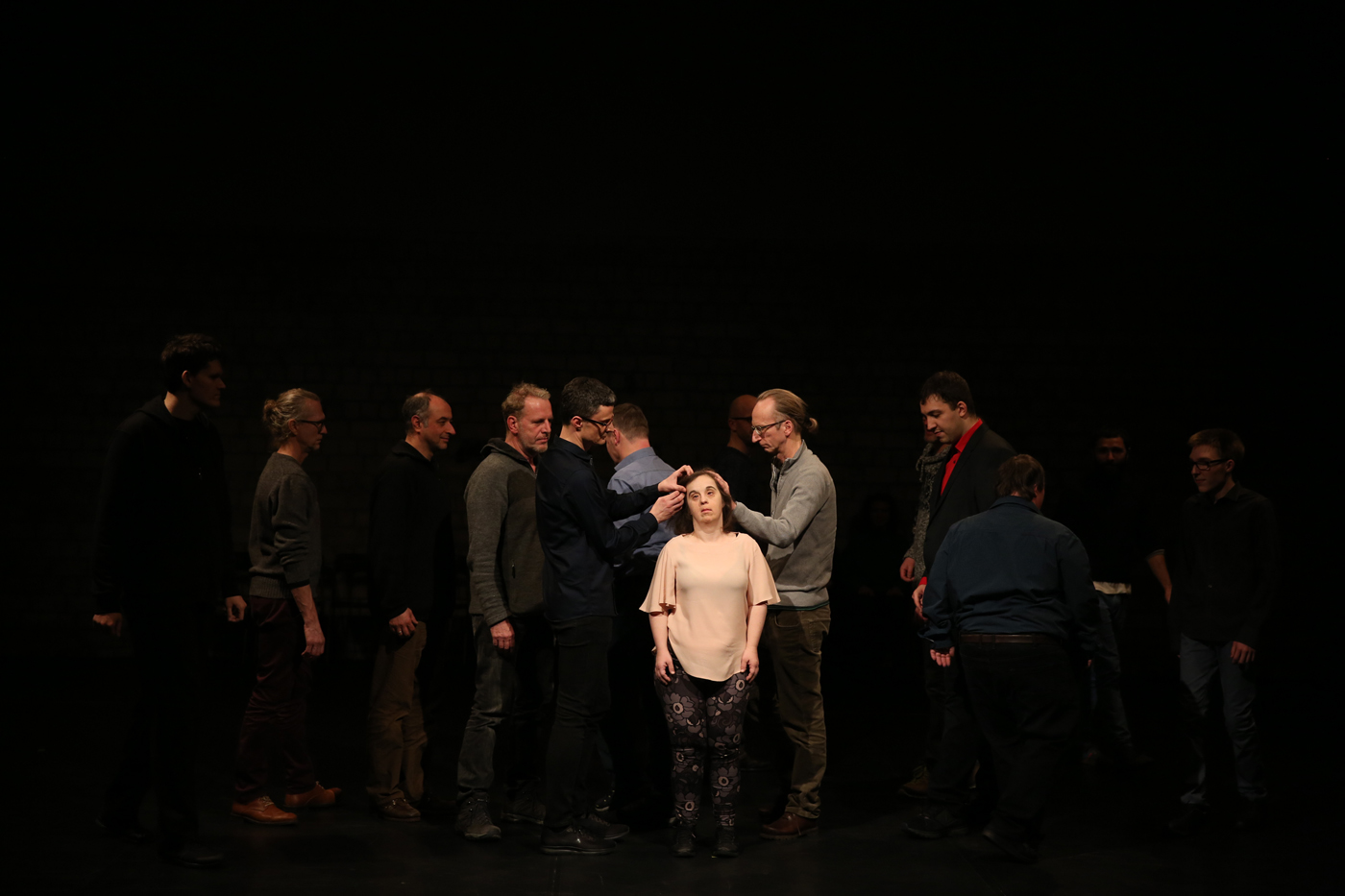
Dis_Sylphide interweaves dance performance and talking about the work to such an extent that they become inseparable. This talk includes an account of the group's sense of its own history, but not merely in a self-congratulatory way: for example, one of the members of the group talks about why she at one point left the group. Natalija Vladisavjlević refers explicitly to her discomfort in a sequence from Kontakthof in which she is literally manhandled by a group of male dancers, some of whom have been invited up from the audience (see Fig. 2). The talk about the work does not shy away from the problems or the affective charge present in theatrical collaborations involving people with learning disabilities. Mutual respect, collaboration and study are a ‘con-viviality’ that includes love and care and taking time with each other.Footnote 21 It is this taking time with each other, over time, that allows Saša Asentić, Natalija Vladisavjlević and the other members of Per.Art to explore and perform virtuosity on their own terms. This is most notable in the switching between modes of performance that reveals the depth of the performers’ study. In this simultaneous location and dislocation, in this radical refusal to settle for borders (such as those between avant-garde dance and dancers with learning disabilities), is the beauty of fugitivity: a non-performance in the interim, and in the break, that is such a distinctive feature of what is going on in Dis_Sylphide.
(Colour online) Natalija Vladisavljević in a sequence from Kontakthof as part of Per.Art's Dis_Sylphide (2018). Photograph by Anja Beutler.

Performing citizenship
Vibeke Gloerstad: In an interview, Asentić responded to questions by dramaturgs Marcel Bugiel and Melanie Zimmermann and Per.Art performer Dalibor Šandor about the company's aesthetic approach to working with colleagues with disabilities. He described their aims as looking for art that ‘invests in the public realm’, connecting ‘artists as citizens’ and ‘creating contents and relations that become new social fact’.Footnote 22 Asentić also emphasized art which ‘can challenge and change the way we are or aren't expected to be, as social subjects, and where we can celebrate the diversity of who we are’; that is, quoting his colleague Vladisavljević, ‘The beautiful feeling to be who you are’.Footnote 23 In response to collaborating performer Šandor, Asentić elaborates, ‘The collaboration level of work between us is precious to me and is really defined by the practice of what some philosophers call an “asymmetrical reciprocity”, a relationship characterized by generosity, gratitude and desire of communion’.Footnote 24
Dis_Sylphide sought to avoid the normative and reductive ideas and practices of a surrounding international context. Asentić states, ‘Theatre is a place where one can rehearse various social relations, as well as temporarily establish them in an ideal of a future society’.Footnote 25 Yet, he continues, theatre operates in a world structured in an ‘ableist way that doesn't provide opportunities, occasions and conditions for such relations to appear, not to mention the impossibility for a subjectivization of disabled persons as artists’.Footnote 26 He describes Dis_Sylphide as an ‘effort’ to open up strict divisions and oppressions, ‘be them social, cultural, artistic or personal – divisions that prevent us from coming together and acting in public’.Footnote 27 As Asentić points out, these divisions or categories ‘are really dangerous for our society today’.Footnote 28 Perhaps most significantly, for Asentić, art institutions frequently cast an individual as an ‘unequal citizen’.Footnote 29 Thus projects with disabled performers are too often categorized as social projects. In this way, he claims, distinctions are made between ‘“real art” projects and “others”’.Footnote 30 For Asentić, then, the group wanted to intervene. And they did, as they performed Wigman's iconoclastic work telling us stories about othering, as they discovered difficult meeting spaces in Bausch's infamous oeuvre and as they explored the possibilities of unfinished selves in Le Roy's seminal solo piece.
Dis_Sylphide illustrates that art exists as a public good, an idea that Asentić adamantly defends. Dis_Sylphide’s performing acts can be seen as performances of citizenship. Recent developments in citizenship studies are concerned with those who, although formally having civil, political and social rights, still do not have them realized in their lives.Footnote 31 The cultural and symbolic practice performed in Dis_Sylphide thus requires a focus on acts where, regardless of status or substance, subjects constitute themselves as citizens or, better still, as those citizens to whom the right to have rights is due, as Isin and Nielsen insist.Footnote 32
Being a subject of these rights involves political struggles to obtain authority. In several scenes, violence from a crowd is directed at the actors with learning disabilities, but we also see them fighting back, creating their own space. According to Isin, being a subject of rights means having both the capacity and the authority to exercise rights and duties.Footnote 33 Aestheticizing this abuse reinstalls paradoxically the authority of the actor and their civil rights, such as freedom from cruel, inhuman or degrading treatment; from exploitation and violence; and from abuse.Footnote 34 It also connects with the social movement of realizing global citizenship for people with disabilities. Through a human rights perspective, both attitudinal and physical barriers are addressed.Footnote 35
Isin contends that a performative perspective on citizenship reveals the creative and transformative possibilities of citizenship itself.Footnote 36 In Acts of Citizenship, Isin and Nilsen state, ‘Ways of being or becoming citizens have proliferated in our time; ecological-citizen, aboriginal-citizen, consumer-citizen, intimate-citizen’.Footnote 37 We could add artistic-citizen. These developments indicate a sort of vitality that is significant. If performers invest themselves in claiming rights, as Dis_Sylphide indirectly does by dissolving processes of othering, they are producing not only new ways of being subjects with rights but also new ways of becoming subjects with responsibilities. Since claiming rights certainly involves ‘“responsibilizing” selves’, it then also means entering the social scene, making space for difference and diversity.Footnote 38
Dis_Sylphide thus shifts the focus from the citizen as individual agent to a relational concept of personhood. When actors discuss the way forward, politically and aesthetically anticipating a rejoinder from the audience, or when the creative process is present during the performance, or even when the audience onstage takes part in a collective birth of the possible, the focus becomes acts of citizenship as collective or individual deeds that rupture social historical patterns.
A performative perspective considers citizenship as anything but stable. Who may or may not act as a subject of rights is determined by ongoing political and social struggles over not only the content of rights, but also who are or are not entitled to them. People actually identify with or are ascribed to various social groups and constantly traverse subject positions from citizens to non-citizens. Moving across these positions or breaking down the boundaries between them involves struggles over rights.Footnote 39 This struggle may be a violent meeting, as in autocratic regimes that, defining people as either super-citizens or non-citizens (although having the same formal citizenship status), force people to be internal migrants or force them into exile, leading to further violence and sometimes resilience.Footnote 40 Or it may develop into a creative meeting, carving out ‘third-cultural spaces of belonging’ – hybridized spaces – opening up for a multitude of ways to belong.Footnote 41 In Dis_Sylphide, the actors strongly contest the boundaries of able and disabled and create new ideas of an inclusive community. This performance is a public gift and an artistic argument.
Through Bausch's ‘courtyard of contact’ (as Kontakthof translates into EnglishFootnote 42) and Le Roy's figure of the unfinished self, Dis_Sylphide can be seen to contribute to the ‘enrichment of society’, as described in Article 30 of the Convention on the Rights of Persons with Disabilities (CRPD): ‘States Parties shall take appropriate measures to enable persons with disabilities to have the opportunity to develop and utilize their creative, artistic and intellectual potential, not only for their own benefit, but also for the enrichment of society’.Footnote 43 In this performance, there is a difference between claiming rights and claiming to be a subject of rights. There is a performative contradiction in the performance's reference to and break from conventions of citizenship. Actors and audiences constitute themselves as citizens.Footnote 44 What emerges is interdependent human beings, social networks and relational ideas of justice.Footnote 45 Dis_Sylphide is a vivid example of what Matt Hargrave might call ‘theatre [that] creates a space in which human proximities can be negotiated and redefined’.Footnote 46 Indeed, Dis_Sylphide, as Asentić comments of Per.Art's work, forges ‘new social facts’.Footnote 47
Bausch stages a space for exploring human approaches (the courtyard) in different ways. And Le Roy explores the possibilities of the body and self – the unfinished selves. Dis_Sylphide re-stages these figures with actors with disabilities, but also in the rewriting. In this way the performance creates hybrid spaces. In an ethical way,Footnote 48 Dis_Sylphide disturbs the binaries of abled and disabled, and turns the discursive conditions of dominance into the grounds of intervention.Footnote 49 We see unruly, unmanageable identities, new identities, social acts and language work against dominant discourses.Footnote 50 Dis_Sylphide stages new subject positions between the notion of abled and disabled – this is the enrichment of society.
Participating in its ‘thought’
Margaret Ames: Sometimes performances strike us as being of particular import, and we are grateful to have been there, to have witnessed the event. Alain Badiou asserts that we go to the theatre ‘to be struck. Struck by theatre ideas’.Footnote 51 The notion of theatre ideas that strike us will underpin my response to Dis_Sylphide alongside a critique of inclusion via Roberto Esposito's thinking on community. Per.Art is a collective. During discussions that were part of the performance, which I examine later on, Asentić described how the group spend work and social time with each other. Dis_Sylphide was an ensemble event. Understanding that Per.Art members are artists from the same extended community has provoked me to wonder about how community might function within the work and to consider Badiou's concept of a thinking theatre in the context of learning disability. Karoline Gritzner and Laura Cull ask, ‘what does it mean to participate in (the thought of) performance; and how might performance, and our participation in/with it, impact upon how we define “thought”?’Footnote 52 Extending Per.Art's enquiry into who gets to dance, I wonder, who gets to participate in thinking through theatre?
In the context of disability studies, Per.Art's approach reveals how cultural production reiterates definitions of normality and excludes its opposite, via appearances of the body in both the social and the aesthetic spheres. Their company statement on the Disability Arts International website states, ‘As a group of artists with and without disabilities, we wanted to reactualize these questions and thus intervene in contemporary dance scene today, offering a possibility to artists with disabilities to appear as subjects and actors of contemporary dance.’Footnote 53 The group positions itself as an organization for art and inclusion. Who might be included encompasses philosophers, architects, artists and, crucially, people with learning disabilities who are active as authors and performers in various art forms. The title of Dis_Sylphide includes the prefix ‘dis’, which both alludes to disability and implies a reversal or negation of the classical ballets La Sylphide and Les Sylphides. Spurred on by these inversions and oppositions, I continue my response to the performance via Esposito's provocative analysis of community as the opposite of the fullness often described as central to the experience of belonging.
Esposito argues that community is impossible and yet essential. Community can only be found in obligation. Rather than being an objective thing that one builds, or belongs to, we exist within a vacuum.Footnote 54 Community in Esposito's terms comes about only through obligation, one to the other, in demonstrable duty. I argue here that Dis_Sylphide performed a series of obligations between individuals, through their collective enquiry into dance, that then produced the ensemble. This is a form of inclusion that does not participate in hierarchical inclusive practice that is formed through normative social constructions.
Watching Per.Art, I wondered, how do people with learning disabilities enable participation in the thought of performance? Natalija Vladisavljević performed her work allowing Wigman's original 1914 choreography to be layered over her own impulse to create a contemporary witch dance. Vladisavljević took her place within the roll call of dancers who have re-created Wigman's expressionist dance. An evocation of rage, fearlessness and strength, she presented her witch body as a learning disabled body, and her learning disabled body as a witch body. Thoughts and assumptions about conditions of normality were provoked and usurped as she appeared to invoke Wigman. At the conclusion she removed her clothes to stand before us in underwear, exposed as a ‘normal’ woman, not a supernatural witch, displacing the trope of the disabled body that represents evil or villainy. She was supported by the collective live accompaniment that honoured her appearance/performance of powerful frailty, held by the semicircle of performers beating rhythm on benches, and vocalizing a score of dis-harmony.
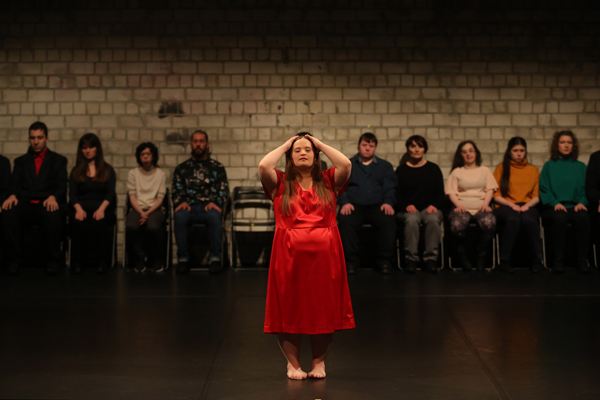
Thinking about who gets to dance was developed in the second section, a performance of quotes from Bausch's Kontakthof. Bausch created this work for three different groups of bodies: professional dance bodies, ageing bodies and teenage bodies (see Fig. 3). Is it a logical extension, then, to make a re-creation for bodies of no particular technical skill and bodies marked with disability? Performatively quoting Kontakthof provoked thought about difference, disability, vulnerability, agency; and again, the question Per.Art asked themselves was, who gets to dance? Who gets to appear in front of an audience?Footnote 55 What values pertain to these dances and these appearances? This contemporary age of the individual took a different turn here as each person performed the opening section to Kontakthof: individuals stepped out of the group, to the front of the stage, extending their faces, teeth, bottoms and chests to us. Contradictory demands for us to look, despite the humiliation of being assessed, were performed with the slightly confrontational attitude found within Bausch's original work. Quoting from Kontakhof drew attention to the schism of learning disability within social norms as we watched these performers dance the violent gestures of display and intimate exposure. Difference was both emphasized and erased as each body addressed our gaze, different and yet one of us, an enactment of Esposito's argument that the ‘we’ of community ‘refers to a constitutive otherness’.Footnote 56
(Colour online) Jelena Stefanovska's examination of Pina Bausch's Kontakthof as part of Per.Art's Dis_Sylphide (2018). Photograph by Anja Beutler.

Bojana Cvejić argues that dance is a means by which we think about the formal apparatus of theatre and representation – a means to enact a philosophy of appearance and representation of the subject.Footnote 57 In Dis_Sylphide this seems to be a primary concern as their process of creating the work was also revealed and re-performed – a process both represented and re-presented between each of the sections as they moved out of dance and gathered together for discussion between each short performance. In a casual, somewhat awkward, manner the ensemble discussed the work, their attitudes and ideas leading to the next section. The elevated stage where they performed framed a working process as a performance, a part of the formal apparatus of theatre. They represented and performed their thinking, which was thought in the performing of the work itself, asking us to redefine theatre as thinking. There was no consensus. Each spoke about divergent ideas that produced collective action.
The final work was an adaptation of Le Roy's Self Unfinished, a slow metamorphosis of the human body through upended shapes, carefully positioned with handovers between performers as they took turns to morph their images into bodies without heads or upside-down unidentifiable creatures that dismissed normative appearance, function and disability. Discussing contemporary dance practices such as Le Roy's, Cvejić argues that problems arise from creativity and that these guide choreographers. For her, creative problems are the thoughts that must be expressed to an audience.Footnote 58 Here, movement is thought. She calls this ‘dance as a movement of thought’.Footnote 59 Reworking and quoting canonical dance works by people without the technical skills of trained dancers, and staging their discussions about these tasks, makes concrete Cjević’s argument for a dance philosophy.
Cjević’s argument is of particular importance in the context of dance-theatre work made by learning disabled people. Such a dance philosophy opens the door towards thinking together, a notion that gestures towards Esposito's emphasis on the importance of ‘openness to the other-than-self’.Footnote 60 It suggests a means of attending to the obligatory demand of one to another, without recourse to the state's problem of inclusion. Badiou argues, ‘Theatre, for its part, always says something about the State, and finally about the state (of the situation)’, and ‘Theatre treats not politics but the consciousness raised in the state of politics’.Footnote 61 The situation that Per.Art determined to consider involved questioning who gets to dance and perform in theatre. I propose that in the context of the UK the state's concept of inclusion is founded on the presumption and reification of exclusion, as it presupposes a normative standard that determines who gets to dance, and also in what kind of work. If theatre is tied to the state, then Dis_Sylphide thinks about the state of dance, theatre and disability.Footnote 62
I think about this evening with Per.Art as indicative of a radical departure from a thinking that posits theatre by people with learning disabilities as merely useful or beneficial. Instead, theatre by people with learning disabilities is about thinking together.
Learning disability and the avant-garde
Dave Calvert: In a discussion about the status and future of learning disabled theatre at the Crossing the Line Festival, held in Roubaix in January 2017, it was suggested that the field constitutes the last avant-garde. The idea held appeal as a way of claiming a place within the theatre landscape that would confer a sense of expectation, prestige and familiarity. Such a label could attract both audiences and funders. The proposal also raises certain questions, however. What concept of the avant-garde is being invoked? Are there enough shared characteristics across this field to form a coherent avant-garde movement? Would a ‘last’ avant-garde face forwards or backwards? And how does the field relate to the existing avant-garde(s)?
As a phrase, ‘the last avant-garde’ implies the sequential development of the avant-garde over time as a progression of discrete movements with specific characteristics. Learning disabled theatre would therefore form one such internally consistent movement, identified by shared aesthetic and political ideas. The three companies that came together in Crossing the Line – L'oiseau mouche (France), Mind the Gap (UK) and Moomsteatern (Sweden) – all engage and promote professional learning disabled performers through high-quality productions. Beyond that similarity, no explicit consistency, either aesthetically or politically, brings the work under a coordinated avant-garde manifesto. Indeed, as a showcase of learning disabled performance, it was the heterogeneity of approaches that was most notable.
Per.Art's Dis_Sylphide, in quoting, reprising and adapting seminal and acclaimed work from avant-garde German dance, allows for further reflection on the relationship between learning disabled performance and the avant-garde. Rather than positioning itself as a ‘last avant-garde’, Dis_Sylphide connects with the historical lineage of the avant-garde more than with the field of inclusive performance. As such, it perhaps presents the latest, rather than last, instalment in a broader ongoing development of interrelated avant-garde performances.
Richard Schechner also considers the avant-garde to be a wider field, with its own lineage and overarching characteristics, but one which
lasted for a period of around one hundred years, roughly from Henrik Ibsen's Et Dukkehjem (A Doll [sic] House) in 1879 to the Wooster Group's LSD, 1983–85 … Avant-garde artists prided themselves on originality, innovation, and the rejection, if not outright destruction, of the past.Footnote 63
As Schechner points out, formal innovation and wilful destruction belonged to a specific historical period and are no longer available. Instead, the established aesthetic and political practices of the historical avant-garde have been assimilated into what Schechner calls the ‘niche-garde’,Footnote 64 a familiar territory within, rather than without, the wider cultural ecology. As such, the avant-garde ‘exists in three realms simultaneously – as a living tradition, as a brand, and as the echo or ghost of the provocation it once was’.Footnote 65 One marker that the contemporary avant-garde is retrospective rather than advancing, Schechner suggests, is its tendency to reprise historical works from the back catalogues of artists such as Allan Kaprow, Marina Abramović and Philip Glass.Footnote 66 The last avant-garde, marching behind the earlier avant-garde(s), must similarly be focused on what precedes it as much as what follows after.
To what extent, then, are Per.Art's reprisals of twentieth-century modern and contemporary dance characteristic of the niche-garde as a valuable but nevertheless static circulation of historical ideas? The performance is often meticulous in its re-creation of the original performances. The choreography of the Kontakthof and Self Unfinished excerpts is intricately reproduced. The pieces are not entirely slavish reproductions of historical artefacts, however, and a degree of adaptation is employed, for both practical and aesthetic reasons. Self Unfinished is developed from Le Roy's original solo into an ensemble tag performance where an individual dancer begins an extract from the original before handing it on to another performer, who picks up and continues the dance before passing it on again, until all members of the ensemble have been involved. Kontakthof, by contrast, requires more performers than are available, and so spectators are encouraged to participate.
These adaptations draw attention to, perhaps, the most central provocation raised by the performance: what happens when different bodies inhabit familiar choreography? For Saša Asentić, the performance explores ‘the difference between the dance world and the realm of creativity of disabled, and other marginal subjects’.Footnote 67 As presented by Per.Art, then, the reproduction of these seminal dances involves an embodied critique in which appropriation by the learning disabled body in particular moves beyond simple reprisal of the earlier works.
Natalija Vladisavljević’s Hexentanz – a viscerally energetic response to Mary Wigman's Hexentanz – harnesses the primitivism which, Christopher Innes proposes, is fundamental to the avant-garde as ‘an antidote to a civilization that almost exclusively emphasizes the intellectual and the rational’.Footnote 68 Wigman's original adoption of primitivism references other cultures, and cultural Others, to embrace the witch as a gendered archetype that is avant-garde in its forceful rejection of patriarchal European intellectualism. Within Western culture of the interwar period, however, learning disability was already framed as the inferior primitive insider, a threatening counterpoint to non-disabled rationality. Vladisavljević is not, therefore, embracing the (alleged) primitivism of the Other, but powerfully reclaiming and instrumentalizing the historical primitivism imposed on her by both society and the avant-garde.
Along with Kontakthof and Self Unfinished, Hexentanz therefore both embraces and critiques the aesthetics of the historical avant-garde, lending Dis_Sylphide more novelty and potency than the niche-garde, even though the effect is to offer a corrective to, rather than a rejection of, the past. If the aesthetics are historical rather than innovative, however, is it learning disability itself which provides the formal element that confers originality, power and an impression of a ‘last’ avant-garde? If so, a further, urgent question is raised: given the inevitable, even desirable, absence of a coherent manifesto, how does the field of inclusive performance avoid the fate of the historical avant-garde, constantly circulating through contemporary culture by perpetuating and trading on the novelty of learning disability without being in advance of anything profoundly new?
Conclusion
Kate Maguire-Rosier: Dis_Sylphide powerfully created a ‘dance piece on disability and dance history in Germany’, as a promotional video of the work introduces it.Footnote 69 Like other members of the working group, I was not present at this live performance so I rely on a mosaic of video documentation, artists’ voices and my colleagues’ writings. Our assorted response echoes my fragmented relationship with this performance, experienced, partially, as a montage of its afterlife. Our conversing voices acknowledge and extend Per.Art's re-presentation of dance theatre histories. The small IFTR audience moved to see the performance together. Then, our discussions moved together before coming to rest as distinct yet co-present voices in this response. Our continued co-presence with the work, though partial, represents movement in time and space.
McCaffrey's view of the performance as a study of the visceral explorations of otherness in non-conventional bodies, and life experience, produces the insight that this performance laid forth interim states of ‘fugitivity’; that is, states distinct from settling. Such in-between, ruptured states reflect not just on the presentation of work being performed but on the talking about this presentation during the performance itself, thereby fashioning a con-vivality of a performance inseparable from its metacommentary. Gloerstad agrees with McCaffrey's recognition of Dis_Sylphide’s powerful sense of community, accounting for the critical implications of this interdependent state through a discussion of acts of citizenship. She evaluates the performance against Asentić’s artistic intention, ultimately finding that the work is a public good and identifying a new form of performance; that of the ‘artistic citizen’. For Ames, Dis_Sylphide becomes a thinking-together in the same vein as Esposito's ‘openess to the other-than-self’. In her account, the work enables participation in the ‘thought of performance’, hence becoming a dance philosophy akin to Cergic's ‘dance as a movement of thought’. Finally, Calvert steps back to re-view the work in the context of the ‘last avant-garde’ that purportedly defines contemporary theatres of learning disability. If the performance exemplifies Schechner's ‘niche-garde’, or constitutes simply one of the ‘latest’ avant-garde performances of 2018, how can learning disabled performance resist the fate of the historical avant-garde; that is to say, how can it resist trading on the novelty of cognitive, intellectual or learning disability? Rebecca Schneider has similarly wondered, ‘Under what rubric is an art history of a theatre piece meant to reside comfortably?’Footnote 70
In effect, Per.Art's piece constitutes a performed migration of a disjointed dance history refracted through different body-minds. In doing so, it reveals certain tensions. Ames, McCaffrey and Gloerstad all understand Per.Art performers to be part of a group, where bodies in movement and speech are inextricably bound to one another through their relationships with one another. And yet these performers with visible disability become foreigners to the stage, traditionally a space for bodies that appear to fit neurotypical, normative embodiment. They even become foreigners to their work, as McCaffrey's exploration points towards. The resulting border states are at times porous, at other times impenetrable. And so McCaffrey's argument urges us to consider access.
From an avant-garde examination of otherness to an embodied critique of an historical avant-garde, reflections on Per.Art's production of Dis_Sylphide sparked ongoing debate amongst members of the IFTR's Performance and Disability working group in Belgrade during July 2018. To put it more precisely, Dis_Sylphide sparked debate mainly amongst those select members who attended the special presentation to IFTR delegates on the Sunday evening, the day before the conference began. This joint response to the performance documents the thoughts of even fewer members.
It is valuable to reflect on the absence of those of us who could not attend the performance. And it is valuable to reflect on the absence of responses from those who were unable to contribute to this particular essay, especially from those who attended the performance. These observations are valuable because they point towards a number of different aspects specific to research at the intersection of disability and theatre.
First, that I was not present at the live performance is significant, not merely because it potentially undermines the credibility of this response. This may, of course, be an assumption; after all, many theatre researchers comment on work which they have not seen live. Nonetheless, it points to the challenge – an imperative, perhaps – for international theatre scholars to be present at live presentations, and, in turn, their dependence on this challenge. This challenge is particular to researching live theatrical productions. For example, music performance finds recorded distribution an acceptable site of analysis. What does it mean, though, to respond to theatrical work not seen live? How might scholars respond to work otherwise?
Second, this author's absence unearths the challenge for theatre scholars with disability specifically to be present at live performances. This challenge may not necessarily be due to limits imposed by impairment, or to the inaccessibility of venues, transport and performance productions, but just to financial restrictions. Theatre shows are expensive, and managing the logistics required to get to a show might be too difficult for some, especially if it means travelling long distances. This latter challenge, whatever its nature, is thus usually entangled with access, whether it be physical, infrastructural, attitudinal, financial, communicative, social or any other type. Arguably, this challenge extends to all theatre researchers, even all theatre-goers. Going to, attending and participating in theatrical events typically involves worldly resources and bodily effort.
This leads to, third, the value of reflecting on those who could not attend Per.Art's piece, or, more broadly, those who cannot attend performances. Within our group in Belgrade, we had more members without disability than with. This is important; it points to the broader issue of access necessary to navigating the travel, locations and institutions involved in attending an international academic conference. Such a conference can act as an extremely beneficial support system to isolated scholars the world over. Indeed, we knew of a colleague who was unable to participate at the conference due to the travel required. Moving back to Per.Art's piece, this disproportionate representation of scholars with disability in our group meant that there were more members without disability from the IFTR Performance and Disability working group who were present at Dis_Sylphide.
In turn, and this segues into a fourth and final point, most, if not all, responses in this collective response to Dis_Sylphide were produced by members without disability. Certainly, this binaristic thinking is contentious. However, in a sociopolitical climate wherein disability continues to function as the marginalized of the marginalized, forgotten, overlooked and omitted from cultural discussions, and where the global disability community protests with the dictum ‘Nothing about us without us!’, this prospective ‘speaking for’ not only absent scholars with disability but also Per.Art's performers is surely not a dismissive concern.Footnote 71
For now, let us return to the centrepiece of our discussion – the artwork. At the time of writing, Per.Art are touring in Iran; this was unexpected, intriguing news. The company's international mobility is a testament to the work this group of artists continues to do and to the prospective influence they, alongside other learning disabled theatre companies, have on the institution of theatre and beyond. Our working group was immensely grateful to have the company travel from Novi Sad overnight to Belgrade for a one-off performance. We understand it was not a simple task. The group refused payment, and so for spectators the performance was free, intensifying Gloerstad's consideration of it as, indeed, a ‘public gift’.
As Dis_Sylphide continues to migrate from one city to another, one country to another, one twentieth-century dance to another, its historic references to absent dancerly bodies ricochet as material, present and enminded resurrections. Its difficulties and possibilities reside in the collective, iterative and productive incapacity that the performance, inflected by disability, sets forth. The value of this piece of writing, then, is in distilling the ‘otherhow’ knowledge, as Rachel Blau Duplessis might describe it,Footnote 72 which is vitally performed in the movement of bodies throughout this piece of theatre.