Introduction
Evidence suggests that childbirth is an event that could be psychologically traumatic, leading to the development of post-traumatic stress disorder (PTSD) and subsyndromal PTSD (Wijma et al. Reference Wijma, Soderquist and Wijma1997; Olde et al. Reference Olde, van der Hart, Kleber, van Son, Wijnen and Pop2005). A traumatic birth can interfere with a mother's attachment to her infant and her overall adjustment (Ballard et al. Reference Ballard, Stanley and Brockington1995; Allen, Reference Allen1998; Soet et al. Reference Soet, Brack and Dilorio2003; Beck, Reference Beck2004a), negatively affect the relationship with her partner (Fones, Reference Fones1996; Allen, Reference Allen1998; Beck, Reference Beck2004a) and overshadow decisions about having additional children (Fones, Reference Fones1996; Saisto et al. Reference Saisto, Salmela-Aro, Nurmi, Kononen and Halmesmaki2001; Bailham & Joseph, Reference Bailham and Joseph2003; Ryding et al. Reference Ryding, Persson, Onell and Kvist2003; Beck, Reference Beck2004b). Aside from the impact on the mother and her family, traumatic birth could impact negatively on the healthcare system by increasing use of medical services (Switzer et al. Reference Switzer, Dew, Thompson, Goycoolea, Derricott and Mullins1999) by both the parents and the offspring.
Studies have suggested a prevalence rate of PTSD following birth from 1% to 6% (Creedy et al. Reference Creedy, Shochet and Horsfall2000; Ayers & Pickering, Reference Ayers and Pickering2001). However, aside from the debate regarding the broadening of the conceptual boundaries of what qualifies as a traumatic event (Baldwin et al. Reference Baldwin, Williams and Houts2004), drawing firm conclusions about the prevalence of PTSD resulting from childbirth is difficult due to a number of methodological shortcomings (Johnston-Robledo & Barnack, Reference Johnston-Robledo and Barnack2004). For example, there have only been two prospective, longitudinal studies of PTSD resulting from childbirth. In the seminal study by Ayers & Pickering (Reference Ayers and Pickering2001), there was a relatively small sample (n<300) and no assessment for pre-existing PTSD using diagnostic criteria before the birthing event. In the second study, Söderquist et al. (Reference Söderquist, Wijma and Wijma2006) assessed a large number of prospective mothers with a longitudinal design and also assessed fear of birth during pregnancy. This study was a subset of Wijma et al. (Reference Wijma, Soderquist and Wijma1997) and found a 3% trauma rate (assessing symptomatic criteria B, C and D) at some point up to 11 months postpartum. The authors suggested that the low rate may be due to birth on the whole being considered a positive experience, yet noted that negative birthing events can lead to PTSD. Major drawbacks of this study, however, included the utilization of a non-validated measure of PTSD, not using DSM-IV criteria to assess for ‘trauma’ (criterion A could be met if the mothers found the birthing experience as merely ‘trying’), no assessment of pre-existent PTSD and the assessment of functional impairment at an individual symptom level rather than a diagnostic level.
The present study is the first large, prospective, longitudinal study assessing the full diagnostic criteria for PTSD following childbirth while also controlling for pre-existing PTSD and affective symptomatology. The potential confound of having a diagnosis of PTSD from any event prior to birth has not been examined systematically nor has the possible contribution of other antenatal factors and mood disorders on the subsequent development of birth-related PTSD (Bailham & Joseph, Reference Bailham and Joseph2003). This prevents a determination of whether the observed PTSD symptoms developed from a childbirth event or are an expression of pre-existing disequilibria (Ayers & Pickering, Reference Ayers and Pickering2001).
Further, without assessing the traumatic nature of the birth event, it is also unknown whether postpartum PTSD symptoms are truly reflective of PTSD or reflective of ‘trauma-like symptoms’. This is particularly relevant given that PTSD, anxiety and depression share symptomatic expressions of general distress (Engelhard et al. Reference Engelhard, van den Hout and Kindt2003). With debate on whether birthing events can even lead to the development of PTSD, the purpose of this article is to report accurate prevalence rates for PTSD caused by birthing events, rather than present a model explaining these rates.
It is notable that few studies have used established measures of PTSD (Ayers & Pickering, Reference Ayers and Pickering2001), an omission when investigating a disorder (Foa & Meadows, Reference Foa and Meadows1997). Furthermore, while there are a number of single case studies reported in the literature (e.g. Ballard et al. Reference Ballard, Stanley and Brockington1995; Fones, Reference Fones1996) and several studies with a small sample size (i.e. <200, e.g. Allen, Reference Allen1998; Keogh et al. Reference Keogh, Ayers and Francis2002; Soet et al. Reference Soet, Brack and Dilorio2003), the relatively low life-time prevalence rate of PTSD would indicate that a large intake sample is necessary.
Finally, there is a need to consider the prevalence of diagnosable PTSD as distinct from the prevalence of women who have subclinical symptoms (i.e. partial PTSD). There is also evidence that the prevalence of partial PTSD is much higher than PTSD and that subsyndromal PTSD is associated with significant disability (Ballenger et al. Reference Ballenger, Davidson, Lecrubier, Nutt, Foa, Kessler, McFarlane and Shalev2000), functional impairment (Stein et al. Reference Stein, Walker, Hazen and Forde1997) and adjustment postpartum (Soet et al. Reference Soet, Brack and Dilorio2003). The present study builds upon previous influential research by investigating the development of PTSD and subclinical symptoms in a large cohort of women recruited in their third trimester of pregnancy. In order to track the development of PTSD and related symptoms, women were followed up at three time points: 4–6 weeks; 12 weeks; 24 weeks postpartum.
Method
Sample and procedure
The protocols used in this study were approved by all relevant university and hospital ethics committees. A sample of women was recruited from two antenatal clinics in Brisbane, Australia, and from two adjoining regional antenatal clinics. Researchers approached consecutive attendees who were waiting for their scheduled antenatal appointments. Women were eligible to participate if they were at least 18 years of age, in their third trimester of pregnancy (from 28 weeks gestation), able to read and write in English and contactable by phone.
Of the 1067 women approached, 933 agreed to participate during the last trimester of pregnancy (87% response rate). A total of 93% (866/933) of these women completed at 4–6 weeks postpartum, 89% (826/933) completed at 12 weeks postpartum and 83% (776/933) completed at 24 weeks postpartum. The 134 non-responders (those who declined to take part in the research) did, nonetheless, answer a short questionnaire relating to their age, marital status, length of relationship, number of children, educational level and ethnic status. There were no significant differences (p<0.01) between responders and non-responders on these variables except for ethnic status. Asian women were less likely to agree to the research compared with Caucasian/Northern European women [χ2(10)=41.68, p<0.001]. The attrition rate between first and last assessment was significant in that those who dropped out were more likely to belong to a lower socio-economic status (SES) and display more pathology at intake.
The following demographics are given to gauge the representativeness of our sample, with Australian national data (AD) following each statistic. As can be seen, and would be expected with such a large group, our sample is quite consistent with Australian data. The mean age of participants was 29 years (mean=28.56, s.d.=5.64; AD mean=29.8; Laws & Hilder, Reference Laws and Hilder2008), most women were married (53.9%) or cohabitating (30.1%; AD=82.1% combined; Social Policy Research Centre, 2006), some were single (13.5%) and a small percentage were separated (1.9%) or divorced (0.5%; AD=14.6% combined; Social Policy Research Centre, 2006). The average relationship length was 6 years. Approximately 86% were Caucasian (AD=89.1%; Social Policy Research Centre, 2006), with remaining participants reflecting a diverse ethnic background. Modal educational level was just less than high school completion (grades 10 or 11; 24.7%), followed by high school completion (22.8%), completion of a technical and further education certificate (20.4%), participation in tertiary studies (1–4 years; 18.4%), completion of a tertiary higher degree (7.6%) and less than grade 10 high school completion (6.2%). Most women had a gross annual household income between AUS$36000 and $50000 (23%; AD=median household income for 2005; Australian Bureau of Statistics, 2007) and AUS$51000–80000 (23.2%). The majority of women nominated homemaker for their employment status (48.7%), followed by full (21.8%) and part-time (9.7%) employment, unemployment (9.6%), casual work (9.1%), disability pension (0.8%) and regular shift work (0.4%). More women than not indicated that they already had children [577 women (61.8%), AD=58.4%; Laws & Hilder, Reference Laws and Hilder2008].
Assessment of PTSD and partial PTSD
The Posttraumatic Diagnostic Scale (PDS self-report; Foa et al. Reference Foa, Cashman, Jaycox and Perry1997) was selected to assess prior exposure to traumatic events, PTSD symptom severity and PTSD diagnoses. In pregnancy, participants were also asked to specify the event ‘that bothers them the most’ when the focus was on current PTSD (Stein et al. Reference Stein, Walker, Hazen and Forde1997).
For postpartum PTSD (related only to the birth), women who met criteria A1 and A2 could meet PTSD or partial PTSD criteria. To examine whether or not criteria A1 (a traumatic event) and A2 (fear response during trauma) was met during birth, we followed exact DSM-IV-TR criteria (American Psychiatric Association, 2000). Participants rated stressors on a 10-point scale ranging from 1 (not at all) to 10 (very much), with ⩾2 representing a ‘yes’ answer. The assessment of criteria A1 and A2 are central to this article and are, therefore, discussed extensively.
The exact questions asked to assess criterion A1 were: (1) ‘Did you feel that your life or your baby's life was threatened during or after the birth?’ (2) ‘Did you think that you or your baby might die?’ (3) ‘Did you experience an actual injury or threat of serious injury around the time of the birth?’ (4) ‘Did your baby experience an actual injury or threat of serious injury around the time of birth?’ (5) ‘Did you feel worried about your own safety during the labour and childbirth?’ (6) ‘Did you feel worried about your baby's safety during the labour and childbirth?’ (7) ‘Were you frightened that your baby was not normal?’ Items 1–4 permitted an assessment of ‘actual or threatened death or serious injury’ (APA, 2000, p. 467). Items 5–7 permitted an assessment of ‘a threat to the physical integrity of self or others’ (APA, 2000, p. 467). No woman who received a diagnosis of PTSD only endorsed item 7 and the diagnosis of PTSD in only four women relied on one or more of items 5, 6 or 7. If a participant's baby died during the birth, then criterion A1 was met (n=3, 0.3%). Further, women who did not experience the commencement of labour were instructed to answer the questions that had a reference to labour and childbirth in relation to the birth event itself.
Criterion A2 was assessed through the following item: ‘During or immediately after childbirth, did you feel intense fear, helplessness, terror or horror?’ As with A1, the item was rated on a 10-point scale (1=not at all to 10=very much), with ⩾2 representing an affirmative answer. The PDS also assesses impairment in important areas of functioning. Criterion F for PTSD was fulfilled if participants answered ‘yes’ on at least one item, thereby indicating impairment in important areas of functioning.
Partial PTSD was diagnosed if the DSM-IV-TR criteria for PTSD were met except that an individual ‘lacked one or two of the necessary three criterion C (avoidance) symptoms and/or they lacked one of the necessary two criterion D (hyperarousal) symptoms’ (Stein et al. Reference Stein, Walker, Hazen and Forde1997, p. 1116). Based on this definition, three partial PTSD groups were formed: group 1 met all PTSD criteria except for one or two of the necessary three criterion C symptoms; group 2 met all PTSD criteria except for one of the necessary two criterion D symptoms; group 3 met all PTSD criteria except for one or two of the necessary three criterion C symptoms and one of the necessary two criterion D symptoms. Partial PTSD-like symptom groups met the same criteria as partial PTSD except the criteria for a traumatic birth event were not met (i.e. a non-criterion A event).
The concurrent validity of the PDS was examined against the Clinician Administered PTSD Scale (CAPS), a scale commonly seen as the gold standard for a diagnosis of PTSD (Griffin et al. Reference Griffin, Uhlmansiek, Resick and Mechanic2004). A random selection of women (n=95) who completed the study at 24 weeks postpartum also agreed to complete the CAPS. Overall, the PDS and CAPS correlated highly at r=0.81 and cross-tabulations indicated good agreement between the CAPS and the PDS on all criteria (A=77.89%; B=88.42%; C=87.36%; D=78.95%; E=100%; F=63.16%).
Assessment of anxiety
Clinically significant levels of anxiety in pregnancy and postpartum were assessed with the State-Trait Anxiety Inventory (STAI) forms Y-1 and Y-2 (Spielberger et al. Reference Spielberger, Gorsuch, Lushene, Vagg and Jacobs1983). The STAI has been utilized in research examining PTSD following childbirth (Creedy et al. Reference Creedy, Shochet and Horsfall2000; Soet et al. Reference Soet, Brack and Dilorio2003), in other PTSD studies (Freedman et al. Reference Freedman, Gluck, Tuval-Mashiach, Brandes, Peri and Shalev2002; Greening et al. Reference Greening, Stoppelbein and Docter2002) and in studies with pregnant (Sjostrom et al. Reference Sjostrom, Valentin, Thelin and Marsal2002) and postpartum (Matthey et al. Reference Matthey, Barnett, Howie and Kavanagh2003) women. Overall, the STAI has been extensively researched and has acceptable reliability and validity (Spielberger et al. Reference Spielberger, Gorsuch, Lushene, Vagg and Jacobs1983; Ayers, Reference Ayers2001). Women who received total subscale scores >40 were considered as having clinically significant symptoms of anxiety (Spielberger et al. Reference Spielberger, Gorsuch, Lushene, Vagg and Jacobs1983).
Assessment of depression
The Edinburgh Postnatal Depression Scale (EPDS; Cox et al. Reference Cox, Holden and Sagovsky1987) was used to assess clinically significant levels of depression in pregnancy and postpartum. The measure has acceptable psychometric properties (Cox et al. Reference Cox, Holden and Sagovsky1987; Eberhard-Gran et al. Reference Eberhard-Gran, Eskild, Tambs, Opjordsmoen and Samuelsen2001) and has been widely used with pregnant and postpartum women and new mothers (Righetti-Veltema et al. Reference Righetti-Veltema, Conne-Perreard, Bousquet and Manzano2002). Consistent with the EPDS recommendations and past research, scores of ⩾12 were used to indicate possible depression and scores of ⩾14 were used to indicate probable depression during pregnancy (Murray & Cox, Reference Murray and Cox1990). Possible depression postpartum was indicated through scores of ⩾9 and probable depression through scores of ⩾12 (Matthey, Reference Matthey2004).
Results
Pre-birth trauma prevalence
Approximately 91% of women self-reported experiencing a potentially traumatic event at some point in their life and 43.3% met DSM-IV criteria for a traumatic event. A considerable number of women reported two (n=187, 22.2%) or more (n=448, 53.1%) potentially traumatic events throughout their life.
Prevalence of traumatic births
A large proportion of this sample reported a ‘traumatic’ birth event, at 4–6 weeks post-partum, using the DSM-IV-TR criteria (n=394, 45.5%). The rate of traumatic birth events in women who had not experienced a prior traumatic life event (that met criterion A) was 43.5%. Thus, prior traumatic events did not contaminate the rate of traumatic birth events [χ2(1)=0.07, not significant]. Of those who endorsed criterion A1 (n=727; 83.95%), only 54.2% (n=394) endorsed A2 as well. Of those who endorsed A2 (n=429; 49.54%) only 35 (8.16%) had not endorsed A1.
In addition to criteria A1 and A2, women were asked whether they experienced any of a series of birth events that were seen as being potentially traumatic. This was to enable us to see which actual events were most related to meeting criteria for PTSD. These events included experiencing an episiotomy, vaginal tear, use of forceps or vacuum instruments to assist vaginal birth, general anaesthetic, emergency Caesarean, baby being placed in a neonatal intensive care unit, baby being born premature, baby experiencing an injury during labour or birth, woman experiencing an injury during labour or birth, woman experiencing a medical complication, baby being born with a medical illness or disability, baby experiencing medical complications and other obstetric complications during birth. Of the 866 women assessed at 1 month postpartum, 80.1% endorsed one or other of these events. By 12 weeks postpartum, this grew to 80.6% and 80.7% by 24 weeks postpartum. Of those women who went on to meet full PTSD criteria at 4–6 weeks postpartum, all had experienced at least one of these birthing events, during which they believed either their life/well-being or the life/well-being of their baby was in danger. But by 12 weeks postpartum, 9.6% reported not experiencing at least one of these events, with only 4.4% by 24 weeks postpartum not experiencing one of these birthing events. In other words, unexpected and potentially harrowing birthing events are common, yet do not necessarily account for women developing PTSD. Yet, those women who did develop PTSD invariably experienced such events.
PTSD and partial PTSD postpartum
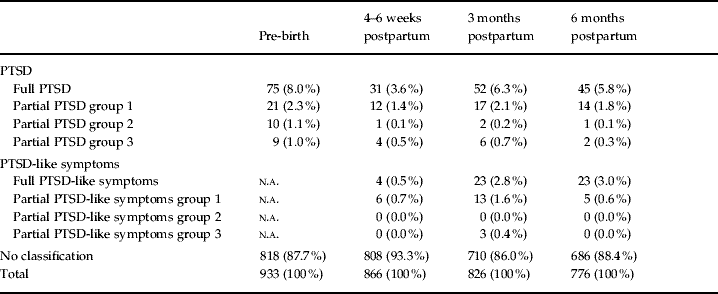
Data regarding estimates of PTSD, partial PTSD and PTSD-like symptoms (both of criterion A not met) are presented in Table 1. Note that the rate of PTSD increases from 3.6% to 6.3% from 4–6 weeks postpartum to 12 weeks postpartum, before declining slightly to 5.8% at 24 weeks postpartum. Following childbirth, 8.9% of women met criteria for PTSD at least once over the three postpartum assessments. PTSD-like symptoms (i.e. symptoms that mirror PTSD symptoms but result from a non-criterion A event) were not examined during the last trimester of pregnancy because participants were instructed to rate symptom severity only if they had experienced a potentially traumatic event.
Prevalence of PTSD, partial PTSD and PTSD-like symptoms pre-birth (any trauma) and postpartum due to birthing event

Partial post-traumatic stress disorder (PTSD) group 1 met all PTSD criteria except for one or two of the necessary three criterion C symptoms; group 2 met all PTSD criteria except for one of the necessary two criterion D symptoms; group 3 met all PTSD criteria except for one or two of the necessary three criterion C symptoms and one of the necessary two criterion D symptoms. Partial PTSD-like symptom groups met the same criteria as partial PTSD except the criteria for a traumatic birth event were not met (i.e. a non-criterion A event).
Adjusted PTSD, partial PTSD and PTSD-like symptoms postpartum
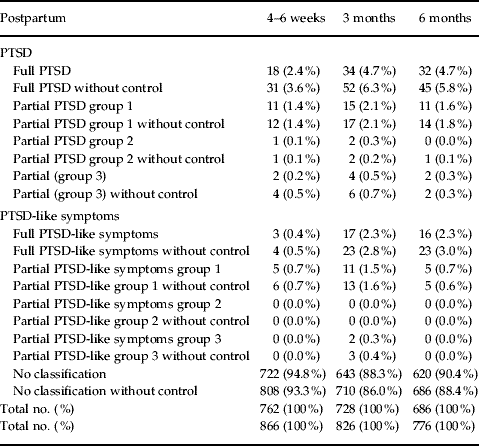
Estimates of PTSD, partial PTSD and PTSD-like symptoms, after removing the data for women with PTSD and partial PTSD prior to childbirth, are presented in Table 2. The rates of PTSD at every time-point postpartum, after removing these data, are below the uncontrolled figure as presented in Table 1. As can be seen, the rates of PTSD postpartum are lower (4.7%) than those initially reported in Table 1. Furthermore, postpartum rates of full PTSD-like symptoms are reduced. Yet, the rates of partial PTSD and partial PTSD-like symptoms are comparable with the rates reported in Table 1.
Adjusted prevalence of PTSD, partial PTSD and PTSD-like symptoms postpartum after controlling for prior PTSD, partial PTSD and PTSD-like symptoms

Partial post-traumatic stress disorder (PTSD) group 1 met all PTSD criteria except for one or two of the necessary three criterion C symptoms; group 2 met all PTSD criteria except for one of the necessary two criterion D symptoms; group 3 met all PTSD criteria except for one or two of the necessary three criterion C symptoms and one of the necessary two criterion D symptoms. Partial PTSD-like symptom groups met the same criteria as partial PTSD except the criteria for a traumatic birth event were not met (i.e. a non-criterion A event).
Clinically significant depression and anxiety during pregnancy
Approximately 122 women (13.1%) had scores on the EPDS that were consistent with a probable diagnosis of depression (EPDS score ⩾14) and another 9.1% (n=85) had scores consistent with possible depression (EPDS score=12 or 13). In addition, 26.8% of women (n=250) had clinically significant symptoms of state anxiety and 29.7% of women (n=277) had clinically significant symptoms of trait anxiety.
Adjusted PTSD, partial PTSD, and PTSD-like symptoms postpartum
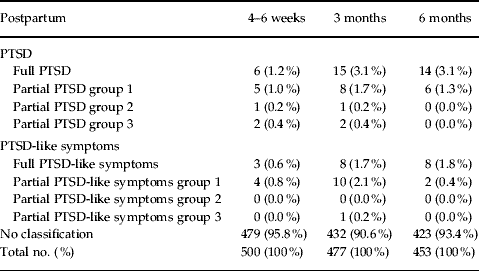
Table 3 presents adjusted estimates of PTSD, partial PTSD and PTSD-like symptoms after removing the data for women with prior PTSD and partial PTSD and clinically significant symptoms of depression or anxiety during pregnancy (as assessed during the last trimester of pregnancy). With a PTSD rate of 3.1% for women with no history of prior trauma symptomatology or depression or anxiety during pregnancy, it is clear that childbirth events can be traumatic and precipitate the onset of PTSD postpartum.
Adjusted prevalence of PTSD, partial PTSD and PTSD-like symptoms postpartum after controlling for prior PTSD phenomenology and clinically significant depression and anxiety during pregnancy

Partial post-traumatic stress disorder (PTSD) group 1 met all PTSD criteria except for one or two of the necessary three criterion C symptoms; group 2 met all PTSD criteria except for one of the necessary two criterion D symptoms; group 3 met all PTSD criteria except for one or two of the necessary three criterion C symptoms and one of the necessary two criterion D symptoms. Partial PTSD-like symptom groups met the same criteria as partial PTSD except the criteria for a traumatic birth event were not met (i.e. a non-criterion A event).
Traumatic birth events and psychopathology postpartum
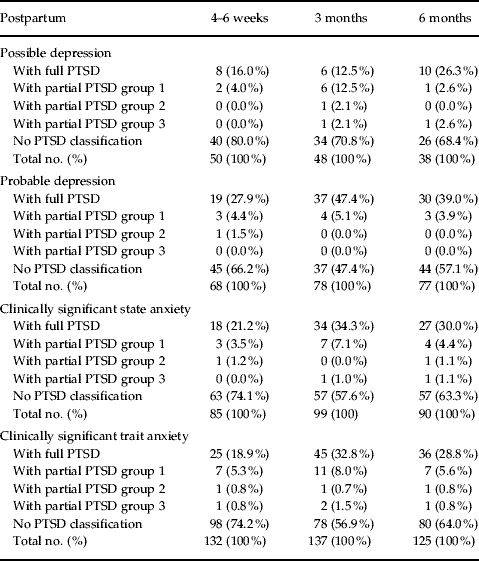
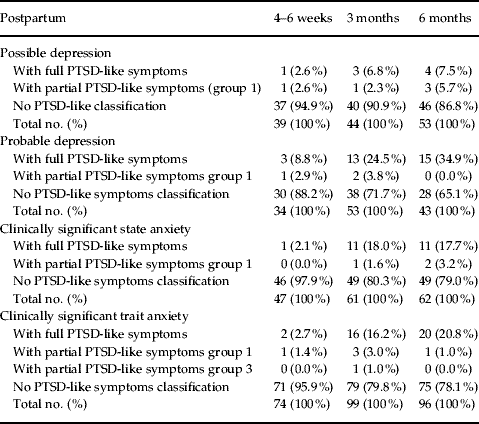
Approximate rates of clinically significant symptoms of postpartum depression and anxiety following a traumatic birth event, with and without concurrent PTSD and partial PTSD, are shown in Table 4. It is evident that, after experiencing a traumatic birth, more women with possible depression had no PTSD classification, in comparison with women with possible depression and experiencing PTSD or partial PTSD. By contrast, there was a comparable number of women with full PTSD and probable depression and women with no PTSD classification but with probable depression (at 12 weeks and 24 weeks postpartum). Also, while women with a PTSD classification experienced significant anxiety, more women with clinically significant anxiety did not have a PTSD classification.
Rates of clinically significant symptoms of depression and anxiety postpartum following a traumatic birth event with and without PTSD and partial PTSD

Partial post-traumatic stress disorder (PTSD) group 1 met all PTSD criteria except for one or two of the necessary three criterion C symptoms; group 2 met all PTSD criteria except for one of the necessary two criterion D symptoms; group 3 met all PTSD criteria except for one or two of the necessary three criterion C symptoms and one of the necessary two criterion D symptoms.
We also assessed for ‘other’ traumatic events (criteria A1 and A2) between birth and 24 weeks postpartum at the last assessment time-point. The way the time-frame was collected meant that we could assess the incidence of PTSD from childbirth at 12 weeks postpartum and women who endorsed having experienced another traumatic event between birth and 12 weeks. This cross tabulation was statistically significant, although with a small effect [χ2(1), n=826)=8.48, p<0.01, ϕ=0.1].
Non-traumatic birth events and psychopathology postpartum
Table 5 presents the rates of clinically significant symptoms of postpartum depression and anxiety following a non-traumatic birth event. Rates of concurrent PTSD-like symptoms are also presented. As indicated in the table, most women with possible depression did not have a PTSD-like symptom classification. Yet, more women with probable depression, in comparison with women with possible depression, had a full PTSD-like symptom classification, although this could reflect general distress postpartum. Likewise, a number of women who had clinically significant symptoms of state and trait anxiety also had a PTSD-like symptom classification. Again, this may be reflective of general distress following childbirth.
Rates of clinically significant symptoms of depression and anxiety postpartum following a non-traumatic birth event with and without PTSD-like symptoms

Partial post-traumatic stress disorder (PTSD)-like symptoms group 1 met all PTSD criteria except for criteria A and one or two of the necessary three criterion C symptoms; partial PTSD-like symptoms group 2 met all PTSD criteria except for criteria A and one of the necessary two criterion D symptoms; partial PTSD-like symptoms group 3 met all PTSD criteria except for criteria A and one or two of the necessary three criterion C symptoms and one of the necessary two criterion D symptoms.
Discussion and recommendations
The current study provides data on PTSD in pregnancy and childbirth that can be considered representative of actual occurrence. Approximately 91% of women self-reported experiencing a potentially traumatic event at some point in their life, which is similar to that reported in other trauma research (e.g. Stein et al. Reference Stein, Walker and Forde2000; Freedman et al. Reference Freedman, Gluck, Tuval-Mashiach, Brandes, Peri and Shalev2002). Also, 43.3% of the sample met criteria for a traumatic event, which is also consistent with past epidemiological research (e.g. Kessler et al. Reference Kessler, Sonnega, Bromet, Hughes and Nelson1995; Creamer et al. Reference Creamer, Burgess and McFarlane2001). A considerable number of women had experienced two (n=187, 22.2%) or more (n=448, 53.1%) potentially traumatic events throughout their life; again, similar rates to those reported in epidemiological research studies (e.g. Creamer et al. Reference Creamer, Burgess and McFarlane2001). The rate of PTSD before childbirth was found to be 8.0% of women, similar to that found by Kessler et al. (Reference Kessler, Sonnega, Bromet, Hughes and Nelson1995), who reported a lifetime prevalence of PTSD equal to 7.8%. We are, therefore, satisfied that our intake sample was reasonably representative of pregnant women in the community.
The current study also revealed that nearly half of women experienced a traumatic birth event. However, in comparison with the number of traumatic birth events, a much smaller percentage of women developed PTSD postpartum. That 45.5% of women reported, between 4 and 6 weeks after the birth, as having met PTSD criteria A1 (experienced threat to self or baby) and A2 (experienced fear, helplessness or horror) during the birth is worthy of comment. In epidemiological surveys, 50% of women and 65% of men have experienced a traumatic event excluding birth (A1; Creamer et al. Reference Creamer, Burgess and McFarlane2001) and, of those who endorse A1, 81% of females and 69% of males also endorse A2 (Creamer et al. Reference Creamer, McFarlane and Burgess2005). Our study demonstrated lower A1 and A2 concordance rates, with only 54.2% of those women endorsing A1 also endorsing A2. This lower concordance rate may be due to the expectation or interpretation of birth being a dangerous time for mother and baby regardless of subjective fear, helplessness or horror. However, with only 8.16% of women who had endorsed A2 not endorsing A1, it appears that subjective fear without viewing the birth as dangerous is unusual.
In the Creamer et al. (Reference Creamer, McFarlane and Burgess2005) study, of those who endorsed A2, 97% went on to endorse persistent traumatic memories of the event. In deriving the DSM-IV-TR criteria (APA, 2000), the intention may have been to have both objective (A1) and subjective (A2) appraisals of event status (traumatic versus non-traumatic). However, criterion A1, as it currently stands, still requires a subjective interpretation of the event.
In the current study, we asked whether the woman interpreted the birth in a similar fashion as if we were asking a returned servicewoman or any other person about a critical event. We had no doubts that the woman had given birth. That this could instigate pause for concern from researchers in the field suggests an a priori worry with criterion creep (or bracket creep; McNally, Reference McNally2003) regarding whether birth could possibly be seen as traumatic at an objective (i.e. subjective third party) level. We caution against such an approach, with the preponderance of research conducted into the predictive value of A1 events finding paradoxical outcomes with ‘non-traumatic’ or ‘stressful life’ events being associated with higher trauma symptomatology than classical ‘traumatic’ events (Long et al. Reference Long, Elhai, Schweinle, Gray, Grubaugh and Frueh2008; van Hooff et al. Reference van Hooff, McFarlane, Baur, Abraham and Barnes2009). That just under half of our sample endorsed criteria A1 and A2 suggests that women who have given birth a month earlier either view the birth as dangerous and causing fear and/or have a lowered threshold for what constitutes danger and fear. The need for a distinction between these two interpretations has not been proven. Whether A1 and A2 related to childbirth have external, long-term validity (i.e. related to functional impairment and help-seeking behaviours due to memories of the birth), as well as short-term, internal validity (predicting PTSD criteria B, C and D) remains to be seen.
Women who developed PTSD as a result of childbirth invariably had experienced an unexpected and potentially harrowing obstetric event. This finding differs from previous findings (Ballard et al. Reference Ballard, Stanley and Brockington1995), where most women with a profile of PTSD had experienced a normal vaginal delivery. We believe that a more exhaustive history, taking assessment of the birthing experience, may be partially responsible for this difference in results.
Consistent with other research findings (Ballard et al. Reference Ballard, Stanley and Brockington1995), this study also found that diagnoses of PTSD postpartum increased initially over time and then appeared to stabilize. However, unlike past research, we found that total PTSD symptom severity decreased initially postpartum and then appeared relatively stable. Similarly, the findings indicated that women can experience clinically significant levels of depression and anxiety postpartum and these rates are comparable with rates obtained in other research studies (Brown & Lumley, Reference Brown and Lumley1998).
We also found that women who obtained a diagnosis of PTSD at 12 weeks postpartum were more likely to experience and/or endorse other events experienced between birth and 12 weeks postpartum as ‘traumatic’. However, it should be stressed that to obtain a diagnosis of PTSD from birth, the woman answered the criteria related solely in relation to the birth and we do not know whether the women who endorsed experiencing another traumatic event would have met the diagnostic criteria of PTSD from that event.
The method utilized during the present study improves on prior research that examined PTSD postpartum by having a large sample, a validated measure of PTSD, assessing impairment and accounting for pre-existent PTSD, depression and anxiety. This approach permits stronger conclusions to be drawn regarding the prevalence of PTSD following childbirth. However, we suggest that while the rates in the present study were compared with those identified through the CAPS, structured clinical interviews for all Axis I disorders (e.g. SCID) may lead to improved specificity in future research.
While this study utilized self-report measures, structured diagnostic interviews were also used, with good agreement between the CAPS and the PDS. Due to the chronicity of untreated PTSD (Sommer & Ehlert, Reference Sommer and Ehlert2004), it would also be advantageous to follow up our current sample for longer than 12 months and assess outcome over at least a 5-year time-span, offering treatment to those with a continued disorder. Considering the attrition rate was over-represented by people from a lower SES and who initially displayed more pathology, these results would, if anything, represent an underestimate of total pathology and impairment.
The findings that a large number of women perceive childbirth to be traumatic, and that approximately 5.8% of women (3.1% when removing any women with a history of PTSD, anxiety or depression during pregnancy) will still have diagnosable PTSD at 6 months postpartum, speaks to the need for additional research into traumatic childbirth events and PTSD postpartum. In 2003, 251 200 births were registered in Australia (Australian Bureau of Statistics, 2004), 695 500 were registered in the UK (National Statistics Online, 2007) and in the USA 4.12 million births were registered in 2004 (Centres for Disease Control and Prevention, 2006). Thus, traumatic birth events and PTSD could potentially impact on a significant number of women worldwide. Overall, these data suggest the need for healthcare professionals and researchers to assess the nature of childbirth events and anxiety conditions, including PTSD, postpartum. Such research could inform prevention and treatment efforts.
Acknowledgements
Funding for this research: 2003–2005, Ipswich Hospital Foundation Grant. All authors had full access to all of the data in the study and take responsibility for the integrity of the data and the accuracy of the data analysis.
Declaration of Interest
None.