I. RESOLUTION OF COMMERCIAL DISPUTES IN AFGHANISTAN
This article explores how and why Afghan merchants choose to use courts or informal dispute resolution methods. It goes beyond the common corruption and inefficiency arguments, which maintain that Afghans do not use courts because they are corrupt and inefficient.Footnote 1 It leverages rich, original data on variation of dispute resolution practices across provinces and types of disputes to gain insights into Afghan merchants’ dispute resolution decisions. In so doing, I reveal a more complex picture of commercial dispute resolution in Afghanistan. In this article, I demonstrate that Afghan merchants do choose courts when courts enforce the parties’ expectations and courts’ judgments are necessary and effective. Moreover, while Afghan merchants do prefer informal dispute resolution methods, they do so because informal methods hold important advantages over courts in the context of Afghanistan where the formal property rights system is a failureFootnote 2 and the business climate is highly volatile.Footnote 3
This article provides two major insights into the workings of commercial dispute resolution institutions in Afghanistan. First, the willingness of the courts to recognize the informally-developed business transactions is a major determinant of whether merchants refer their disputes to courts. Second, the presence of strong and widespread social ties, along with the cultural salience of informal institutions of dispute resolution, has allowed Afghan merchants to resolve most of their commercial disputes outside the court system effectively. However, the decision to choose informal institutions, instead of courts, is made based on practical considerations, the most important of which is the relative capability of each type of institution in delivering a desirable outcome.
While this article provides contextual insights into why informal dispute resolutions are effective and popular in Afghanistan for most commercial disputes, it agrees with Douglas North in that inefficiency of informal institutions impedes growth.Footnote 4 To overcome the limits of informal institutions, this article offers two recommendations: improving the enforceability and desirability of the commercial courts’ judgments, and recognizing the dispute resolution functions of local business associations. Afghanistan needs to take practical steps to improve the enforcement of commercial courts’ judgments. In doing so, Afghanistan's government should prioritize improving the handling of commercial property disputes by the courts, because court judgments are more necessary and effective in those disputes, and also because formal dispute resolution institutions have decisive disadvantages over informal institutions when it comes to resolving contractual disputes in the uncertain business climate of Afghanistan. Moreover, Afghanistan's judiciary needs to be more willing to give effect to the parties’ expectations in the context of innovative commercial transactions. Given that commercial courts in Afghanistan are more inclined to recognize informally-developed arrangements, Afghanistan's judiciary and legislature can promote business-friendly judicial treatment by assigning commercially important transactions to the jurisdiction of commercial courts. Afghanistan also needs to recognize that local business associations provide an important dispute resolution function by enforcing commercial transactions.
This case study of Afghanistan confirms the dominant scholarly opinion that while informal institutions can effectively resolve disputes and enforce contracts by relying on the reputation and social embeddedness of the actors, they impede growth and economies of scale.Footnote 5 It further contributes to the literature in three important ways. First, in Part III.D, it challenges the monolithic view of the use of courts by showing that merchants strategically choose to use courts for some disputes but not others by considering the comparative advantages of courts versus other options for different types of disputes. Second, in the same Part, it illustrates that the willingness of courts to effectuate parties’ expectations plays a crucial role in merchants’ decisions to use or avoid courts. Third, in Part IV.A.2 this article demonstrates that informal institutions can provide the necessary flexibility in enforcing contracts where the formal property rights system is failing, and the business climate is very uncertain.
Beginning with formal institutions, in Part III, this article examines the function and reliability of commercial courts. Next, in Part IV, it describes the informal processes of dispute resolution and the advantages that these informal institutions have in resolving most commercial disputes in Afghanistan.
A. The Literature on Dispute Resolution Institutions
I will discuss the relevant literature briefly in two parts. First, I focus on how dispute resolution institutions matter and the debate over the relative efficiency and efficacy of formal and informal dispute resolution. Next, I consider the willingness of actors to resort to courts versus other options.
1. How Dispute Resolution Institutions Matter and the Debate over Relative Efficiency and Efficacy of Informal and Formal Dispute Resolution
Transactions give rise to numerous chances for opportunistic behaviour engendered by information asymmetry, adverse selection, moral hazards, and bounded rationality.Footnote 6 Therefore, a transaction only occurs – or gains from an exchange are actualized – if the costs of transacting are lower than the benefits that can be gained from the transaction, parties can commit themselves ex ante, and opportunism is reasonably curtailed.
Institutions are the solution to the problems of transacting under conditions of imperfect information and, as such, determine the prevailing transaction costs.Footnote 7 Institutions are the set of formal and/or informal rules, norms, beliefs, conventions, and enforcement mechanisms that facilitate, coordinate, and constrain behaviour.Footnote 8 Among other things, institutions allow parties to commit ex ante, and curtail opportunism by credibly constraining party behaviour. In short, they provide a solution to the problems of costliness of transacting and opportunism.Footnote 9 However, this solution need not be efficient.Footnote 10
Of the institutions within a country, the institutions that are used to enforce contracts are especially important, because they determine the cost of enforcement. North and Greif argue that informal contract enforcement mechanisms increase production costs and limit economic growth because they limit the partners with whom merchants can conduct business.Footnote 11 Therefore, they emphasize the importance of formal contract enforcement mechanisms.Footnote 12 Formal contract enforcement mechanisms allow merchants to do business with strangers, thus lowering production costs and facilitating economies of scale by expanding the pool of transacting partners. On the other hand, other scholars argue that informal institutions can effectively ensure enforcement of contracts.Footnote 13 In some contexts, informal institutions can do so at an even lower cost than formal institutions, without negative consequences for efficiency.Footnote 14
Two other strands of literature exist in between these two extreme views. One strand looks at informal institutions that rely on reputation to enforce contracts at a lower cost in countries with good formal institutions.Footnote 15 Another examines the informal ways of enforcing contracts by leveraging the social embeddedness of actors in societies that lack good formal institutions.Footnote 16 Insights from these two strands of literature reveal that informal ways of enforcing contracts, against a background of strong formal institutions, can aid efficiency by lowering enforcement costs. However, in societies where actors can only resort to informal means of contract enforcement, informal institutions may impede growth because they make it difficult to do business with outsiders.
The case of Afghanistan supports the prevailing scholarly opinion that improving formal institutions is crucial to raise efficiency and support growth; however, it may be unwise to replace informal institutions entirely.
2. The Willingness to Sue in Court versus Other Options
This article seeks to explain why merchants choose to use or avoid courts, beyond the problems of corruption and inefficiency of courts in Afghanistan, which are constant across types of disputes and therefore cannot explain the variation in dispute resolution choices made by Afghan merchants. The aversion to the use of courts is often explained in cultural terms, notably individualism and communalism.Footnote 17 Scholars have frequently argued that aversion to adversarial forms of dispute resolution is rooted in a cultural desire to maintain social harmony, while courts are more popular in individualistic societies.Footnote 18 Countering this cultural view, some scholars have argued that this analysis is often misleading. Haley has argued that litigation comes at the end of a multi-stage process after each stage fails to produce a solution that is equal or preferable to a court remedy.Footnote 19 In Japan, he argues, the availability and effectiveness of third-party intervention in the form of mediation, the courts’ inability to provide adequate relief and their inability to enforce their decisions via contempt of court proceedings, as well as the limited number of judges and lawyers, are more convincing explanations for the low rate of litigation in Japan.Footnote 20 Haley shows that when choosing to use or avoid courts, Japanese parties make strategic decisions based on the availability and effectiveness of alternatives to courts, and the ability of courts to produce a desirable outcome.Footnote 21
This article also finds that Afghan merchants make strategic decisions in their choices of formal and informal dispute resolution institutions. In cases where court judgments are necessary and effective, they opt to use them. When informal dispute resolution can produce equal or superior outcomes at a lower cost, they use informal institutions instead. Given the uncertain enforcement of court judgments, the courts’ unwillingness to effectuate parties’ expectations, and the cultural salience of informal dispute resolution methods, the latter is most often the case. In Afghanistan, as in Japan, merchants are strategic in their use or avoidance of courts. However, in Afghanistan, the failure of the formal property rights system, and the volatile business climate, have also played an important role in whether Afghan merchants opt for more flexible out-of-court solutions.
B. Methodology
This article explores why and how Afghan merchants choose to use courts or informal dispute resolution methods. To answer this question, this article draws from more than eighty-three semi-structured interviews with Afghan merchants, business leaders, Hawaladars,Footnote 22 and judicial officials conducted between March and August 2017 in five major provinces of Afghanistan, namely Kabul, Herat, Balkh, Nangarhar, and Kandahar. These five provinces collectively represent half of Afghanistan's economy,Footnote 23 one-third of Afghanistan's total population,Footnote 24 and more than four-fifths of Afghanistan's urban population.Footnote 25 The commercial courts that sit in these five provinces hear more than 90 per cent of total commercial disputes in the country.Footnote 26
The samples used in this study were chosen based on my own contacts and local informants. In addition to a number of key informants who were interviewed based on their positions, I attempted to interview a rich and diverse range of businesspeople by selecting various merchants in major marketplaces as interviewees at random, and by driving around industrial towns, randomly choosing factory owners to interview.
II. OVERVIEW OF CREDIT TRANSACTIONS AND DISPUTE RESOLUTION INSTITUTIONS IN AFGHANISTAN
Afghan merchants struggle with significant challenges. They face a very uncertain environmentFootnote 27 characterized by poor infrastructure, poor and volatile security conditions, political instability, social tensions, unreliable transnational trade routes, an environment that has its roots in ethnic tensions and a prolonged period of civil conflicts and foreign invasions.Footnote 28 Formal institutions have low capacity and very limited reach.Footnote 29 Corruption plagues formal institutions.Footnote 30
Afghanistan's economy is heavily dependent on foreign aid and unsustainable demand generated by the presence of international military forces. More than half of the Afghan economy is based on the service industry (eg logistics, construction, and transportation), the major demand for which is generated by international forces.Footnote 31 The dependence on foreign aid and the presence of international military forces have made Afghanistan's economy even less stable.
Property rights are generally insecure. Although the risk of expropriation by the government is currently low, Afghan investors fear that their property can be taken away from them by powerful individuals inside and outside the government.Footnote 32 Afghans spend considerable resources on protecting their property.Footnote 33 Wealthy Afghans hire bodyguards and pay protection fees to different groups.Footnote 34 Trade in assets and collateralization of assets are constrained by uncertain formal property rights and the absence of a property registry.Footnote 35
Afghans often resolve most common commercial disputes through bilateral and multilateral mechanisms, like business collectives. Shura, which literarily means consultation or congregation, is an Islamic concept derived from the Quranic command, ‘Those who hearken to their Lord, and establish regular Prayer; who (conduct) their affairs by mutual Consultation; who spend out of what We bestow on them for Sustenance’.Footnote 36 In Afghanistan, shura refers to a congregation of varying levels of permanence and/or institutionalization that often consist of merchants or other respected individuals gathered to consult on an issue, make a collective decision, or help to resolve a dispute. Jirga is a cultural institution for and by Pashtuns, who are the dominant ethnic group in Afghanistan. It consists of a congregation of autonomous Pashtun men who gather with the aim of consulting on a public issue, making a public decision, or resolving a dispute.
This article focuses on disputes arising from credit transactions because those disputes are not only the most common type of commercial dispute, but also the most difficult to resolve. For the purposes of this article, credit transactions encompass all inter-temporal transactions. In addition to the typical credit transactions that can be found in other countries, in the context of Afghanistan, a number of informally-developed credit transactions are also discussed. Sar qufli and Gerawee are two of these informal credit transactions. The former has been recognized by commercial courts, while the judiciary has resisted the formal recognition of the latter.
In addition to these two transactions, Afghan merchants also use Hawaladars’ line of credit to cope with the uncertainty of Afghanistan's business climate.Footnote 37 In order to maximize sales, large merchants in Afghanistan distribute their products on credit, and are paid in unpredictable installments over time when their products are sold. However, these large merchants who act as creditors to their domestic customers often have fixed financial commitments to their foreign suppliers. To protect themselves against cash flow interruptions from their domestic customers, among other reasons, large merchants in Afghanistan collect and send their money domestically and internationally using Hawaladars. This way, if they need to make a payment to a foreign supplier but they do not have sufficient funds available, the Hawaladars would send the money on their behalf, and the merchant can pay back the Hawaladar as he receives money from his domestic customers. As a Kabuli cellphone merchant put it:Footnote 38
When you sell in Afghanistan … whilst buying in China where you have to pay in cash, you have to work with Hawaladars. You need Hawaladars to give you credit so you can make the large payments. Then you can pay Hawaladars as you collect the money throughout weeks when you are paid by your domestic customers in Afghanistan. Hawaladars allow you to bridge the gap between a cash-based market and a credit-based market (…) we use Hawaladars despite the fact that Bank's TT [transfer of money via banks] is cheaper.
Hawaladars provide this line of credit to their merchant-clients to retain the currency exchange and money transfer business that their merchants-clients generate for them. Hawaladars profit from currency exchange and money transfer services they provide.
A. Sar qufli
Sar qufli (which literally means ‘main lock’ or ‘head lock’) has been adopted by merchants and developers in Afghanistan as a response to their practical needs in the absence of legislation. However, commercial courts have recognized Sar qufli and have resolved disputes based on the customary norms that have developed organically around this practice. I argue that the commercial courts’ willingness to enforce the customary rules of Sar qufli is the reason why Sar qufli disputes are one of the most common disputes in commercial courts.
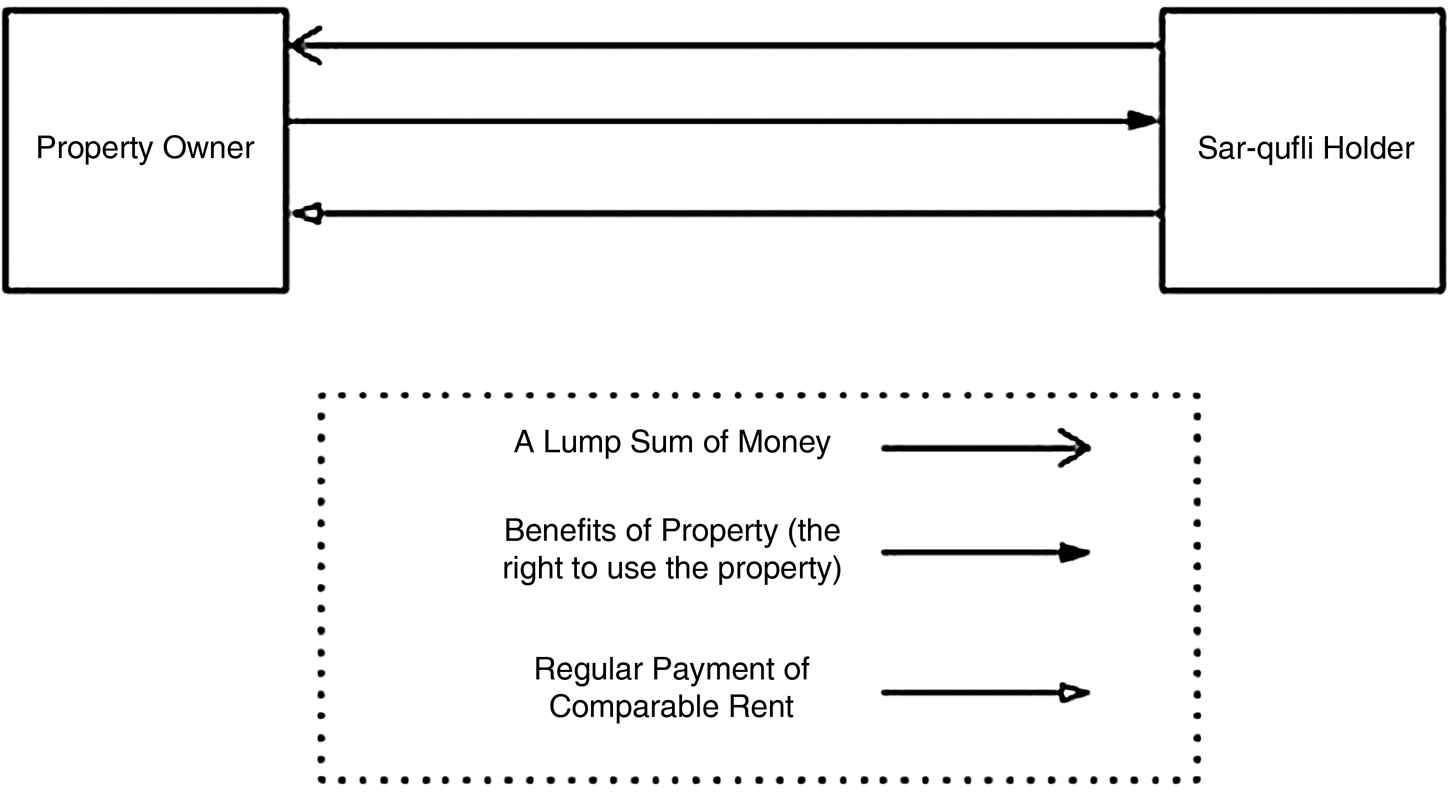
As a customary transaction, the specifics of Sar qufli transactions may vary across localities. Essentially, Sar qufli is best conceptualized as the commodification of commercial reputation. Sar qufli is a transaction whereby a lessee protects himself against eviction by paying a lump sum of money to the lessor. By paying a sum of money, the lessee acquires Sar qufli in the property. The lessor cannot evict a Sar qufli-holder lessee as long as he pays the comparable rent. Lessees use Sar qufli to protect the value created by the use of the property (eg business reputation which is tied to a place and cannot be readily transferred elsewhere). A lessor uses Sar qufli to retain ownership of the property while either raising capital to develop the property (eg building a shopping centre) or recovering the capital (cashing in) against the value of an already developed property.
When someone has a Sar qufli, he has the right to the continued usage of the property, subject to reasonable increase in rent, unless the owner/developer buys back the Sar qufli. The price of Sar qufli is determined by how much a Sar qufli-holder lessee is willing to accept to vacate the place of business. Thus, Sar qufli is essentially the commodification of the reputational value of a place of business.
B. Gerawee
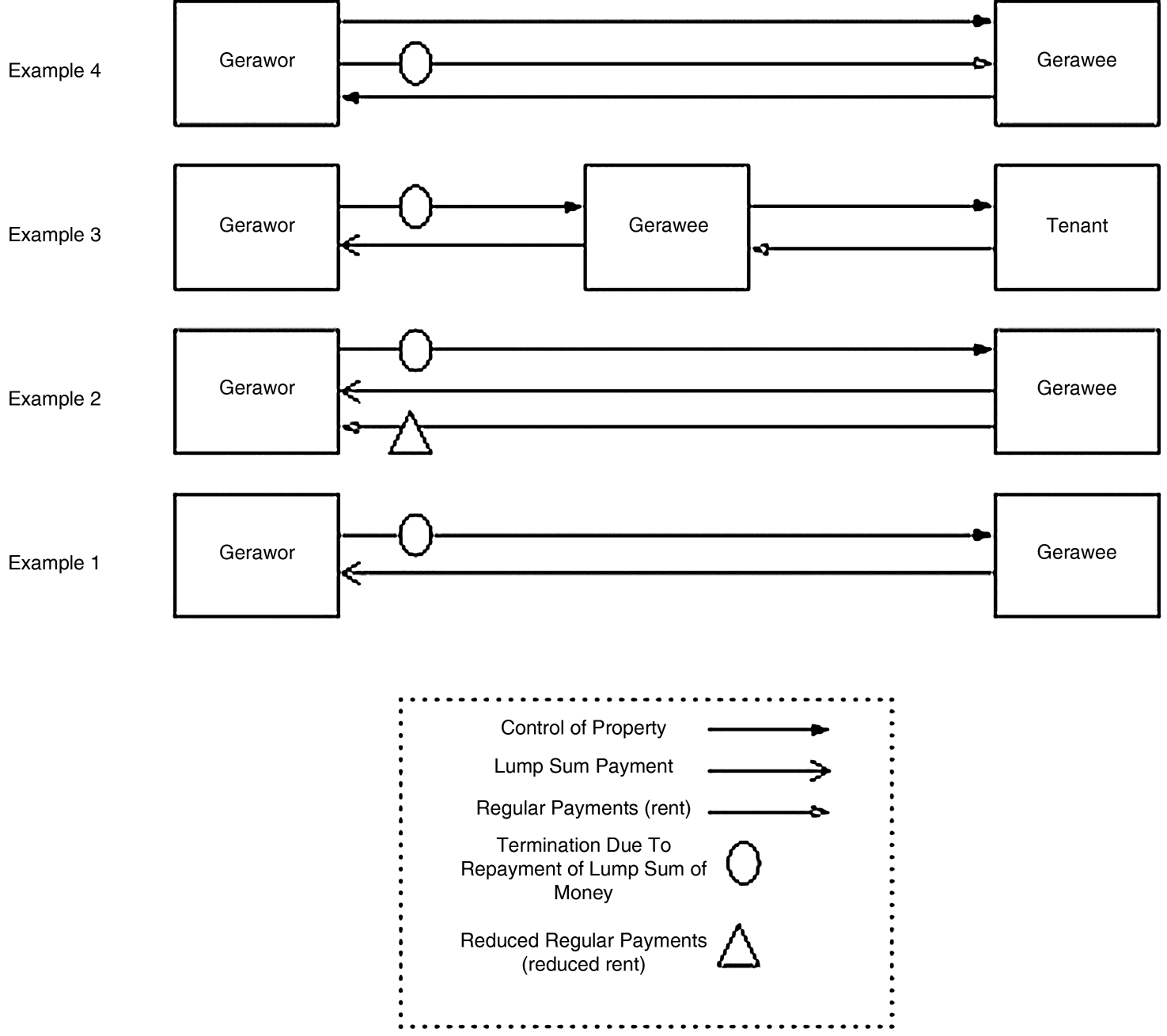
Gerawee is a form of investment financing. This transaction enables the owner of a property to raise money against the value of his/her property and is broadly similar to a mortgage with one key difference: Afghan courts generally unwilling to recognize that the financier in the Gerawee transaction has a security right. In light of the legal and Shari'ah-related uncertainties associated with the customary practice of Gerawee, the civil courts, which have jurisdiction over Gerawee disputes, have not formally recognized Gerawee. Gerawee sits on the intersection between housing and finance. The supply of Gerawee is determined by the need to raise capital while the demand for Gerawee is determined by the need for housing. There are four types of Gerawee, as exemplified in these common fact patterns.
Example 1. A, who needs a sum of money (Gerawor), may enter into an agreement with B, who is willing to provide him with a sum of money (Gerawe-ee). Under the terms of their agreement, B agrees to provide A with an amount of money, to be fully repaid at a later date, in exchange for the right to live in A's house. The amount of money paid by B is usually much lower than the market value of the house. It is common for the agreement to specify the length of the contract (ie the date of repayment). However, B will usually have the right to live in the house until the debt is fully repaid, even if the term of the contract lapses.
Sar qufli

Example 2. B agrees to provide A with an amount of money, to be fully repaid at a later date, in exchange for the right to lease A's house for considerably lower rent than market price. As in the previous scenario, the amount of money paid by B is usually much lower than the market value of the house. Similarly, it is common for the agreement to specify the length of the contract (ie the date of repayment). B usually has the right to retain the lease to the house until the debt is fully repaid, even if the term of the contract elapses.
Example 3. B agrees to provide A with an amount of money, to be fully repaid at a later date, in exchange for the right to lease A's house and then sublet it to a tenant. Under this scenario, B will receive the rent from the tenant. Like the previous scenarios, the amount of money paid by B is usually much lower than the market value of the house. It is common for the agreement to specify the length of the contract (ie the date of repayment); however, like the other arrangements described above, B usually will have the right to receive the rent from the tenant until the sum of money owed by A is fully repaid, even if the term of the contract elapses.
Example 4. Another example of Gerawee is an agreement under which B agrees to provide A with an amount of money, to be fully repaid in a later date, in exchange for the right to lease A's house and then sublet it to a tenant. However, unlike in Example 3, B will lease back A's house to A (A will retain the possession of the house). B will then receive the rent from A. Like the previous scenarios, the amount of money paid by B is usually much lower than the market value of the house. Similarly, it is common for the agreement to specify the length of the contract (ie the date of repayment); however, B usually has the right to receive rent from A until the debt is fully repaid, even if the term of the contract elapses. This scenario is closest to a mortgage contract.
III. FORMAL COMMERCIAL DISPUTE RESOLUTION IN AFGHANISTAN
In Afghanistan, formal dispute resolution mechanisms are expensive, uncertain, and ineffective.Footnote 39 Therefore, most merchants choose to resolve most of their disputes outside of formal dispute resolution institutions. This Part first describes the formal dispute resolution in Afghanistan and shows why and when merchants most often opt to use them. This Part also describes the rules of jurisdiction in Afghanistan to explain why Sar qufli falls under the jurisdiction of commercial courts while Gerawee does not. Given the marked difference in attitudes, laws, and actors involved in commercial and civil courts, the jurisdictional rules are crucial for the development of business-friendly judicial jurisprudence.
A. How a Formal Commercial Dispute Begins
There is a primary commercial court in each province's capital city.Footnote 40 Primary commercial courts hear all disputes arising from a commercial transaction at the first level.Footnote 41 There are two ways that a commercial dispute can find its way to a court in Afghanistan. The first is through the Huquq Department. The plaintiff can file a complaint with the Huquq Department which is part of the Ministry of Justice.Footnote 42 There is a Huquq Department in each province's capital city as well as in each district. Commercial claims are filed with the Huquq Department at each province's capital city.Footnote 43 Upon receiving a complaint, specialists at the Huquq Department will subpoena the defendant. Specialists first attempt to mediate between the parties to help them reach an amicable resolution of their disputes.Footnote 44 If the mediation is successful, they will record the agreement and bring the proceedings to an end.Footnote 45 If the mediation is unsuccessful, the specialists will identify the points of contention and record the parties’ claims and possible evidence to be sent to a court so the court proceedings can be expedited.Footnote 46 The court has the discretion to consider the records produced by Huquq Department or to ignore them completely.
Gerawee and its Variations

The second is through the Commercial Courts. There is no legal requirement for the plaintiff to first file his complaint with the Huquq Department before commencing court proceedings. A plaintiff can thus bypass the Huquq Department and file a complaint directly at a primary commercial court.Footnote 47 However, the court may decide to refer the case back to the Huquq Department or begin its own proceedings. After a final judgment is rendered in a commercial case (or any other non-criminal case), the judgment will be sent to the Huquq Department for enforcement.Footnote 48
B. Jurisdiction of Commercial Courts
When a case is sent to a primary commercial court by a Huquq Department, or a complaint is filed directly at the court, the court must first determine if it has jurisdiction over the case. With respect to subject matter jurisdiction, according to Article 1 of Usul Muhakimat Tijrati [Principles of Commercial Procedure] (Principles of Commercial Procedure) enacted in 1965, any dispute arising from a commercial transaction falls under the jurisdiction of commercial courts.Footnote 49 Turning to personal jurisdiction, Articles 6 to 14 of the Principles of Commercial Procedure state that a primary commercial court has personal jurisdiction over a defendant if it the court sits in the domicile of the defendant,Footnote 50 or the principal place of business of the defendant,Footnote 51 or a place of business of the defendant that has nexus with the case,Footnote 52 or the place of formation or place of execution of the contract, provided that the defendant or its representative is present at that place at the time the complaint is filled with the court.Footnote 53
The definition of a commercial transaction is provided in another piece of legislation, namely the Usulnameh on the Commercial Law of Afghanistan [Principles of Afghanistan Commercial Law] (Commercial Law) enacted in 1955. Article 8 of the Commercial Law defines a merchant as anyone, whether an individual or a corporation, who possesses legal capacity and habitually engages in a one or more commercial transaction in his own name.Footnote 54 The Commercial Law introduces three categories of commercial transactions: (1) primary commercial transactions; (2) inherent commercial transactions; and (3) auxiliary commercial transactions.
In practice, the main commercial transactions employed are primary commercial transactions.Footnote 55 If a person conducts these transactions habitually, that person is legally considered a merchant, that person's transactions will be presumptively regulated by commercial laws, and any disputes arising from those transactions will fall under the jurisdiction of commercial courts.Footnote 56 Inherent commercial transactions, on the other hand, are regulated by commercial laws and are subject to the jurisdiction of commercial courts regardless of the status of parties concerned.Footnote 57 Auxiliary commercial transactions are those transactions that normally do not qualify as commercial transactions and do not confer the status of merchant onto the parties concerned even if conducted habitually. The latter transactions may nonetheless fall under the purview of commercial laws and jurisdiction of commercial courts if conducted by a person who is otherwise legally considered a merchant.Footnote 58 If a transaction is considered commercial only with regard to one party, commercial laws will still apply to the obligations arising from the transactions, and any dispute arising from that transaction where the merchant-party is the defendant will be tried in a commercial court.Footnote 59
According to the Afghanistan Supreme Court, ownership disputes do not fall under the jurisdiction of commercial courts.Footnote 60 Therefore, a transaction concerning the transfer of ownership of a non-fungible property is not a commercial transaction, and disputes arising from that transaction falls outside the jurisdiction of commercial courts. The Afghanistan Supreme Court, however, has decided that transactions concerning the benefits of non-fungible property can be a commercial transaction if they fall within one of the categories of commercial transactions.Footnote 61 Therefore, disputes arising from a commercial transaction concerning the benefits of a non-fungible property fall under the jurisdiction of commercial courts.
The Afghanistan Supreme Court has decided that if a person leases a store, or gives a store to Sar qufli, for commercial purposes, disputes arising from the lease and Sar qufli fall under the jurisdiction of commercial courts.Footnote 62 This is because Sar qufli and commercial leases are transactions relating to the benefit of non-fungible properties rather than its ownership.Footnote 63 The subject of transaction in Sar qufli and commercial lease is the right to benefit from a non-fungible property (eg a store or a warehouse) not its ownership. Therefore, these transactions fall under the jurisdiction of the commercial court. Sar qufli and commercial leases make up the most common disputes in Afghanistan commercial courts. Gerawee, on the other hand, does not fall under the jurisdiction of commercial courts because, according to the Afghanistan Supreme Court, the Gerawee, or rather the formal legal title used to resolve its disputes, Bai al-Wafa (the sale with the right of repurchase), constitutes a transaction concerning the ownership of a non-fungible property, and therefore falls outside the jurisdiction of commercial courts.Footnote 64
According to data from the Quarterly Judicial Activities Reports, the primary commercial courts and commercial dewans [divisions] of appeal courts in Afghanistan's five major provinces (Kabul, Herat, Nangarhar, Balkh, and Kandahar) account for roughly 90 per cent of commercial cases received and decided by commercial courts at primary and appellate levels nationwide.Footnote 65 These five provinces, however, only represent half of Afghanistan's economyFootnote 66 and one-third of Afghanistan's population.Footnote 67 This does not necessarily mean that the merchants who reside in the twenty-nine other provinces do not utilize commercial courts. Instead, as interview data reveals, businesses in Afghanistan tend to be regional and these five provinces are regional hubs; further, commercial courts have very expansive rules of personal jurisdiction. Therefore, it is easy for a commercial dispute involving merchants doing business in a number of neighbouring provinces to gravitate to primary commercial courts in regional hub cities where courts are more competent, and where the rule of law is stronger.
C. Commercial Court Procedure
Commercial court procedures disincentivize the use of courts because they are burdensome, and the rules of evidence are incongruent with the prevailing business practices in the country. Court proceedings can only be commenced in a primary commercial court after the court decides it has jurisdiction over the case. However, before the primary commercial court hears preliminary motions, it will ordinarily advise the parties to consider mediation.Footnote 68 If the parties agree, the court will ask each party to choose a mediator.Footnote 69 The court records the name of the mediators, but the conduct of the mediation is entirely separate from the court proceedings.Footnote 70 Pre-trial mediation is not mandatory, and any party may refuse mediation.Footnote 71 Mediation is not ‘court-annexed’, in that the mediators operate entirely independently from the court. If the mediation is successful and parties reach an amicable resolution, the court may incorporate their agreement in its judgment as it stands without any modificationFootnote 72 and that will be the end of the proceedings. If mediation is unsuccessful, the mediators may submit their opinion to the court. However, this report does not have any evidentiary or binding value under the law.Footnote 73 Parties to the dispute can return to the mediation at any stage of the proceedings if they choose.Footnote 74 However, the court will only advise the parties to resort to mediation once.Footnote 75
If parties refuse to try mediation or if a mediation fails, the primary commercial court begins its proceedings by inviting parties to file their preliminary motions.Footnote 76 After a decision is issued in respect of these motions, the court will invite the parties to file their briefs and present evidence.Footnote 77
Article 2 of the Commercial Law states the rules applicable to commercial disputes:
Commercial disputes are to be settled in accordance with legally binding agreements and in their absence, disputes are to be determined and settled by reference to the meaning and implication of existing commercial laws. In the absence of a law, local and special customs (those that are commonly recognized, consented to, and used) are applied. Local customs and practice are preferred to general custom. In the absence of any other of the above-mentioned methods, any other laws which might apply to the dispute are used.Footnote 78
Parties may use any of the following as evidence in a commercial court: (1) witness testimony;Footnote 79 (2) expert witness;Footnote 80 (3) written documents;Footnote 81 (4) admissions;Footnote 82 and (5) commercial books.Footnote 83
A panel of three judges at the primary commercial courts hears the case.Footnote 84 After the primary court reaches its decision, and the primary commercial court's decision is announced to the parties, either party has the right to appeal the case to the Court of Appeal. Commercial disputes which are appealed will be decided by the Commercial Dewan of the Court of Appeal. Under Afghanistan law, a panel of three judges at the Commercial Dewan of the Court of Appeal will rehear the case in its entirety, and render a decision.Footnote 85 The decision of the Commercial Dewan of the Court of Appeal is binding and enforceable after it is issued to the parties.Footnote 86 Decisions of Commercial Dewan of the Courts of Appeal, if appealed, are reviewed by the Commercial Dewan of Afghanistan Supreme Court. Two justices, advised by judicial advisors, review and decide the cases at Dewans of Afghanistan Supreme Court.Footnote 87Dewans of the Afghanistan Supreme Court only review the application of law in a case.Footnote 88 A Dewan of the Afghanistan Supreme Court may affirm, reverse and remand, correct, or annul a decision of a lower court that has been appealed to it.Footnote 89
D. Enforcement of Commercial Courts’ Decisions
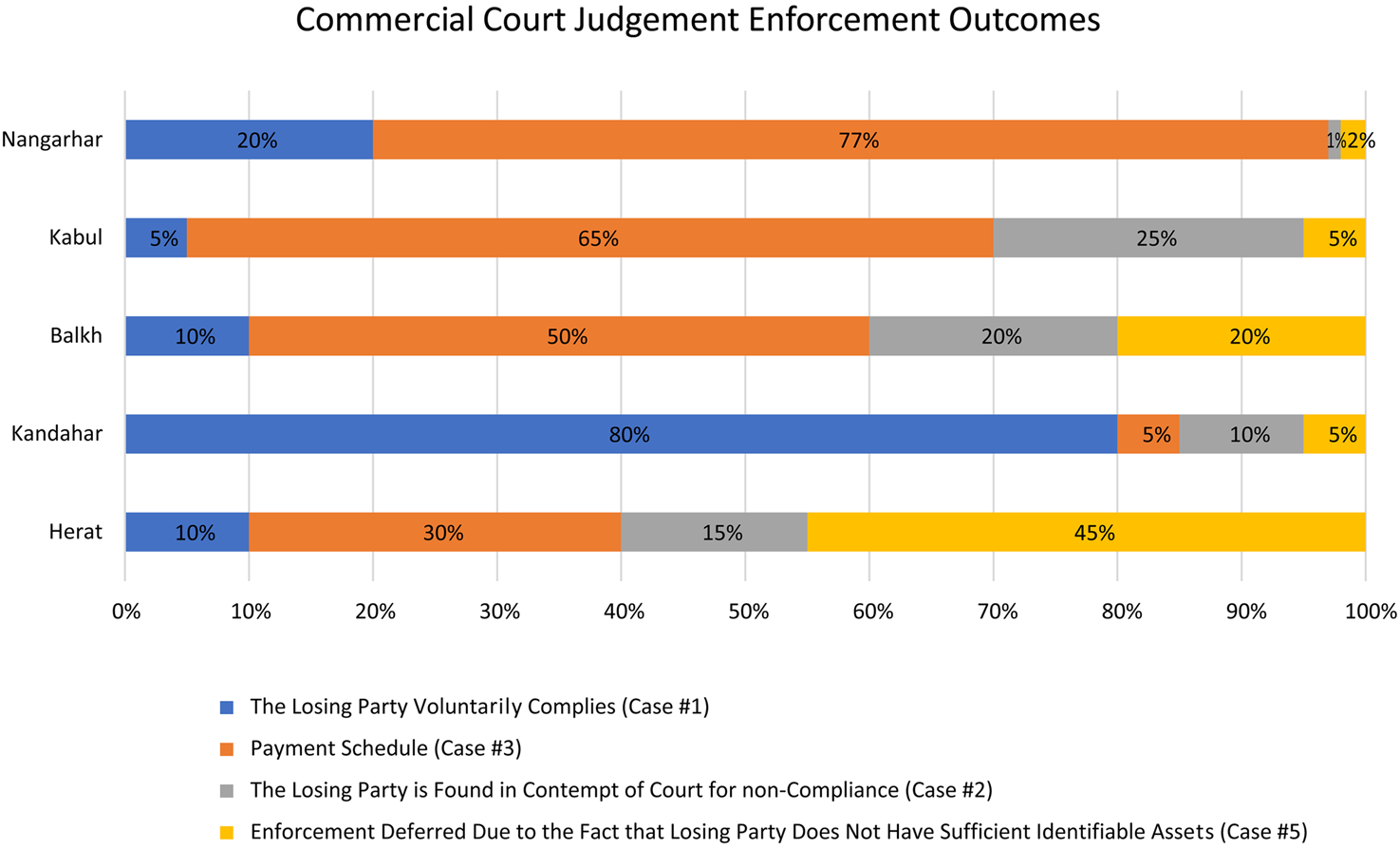
In Afghanistan, the enforcement of the commercial courts’ decisions is generally uncertain, which makes the use of commercial courts ineffective. The most likely outcome is a payment schedule; this can be long, and requires the continued supervision of the courts and the Huquq Department (see Figure 3 below). Merchants can usually achieve a similar, or even better, solution outside the courts. However, non-fungible property (especially immovable non-fungible property) are an exception to this rule.
Afghanistan's Commercial Courts' Judgment Enforcement Outcomes by Province for the Last Hijri YearFootnote 107

If a party obtains a final judgment in an ownership dispute concerning a non-fungible property (eg a store or a house), and the property is located in an area where the government has control, the judgment will most likely be enforced. It is because the subject of this judgment is an identifiable specific property. Under Afghanistan's rules on civil and commercial procedure, precise description of the specific property is a fundamental requirement of a lawsuit.Footnote 90
Sar qufli and lease disputes, by virtue of their subject matter, relate to immovable non-fungible property; hence, they fall within this category. This explains why parties most often resort to courts for Sar qufli and commercial lease disputes but not for other types of disputes. Court decisions are both effective and necessary when it comes to Sar qufli and lease disputes. This is because in Sar qufli and lease disputes, the lawsuit is brought against a party that has actual possession of an immovable property, with the aim of regaining possession.Footnote 91 The purpose of the judgment is a permanent change in a state of affairs, and the remedy – eviction of the party in possession – necessarily requires the use of force. This is why Sar qufli and lease disputes make up the majority of cases heard in commercial courts.Footnote 92
Under Afghan law, the Huquq Department is in charge of enforcing the judgments issued by commercial courts.Footnote 93 The following analysis of the enforcement of commercial court judgments focuses on the judgments concerning fungible property and monetary claims, and is based on the interview conducted by the author with a Judgment Specialist at the Herat Huquq Department.Footnote 94 The enforcement of judgments concerning fungible properties and monetary claims has paramount importance because, due to the nature of commercial transactions, fungible property and monetary claims are the most common subject of disputes among merchants. Although disputes concerning non-fungible property (eg the lease of a store or a warehouse) dominate formal court cases, they constitute a small percentage of commercial disputes.
In Afghanistan, after an enforceable judgment is rendered, the judgment will be sent to the Huquq Department for enforcement.Footnote 95 The Huquq Department will notify the losing party of the fact that a final and enforceable judgment has been rendered against him or her.Footnote 96 At this point, there are five possible outcomes.Footnote 97
First, if the losing party voluntarily complies with the court judgment, the Huquq Department will retain the file and the proceedings end. Second, if the losing party rejects the court's judgment and refuses to comply, the losing party will be held in contempt of court and referred to the prosecution office. The prosecutor will issue an indictment, and the public security dewan of the court will convict him. The usual sentence for the first offence is a six-month jail term. If the losing party does not comply and repeats the contemptuous behaviour after the end of his sentence, he can be indicted and given a heavier sentence. Theoretically, this process can be repeated until the losing party complies. Third, if the losing party accepts the court's judgment but claims that he does not have the assets to pay the sums awarded in the judgment, the Huquq Department will suggest setting up a payment schedule. If the judgment holder agrees, the Huquq Department will submit the payment schedule to the provincial governor's office. If the governor grants approval, the court with jurisdiction over the case will issue an order against the losing party requiring him to pay the judgment as per the payment schedule. If the losing party violates the payment schedule, he will be found to be in contempt of court. He will be referred to the prosecution office and will be tried for contempt.
While there is a legal requirement that the payment schedule cannot exceed nine months, which the Afghanistan Supreme Court has reaffirmed,Footnote 98 there is:
another provision that gives the court the discretion to determine the length of the payment schedule according to the losing party's financial status. Some courts have taken this to mean the court can approve a payment schedule that exceeds nine months if the financial status of the losing side warrants it.Footnote 99
The amount of each instalment is determined in the following manner. The court first ascertains the monthly income of the losing side (for instance, the daily wage of a simple labourer) then subtracts the losing side's essential expenses. The losing party is required to pay the remaining amount to the winning side to satisfy the judgment.Footnote 100 According to Kamal, a Judgment Enforcement Specialist at the Herat Huquq Department, most payment schedules consist of four to nine monthly payments.Footnote 101
Fourth, if the losing party accepts the court's judgment but refuses to pay, claiming that he does not have the assets to satisfy the judgment, or if either the losing side cannot pay the judgment in instalments or the prevailing side does not accept the instalments claiming that the losing side has sufficient assets and should not need a payment schedule, the Huquq Department, on the recommendation of the prevailing side, will send letters to the municipality, district, banks, or other places where the losing side's assets can be located to obtain a report on the available assets. If any asset is located, the Huquq Department will ask a court to order its confiscation (eg bank accounts), or auction (eg real estate) so that the winning party can be paid from the money that is received from the auction or confiscation.
Fifth, if no assets can be found and the losing side in unable to even make instalment payments due to financial difficulties, the Huquq Department will require the losing party to procure a guarantor, who will ensure that the party will pay the sums due as soon as his financial status improves. After receiving this guarantee, the Huquq Department will defer enforcement of the judgment until such time as the losing party's financial status improves so that he can pay in instalments or in whole, or until such time that the winning party can locate any of the losing party's assets against which the judgment can be enforced.
At present, there are no formal bankruptcy proceedings in Afghanistan. According to Decision 307–369 (2007) of the High Council of the Afghanistan Supreme Court,Footnote 102 courts are not permitted to initiate bankruptcy proceedings in commercial or non-commercial cases.Footnote 103 The courts are instead required to issue a judgment, and determine the obligations owed by the losing side.Footnote 104 If the winner can show that the loser has assets, the judgment will be enforced.Footnote 105 If the winner cannot show that the loser has assets, and the loser does not have assets, enforcement will be delayed until such time as the winner can show that defendant has assets that can be used to satisfy the judgment.Footnote 106
Figure 3 provides rough estimates of judgment enforcement outcomes for different provinces (excluding judgments concerning non-fungible properties) as provided by the Huquq Department's Judgment Specialists.
According to these rough estimates, payment by instalments is the most common outcome of a commercial court's judgment. This explains why court remedies are so unpopular. Creditors can usually reach an agreement for a better payment schedule outside of a court, considering the time and money that the litigation process takes, and the limits of Huquq departments in locating the losing party's assets.
However, there are two outliers in this survey. Commercial judgments are most often deferred in Herat province because the losing party does not have sufficient and identifiable assets, while Kandahar is the province where the losing party is most likely to voluntarily comply with a court judgment. These outliers can be explained if one takes into account the number of commercial judgments per year rendered in the five provinces, adjusted for population: for every one million people, the average annual number of commercial judgments rendered in the major provinces in the past six years is as follows: Kabul (258), Herat (204), Balkh (125), Kandahar (48), and Nangarhar (32).Footnote 108
Herat has the highest rate of enforcement deferral because Heratis are much more likely to use the courts, making it more likely for a judgment to be rendered against a party with insufficient identifiable assets. In addition, Herat has the largest number of small businesses.Footnote 109 These are the most frequent court users and are also the most likely to not have sufficient funds. Kandahar, on the other hand, has very low court usage coupled with the lowest number of small businesses, which could explain why most judgments are voluntarily enforced.Footnote 110 Nangarhar, on the hand, while having a low court usage rate, has a much larger number of small businesses, which may explain why it diverges from Kandahar when it comes to the prevalence of scheduled payments.Footnote 111
The sharp difference between the rate of commercial judgments per million people for Kandahar (48) and Nangarhar (32), which are predominantly Pashtun and also the most ethnically homogenous provinces, as compared to Kabul, Herat, and Balkh, which are more ethnically heterogeneous and/or dominated by the Tajik ethnic group, suggests that ethnic homogeneity and Pashtun institutions of jirga are likely to be responsible for making out-of-court dispute settlement more effective, thus reducing the rate of court use. This position is supported by a comparison between per capita business registrations and court use in Balkh, Kandahar, and Nangarhar. Balkh has a higher rate of court use (almost double) compared to Nangarhar and Kandahar, while Kandahar and Nangarhar both have higher per capita business registrations.Footnote 112 The prevalence of small businesses cannot explain this pattern, because while Kandahar has a low number of smaller businesses, Nangarhar has a large number of small businesses.
In addition to the formal rules of enforcement, there are two other features of court procedures that have a direct effect on the popularity of the courts among merchants: judgment tax, and non-acceptance of verbal contracts. It seems that the tax on final judgments is an important deterrent against the use of formal courts. The tax is ostensibly designed to do three things, although it is not clear if these goals have been achieved: (a) cover the court's costs; (b) deter frivolous lawsuits; and (c) encourage amicable resolution of disputes outside the courts.
If a court enters a judgment against the plaintiff, the plaintiff has to pay only 1 per cent of the value of the judgment to the government.Footnote 113 However, if a court enters a judgment against a defendant, the defendant is required to pay 10 per cent of the value of the judgment. If parties reach an amicable solution outside the courts and want their agreement to be incorporated into a court's judgment, each side must pay 5 per cent. The lower rate for plaintiffs seems to be designed to encourage the use of formal courts, whereas the higher rate for defendants seems to be designed to encourage out-of-court-settlement; however, the court can only formally approve the settlement if the parties pay 5 per cent each. This last provision appears to penalize parties using the formal court system to effectuate an amicable resolution, which seems to be at odds with the government's policy to encourage the use of the formal court system. Additionally, this tax is collectable upon the issuance of the first court's verdict, despite the fact that the judgment can be appealed as a matter of right to the second and third court. Beyond the judgment tax, the most common reasons for not using formal court system cited by interviewees were corruption and ineffectiveness of the court. Few interviewees mentioned the judgment tax because merchants do not use the courts frequently, and they therefore do not incur the judgment tax.
Afghan courts generally do not enforce oral contracts. This is despite the fact that an overwhelming majority of the business dealings in Afghanistan are conducted orally. From the accounts of judges in five major Afghan provinces that collectively handle 90 per cent of commercial disputes in Afghanistan, it appeared that hostility toward oral contracts stem from their uncertainty and non-specificity. Oral contracts are not, ipso facto, invalid under Afghanistan commercial laws. Therefore, most judges do not claim that an oral contract is ipso facto invalid. However, they cite reasons such as the difficulty of proving the formation of an oral contract, its content, and its terms to explain why they base most of their decisions on written contracts.Footnote 114
1. Why Court Judgments Are Difficult to Enforce
A confluence of multiple factors – which are fundamentally related to the high volatility of Afghanistan's business climateFootnote 115 and the lack of functioning formal property rights – render the enforcement of commercial courts’ judgments uncertain. The first factor is the difficulty in locating the losing party's assets. In the absence of an inclusive formal property rights system, information pertaining to the losing party's assets is hard to locate. The existing property rights system in Afghanistan is highly fragmented. There is no central property registry for formal property rights and more than 80 per cent of property is held informally.Footnote 116 Compared to local business associations, judgment enforcement officials are not well positioned to access informal sources of information about the losing party's assets. Judgment enforcement officials have to rely on limited formal property records, self-reporting, and the information provided by the winning party to locate assets against which a judgment can be enforced.Footnote 117 The uncertainty of rules on property ownership further complicates judgment enforcement.
The difficulty in locating the losing party's assets was the stated rationale behind the Afghanistan Supreme Court decision to halt the use of formal bankruptcy proceedings in Afghanistan. Given the scarcity of property information, the Afghanistan Supreme Court was apparently concerned that the losing parties would misuse the bankruptcy proceedings to hide their assets. As a result, genuinely insolvent merchants cannot avail themselves of bankruptcy proceedings. This institutional failure disincentivizes merchants from taking risks, which means they are less likely to expand or invest in new businesses.
The second reason for the low rate of enforcement is the type of disputes heard in courts. Most court disputes are end-of-business and end-of-relationship disputes among smaller and medium-sized merchants who are far less cooperative compared to disputants who opt to resolve their disputes outside of the court system.Footnote 118As a result, commercial disputes in courts are most often rendered against judgment-proof and obstructionist parties. The third factor is the high rate of insolvency caused by the volatile business climate. Commercial court judgments are hard to enforce, partly because losing parties – and Afghan merchants in general – are more likely to be insolvent, rendering them judgment-proof.
The final factor is underdeveloped security rights. High insolvency rates in Afghanistan mean that security rights are of paramount importance for securitizing credit transactions. The fact that merchants do not have enough assets to satisfy court judgments means that determining who has priority over the existing assets is crucial. However, outside formal mortgage laws, security rights are extremely underdeveloped in Afghanistan. Afghan laws and Afghan courts do not recognize contractually created security rights. This means informal credit transactions cannot be securitized. In common cases of insolvency, most creditors, given the very low rate of formal mortgage law users, have limited protection – even if they have ostensibly obtained security for the transaction.
2. Enforcement of Bank Loans
Afghan judges and Afghan laws are not the main impediment to the enforcement of bank loans. The Afghanistan Supreme Court has emphasized the primacy of the rights of banks holding formal mortgages over other creditors.Footnote 119 According to the rules of commercial procedure, the authorization of sale of collateral does not require a trial and upon verification of registry of formal collateral, the court may issue an injunction (qarar) authorizing auction of the collateral.Footnote 120
The interest-bearing nature of bank loans does not stop Afghan judges from enforcing bank loans. All commercial judges interviewed stated that they enforce bank loans according to Afghan laws despite the interest-bearing nature of the transaction. As the Chief Judge of the Primary Commercial Court in Balkh explained: ‘This is the law. I do think interest is prohibited under Islamic law, but I will enforce a bank loan because it is the law. The responsibility lies with the people who made the law not me.’Footnote 121
Interview transcripts reveal that, in cases of default, courts can be relied on to enforce bank loans by ordering the sale of the collateral if certain conditions are present. The enforcement of bank loans is most often hindered, according to commercial judges, for several reasons. First, given the complexity of determining legal ownership, other parties may claim ownership of the same collateral that the bank seeks to sell; this requires courts to determine ownership before authorizing the auction.Footnote 122 Second, there can be multiple liens on the collateral.Footnote 123 According to Afghan mortgage laws, a property can be used as collateral for multiple loans if the new mortgagee is informed of the existing liens.Footnote 124 In such case, liens will be enforced in the order that they are registered.Footnote 125 Sometimes banks accept collateral that is already subject to a lien, in which case, the courts will have to ascertain whether the mortgagee knew about the existing lien, and determine the priorities of enforcement.Footnote 126 As a result, banks may not be able to collect on a non-performing loan. Third, volatility in the real estate market means that the value of the collateral may depreciate below the amount of the debt, rendering it impossible for the banks to satisfy the debt by sale of the collateral. In such cases, banks will be treated as unsecured creditors and may have to pursue collection through a trial or join other possible creditors in court to collect the remaining debt. Lastly, banks will only enforce a security right if the collateral is fully and precisely specified in the loan contract and in the mortgage registration documents.Footnote 127 According to Afghan commercial judges, a common problem in enforcing a mortgage claim is that the property is not fully specified because banks did not diligently specify the mortgage in the loan contract and/or mortgage registration.
E. Afghanistan's New Law on Enforcement of Rights
Until recently, including for the duration of the empirical research presented here, the Law on Enforcement of Rights enacted by the Taliban regime in 1999 regulated the enforcement of commercial (and civil) judgments and the functions of the Huquq Departments in Afghanistan. On 22 September 2018, Afghanistan enacted a new Law of Enforcement of Rights.Footnote 128 The new law does not diverge significantly from the old regime that is explored in this article. With a few exceptions, the new regime left the rules regarding the enforcement of judgments and the functions of the Huquq Departments largely unchanged.
There are a few changes in the law that could be seen as positive developments. First, the new regime has reduced the judgment enforcement tax to a flat rate of 2 per cent.Footnote 129 As explained above, the high judgment tax rate could be perceived as a disincentive against court usage. However, given that Afghan merchants did not report the old judgment tax as a major disincentive against court use, the impact of the new tax rate may be limited. Second, the new regime extends the maximum length of payment schedules from nine months to one year.Footnote 130 This is a positive change, since in practice payment schedules were often set up for a year or even longer. Third, the new regime mandates the creation of a new police force dedicated to the enforcement of court judgments.Footnote 131 While the new police force has not been established at present, this could be a positive development as well. Finally, the new law mandates the creation of an inter-agency commission tasked with the recovery of hard-to-collect debts.Footnote 132 Ostensibly, this new commission is designed to aid the collection of default bank loans, and its effectiveness remains to be seen.
Despite the positive changes, the new regime is unlikely to result in a fundamental change in the popularity of court litigation. This is because, aside from corruption, the uncertainty in the enforcement of court judgments is caused by the failure of the property rights system and the volatile business climate. Afghanistan's new government has also announced major property registration reform programmes,Footnote 133 and there have been some positive steps taken in implementing these plans, but this is far from the establishment of a functioning formal property rights system in Afghanistan.
F. Formal Arbitration and Mediation
There is no regime for legally binding arbitration awards in Afghanistan at present. According to Faizy, the head of the Afghanistan Commercial Dispute Resolution Center, ‘although Afghanistan has passed an arbitration law, there is no arbitration in Afghanistan because there are no arbitration rules, and also there is no procedure or authority by which an arbitrator's license can be issued.’Footnote 134
The Center only administers mediation proceedings, which are completely non-binding in the absence of a binding settlement agreement between the parties. Mediation services provided by the Center are not very popular. According to Faizy, there have been only thirteen mediations held by the Center in the last three years (2014/15 to 2016/17) with most of them being held in the year 2016/2017. In explaining how the Center administers mediation proceedings, Faizy said that ‘the difference between our mediation and jirgas is that we use written documents and follow the law’. While Faizy saw this as a positive point, the formality of the Center-provided mediation may be the reason for its unpopularity. This position is supported by the fact that according to Faizy, members of the board of Afghanistan's Chamber of Commerce and Industries conduct informal dispute resolution proceedings without referring disputes to the Center. This is despite the fact that the Center is a part of the Chamber.
Herat's Chamber of Commerce and Industries (Herat Chamber) is the only chamber in Afghanistan operating a formal dispute resolution center.Footnote 135 Herat's Center is party to an agreement which allows it to jointly operate with a Chamber of Commerce in Mashhad, Herat's neighbouring province in Iran. According to the President of Herat Chamber, the Center provides binding arbitration as well as mediation services. However, the legally binding arbitration has not yet been used. The Center in Herat handles 4–5 cases each year, the majority of which, according to the President of the Herat Chamber, consist of disputes between Herati merchants and Irani merchants. The Herat Chamber is a party to a joint chamber of commerce between Herat and Mashhad. Disputes between Iranian and Herati merchants, who are members of the Mashhad Chamber and the Herat Chamber respectively, can be resolved through the dispute resolution committee of the joint chamber. These services are used to resolve a few cases each year, according to the President of the Herat Chamber.
IV. INFORMAL DISPUTE RESOLUTION INSTITUTIONS IN AFGHANISTAN: WHO USES THEM AND WHY?
Afghanistan's formal dispute resolution system is generally ineffective. Contrary to conventional wisdom, Afghan merchants avoid going to courts not because of their unchanging aversion to the use of formal, non-reconciliatory dispute resolution rooted in a cultural desire to maintain communal harmony,Footnote 136 but because formal dispute resolutions are ineffective. Court procedures are costly and time-consuming while enforcement of court judgments is uncertain. The uncertainty in the enforcement of court judgments is due to the difficulty in locating a person's assets, high rates of insolvency, and the absence of clear security rights outside of formal mortgage transactions. Court judgments are often enforced through repayment schedules that can be, in practice, as long as a few years.
In Afghanistan, the out-of-court dispute resolution options can, in most cases, deliver the same result as formal court systems in a cheaper and more effective way. Informal dispute resolution institutions, such as business associations, are often better at locating a person's assets, factoring in environmental uncertainties, and dealing with insolvent parties. This is because users of informal institutions tend to be more cooperative; further, these institutions have better knowledge of assets to which a person has access (even if he does not legally own those assets), they are not bound by the formal rules of separation of ownership, and they give more consideration to the idea of fairness.
Afghan merchants do use courts when it is necessary and effective to do so. Commercial courts in Afghanistan handle many Sar qufli and commercial lease cases. Merchants use courts for Sar qufli and commercial lease cases because these are property right claims brought against the party who is in actual possession of the property. In such cases, the court judgments are both necessary and effective because they provide access to the coercive power of the state to repossess a specific immovable property.
Contractual and financial claims are most often resolved informally in business collectives, shuras, and jirgas. To maximize sales within supply chains, major merchants distribute their products on credit in exchange for a promise by local distributors that they will pay them back as they sell the products. These contracts are not about strict, ex ante risk allocation, but rather tools for cooperation and risk sharing in an uncertain business climate. When a dispute arises in this context, the key issues are often regarding whether the debtor was a good business partner, made a good attempt to sell the products, acted in good faith, and so on. These contracts are hard to enforce with reference to formal rules. Community-based and informal dispute resolution mechanisms are better placed to resolve these issues in a meaningful way, and to produce acceptable outcomes.
While informal dispute resolution mechanisms are effective in resolving the most common disputes among merchants who are part of Afghan society, they place outsiders at a disadvantage. By conflating a person's social reputation and business reputation, informal dispute resolution institutions increase the cost of dissolving business relationships by locking parties into existing business networks. They also hinder the formalization and depersonalization of business relations with negative consequences for long-term economic growth. Informal dispute resolution institutions circumvent the application of formal legal rules of bankruptcy, limited liability, and separation of private ownership; thus, they make it harder for the Afghan economy to create formal and lasting institutions.
A. Afghan Merchants Prefer Informal Dispute Resolution Institutions
The research presented in this article shows that Afghan merchants are reluctant to engage in court litigation. In general, they prefer inter-party negotiation and compromise, and to a lesser extent, multilateral dispute resolution institutions such as business community unions and associations. However, there were two outliers in my sample in Herat. Both are well-educated, medium-sized merchants who have a positive view of the formal court system.Footnote 137 They resorted to court litigation for relatively low-value claims.Footnote 138 In most of these cases, the parties against whom these outliers brought claims complied with the plaintiff's demands before the court could render a final decision.Footnote 139 There are three possible explanations for these outliers’ views on the court system.
First, it may be that for low-value claims, defendants may believe that going through formal court proceedings will be too costly and time-consuming, such that it would be cheaper to simply comply with the plaintiff's demands. In effect, the courts’ reputation for ineffectiveness and corruption works in favour of a small number of plaintiffs who go to courts for low-value claims. Another possibility is that that courts are generally effective, and it is the false common perception that the courts are inefficient that is keeping merchants from using the courts. The unique background of these two merchants (eg high levels of education) may be the reason why they were willing to buck conventional wisdom by resorting to court litigation. If this is true, one wonders why their positive experiences have not motivated other merchants to use courts. Alternatively, it may be that these two merchants’ experiences are the exception rather than the rule because of their connections, social status, or some other reason.
1. Who Uses Formal and Informal Dispute Resolution Institutions in Afghanistan?
Interview data reveals that small and medium-sized merchants are the most common users of courts, while large merchants use courts much less frequently. This finding is unexpected because the dominant position in the literature posits that business size is positively correlated with the use of formal institutions, especially courts.Footnote 140 In Afghanistan, however, small and medium-sized merchants use courts more often than larger merchants. There are several possible explanations for this. First, in Afghanistan, use of the court is usually an end-of-business occurrence. Smaller businesses, because of their limited capital, are more likely to get involved in such end-of-business disputes and therefore, they are more likely to use courts. Larger merchants, on the other hand, have a higher tolerance for non-payment and delays in payment. They can price in non-payments and other problems. Thus, they are less likely to use courts. Further, larger merchants are better connected and more involved in the business community, and are better positioned to take advantage of out-of-court remedies like unions, chambers, or jirgas. Similarly, decisions of multilateral dispute resolution forums, such as unions, chambers, or jirgas, are most effective against larger merchants because they have more to lose in the form of social status and reputation. This may explain why larger merchants are less inclined to use courts compared to smaller merchants.
The use of threats and force to enforce commercial obligations was rare in my research generally. Therefore, the fact that larger businesses are usually more powerful is less likely to be a reason why such businesses tend not to resort to court proceedings. This is the case even though larger businesses are also more likely to have more resources to influence formal institutions through money and political connections. Therefore, the political and social power of larger businesses do not seem to be a determinant in the choice between formal and informal dispute resolution institutions.
The availability of out-of-court and out-of-chamber solutions determines whether a merchant goes to court or to the chamber. Large businesses do not go to courts because they have better access to out-of-court dispute resolution. As an example, Pakistani merchants who do business with Afghan merchants tend to avoid the Kandahar Chamber of Commerce for informal dispute resolution because Pakistani merchants, by virtue of their ethnic and personal relations, have access to out-of-chamber dispute resolution mechanisms that they trust. For example, they can resort to a jirga to resolve their dispute. Iranian merchants who do business in Afghanistan, on the other hand, have less access to out-of-chamber remedies; therefore, as an interview with the Vice President of the Kandahar Chamber revealed, Iranian merchants are more likely to resort to the Chamber to resolve a dispute.Footnote 141
2. Why Do Merchants Use Informal Dispute Resolution Mechanisms?
This article argues that the effectiveness of court remedies dictates when and if merchants decide to pursue a dispute in court rather than some informal dispute resolution mechanism. Court remedies, in effect, compete with the out-of-court debt collection remedies. Currently, out-of-court debt collection remedies are generally superior to the formal court system. If the defendant refuses to pay, the out-of-court remedies range from bilateral negotiations to harassment, and in some cases harsher tools of intimidation. In some cases, the creditors are willing to exchange one debt for another with a discount as a last resort. A Kabuli cell phone merchant said: ‘When a debtor is unable to pay, the creditor suggests that he buy something like a car on credit and then sell it for a very good price [a high price] to the creditor in exchange for the debt.’Footnote 142
This allows the debtor to use his soft capital – his reputation and social connections – to eliminate part of the debt by selling the goods for a higher price, and/or obtain an extension on the debt by exchanging one long-delayed debt for a more recent one. This enables the debtor to stay in business.
In multilateral dispute resolution, merchants involve market elders, unions, chambers, or even friends and families in a dispute.Footnote 143 In multilateral mechanisms, a group of people (or a person) who are knowledgeable about the customary norms of the relevant market mediate between the disputants so that they can reach an amicable resolution. The mediators’ incentive is to resolve the dispute in a way that would allow the disputants to continue doing business, while upholding the norms of the market. Mediators are not interested in finding the party at fault. They often review the evidence provided by each disputant, but as the Vice President of the Kandahar Chamber said: ‘It is not about evidence. If the evidence were clear or helpful, they [disputants] would not come to us. We are conciliators. We persuade them to compromise.’Footnote 144
Mediators do make decisions, but mediators’ decisions are not binding on the disputants. Disputants can, and sometimes do, decide to go to court after a mediation. Multilateral mechanisms are effective at resolving disputes. An overwhelming majority of disputes that are brought before multilateral mechanisms are resolved.
Multilateral mechanisms are effective because they are often the last resort. According to the same interviewee, ‘they [disputants] come to us as a last resort. We find a way to end the dispute. If courts were any help they would have gone to the courts.’Footnote 145 However, it is also true that going to a jirga, a shura, or a union shows willingness by all parties to resolve the issue, because these forums do not have legal power to compel attendance.
Informal institutions exert pressure on disputants to resolve their dispute by increasing the social and economic cost of non-compliance. These institutions do so by increasing the number and social standing of the people who are aware of, and involved in resolving, the dispute. For example, a dispute may begin with just a few immediate neighbours of the disputants in the market trying to persuade them to agree on a resolution. If the disputants are unable to reach an amicable agreement, the dispute might escalate to a market-wide association, then to a province-wide commercial chamber or a union. As the dispute persists, more merchants, who are potential business partners, and more important merchants, who are the main sellers/creditors in the market, become aware of and involved in the dispute. Thus, the increasing reputational cost of the dispute exerts pressure on parties to settle.
Furthermore, although institutions such as shura, jirga, or a union are business institutions, they also wield significant social power. This means that a disputant does not become immune to the social power of these institutions even if he is seeking to exit a market, as would be the case in end-of-business disputes. This also means that the effectiveness of multilateral mechanisms is directly correlated with the social standing and business status of the disputants in the market. Large businesses and influential members of the market and society care more about their social status and their standing in the market, so they are more likely to comply with a decision of a multilateral institution.
In the context of Afghanistan, multilateral institutions, such as jirgas, unions, and shuras, enjoy greater social legitimacy compared to the courts. Courts do not enjoy strong social legitimacy because they are perceived as corrupt.Footnote 146 This means that a disputant may be more concerned about defying a decision of a jirga, shura, or a union than a court's judgment. The multilateral institutions in the Hawaldari market are particularly effective because they are backed by a collective desire to protect the reputation of the Hawaldari market, which is a form of common asset. The power of the Hawaldars union to mediate disputes among Hawaldars is also formalized by the Da Afghanistan Bank's Regulation, which empowers Hawaldars unions to mediate disputes between Hawaladars if they resort to the union.Footnote 147
Notably, some interviewees expressed discontent with the decisions of multilateral institutions. Interview data reveal areas of discontent with the decisions of jirgas and business forums. There are two main areas of discontent: some merchants believe that jirgas are not impartial, and some creditors believe they are pro-debtor. The latter is generally cited as evidence of the former. As one Kandahari merchant said, ‘they [Jirgas] ask us to accept 100,000 AFN for a 1 million AFN debt or they set up long repayment schedule. For example, they ask us to accept 100,000 AFN this year and 300,000 AFN next year.’Footnote 148
At first blush, these complaints may appear to be serious shortcomings. However, this is only when one compares the informal process to the court proceedings against a solvent defendant. Such a comparison would be misleading. This is because the informal processes of jirgas and unions are most often invoked when the defendant is insolvent. These cases are end-of-business and end-of-relationship cases. Therefore, the correct comparison would be to compare these informal processes with a bankruptcy proceeding. If one does that, the decisions of informal institutions appear more reasonable and realistic rather than merely conciliatory or pro-debtor.
As mentioned above, formal bankruptcy proceedings have been formally suspended by the Afghanistan Supreme Court. In effect, because a debtor cannot enjoy the benefits of invoking bankruptcy in formal courts, informal forums provide a much-needed relief. However, the formal suspension of bankruptcy proceedings, coupled with the informal norms of dispute resolution, means that the usual protection afforded by limited liability does not exist in practice. Informal dispute resolution mechanisms do not recognize the principle of limited liability. They are instead guided by a moral understanding of obligation coupled with a culturally informed notion of fairness. As a result, all of a debtor's assets are considered when settling a debt. The suspension of the principle of limited liability hinders the effective risk diversification that would be legally available to a merchant. This dissuades merchants from engaging in risky businesses. This pro-creditor attitude is counterbalanced with the notion of fairness. Under informal dispute resolution institutions, the creditor is often expected, demanded, and advised to provide relief to the debtor based on the culturally-informed notions of fairness, forgiveness, and mutual help.
The informal institutions are sometimes effective because they are not bound by the formal rules of property ownership. In an informal institution, all the assets to which the debtor has access are considered a legitimate source for debt collection. While courts can only enforce judgments against property formally held by the losing party, informal institutions can pressure the debtor to use any asset to which he has access (regardless of formal property rules) to repay a debt. For example, jewellery belonging to a debtor's wife cannot be used to enforce a court judgment because it is legally owned by the wife; however, in a shura, union, or a jirga, a debtor cannot claim that he does not have sufficient assets to honor his debt if his wife has valuable jewellery. Moreover, since contracts are not tools of ex ante risk allocation, informal dispute resolution methods are better placed to produce acceptable outcomes because they are better positioned to decide whether a debtor was acting properly or improperly in a risk-sharing, cooperative arrangement.
3. Variation in the Effectiveness of Informal Dispute Resolution Institutions
The empirical research presented here suggests that there is a significant variation in the ability of business associations, such as unions and chambers, to resolve disputes. The ability of an association to effectively resolve a dispute is dependent on a series of factors which include the geographical concentration of its members; the exclusiveness of the market; the number of players; the type of profession (eg whether it is a lifetime profession or not); whether the market's collective reputation is a common asset; and whether the structure of the market gives the association leader gatekeeping power.
Dispute resolution is more institutionalized in associations like the Hawaladars’ union that represents a market which is concentrated in a geographical area, has a limited number of members who interact with each other regularly, and whose members pursue their business as a lifetime career. Additional characteristics of Hawaladars unions are that the formal laws give the association some authority over admission and resolution of disputes, and its members share the collective reputation of the Hawaladar as a common asset. Chambers, by contrast, lie on the other end of the spectrum. Chambers’ members are spread across a province and they do not necessarily have consistent interactions with each other. Members may easily join or leave the chamber. Merchant-members do not share a collective reputation and the chamber has no influence on who gets to be a merchant. Unions and local associations fall somewhere in between these two extremes.
There are also regional variations. Dispute resolution is much less institutionalized in Balkh as compared to Herat. In Balkh, there are fewer business unions. The unions that do exist do not engage in dispute resolution. The Balkh Chamber of Commerce, which is the only business association that engages in some dispute resolution practices, does so on an ad hoc basis (there is no dispute resolution board/committee/center) and much less often than in Herat. The Balkh Chamber does not offer transnational dispute resolution whereas the Herat Chamber does most of its dispute resolution work in this area. The Balkh Chamber is not part of any transnational or joint chamber with Afghanistan's business partners (eg Iran or Pakistan). Balkh's Hawaladars union is similarly less institutionalized. Until very recently, there has been no dispute resolution board/committee/center, or administrative body for the Hawaladars union. The President of Balkh's Hawwaladars union only has a very small shop where he supposedly discharged his duties as the president of the union. By contrast, the Hawaladars union in Herat has more space, more administrative staff, and a more developed organizational structure.
In contrast to Herat, and similar to Balkh, dispute resolution in Nangarhar is less institutionalized in the unions or the chamber. In fact, interestingly enough, most interviewees talked about the union and the chamber as if they were part of the government and going to them would be similar to using state-run institutions. This may be because of the prevalence of another Pashtun cultural institution, the jirga. In Nangarhar, the use of jirga is more common. A jirga is an ad hoc council formed from influential people who have knowledge about the disputants. The jirga mediates between the disputants and seems to be very effective in resolving smaller disputes in Nangarhar. Another possible reason for the under-institutionalization of dispute resolution in Nangarhar, at least with regard to chambers, is the proximity of Nangarhar to Kabul. Nangarhar is only a three-hour drive away from the center of Kabul, so most big disputes are referred and handled there because most large merchants have a presence in Kabul as well. Smaller disputes seem to be handled locally by jirgas.
Kandahar seems to follow the Nangarhar model of merchant dispute resolution. Like Nangarhar, Kandahar is also a majority Pashtun province where the use of jirga is the norm. However, unlike Nangarhar, jirga in Kandahar are institutionalized within the chamber and unions. In other word, Pashtun culture and jirga do not seem to be an impediment to the institutionalization of dispute resolution. On the contrary, they seem to facilitate the institutionalization of dispute resolution in Kandahar.
Aside from purely domestic disputes, it is notable that there is a sizeable group of Kandahari merchants who trade dried fruits with Europe and India.Footnote 149 Their business partners in those countries are usually from the Afghan diaspora.Footnote 150 They use the same model of risk-sharing and flexible contracts to trade with their Afghan counterparts in Europe and India, as they do in Afghanistan. They employ the institution of jirga to resolve disputes with their Afghan counterparts in Europe.Footnote 151
4. Informal Dispute Resolution and Pashtun Culture
The interview data suggests that informal dispute resolutions are more effective in Kandahar and Nangarhar. This observation is confirmed by the low rate of per capita court usage in these two provinces, compared to the other three provinces which are either more ethnically heterogeneous or dominated by non-Pashtun ethnic groups.
The cultural roots of jirgas give them more coercive power in predominately Pashtun provinces such as Kandahar and Nangarhar. The cultural salience of jirga in Pashtun culture provides a focal point and increases its coercive and persuasive power in predominantly Pashtun provinces. Defying and disrespecting a jirga has more severe social consequences in a homogenously Pashtun province. While shuras, which have Islamic roots and are generally understood as a generic counterpart to the jirgas, and business community unions were common across all research sites and provinces, they did not have the same cultural salience as jirgas. This is likely because Pashtuns have a longer history of autonomy and self-regulation in Afghanistan compared to non-Pashtun ethnic groups, who by virtue of being minorities were more reliant on and controlled by the central authority in Afghanistan.Footnote 152 For example, Tajiks have historically been more likely to settle in a city (compared to Pashtuns) and to staff the Afghan government's bureaucracy.Footnote 153
Pashtuns’ cultural aversion to the use of signed written documents – to avoid offending their customers by doubting their trustworthiness – in the course of their business dealings also contributes to the low rate of court use. Written signed documents are instrumental in court proceedings; it is much harder to win a case before a formal court without written signed documents as evidence. Thus, both the cultural salience of jirga in the Pashtun culture and their aversion to the use of signed written documents in the course of business dealings render the use of formal courts both less necessary and more difficult in Kandahar and Nangarhar.
5. The Use of Force to Resolve a Commercial Dispute
The use of force or threats to collect a debt or to resist debt collection is rare in Afghanistan. It is mostly because business in Afghanistan is based on reputation and relationship. If a merchant uses force to resolve a dispute, it will affect his ability to do business as it will dissuade other merchants from doing business with a merchant who has a reputation of resorting to force or threats. As a Nangarhari merchant said: ‘If you use force or threats you cannot work in the market.’Footnote 154
Although rare, the use of force and threats in commercial settings does occur. Most often, the use of force is exercised by a non-merchant party in a commercial transaction. For example, a non-merchant who is a party in a one-time business deal (eg importing oil) may resort to using threats to resolve a dispute. Interviews conducted in Kabul suggest the use of force or threats is more common there.Footnote 155 This may be because of two reasons: there are more people with access to power in Kabul; and there are fewer wide-reaching cultural, ethnic, or social norms constraining power and the use of threats due to the increased diversity in Kabul. Interview data from Kabul suggests that the use of force or threats is also sector-dependent. Some sectors are more prone to the use of threats or force due to the actors involved.Footnote 156 For example, the construction industry is dominated by actors who wield significant political power, such that actors are more prone to use force or threats in a business context.Footnote 157
Interview data from Kandahar suggests that qawm – a perceived community of people with a common ancestor – is a factor that controls the use of force in both business and other settings in Kandahar.Footnote 158 On the other hand, it seems that political connections may have empowered Kandahari merchants in certain sectors that rely on political connections.Footnote 159 The effect of qawm is possibly more keenly felt in Kandahar because it is the least urbanized and least ethnically diverse of the five research sites.Footnote 160
V. CONCLUSION
This case study of Afghanistan makes an important contribution to the literature on the choice of courts versus other options in resolving commercial disputes. It shows that merchants make strategic decisions to use or avoid courts for some but not other disputes depending on the comparative efficacy of courts versus available alternatives. It also highlights the importance of a formal system of property rights and environmental uncertainty in the use of court systems. Finally, it underscores the importance of a responsive judiciary in expanding the role of courts.
Merchants in Afghanistan opt to resolve their disputes outside the court system because the failed property rights system and the uncertainty of Afghanistan's business climate have rendered the enforcement of court judgments uncertain. In certain property disputes over which (according to the Supreme Court) the commercial courts have jurisdiction, merchants do resort to courts because in those disputes court judgments are both necessary and effective. This suggests that the aversion to the use of courts is based on practical considerations, and not an unwavering cultural aversion to the use of adversarial dispute resolution mechanisms.
Informal dispute resolution institutions are effective at resolving contract disputes in Afghanistan because they most often involve cooperative disputants, and because they are not bound by the rules of formal property rights systems. Actors in informal institutions are better positioned to access information regarding the assets to which a disputant has access (even if he may not formally own those assets) and can draw on a combination of social and economic incentives to encourage disputants to resolve their disputes. Informal ways of resolving disputes are also better at handling disputes that occur over the risk-sharing, cooperative arrangements, that are common in Afghanistan's uncertain business climate.
Informal dispute resolution institutions may be effective, but they put outsiders at a disadvantage, and they hinder the formalization of business dealings in Afghanistan. Therefore, Afghanistan needs to improve the enforcement of court judgments to promote the use of courts. To do so, Afghanistan needs to undertake important property rights reforms. In the short and medium term, however, Afghanistan can promote the use of courts by expanding the jurisdiction of commercial courts especially with respect to property disputes. Commercial courts have proven more willing to give effect to the expectations of parties in the context of innovative commercial transactions; thus, expanding the jurisdiction of commercial courts can lead to the creation of more business-friendly jurisprudence, and hence, more merchants may choose to use the courts. Afghanistan should also recognize that local business associations play a vital role in dispute resolution, and that the current approach to using formalized alternative dispute resolution mechanisms should also include ways to enhance and improve the role of local business collectives.