Introduction
Starch and protein are important macro-nutrients in poultry diets and the efficiency of their utilisation is critical for sustainable chicken-meat production. Feed conversion ratio (FCR) is the best indicator of sustainable chicken-meat production given its impact on profitability particularly with escalating feed ingredient prices. Attention is paid to ileal digestible amino acids and energy density in the least-cost formulation of diets for broiler chickens. The starch component of the diet is the single biggest energy source and axiomatically, the dietary protein component provides the amino acid profile. In typical broiler diets the bulk of starch is derived from maize, wheat and at times sorghum and the protein is derived from vegetable (and animal) protein meals, grains and an increasing array of synthetic amino acids. There is a relatively small focus on starch digestibility, perhaps because it is usually not considered to be a limiting factor (Moran, Reference MORAN1982).While this may apply to maize it is arguably not the case for wheat and sorghum. Conversely, there has been an intense focus on the apparent ileal digestibility, or variants, of amino acids. By determining the digestibility coefficients of starch and protein/amino acids at the terminal ileum eliminates the confounding effects of hindgut fermentation (Ravindran and Bryden, Reference RAVINDRAN and BRYDEN1999) it overlooks the fact that glucose and amino acids are mainly absorbed in the jejunum. In addition, Rerat (Reference RERAT1993) contended that these digestibility coefficients are global and static and do not account for the different absorption rates which vary for different nutrients; the kinetics associated with differences in relative absorption rates of nutrients is necessary for a more complete understanding of the value of feedstuffs.
In this paper digestive dynamics are defined to include the digestion of nutrients in the gut lumen, absorption of end-products into the gut mucosa, and their entry into the systemic circulation. This process involves both static and kinetic components and while ileal digestibility coefficients are static assessments they can be used to investigate the kinetic aspects of digestion and absorption. That is the rate, quantity and site of absorption of glucose and amino acids along the small intestine. The rate of digestion may be deduced by fitting apparent digestibility coefficients and mean retention times in intestinal segments into an exponential mathematical model. The quantity of a nutrient absorbed at the terminal ileum or other intestinal segments is a simple function of feed intake, dietary concentrations and digestibility coefficients. The site of absorption may be defined as one of four small intestinal segments (proximal and distal jejunum, proximal and distal ileum) and the amounts of starch or protein that apparently disappear or were absorbed may be calculated. While kinetic parameters hinge on static digestibility coefficients they represent an instructive extension of the underlying static data. More than sixty years ago, Geiger (Reference GEIGER1950) noted that the relative timing of amino acid and carbohydrate inputs can markedly affect protein synthesis and the efficiency of feed utilisation. This opinion suggests that starch and protein digestive dynamics should not be treated in isolation but in combination because a balanced provision of glucose and amino acids at sites of protein synthesis is a fundamental prerequisite for efficient growth. Consequently, the purpose of this review paper is to consider digestive dynamics of starch and protein in broiler chickens in tandem with an emphasis on their impact on efficiency of feed conversion.
Feeding frequency, availability and absorption of starch and protein
Many factors affect the availability of both glucose and amino acids in the gut from the breakdown of starch and protein respectively, and these can lead to differences in availability and uptakes related to final meat laydown in the carcass. Batterham and Murison (Reference BATTERHAM and MURISON1981) concluded that it is likely that there are differential rates of absorption between free and protein-bound forms of amino acids. This causes asynchronous availability of free and protein-bound lysine at sites of protein metabolism. The differences in the rates of absorption of free versus protein-bound lysine were largely negated by frequency that animals feed.
The effects of feeding frequency are important in any consideration of digestive dynamics. Broilers are fed on an ad libitum basis in practice and this essentially unrestricted access to feed could accommodate differences in rates of digestion/absorption of nutrients. However, depending on the lighting regimen, ad libitum or unrestricted access to feed does not equate to continuous feeding. Broiler chickens exhibit diurnal feeding patterns and consume most of their ration either at the start or end of the day, or both, but not in the middle of the day (Savory, Reference SAVORY1980). Jensen et al. (Reference JENSEN, MCGINNIS, REDDY and MERRILL1962) found that chicks offered pelleted diets under a ‘12-hours-on’ lighting regime spent only 4.7% of illuminated time in eating. Also, Fujita (Reference FUJITA1974) reported that chicks offered mash diets spent 38.6% of time eating, but this was reduced to 10.8% by pelleted diets under a ‘14-hours-on’ lighting regime.
Gut passage rates in broilers are rapid, and Svihus and Hetland (Reference SVIHUS and HETLAND2001) reported an average rate of 5.04 hours in broilers based on time taken for 50% of titanium dioxide to pass through the tract. Another estimate is that it takes 7.27 hours for digesta to transit the entire gastrointestinal tract in broilers (Denbow, Reference DENBOW2000). Based on five of our studies (Liu et al., Reference LIU, SELLE, COURT and COWIESON2013a; Reference LIU, SELLE and COWIESON2013b; Reference LIU, SELLE and COWIESON2013c; Reference LIU, SELLE and COWIESON2013d; Reference LIU, SELLE and COWIESON2014b), the average retention time in the jejunum and ileum was 2.98 hours which agreed with the data of Denbow (Reference DENBOW2000) who determined from transit in the crop, proventriculus, gizzard, and duodenum, that digesta would reach the terminal ileum in broilers in 4.31 hours. Thus, despite unrestricted access to feed in commercial production systems, and dependent on lighting regimen, it appears that feed consumption patterns may still provide scope for asynchronies in digestion and absorption of nutrients in the small intestine to influence broiler performance.
starch and glucose
The digestion of starch by pancreatic α-amylase and absorption of glucose in broilers is well documented (Moran, Reference MORAN1982). Riesenfeld et al. (Reference RIESENFELD, SKLAN, BAR, EISNER and HURWITZ1980) found that approximately 65% of starch was digested by the time it reached end of duodenum, 85% by the end of the jejunum and 97% by the terminal ileum. It has been shown that glucose absorption marginally lags behind starch digestion. Glucose absorption generates insulin secretion from the pancreas but the role of this powerful peptide hormone in avian species needs clarification. While Simon (Reference SIMON1989) contended that the broiler chicken is an instructive model for the roles of insulin there are differences between avian and mammalian species. Blood glucose levels in chickens are twice as high as that in most mammals (Belo et al., Reference BELO, ROMSOS and LEVEILLE1976), chickens exhibit a relative resistance to mammalian insulin and doses required to obtain hypoglycaemic effects are higher than in mammals (Tesseraud et al., Reference TESSERAUD, METAYER, DUCHENE, BIGOT, GRIZARD and DUPONT2007). Nevertheless, Tokushima et al. (Reference TOKUSHIMA, TAKAHASHI, SATO and AKIBA2005) found that glucose uptakes by skeletal muscle in broilers were doubled within ten minutes of insulin administration. This suggests that an insulin-responsive glucose transport mechanisms are present in chickens despite the absence of the GLUT4 homologous gene, the insulin-responsive glucose transporter in mammals. The effects of insulin in depressing hepatic gluconeogenesis and promoting net protein accretion are potentially potent. Therefore, a better understanding of the role of insulin in avian physiology is necessary to interpret the impacts of glucose and insulin on digestive dynamics with certainty. Slowly digestible starch was shown to enhance feed conversion efficiency in broilers (Weurding, Reference WEURDING2002) and it follows that slowly digestible starch may generate more sustained circulating levels of glucose and insulin which may be the genesis of FCR improvements. However, it remains premature to draw such conclusions and the real additional possibility that slowly digestible starch has a protein sparing effect (Weurding et al., Reference WEURDING, ENTING and VERSTEGEN2003b).
protein and amino acids
The digestion of protein by pepsin and pancreatic proteases and absorption of amino acids in broilers is well documented and the multiple fates of absorbed amino acids other than protein accretion (Wu, Reference WU2009). On the basis of apparent ileal digestibility coefficients, protein digestion is inferior to starch which is partially due to endogenous flows of protein/amino acids. Starch digestibility is not similarly compromised but the contribution of endogenous flows to the wastage of amino acids remains.
While endogenous flows are responsible for shortfalls in the incorporation of dietary amino acids into skeleton protein, their negative impact is exceeded by incomplete protein digestion in the gut lumen and parenteral catabolism of amino acids. Inevitable and preferential catabolism is the largest single source of lysine wastage in pigs and broilers (Moughan, Reference MOUGHAN2014). Amino acids are utilised in the gut mucosa for structural and secretional protein synthesis, surprisingly, tangible amounts of amino acids (rather than glucose) undergo catabolism to provide energy to meet the copious requirements of the gut (Cant et al., Reference CANT, MCBRIDE and CROOM1996; Wu, Reference WU1998). More investigations into the catabolism of amino acids in the gut mucosa have been completed in pigs and rodents than poultry. In a relevant study Watford et al. (Reference WATFORD, LUND and KREBS1979) showed that glutamic acid/glutamine underwent catabolism in the avian gut mucosa but was responsible for less oxygen consumption than glucose catabolism.
Slowly digestible starch and catabolism of amino acids in the gut mucosa
There is evidence to suggest that the provision of some slowly digestible starch in broiler diets benefits feed conversion efficiency (Weurding, Reference WEURDING2002; Weurding et al., Reference WEURDING, ENTING and VERSTEGEN2003a; Reference WEURDING, ENTING and VERSTEGEN2003b; Enting et al., Reference ENTING, POS, WEURDING and VELDMAN2005; Li et al., Reference LI, DAI, YIN, ZHANG, HUANG, RUAN, DENG and XIE2008; del Alamo et al., Reference DEL ALAMO, DE AYALA, DEN HARTOG, VERSTEGEN and VILLAMIDE2009). Weurding (Reference WEURDING2002) concluded that slowly digestible starch (starch digested in the lower small intestine) improved FCR and this beneficial effect was more pronounced for low protein diets. More recently, Selle et al. (Reference SELLE, LIU, CAI, CALDWELL and COWIESONA2013a), Selle et al. (Reference SELLE, LIU, CAI, CALDWELL and COWIESON2014) and Liu et al. (Reference LIU, SELLE, KHODDAMI, ROBERTS and COWIESON2014c) reported that gradually digestible starch, which is the starch digested in the distal jejunum, proximal and distal ileum, increased energy utilisation (AME, AMEn) in addition to FCR in sorghum-based broiler diets. A more continuous absorption of glucose from the gut by the provision of slowly digestible starch could be of benefit by modifying the insulin-induced response, although glucose and insulin metabolism between avian and mammalian species remains may be different. An alternative theory is that slowly digestible starch may enhance FCR in broilers due to a protein-sparing effect (Weurding et al., Reference WEURDING, ENTING and VERSTEGEN2003b). Enting et al. (Reference ENTING, POS, WEURDING and VELDMAN2005) showed that there was a significant interaction between the addition of glutamine and casein and starch digestion rates and they suggested that slowly digestible starch might prevent the use of amino acids as an energy source for the gut wall.
The gastrointestinal tract uses approximately 20% of incoming dietary energy for digestive and absorptive processes (Cant et al., Reference CANT, MCBRIDE and CROOM1996) and much of this energy is derived from the catabolism of amino acids rather than glucose (Fuller and Reeds, Reference FULLER and REEDS1998). Fleming et al. (Reference FLEMING, ZAMBELL and FITCH1997) suggested that in the rat, starch/glucose and glutamic acid/glutamine are approximately equally important energy substrates for small intestinal mucosal cells. Net ATP production from glucose was greater than glutamine by a two-fold factor. It follows that glucose from rapidly digested starch sources would be depleted in the upper small intestine, effectively forcing mucosal cells in the lower small intestine to oxidise amino acids to provide energy. In other monogastrics, Van der Meulen et al. (Reference VAN DER MEULEN, BAKKER, SMITS and DEVISSER1997) showed that less rapidly digested purified native pea starch significantly increased the net portal flux of essential amino acids by 22.9% in comparison to more rapidly digestible maize starch. Thus, slowly digestible starch sources would provide more glucose to the lower small intestine which would spare amino acids from catabolism and that the energy derivation from glucose would be substantially more efficient.
Rate of starch and protein digestion in sorghum-based broiler diets
The impact of digestive dynamics of starch and protein on broiler performance was investigated in a series of experiments using grain sorghum as a dietary model (Liu et al., Reference LIU, SELLE, COURT and COWIESON2013a; Reference LIU, SELLE and COWIESON2013b; Reference LIU, SELLE and COWIESON2013c; Reference LIU, SELLE and COWIESON2014b; Reference LIU, SELLE, KHODDAMI, ROBERTS and COWIESON2014c; Selle et al., Reference SELLE, LIU, CAI, CALDWELL and COWIESONA2013a; Reference SELLE, LIU, CAI, CALDWELL and COWIESON2014). Sorghum-based broiler diets are practical vehicles for such experiments as the in vitro digestibility of sorghum starch is inferior to other grains (Giuberti et al., Reference GIUBERTI, GALLO, CERIOLI and MASOERO2012). A meta-analysis of the relationship between starch and protein digestion rates and efficiency of feed conversion was completed (Liu et al., Reference LIU, SELLE and COWIESON2013e). The underlying data sets included 33 dietary treatments including different sorghum varieties, feed forms (raw mash, intact pellet, reground mash), hammer-mill screen sizes, steam-pelleting conditioning temperatures, exogenous enzymes and a reducing agent (Liu et al., Reference LIU, SELLE, COURT and COWIESON2013a; Reference LIU, SELLE and COWIESON2013b; Reference LIU, SELLE and COWIESON2013c; Reference LIU, SELLE and COWIESON2013d; Reference LIU, SELLE and COWIESON2014b; Reference LIU, SELLE, KHODDAMI, ROBERTS and COWIESON2014c). Variations between experiments did not contribute to this model as the experimental leverage was not significant (P=0.345). The following equation describes the significant relationship (r2=0.759; P < 0.05) between starch (kstarch) and protein (knitrogen) digestion rates and FCR:
FCR=1.719 – 0.272*log(knitrogen) + 0.0864*log(knitrogen)*log (kstarch)
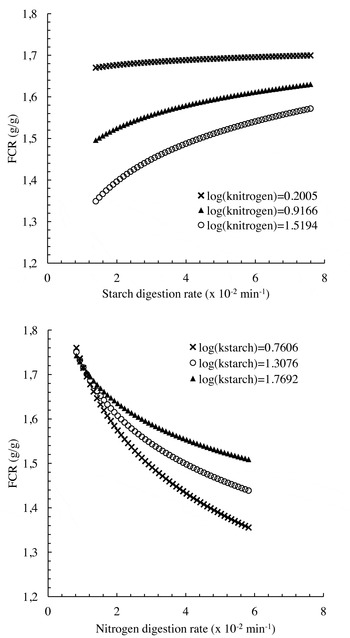
The equation indicates that 76% of variation in FCR may be attributed to starch and protein (N) digestion rates along the small intestine. There was also an interaction between starch and protein digestion rates such that coupling slowly digestible starch with rapidly digestible protein is advantageous for feed conversion efficiency (Figure 1). As is evident in Figure 1b, increasing the rate of protein digestion relative to starch has the potential to enhance efficiency of feed conversion.
From the same meta-analysis, N retention was predicted by the following equation (r2=0.242, P < 0.001) on the basis of protein digestion rates:
N retention(%)=57.71 + 18.63*log(knitrogen) – 13.415*[log*(knitrogen)]2.
This relationship indicates that the maximal N retention of 64.2% would be realised with a N digestion rate of 4.90 × 10⁻² min-1. Also, N-corrected apparent metabolisable energy (AMEn) was predicted by the following equation (r2=0.341, P < 0.001) on the same basis:
AMEn(MJ/kg)=12.837 + 0.447*log(knitrogen)*log(kstarch) – 1.488*log(knitrogen).
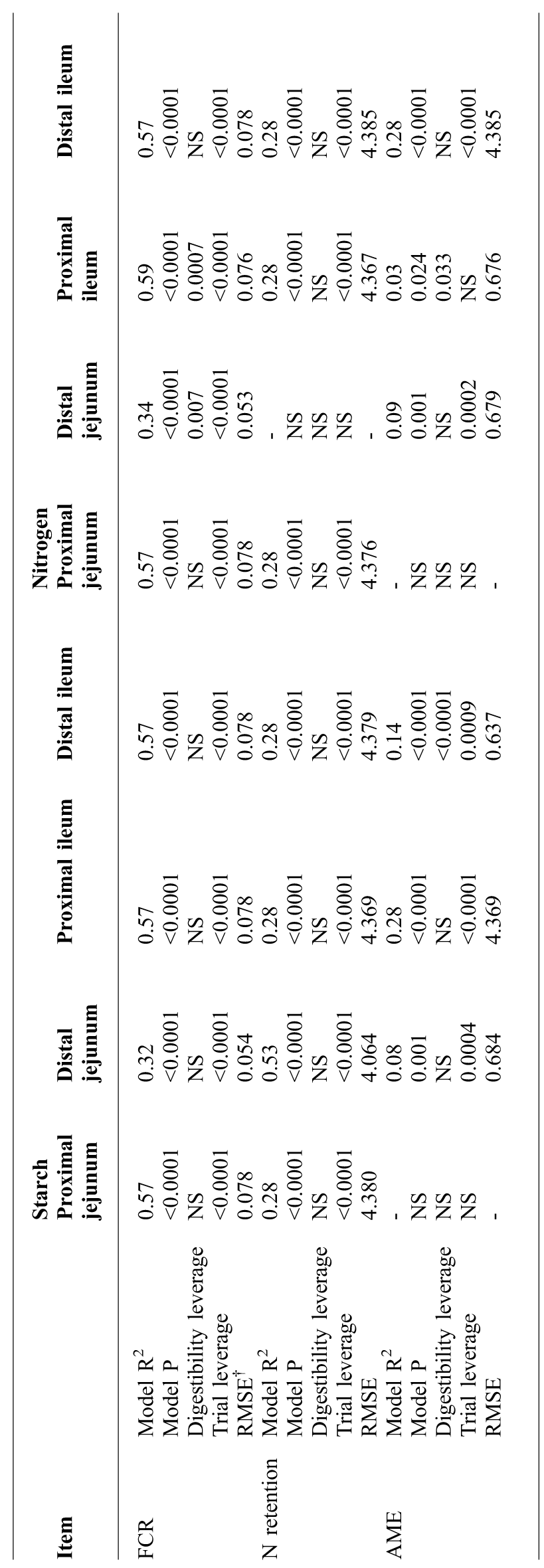
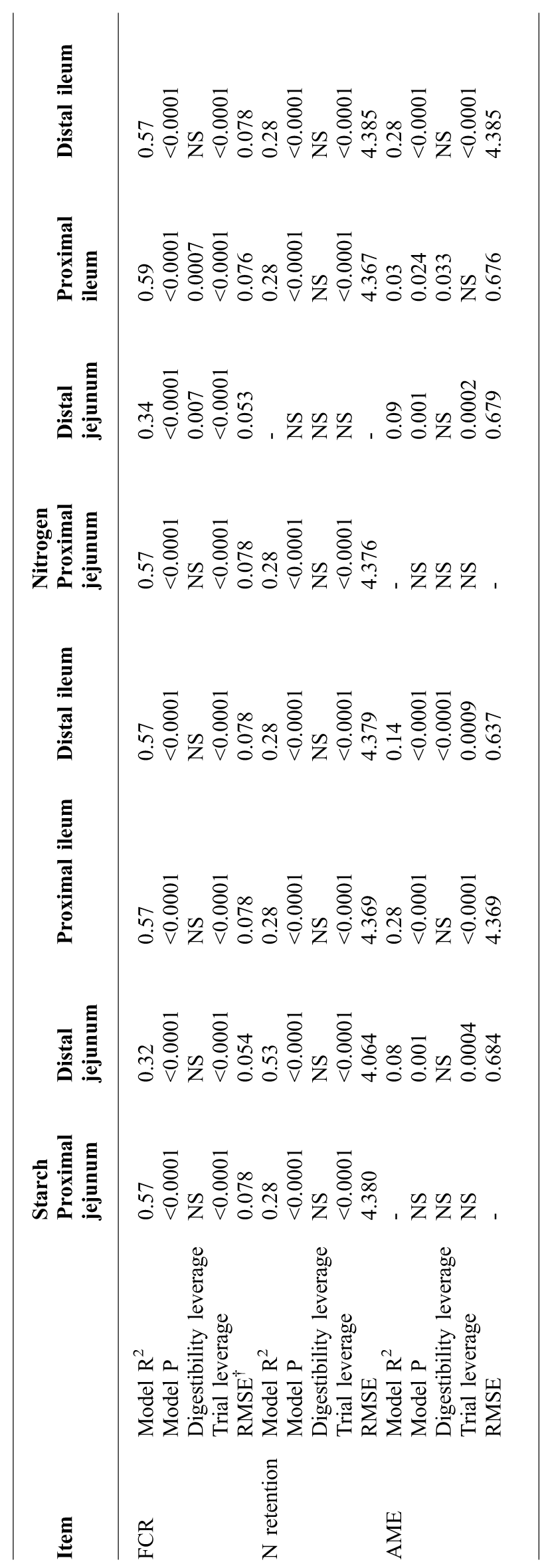
It is evident that rates of starch and protein digestion, either individually or in combination, influence feed conversion efficiency, N retention and energy utilisation. However, it is instructive to examine the effects of digestibility coefficients of starch and protein in these parameters (Table 1). Feed conversion ratios were not correlated with starch digestibility coefficients in all four small intestinal segments. In contrast, N digestibility coefficients were correlated with FCR in the distal jejunum and proximal ileum but variation between experiments was significant. Nitrogen retention, which is a broad indication of protein utilisation in chickens, was not correlated with starch and protein digestibility coefficients in any small intestinal site. Energy utilisation (AME) was correlated with starch digestibility at the distal ileum and N digestibility at the proximal ileum but, again, experimental leverage was significant. These findings suggest that static, starch and N digestibility coefficients on an individual basis are not highly indicative of feed conversion efficiency and nutrient utilisation in broiler chickens but they may be converted to more meaningful indicators when expressed in the context of digestive dynamics.
The predicted model of FCR with nitrogen digestion rate, when log(kstarch) was fixed to three levels; and the predicted model of FCR with starch digestion rate, when log(knitrogen) was fixed.

Relative starch and protein disappearance in a sorghum-based broiler diet
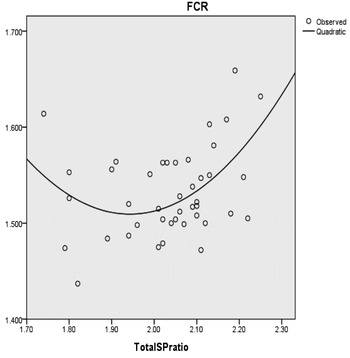
Selle et al. (Reference SELLE, LIU, CAI and COWIESON2013b) offered broilers six diets based on a red sorghum (121 g/kg protein, 706 g/kg starch) where the diets were offered as mash, intact pellets steam-pelleted at conditioning temperatures of 65, 80 and 95°C, reground mash following pelleting at 95°C, and with protease added to the 80°C diet. The quantities of starch and protein (g/bird) that disappeared or were apparently absorbed from four small intestinal segments were retrospectively calculated. Individually, absorption of starch and protein were not linearly (P>0.15) or quadratically (P>0.30) related to FCR. However, the ratio or balance of total starch:protein absorbed was quadratically related to FCR (r=0.470; P < 0.01) as expressed in the following equation:
y=5.193 – 3.792*ratio + 0.976*ratio2
It may be deduced that the optimum starch:protein ratio for feed conversion efficiency was 1.934 which would generate an FCR of 1.510 as shown in Figure 2 where a relative excess of either component could depress feed conversion efficiency. In addition, the starch:protein absorbed ratio was linearly (r=0.433; P < 0.005) and quadratically (r=0.444; P < 0.015) related to energy utilisation (AME) in this experiment.
Quadratic relationship (r = 0.470; P < 0.01) between starch:protein apparent absorption ratios (TotalSPratio) from four small intestinal segments and feed conversion ratios (FCR) in broilers (adapted from Selle et al. (Reference SELLE, LIU, CAI and COWIESON2013b)).

Manipulation of starch and protein digestive dynamics
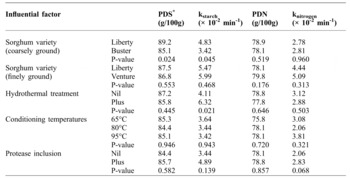
Several factors have the potential to modify starch and protein digestive dynamics are discussed below but the inherent variation in grains that exists in starch and protein content of relevant grains from different sources should not be overlooked. For example, Weurding et al. (Reference WEURDING, VELDMAN, VEEN, VAN DER AAR and VERSTEGEN2001) found different small intestinal starch digestion rates in broilers across feedstuffs where sorghum had the lowest starch digestibility and the slowest starch digestion rate. As shown in Table 2, Liu et al. (Reference LIU, SELLE and COWIESON2013d) compared digestive dynamics of starch and protein in red (Buster) and white (Liberty) sorghums and found that white sorghum had significantly a 41% higher starch digestion rate (4.83 versus 3.42 × 10⁻² min-1, P < 0.05) than red sorghum but there was no significant difference in protein digestion rate. The digestibility coefficients of amino acids in numerous feedstuffs have been very extensively recorded but information about protein/amino acid digestion rates of different feedstuffs is limited. However, it has been demonstrated in rats that the digestion of lysine from casein in the gut lumen and its appearance in portal circulation is more rapid than lysine from soy flour (Goldberg and Guggenheim, Reference GOLDBERG and GUGGENHEIM1962).
The effects* of apparent digestibility coefficients of starch and protein on feed conversion ratio (FCR), nitrogen (N) retention and apparent metabolisable energy (AME).

*Model terms ‘digestibility’ and ‘trial’
† RMSE=Root Mean Square Error
whole grain feeding
The practice of offering some whole grain, usually wheat, to broiler chickens in tandem with a pelleted concentrate is increasingly being used in Europe, Canada and Australia (Liu et al., Reference LIU, TRUONG and SELLE2014d). Whole grain feeding (WGF) has the potential to enhance FCR and energy utilisation and this is mainly attributed to the development of larger and more functional gizzards. However, as demonstrated by Wu et al. (Reference WU, RAVINDRAN, THOMAS, BIRTLES and HENDRIKS2004), pre-pelleting addition of whole grain has the capacity to improve FCR and AME without triggering heavier relative gizzard weights which indicates other mechanisms may be involved. There are indications that WGF generates slowly digestible starch which may be a partial genesis of FCR and AME improvements. This may stem from delayed gut passage rates, increased grain particle sizes and increased episodes of reverse peristalsis but direct supportive evidence is lacking. However, compared to whole grain, there is the likelihood that grain that has been hammer-milled and steam-pelleted will possess faster starch digestion rates.
hydrothermal processes
Hydrothermal processes are essentially limited to steam-pelleting broiler diets. However, starch gelatinisation is in the order of only 20% in steam-pelleted diets because of relatively short exposure times, low moisture additions and moderate temperatures during the steam-pelleting process (Svihus et al., Reference SVIHUS, UHLEN and HARSTAD2005). Liu et al. (Reference LIU, SELLE and COWIESON2013d) compared the digestive dynamics of an unprocessed sorghum-based mash diet with a reground mash diet pre-pelleted at a conditioning temperature of 95°C to eliminate the feed form effects of an intact pellet. As shown in Table 2
The factors influencing dynamics starch and protein digestion in sorghum based broiler diets.
*PDS=potential digestible starch; PDN=potential digestible nitrogen; kstarch=starch digestion rate; knitrogen=nitrogen digestion rate
, the hydrothermal component significantly increased starch digestion rates by 54% (6.32 versus 4.11 versus × 10-2 min-1). Liu et al. (Reference LIU, SELLE and COWIESON2013b) also showed that increasing conditioning temperatures from 65 to 80 and 95°C did not influence dynamics of starch and protein digestion. Decreased grain particle sizes have been shown to accelerate in vitro starch digestion rates (Al-Rabadi et al., Reference AL-RABADI, GILBERT and GIDLEY2009; Mahasukhonthachat et al., Reference MAHASUKHONTHACHAT, SOPADE and GIDLEY2010). In the Liu et al. (Reference LIU, SELLE and COWIESON2013b) comparison sorghum grain was initially ground through a 3.2 mm hammer-mill screen. However, the secondary particle size reduction from steam-pelleting coupled with physical attrition, rather than starch gelatinisation, probably accounted the substantial increase in starch digestion rates observed in the reground mash diets. This finding has obvious implications for whole grain feeding and may be the prime factor in the generation of slowly digestible starch that appears to be associated with this approach.
exogenous enzymes
Exogenous enzymes were adopted by the chicken-meat industry in the mid-1980s and were initially included in diets based on the ‘viscous grains’, barley and wheat, but now feed enzymes are routinely included in all poultry diets. Xylanase has shown to improve jejunal and ileal starch digestibility in wheat-based diets (Choct et al., Reference CHOCT, HUGHES and BEDFORD1999) and improvements in jejunal digestibility is suggestive of increased starch digestion rates and rapidly digestible starch. Phytase feed enzymes are almost invariably included in broiler diets and this practice has been the subject of a large number of publications (Selle and Ravindran, Reference SELLE and RAVINDRAN2007; Selle et al., Reference SELLE, COWIESON, COWIESON and RAVINDRAN2012). The substrate phytate has the capacity to impede digestion of protein and absorption of amino acids and, probably to a lesser extent, starch and glucose, thereby impacting on digestive dynamics. The impact of this essentially remains unexplored. However, Liu et al. (Reference LIU, CADOGAN, PÉRON, TRUONG and SELLE2014a) reported that in P-adequate maize-based broiler diets phytase improved weight gain by 12.3% (1387 versus 1235 g/bird) and FCR by 4.02% (1.457 versus 1.518). This was associated with phytase-induced increases in digestion rates of starch (11.66 versus 8.48 g/hour) and protein (5.55 versus 4.33 g/hour) by 37.5 and 28.2% in the small intestine, respectively. Phytase can influence starch and protein digestion rates and this should be taken into consideration in the context of digestive dynamics. Protease and amylase, by definition, may directly influence starch and protein digestive dynamics. Liu et al. (Reference LIU, SELLE, COURT and COWIESON2013a) showed that in sorghum-based broiler diets, an exogenous protease significantly increased the digestion rates of 12 ex 16 amino acids, including leucine (3.05 versus 2.07 × 10⁻² min-1) and histidine (3.45 versus 2.57 × 10⁻² min-1) by 47.3 and 34.2%, respectively. Protease also tended to increase protein digestion rates (P < 0.07) but did not influence starch digestion rates (P>0.125).
synthetic amino acids
Synthetic amino acids appear in the portal circulation more rapidly than protein-bound amino acids and have the potential to modify protein digestive dynamics. In one feeding study wheat-based broiler diets were supplemented with 2.06 g/kg methionine, 2.95 g/kg lysine hydrochloride and 0.87 g/kg threonine (Selle et al., Reference SELLE, GILL and SCOTT2007). This represented 40, 20 and 11%, respectively, of the specific amino acid concentrations in the diet but 2.5% of the dietary protein content. These proportions are substantial for relevant amino acids and it is likely that the use of these and other synthetic amino acids will increase in response to escalating protein meal prices. Synthetic amino acids have the capacity to increase protein digestive dynamics relative to starch which could be beneficial but also, the balance of synthetic amino acids and protein-bound amino acids counterparts may become skewed at protein deposition sites and be detrimental. This was demonstrated by Batterham and Bayley (Reference BATTERHAM and BAYLEY1989) in the case of phenylalanine oxidation in grower pig fed on a restricted basis with free lysine-supplemented diets.
Conclusions
Digestive dynamics of starch and protein along the small intestine are relevant to efficiency of feed conversion and energy utilisation. However, the number of studies that have investigated digestive dynamics in broiler chickens and possible strategies to enhance performance by balancing starch and protein digestive dynamics are limited. To enable practical nutritionists to embrace the concept of digestive dynamics in formulating broiler diets will require the generation of a considerable amount of data on the digestion rates of feed ingredients. It is only with this database that nutritionists will be able to adopt digestive dynamic concepts where recognition is given to rates, sites and amounts of digestion. As a consequence, with this information, nutritionists will be better positioned to predict and improve the efficiency of feed conversion in broiler chickens.