Hypertrophic cardiomyopathy is an inherited heart muscle disease with an estimated prevalence in the adult population of 1:500. Owing to the autosomal dominant nature of this disease, persons who have a parent with hypertrophic cardiomyopathy have a 50% risk of inheriting the mutation.Reference Hada, Sakamoto, Amano, Gidding, Kurosaki and Bild1, Reference Maron, Gardin, Flack, Gidding, Kurosaki and Bild2 Hypertrophic cardiomyopathy carries a risk of sudden malignant arrhythmias and is the most common medical cause of sudden cardiac death during exercise in childhood and adolescence. The left ventricular hypertrophy associated with the disease tends to accelerate during puberty, and the risk of sudden unexpected death reaches the highest level between 9 and 16 years of age.Reference Östman-Smith, Wettrell and Keeton3 Lifestyle modifications have been shown to result in decreased mortality rates.Reference Corrado, Basso, Schiavon and Thiene4–Reference Bjornstad, Corrado and Pelliccia6 Similarly, medical therapy with high-dose beta-blockers have been shown to reduce mortality in childhood hypertrophic cardiomyopathy.Reference Östman-Smith, Wettrell and Riesenfeld7, Reference Östman-Smith, Wettrell and Keeton8 Therefore, screening to identify symptom-free individuals is justified according to the World Health Organization criteria.Reference Wilson and Jungner9 Published official guidelines recommend family screening in inherited cardiac disease,Reference Maron, Chaitman and Ackerman10, Reference Maron, McKenna and Danielson11 and this has become a policy recommended by the Swedish National Board of Health and Welfare.12 Such a screening policy will, however, lead to a number of asymptomatic children and adolescents receiving a diagnosis of a chronic disease that carries consequences for their future lifestyle. There are few studies on the psychosocial impact of the diagnosis of hypertrophic cardiomyopathy in children and adolescents. A diagnosis of hypertrophic cardiomyopathy involves a transition from the experience of feeling healthy to having a potentially life-threatening chronic heart condition. This affects both the individual child and the rest of the family, in particular the parents, and sufficient support for affected families is a cornerstone in creating a basis for these individuals to live a good life even after the diagnosis.Reference Bratt, Ostman-Smith, Sparud-Lundin and Axelsson13 Changes in health and onset of illness in individuals initiates a process of transition, which by itself may in turn affect their health negatively.Reference Meleis, Sawyer, Im, Hilfinger Messias and Schumacher14 The aim of this study was to describe children's and adolescents’ experiences of being screened positive for hypertrophic cardiomyopathy and how this impacts their daily life.
Patients and methods
This is a qualitative descriptive study based on individual interviews, using qualitative content analysis to describe asymptomatic children's experiences of being diagnosed with hypertrophic cardiomyopathy through family screening. Asymptomatic children and adolescents between the age of 8 and 18 years diagnosed with hypertrophic cardiomyopathy through family screening were consecutively recruited and asked to participate in the study between January, 2007 and December, 2009. They had to understand and speak the Swedish language. The participants were recruited from a specialist outpatient clinic. After a period of between 1 and 2 years from the date of the diagnosis, a letter was sent to the families, with information about the study. The family was contacted by phone 2 weeks later and asked whether the child wanted to participate. The child's guardian(s) received the same information as the child and had to give their permission for participation.
Data collection – interviews
Interviews were conducted between May, 2007 and December, 2009. The first author performed all interviews. The interviewer met the participants in the role of a healthcare professional at the outpatient clinic. To emphasise that the interviewer was in the role of a researcher, she did not wear the hospital uniform. In all, 12 interviews were conducted in a private room at the hospital, one of two paediatric cardiac surgery centres in Sweden, and one child wished to be interviewed at home. The median timing of the interviews was 18 months after diagnosis. The participants were invited to talk freely about their experiences and thoughts after they received the information about the diagnosis. The interviews were guided by open-ended main questions and a set of sub-questions, and were audio-taped and transcribed verbatim by the first author. The median interview duration was 14 minutes.
Content analysis
The interviews were analysed by means of qualitative content analysis, a method for the systematic analysis of interview texts in various steps.Reference Krippendorff15 The content analysis used was influenced by Graneheim and Lundman.Reference Graneheim and Lundman16 The 13 interviews were combined into one text and were then read several times to get an initial understanding of the whole. After this step, the text was divided into units of meaning that were condensed into shorter units still preserving the core content. The condensed meaning units were coded and labelled on the basis of shared concepts. During the analysis, when identifying and describing the content, efforts were made to stay close to the interview text. By going back and forth within the whole interview text, the meaning units and codes, subthemes and themes were identified. The co-authors reviewed the transcribed interviews and coding scheme to enhance conformability and increase validity and trustworthiness. If agreement could not be achieved, further analysis was performed until consensus was reached.
Ethical considerations
According to rules applied by the local research ethics committee at the commencement of the study, committee approval was not required for studies involving questionnaires or interviews. Written and verbal information about the study was given, stressing that participation was entirely voluntary, and informed consent was obtained. Confidentiality was guaranteed. Children were recruited among participants in a treatment study with ethical approval (Study Code ÖS 257-02). The study was performed according to the Declaration of Helsinki.17
Results
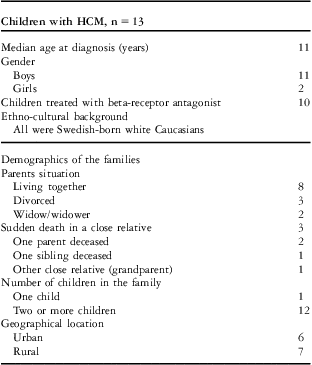
In all, 15 children and adolescents were invited and 13 agreed to participate. The two children who declined were both girls. Their socio-demographic and medical characteristics did not differ from that of the participating families shown in Table 1. The text analysis resulted in one overall theme, three themes, and 11 subthemes (Table 2). Quotes will be referred to as boy or girl followed by age.
Socio-demographic and medical characteristics of the children and the families.
HCM = hypertrophic cardiomyopathy
Navigating from being healthy to having a chronic potentially life-threatening heart disease.

Navigating from being healthy to having a chronic life-threatening heart disease
The overall theme describes the transition process, which started the moment the participants were informed about their diagnosis. From that point in time, they started a journey with a map with multiple choices. Many waypoints were similar or identical for all participating children at baseline and some were different, which could be depending on age, gender, and socio-demographic background. They all started asymptomatic and they all ended up being diagnosed with a potentially life-threatening heart disease that would last lifelong. The diagnosis was perceived as having more or less implications on their daily life and on their future. They all navigated through the initial process, which they passed with varied emotional responses and reactions, and they tried to cope with the fact and the consequences of the diagnosis. Daily life was affected both in the individual context and in their social context. At the end, they strived for reorientation and to find ways to cope with new reference frames in life and succeeded in having faith and hope in the future. In addition, the natural development during adolescence was also present during this transition.
An involuntary change
Children diagnosed through family screening described experiences of an involuntary change in life accompanied by immediate emotional reactions. They tried to handle the situation and to cope with the diagnosis using different strategies.
Grief characterised the immediate period after the diagnosis and included feelings of disappointment, loss of freedom of choice, and feelings of injustice. Some children, more common in the younger ages, said they felt sad for a short while and then they “forgot” about it. “…I remember…that I was sad… // I forgot about it in the evening (boy 9 years)”. Older children and adolescents expressed that grief more or less was the dominant emotion during the first year after the diagnosis, and for some the diagnosis created feelings that their life was destroyed. “Yes, it was as if the world had collapsed (boy 15 years)”. Loss was described in terms of losing the freedom of choosing leisure-time activities, education, and future professions. This was experienced as a severe loss. Being forced to face the fact that they had to quit sports activities affected many of them deeply, as team sports participation was considered one of the most important things in life. “I am not sure… I mean I was not depressed by having the disease, I felt sorrow because I could not continue to play soccer…that is what makes me sad…(girl 15 years). They said… stop playing hockey, stop the soccer…yes all the sports I was doing, stop the training, and that was what I was living for (boy 15 years)”. Feelings of injustice and disappointment were described, and thoughts and questions about why the disease hit them were expressed. They felt that it was unfair. “That everything was shit…I…thought it was unfair (Boy 18)”, “So damned typical…why me? (boy 12 years)”.
Fear due to the life-threatening character of the disease was obvious. They also feared the unknown and what the diagnosis would lead to. The fear of being at risk of dying suddenly was described. Children and adolescents with the experience of sudden death in a close relative described this more often. “Your heart gets thick and if you exercise too much you may die…(boy 9 years)”, “At that time I was afraid of that…that maybe I would not get blood and just die there on the floor or whatever. So it was a little like that…(boy 18 years)”. Some were afraid and anxious of being forced to undergo surgery even if surgery was not mentioned in the information regarding the treatment regime. “Afraid of being operated upon… well…that was what I was thinking…(girl 15 years)”, “No I think I thought…if I would have surgery with one of those devices put into me…just like that…(girl 15 years)”.
Gratitude at having been diagnosed in time was also stated. Gratitude because the disease was detected before any serious or even life-threatening complication occurred. “Yes…then they know…they have full control over me…all the time…and that makes me feel good. I was thinking about that before, what if my uncle had not…if he had died from some other reason, then I would not have known…so I think it is very good. I really think so (boy 18 years)”.
The fact that they were diagnosed with a chronic condition that was life threatening meant that they had to face a painful reality. They dealt with this using different strategies. Some children, more common in younger ages, described that they accepted the diagnosis as a matter of fact, and did not describe any specific feelings or reactions in connection with the diagnosis, whereas others, especially older children, preferred to repress the information. This was described as not wanting to think about it; they wanted life to continue unchanged “I probably didn't think so much about it, I think I just thought…well…do I have a heart disorder or something…I mean OK…then I have…I don′t think I thought so much about it…”. I tried to forget about it as much as possible…and just thought about it as little as possible…(boy 12 years)”.
Impact on daily life
The lifestyle recommendations prescribed were experienced as limitations and restrictions that affected daily life, especially physical activities. They were forced to quit some sports and other inappropriate leisure activities, and they had to cope with ongoing worries.
Limitations in daily life had a major impact. Future professional and educational plans had to be reconsidered “Yes…I set up limits for myself. Like now it is enough. Now I go back home and relax, sit down and just take it easy (boy 18 years)”, “I was swimming, but I quit that because it was too much effort…but now I have started high school…there we work outside sometimes and it is a lot of physical work and I manage that well…that is a quite different thing than sports… . But I participate in sports also now… . I do this on my level (girl 15 years)”. However, a neglecting and negative attitude towards the lifestyle recommendations was also described, more common in children with previously high degree of sports participation. They sometimes did not want to accept and follow the advice given. “No they didn't say I couldn't do anything…but that it would be good if I started with some less intense sport…but I didn't want that (boy 17 years)”. Descriptions of experienced fatigue and even exhaustion during or after physical activity were expressed, sometimes as a possible side effect of the medication. “I would probably have had better physical ability if I had not been on the medicine… // I am more easily exhausted…but I don′t put in as much effort…when running I do it slower than before (boy 17 years)”, “Well it is the medicine I think, it makes you tired, I think I have to switch to some other drug soon. I oversleep every morning, I′m like paralyzed in the bed in the morning. Just can′t get up (boy 18 years)”. Some did not experience any limitations and they often had a low level of interest in physical activities or sports. Others had not yet planned their future profession, or had already planned to work within advisable professions. The only difference they noted was the medication. “Well it wasn′t that much different…except I had to take that drug (girl 15 years)”.
The tangibility of the disease appeared in different situations in their daily life. Some children said that the disease became close and real at bedtime or in situations that were quiet and peaceful and allowed thoughts to roam. In these situations, thoughts and anxiety became entwined and sometimes frightening. “When I′m about to fall asleep I usually think about it…what if something happens? (boy 11 years)”. The disease also became present when they had to decide their participation in any kind of physical activity. They had to remind themselves of their limitations in physical activities.
“Well…when exercising you often think about it…at least sometimes…I think about it when I get exhausted… . (girl 15 years)”. Thoughts about daily life and why the consequences hit them and changed their life came to the fore in different situations. “But as I say I really think about it every day. How it could have been. That I could have been playing hockey with my friends // …As I said…I think about sports every day…it is not so easy to forget about it. When I know…as I said…how good I was without boasting too much…what a good chance I had (boy 15 years)”. Some children and adolescents were reminded when they took the medication and never otherwise or did not think about the disease every day or much at all. “…in reality it is every morning and night when I take the medication…sometimes during athletics…I′m probably not thinking about it…I have it…it′s just there… (boy 12 years)”.
Adaptation to a life with new reference frames and changes in daily lifestyle was an important task. Ongoing worries were present during daily life while trying to cope with fear and the awareness of risk. Worries were most obvious in certain situations such as during activities with restrictions. Some children also expressed anxiety when they experienced symptoms that might be related to the diagnosis. “I worry sometimes when I…sit on my bed…and…after a while the heart beats very fast (boy 9 years)”. Thoughts about the progression of the disease were apparent in some, whereas others did not describe this or any other worries at all. Adapting to the restrictions and limitations in addition to handling changes became an important task. They also had to adapt to new options in life and sometimes reconsider future plans. “Yes…I thought that I maybe could not attend this high school but I asked the doctor, and she said it was OK…but you have to take it a little easy…and it has worked out well…much better than I thought…(girl 15 years)”, “When you sit in school you think like this…why do I have to sit here? When I could have attended the ice hockey high school or the athletics high school. These thoughts follow me all the time actually (boy 15 years)”.
Social changes in their community also became a central issue. Suddenly their natural environment for leisure-time activities and school was affected as a consequence of the lifestyle recommendations. In some cases, the social context was lost, which affected them deeply. This change was gradual. “Didn′t loose contact with my friends directly but later…miss soccer above all my friends…I am not seeing the same friends any more…(boy 17 years)”, “…I think about it every day actually. How it could have been. That I could have been with my friends on the hockey-rink…(boy 15 years)”. The social support was important and in younger ages support often came from the closest family, whereas for the adolescents friends, teachers, and girlfriend/boyfriend also contributed to the social support context. “…Mum comforts me (boy 11 years)”, “My girlfriend supports me if I need to talk about something (boy 18 years)”. Thoughts about consequences in school and particular in grading school gymnastics were mentioned. “Yes…the worst was how they would put my grades? Will they lower them? But it was good we could talk about it…and to hear that it would have no influence on my grades (girl 15 years)”. Some wanted to inform their friends and teachers about the disease so that they would understand why they had to be treated differently in certain situations, whereas others did not want anyone outside the closest family to know. “No…sometimes when we play rounders…then I usually ask somebody who runs fast to run for me…then somebody may say “but run now!” And then I say I am not allowed to…and then they say “yeah that′s right (boy 10 years)”, “The first day when I had heard about it…then I told everybody that I had a heart disease. Instead of keeping it secret…then they would just…why does he go to a cardiologist? I think it is best to tell everybody (boy 12 years)”.
Another important aspect of informing others was described as a matter of increasing sense of security, as they would know how to handle emergency situations that might occur. To prepare others gave a sense of relief and made them feel more secure. Friends and relatives also had a protective function; they reminded them of things that were not appropriate to participate in. “Yes…if something would happen to me some time they might just think I just fainted…it is important that they know… // Because you don′t call an ambulance because you fainted…but if they know you have heart disease… // in the beginning they were there…when I was not allowed to run…then they were there and…no, no you are not allowed to run…(girl 15 years)”.
Reorientation
Future plans were most common in older children, although younger children also expressed an understanding of not being allowed to freely choose profession. In the beginning, some children described that they had lost faith in the future and that their life was ruined. At the time of the interview some 18 months later, and within the reorientation phase, they had reconsidered and no one expressed those feelings or thoughts anymore. They had gone through a process that changed their reference frames in life and they seemed to have had adapted and reoriented.
Sense of control was the opposite to feelings of anxiety and fear due to possible complications of the disease and was described as an understanding regarding the importance of compliance to the medications and lifestyle recommendations. Thoughts about what might happen if they did not take their medication or did inappropriate physical activities were, however, also described. Feelings of security were also related to the medical check-ups. “Yes, if I do not take my medication, and don′t take care of myself, then of course…something might happen one day // Yes and that my doctor says everything will be OK, that makes me feel safe. Yes, now when my doctor says it looks very good, I feel…now it is just to continue with the drug…even if I know I will have to live with the disease… // I feel good about coming to medical check-ups, then you know, I mean then I feel that you have control if something would happen (girl 15 years)”.
Responsibility was an important part in taking control over life. They understood that if they acted responsibly, which in this context meant managing medication and complying with lifestyle recommendations, they had better possibilities to remain asymptomatic and free from complications. Worries of serious complications made them adapt and they developed an understanding of the importance of their own responsibility “I was thinking that…if my heart could break or whatever could happen…I had limits for myself, I did take it very easy…I didn′t want to overwork, to risk a complication. I was very calm. I really was…(boy 18 years)”. Thoughts and consequences of planning a family in the future was expressed, but not as being a problem. “It can be transmitted…to the children I will have, that is how I have understood it. // I know myself how my life has been, so I think my children will also manage it…(boy 18 years)”.
Hope and faith in the future was a positive aspect in the reorientation process. After being forced to an involuntary change in life, they strived towards a reorientation with new reference frames. They wanted life to continue without any complications, and after a while the reorientation was something that they could see as something positive in life “It would have been athletics teacher then. Something within sports, I cannot think of anything else. // I have got the opportunity now to do many other things, that is clear. I have read about the body now and I find it really interesting. I wouldn′t have been able to do that had I been active within sports or athletics. So that is positive in a way (boy 15 years)”,“No… I am thinking it will work out well. I too will also be able to have an ordinary job even if I have this problem. It will not stop me. It will not. For sure…“// No, I see a bright future all the time…(boy 18 years)”.
Discussion
The aim of this study was to describe asymptomatic children's experiences, and the adjustment mechanisms they employed, after being diagnosed with hypertrophic cardiomyopathy through family screening. The study focuses on the child's experience in contrast to our previous study,Reference Bratt, Ostman-Smith, Sparud-Lundin and Axelsson13 which focused on the parent's experiences of having their asymptomatic child diagnosed with hypertrophic cardiomyopathy. We chose a qualitative method because it increases insight into the complexity of the needs of children from their perspective. ClarkReference Clark18 claims that there is a need for describing patient's experiences in paediatric cardiology, and that the professional healthcare system should not only diagnose and treat. There is a need to deepen the knowledge of interpersonal interaction and support and qualitative studies are well suited to address these aspects.
The overall theme in the present study synthesises the transition process that these children went through. They had to learn to navigate within a new frame and to reconsider future plans. The immediate responses and reactions were characterised by grief, fear, and also gratitude, and they tried different strategies to deal with the new facts. Suppression of knowledge was more common in older ages, whereas the younger children often accepted the diagnosis and lifestyle changes quite quickly. The necessity of lifestyle modifications according to current guidelinesReference Corrado, Pelliccia and Bjornstad5, Reference Maron, Chaitman and Ackerman10, 12 was associated with fear and anxiety both in this study and in our previous study on the reaction of the parents.Reference Bratt, Ostman-Smith, Sparud-Lundin and Axelsson13 This anxiety was most pronounced in direct relation with physical activities.Reference Bratt, Ostman-Smith, Sparud-Lundin and Axelsson13, Reference Hendriks, Grosfeld and Van Tintelen19, Reference Meulenkamp, Tibben and Mollema20 Some had no daily awareness of the disease, but some were forced to make active decisions about whether they should participate in certain activities. The degree of impact on daily life was related to interest in sports and physical activities. Children interested in sports often had their social network in the sports community, and thus the diagnosis not only ruined their possibility to pursue their greatest interest, it also affected and changed their social context.
There is a lack of studies on the psychosocial consequences of family screening in children. However, Meulenkamp et alReference Meulenkamp, Tibben and Mollema20 performed a similar qualitative interview study on children diagnosed through family screening as having Long QT syndrome, hypertrophic cardiomyopathy, or familial hypercholesterolaemia. Although their study included only six children with hypertrophic cardiomyopathy, their findings can be compared with the results of the current study. Some of their patients were also given advice on restrictions in future careers and physical activities, and most received prophylactic medication. Most children in that study coped quite effectively with their condition and their parents confirmed the impression of successful adaptation. Meulenkamp et alReference Meulenkamp, Tibben and Mollema20 also concluded that feelings of control appeared to be of paramount importance for the coping process. The children who doubted the effectiveness of preventive measures appeared to have more problems with compliance. In another study, Smets et alReference Smets, Stam and Meulenkamp21 studied health-related quality of life in the same group of children and found no significant differences compared with a reference group.
Meleis et alReference Meleis, Sawyer, Im, Hilfinger Messias and Schumacher14 describes a diagnostic and unanticipated transition characterised as a deviation from the illusiveness of normality. It is important to identify the needs and complexities of transition experiences. There are, however, few or no studies on how adolescents who are informed that they have a life-threatening chronic disease, although asymptomatic, handle normative developmental tasks, such as identity formation. Luyckx et alReference Luyckx, Goossens, Van Damme and Moons22 found that adolescents with congenital heart disease tackled their identity formation process in a manner similar to how their healthy peers did. Marginalisation from peers seems not to be a problem in our study, and the children in the current study seemed to adapt quite well in the medium-term perspective. However, it was sometimes a turbulent journey to reach that point of reorientation when they felt faith and hope in the future. The impact of the initial diagnosis seemed more severe, and the process of adaptation more turbulent, in the adolescents than in the younger children. There are medical reasons why screening ought to be carried out before the risk of sudden death becomes significant around 8 years of ageReference Östman-Smith, Wettrell and Keeton3 and this study indicates that there might be psychosocial reasons why the first screening should be carried out in early childhood, rather than at the beginning of adolescence.
Family screening and diagnosis in asymptomatic children must be accompanied by rigorous follow-up, focusing not only on medical issues. There is a need for healthcare professionals to develop routines and follow-up programmes. This should ideally be based in a healthcare team, which includes a liaison nurse specialised in inherited cardiac disease and a cardiologist, with access to a physiotherapist and a psychologist. It is crucial that the follow-up should not only consist of medical status and follow-up of treatment, but also engage with compliance to lifestyle changes. Newly diagnosed individuals need support in starting up their navigation. In contrast to findings in our previous study of the experiences of the parents,Reference Bratt, Ostman-Smith, Sparud-Lundin and Axelsson13 the children did not mention a need for an easy access to a liaison nurse. Children often talked to their parents or friends when they wanted support or comfort, which creates a need for parents to have the “life-line” as they described the contact with the liaison nurse.
Methodological considerations
The retrospective design is a limitation but necessary in order to study transition mechanisms. As in many qualitative studies, the number of participants was small. The interview duration was short, but it is a well-known fact that when interviewing children long interviews should be avoided because of their limited ability to concentrate.Reference Kortesluoma, Hentinen and Nikkonen23 The participants were recruited from one specialist clinic, and this might affect the findings. Data were collected from the participants’ memories of their experiences of the diagnosis within a 2-year time period. Children 6 years of age and older have cognitive and language capabilities to be interviewed, and their autobiographical memory has been shown to be very accurate and stable over time.Reference Docherty and Sandelowski24 All participants were Swedish-born, and if the study had been based on a more diverse ethnic group other themes may have occurred. Another issue is that the study group consisted of a larger proportion of boys; however, the gender balance in childhood hypertrophic cardiomyopathy shows male preponderance.Reference Östman-Smith, Wettrell and Keeton3, Reference Olivotto, Maron and Adabag25
Conclusions
Children diagnosed with hypertrophic cardiomyopathy through family screening went through an involuntary change resulting in limitations and restrictions in life. This initiated a reorientation process that was navigated with less turbulence by the younger children and seemed to be more prominent in adolescents. Lifestyle recommendations had the most severe impact on daily life and sometimes affected their social context. This study indicates that there is a need for support for the child during this journey. Healthcare professionals have to consider the specific needs in these families.
Clinical implications
Knowledge about how asymptomatic patients react when they receive the information about a chronic life-threatening disease is necessary to offer good patient and family support when embarking on a general programme for family screening. There is a need to develop patient education in order to reach higher compliance and adaptation and to give patients an instrument for taking responsibility for their health. The relationship of anxiety to physical activities highlights the possible benefit of involving physiotherapist and/or psychologist in the follow-up. Thus, a screening diagnosis should be followed by rigorous follow-up, focusing not only on medical issues, and with access to a multi-professional team.
Acknowledgements
The authors thank the children and adolescents who participated in this study. This study was made possible by the funding and support from the Swedish Heart-Lung Foundation, the Swedish Heart-Children's Association, the Märtha and Gustaf Ågren Foundation Gothenburg in Sweden, Majblomman in Sweden, and the Petter Silverskiölds Foundation, Sweden.