Introduction
Common wheat (Triticum aestivum L.) is one of the most important strategic cereal crops in the world, grows in diverse environments, and is a major component of global food security (Shahinnia et al., Reference Shahinnia, Le Roy, Laborde, Sznajder, Kalambettu, Mahjourimjad, Tillbrook and Fleury2016; Nagy et al., Reference Nagy, Lehoczki-Krsjak, Lantos and Pauk2018). The 21st century continues to witness climate change realities, such as elevated temperature levels, leading to the occurrence of drought episodes, which are one of the environmental factors reducing the productivity of cereal crops worldwide (Tuberosa, Reference Tuberosa2012; Ramya et al., Reference Ramya, Singh, Jain, Singh, Pandey, Sharma, Kumer, Harikrishna and Prabhu2016).
Drought tolerance, if taken as a concept, generally refers to the ability of plants to preserve yield under water-limited conditions (Hoffmann and Burucs, Reference Hoffmann and Burucs2005), whereas from an agronomic viewpoint, it can be interpreted as a plant's ability to minimize yield loss as a result of scarce available water (Clarke and McCaig, Reference Clarke and McCaig1982). Characterization is still the main criterion for examining and selecting drought-tolerant breeding materials, which is based on drought-adaptive and constitutive morpho-physiological traits with grain yield and its components among these traits (Passioura, Reference Passioura2012; Nagy et al., Reference Nagy, Lehoczki-Krsjak, Lantos and Pauk2018). Knowledge about the phenotype response of plants is urgently demanded in breeding programmes to achieve high and stable yields and thus be better prepared, considering climate change's threat to food security (Brown et al., Reference Brown, Cheng, Sirault, Rungrat, Murray, Trtilek, Furbank, Badger, Pogson and Borevitz2014).
The shoot dry weight and yield parameters measured after harvesting are relevant traits in characterising wheat genotypes for drought tolerance (Majer et al., Reference Majer, Sass, Lelley, Cseuz, Vass, Dudits and Pauk2008). Moreover, the importance of root traits in drought tolerance has been well determined (Wasaya et al., Reference Wasaya, Zhang, Fang and Yan2018). Numerous studies have shown the role of the deep and vigorous root systems for higher yields in wheat (Manschadi et al., Reference Manschadi, Christopher, Hammer and Devoil2010; Wasson et al., Reference Wasson, Richards, Chatrath, Misra, Prasad, Rebetzke, Kirkegaard, Christopher and Watt2012), barley (Forster et al., Reference Forster, Thomas and Chloupek2005) and other cereal crops, while some rice-executed experiments proved a notable lack of correlation between root features and drought tolerance (Pantuwan et al., Reference Pantuwan, Fukai, Cooper, Rajatasereekul and O'toole2002; Subashri et al., Reference Subashri, Robin, Vinod, Rajeswari, Mohanasundaram and Raveendran2009).
Flowering time is another critical factor in an ideal adaptation that affects the yield in environments with limited water availability and distribution during the growing season (Tuberosa, Reference Tuberosa2012). Several trials that applied different levels of water availability on various crops demonstrated the association between the plasticity of yield and flowering time (Sadras et al., Reference Sadras, Reynolds, De la Vega, Petrie and Robinson2009).
Evaluation of the yield performance of genotypes in different environments with varying water availability (well-watered, more moderate water scarcity and severe drought) allows effective prediction of the drought resistance of genotypes (Mohammadi, Reference Mohammadi2016). Hence, phenotyping using controlled water regimes provides yield-based germplasm screening, enabling the selection of genotypes with high yields under both well-watered and drought stress conditions (Mwadzingeni et al., Reference Mwadzingeni, Shimelis, Tesfay and Tsilo2016b). The targeted traits for improving yield under water-limited conditions must be genetically correlated with yield and have a higher inheritability than the yield itself (Blum, Reference Blum2018).
In this study, nine selected entries consisting of both drought-tolerant and sensitive wheat varieties and germplasm – previously tested in different phenotyping experiments (Nagy et al., Reference Nagy, Lantos and Pauk2017; Nagy, Reference Nagy2019) – were tested. Their performance was studied under well-watered and drought stress treatments for the traits: heading time, plant height, above-ground biomass, seed number/plant, grain yield/plant, harvest index, root length and root dry mass.
Materials and methods
Plant material and cultivation method
This study involved nine wheat genotypes: six pre-selected DH lines originating from a mapping population for drought tolerance at Cereal Research Non-profit Ltd., Szeged, Hungary, and grouped into two classifications based on the study by Nagy (Reference Nagy2019) – drought-tolerant (PC61, PC110 and PC332) and drought-sensitive (PC84, PC92 and PC94) – and three other varieties from different sources. The latter included varieties: ‘Plainsman V.’ (drought-tolerant), ‘GK Berény’ (drought-tolerant) and ‘GK Élet’ (drought-sensitive) and were used as control genotypes under well-watered and drought stress conditions. ‘Plainsman V.’ is a drought-tolerant variety developed in Kansas, USA, in 1974. It is hard red winter wheat, which gives moderate grain yield with high protein content, and its maturity is early. ‘GK Berény’ is a Hungarian registered variety that is drought-tolerant and early maturing. ‘GK Élet’ is also a Hungarian early maturing variety. As for the DH lines, they were derived from the cross between the drought-tolerant ‘Plainsman V.’ and the drought-sensitive ‘Capelle Desprez’ (French) varieties (Gallé et al., Reference Gallé, Csiszár, Secenji, Guóth, Cseuz, Tari, Gyorgyey and Erdei2009). They were developed through another culture from the F1 generation following the protocol of Pauk et al. (Reference Pauk, Mihály, Puolimatka, Maluszynski, Kasha, Forster and Szarejko2003). The first phenotyping experiment was carried out in the 2017–2018 season (Nagy, Reference Nagy2019) in the greenhouse of the CR Ltd. in Szeged. The seeds were sown on a 1:1 soil and sand mixture in a growing chamber.
One-week-old seedlings were transferred into a cold chamber for vernalization for 6 weeks at 4°C under permanent dim light. After the vernalization period, each seedling was transplanted into a plastic pot filled with a soil mixture of 520 g peat soil, 1276 g dry sandy soil and 3 g controlled-release fertilizer (Osmocote® Exact®, Scotts® Company, Marysville, Ohio) comprised of NPK (16, 9, 12%, respectively) + MgO 2.5% + micro-elements.
Water management
The water capacity of the soil mixture used was determined by calculating the difference between the weight of air-dry soil and water-saturated soil (Cseri et al., Reference Cseri, Sass, Törjék, Pauk, Vass and Dudits2013) before planting. One hundred millilitres of water was then applied to each seedling to ensure adaptation. All genotypes per treatment were supplied with the same amount of water each time (twice a week) with the average irrigation need of the plants, which were different each watering day. The average irrigation need was estimated for each of the plants by calculating the difference between the mean of five well-watered pots weight and the control weight (the difference between the weight of air-dry soil and water-saturated soil). The well-watered plants were irrigated to 60% soil water capacity, while irrigation of the plants was done to one-third of the soil water capacity in the drought stress treatment. The amount of water added to each plant during the growing season was 1654 ml in the drought stress treatment, and 4962 ml in the well-watered treatment.
Investigated traits
Several morphological traits were recorded, such as days to heading, which was calculated for each plant when the upper half of the main spike emerged from the flag leaf sheath. Plant height was recorded after flowering and measured from the ground to the top of the spike (the awn length was not included).
When grains matured, the plants were harvested as a whole, and each plant was placed into a thermostat cabinet in a paper box for drying at 42°C until the weight stabilized. Above-ground biomass weight, seed number/plant, grain yield/plant, harvest index, root length and root weight were then recorded.
Two weeks after the harvest, roots were carefully removed from the soil and washed, before being dried away from direct sunlight, after which the root dry mass was measured.
Experimental design and statistical analysis
The experiment was set up in a randomized complete block design with two treatments (well-watered and drought stress) and five replications. The period of the treatments lasted from 31 January 2019 to 10 July 2019, where the standard greenhouse wheat-growing programme according to Cseri et al. (Reference Cseri, Sass, Törjék, Pauk, Vass and Dudits2013) and Paul et al. (Reference Paul, Pauk, Deák, Sass and Vass2016) was applied.
The collected data were entered into an Excel programme and analysed using R software, version 3.6.1. (R Core Team, 2019). Two-way analysis of variance was used to calculate the standard errors (SE), the least significant differences (LSD0.05), mean squares, the interaction between genotypes and treatments, F value and F probabilities for all phenotypic traits. The test of the correlation matrix was conducted using Pearson product-moment type and pairwise-P values to determine the significance of correlation coefficient values. The fitted linear regression model was used to determine the relationship between the traits. Comparative analysis between two treatments (well-watered and drought stress) was performed for each trait to calculate the reduction value and the percentage of depression. Stress tolerance index (STI) was calculated according to Fernandez (Reference Fernandez and Kuo1992), STI = (y w + y s)/ȳ 2w where y w is the grain yield of a genotype under well-watered conditions, y s is the grain yield of a genotype under drought stress conditions, and ȳ w is the mean of yields under well-watered conditions.
Results
The response of studied trait to water deficit
The statistical analysis of variance (two-way ANOVA) for all studied traits is shown in Table 1. High significant differences of genotype and treatment effects were obtained in all traits except root length. For root length, the genotype effect was significant at P < 0.01, while the treatment effect was significant at P < 0.05. The results of genotype and treatment interaction effect revealed significant differences at P < 0.001 in the traits of heading time and plant height, and the significance at P < 0.05 was present in the traits of above-ground biomass, seed number/plant, harvest index, root length and root dry mass; in contrast, a non-significant difference of genotype and treatment interaction was found in grain yield/plant.
Analysis of two-way ANOVA for each studied trait (Main square)

Significant differences at *P < 0.05, **P < 0.01, ***P < 0.001, respectively.
In this study, the influence of water shortage on wheat genotypes was observed on all investigated traits since the plants changed their phenotype and dry matter accumulation in response to drought stress. Figure 1 demonstrates the effect of drought stress on the investigated traits.
The responses of nine wheat genotypes under well-watered and drought stress conditions for the following agronomical traits: (a) heading time, (b) plant height, (c) above-ground biomass, (d) seed number/plant, (e) grain yield/plant, (f) harvest index, (g) root length, (h) root dry mass. Pl, Plainsman V.; GB, GK Berény; GÉ, GK Élet.

Heading time
The number of days to flowering ranged from 60.2 d in ‘GK Élet’ to 76 d in ‘Plainsman V.’ under well-watered conditions, and from 58.2 d in ‘GK Élet’ to 76.40 d in ‘Plainsman V.’ under drought stress conditions. Drought caused a decrease in days to flowering in all genotypes, as compared to the well-watered conditions, except for ‘Plainsman V.’, which took 0.40 of a day longer to flower under drought treatment compared to the control treatment. Values of the decrease caused by drought were significant in all genotypes except ‘Plainsman V.’ and ‘PC94’. The decrease was the highest in ‘PC84’ and ‘PC110’ (6.60 and 4.40 d, respectively) (Fig. 1(a)).
Plant height
Water deficit affected the plant height of each studied genotype significantly, as compared to the well-watered conditions. Plant height varied from 64.6 cm in ‘Plainsman V.’ under drought stress to 75.60 cm in well-watered conditions, representing the least variation. ‘PC332’ had the highest variation, between 50.80 cm under drought stress and 80.2 cm in the well-watered treatment. The genotypes ‘Plainsman V.’, ‘GK Berény’ and ‘GK Élet’ had the least decrease (11, 16.40 and 16.80 cm, respectively), while ‘PC332’ and ‘PC61’ had the highest decrease in this trait (29.40 and 26 cm, respectively) (Fig. 2(b)).
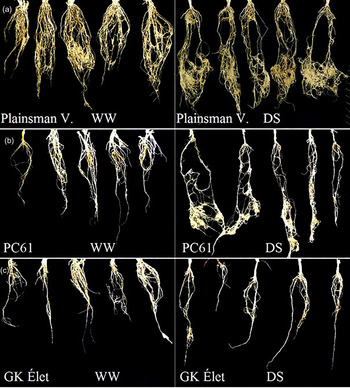
Comparison between replicates of roots under well-watered (WW) and drought-stress (DS) treatments for ‘Plainsman V.’, ‘PC61’ and ‘GK Élet’ genotypes: (a) the five root replicates of ‘Plainsman V.’ genotype under WW and DS treatments; (b) the five root replicates of ‘PC61’ genotype under WW and DS treatments; (c) the five root replicates of ‘GK Élet’ genotype under WW and DS treatments.

Above-ground biomass
Each studied genotype exhibited a significant reduction in above-ground biomass when drought stress was applied compared to the well-watered conditions. The values of this trait ranged from 9.73 g in ‘GK Élet’ to 14.46 g in ‘Plainsman V.’ in the well-watered treatment, and from 2.36 g in ‘GK Élet’ to 4.84 g in ‘Plainsman V.’ under water-stress treatment. The lowest reductions in above-ground biomass trait were observed at ‘PC84’, ‘PC94’ and ‘PC61’ (6.83, 7.05 and 7.33 g, respectively), while the highest reductions were in the genotypes: ‘Plainsman V.’, ‘GK Berény’ and ‘PC332’ (9.62, 8.40 and 7.69 g, respectively) (Fig. 1(c)). The above-ground biomass depression percentage due to drought stress was between 64.99 and 75.75%, as compared to the well-watered treatment. The genotypes ‘PC84’ and ‘Plainsman V.’ had the lowest depression (64.99 and 66.53%, respectively), while the depression percentage was the highest in ‘GK Élet’, ‘PC92’ and ‘PC332’ (75.75, 73.73 and 71.67%, respectively) (online Supplementary Fig. S1(a)).
Seed number/plant
Water shortage caused a significant drop in the seed number/plant of each studied genotype; ‘PC84’ recorded the lowest variation of this trait, between 43.20 under drought stress and 128.40 under well-watered conditions, while ‘GK Berény’ had the highest variation, between 68 under drought stress treatment and 220.80 under well-watered treatment. The lowest reduction values of seed number/plant were in ‘PC84’, ‘PC61’ and ‘GK Élet’ (58.20, 109.60 and 111.40, respectively), while the genotypes ‘GK Berény’, ‘PC332’ and ‘Plainsman V.’ had the highest reduction (152.80, 139 and 130.20, respectively) (Fig. 1(d)).
Seed number/plant depression among all genotypes differed between 64.84 and 79.01% under water-deficit conditions compared to well-watered conditions. The lowest seed number depression was found in the case of ‘Plainsman V.’, ‘PC84’ and ‘PC61’ (64.84, 66.36 and 67.57%, respectively), while the genotypes ‘GK Élet’, ‘PC94’ and ‘PC92’ had the highest depression percentage (79.01, 78.20 and 77.02%, respectively) (online Supplementary Fig. S1(b)).
Grain yield/plant
The grain yield per plant of each studied genotype reduced significantly under drought stress compared with the well-watered conditions. The values of grain yield ranged from 3.62 g in ‘PC84’ to 7.18 g in ‘Plainsman V.’ under well-watered treatment and from 0.93 g in ‘PC94’ to 2.18 g in ‘Plainsman V.’ under water depletion. The lowest reduction values of grain yield/plant were in ‘PC84’, ‘PC110’ and ‘PC94’ (3.62, 3.90 and 4.16 g, respectively), while the genotypes ‘GK Berény’, ‘Plainsman V.’ and ‘PC332’ had the highest reduction values of grain yield/plant (5.08, 5 and 4.54 g, respectively) (Fig. 1(e)).
In this study, the grain yield/plant performance of genotypes differed under the drought stress treatment compared to the well-watered treatment, and the depression percentage was between 69.64 and 81.73%. The genotypes ‘Plainsman V.’, ‘GK Berény’ and ‘PC110’ achieved the best performance of grain yield/plant according to the depression index, where their grain yield/plant loss percentages of well-watered grain yield/plant were the lowest among all values (69.64, 76.51 and 77.08%, respectively), while the highest loss percentages of grain yield/plant were observed in ‘PC94’, ‘PC332’ and ‘PC92’ (81.73, 81.65 and 80.04%, respectively) (online Supplementary Fig. S1(c)). The calculated STI of all genotypes revealed a variation in all values, which was between 0.289 and 0.179. The highest values of STI were found in ‘Plainsman V.’, ‘GK Berény’ and ‘PC61’ (0.289, 0.261 and 0.214, respectively); these genotypes had higher STI than the drought-sensitive ‘GK Élet’ genotype (online Supplementary Table S1).
Harvest index
All genotypes responded to water deficit with a harvest index decrease. The harvest index varied from 45% in ‘Plainsman V.’ under drought stress treatment to 49.71% under well-watered treatment – the smallest reduction – and varied from 33.23% in ‘PC94’ under drought stress to 51.55% in well-watered conditions, representing the highest reduction. The genotypes ‘Plainsman V.’, ‘GK Élet’ and ‘PC92’ obtained the lowest reduction values of harvest index (4.71, 7.18 and 11.53%, respectively), while the highest reduction values were obtained in ‘PC94’, ‘PC332’ and ‘PC84’ (18.32, 18.06 and 16.96%, respectively) (Fig. 1(f)).
The depression percentage of the harvest index caused by water deficit was from 9.47 to 38.45%. The lowest percentage depression of this trait was observed in ‘Plainsman V.’, ‘GK Élet’ and ‘GK Berény’ (9.47, 13.01 and 23.27%, respectively), while the highest percentages of depression were in ‘PC84’, ‘PC94’ and ‘PC332’ (38.45, 35.54 and 34.82%, respectively) (online Supplementary Fig. S1(d)).
Root length
The root length values ranged between 18.20 cm in ‘GK Élet’ and 29.20 cm in ‘PC332’ under well-watered conditions, while the values varied from 24.20 cm in ‘PC84’ to 27 cm in ‘PC61’ under water-deficit conditions. Drought stress caused a non-significant root length reduction compared with well-watered root length in some investigated genotypes, namely ‘PC332’, ‘PC110’, ‘Plainsman V.’ and ‘PC84’ genotypes (3.60, 2.40, 0.60 and 0.40 cm, respectively), but the other genotypes (‘GK Berény’, ‘PC94’, ‘PC92’, ‘PC61’ and ‘GK Élet’) responded to water deficit by increasing the root length compared with the well-watered root length. The increase was significant in ‘PC61’ and ‘GK Élet’ (7.40 and 8 cm, respectively) (Fig. 1(g)). Under drought stress conditions, only four genotypes ‘PC84’, ‘Plainsman V.’, ‘PC110’ and ‘PC332’ had root length depressions per 100 of well-watered root length – 1.63, 2.31, 8.28 and 12.33%, respectively – (online Supplementary Fig. S1(e)).
Root dry mass
Figure 2 shows the difference between a group of roots under well-watered conditions and a group of roots under drought stress conditions for ‘Plainsman V.’, ‘PC61’ and ‘GK Élet’. A significant reduction was observed in the root dry mass trait of most studied genotypes under drought stress compared with well-watered conditions, while the three genotypes ‘PC94’, ‘PC61’ and ‘PC110’ achieved non-significant reduction. Furthermore, these three genotypes had the lowest decrease values among all genotypes (0.043, 0.075 and 0.079 g, respectively), whereas the highest decrease was in ‘Plainsman V.’ and ‘PC92’ (0.241 and 0.195 g, respectively). Under well-watered conditions, plants attained root dry mass values between 0.171 g in ‘PC94’ and 0.481 g in ‘Plainsman V.’, while under drought stress, plants had values of root dry mass from 0.072 g in ‘GK Élet’ to 0.240 g in ‘Plainsman V.’ (Fig. 1(h)).
The loss percentage of root dry mass due to drought stress varied from 25.15 to 65.55%. The smallest depressions of root dry mass under drought were in ‘PC94’, ‘PC332’ and ‘PC110’ (25.15, 36.40 and 38.35%, respectively), while the highest depressions were recorded in ‘GK Élet’, ‘PC92’ and ‘Plainsman V.’ (65.55, 65 and 50.10%, respectively) (online Supplementary Fig. S1(f)).
Correlation between the studied traits under well-watered and drought stress treatments
Table 2 shows the correlation coefficient values for the investigated traits. A positive significant correlation was obtained between heading time and above-ground biomass under well-watered and drought stress conditions, moreover, heading time correlated significantly with grain yield/plant and plant height under drought stress treatment. Additionally, above-ground biomass showed a positive correlation with each of the following traits: grain yield/plant, root dry mass and seed number/plant under both treatments. Grain yield/plant had a positive correlation with seed number/plant under both treatments, while root dry mass correlated positively with seed number/plant under drought stress conditions. Grain yield/plant had a non-significant correlation with plant height, harvest index, root length and root dry mass, respectively, under both conditions.
Correlation between all studied traits under well-watered (ww) and drought stress (ds) treatments

ns, correlation is not significant.
Correlation is significant at *P < 0.05, **P < 0.01, ***P < 0.001, respectively. Traits abbreviations: HT, heading time; PH, plant height; AGB, above-ground biomass; SN/p, seed number/plant; GY/p, grain yield/plant; HI, harvest index; RL, root length; RDM, root dry mass.
On the other hand, a significant positive correlation was found between grain yield/plant depression and each of these traits: plant height, seed number/plant and harvest index depressions, while harvest index depression correlated negatively and significantly with root dry mass depression. Furthermore, a positive significant correlation was observed between the above-ground biomass depression and the seed number/plant depression, and between plant height depression and harvest index depression (Table 3).
Correlations between plant height depression (PH.D), above-ground biomass depression (AGB.D), seed number/plant depression (SN/p.D), grain yield/plant depression (GY/p.D), harvest index depression (HI.D), root dry mass depression (RDM.D)

ns, correlation is not significant.
Correlation is significant at *P < 0.05, **P < 0.01, ***P < 0.001, respectively.
Relationships between some studied traits under well-watered and drought stress conditions
Simple linear regression analysis showed the relationships between some investigated traits (Fig. 3(a–i)). Under well-watered conditions, strong significant relationships were found between the grain yield/plant with both above-ground biomass and seed number/plant. Moreover, above-ground biomass had a strong significant relationship with root dry mass, while the relationship between root dry mass and grain yield/plant was non-significant. On the other hand, under drought stress conditions, there were moderate relationships between grain yield/plant and both heading time and seed number/plant. There was a strong and significant relationship between grain yield/plant and above-ground biomass, while a non-significant relationship was observed between yield/plant and root dry mass. Root dry mass and above-ground biomass had a strong positive significant relationship under drought stress conditions.
Simple relationships between some traits in the case of well-watered (WW) and drought-stress (DS) treatments: (a) the relationship between AGB and GY/p under WW treatment; (b) the relationship between SN/p and GY/p under WW treatment; (c) the relationship between RDM and GY/p under WW treatment; (d) the relationship between RDM and AGB under WW treatment; (e) the relationship between HT and GY/p under DS treatment; (f) the relationship between AGB and GY/p under DS treatment; (g) the relationship between SN/p and GY/p under DS treatment; (h) the relationship between RDM and GY/p under DS treatment; (i) the relationship between RDM and AGB under DS treatment. Traits abbreviations: see Table 2.

Discussion
The global agricultural sector has been facing major challenges and difficulties arising from climate change realities, and the need to produce 70% more food for the planet's rapidly increasing population is perpetually more urgent. These and other factors hamper the productivity of crops, thus crippling efforts to meet the food demand. Drought is one of the environmental factors reducing the production of cereal crops worldwide (Rivero et al., Reference Rivero, Kojima, Gepstein, Sakakibara, Mittler, Gepstein and Blumwald2007; Parihar et al., Reference Parihar, Singh, Singh, Singh and Prasad2015; Ramya et al., Reference Ramya, Singh, Jain, Singh, Pandey, Sharma, Kumer, Harikrishna and Prabhu2016). Breeders try to overcome this obstacle through the development, phenotyping and selection of new drought-tolerant genotypes (Grzesiak et al., Reference Grzesiak, Hordyńska, Szczyrek, Grzesiak, Noga and Szechyńska-Hebda2019).
Shoot dry weight and grain yield parameters measured after harvesting are relevant traits in characterising wheat germplasm for drought tolerance (Majer et al., Reference Majer, Sass, Lelley, Cseuz, Vass, Dudits and Pauk2008). The relative grain yield performance of genotypes in well-watered and drought stress conditions is considered an essential onset point to identify the traits associated with drought resistance and select the drought-tolerant genotypes (Sio-Se Mardeh et al., Reference Sio-Se Mardeh, Ahmadi, Poustini and Mohammadi2006). Subsequently, the groups of target traits that are associated with grain yield under drought stress conditions should be selected for drought tolerance experiments (Mwadzingeni et al., Reference Mwadzingeni, Shimelis, Dube, Laing and Tsilo2016a).
The opinions of researchers are diverse in connection with the methods of phenotyping for drought tolerance in wheat. The use of greenhouses allows for accurate control of the experimental environments – soil composition, temperature degree and amount of added water (Gáspár et al., Reference Gáspár, Pálma, Fodor, Hoffmann, Nyitrai, István and Sárvári2005; Majer et al., Reference Majer, Sass, Lelley, Cseuz, Vass, Dudits and Pauk2008; Nagy et al., Reference Nagy, Lantos and Pauk2017; Reference Nagy, Lehoczki-Krsjak, Lantos and Pauk2018). In field experiments, however, breeders are unable to control the environmental conditions, as the seasonal water availability for crops varies over the years within the same environment. Therefore, the controlled testing of environmental interactions is of crucial importance in obtaining reliable results to select the improved genotypes (Al-salimiyia et al., Reference Al-salimiyia, De Luigi, Abu-Rabada, Ayad and Basheer-Salimia2018).
Heading time is the most critical factor in an ideal adaptation that affects grain yield in environments that differ in water availability and distribution during the growing season (Tuberosa, Reference Tuberosa2012). Earliness is an important parameter for a breeding programme for drought stress tolerance (Lopes et al., Reference Lopes, Reynolds, Jalal-Kamali, Moussa, Feltaous, Tahir, Barma, Vargas, Mannes and Baum2012; Nagy et al., Reference Nagy, Lantos and Pauk2017, Reference Nagy, Lehoczki-Krsjak, Lantos and Pauk2018). Several trials, which applied different levels of water availability on various crops, demonstrated the relationship between the plasticity of grain yield and heading time (Sadras et al., Reference Sadras, Reynolds, De la Vega, Petrie and Robinson2009). In the current study, all the involved genotypes under drought stress conditions had earlier heading times than under well-watered conditions, except ‘Plainsman V.’, which achieved a non-significant slight increase in heading time under drought stress condition, as compared to the well-watered one. Blum (Reference Blum2010) confirmed that a crop's capacity to reduce the number of days to heading and days to maturity may guarantee a drought escape. However, a plant's life cycle should not be too short, in order to avoid grain yield loss (Mwadzingeni et al., Reference Mwadzingeni, Shimelis, Tesfay and Tsilo2016b). The significant correlation between grain yield/plant and heading time under drought stress conditions corroborates the findings of Bennet et al. (Reference Bennet, Reynolds, Mullan, Izanloo, Kuchel, Langridge and Schurbusch2012) and Nagy et al. (Reference Nagy, Lehoczki-Krsjak, Lantos and Pauk2018) but is contrary to Mwadzingeni et al. (Reference Mwadzingeni, Shimelis, Tesfay and Tsilo2016b) findings since a weak correlation was found between grain yield/plant and heading time under the same conditions.
Plant height is an easy and suitable agronomic trait for drought tolerance evaluation (Zhang et al., Reference Zhang, Hao, Ren, Chang, Liu and Jing2011). Under drought conditions, phenotypic changes and the partitioning of dry matter can occur in plants as a response to water-deficit stress (Passioura, Reference Passioura2012). In this study, the plant height of each investigated germplasm was reduced under drought stress as compared to the well-watered conditions, with the reduction ranging between 11 and 29.40 cm. Mwadzingeni et al. (Reference Mwadzingeni, Shimelis, Tesfay and Tsilo2016b) verified that tall and late-maturing genotypes have the capability and enough time to accumulate photosynthesis assimilates, which lead to higher grain yield under well-watered conditions. In our study, the results disagreed with this finding under well-watered conditions but agreed with this finding under drought conditions. Our results showed that the plant height trait did not correlate with harvest index under either well-watered or drought stress conditions. This finding was not harmonious with Slafer et al. (Reference Slafer, Araus, Royo and Del Moral2005), who reported that reduced plant height was related to high harvest index.
In water-limited environments, the pattern of biomass allocation is one of the important adaptive strategies in wheat. Biomass accumulation and allocation are closely associated with the size of crop organs and plant architecture (Wang et al., Reference Wang, Turner, Liu, Siddique and Xiong2017). Water deficit negatively affects the biomass production and accumulation of most crops (Grover et al., Reference Grover, Kapoor, Lakshmi, Agarwal, Sahi, Katiyar-Agarwal, Agarwal and Dubey2001). Our results confirmed that all genotypes under drought stress conditions had an average above-ground biomass loss ranging from 64.99 to 75.75%. Root dry mass under well-watered and drought stress conditions had a strong positive correlation with the above-ground biomass. Under drought stress, genotypes ‘Plainsman V.’ and ‘GK Berény’ had high above-ground biomass, in addition to high root dry mass and grain yield/plant. The ability of these two genotypes to uptake water and nutrients was high under drought stress, which is reflected by the above-ground biomass (Elazab et al., Reference Elazab, Serret and Araus2016). A positive correlation was found between grain yield/plant and above-ground biomass under both treatments. Our results were similar to the recent findings by Nagy et al. (Reference Nagy, Lehoczki-Krsjak, Lantos and Pauk2018).
One of the strategies in plant breeding to improve the adaptation to drought conditions is the selection of germplasm that has a relatively high yield under both stress and non-stress conditions (Mwadzingeni et al., Reference Mwadzingeni, Shimelis, Dube, Laing and Tsilo2016a). Grain yield improvement is still the focus of breeding programmes (Mason et al., Reference Mason, Hays, Mondal, Ibrahim and Basnet2013). However, Gao et al. (Reference Gao, Wen, Liu, Raheed, Yin, Xia, Wu and He2015) reported that there were difficulties in selecting stable high-yielding genotypes under different field conditions, owing to the substantial influence of the environment on grain yield. Grain yield/plant decreased in all investigated genotypes under drought stress conditions compared to the well-watered conditions. The grain yield depression percentages varied from 69.64 to 81.73%. This was attributed to the reduction of the above-ground biomass and seed number/plant traits. These results match the findings of Nagy et al. (Reference Nagy, Lehoczki-Krsjak, Lantos and Pauk2018). All investigated genotypes responded to drought stress with a significant harvest index reduction compared to the well-watered conditions, except for genotypes ‘Plainsman V.’ and ‘GK Élet’, in which case the reduction was non-significant. The study by Varga et al. (Reference Varga, Vida, Varga-László, Bencze and Veisz2015) confirmed that there was an essential effect of harvest index on yield. In our study, no correlation was found between grain yield/plant and harvest index under drought stress, which agrees with the findings of Nagy et al. (Reference Nagy, Lehoczki-Krsjak, Lantos and Pauk2018) and is contrary to those of Varga et al. (Reference Varga, Vida, Varga-László, Bencze and Veisz2015). Our study confirmed that the genotypes with high grain yield/plant under both well-watered and drought stress conditions also had a high STI value, which supports the findings of Mwadzingeni et al. (Reference Mwadzingeni, Shimelis, Tesfay and Tsilo2016b). Genotypes ‘Plainsman V.’, ‘GK Berény’, ‘PC61’ and ‘PC110’ recorded the highest grain yield/plant under both conditions, in addition to the best STI values. The obtained results confirmed the efficiency of this index in selection.
The role of root traits in drought tolerance has been fairly well-revealed in previous studies (Wasaya et al., Reference Wasaya, Zhang, Fang and Yan2018), highlighting that the effect of water deficit on plants eventually causes an increase in root growth (Keim and Kronstad, Reference Keim and Kronstad1981). In our study, wheat genotypes responded differently to drought stress for the root length trait, in that genotypes ‘GK Berény’, ‘PC61’, ‘GK Élet’, ‘PC92’ and ‘PC94’ recorded increased root length rates ranging between 2.36 and 43.96% under drought stress compared to well-watered conditions, while a depression ranging between 1.63 and 12.33% was obtained for this trait in ‘Plainsman V.’, ‘PC110’, ‘PC332’ and ‘PC84’ under drought stress. The roots play an important role in up-taking water and nutrients from deep soil layers during drought stress, and affect grain yield by their size and architecture, influenced by the distribution of soil moisture and the level of competition for water resources within the plant community (King et al., Reference King, Purcell and Brye2009; Wasaya et al., Reference Wasaya, Zhang, Fang and Yan2018). Under drought stress, faster-growing genotypes with deeper elongating roots should be utilized in breeding programmes to ensure the stability of grain yield, as they can exploit moisture in deep soil layers.
A study by Tomar et al. (Reference Tomar, Tiwari, Naik, Chand, Deshmukh, Mallick, Singh, Singh and Tomar2016) on PVC pipes revealed that root length correlated positively with both above-ground biomass and grain yield under drought stress, while root dry mass did not achieve a correlation with grain yield under the same conditions. Several other studies have also highlighted the role of deep and vigorous root systems for increased grain yield in wheat (Manschadi et al., Reference Manschadi, Christopher, Hammer and Devoil2010; Wasson et al., Reference Wasson, Richards, Chatrath, Misra, Prasad, Rebetzke, Kirkegaard, Christopher and Watt2012), barley (Forster et al., Reference Forster, Thomas and Chloupek2005) and other cereal crops. The findings in this study, however, were in contrast with those of the above-mentioned studies because the root length and root dry mass were not in correlation with the grain yield under drought stress conditions. Similar results were reported in experiments carried out on rice, which demonstrated a notable lack of correlation between root features and drought tolerance (Pantuwan et al., Reference Pantuwan, Fukai, Cooper, Rajatasereekul and O'toole2002; Subashri et al., Reference Subashri, Robin, Vinod, Rajeswari, Mohanasundaram and Raveendran2009). Nagy et al. (Reference Nagy, Lehoczki-Krsjak, Lantos and Pauk2018), in their experiment, did not find a correlation between root dry mass and grain yield either. The non-correlation between root features and grain yield/plant in this study may have been due to the use of pots, thus creating a restriction for deep root penetration. Therefore, the large root systems could not be an advantage for the plants. This result agreed with the findings of Elazab et al. (Reference Elazab, Serret and Araus2016), in which there was also restricted root growth in their experiment that was executed in lysimeters.
On the other hand, the current study recorded a positive correlation under drought stress conditions between root dry mass and both above-ground biomass and seed number/plant. A negative correlation was obtained between root dry mass and above-ground biomass under a water-deficit regime in the study of Elazab et al. (Reference Elazab, Serret and Araus2016). Root dry mass depression was recorded for all studied genotypes under water-deficit conditions compared to well-watered conditions. The values of depression percentage varied from 25.15 to 65.55%. The study of root traits as a selection criterion for drought tolerance faces the challenge of phenotyping field-grown plant roots (Richards, Reference Richards2008; Leitner et al., Reference Leitner, Meunier, Bodner, Javaux and Schnepf2014), where the structure and composition of the soil are obstacles in obtaining precise values for root features in the field study. For this reason, the use of greenhouse pot experiments under controlled conditions presents a solution. However, caution is required when applying this type of study, since a lack of quality and quantity of root information may cause inconsistencies of phenotyping between studies. Moreover, the study under controlled conditions, in comparison to field conditions, concentrates on the effects of one factor (water regime), while disregarding the interactions between the root system and other environmental factors at the soil level, such as soil type, fertilizer applications, plant density and tillage process (Zhang et al., Reference Zhang, Chen, Sun, Wang and Shao2009; Shen et al., Reference Shen, Li and Shao2013). The study of single plants grown in greenhouse pots or tubes does not mirror the situation of plants grown in the field. Overall, our study shows that selecting drought-tolerant genotypes based on root length and root dry mass traits could be inefficient since a weak correlation between them and grain yield/plant was recorded. Further studies on wheat in the field, growth chambers and the greenhouse, using a high number of genotypes to investigate this kind of correlation, are recommended.
In conclusion, the irrigation system utilized in this study can be applied efficiently for the evaluation and selection of drought-tolerant genotypes in breeding programmes. Every genotype showed depression under water-deficit conditions compared to well-watered conditions in all investigated traits. Each tested genotype had a grain yield under drought stress treatment. Genotypes ‘Plainsman V.’, ‘GK Berény’ and ‘PC61’ had the highest tolerance for drought among the investigated genotypes based on grain yield depression and STI value. A positive significant correlation was obtained between grain yield/plant and seed number/plant under both well-watered and drought stress conditions. This study found that selection among genotypes for high above-ground biomass leads to selection for high grain yield/plant under both conditions. It highlights the importance of genotypes with high above-ground biomass and seed number/plant for increasing grain yield under water-deficit conditions. It was also established that genotypes with higher root dry mass have higher above-ground biomass under drought stress conditions.
Supplementary material
To view supplementary material for this article, please visit https://doi.org/10.1017/S1479262120000398
Acknowledgements
This work was supported by the Stipendium Hungaricum Scholarship of The Hungarian Government and executed at Cereal Research Non-Profit Ltd., Szeged, Hungary. The authors appreciate the support of the scientific programmes (National Research, Development and Innovation Office, grant number ‘TUDFO/51757/2019-ITM’, ‘GINOP-2.2.1-15-2016-00026’ and ‘GINOP 2.2.1-15-2017-00042’; Ministry for Innovation and Technology, the project tender: 2020-4.1.1-TKP2020 entitled ‘Combination of wheat biotic and abiotic stress tolerance with yield and quality to produce new profitable wheat varieties with yield stability’). This project was also supported by the János Bólyai Research Scholarship of the Hungarian Academy of Sciences. The research Grant Project: EFOP-3.6.3-VEKOP-16-2017-00008 supported the research effectively, as well. The latter project is co-financed by the European Union and the European Social Fund. The authors thank Elizabeth Buza for language correction.