Introduction
Moderate to severe traumatic brain injury (TBI) in childhood increases risk for a wide variety of neuropsychological difficulties, which can persist for years post injury (Anderson, Catroppa, Morse, Haritou, & Rosenfeld, Reference Anderson, Catroppa, Morse, Haritou and Rosenfeld2000; Babikian & Asarnow, Reference Babikian and Asarnow2009; Horneman & Emanuelson, Reference Horneman and Emanuelson2009; Kinsella et al., Reference Kinsella, Prior, Sawyer, Ong, Murtagh, Eisenmajer and Klug1997; Miller & Donders, Reference Miller and Donders2003). Whether academic deficits as measured by individual achievement tests are apparent after pediatric TBI is less clear, as some studies have found persistent difficulties, while others have demonstrated few or no lasting effects (Ewing-Cobbs, Fletcher, Levin, Iovino, & Miner, Reference Ewing-Cobbs, Fletcher, Levin, Iovino and Miner1998; Ewing-Cobbs et al., Reference Ewing-Cobbs, Barnes, Fletcher, Levin, Swank and Song2004; Taylor et al., Reference Taylor, Swartwout, Yeates, Walz, Stancin and Wade2008).
Regardless of performance on standardized academic and neuropsychological tests, everyday school-based outcomes are generally poor after pediatric TBI. Children with TBI tend to earn worse grades, show higher rates of grade retention, and receive more special education services than non-injured peers (Donders, Reference Donders1994; Ewing-Cobbs et al., Reference Ewing-Cobbs, Fletcher, Levin, Iovino and Miner1998; Kinsella et al., Reference Kinsella, Prior, Sawyer, Ong, Murtagh, Eisenmajer and Klug1997; Perrott, Taylor, & Montes, Reference Perrott, Taylor and Montes1991). Educational outcome is of significant concern to families and patients with pediatric TBI and is often identified in clinical settings as a primary contributor to parental stress and family burden (Savage, DePompei, Tyler, & Lash, Reference Savage, DePompei, Tyler and Lash2005). Literature on adult TBI outcomes mirrors these findings with reduced occupational success following moderate to severe TBI (Muscara, Catroppa, & Anderson, Reference Muscara, Catroppa and Anderson2008; Ryu, Cullen, & Bayley, Reference Ryu, Cullen and Bayley2010).
Relatively little research has investigated predictors of functional educational outcomes after pediatric TBI. Persistence of cognitive and academic skills deficits is related to injury severity as well as to family demographics, age at injury, and the child's premorbid developmental and academic levels (Ewing-Cobbs et al., Reference Ewing-Cobbs, Barnes, Fletcher, Levin, Swank and Song2004; Taylor et al., Reference Taylor, Yeates, Wade, Drotar, Stancin and Minich2002). However, the existing literature is mixed regarding the utility of general cognitive, neuropsychological, and academic achievement testing to predict classroom outcomes above and beyond the effect of injury severity (Ewing-Cobbs et al., Reference Ewing-Cobbs, Barnes, Fletcher, Levin, Swank and Song2004; Kinsella et al., Reference Kinsella, Prior, Sawyer, Ong, Murtagh, Eisenmajer and Klug1997; Miller & Donders, Reference Miller and Donders2003; Schwartz et al., Reference Schwartz, Taylor, Drotar, Yeates, Wade and Stancin2003). Most consistently, verbal list learning tests predict variance in educational outcomes beyond that accounted for by injury severity and cognitive and neuropsychological testing (Kinsella et al., Reference Kinsella, Prior, Sawyer, Ong, Murtagh, Eisenmajer and Klug1997; Miller & Donders, Reference Miller and Donders2003). In contrast, these studies found that individual neuropsychological constructs, such as processing speed and IQ, were not predictive of educational outcomes when verbal learning and injury severity were included in their models.
Behaviors that are frequently classified as executive functions (EF), including attentional control, inhibition, organization, planning, and self-monitoring, impact functional outcomes in other pediatric populations, such as children with attention-deficit/hyperactivity disorder (ADHD) (Biederman et al., Reference Biederman, Monuteaux, Doyle, Seidman, Wilens, Ferrero and Faraone2004). The prevalence of EF deficits following pediatric TBI is well documented (Dennis, Guger, Roncadin, Barnes, & Schachar, Reference Dennis, Guger, Roncadin, Barnes and Schachar2001; Levin & Hanten, Reference Levin and Hanten2005) and suggests that these impairments may be useful predictors of functional educational outcomes in pediatric TBI. However, we are not aware of studies that have focused specifically on the utility of EF measures in predicting long-term educational outcomes in this population.
Observations of problems in EF in daily life have commonly been measured using the Behavior Rating Inventory of Executive Functions (BRIEF; Gioia, Isquith, Guy, & Kenworthy, Reference Gioia, Isquith, Guy and Kenworthy2000). Research on parent- and teacher-reports of daily behaviors typically associated with EF (e.g., organization, attention, emotion-regulation) has revealed only modest to nonexistent concurrent associations between these behaviorally based measures and scores on performance-based tests of EF administered in a laboratory setting (Toplak, West, & Stanovich, Reference Toplak, West and Stanovich2013). Yet, scores on the BRIEF have been linked to children's adaptive functioning, social competency, and social-emotional adjustment after TBI, as well as family outcomes 5 years post injury, independent of injury severity (Ganesalingam et al., Reference Ganesalingam, Yeates, Taylor, Walz, Stancin and Wade2011; Mangeot, Armstrong, Colvin, Yeates, & Taylor, Reference Mangeot, Armstrong, Colvin, Yeates and Taylor2002). Reduced integrity of the uncinate fasciulus, a brain area implicated in emotional and behavioral regulation, has also been associated with impaired scores on the parent-report BRIEF after pediatric TBI (Johnson et al., Reference Johnson, Juranek, Kramer, Prasad, Swank and Ewing-Cobbs2011). Furthermore, Rassovsky and colleagues (Reference Rassovsky, Satz, Alfano, Light, Zaucha, McArthur and Hovda2006) found that, in adults, examiner- and self-reports of problems in EF were significant predictors of employability and functional independence. Less research has been done on the external validity of the adolescent self-report version of the BRIEF (BRIEF Self-Report) in neuropsychological populations. However, a study by Mahone, Zabel, Levey, Verda, and Kinsman (Reference Mahone, Zabel, Levey, Verda and Kinsman2002) found that adolescents with myelomengingocele and hydrocephalus were more likely to rate themselves as impaired on the BRIEF Self-Report Behavior Regulation Index than on another common self-report questionnaire, the Behavior Assessment System for Children (BASC; Reynolds & Kamphaus, Reference Reynolds and Kamphaus1998).
Taken together, the extant research suggests that behaviors measured by the BRIEF explain significant variance in functional outcomes following TBI in adults, and that the BRIEF is more sensitive to social emotional outcomes than are performance-based tests of EF in the pediatric TBI population. The current study aims to extend these findings by examining the BRIEF in relation to educational outcomes following pediatric TBI.
The primary goal of the current study was to determine if parent- and self- ratings of EF on the BRIEF were related to educational outcomes in adolescents who had sustained a TBI. We hypothesized that problems in EF as evident on the BRIEF would affect educational success in the classroom setting 12 months later. We used path modeling to test our hypothesis that scores on the BRIEF at the initial assessment would contribute unique predictive variance for educational outcomes 12 months later, even when injury severity, family demographics, and cognitive functioning were included in the model. Furthermore, based on previously published small effects of neuropsychological test performance on later educational outcomes, we predicted that both parent- and self-ratings on the BRIEF would be more closely related to educational outcomes than would performance on memory testing. We included socioeconomic status (SES) and treatment variables in our model as well, to account for the potential effects of family resources and clinical intervention on outcomes of pediatric TBI.
Methods
Overview
The current study is part of a larger randomized clinical trial comparing the efficacy of two Internet-based interventions: (1) Counselor Assisted Problem Solving (CAPS), a 6-month, Web-based, family-centered intervention that focuses on problem solving, communication, and self-regulation, and (2) an Internet resource comparison (IRC) group. Half of the sample was randomly assigned to each group. While not the focus of the current study, group assignment was included in the models to account for the possible influence of intervention on educational outcomes. The parent study was conducted at five major trauma centers and included an initial assessment as well as three follow-up assessments within 24 months of the injury.
Participants
One hundred thirty-two adolescents aged 12 to 18 years old who were hospitalized for a complicated mild to severe TBI and their families were recruited. Eligible participants displayed an alteration of neurological functioning as measured by a Glasgow Coma Scale (GCS) score less than 13 or evidence of neurological insult as seen on computerized tomography or magnetic resonance imaging. Exclusion criteria included non-blunt trauma (e.g., penetrating head injury), primary language other than English, history of intellectual disability before injury, history of child abuse as documented in the medical record or reported by parents, insufficient recovery to allow participation in the study, and history of participant or parental psychiatric hospitalization within 1 year previous to enrollment. A total of 308 families were initially identified for participation. Of these, 52 were found to be ineligible, 52 refused participation, 5 could not be contacted, and 67 were unable to be recruited within 6 months post-injury. Relative to the final group of 132 participants, nonparticipants had less severe injuries on average and were more likely to be non-Caucasian; age at injury did not differ.
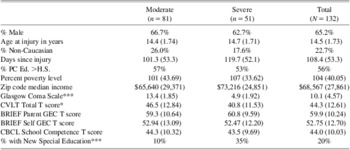
The final group of participants included 65% males and 23% non-Caucasians. The mean age of injury was 14.54 years (SD = 1.74) and mean time since injury at the initial follow-up was 3.56 months (SD = 1.74). GCS scores were recorded in the medical records for 125 of the 132 participating adolescents. Fifty participants had severe TBI (GCS score 3–8), 21 had moderate TBI (GCS score 9–12), and 54 had complicated mild TBI (GCS score 13–15 with evidence of neurological abnormality on CT or MRI). Following previous research (Schwartz et al., Reference Schwartz, Taylor, Drotar, Yeates, Wade and Stancin2003; Taylor et al., Reference Taylor, Yeates, Wade, Drotar, Stancin and Minich2002), we grouped individuals with moderate and complicated mild injuries together into a single Moderate group. The 7 participants without a documented GCS score were assigned to the severe TBI group if the medical record indicated that the child was verbally unresponsive with no spontaneous eye opening or purposeful movement, and to the moderate TBI group if there was an indication of impaired consciousness or abnormal imaging findings, but the child did not meet criteria for severe TBI. Severe and Moderate TBI groups did not differ on age, gender, time since injury, or proportion non-Caucasian (see Table 1).
Participant demographics by injury severity

Note. Standard deviations in parentheses, except for Special Ed (%). % PC Ed. >HS reflects percent of group with primary caregiver educational attainment greater than high school or GED degree. Percent Poverty level reflects family income relative to the national poverty threshold, with >100 reflecting a higher income. CVLT = California Verbal Learning Test, initial assessment; BRIEF GEC = Behavior Rating Inventory of Executive Functions Global Executive Composite parental mean, initial assessment; CBCL = Child Behavior Checklist, 12 month follow-up; Special Education = use of special education supports, 12 month follow-up.
***p < .001, **p < .01, *p < .05 indicate significant differences according to T-test or Chi-square analyses.
SES for the participating adolescents was collected via self-report by the primary caregiver as well as census tract information, and included level of education of the primary caregiver, median income and percent poverty level for the family's residence based on census data, and the financial stress composite score from the Life Stressors and Social Resources Inventory – Adult Version (Moos & Moos, Reference Moos and Moos1994). An SES factor score was derived using maximum likelihood extraction without rotation in Mplus 6.0. The two injury severity groups did not differ significantly on SES.
Procedure
Participants were recruited following guidelines and procedures approved by the institutional review boards at participating institutions. Families were approached either in person at the hospital where the adolescent was being treated, or by phone within 6 months of the injury, and informed about the study and eligibility requirements. Interested families were sent additional packets of information by mail and contacted by phone to schedule an initial assessment. Families were contacted by phone to schedule follow-up assessments approximately 6, 12, and 18 months after the initial assessment. All assessments took place in the family's homes after families gave their informed consent and with adolescent assent. At the initial assessment, adolescents completed cognitive testing, structured interviews, and self-report questionnaires. The primary caregiver (and when possible both parents) also completed child- and self-report questionnaires, as well as structured interviews. Follow-up assessments included parent- and child-reports of child and family functioning, as well as parent-interview. The initial assessment took approximately 2.5 hr, and follow-up assessments took approximately 1.5 hr. Only data from the initial assessment and 6- and 12-month follow-ups were available for the current study.
Measures
Behavior Rating Inventory of Executive Function (BRIEF)
The Parent-Report and Self-Report versions of the BRIEF (Gioia et al., Reference Gioia, Isquith, Guy and Kenworthy2000) were completed at the initial assessment (i.e., before assignment to treatment groups). The parent report was completed by the primary caregiver and in some cases, by both parents. When both parents completed the assessment, the mean of the two scores was used. The BRIEF contains 86 items comprising eight clinical subscales that contribute to a Behavioral Regulation Index (BRI) and a Metacognition Index (MI). These two indices combine to form the Global Executive Composite (GEC) score. All scores were T-scores with mean = 50, standard deviation = 10, and were multiplied by −1 so that higher scores would reflect better EF. Sixty-seven BRIEF T-scores were the mean of the T-scores obtained from both parents, 63 were based on ratings from a single parent (59 mothers and 4 fathers), and two participants were missing Parent-Report BRIEF data at the initial assessment. A total of 129 Self-Report BRIEF measures were completed at the initial assessment. Parent- and Self-report GEC scores were moderately correlated (r = .5). When both of these predictors were included simultaneously in the model, the predictive power of each was reduced, suggesting enough overlap to consider them redundant. Furthermore, the overall results did not change. Thus, the models are presented with these two measures analyzed independently.
Verbal memory
At the initial assessment, verbal learning and memory were assessed using the age-appropriate version of the California Verbal Learning Test (CVLT; Delis, Kramer, Kaplan, & Ober, Reference Delis, Kramer, Kaplan and Ober1994, Reference Delis, Kramer, Kaplan and Ober2000), a verbal list-learning procedure. The T-score total learning across the five learning trials was used in analyses.
Educational outcomes
Educational outcomes at the 12-month follow-up were assessed using the School Competency subscale of the Child Behavior Checklist (CBCL; Achenbach, Reference Achenbach2001), a parent-report measure of broad behavioral and social-emotional functioning. The School Competency scale is a composite measuring attained grades in individual academic subjects, use of special education, and educational promotion. As an alternative measure of educational outcomes at the 12-month follow-up, parents reported on whether the adolescent was receiving any special education services at the 12-month follow-up, and whether formal special education services had been in place before the injury. Due to the overlap between this and the CBCL School Competence scale, we chose to analyze these outcomes separately. Adolescents receiving special education who had not received it before injury were coded as 1; adolescents not receiving special education at the 12-month follow-up, or those who were already receiving it before the injury, were coded as 0. Formal special education services were in place for 21 participants before the injury, and 26 different adolescents were receiving post-injury initiated services at the 12-month follow-up. Given the high number of premorbid special education users, the established comorbidity between pediatric TBI and premorbid attention and learning problems, and the potentially worse effects TBI could have on children with special needs because of their presumed lower cognitive and/or brain reserve (Goldstrohm & Arffa, Reference Goldstrohm and Arffa2005; Yeates et al., Reference Yeates, Armstrong, Janusz, Taylor, Wade, Stancin and Drotar2005), participants who had formal special education services before the injury were not excluded from the study.
Analysis
Data cleaning and preliminary analyses were done using SPSS 18.0. Path analyses were conducted using Mplus 6.0. All models included the GCS score, SES, treatment group (CAPS vs. IRC), and the CVLT as predictors. Multiple models were examined, with each combination of BRIEF composite (GEC, MI, BRI) and version (Parent- and Self-Report) considered individually. Additionally, two independent educational outcomes were tested: the CBCL School Competency subscale and post-injury initiated use of special education at the 12-month follow-up (yes/no).
Goodness-of-fit of the path models was assessed using the χ2 exact test; models with non-significant χ2 values (p > .05) were considered to fit the data well (Barrett, Reference Barrett2007). Additionally, following previously published research, the Comparative Fit Index (CFI) and Root Mean Square Error of Approximation (RMSEA) were reported as approximations of fit. In general, values of CFI >.9, and RMSEA < .05 are considered to approximate an excellent fit. The χ2 difference testing was used to compare model fits when constraints were placed on path weights (e.g., constraining a path to equal 0, or constraining two paths to equal one another). Significantly different χ2 values indicated a worse fit for the constrained model. In contrast, if the constrained and free models fit the data equally well, the constrained path coefficients were considered to be comparable (Kline, Reference Kline2005). As the special education outcome was a dichotomous variable, these models were calculated in Mplus 6.0 using logistic regression. Standardized path coefficients predicting this outcome variable are imprecise and thus cannot be compared to one another directly. Rather, following guidelines set forth by the authors of Mplus, interpretation of these path coefficients was limited to their sign and statistical significance (Methuen & Methuen, Reference Methuen and Methuen1998–2004).
Results
Preliminary Analysis
All data were initially inspected for outliers and normal distributions. Outliers were Winsorized to three standard deviations from the mean. Final skew and kurtosis values were within the acceptable range, with absolute values less than 2. Mplus 6.0 uses full information maximum likelihood (FIML) to account for missing data. At each time point, the number of participants with any missing data (due to attrition or incomplete collection) on one or more variables was: Initial assessment = 12; 12-month follow-up = 44. Attrition accounted for 21 of the missing data points at the 12-month follow-up. Participants with missing data at any time point were older and had a lower SES, on average, than participants with complete data. There were no differences in GCS score between participants with any missing data and those with complete data.
Participants in the Moderate versus Severe groups did not differ on primary caregiver education, percent poverty level, median income of their zip code, or age at injury. Preliminary analyses revealed that the Severe TBI group had significantly lower scores on the CVLT at the initial assessment and higher rates of special education at the 12-month follow-up than the Moderate TBI group (Table 1).
Path Models
CBCL School Competence outcome
The first model included the BRIEF Parent-Report GEC from the initial assessment as a predictor, and the CBCL School Competence scale as the 12-month follow-up outcome. The model had an excellent fit: χ2(2) = 1.086, p = .581, CFI = 1.00, RMSEA = 0.00. CBCL School Competence was predicted by the BRIEF Parent-Report GEC (B = .31; SE = .08; p < .001) and family SES (B = 2.60; SE = .80; p = .001), but not by injury severity (B = .05; SE = .18; p = .797), CVLT (B = .11; SE = .07; p = .111), or study group (B = −2.84; SE = 1.5; p = .066). See Figure 1. The model was re-run using the BRI and MI composites of the BRIEF Parent-Report, with similar results, so the GEC was used in subsequent analyses. To test the hypothesis that behavioral assessment of EF, as measured here by the BRIEF Parent-Report GEC, would be more predictive of CBCL School Competence than verbal memory, as assessed by the CVLT, we constrained the standardized coefficients of those two paths to be equal. With the paths constrained, the χ2 was not significantly different (χ2(3) = 3.200; p = .362, CFI = .996; RMSEA = .022; Δχ2(1) = 2.114; p = .146), indicating that the path coefficients from the BRIEF Parent-Report GEC and from the CVLT to the CBCL School Competence outcome were not significantly different, with a shared standardized β = 0.25.
Path model with BRIEF Parent-Report GEC predicting CBCL School Competence. Note. All paths were included in the model. χ2(2) = 1.086, p > .05, CFI = 1.00, RMSEA = 0.00. Dashed lines indicate non-significant paths. Path weights are standardized. ***p < .001, **p < .01, *p < .05.

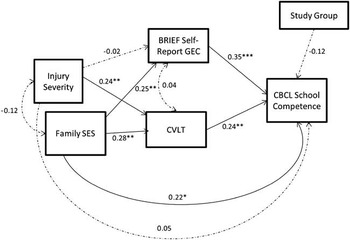
Next, we ran the model using the BRIEF self-report GEC. This model also had an excellent fit: χ2(2) = 0.747, p = .688, CFI = 1.00, RMSEA = 0.00. CBCL School Competence was significantly predicted by the BRIEF Self-Report GEC (B = .25; SE = .064; p < .001) and the CVLT (B = .18; SE = .066; p = .006; Figure 2). Again, results were comparable when the BRIEF Self-Report MI and BRI scales were used in place of the GEC. When standardized coefficients of the paths from the BRIEF Self-Report GEC and CVLT to the CBCL School Competence were constrained to be equal, the fit was significantly worse (χ2(3) = 18.471; p = .001; CFI = .695; RMSEA = .166; Δχ2(1) = 17.724; p < .001), indicating that the standardized path coefficient from the BRIEF Self-Report GEC to CBCL School Competence was significantly stronger than that from the CVLT.
Path model with BRIEF Self-Report GEC predicting CBCL School Competence. Note. χ2(2) = .747, p > .05, CFI = 1.00, RMSEA = .0.00. Dashed lines indicate non-significant paths. Path weights are standardized. ***p < .001, **p < .01, *p < .05.

Special education outcome
The next model was tested using post-injury initiation of special education services as the 12-month follow-up educational outcome and the BRIEF Parent-Report GEC as a predictor. Again, the data fit the model well (χ2(4) = 2.488; p = .647; CFI = 1.00; RMSEA = 0.00). However, only injury severity was a significant predictor of special education, with lower GCS score predicting use of special education services at the 12-month follow-up (B = −.12; SE = .020; p < .001; Figure 3). There was a trend toward lower CVLT scores predicting use of special education (B = −.019; SE = .01; p = .065). When the BRIEF BRI and MI composites were modeled separately, results were comparable and neither score was a significant predictor of special education outcomes.
Path model with BRIEF Parent-Report GEC predicting Special Education. Note. Special Education is a dichotomous outcome variable, thus the pictured model is a logistic regression, which means that the degrees of freedom were calculated differently than in an OLS regression, and the magnitude of standardized coefficients to the Special Ed outcome variable should be interpreted with caution (see Methuen & Methuen, Reference Methuen and Methuen1998–2004). 95% CI for odds ratios are presented in parentheses. χ2(4) = 2.488, p > .05, CFI = 1.00, RMSEA = 0.00. Dashed lines indicate non-significant paths. Path weights are standardized. ***p < .001, **p < .01, *p < .05.

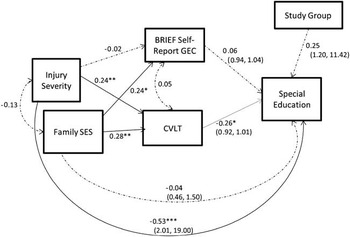
The special education model was re-run using the BRIEF Self-Report as a predictor. This model had an excellent fit: χ2(4) = 2.314, p = .678, CFI = 1.00, RMSEA = 0.00. Lower GCS scores again predicted post-injury initiation of special education at the 12-month follow-up (B = −.120; SE = .019; p < .001; Figure 4). In this model, the association between lower CVLT scores and special education reached significance (B = −.021; SE = .01; p = .039). Similar results were obtained using the BRIEF Self-Report MI and BRI scales.
Path model with BRIEF Self-Report GEC predicting Special Education. Note. Special Education is a dichotomous outcome variable, thus the pictured model is a logistic regression, which means that the degrees of freedom were calculated differently than in an OLS regression, and the magnitude of standardized coefficients to the Special Ed outcome variable should be interpreted with caution (see Methuen & Methuen, Reference Methuen and Methuen1998–2004). 95% CI for odds ratios are presented in parentheses. χ2(4) = 2.314, p > .05, CFI = 1.00, RMSEA = 0.00. Dashed lines indicate non-significant paths. Path weights are standardized. ***p < .001, **p < .01, *p < .05.

Path coefficients predicting special education were calculated using logistic regression, due to the fact that this variable is binomial. Thus, the magnitude of the standardized path coefficients need to be interpreted with caution (Figures 3 and 4; Methuen & Methuen, Reference Methuen and Methuen1998–2004) and the standardized paths from the BRIEF and the CVLT to this outcome could not be compared directly.
Discussion
The goal of the current study was to examine early predictors of functional educational outcomes in adolescents after TBI. Previous research has highlighted a discrepancy between children's performance on laboratory cognitive and academic achievement tests and their success in the school setting post-TBI. As hypothesized, the BRIEF contributed unique variance to the prediction of CBCL School Competence outcomes, even with injury severity, SES, and the CVLT in the model. Contrary to our hypothesis, the BRIEF did not predict use of special education services when these other constructs were included in the model.
We also tested the hypothesis that the BRIEF would predict educational outcomes more strongly than the CVLT. When standardized path coefficients were compared, only the self-report version of the BRIEF was significantly more predictive of CBCL School Competence than the CVLT. Furthermore, only the CVLT was a significant predictor of post-injury initiation of special education. Thus, both the BRIEF and the CVLT remained important predictors of educational outcomes, even after accounting for injury severity and demographic variables in the models.
In our sample, the parent and adolescent reports on the BRIEF were moderately correlated (r = .50), and the models were generally consistent across raters. However, the path coefficient from the CVLT to educational outcome varied slightly, depending on the BRIEF report that was used. This appeared to relate to the fact that in these models, the Parent-Report BRIEF was significantly associated with our objective measure of cognitive functioning, the CVLT, while the Self-Report BRIEF was not. This suggests that parent reports of the adolescent's EF behaviors may be more objective in nature than an adolescent's self-report. The finding underscores the importance of a comprehensive, multi-rater, and multi-domain evaluation of adolescents following TBI.
Injury severity as measured by the GCS score did not predict scores on the BRIEF at the initial assessment. Because both the moderate and severe TBI groups had worse BRIEF Parent-Report and Self-Report GEC scores at the initial assessment compared to the norming population, a stronger association between injury severity and BRIEF scores may have resulted had we included a non-TBI comparison group. However, the GCS score predicted both post-injury initiation of special education and performance on the CVLT; and the CVLT was in turn related to both educational outcomes. This finding suggests that adolescents with more severe TBI are more likely to be identified for special education services after injury and that possibly, difficulties with EF in the classroom setting are interpreted by school personnel as indications of poor self-regulation, rather than of cognitive issues that might warrant special education services.
Higher SES predicted better CBCL School Competence ratings, but not use of post-injury initiated special education. The mechanism underlying the association between higher SES and School Competence is unknown, but may either reflect premorbid factors (such as parental IQ or school resources) or a greater access by higher SES families to rehabilitation services. The lack of association between SES and post-injury initiation of special education indicates that the greater resources potentially available to higher SES families did not entail more access to school-based special education programs; rather, higher SES families may be more likely to hire private tutors than to access services through the school.
Although the goals of the parent study were largely geared toward improving social-emotional functioning in the teens and their families, we included the CAPS intervention in the model under the expectation that it might be associated with both school achievement and receipt of special education supports. The results demonstrated that this was not the case when demographic, cognitive, and EF variables were included in the model. Previous research suggests that older subjects in this study sample benefited more from the CAPS intervention than did younger adolescents (Wade et al., Reference Wade, Stancin, Kirkwood, Brown, McMullen and Taylor2013). Thus, we might have seen a significant treatment effect had we split the group into age cohorts.
Limitations of this study include the fact that teacher-ratings on the CBCL School Competence scale were not collected as part of this study, and would have offered increased objectivity. Future research would benefit from the use of additional, independent measures of predictor and outcome variables. Outcomes, for example, might beneficially include more objective measures of educational performance such as grade point averages, in-class behaviors, homework completion rates, and teacher ratings of academic success. Measures of pre-injury cognitive and academic functioning, such as those based on academic transcripts and teacher interviews, would also allow for a more objective evaluation of premorbid factors contributing to post-injury academic functioning. Additionally, the current study would have benefited from a better understanding of the specific special education services provided to participants, both before and following injury. Finally, despite the large size, the sample in the current study is relatively homogeneous ethnically and culturally. Specifically, participants in this study were mostly Caucasian. Future research should aim to test these models in minority populations to determine whether the findings generalize to more ethnically diverse samples.
Age and developmental level at the time of injury are known to interact with injury severity and injury location to produce varying cognitive and educational outcomes (Taylor & Alden, Reference Taylor and Alden1997). Additionally, as children get older, the expectations for independent completion of work increase, placing greater demands on EF processes. Thus, an extension of the current research would be to test compare these models across younger children versus older adolescents. The relation of deficits in EF skills to subsequent learning may vary with age and other cognitive processes (e.g., memory and language), thus these processes may need to be taken into account as additional predictors of academic outcomes.
The neuroanatomical location of the injury may also be an important predictor of educational outcomes. For example, as described in the introduction, the uncinate fasciculus has been found to be sensitive to behaviors measured by the BRIEF. Thus, there is potential for a predictive effect of injury location as well as injury severity. Taken one step further, there may be an interaction between the child's developmental level and injury location that uniquely predicts behavioral and cognitive outcomes. Research with larger sample sizes is needed to characterize these more complex associations of age and injury characteristics with educational outcomes.
The current results support the continued use of both the BRIEF and CVLT as measures of functioning in pediatric TBI in both research and clinical settings. The association of daily EF behaviors and verbal memory skills with educational outcomes also suggests a need to focus on interventions to improve these abilities and to encourage use of compensatory strategies and accommodations for such deficits. Adolescents who are struggling academically might benefit, for example, from tutoring and psychotherapy to support improved memory, organization, planning, and monitoring skills. Adolescents receiving psychotherapeutic interventions following TBI have shown improvement on BRIEF GEC scores post-treatment, suggesting that these skills can be improved in this age group (Wade et al., Reference Wade, Walz, Carey, Williams, Cass, Herren and Yeates2010). Additionally, interventions designed for children with ADHD may be appropriate, and typically include implementation of recipe-like approaches to tasks; increased structure and continuity across the home and school environments; and teaching specific strategies for organization of written composition and mathematical computation. As described earlier, the BRIEF also captures emotional regulation and self-control. While the intervention conducted within the parent project for this study was not related to educational outcomes, our results suggest that improved self-monitoring, emotional control and other metacognitive skills may support academic performance in the classroom.
Conclusions
The current study highlights the impact of behavior ratings of impaired EF and verbal memory deficits on educational outcomes following pediatric TBI. Behavior ratings of EF appear to be a critical, unique predictor of educational outcomes in adolescents who have suffered a TBI, and thus warrant a closer look by researchers and rehabilitation clinicians.
Acknowledgments
The authors thank Robert Blaha, Elizabeth Hagesfeld, Michelle Jacobs, Daniel Maier, and Nina Fox in data collection and entry, Amy Cassedy in data management, and John Stullenberger in Website support. We also thank the therapists JoAnne Carey, PsyD, Britt Nielsen, PsyD, and Brad Jackson, PhD. Conflicts of Interest and Sources of Funding: This work was supported in part by (1) NIH grant R01-MH073764 from the National Institute of Mental Health; and (2) a grant from the Colorado Traumatic Brain Injury Trust Fund Research Program, Colorado Department of Human Services, Division of Vocational Rehabilitation, Traumatic Brain Injury Program. We certify that no party having a direct interest in the results of the research supporting this article has or will confer a benefit on us or on any organization with which we are associated AND, if applicable, we certify that all financial and material support for this research (e.g., NIH or NHS grants) and work are clearly identified in the title page of the manuscript. This clinical trial was registered with clinicaltrials.gov, assigned identifier: NCT00409448. The authors acknowledge that the information in this manuscript and the manuscript itself has never been published either electronically or in print.