Intimate partner violence continues to be a major social problem that requires a categorical response by political leaders in order to bring about its eradication. Actions in Spain to bring an end to this type of violence were heightened with the passing of Organic Law 1/2004 on Integral Protection Measures against Gender Violence. Since that time, efforts have been focused on drawing public attention to the problem, improving the means available to attend to victims and escalating action against perpetrators. However, as pointed out by Kelly and Johnson (Reference Kelly and Johnson2008), an excessively determined strategy hinders the decision-making process in the judicial and psychosocial spheres by masking some of the essential issues related to the characteristics of perpetrators and the dynamics of violence. A number of studies stress that the type of program applied should be adapted to the different typologies of men who batter and to the existence of specific therapeutic needs (Amor, Echeburúa, & Loinaz, Reference Amor, Echeburúa and Loinaz2009; Boira & Jodrá, Reference Boira and Jodrá2010; Loinaz & Echeburúa, Reference Loinaz and Echeburúa2010). On the other hand, the effectiveness of actions directed towards re-educating male batterers has been questioned as a means of eradicating intimate partner violence (Boira, Reference Boira2010). In fact, international reviews on the effectiveness of the programs implemented to date have shown modest results (Babcock, Green, & Robie, Reference Babcock, Green and Robie2004; Feder & Wilson, Reference Feder and Wilson2005; Murphy & Ting, Reference Murphy and Ting2010; Sartin, Hansen, & Huss, Reference Sartin, Hansen and Huss2006; Saunders, Reference Saunders2008). Programs for partner violent males in Spain have gained significant momentum in recent years. These treatments are currently applied under three possible conditions: (a) voluntary participation; (b) as the consequence of a court-mandated measure that replaces or leads to the suspension of a prison sentence; and (c) once the perpetrator is serving a sentence in a penitentiary institution. Of these, (b) is the alternative that poses the greatest technical challenges and may hamper the achievement of positive results. The program in this case must be attended on a mandatory basis, which accentuates the low motivation of these men and their difficulty in coming to terms with their violent behavior. Consequently, this type of intervention differs in a number of basic aspects from the more conventional therapeutic approach that is characterized by a motivated client who works in collaboration with the therapist (Ross, Polaschek, & Ward, Reference Ross, Polaschek and Ward2008).
From this perspective, the analysis of the therapeutic alliance takes on special relevance. Although the characteristics of the rapport established between client and therapist have always been a focus of constant attention and contention (Stiles & Goldsmith, Reference Stiles, Goldsmith, Muran and Barber2010), different studies have shown that an appropriate therapeutic alliance in a context of ongoing therapy can have a positive influence on the results of intervention (Corbella & Botella, Reference Corbella and Botella2003). According to the definition put forward by Bordin (Reference Bordin1979), the therapeutic alliance is understood as the collaborative relationship between the client and the therapist, and is based on the degree of agreement with the goals of the intervention, the tasks to be performed and the creation of a positive bond between both parties. Despite this construct being developed within the framework of psychoanalysis, its effects have been studied in interventions with various theoretical orientations and treatment formats other than that of individual therapy (Muran & Barner, Reference Muran and Barber2010). Specifically, the analysis of the therapeutic alliance in group interventions is of particular interest for the work presented here. In this case, both the cohesion and climate present in the group appear to play an important part in the creation of the therapeutic alliance. Piper and Ogrodniczuk (Reference Piper, Ogrodniczuk, Muran and Barber2010) reviewed the associations between cohesion, climate and alliance, their possible consideration as independent constructs, and their predictive power for the results of treatment.
It has also been observed that the therapeutic alliance is an important factor in group therapy for partner violent males (Brown & O’Leary, Reference Brown and O’Leary2000; Rosenberg, Reference Rosenberg2003; Taft & Murphy, Reference Taft and Murphy2007). Studies have been made of the different variables associated with both the characteristics of male batterers and with their adhesion to treatment, their motivation and the characteristics of the therapists that may have a bearing on the strengthening of the therapeutic alliance (Carbajosa, Boira, & Tomás-Aragonés, Reference Carbajosa, Boira and Tomás-Aragonés2013; Musser & Murphy, Reference Musser and Murphy2009; Taft, Murphy, King, Musser, & DeDeyn, Reference Taft, Murphy, King, Musser and DeDeyn2003; Taft, Murphy, Musser, & Remington, Reference Taft, Murphy, Musser and Remington2004). Consequently, an important challenge in this context is to identify the possible triggers and incentives for change that lead to improvement in the effectiveness of treatment.
The aim of this paper is to evaluate the importance of the therapeutic alliance and the context of intervention in the therapeutic process. Likewise, an attempt has been made to determine which features of the intervention are most highly rated and perceived to be of greatest usefulness by male batterers. For this purpose, a study was made of a group of men convicted of intimate partner violence who were under court mandate to attend a treatment program. Two complementary studies were made: a descriptive analysis (Study 1), which studies the therapeutic alliance in relation to the group climate, the interest offered by the therapy and an evaluation of its usefulness; and a qualitative study (Study 2), which analyses the content of the participants’ discourse in order to determine how the different aspects of the intervention were rated.
Method
Participants
The same sample was used in both studies and comprised 27 men who completed a program of psychological intervention for convicted perpetrators of intimate partner violence held at the Women’s Institute of Aragón during 2010. Therapy was commenced by 45 men; of these, six (13.33%) discontinued the program during the intervention stage, while 12 did not participate, either because they did not attend or because they refused to take part (26.66%). Finally, 60% of the initial sample (27 subjects) completed the program and consented to participating in the study.
The participants were referred to the program by the Sentence and Alternative Measures Management Service of Zaragoza (Spanish Ministry of the Interior). The inclusion criterion for the program was a conviction for intimate partner violence and court-mandated therapy as a condition for suspension of the prison sentence. The exclusion criteria were: (a) presence of a severe medical or psychological disorder; (b) problems related to language proficiency, intellectual impairment and substance abuse; (c) inability to attend intervention sessions; and (d) refusal to participate.
Treatment
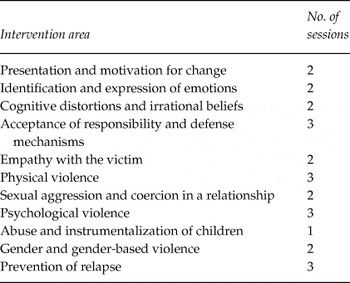
The program applied was that proposed by the Secretary-General of the General Directorate of Penitentiary Institutions of Spain (Ruiz et al., Reference Ruiz, Negredo, Ruiz, García-Moreno, Herrero, Yela and Pérez2010). This is a psychoeducational program of cognitive-behavioral orientation that includes a number of gender-specific aspects. The treatment was applied as group therapy. The therapy was organized into intervention areas with a progressive and structured workload. They covered a number of basic aspects, such as acceptance of responsibility by the offender, empathy with victims and the transformation of belief systems related to women and the use of violence. The different areas comprising the program are shown in Table 1.
Intimate Partner Violence. Batterer Intervention Program (PRIA) (Ruiz et al., Reference Ruiz, Negredo, Ruiz, García-Moreno, Herrero, Yela and Pérez2010)

The men who initially commenced the program (N = 45) were divided into 4 groups (n 1 = 11; n 2 = 12; n 3 = 10; n 4 = 12). The assignation of subjects to one group or another was made taking into consideration their preference for day and time (morning or evening). The program was held at a facility provided by the Autonomous Region of Aragon over the course of 7 months. The treatment stage lasted 4 months and the follow-up period lasted another 3 months. The treatment stage consisted of 25 sessions, with 2 follow-up sessions. Follow-up sessions were held at 1 month and 3 months after treatment was completed. The approximate frequency of sessions was 2 per week, each lasting 2 hours.
The psychologist leading the program, a cognitive-behavioral therapist with more than five years’ experience in interventions with convicted offenders and in cases of intimate partner violence, was appointed by the Women’s Institute of Aragon. Additionally, the actions carried out in the different treatment groups were supervised by the coordinating psychologist appointed by the Women’s Institute of Aragon and a psychologist from the Open Regime Department of the General Directorate of Penitentiary Institutions.
Study 1 Method
Instruments
The therapeutic alliance was measured by means of the Working Alliance Inventory-Short (WAI-S) (Tracey & Kokotovic, Reference Tracey and Kokotovic1989; Spanish version by Corbella, Botella, Gómez, Herrero, & Pacheco, Reference Corbella, Botella, Gómez, Herrero and Pacheco2011). This self-administered questionnaire consisted of 12 items scored on a Likert-type scale with 7 response options ranging from 1 (never) to 7 (always). Three subscales describing the main characteristics of the therapeutic alliance were rated: (a) tasks, showing the level of agreement between the therapist and client on the tasks to be performed; (b) bond, rating the development of a personal rapport between therapist and client; and (c) goals, covering the degree of agreement between the therapist and client as to the goals of the therapeutic process. The internal consistency of the Spanish version, obtained by means of Cronbach’s coefficient alpha (α) was .91 (Corbella et al., Reference Corbella, Botella, Gómez, Herrero and Pacheco2011).
An ad hoc questionnaire was administered complementarily to evaluate a number of aspects related to group climate (3 items), the usefulness of the therapy (4 items) and the different issues dealt with during the program (13 items), scored, in this case, on a Likert-type scale of 7 response options ranging from 1 (not at all) to 7 (very much). Finally, an item was included relative to the desire of the offenders to resume their relationship with the victim once their restraining orders were lifted.
Procedure
The evaluation questionnaires and the WAI-S were administered upon completion of the follow-up stage (three months after completion of the treatment). Two aims were pursued with this strategy: (a) to remove any conditioning of the participants’ opinions by the end stage of the intervention; and (b) to mitigate any feelings of coercion the men might have, enabling freer expression of their opinions. The participants were made aware of the anonymous nature of the administered questionnaires and it was explained to them that the aim of the research was to know their opinion and how they rated the program that they had attended.
Data analysis
The statistical procedure was initiated by analyzing the possible differences between the group of men that participated in the study (N = 27) and those that did not (N = 18) as a consequence of abandoning treatment or refusing to participate. The socio-demographic variables of both groups were studied by means of Pearson’s Chi-square test of independence (χ²). A descriptive exploration of the variables selected for this task was subsequently made. The analysis of correlations made use of Pearson’s correlation coefficient (r). A significance level of 5% was used in both the Chi-square test and the correlation coefficient, and the contrasted hypothesis was rejected when the p-value was lower than .05.
Results
Socio-demographic variables
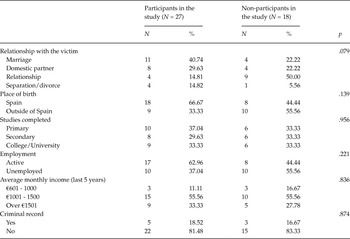
The primary socio-demographic variables of the participants in the study are given in Table 2.
Socio-demographic characteristics of the sample

Note:
NB: p is the p-value associated with Pearson’s Chi-square test of independence.
The mean age of participants was 40.11 years (SD = 7.5; range 20–65). The most frequent relationship maintained by participants with their victims prior to the offence was that of spouse (40.74%) or domestic partner (29.63%). 66.67% (n = 18) of the men were Spanish citizens. Of the foreign nationals, 22.22% of the total (n = 6) were Latin American, all citizens of Ecuador. The general level of education of the participants was low, with 37.04% not having completed compulsory education.
Table 2 also includes socio-demographic characteristics of the group of men who commenced the treatment program but who did not participate in the study. There were no statistically significant differences between the study participants and those who did not take part in relation to the considered variables.
Descriptive analysis
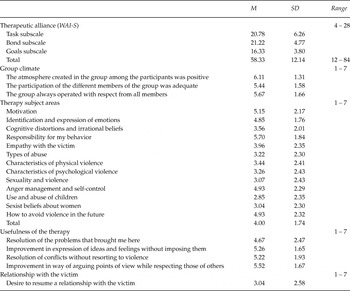
The main results of this section are shown in Table 3.
Descriptive analysis of the studied variables (N = 27)

Therapeutic alliance, group climate and areas of interest in the therapy
The mean score obtained in the questionnaire that rated the therapeutic alliance (WAI-S) was 58.33 (SD = 12.14) out of a maximum score of 84. Of the dimensions rated in the questionnaire, the highest mean score was obtained in the bond subscale (M = 21.22; SD = 4.77), and the lowest was obtained in the goals subscale (M = 16.33; SD = 3.80). The scores obtained for the three items that rated the group climate were above the mean score of the scale (4), with the highest score being that of the atmosphere created in the group (M = 6.11; SD = 1.31), compared to those of participation (M = 5.44; SD = 1.58) and respect (M = 5.67; SD = 1.66). With regard to the subject areas of the program that were most highly rated by subjects, the best scores were given to the most general aspects of the intervention: responsibility over my behavior (M = 5.70; SD = 1.84); motivation (M = 5.15; SD = 2.17); anger management and self-control (M = 5.70; SD = 2.29); and how to avoid violence in the future (M = 4.93; SD = 2.32). On the contrary, the least rated contents were those dealing with more specific violence-related aspects: use and abuse of children (M = 2.85; SD = 2.35); sexist beliefs about women (M = 3.04; SD = 2.30); sexuality and violence (M = 3.07; SD = 2.43); and types of abuse (M = 3.22; SD = 2.30).
Usefulness of therapy and the desire to return to a relationship with the victim
The four items that rated the usefulness of the therapy as perceived by the participants scored higher than the mean for the scale (4). Of those, the lowest scoring question was that referring to whether the therapy had helped to resolve the problems that had led the subjects to the intervention (M = 4.67; SD = 2.47), compared to whether subjects had been helped to resolve conflicts without resorting to violence (M = 5.22; SD = 1.93), improving expression of their ideas and feelings (M = 5.26; SD = 1.65) and improving their way of arguing their points of view while respecting those of others (M = 5.52; SD = 1.67). However, with regard to the men’s desire to resume their relationship with the victim once the restraining order was lifted, the scores obtained were situated in the lower half of the scale (M = 3.04). Nonetheless, it should be pointed out that there was a great deal of dispersion in the data (SD = 2.58). In fact, while 15 subjects scored 1 (never) for their desire to return to the victim, 7 subjects scored 6 or 7 (almost always or always).
Analysis of correlations
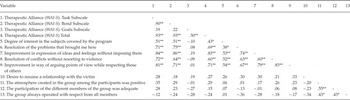
The items in which the participants rated the usefulness of the therapy show a statistically significant correlation with the total score and with two of the three subscales (tasks and goals) on the questionnaire that measured the therapeutic alliance (WAI-S). More specifically, the following correlations were obtained with regard to the total score: therapy has helped me to resolve the problems that brought me here (r = .69; p < .01); to improve the way I express my ideas and feelings (r = .83; p < .01); to resolve conflicts without resorting to violence (r = .60; p < .01); and to improve the way I argue my points of view (r = .71; p < .01). Likewise, the therapeutic alliance correlated significantly with the mean level of interest shown by the subjects for the subjects dealt with during the program: tasks (r = .51; p < .01); bond (r = .51; p < .01); and total score (r = .43; p < .05).
Finally, there was no significant correlation between the items evaluating the group climate with either the therapeutic alliance or the usefulness of the therapy. Additionally, there was no statistically significant relation observed with the item rating the desire of the men to resume their relationship with the victim. The results of this analysis are shown in Table 4.
Analysis of correlations

Note:
*p < .05; **p < .01.
Discussion
The data obtained in this quantitative analysis present a statistically significant relationship between the therapeutic alliance and the way the subjects rated the treatment. According to Taft and Murphy (Reference Taft and Murphy2007), the therapeutic alliance could be an indicator of the outcome of intervention and a predictor for future violent behavior. These authors reviewed the main studies that considered this variable in the context of intervention with male batterers (e.g., Brown, O’Leary, & Feldbau, Reference Brown, O’Leary and Feldbau1997; Rondeau, Brodeur, Brochu, & Lemire, Reference Rondeau, Brodeur, Brochu and Lemire2001; Taft et al., Reference Taft, Murphy, Musser and Remington2004) and indicated that there was a need to continue researching into the factors that could improve the therapeutic alliance and the strategies involved in this process. However, the opinion of Barber, Khalsa, and Sharpless (Reference Barber, Khalsa, Sharpless, Muran and Barber2010) was that it would be necessary for future works to specify the role played by the therapeutic alliance as possible mediators, moderators or predictors of the outcome of therapy.
The results of evaluating the different areas of the program were similar to those obtained by Rosenberg (Reference Rosenberg2003) from in-depth interviews made with a group of male partner violence perpetrators who had attended a treatment program. The author identified that the aspects of the program that were perceived to be most useful were the support received from other group members and their bond with their therapists. Secondarily, value was placed on the improvement made in anger management and in interpersonal communication skills.
Despite the existence of different Spanish studies evaluating the effectiveness of treatments and the degree of influence exerted on the therapy by some of the variables related to characteristics of the aggressors (e.g., Echeburúa & Fernández-Montalvo, 2009; Echeburúa, Sarasua, Zubizarreta, Amor, & Corral, Reference Echeburúa, Sarasua, Zubizarreta, Amor and Corral2010; Echeburúa, Sarasua, Zubizarreta, & Corral, Reference Echeburúa, Sarasua, Zubizarreta and Corral2009; Fernández-Montalvo, López-Goñi, & Arteaga, Reference Fernández-Montalvo, López-Goñi and Arteaga2011; Loinaz, Torrubia, Echeburúa, Navarro, & Fernández, Reference Loinaz, Torrubia, Echeburúa, Navarro and Fernández2009), none of these works treat the characteristics of the therapeutic alliance or the way they are rated by the convicted offenders as relevant aspects of the intervention. Pérez and Martínez (Reference Pérez and Martínez2010), however, evaluated the satisfaction of a group of men who completed a community program for convicted perpetrators of intimate partner violence by means of a telephone survey. The participants generally showed their satisfaction both with the service received and with the degree to which the program had helped them to improve their way of coping with problems. Those results support the ones presented in this current work, which reinforce the positive evaluation of this type of intervention.
Finally, it should be pointed out that there was no relation between any of the variables analyzed and the item that measured the desire of the men to resume their relationship with the victim. This may indicate that their intention in this regard is independent of the opinions expressed by the men and their willingness to change.
Study 2 Method
Instruments
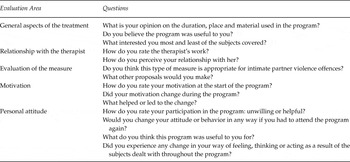
The technique used for the study and the qualitative analysis was the discussion group. The purpose of this was to gain a deeper understanding of a situation through the participants’ emerging discourse. In this case, the different aspects involved in the treatment program were analyzed through the subjects’ perceptions and the assessment they made (Amozurrutia & Marcuello, Reference Amozurrutia and Marcuello2011). Table 5 shows the script for the subjects and questions presented to the discussion group.
Discussion Group Script

Procedure
The discussion group was held once the administration of treatment evaluation questionnaires had concluded (Study 1). Three groups were formed with nine subjects in each one. The criterion for forming the discussion groups was that each one should contain men from the different treatment groups. In order to prevent interference, the groups were led by members of the research team. The therapist who applied the program was not present at any time. The discussions lasted 1 hour and 15 minutes, approximately. An audio recording was made for all the groups and their content was transcribed integrally. It was made clear to each group that their conversations were to be strictly confidential and that their responses would in no way influence their sentences. The non-therapeutic nature of the group was also stressed.
Discourse analysis
First, once the conversations held in each of the discussion groups were recorded and transcribed, empirical material was obtained for analysis. The empirical material was a text –a transcript– in which the series of statements made in the actual language of each of the agents involved in the discussion groups and their interaction with the other agents was compiled. Differentiation was made (Amozurrutia & Marcuello, Reference Amozurrutia and Marcuello2011) of at least four components in these discourses (texts): (a) identification of the participating agent; (b) indication of the approximate time of his intervention in seconds and/or minutes; (c) identification of the paragraphs to be interpreted which, together with the previous aspects, enabled every intervention and their interaction with one or more statements made by each agent to be delimited; and (d) description of other events recorded in the group, whether laughter, comments, murmuring, etc.
Second, this information offered two possibilities for analysis of the event: on the one hand, that of using a previously established categorical outline in order to define the degree to which the participations were related to the categories; and on the other, that of inferring the categorical outline to be a process of analysis of the explicit and implicit statements in the transcript. This process would be conducted by means of a heuristic strategy in which the analyst was to find the most appropriate categorical outline that would enable the largest number of statements to be classified and evaluated. Both were combined in this case, with special emphasis placed on establishing subject areas for the different statements that were presented in the transcript. They were then used to define variables and categories that provided elements with which to know the distribution of their meanings and to deduce trends. Nevertheless, the basic discourse positioning of the participants was also identified, as was the internal consistency and the congruence of such positions with the general climate in which the group was held.
Third, the analysts’ conclusion was contrasted with the results of the discourse analysis; internal inconsistencies were revised; and the key points were identified. The ideas emerging in the three groups were similar and were centered on the way in which the participants coped with the therapy, on the relations that were established – among themselves and with the therapist – and on their evaluation of the therapeutic process.
Results
This section presents the main results of the qualitative study performed. From the offenders’ discourse, the subject areas analyzed were: (a) characteristics of the program and the intervention context; (b) motivation; (c) participation, group climate and cohesion; (d) therapeutic alliance; and (e) evaluation of the usefulness of the program.
Characteristics of the program and intervention context
In general terms, the opinion was positive with regard to the duration of treatment and the times and frequency at which the groups sessions were held. The material and contents covered by the program were rated positively. However, a number of participants considered that a part of the contents was unrelated to their problem or showed types of behaviors with which they did not identify.
MAN-26: There’s a lot of people here speaking about things I really don’t identify with. I’m just here because I said something to my wife, but there are others that did hurt theirs... maybe the group should have been formed based on that.
The participants perceived and rated the offence very differently depending on the presence or absence of physical violence. It was also typical of perpetrators to minimize the seriousness of their behavior by showing their difficulty in considering violence as part of a process that goes beyond the occasional use of some or other type of violence.
With regard to the intervention context, a feature that appeared constantly in the accounts was the compulsory nature of the therapy:
MAN-10: Everything you’re forced to do is thought to be bad, even if it’s good for you; but you’re not going to see that in the beginning. As long as the first impression is a bad one, it’s bad.
This circumstance appeared to cast a negative light on the entire process, regardless of the fact that subjects’ levels of motivation, participation and involvement might change during the course of the program.
Motivation
The motivation for participants to join the group was very low. As previously mentioned, this situation may have been a consequence of the compulsory nature of the program and the insignificant awareness offenders had of the problem of intimate partner violence:
MAN-10: I didn’t want to get involved at all. I wasn’t motivated and it was hard for me to speak.
MAN-27: Most of us thought we shouldn’t be here. You see yourself as innocent and you see how unfair it is, like it doesn’t apply to you... I’m not like the others who come here; I’m not a criminal. Why should I have to attend a program if I’m all right? I’m normal, like people with normal lives.
However, it should be pointed out that some men admitted their motivation had increased as the program progressed. Among the reasons given was the greater trust that existed between the participants and with the therapist.
MAN-26: They were talking, and as I listened to them, I started becoming more confident. I began to identify more with what they were saying and with what had happened.
Along similar lines:
MAN-7: Nobody knew anybody until we introduced ourselves. We all sort of already knew why we were there. We introduced ourselves and explained why... On the third or fourth day you started loosening up, but the first two felt like we were held back a bit, like we didn’t trust anybody.
Despite the unfavorable context in which the therapy was conducted, the group process appeared to improve the offenders’ attitude and predisposition. Nonetheless, it could be questioned whether this progress was due to a genuine willingness to change or to a situation of resignation. The following opinion is an example of this perspective:
MAN-6: What I have to say is that we were made to come and I think that very few of the people on this program... have come to feel so motivated with it so as to say that it’s great; but once you’re here... well, you say you have to look at it positively, don’t you?
Participation and group climate and cohesion
The offenders rated their participation as an indicator of the group’s success:
MAN-3: Nobody wanted to speak, but later, when people started to come out with things, then nobody wanted to shut up.
It has been insisted that the low initial participation was caused by the lack of familiarity between participants and to the fact that they were open to judgment by others. They began to “lose their fear” progressively, and finally they all ended up “telling their story”. Generally, it would seem that as the group became united, the men’s communication and confidence, and their bond with the therapist grew.
However, the degree of participation and the dynamics were not the same in the different treatment groups. The group climate was perceived to be negative in one of them. In this case, the situation was attributed to the attitude to therapy held by a number of men and to the presence of sub-groups:
MAN-13: The group I belonged was difficult, very complicated. She [the therapist] had to put up with it. Later she managed to direct the proceedings a bit more, but in the beginning, all I wanted to do was get up and leave. Some people were completely out of line.
MAN-15: You know what? Most of us, except for a few, are really burnt out with our situation. We feel bad about ourselves. Between those who didn’t talk and those who did... there were lots of little groups... We came with our own personal problems and we were really beat up about it, mentally.
Therapeutic alliance
The type of relationship the participants established with the therapist seemed to play an important role in the way the therapy was perceived. A series of the therapist’s skills were identified in the discourse analysis that could be related to the creation of the therapeutic bond. These skills were the ability to listen and to solve problems, understanding, empathy and professional abilities perceived by the offenders. With regard to the willingness of the therapist to listen and understand problems, one of the participants stated:
MAN-26: I thought it [the psychologist’s attitude] was very good. Yes, she was attentive to all of us and to how we were behaving, because while she was with us, she made us feel like she was getting to know us more each session... If someone was a bit down, she showed concern, and she asked him about it at the end.
This account stresses how the therapist’s attitude encouraged the possibility of feeling at ease in the group and, as Man-25 points out, showed her ability to encourage participation and involvement:
MAN-25: Yes, I think that the important thing is to open up so you can understand things. But you tend to hold things back at the beginning... Although some spoke more than others, the psychologist spoke to each of us and encouraged each of us.
Likewise, the therapist’s ability to resolve difficult situations was acknowledged. In this regard, the therapist’s leadership and style, and way of confronting and supporting were important for the creation and development of the therapeutic alliance:
MAN-13: It’s hard work; that much I understand... You need lots of patience and a lot of subtlety, and it doesn’t matter how much you try to discuss something, you also have be tough... And when someone had to be taken out, it was done very diplomatically.
Finally, despite the fact that there was resistance initially shown by some men owing to the fact the psychologist was a woman, this was not viewed negatively on the whole.
Evaluation of the usefulness of the program
Three situations were identified in relation to the contributions on the usefulness of the program: (a) that of the participants who stated the program helped them; (b) that of the participants who had a negative opinion or rejected the treatment; and (c) that of the participants who said nothing and did not express any opinions. As expected, the emerging discourse was a common one and, regardless of the fact that opinions about the treatment changed during its course, those participants who expressed their opinions did so very clearly.
The aggressors that expressed positive views recognized the damage they had done and considered the need to make changes in the future, both in their attitudes and in their violence-related behavior. Some of these opinions were:
MAN-10: Of course I feel guilty now about what I said and what brought me here, but I think this will help me in the future... I don’t know about new relationships; it’s just something I’ll have to think about, but I haven’t got one... When the moment comes, I will, and I think that with what I’ve learnt and what life will also show me in the future, I think it will be positive for me.
MAN-27: A lot of the content was really useful, like starting out by looking at our past... That’s what made us what we are, or if we are carrying something, that’s what it leads us to do... It’s important to see you’ve got things that you need to work on, because if you don’t think you’ve got anything to change, that everything’s perfect, that what happens just does, just because, later the program makes your realize that it isn’t like that; you’ve got lots of things to improve.
MAN-7: Yes, if you don’t look at those points, then we probably wouldn’t realize that we all have flaws and make mistakes... and here they teach you to correct them... Many times [referring to the future] when we’re nervous or worked up, then you turn around and you go for a walk and say it’s not worth it... and, whether you like it or not, these talks come to mind.
The negative opinions about the intervention began with the premise that there was no attitude or behavior to rectify. Because the problem was not acknowledged, it made no sense to attend a treatment program. The following participant expressed this clearly:
MAN-24: I think that the justice system is unfair. I was judged by society, not by a judge, and that’s that. I didn’t have a problem, or anything; but because society is going on about these things, it judged me... I came; I did the courses; I did the exercises; I did everything and that’s it. I’m good. I didn’t have a problem.
Finally, the group of participants showed a very ambivalent attitude to the usefulness of the therapy and the possibilities for change. On the one hand, they admitted that the treatment may have helped them improve some skills, such as self-control. However, they showed that they basically did not change and that they continued to think the same way as when they started the program.
Discussion
As pointed out by other authors (Ross et al., Reference Ross, Polaschek and Ward2008; Taft et al., Reference Taft, Murphy, Musser and Remington2004), the qualitative analysis shows that the mandatory nature of the program is a basic element of the therapeutic context that influences the motivation of offenders. Likewise, the men’s discourse also suggests that the aspects associated with the intervention setting, the therapeutic alliance and the therapist’s skills are relevant for the adherence to the treatment by offenders for the improvement in the results obtained.
Nonetheless, the therapist’s performance or preconceptions about intimate partner violence may interfere and modulate the therapy by helping or hindering the willingness of subjects to change. It has been shown that an empathetic attitude and one of listening, which minimizes the propensity of perpetrators to feel they are being judged, favors the therapeutic process. However, it should be taken into consideration that the therapist’s role in this intervention framework is ambivalent, as a consequence of the dual function of offering psychological attention and also of supervising a court-mandated measure.
The qualitative analysis also reveals that the characteristics of aggressors and their predisposition to the treatment are different. This makes it necessary to discriminate against the subjects most unwilling to undergo treatment as part of the evaluation process, owing to the fact that this can influence the workings of the group and the outcome of the therapy. It is therefore important that the therapist should be able to know the state of change in which the man finds himself and his possible evolution throughout the treatment (Prochaska & DiClemente, Reference Prochaska, DiClemente and Norcross1986; Quinteros & Carbajosa, Reference Quinteros and Carbajosa2008). In this context, a qualitative approach that analyses the aggressor’s discourse would allow his degree of willingness to change to be observed, which would help to direct the therapy strategically. In types of cases where the subjects have a negative influence on group dynamics, it is necessary to broaden the repertoire of techniques and intervention strategies, and to evaluate the possibility of providing individual therapy.
General Discussion
Research into the effectiveness of intervention programs with partner violent men has been marked by intense debate and a state of constant review and questioning (Corvo, Dutton, & Chen, Reference Corvo, Dutton and Chen2008; Langhinrichsen-Rohling, Reference Langhinrichsen-Rohling2010; Saunders, Reference Saunders2008). However, new lines of work have emerged in recent years focusing on the analysis of the therapeutic process. They stress that beyond the debate regarding the pertinence and efficacy of programs in terms of their theoretical orientation, there is a need to identify the elements of the process that can influence the therapy and to consider them in the design of treatments (Quinteros, Reference Quinteros2010). Another line of study has considered widening evaluation strategies by incorporating qualitative analysis methodologies. According to Buchbinder and Eisikovits (Reference Buchbinder and Eisikovits2008), there are few exceptions where the focus of attention is directed towards the perceptions that the male batterer holds about the process of the therapy to which he is being subjected. The results presented reinforce this line of work and point to the need for broadening strategies in order to improve the evaluation and design of programs.
It is also necessary to consider that a more precise evaluation of the impact of the treatment may require scrutiny of the specific setting in which the program is applied. The intervention model with aggressors proposed by Ross et al. (Reference Ross, Polaschek and Ward2008) may be useful for this purpose as it defines and differentiates the proximate and ultimate factors that influence the therapeutic process. According to these authors, the proximate factors are those closest to the area of intervention and influence of the therapy (therapeutic context) and the ultimate factors are those outside their control, which are related to the institutional, legal and political context. Although they are not directly present in the treatment, the latter define the framework in which therapy is held. The influence of the ultimate factors limits the therapist’s flexibility in such essential aspects as the program contents or confidentiality, which should be taken into account in order to adjust the type of intervention made to each specific context. The ultimate factors may determine the outcome of treatment, making their incorporation necessary in future studies.
The two studies presented in this article focused on some of the proximate factors proposed by Ross et al. (Reference Ross, Polaschek and Ward2008). The results have identified some variables related with the therapeutic context that appear to play an important role as facilitators of change. In both the descriptive and qualitative analysis, the participants highlighted their bond with the therapist as particularly significant, together with the support they received from other group members and a number of specific areas such as responsibility, emotional control and communication strategies. Reinforcing those features in the intervention design and their strategic use by therapists may improve the effectiveness of treatment (Carbajosa et al., Reference Carbajosa, Boira and Tomás-Aragonés2013).
Awareness of the best and worst rated subjects could direct therapists to choose the most appropriate techniques at all times. In a complex intervention context with limited results and characterized by offenders’ low motivation and their difficulty in acknowledging the problem of violence, this line of work may provide an opportunity to perfect therapeutic strategies.
Finally, a number of limitations of the study should be pointed out. First, the decision as to the anonymous nature of the questionnaires administered hindered comparison between the aspects evaluated and the possible effects of the treatment. Second, despite the lack of significant differences in the basic socio-demographic variables between the group of participants and those men that initiated treatment but did not participate, the absence of evaluations from non-participants may have skewed the obtained results. Lastly, in addition to considering the previously mentioned aspects, future studies will need to expand the sample and to assess different treatment types and intervention contexts that will enable greater generalization of the results.