


Introduction
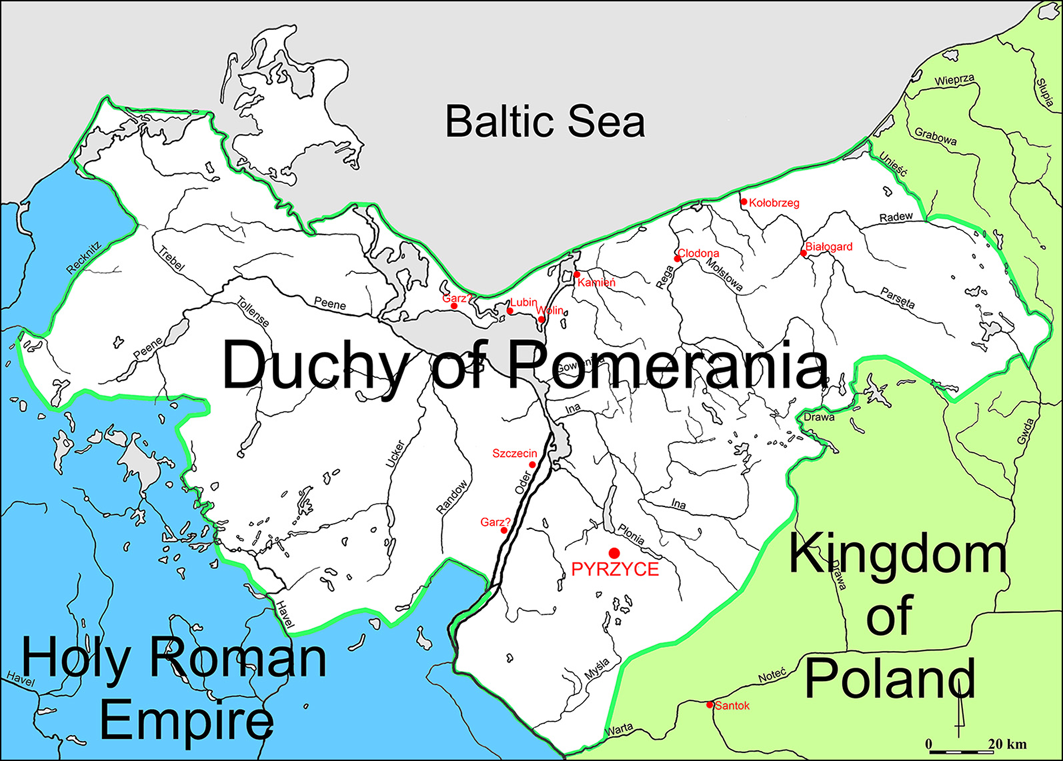
The year 2024 marked the 900th anniversary of Bishop Otto of Bamberg’s mission to Christianise Pomerania. It was a systematic enterprise of conversion that followed an established pattern of approaching consecutive communities and involved founding churches and appointing priests, which resulted in the Pomeranian bishopric being created in 1140. In the early twelfth century, Pomerania was inhabited by Slavic groups, most of whom were still Pagan. As the area was surrounded by Christian monarchies, Otto’s mission was also a political enterprise to forge new alliances and increase the dominance of Christian states in the region (Figure 1). Poland, under Bolesław III Wrymouth, was particularly active and had been the patron of Otto’s first mission in 1124. For Wartislaw, Duke of Pomerania, and the communities under his rule, the decision to accept Christianity was a political compromise that, while partially accommodating foreign claims, was intended to preserve independence.
Map of the Duchy of Pomerania showing the places of Otto’s mission (figure by A. Janowski).

The desire to understand the process of transitioning between Paganism and Christianity in Pomerania has inspired much historical, archaeological and anthropological research. Our project focuses on Pyrzyce, where the Pomeranian part of Otto’s mission began, and aims to establish the chronology of the stronghold, to uncover possible material traces of religious change and to complete the picture of the mission, thus contributing to the debate on the Christianisation of Eastern European territories (cf. Vargha & Štefan Reference Vargha and Štefan2024). Initial results confirm signs of both Slavic Paganism and Christianity in twelfth-century Pyrzyce.
Text-driven archaeology
As written sources on Pomerania’s Christianisation influence the recent interpretation of finds (Rębkowski Reference Rębkowski2011), the project may be framed as text-driven archaeology. Pyrzyce at the beginning of the twelfth century was a place of political and religious significance, both for Slavic and Christian faiths. The arrival of Otto paved the way for seminal events that transformed the local religious landscape. Historical sources describing the moment of transition are written from the Christian perspective: a circular letter attributed to Otto that reports on the missionary’s work in Pomerania and was quoted extensively in Ekkehard of Aura’s chronicle, and three twelfth-century vitae (‘lives’) of Otto written by an unnamed monk from Prüfening, Ebo of Michelsberg and Herbord of Michelsberg (Rosik Reference Rosik2020; Jezierski Reference Jezierski2022: 121–25). Although the hagiographies focus on the power of Otto’s work, they also provide some historical background to the Christianisation mission, each asserting that the mission began in Pyrzyce. Ebo claims the bishop converted only some of Pyrzyce’s inhabitants, with others making acceptance of ‘this new law’ dependent on the council of their leaders and elders. The latest life, written by Herbord around 1159, describes a complete conversion, depicting an idealised community created through mass baptisms. This process culminated in the erection of a church, its altar consecrated along with the sanctuarium (presbytery) and the appointment of a priest. Herbord’s version, giving the inhabitants of Pyrzyce the role of ‘first-fruits of the divine harvest’, still resonates with contemporary local religious imagery.
Case study
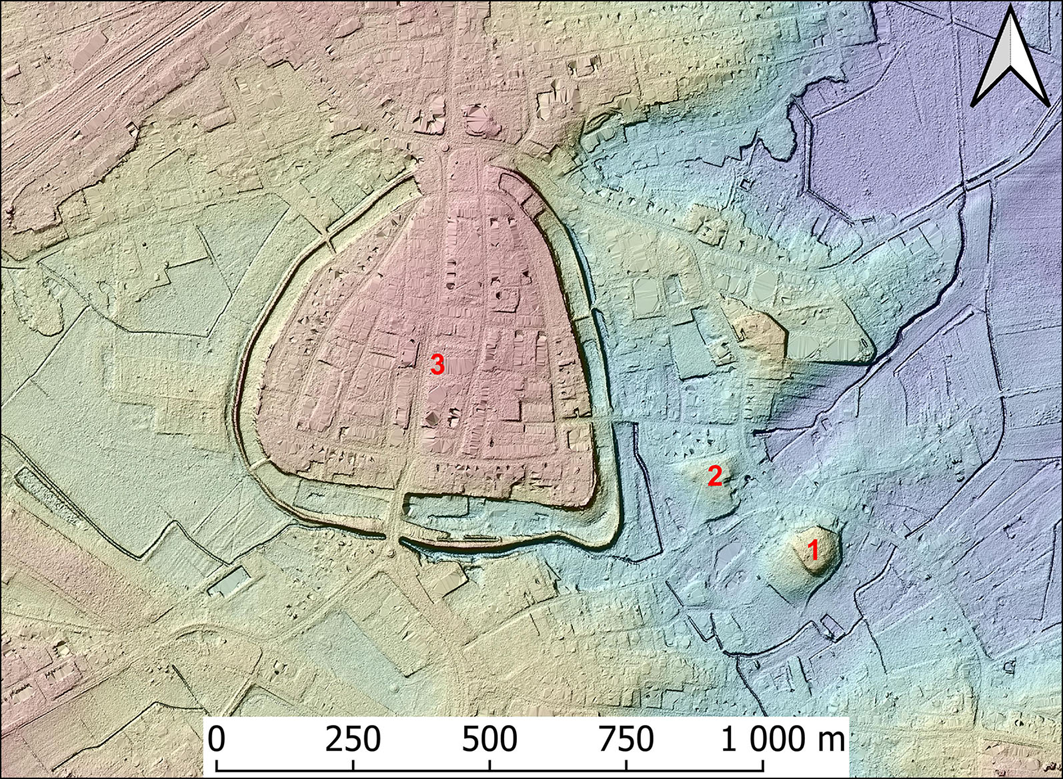
The castrum Pirissam (Pyrzyce) is mentioned in historical sources as being among the most important strongholds in Pomerania and details about its location have informed targeted archaeological excavation. A document from 1321 mentions the defensive embankment, moat and castle hill, called a borchwall, which together designate the research area (Heinemann Reference Heinemann1906: no. 3523). Results of airborne laser scanning show that the stronghold, located about 300m south-east of the chartered town, is an oval with dimensions of approximately 150 × 110m (Figure 2). It can be divided into two parts: a north-eastern area (I) that is roughly circular (95m in diameter) and raised approximately 5m above the surrounding area (Figure 3); and a south-western area (II) that is slightly smaller, measuring 50 × 100m. The site covers around 1.6ha in total. Until recently, knowledge of the stronghold was limited. Modest planned excavations were conducted in 1969 and 1976, revealing defensive embankments in trench profiles approximately 30m south-west of area II that are no longer visible at the surface (Cnotliwy et al. Reference Cnotliwy1979: 204–14).
Lidar model of Pyrzyce with the location of the medieval stronghold (1), monastery of Augustinian nuns (2) and chartered town (3) (figure by G. Kiarszys & A. Janowski).

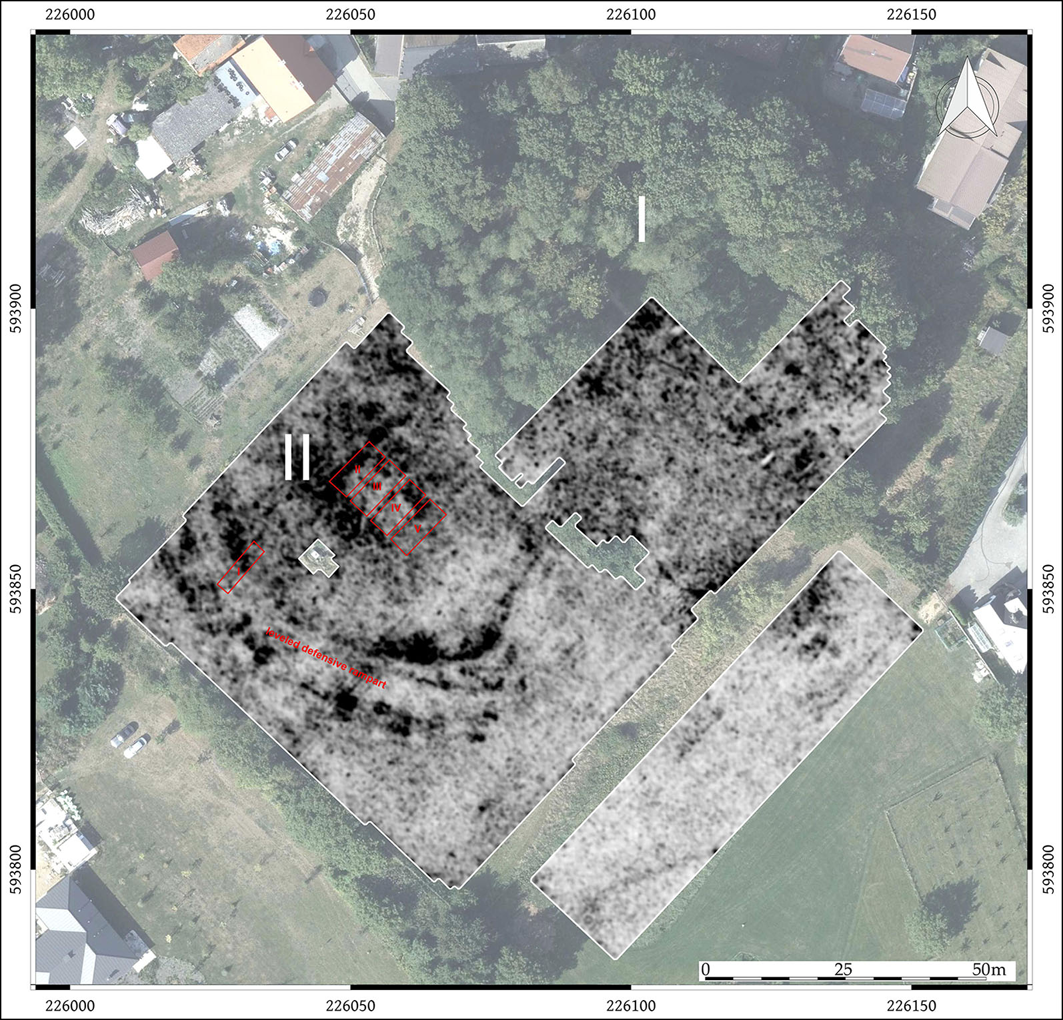
Result of GPR survey (depth range: 0.90–1.20m) with the boundaries of trenches I–V overlaid (figure by R. Ryndziewicz).

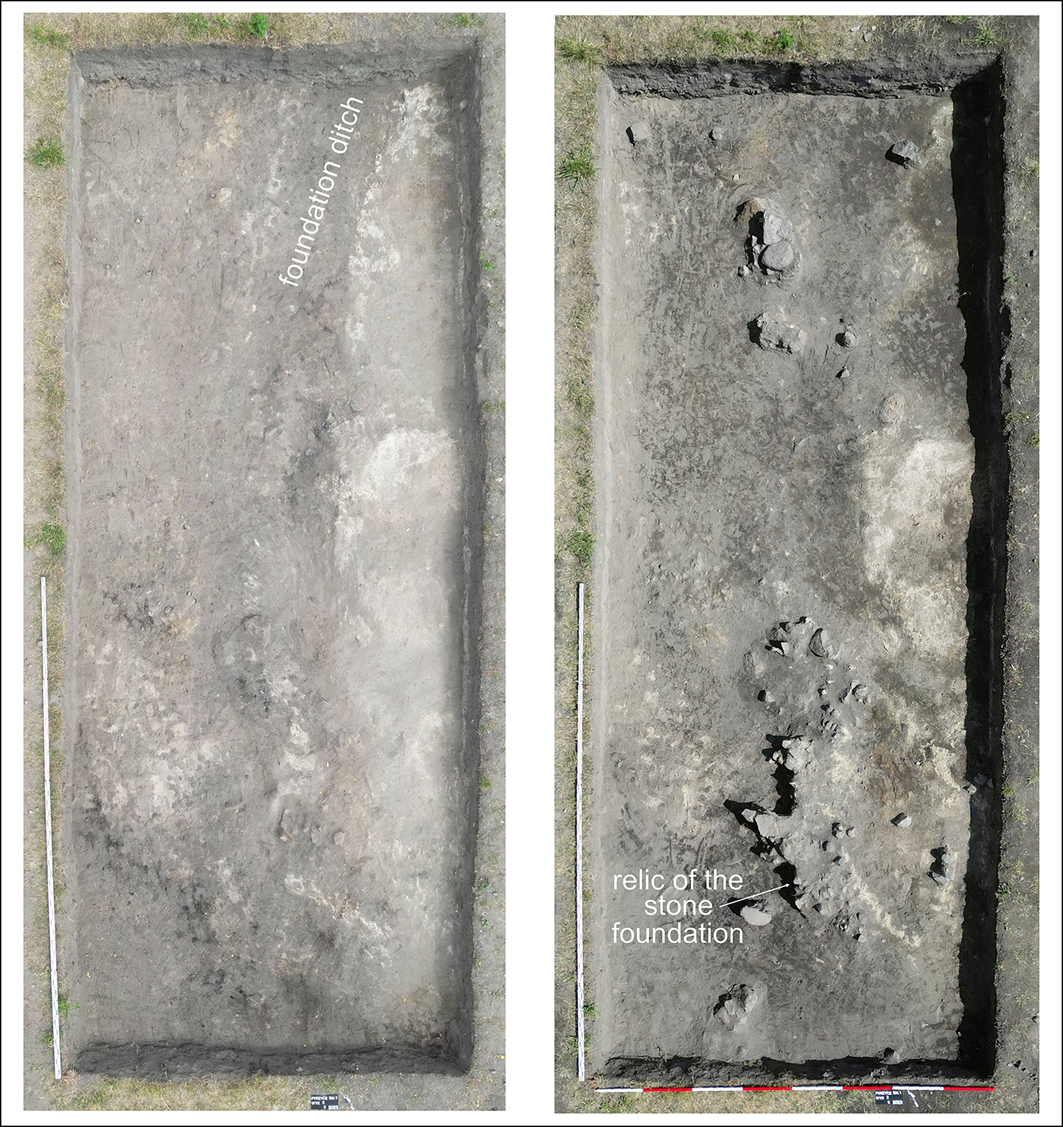
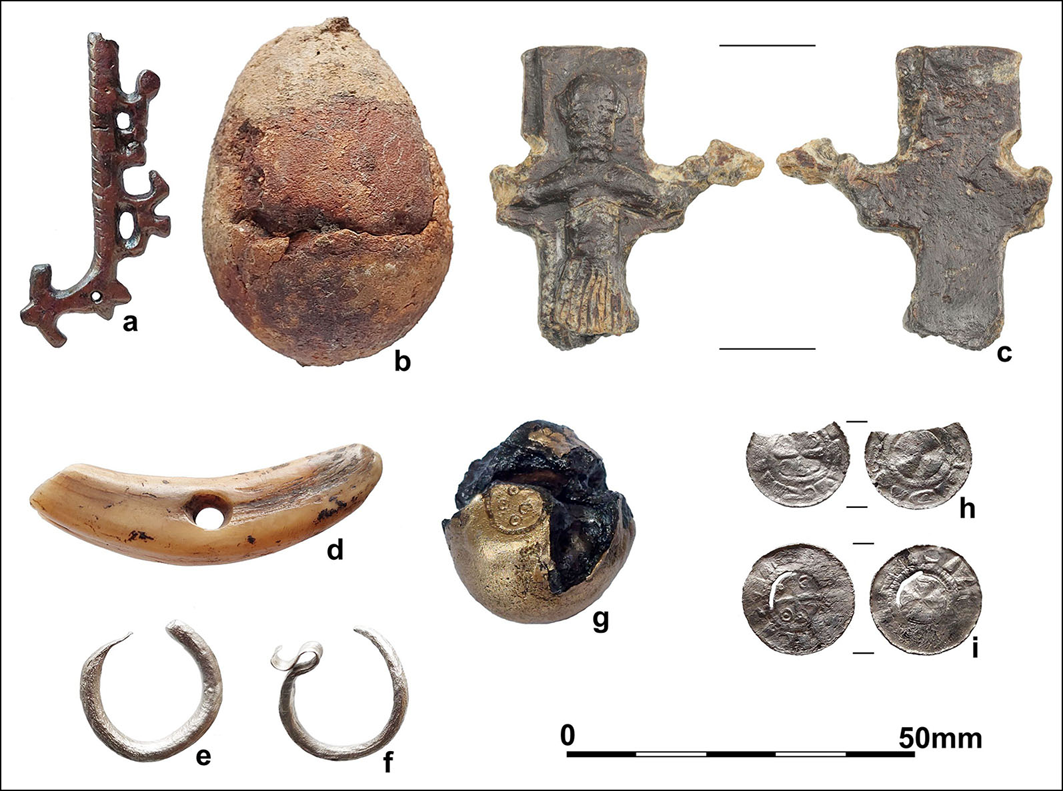
As part of the current project, non-invasive prospection using ground-penetrating radar (GPR) began in 2022 (Figure 3). Results confirmed the presence of underground defensive embankment layers and revealed a rectangular structure (15 × 8m) at a depth of approximately 1m between the embankment and area I of the stronghold. Excavations in 2023 and 2024 focused on these two areas to investigate the relationship between the embankment’s structure and the settlement layers inside. Trench I, located on the inner slope of the embankment, produced deposits to a depth of 3.10m, covering a period from the second half of the ninth century to the twelfth/thirteenth centuries and a modern layer. The embankment was likely built at the end of the tenth/beginning of the eleventh century, destroyed no later than the thirteenth century and levelled soon after. Trenches II–V investigated the rectangular signal in the GPR data (Figures 3 & 4), revealing the foundation of a poorly preserved structure, possibly half-timbered with clay-sealed wooden pillars, which can be dated to the second half of the eleventh/first half of the twelfth century. The foundation, erected on a small clay elevation, was made of stones not joined with mortar. The function of this structure is unclear; associated finds—a knife sheath fitting with anthropomorphic and animal motifs, a clay egg rattle, amulets and a twelfth-century lead cross (Figure 5a–d)—reflect both Pagan and Christian symbolism and potential ritual uses. Together with the structure’s location and form, this raises the possibility that the building served cultic or assembly functions. Jewellery, weights suggesting exchange and coins from the second half of the tenth to eleventh centuries (Figure 5e–i) further testify to the importance of the site.
Trench II: western wall of the building in subsequent stages of exploration, upper layer on the left (figure by A. Janowski).

Selected artefacts discovered around the building: a) the lower part of a knife sheath fitting, representing the tripartite Pagan cosmos; b) a clay egg rattle, symbolising new life; c) a unique lead crucifix, twelfth century; d) an amulet made of an animal tooth; e & f) silver temple rings, tenth–eleventh centuries; g) spherical weight with flat poles, eleventh–twelfth centuries; h & i) cross denarii, second half of the tenth–eleventh century (figure by A. Janowski).

Conclusions
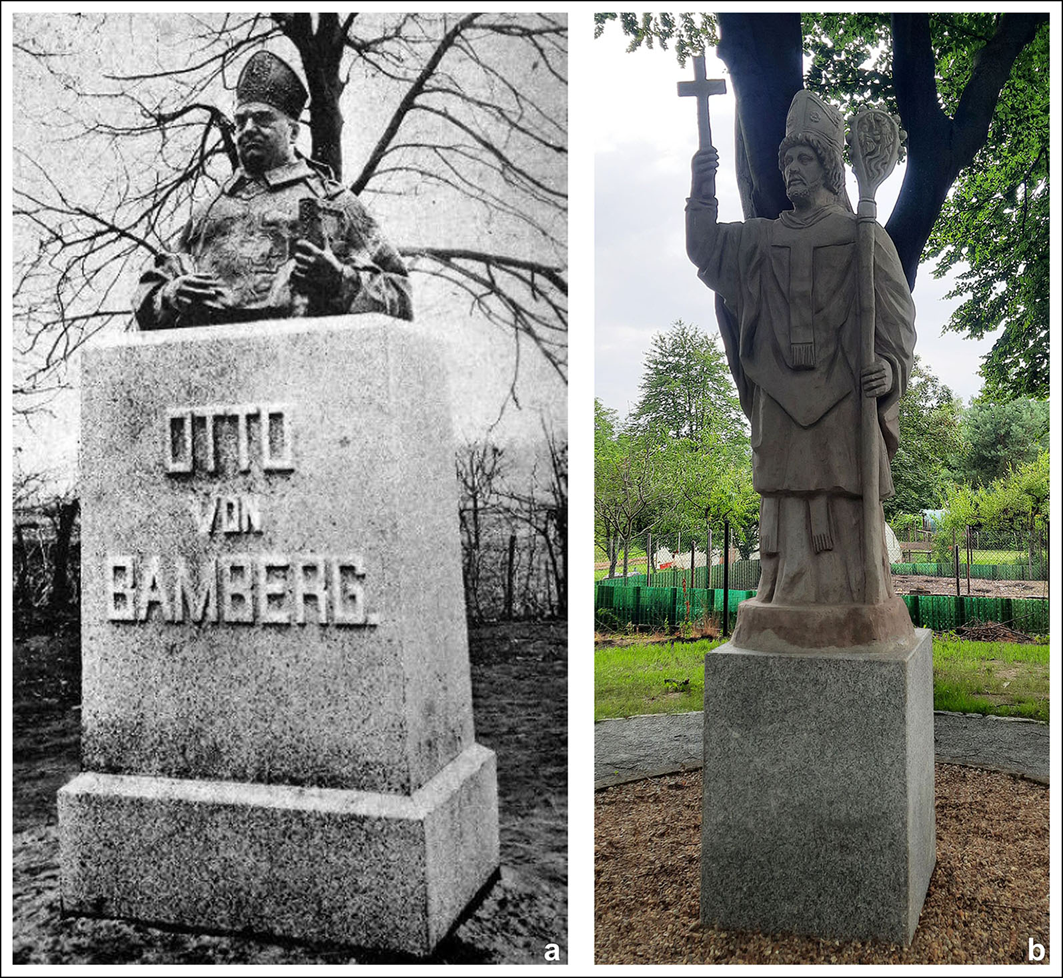
While it is unlikely that the rectangular structure is the church described in the various lives of Otto, it provides a context for the interpretation of other findings; excavated objects belong to both Slavic Pagan and Christian traditions, attesting to the moment of religious and social transition. The research is already engaging with the religious imagery in Pyrzyce. Historical accounts and archaeological studies of Otto’s mission in the town are being used by local actors to transform the contemporary social memory of the events, create new projects for local identity and ritual scenarios (Figure 6). In bringing together three disciplines, the resulting dialogue is augmenting the discussion on Otto’s Pomeranian mission, demonstrating the social role of archaeological excavations for local communities.
Statue of Otto of Bamberg: a) before 1945 (A. Janowski’s archive); b) erected in 2024 (photograph by K. Baraniecka-Olszewska).

Funding statement
Narodowe Centrum Nauki, grant no 2022/46/E/HS3/00118, Polish Ministry of Education and Science (project: The baptism of Pomerania).

 Open access

