Atrial flutter is a commonly encountered arrhythmia in the perinatal period and accounts for approximately one-third of fetal arrhythmias. It can lead to serious consequences such as hydrops fetalis and even death, if left untreated.Reference Casey and McCrindle 1 , Reference Lisowski and Verheijen 2 Numerous methods exist to convert fetuses and neonates in atrial flutter to normal sinus rhythm, which include anti-arrhythmic medications, pacing, and direct current cardioversion.
The oldest method used to cardiovert neonates from atrial flutter into normal sinus rhythm is through the use of medications. Anti-arrhythmic agents including digoxin, sotalol, flecainide, propranolol, and amiodarone also have been reported with variable rates of success.Reference Casey and McCrindle 1 , Reference Texter and Kertesz 3 , Reference Martin and Hernandez 4 A major advantage to using anti-arrhythmic agents is that they are non-invasive. However, each of these medications is associated with adverse effects including ventricular arrhythmias, atrioventricular block, hepatotoxicity, and thyroid abnormalities.Reference Texter and Kertesz 3 , Reference Bell, Thoele and Mander 5 – Reference Woolf, Wenger and Smith 8 Therefore, they require diligent monitoring for adverse effects until cardioversion is successful. In addition, digoxin and flecainide also require monitoring of their levels to confirm a safe range.
In addition to medications to convert these patients, pacing has been reported as an effective method for converting atrial flutter to normal sinus rhythm with its success rates ranging from 30 to 70%.Reference Texter and Kertesz 3 , Reference Dunnigan and Benson 9 Pacing has several advantages over medications, which include immediate conversion without a need to perform labs or long-term monitoring. The drawbacks to pacing is that it is invasive, requiring placement of intracardiac or transoesophageal catheter to pace the atrium. In addition, to perform this procedure successfully and without pain, it requires sedating the patient. In addition, when atrial pacing is performed on a neonate with atrial flutter, there is a small but significant risk of degeneration of atrial flutter into atrial fibrillation, which generally necessitates the use of direct current cardioversion.Reference Casey and McCrindle 1 , Reference Rhodes, Walsh and Saul 10
The first successful direct current cardioversion of neonatal atrial flutter was reported in 1965.Reference Hassenruck, Chojnacki and Barker 11 Direct current cardioversion is considered the most successful method of conversion of atrial flutter to normal sinus rhythm with reported success rates of >85%.Reference Lisowski and Verheijen 2 , Reference Texter and Kertesz 3 The advantages of direct current cardioversion include immediate conversion, readily available, and it is easy to perform. The drawbacks of direct current cardioversion include need for sedation and hypothetical risk of converting atrial flutter into a serious arrhythmia and burns on the skin if appropriate amount of energy is not delivered.
To date, no studies exist comparing the cost efficiency of these methods of cardioversion for neonatal atrial flutter. The purpose of this study is to compare the cost-effectiveness of digoxin, pacing, and direct current cardioversion in the conversion of atrial flutter in neonates.
Materials and methods
Subject selection
A literature search of articles published in the English language was performed through Pub Med® to identify published studies of atrial flutter in neonates under 30 days in which attempt(s) were made to convert to normal sinus rhythm with either digoxin, pacing, or direct current cardioversion.
Inclusion criteria
Inclusion criteria were isolated atrial flutter, neonatal age group<30 days, and first-line therapy with digoxin, pacing, or direct current cardioversion.
Exclusion criteria
Neonates with CHD, post-operative patients, and those who received multiple medications at first attempt were excluded from analysis.
Assumptions
A few assumptions in this study include intravenous access for all, sedation for direct current cardioversion and pacing, neonatal ICU stay of 3 days for successful direct current cardioversion or pacing, and 4 days for digoxin for loading and monitoring of adverse events. Each failed conversion attempt resulted in an additional hospital day and each failed attempt progressed to the next methodology until success was achieved.
Data extraction and analysis
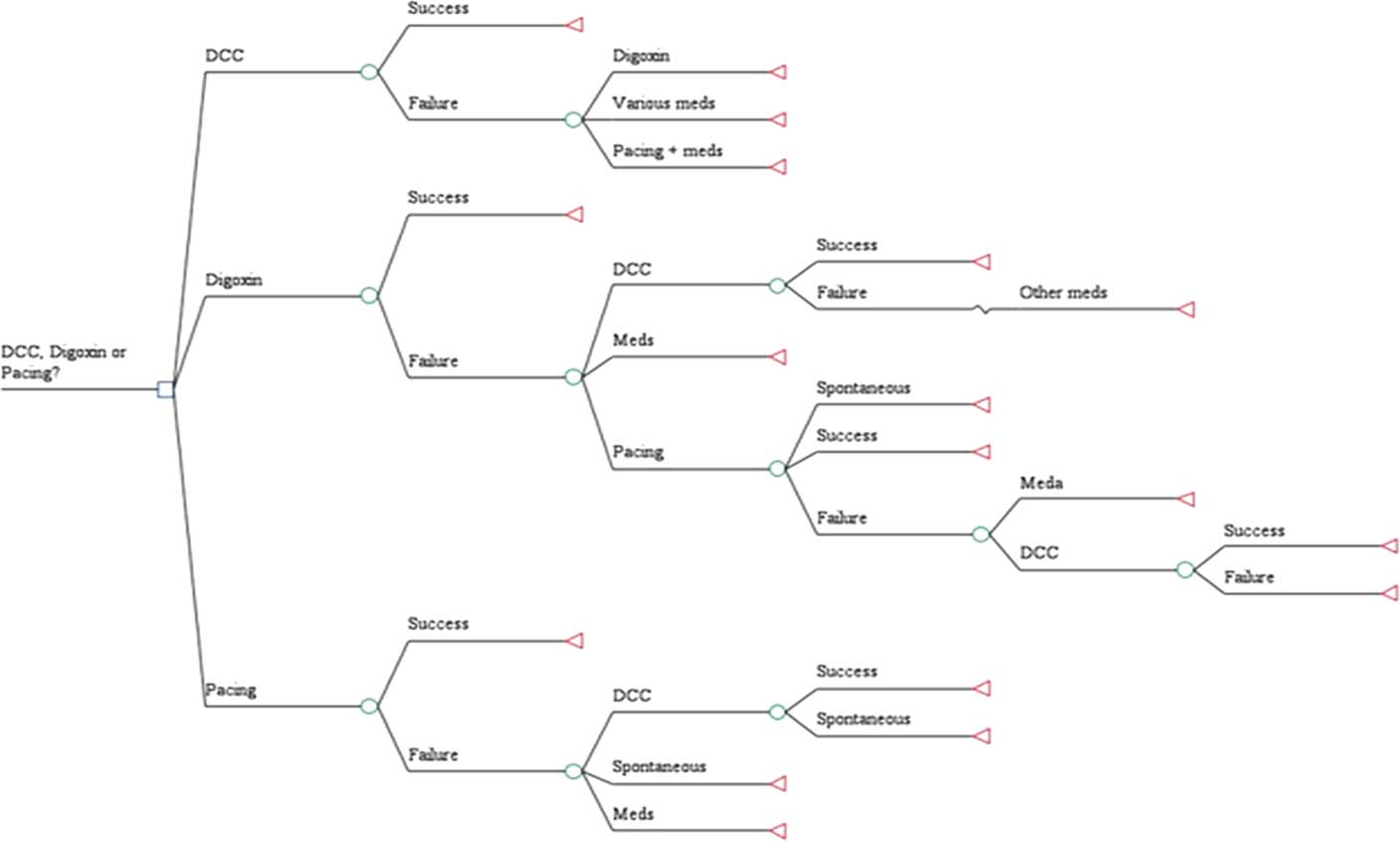
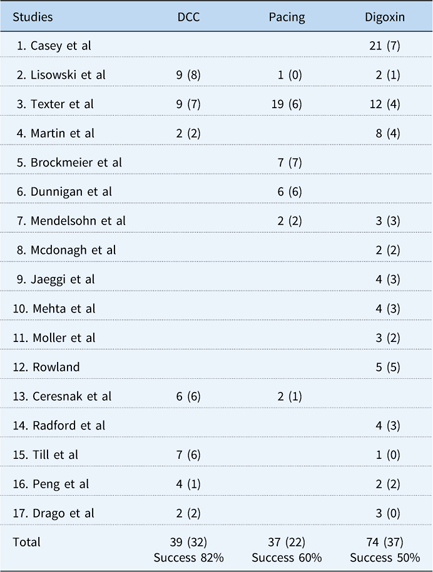
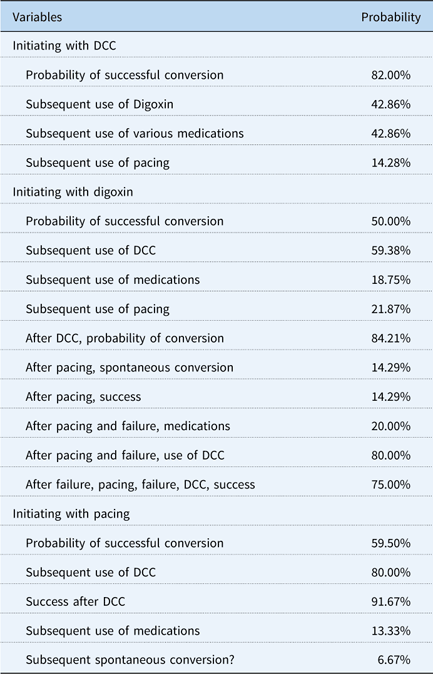
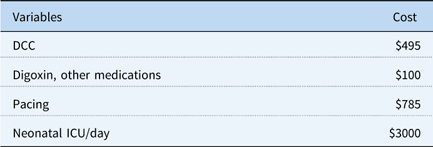
The efficacies of digoxin, pacing, and direct current cardioversion in the conversion of neonatal atrial flutter are illustrated in Table 1. A decision tree was developed using Treeage Pro software® to model the alternative treatment strategies, including the sequence of events as displayed in Figure 1 that can occur as a result of each treatment. Both successful and unsuccessful conversion rates for all three methods of cardioversion were included. Figure 1 displays the model decision tree. The probabilities for this model were obtained from the meta-analysis conversion rates of atrial flutter in neonates (Table 2). Patients who failed initial methodology of conversion progressed to the next methodology until successful, as represented in the decision tree. Each failed conversion resulted in additional neonatal ICU stay. Cost values for this model are based on 2015 Medicare reimbursement rates (Table 3). The cost end point was the time from presentation until the atrial flutter was converted. One-way sensitivity analyses were performed on initial digoxin, pacing, and direct current cardioversion conversion rates and the daily cost in the neonatal ICU.
Treeage Pro decision tree model illustrating the three methods of cardioversion. DCC=direct current cardioversion.

List of published studies of atrial flutter in neonates.

DCC=direct current cardioversion.
Table of probabilities.

DCC=direct current cardioversion.
Table of costs.

DCC=direct current cardioversion.
Results
A total of 150 neonates with atrial flutter who underwent successful conversion either by digoxin, pacing, or direct current cardioversion were identified from meta-analysisReference Casey and McCrindle 1 – Reference Martin and Hernandez 4 , Reference Dunnigan and Benson 9 , Reference Brockmeier, Ulmer and Hessling 12 – Reference Drago, Mazza, Garibaldi, Mafrici, Santilli and Ragonese 23 (Table 1). Digoxin was found to have a successful conversion rate of 50% (37/74), pacing of 60% (22/37), and direct current cardioversion of 82% (32/39) (Table 2). The cost analysis for cardioversion of atrial flutter identified that the total cost of cardioverting neonatal atrial flutter with digoxin was $14 374, pacing was $11 086, and direct current cardioversion was $10 304. The majority of the additional costs for pacing and digoxin stems from prolonged neonatal ICU stay because of their elevated failure rates when compared with direct current cardioversion.
One-way sensitivity analysis on the probability of pacing found that direct current cardioversion remains the most cost-efficient treatment strategy regardless of varying the assumption within the range of values found in the literature. Direct current cardioversion remains cost-effective until the assumed conversion rate is below 64.6%. One-way sensitivity analysis on the cost per day in the neonatal ICU found that direct current cardioversion remains the most cost-efficient treatment strategy for all cost values. Example calculation is illustrated in Appendix A.
Discussion
Neonatal atrial flutter can be converted to normal sinus rhythm by various methods, including anti-arrhythmic agents, pacing, or direct current cardioversion. Each of these methods has advantages and disadvantages. Cardioversion through the use of medications such as digoxin is comparatively easier, as this does not require sedation and is a non-invasive method, but its main limitation is prolonged monitoring for adverse events during loading and its lower reported success rate than direct current cardioversion and pacing. Digoxin loading requires administration of the total digitalising dose – 25–35 µg/kg – in three divided doses 8 h apart, and the maintenance dose begins 24 h after the last loading dose. Therefore, it takes atleast 1 day to digitalise the infant and another day to start the maintenance dose – 8–10 µg/kg per day every 12 h – and additional 2 days to achieve steady state and monitor for adverse events such as bradycardia, heart block, electrolyte imbalance vomiting, and diarrhoea. This explains the rationale for our choice of 4 days of hospital stay to cardiovert with digoxin.
From the meta-analysis, it is evident that direct current cardioversion is the most effective method of cardioversion at 82%Reference Casey and McCrindle 1 – Reference Martin and Hernandez 4 , Reference Dunnigan and Benson 9 , Reference Brockmeier, Ulmer and Hessling 12 – Reference Drago, Mazza, Garibaldi, Mafrici, Santilli and Ragonese 23 , whereas digoxin’s success rates were reported at 50% and pacing at 60%. The cost analysis data from this study indicates that the total cost of cardioverting a neonate with direct current cardioversion is $10 304, pacing is $11 086, and digoxin is $14 374. The additional cost of cardioverting with pacing and digoxin appears to come from prolonged hospital stay owing to failure rates. If the conversion rate of direct current cardioversion drops to <64.6%, pacing becomes more cost-effective. Several studies have shown that direct current cardioversion has the highest conversion rate, which is >85%. Thus, we can safely conclude that direct current cardioversion is the most cost-effective method of cardioversion in neonatal atrial flutter. It has the highest success rates, presumed shorter length of stay, and results in a cost-savings between $800 and $4000. It is important to note that, although all therapies modelled are within the current standard of care, given the span of time of studies the practice was different based on multitude of biases. If we wish to pursue the questions of evidence-based best practice, it would be worth considering a multi-institutional, prospective, randomised trial.
Limitations
The results of our study are based on the meta-analysis of data obtained from previously published studies of neonatal atrial flutter. There are few large studies to compare the efficacy of various methods of cardioversion. A few assumptions had to be made in this study to compute the costs associated with each method of cardioversion such as extra day in neonatal ICU for each failed attempt. The study compares procedures performed in different institutions with different policies and very different publication time, 1963 versus 2006. The hospitalisation policies were different just like the type of available defibrillators. It may be that the success in direct current cardioversion could be even higher with the hardware available at present. We did not specifically look at cardioversion in premature infants and whether it had any impact on length of stay or cost.
Conclusion
In conclusion, direct current cardioversion is the most effective, as well as the cost-effective, method of cardioversion for neonatal atrial flutter. Direct current cardioversion can save health care dollars between $800 and $4000, when compared with pacing and digoxin, respectively.
Acknowledgements
None.
Financial Support
This research received no specific grant from any funding agency, commercial or not-for-profit sectors.
Conflicts of Interest
None.
Appendix A
Example calculation
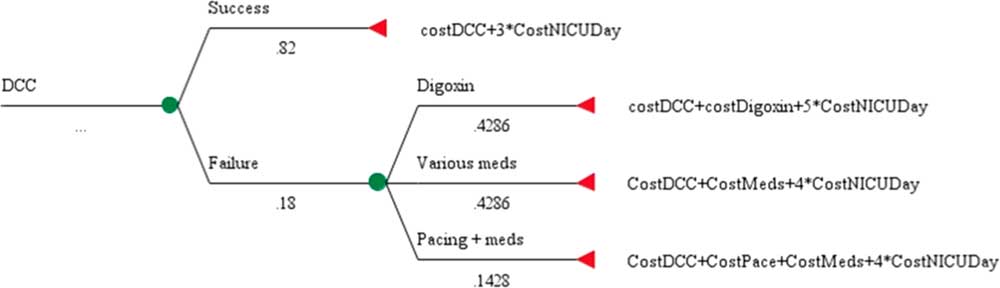
Figure 2 illustrates the different pathways that can occur when direct current cardioversion is used as the initial treatment, along with the relevant probabilities and cost structures for each pathway. The outline below details the calculations for each of the four pathways – one if direct current cardioversion is successful and three if direct current cardioversion is a failure:
Decision tree detail for direct current cardioversion pathways. DCC=direct current cardioversion.

∙ if direct current cardioversion is successful, the cost is calculated to be $9,495 (Costs of direct current cardioversion plus 3 days in the neonatal ICU: $495+3×$3000); and
∙ if direct current cardioversion is a failure, various outcomes can result:
° digoxin is applied at a total cost of $15 595 (costs of direct current cardioversion plus Digoxin plus 5 days in the neonatal ICU: $495++$100+5×$3000);
° various medications are applied at a cost of $12 595 (costs of direct current cardioversion plus medications plus 4 days in the neonatal ICU: $495+$100+4×$3000); and
° pacing and various medications are applied at a total cost of $13 380 (costs of direct current cardioversion plus pacing plus medications plus 4 days in the neonatal ICU: $495+$785+$100+4×$3000).
Referencing the detail and tree above:
∙ if direct current cardioversion is successful, the cost is $9495; and
∙ if direct current cardioversion is a failure, the cost is the weighted average of the three pathways that follow with the relevant probabilities applied:
 $$0.4286\,{\times}\,\,\$15\:\:595{\,\plus\,}0.4286{\rm }{\,\times\,}\$12\:\:595{\,\plus\,}0.1428{\,\times\,}\$13\:\:380{\,\equals\,}\$13\:\:993$$
Pursuing direct current cardioversion has an 82% probability of success and an 18% probability of failure. These probabilities then are applied to the costs if direct current cardioversion is successful and the average cost if direct current cardioversion is a failure:
 $$0.82{\,\times\,}\$9495{\,\plus\,}0.18{\,\times\,}\$13\:\:993{\,\equals\,}\$10\:304$$
Thus, this demonstrates how expected costs are determined for the direct current cardioversion alternative resulting in an overall expected cost of $10 304. Similar methods were applied in calculating the expected cost for digoxin and for pacing.