1 Introduction
In the wake of a pioneering work of Hadamard dating back to 1898 [Reference Hadamard13], the unit tangent bundle of a negatively curved Riemannian manifold M, which we denote by
$T^1M$
 and equip with the geodesic flow, has been widely considered as a canonical example of hyperbolic dynamics. This paper focuses on the generalization of a property that has been known since the 1970s under the negative curvature assumption: the genericity of ergodic measures in the space of invariant probability measures.
Let
$\mathcal {M}$
 be the space of invariant probability measures of the geodesic flow on
$T^1M$
 , equipped with the weak-* topology induced by the geodesic distance of the Sasaki metric. It is a compact and convex subset of the space of probability measures, and its extremal points are exactly the ergodic measures, whose set will be denoted by
$\mathcal M_e$
 . Hence,
$\mathcal M_e$
 is dense in
$\mathcal M$
 if and only if the latter is a realization of the Poulsen simplex [Reference Lindenstrauss, Olsen and Sternfeld16]. Moreover, the set of ergodic probability measures
$\mathcal {M}_e$
 is a
$G_\delta $
 set of
$\mathcal {M}$
 [Reference Parthasarathy19]; thus, the density condition
$\overline {\mathcal {M}_e} = \mathcal {M}$
 is equivalent to the following statement: ergodic measures are generic in the space of invariant probability measures.
Since the works of Sigmund on topologically mixing Anosov flows [Reference Sigmund22], this property has been known to hold for negatively curved compact manifolds. Coudène and Schapira [Reference Coudène and Schapira7] generalized it to non-positively curved manifolds whose universal cover has no flat strips. Their argument relies on several dynamical properties, such as the closing lemma, the transitivity, and the local product structure. This bridge between the dynamical properties of a flow and the density of the set of ergodic measures has been generalized later by Gelfert and Kwietniak [Reference Gelfert and Kwietniak11].
When it comes to necessary conditions, Coudène and Schapira [Reference Coudène and Schapira6, Reference Coudène and Schapira7] proved that for non-positively curved compact surfaces, the genericity of ergodic measures on
$T^1M$
 is equivalent to the condition that the universal cover of M has no flat strips. For non-positively curved manifolds of higher dimension, Coudène and Schapira remark that their argument could be generalized to prove that if M contains an open isometric embedding of the product of
$S^1$
 with a Euclidean ball, then the genericity of ergodic measures fails. A similar setting was studied by Constantine et al [Reference Constantine, Lafont, McReynolds and Thompson5]. They introduced the notion of fat 1-flat as an open embedding of the product of
$\mathbb {R}$
 with a Euclidean ball. However, one of their main results is the existence of manifolds whose universal cover contains a fat 1-flat, yet the quotient of this flat is not isometric to the product of
$S^1$
 with a Euclidean ball. Proposition 1 states a criterion that is sharper than the criterion of Coudène and Schapira in dimension higher than 2. Notably, it applies to all manifolds whose universal cover contains a fat 1-flat and does not require any general assumption on the curvature of M.
A precise definition of tubular neighborhood can be found in [Reference Lee15].
Proposition 1. Let M,
$\widehat N$
 , and
$\tilde N$
 be Riemannian manifolds,
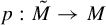
$p:\tilde M\to M$
 an isometric cover, and
$\phi $
 an open isometric embedding of
$\widehat N\times \tilde N$
 , equipped with the product metric, into
$\tilde M$
 . Assume that
$\tilde N$
 is geodesically complete and there exists
$x\in \widehat N$
 such that at least one of the following assumptions holds, with the notation
$N=(p\circ \phi )(\{x\}\times \tilde N)$
 :
-
(1) N is an embedded submanifold of M, $(p\circ \phi )(\widehat N\times \tilde N)$
 is a tubular neighborhood of N, and both N and
$M\setminus \overline {N}$
contain a closed geodesic (
$\overline N$
denotes the closure of N);
-
(2) N is homeomorphic to $S^1$
.



Then, the set of ergodic probability measures is not generic in the set of invariant probability measures on
$T^1M$
 .
Remark. The embedding
$\phi $
 being open implies
$\dim \widehat N + \dim \tilde N=\dim M$
 .
Proposition 1 can be applied to the manifolds introduced by Constantine et al in [Reference Constantine, Lafont, McReynolds and Thompson5, Theorem A], with
$N=S^1$
 and
$\widehat N$
 a Euclidean ball, showing that ergodic measures are not dense in the space of invariant probability measures.
A direct corollary of Proposition 1 is that the entropy density of
$\mathcal M_e$
 also fails under the same assumptions. Introduced by Orey and Föllmer [Reference Föllmer and Orey10, Reference Orey18], this property has received much interest in the last two decades, notably because of its relation to the weak specification property [Reference Constantine, Lafont and Thompson4, Reference Quas and Soo21]. It has proven to be especially relevant in the field of symbolic dynamics [Reference Pfister and Sullivan20] and was used to prove large deviation theorems [Reference Climenhaga, Thompson and Yamamoto3, Reference Eizenberg, Kifer and Weiss9].
Section 2 contains the proof of Proposition 1. In §3, we state a corollary of Proposition 1 and we present an example of a non-positively curved manifold that was introduced by Gromov [Reference Gromov12] and has been studied by numerous authors [Reference Ballmann, Brin and Eberlein1, Reference Ballmann, Gromov and Schroeder2, Reference Eberlein8, Reference Knieper14]. For this example, while the genericity of ergodic measures had remained an open question until now, we show that it fails using Corollary 2.
2 Proof of the non-genericity of ergodic measures
We consider
$M, \tilde M, \widehat N, N, \tilde N$
 , p,
$\phi $
 , and x that satisfy the assumptions of Proposition 1. The goal of this section is to prove that
$\mathcal M_e$
 is not dense in
$\mathcal M$
 .
Without loss of generality, we can consider
$\tilde N$
 to be connected, since at least one of its connected components satisfies all the assumptions of Proposition 1. Moreover, if Assumption 1 does not hold, since N is then compact, by making
$\widehat N$
 smaller if necessary, we can still assume that
$(p\circ \phi )(\widehat N\times \tilde N)$
 is a tubular neighborhood of N.
Let us introduce some notation. Hereafter,
$\pi :TM\rightarrow M$
 ,
$\tilde \pi :T\tilde M\rightarrow \tilde M$
 , and
$\widehat {\pi }:T\widehat N\rightarrow \widehat N$
 denote the projections that map any vector onto its base-point. The geodesic flows on the tangent bundles and unit tangent bundles of all the manifolds involved are denoted by the standard notation
$(g_s)$
 , even when they are not complete. The Lebesgue measure on
$\mathbb {R}$
 is denoted by
$\unicode{x3bb} $
 .
All the tangent bundles are equipped with the geodesic distance induced by the Sasaki metric. The distance to a subset of a manifold is defined as the infimum of all distances to the elements of this subset. It is a continuous map. For any
$r>0$
 , and any subsets
$A\subset T^1M$
 and
$\tilde A\subset T^1\tilde M$
 , their r-neighborhoods are denoted by

Similarly, the r-ball of
$\widehat N$
 centered at x is denoted by
$\widehat {B}_r = \{y\in \widehat N \mid d_{\widehat N}(x,y) < r\}$
 . According to [Reference do Carmo.17, Ch. 3, Proposition 4.2], we can define a positive radius
$\rho $
 such that the ball
$\widehat B_{\rho }$
 is strongly convex and, making
$\rho $
 smaller if necessary, we can assume that the exponential map is well defined on the
$\rho $
 -ball centered at
$0$
 of the tangent space
$T_x\widehat N$
 .
Let E be a connected component of
$T^1N$
 .
If
$\dim N\ge 2$
 , then
$E = T^1N$
 . According to Assumption 1, there exists a closed geodesic in
$M\setminus \overline N$
 . Hence, there exists a subset of
$T^1M\setminus \overline E$
 that is invariant by the geodesic flow and diffeomorphic to
$S^1$
 : we denote it by F. Since F is compact and disjoint from
$\overline E$
 , the distance
$d_{TM}(E, F) = \inf \{d_{TM}(x, y)\mid (x, y)\in E\times F\}$
 is positive.
If
$\dim N\le 1$
 , then N is homeomorphic to
$S^1$
 , otherwise, it would not contain a closed geodesic. Thus,
$T^1N$
 has exactly two connected components, both compact. In this case, we set
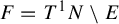
$F = T^1N\setminus E$
 , which still satisfies
$d_{TM}(E, F)>0$
 .
In both cases, we can pick
$r\in (0, \rho /2)$
 such that
$2r < d_{TM}(E, F)$
 . The following lemma describes the behavior of geodesics within the ball
$\widehat B_{2r}$
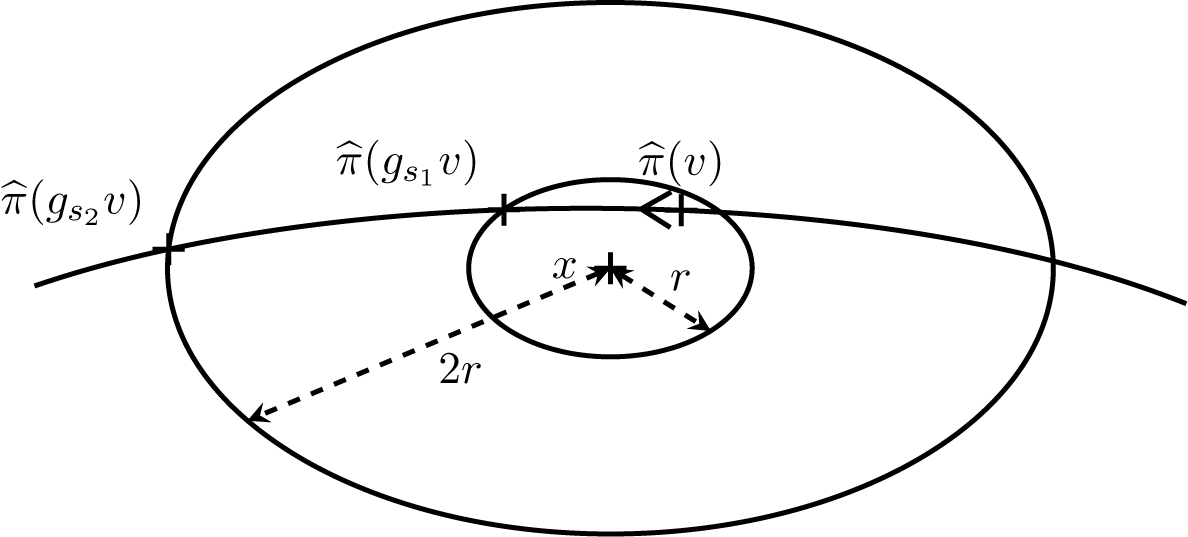
 (see Figure 1).
Lemma 1. Let
$v\in T^1\widehat {B}_{r}\subset T^1\widehat N$
 . Then,
$\{s>0 \mid \widehat {\pi }({g}_sv)\not \in \widehat {B}_{r}\}$
 and
$\{s>0 \mid \widehat {\pi }({g}_sv)\not \in \widehat {B}_{2r}\}$
 are closed non-empty subsets of
$\mathbb {R}$
 . Set

Then,
$\{\widehat {\pi }({g}_sv) \mid s_1\le s< s_2\}$
 is contained in
$\widehat {B}_{2r}\setminus \widehat {B}_{r}$
 and the inequality
$s_1\leq \frac 23s_2$
 holds.
Proof. Since the exponential map is well defined on the
$\rho $
 -ball centered at
$0$
 of
$T_x\widehat N$
 , the geodesic
$s\mapsto \widehat \pi (g_sv)$
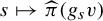 can be extended at least until it exits
$\widehat B_{2r}$
 ; thus,
$\{s>0 \mid \widehat {\pi }({g}_sv)\not \in \widehat {B}_{r}\}$
 and
$\{s>0 \mid \widehat {\pi }({g}_sv)\not \in \widehat {B}_{2r}\}$
 are non-empty. They are closed because the balls
$\widehat {B}_{r}$
 and
$\widehat {B}_{2r}$
 are open.
Let
$s \in [s_1,s_2)$
 . Then,
$\widehat {\pi }({g}_sv)$
 belongs to
$\widehat B_{2r}$
 by definition of
$s_2$
 . If it did belong to
$\widehat {B}_{r}$
 , then, by convexity of
$\widehat {B}_{r}$
 , there would exist a geodesic segment connecting
$\widehat {\pi }(v)$
 and
$\widehat {\pi }({g}_sv)$
 that is contained in
$\widehat {B}_{r}$
 . By the strong convexity of
$\widehat {B}_{\rho }$
 , this segment would have to be equal to
$\{\widehat {\pi }({g}_tv) \mid 0\leq t\leq s\}$
 , which is contradictory because the latter is not contained in
$\widehat {B}_{r}$
 . Hence,
$\widehat {\pi }({g}_sv) \in \widehat {B}_{2r}\setminus \widehat {B}_{r}$
 .
Moreover, by the strong convexity of
$\widehat B_\rho $
 , the segment
$\{\widehat \pi (g_tv)\mid 0\le t\le s_1\}$
 is a length-minimizing geodesic; thus, the triangle inequality yields
$s_1\le 2r$
 .
Finally, the reversed triangle inequality yields

Hence,
$s_1\le \tfrac 23 s_2$
 .
Lemma 2. Let
$u\in T^1M\setminus B_{r}(E)$
 and set
$U = \{t>0 \mid g_tu \in B_r(E)\}$
 . Then,

The behavior of geodesics within the ball
$\widehat B_{2r}$
 .

The proof of Lemma 2 relies on the argument that the orbit of u can be decomposed into a finite or countable union of geodesic arcs that intersect E exactly once. The intersection with E of those segments can be projected on geodesic segments of
$\widehat N$
 and Lemma 1 yields an upper bound on the average time spent inside
$B_r(E)$
 . It is worth noting that the estimate
$\frac 23$
 in Lemma 2 is arbitrary. Improving the argument of Lemma 1 and choosing r smaller could give arbitrarily low upper bounds.
Proof. If U is bounded, the limit of
${ \unicode{x3bb} ([0,T]\cap U)}/{T}$
 is zero and the lemma is proved. Let us assume that U is unbounded. As a non-empty open subset of
$\mathbb {R}$
 , it is a finite or countable union of disjoint intervals. Let
$(t_{-1},{t_1})$
 be one of those intervals (with
$t_1 \in (0,\infty ]$
 ).
Let
$\tilde E$
 be a connected component of the unit tangent bundle of
$\phi (\{x\}\times \tilde N)$
 such that
$E = dp(\tilde E)$
 . The geodesic distance induced by the Sasaki metric on
$T\tilde M$
 is bounded below by the geodesic distance on
$\tilde M$
 . Hence,
$\tilde \pi (\tilde B_r(\tilde E))$
 is contained in the r-neighborhood of
$\phi (\{x\}\times \tilde N)$
 , and since
$\widehat N\times \tilde N$
 is equipped with the product metric, the following inclusion holds:

Since
$\tilde N$
 is connected and geodesically complete,
$\phi (\{x\}\times \tilde N)$
 is a connected component of
$p^{-1}(N)$
 and since
$(p\circ \phi )(\widehat N\times \tilde N)$
 is a tubular neighborhood of N, then
$\phi (\widehat N\times \tilde N)$
 is a connected component of
$p^{-1}((p\circ \phi )(\widehat N\times \tilde N))$
 . Thus, any geodesic segment in
$(p\circ \phi )(\widehat N\times \tilde N)$
 admits a lift in
$\phi (\widehat N\times \tilde N)$
 . In particular, we can find a lift
$\tilde u\in T^1\tilde M$
 of u such that
$g_{t}\tilde u$
 belongs to
$\tilde B_r(\tilde E)$
 for all
$t\in (t_{-1}, t_1)$
 .
Let us pick
$t_0 \in (t_{-1},{t_1})$
 , and let
$v\in T\widehat N$
 and
$w\in T\tilde N$
 such that
$g_{t_0}\tilde u=d\phi (v,w)$
 . To prove by contradiction that
$\|v\|$
 is positive, let us assume that
$\|v\|=0$
 . Then,
$\tilde u = d\phi (v, g_{-t_0}w)$
 holds and one has
$d_{T\widehat N}(v, 0_{T_x\widehat N}) = d_{\widehat N}(\widehat \pi (v), x)$
 . Hence,

Since
$g_{t_0}\tilde u\in \tilde B_r(\tilde E)$
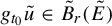 , (*) shows that this distance is smaller than r by (*). Moreover, the vector
$d\phi (0_{T_x\widehat N}, w)$
 belongs to the unit tangent bundle of
$\phi (\{x\}\times \tilde N)$
 . The latter is either equal to
$\tilde E$
 (if
$\dim N\ge 2$
 ) or the union of
$\tilde E$
 and a lift of F (if
$\dim N\le ~1$
 ). According to (**), the vector
$d\phi (0_{T_x\widehat N}, w)$
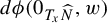 belongs also to the
$2r$
 -neighborhood of
$\tilde E$
 , which must be disjoint from any lift of F since
$2r<d_{TM}(E, F)$
 . In both cases,
$d\phi (0_{T_x\widehat N}, w)$
 must belong to
$\tilde E$
 . Since
$\tilde N$
 is geodesically complete, the vector
$d\phi (0_{T_x\widehat N}, g_{-t_0}w)$
 also belongs to
$\tilde E$
 , and (**) yields
$\tilde u\in \tilde B_r(\tilde E)$
 , which leads to a contradiction because
$u\not \in B_r(E)$
 . Hence, the norm of v must be positive.
By (*), since
$g_{t_0}\tilde u\in \tilde B_r(\tilde E)$
 , the point
$\widehat \pi \big ({v}/{\|v\|}\big )$
 belongs to
$\widehat B_r$
 ; thus,
${v}/{\|v\|}$
 satisfies the assumptions of Lemma 1, and we can set
$s_1$
 and
$s_2$
 as in the statement of the lemma. Moreover,
$g_s({v}/{\|v\|})$
 is well defined for all
$s\in [s_1, s_2)$
 and the following holds:

Hence, the geodesic arc
$\{\pi (g_{(s\!{\|v\|})+t_0}\tilde u)\mid s_1\le s<s_2\}$
 is contained in
$\phi (\widehat N\times \tilde N)$
 , which is a lift of a tubular neighborhood of N, and since the normal exponential map of
$\phi (\{x\}\times \tilde N)$
 coincides with he pull-back of the normal exponential map of N by
$dp$
 , one has

This is larger than r by Lemma 1. Hence, the interval
$[{s_1}/{\|v\|}+t_0, {s_2}/{\|v\|}+t_0)$
 is disjoint from U, and the inequalities
${s_1}/{\|v\|}+t_0 \ge t_1$
 and
${s_2}/{\|v\|}+t_0\le t_2$
 hold, with
$t_2=\inf (U\cap (t_1, +\infty ))$
 . Notice that
$t_2$
 exists because U is unbounded and
$t_1$
 is not
$+\infty $
 , since it is bounded by
${s_1}/{\|v\|}+t_0$
 . Additionally, the conclusion of Lemma 1 yields

Since
$t_1-t_{-1}=\sup \{t_1-t_0 \mid t_0\in (t_{-1},t_1)\}$
 , we also get the inequality:

This argument can be applied to any maximal open interval in U. In particular, every such interval is bounded. Since U is unbounded, its partition in open intervals must be countable, which means that there exist two sequences
$(t_{-1}^{(n)})_{n\in {\mathbb {N}}}$
 and
$(t_1^{(n)})_{n\in {\mathbb {N}}}$
 such that

Hence,

The sequence
$t_{-1}^{(n)}$
 tends to infinity because U is unbounded, which proves Lemma 2.
To conclude the proof of Proposition 1, let us build an invariant probability measure on
$T^1M$
 that is not in the closure of the set of ergodic probability measures.
We can pick
$\mu _E\in \mathcal M_e$
 and
$\mu _F\in \mathcal M_e$
 supported on E and F, respectively, since they both contain a closed geodesic. Let us set
$\mu = \frac 34\mu _E + \frac 14\mu _F\in \mathcal M$
 .
The semi-norms induced by the bounded continuous functions form a basis of the weak-* topology. We define two bounded continuous functions
$\chi _{r}:T^1M\to \mathbb {R}$
 and
$\xi _{r}:T^1M\to \mathbb {R}$
 by

The r-neighborhoods of E and F are disjoint since
$2r<d_{TM}(E, F)$
 . Hence, the integrals of
$\chi _r$
 and
$\xi _r$
 are equal to
$\frac {3}4$
 and
$\frac 14$
 , respectively, and the following subset of
$\mathcal M$
 is an open neighborhood of
$\mu $
 :

By contradiction, assume that there exists
$\nu \in \mathcal {O}\cap \mathcal M_e$
 . Since
$\chi _{r}$
 and
$\xi _{r}$
 are bounded by
$1$
 and vanish respectively on the complements of
$B_r(E)$
 and
$B_r(F)$
 , the measure
$\nu $
 satisfies

According to the ergodic theorem, for
$\nu $
 -almost all vectors
$v\in T^1M$
 , one has

In particular, this limit holds for at least one vector
$v\in B_r(F)$
 . This vector does not belong to
$B_r(E)$
 because of the inequality
$2r<d_{TM}(E, F)$
 . Hence, Lemma 2 can be applied to v, leading to a contradiction with the limit above. We have proved that the neighborhood
$\mathcal O$
 is disjoint from
$\mathcal M_e$
 ; hence, the latter is not dense.
3 Application to manifolds with a local product metric
In this section, we prove a direct corollary of Proposition 1 and we use it to show that ergodic probability measures are not generic for a specific example of non-positively curved manifold.
Corollary 2. Let M,
$\widehat N$
 , and N be Riemannian manifolds. Assume that
$\dim \widehat N\ge 1$
 , N is geodesically complete and contains a closed geodesic, and M contains an open submanifold isometric to
$\widehat N\times N$
 , equipped with the product metric. Then, the set of ergodic probability measures is not generic in the set of invariant probability measures on
$T^1M$
 .
Proof. Under those assumptions, there exists an open isometric embedding
$\phi $
 of
$\widehat N\times \tilde N$
 into
$\tilde M$
 , where
$\tilde M=M$
 ,
$\tilde N=N$
 , and the cover
$p: \tilde M \to M$
 is the identity map. Let
$x\in \widehat N$
 and let us prove that the submanifold
$\phi (\{x\}\times N)$
 satisfies Assumption 1 of Proposition 1.
Restricting, if necessary,
$\widehat N$
 to an open geodesic ball centered at x, we can assume that
$\phi (\widehat N\times \tilde N)$
 is a tubular neighborhood of
$\phi (\{x\}\times N)$
 . Moreover,
$\phi (\{x\}\times N)$
 is geodesically complete and contains a closed geodesic since it is isometric to N. Finally, the set
$\widehat N\setminus \{x\}$
 is non-empty since
$\dim \widehat N\ge 1$
 and for all
$y\in \widehat N\setminus \{x\}$
 , the submanifold
$\phi (\{y\}\times N)\subset M\setminus \overline {\phi (\{x\}\times N)}$
 also contains a closed geodesic.
Let us now discuss a specific example of a non-positively curved manifold that was introduced by Gromov [Reference Gromov12] and has been studied by numerous authors [Reference Ballmann, Brin and Eberlein1, Reference Ballmann, Gromov and Schroeder2, Reference Eberlein8, Reference Knieper14].
Let
$\Sigma _2$
 be a compact hyperbolic surface of genus 2. Let
$A\subset \Sigma _2$
 be a simple closed geodesic such that
$\Sigma _2\setminus A$
 has two connected components isometric to each other. We denote by
$\Sigma _{\mathrm {half}}$
 one of those connected components. Rescaling
$\Sigma _2$
 if necessary, let us assume that A is isometric to
$S^1$
 . Let
$\phi $
 be that isometry. Then,
$(\Sigma _{\mathrm {half}} \cup A)\times S^1$
 and
$S^1 \times (\Sigma _{\mathrm {half}} \cup A)$
 are compact 3-manifolds with boundary, and the following is an isometry between their boundary components:

Finally, modify the constant-curvature Riemannian metric of
$\Sigma _{\mathrm {half}}$
 so that the adjunction space

is a smooth
$3$
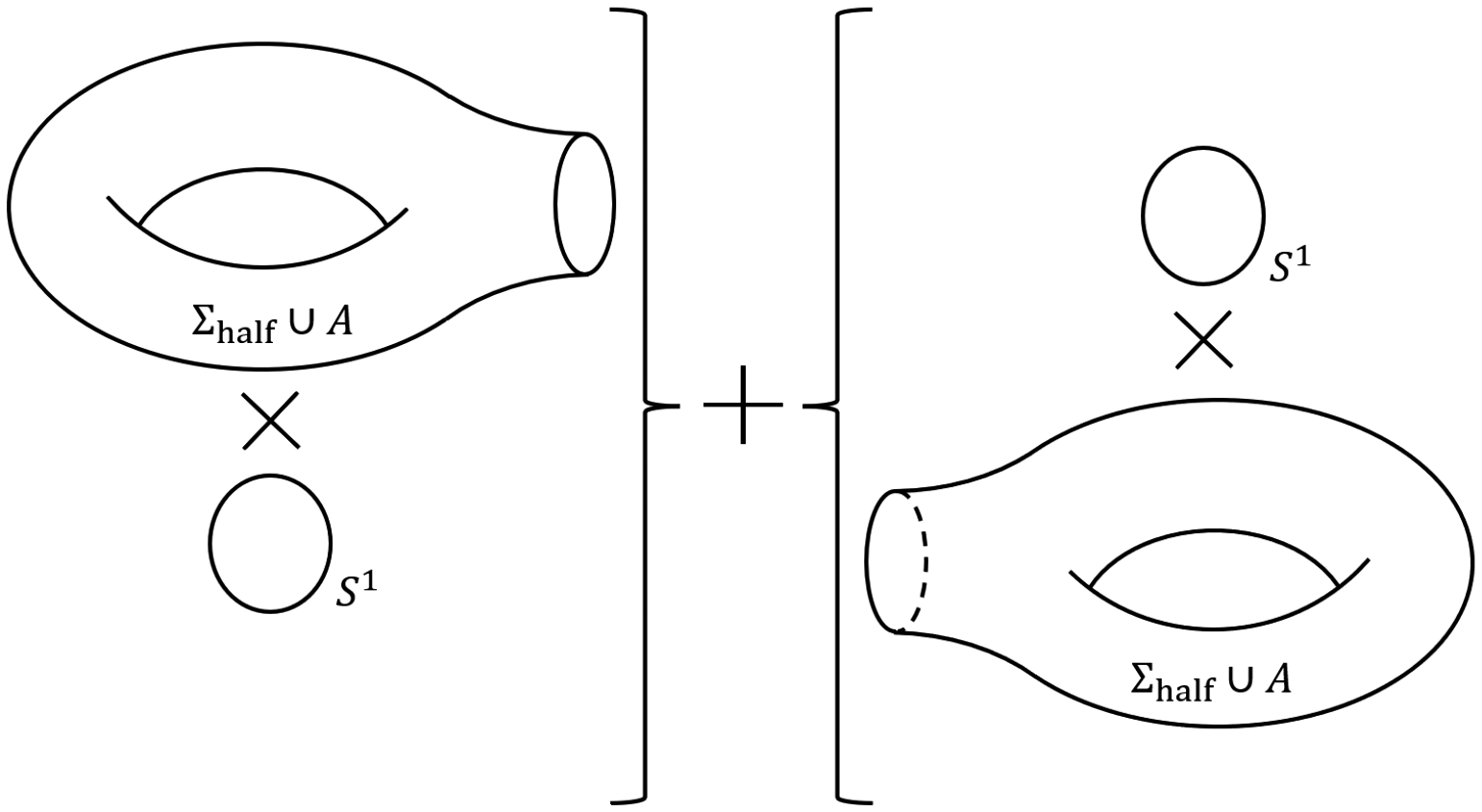
 -manifold whose curvature vanishes on the central torus. This construction is illustrated in Figure 2.
The non-positively curved
$3$
 -manifold introduced by Gromov.

Even though the universal cover of M does not contain a fat
$1$
 -flat, we can prove that
$\mathcal M_e$
 is not dense in
$\mathcal M$
 .
Corollary 3. Ergodic measures are not generic in the space of invariant probability measures on
$T^1M$
 .
Proof. The inclusion map
$\Sigma _{\mathrm {half}}\times S^1 \rightarrow M$
 is an embedding that satisfies the assumptions of Corollary 2, with
$S^1$
 being a geodesically complete manifold that contains at least one closed geodesic.