Introduction
Dementia with Lewy bodies (DLB) is the second most common progressive dementia after Alzheimer's disease (AD); accounting for 1 in 25 community and 1 in 13 secondary care cases diagnosed (Vann Jones and O’Brien, Reference Vann Jones and O’Brien2013). DLB symptomology presents many discrete difficulties in addition to those typical of AD. These include recurrent visual hallucinations, spontaneous alterations in concentration and attention (cognitive fluctuations), parkinsonian symptoms, autonomic symptoms and sleep disturbances. People with DLB have significantly more depressive symptoms (Yamane et al., Reference Yamane, Sakai and Maeda2011), and their quality of life rated by their caregivers is much worse than for people with AD; 24% of caregivers for people with DLB (6% for AD) rated their cared for person's health state at a level which a general population sample rated as worse than death (Boström et al., Reference Boström, Jönsson, Minthon and Londos2007).
Dementia caregivers experience major impacts in terms of their mental and physical health and having a partner with dementia is associated with lower levels of life satisfaction and more symptoms of anxiety and depression than reported by spouses of elderly individuals without dementia (Ask et al., Reference Ask, Langballe, Holmes, Selbaek, Saltvedt and Tambs2014). Furthermore, caregivers of people with DLB report more stress compared with AD and vascular dementia, with daytime somnolence, one feature of cognitive fluctuations commonly seen in DLB, particularly associated with increased stress (Lee et al., Reference Lee, McKeith, Mosimann, Ghosh-Nodyal and Thomas2013).
The National Institute for Health and Care Excellence Dementia Guidelines (England and Wales) (NICE QS30, 2013) recognize that people with dementia and family members need ongoing support, recommending that information regarding prognosis, treatments and local services is delivered by staff with local knowledge and expertise. Peer support for caregivers is recommended within the National Dementia Strategy for England (Department of Health, 2009). This type of dementia support may be offered within local memory clinic services, by charities or (for those able to access them), by online carers psychoeducation programs (Lewis et al., Reference Lewis, Hobday and Hepburn2010).
Regarding the specific needs of people with DLB and their caregivers a range of online resources including help and information sheets are accessible via websites including, for example, the Lewy Body Society (http://lewybody.org/), the Lewy Body Dementia Association (http://www.lbda.org/) and Alzheimer's Australia (https://fightdementia.org.au/).
These are valuable resources and incorporate insights gained from DLB carer interviews and focus groups in their design (for example see Nicholson, Reference Nicholson2010). Online resources however, do not offer the emotional and instrumental social support from peers and direct access to informed facilitators recommended within the above guidelines. They are also limited by being unavailable to those without access to, or familiarity with, digital information and may be difficult to engage with both cognitively and physically for those with DLB as their conditions progresses. Within the UK, no data currently exists on the development of DLB specific information and support interventions (or packages) for face to face delivery to those with DLB and caregivers.
A key stress point is around the time of diagnosis (Newbronner et al., Reference Newbronner, Chamberlain, Borthwick, Baxter and Glendinning2013). Our objective was to explore the information and support needs of people with DLB and their caregivers around the point of diagnosis, in order to inform the development of theory-based, directly delivered interventions to improve coping with stress and increase quality of life.
Methods
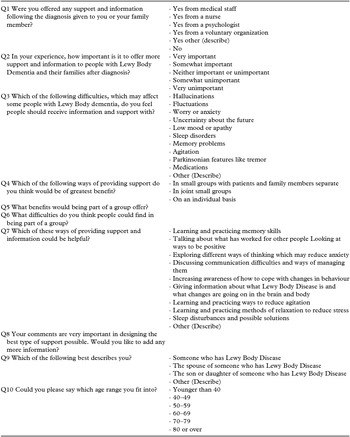
This was a retrospective publically open survey conducted during May 2014. The survey was hosted on the Lewy Body Society (LBS) website (http://lewybody.org/) which is the only DLB-specific charity in the United Kingdom (UK); typically receiving over 2,500 website visits each month. Respondents accessed the survey by a self-initiated search of the site where information about the survey was posted on and linked from the home page. The survey which is shown in Table 1 comprised ten short questions to avoid respondent fatigue and to be appropriate for people with DLB or their family members. Question content was informed by discussions with people with DLB and carers during one of the author's (AK) clinical work.
Survey questions

Questions focused on past support and information experiences, difficulties encountered that could benefit from information and support, and appropriate topics for inclusion in future resource development. Questions with multiple choice responses were summarized as percentage frequencies. Free-text responses were collated into common themes using content analysis.
Results
In total 125 people responded (89% female). The vast majority of respondents (80%) came from UK wide locations, which included South England; 39.2% (n = 49), Scotland and Northern England; 22.4% (n = 28), and Wales and the Midlands; 15.2% (n = 19). Respondents from outside the UK included the US; 6.4% (n = 8) and Europe 4% (n = 5). The majority of respondents were first degree relatives (children) of people with DLB (n = 85, 68%), followed by spouses (n = 22, 17.6%). Others included sisters, sons/daughters in law and grandchildren (n = 15, 12%.) Only three respondents (2.4%) were people with DLB.
Approximately half (49%, n = 61) of respondents stated they had not been offered any information or support following diagnosis. Of the 51% (n = 64) who had been offered support, the majority (50%, n = 32) had received support from medical staff. Psychologists (16%, n = 10), nurses (11%, n = 7) and voluntary organizations (9%, n = 6) were also reported as information providers, whilst for a minority (5%, n = 3), memory clinic staff, health professional friends and a social worker were also specified. Overwhelmingly 97% of respondents felt it was important to offer information and support at the time of diagnosis (n = 121). Only three respondents (a widower and two daughters) stated that this was somewhat or very unimportant.
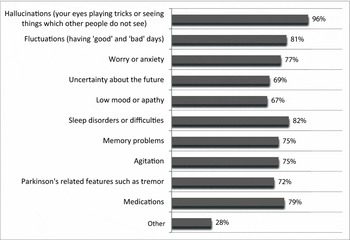
Responses regarding information and support needs are shown in Figure 1. Almost all respondents (96%, n = 120) desired more information and support in coping with hallucinations. Analysis of free-text data yielded two additional categories of information and support needs: (i) mental health issues including coping with anger, personality changes and misidentification; and (ii) coping with physical health issues, namely urinary problems, falls and poor mobility. Information on genetics, research, prognosis, life expectancy and end of life care were also identified as salient information needs.
Information and support needs identified by survey respondents.

Preferences on the optimal structure for information and support provision were mixed; 32% (n = 40) of respondents preferred small groups separating patients and family members, 28% (n = 35) small groups together and 40% (n = 50) individual sessions. Male respondents were divided equally between preferring group or individual support but more females preferred groups (61%, n = 68).
Respondents identified multiple benefits of group support: receiving emotional social support; comparing notes including any positive information; opportunities to share their experiences and learn from the experiences of others; a reduced sense of being isolated; and receipt of “all in the same boat” type of peer support.
Regarding potential difficulties with group support, respondents identified: risk of distress through contact with others affected by DLB (“hearing the heartbreak”) including concerns about how DLB affected other group members compared to themselves (engaging in social comparison); admitting they could not cope, anxiety about talking in front of strangers and admitting to their diagnosis in public; fear of becoming too emotional; and sharing difficult family situations with others. Practical difficulties included being unable to attend due to caregiving responsibilities.
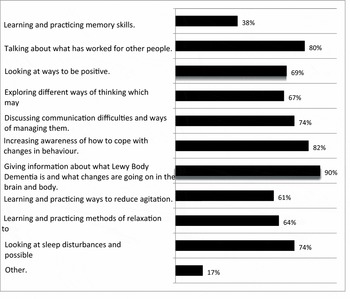
Preferences for methods of support and information provision are shown in Figure 2. These indicated that most respondents (90%, n = 112) wanted to be given information about the physiological mechanisms of DLB and 80% (n = 100) were keen to learn what others found helpful. Free-text responses included: support for carers similar to Macmillan cancer support; preparing carers for condition progression; dealing with grief; and coping with carer isolation.
Methods of providing support and information identified by survey respondents.

Discussion
This study highlights the lack of information and support provided to people with DLB and their caregivers around the point of diagnosis. Respondents identified the importance of tangible support and information around diagnosis, yet nearly 50% stated they were not offered this. The current lack of DLB specific support groups excludes access to the benefits of emotional and instrumental social support from peers. Whilst some dementia information is generic to all dementia types, specialist information about the physiological aspects of DLB, including how to cope effectively with DLB-related symptomology, and associated somatic and mental health comorbidities are rarely addressed.
The survey sample provided UK wide geographical representation. As a web survey, hosted by the UK based LBS but universally accessible, a small number of respondents participated from other areas including Europe, Canada and the US which may be seen as indicative of the wider need for information and support. However given the sample contained 80% of UK respondents it is reasonable that the findings can be regarded as generalizable to UK practice. It is notable however that the findings chime with previous research studies in this area from other countries (Zweig and Galvin, Reference Zweig and Galvin2014) suggesting that themes are not just national but international in perspective.
In particular, the lack of awareness of DLB (compared with AD) by clinicians, patients and their families can mean that patients experience delays in diagnosis, receive alternative initial diagnoses and have to see multiple clinicians to achieve a diagnosis (Zweig and Galvin, Reference Zweig and Galvin2014). This “knowledge” gap is reflected in the present survey by the high proportion (90%) of respondents wanting more information about the physiological mechanisms involved in DLB.
The most highly rated area where respondents felt people should receive information and support was hallucinations (96%). It is possible that hallucinations were a significant factor in the differential diagnoses of the cohort. However it is perhaps more likely that this reflects the nature of the respondents as predominantly family members of people with DLB. Hallucinations can be more problematic to others than to those experiencing them, with 85% of caregivers finding visual hallucinations very stressful or moderately stressful compared with 45% of patients (Barnes et al., Reference Barnes, Connelly, Boubert and Maravic2013).
Other issues which were rated highly related to fluctuations and sleep disorders which also have a major impact on carers’ ability to maintain their caring role. Similarly the issue of driving which was not raised as an area where support and information was needed may be less pertinent to carers.
Medication management was only rated fourth with 79% of respondents regarding this is an issue. This may suggest that people find it easier to raise this issue with medical staff or with pharmacists and so do not see as much need for support compared to the more sensitive topics which were rated more highly.
Poor community awareness and the lower incidence of DLB compared to AD often means that caregivers experience social isolation (Leggett et al., Reference Leggett, Zarit, Taylor and Galvin2011), which may explain the high proportion (80%) who wanted information about what strategies others in their position found helpful.
The views of people with DLB were under-represented among those who responded to this survey. This may have led to an intrinsic bias towards carer concerns rather than patient concerns although it is possible that carers completed the survey on behalf of people with DLB, perhaps due to their limited capacity. It may also be representative of the digital divide in using online surveys with only 19%, (n = 24, f = 18, m = 6) of respondents aged over 60. This highlights the need to ensure alternative methodologies are employed for seeking the views of people with DLB regarding content and the most appropriate approaches towards delivery (e.g. focus groups) before designing support packages.
Preferences for group or individual support were mixed and the variety of comments regarding the benefits and drawbacks of group-based support highlight the dilemma in providing the optimum type of support to suit all participants. This is further complicated by financial constraints and the practical issues involved in travelling to venues as the relatively small numbers of people can be geographically distal.
A further need, which was spontaneously elicited as a free-text response and thus may not have been considered otherwise, was the desire for up-to-date information on research. Assumptions that families already have enough demands may deny them the experience of contributing towards increasing knowledge or finding a cure. Prognosis and end of life care may be erroneously omitted as too sensitive an issue, but was identified as a support need within this survey.
The survey approach is a limitation and other methods may provide greater clarification but there is very limited data in this area and this survey helps illustrate what topics may be usefully considered in the development of any prospective study. A further limitation is the retrospective nature of the survey such that respondents were asked to think back to what information and support needs they had at the time of diagnosis. Work is needed to validate the identified needs in a group of newly diagnosed people and carers.
Conclusions
This data provides direct experiential evidence from people living with DLB and particularly their families on the perceived benefit of providing specific and timely DLB-related support and information. Specifically it could be used to inform the design of DLB support and information interventions, particularly by helping to identify optimal mode of delivery and content. More focus on patient needs is also warranted and focus group and qualitative studies with DLB patients would help provide illumination on this.
An information and support intervention that is delivered in an acceptable way and addresses the key needs and priorities of intervention recipients, is more likely to be effective, enhancing knowledge and adaptive coping in response to the challenges experienced.
Accessible, high quality information and both instrumental and emotional social support should be offered to people with DLB and their families around the diagnostic period. Important components should involve eliciting salient information needs from carers and people with DLB, where possible, and tailoring information and support to meet these needs. Referral to a variety of robust sources of information and identification of appropriate opportunities for peer support are other important components.
Conflict of interest
None.
Description of authors’ roles
A. Killen designed and executed the survey, analyzed the data, interpreted the survey results and drafted the manuscript.
D. Flynn and A. De Brun interpreted the survey results and drafted the manuscript.
N. O’Brien, J. O’Brien, I. McKeith and A. J. Thomas reviewed the manuscript
J.-P. Taylor contributed to the study design, interpreted the survey results, and drafted the manuscript.
Acknowledgments
Supported by the National Institute for Health Research (NIHR) under its Programme Grants for Applied Research program (DTC-RP-PG-0311-12001) and the NIHR Biomedical Research Unit in Lewy Body Dementia and Biomedical Research Centre awarded to Newcastle upon Tyne Hospitals NHS Foundation Trust and Newcastle University. The authors would like to offer their grateful thanks to the Lewy Body Society for hosting the web survey and to all the participants for their thoughtful and insightful responses.