

The Chairman (Mr A. M. Slater, F.I.A.): The meeting tonight will take a different format in that the authors are going to present a summary of the work to date of the working party.
After that, we will open the floor for discussion which will help them shape the final paper.
We have two speakers. Scott Eason is a qualified actuary and heads the advisory team for UK insurers at Societe Generale, focusing on risk management, yield enhancement and savings products. He joined Societe Generale in 2009 after spells running his own consultancy business for UK insurers and as an investment strategy actuary at Legal and General. His early career consisted of over 10 years in the insurance and financial services practice at Watson Wyatt.
Gillian Foroughi is a consulting actuary, working in the risk and financial services segment of Towers Watson in London since 1991. She specialises in life assurance product design and distribution strategies with a particular interest in variable annuity business. She is currently a member of the Towers Watson European Asset Liability Initiative with responsibility for variable annuity hedging.
Mr S. D. Eason, F.I.A.: Mrs Foroughi and I are presenting this session on behalf of the Investment Products for Retirement Savings Working Party.
The working party has been running for over 18 months. We initially presented at the Finance and Investment and Enterprise and Risk Management (FIERM) conference in June 2011 on the challenges facing Defined Contribution Schemes (DC). Since then we have narrowed our focus on to the topic of whether there is a place in the UK mass-market for a guaranteed pensions product. As Mr Slater said, we are in the process of producing a formal report of our work, and a draft paper setting out our progress to date, and intended future work, was circulated ahead of this session.
Our view is that defined benefit schemes have proven to be too expensive for providers. But the working group is concerned that defined contribution schemes, as currently practised, are not the best alternative. We believe that there is significant risk that DC will not provide sufficient retirement income for members due to insufficient investment returns and contribution rates not being high enough. This could lead to significant social cost.
With auto-enrolment coming, this issue is only going to get bigger and we see it as a ticking timebomb. Our presentation follows the order of the paper.
We look at the wants and needs of individuals and other stakeholders and at pensions systems around the world and methods of providing guarantees. In the paper we state a desire to carry out a comparison of the various approaches. Hot off the press we have the first results of this analysis and, while not finished, it starts to help give weight to our initial conclusions.
So, what do people want and need? There is no point in designing a pension scheme that is neither wanted nor needed. Equally, the distinction between wants and needs is important. Clearly, an individual is going to want the best pension that they can have, but are they willing to gamble on the level of this? They need a level of income that provides them with a certain level of lifestyle in retirement.
Large amounts of research have been carried out and it generally all points to savers wanting a protection of principal. This is often cited as one of the main reasons for not saving more in DC schemes. While the need is more for real income and this is affected by inflation, interest rates and longevity, it is clear that a guarantee would encourage savings and help meet the needs of savers. It also helps in retirement planning.
Generally, there is a belief that lowest cost and simplicity are best, but this is not necessarily the case, and the key features of a well-designed scheme are that it provides value for money and meets the needs of individuals.
For the mass-market there are two other key issues. Most individuals will want minimum involvement, and portability of fund across employers will become increasingly important as employment becomes more fluid.
Employers’ wants and needs are fairly straightforward. They want to offer a benefit to employees that is appreciated and represents value for money. However, they do not want it to take over their business and so need flexibility and low governance.
One of the things we did during the working party was to interview a number of stakeholders. The feedback that we got from the CBI was extremely strong. They did not want regulation and red tape to take over and stop them from running their own business.
The wants and needs of regulators will have a strong impact on providers. We have had a number of scandals in the pensions and savings arena, and both regulators and providers are very keen to avoid any further troubles. To achieve this, regulation generally requires and favours simple value for money products. Clearly, however, providers will require a need for profitable products, and Mrs Foroughi will talk about this later.
A very large number of DC members end up in the default fund, either actively or passively. This needs to be the option therefore that best fits the needs and wants of the majority of members in a scheme. The Department for Work and Pensions recently published guidance on what features it feels a default option should have.
Those were: it needed to have a simple and easy to explain high-level objective; it needed to take account of the likely characteristics and needs of employees who will be automatically enrolled; it needed to be appropriately and competitively priced; and the investment strategy should reflect the overall objective of the default option and the balance between risk and the potential for growth.
We believe that a fund targeting outperformance of risk-free assets with a guaranteed minimum level at retirement meets such criteria if priced appropriately.
I am now going to hand over to Mrs Foroughi to talk about what others do and methods of providing guarantees.
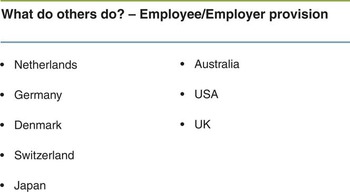
Mrs G. M. P. Foroughi, F.I.A.: The working party looked at what is done around the world in terms of Pillar II provision. By Pillar II, I mean provision that is organised by the employee and employer together as opposed to state or individual provision. The details are shown in the paper by country, but I decided to summarise it by grouping the countries into two different groups. The English-speaking countries are on the right-hand side of
Figure 1. They had relatively low levels of guarantees.
Figure 1

As an example, in Australia employees are obliged to have a funded pension and there is a wide variety of different pension types. But about 80% are Defined Contribution(DC) with trustees often responsible for investment strategy. Typically, there is about 70% equity exposure for active members, and guarantees are very rare.
The other countries had significant numbers of people from the mass-market with guarantees in their Pillar II provision. There were often mandatory schemes. For example, in Switzerland employers have to have a Pillar II scheme with a minimum return which is linked to 7-year Swiss government bonds. This guarantee does not just apply on retirement, but also on switching.
Now, of course, we can look at the different approaches and say that they are historic or cultural values about risk and return.
But I want us to consider whether there are genuine differences in mass market attitudes to risk and return between the countries on the left and the right, or whether there are actually other factors influencing scheme design, and if there are, are those factors valid?
We need to be quite careful in interpreting historic evidence. Are we basing our judgement on evidence which was gathered during a high return world, and how much of that evidence applies in the future when we might be looking at much lower returns on average?
On the other hand, is it right to assume that people want guarantees because they are clinging to the old DB schemes? Would they value guarantees as highly if they had to pay a fair price for them?
Moving on to differences in political philosophy between the different governments, one goal of government is clearly to make sure that the number of people who have to rely on state benefits is limited. You can certainly argue that in the countries on the left-hand side the Government has exerted pressure on scheme design to include guarantees, and in some cases those guarantees will not be needed and will not be wanted.
Relative to those countries, the UK government has quite a non-interventionist attitude. But if we ask how much that has influenced scheme design in the UK, it is hard actually to pin it on the Government because even an extreme libertarian would not mind having a scheme that had extra options available including guarantees, providing people paid a fair price for them.
For a government that is non-interventionist, nudging people into default funds with guarantees does seem to solve a few problems, but perhaps suppliers do not feel comfortable with this. I think that there is a big question for our profession about whether it is our professional duty to do what we think is right for customers who do not express a preference, but how do we judge what is right?
It may be that we are taking the view that with such low contribution levels in the UK, the only chance of anyone getting anywhere near to the pension that they really want or need is to invest in equities. But are we treating those investors fairly?
I would say that governments also influence design indirectly by making the suppliers of pension funds suspicious and nervous that they will be blamed when things go wrong. In retail financial services the pensions review and the endowment debacle have left the industry with a tarnished reputation because we did not explain the guarantees effectively to investors. I think suppliers of pension schemes are sometimes afraid to include guarantees in pensions design for this reason. For similar reasons, they are much happier doing what a customer wants than perhaps what they need, because in a bad scenario they might be able to avoid the fall-out.
If you look to other industries, when operational risks hit a company or an industry, a typical reaction is to try to remove the company or industry from the possibility of further reputational risk and so stop doing that sort of business. However, I would argue that some of these industries then expose themselves to the ultimate reputational risk that is not putting the customer first.
We need to consider whether we are unduly influencing the suppliers by our own views about risk and return. We are relatively sophisticated in terms of know-how and involvement in investment. My view of customers in the UK mass-market is that for them capital security is key, and beating the bank rate next. They often have a very low risk and reward understanding but one thing that they do understand is a guaranteed floor. I think explaining potential upside returns is much more difficult than explaining guaranteed floors to customers. I think the mass-market customers are dependent on advice. They are risk-adverse and they have a preference for packaged solutions.
Now I am going to move on to methods for providing guarantees. Then Mr Eason is going to present some stochastic results of different investment strategies.
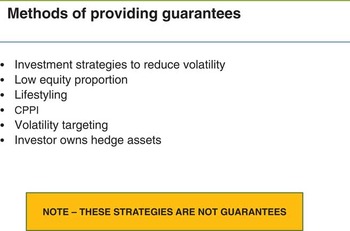
I want to emphasise that we need to differentiate for investors between the investment strategies in
Figure 2and “guarantees”.
Figure 2

The strategies ought to reduce the volatility of returns but they are not in and of themselves guarantees. A guarantee applies in the situation where an institution, such as an insurance company or investment bank, makes a promise that it will make good the difference if the value of the fund at a certain time, such as retirement, is lower than a defined floor.
The first investment strategy is lifestyling. This is very common in UK DC funds. It is based on the idea that a lower equity percentage gives more predictable returns and it builds on this by having a reducing percentage allocated to the risky assets as the individual reaches retirement. This gives the fund a chance to grow or recover from falls in the early years and, by investing in bonds closer to retirement, it matches annuity income much better.
It has the advantage that it is reasonably easy to understand and explain and it does seem sensible. It is important, however, to realise that this is not an investor guarantee. The saver still takes the investment risk. Mr Eason will show later that there is a very wide range of potential returns from this strategy.
The National Employment Savings Trust (NEST) uses target date funds which are based on this lifestyling approach. It also incorporates an idea of a foundation stage in the early years of a contract. This is a less risky investment strategy in the first few years so that investors are not put off making contributions by early falls in the value of their funds.
Constant proportion portfolio insurance (CPPI) is a strategy based around what percentage is going to be invested in risky assets. In this case it is a dynamic percentage that is set on a daily basis, based on the amount that the guarantee is in the money and an assumed maximum daily crash.
So you can invest in risky assets to the extent that they might fall to the maximum daily crash level. You will not breach the guarantee unless that assumption about the maximum daily crash is wrong. But, unfortunately, this method introduces the monetisation problem, so that if there is a fall in the value of the fund in the early days of the contract, the CPPI mechanism means that virtually the whole fund is invested in low yielding assets but with relatively high charges. This happened a lot at the time of the credit crunch, but investors were usually given the option to accept a lower level of guarantee yet still benefit from potential equity upside.
Thirdly, we are going to look at volatility target funds. In this case the percentage invested in risky assets depends on a target level of volatility that is set for a particular fund. There is a weighted average of risky and non-risky assets held based on their recent short-term realised volatilities. We are looking at the last two months or so of realised volatility for each asset class. The rationale of this is that apparently there is extensive empirical evidence showing that it is good to be underweight in an asset when it is volatile, and that recent volatility is a good indicator of future volatility. Essentially this strategy is supposed to make you quicker on the draw than everybody else in the market. NEST intends to use these volatility controlled funds.
Monetisation is less of an issue here; instead the issue is that there is no guarantee in future that the rationale will hold true. As I said, none of these strategies represent actual guarantees.
Now we consider the situation where an institution provides a guarantee. The institution has to hold capital because it has made a promise to make good the guarantee. It will have either to accept that risk or dynamically hedge it. It may hedge it with an investment bank, for example, but ultimately the firm that takes on the ultimate residual risk will be dynamically hedging the risk once it gets above a certain volume.
The reason that I am talking about this is because it means that there is a certain price for the guarantee; the price is the risk-neutral cost of the guarantee.
There may be differences in terms of profit loadings that are taken by manufacturers of guarantees, expense loadings and cost of the capital that they have to hold which depends on their regulatory regime. However, for a particular investment strategy and guaranteed floor, for a given economic outlook and for a certain level of charges being taken from the fund, the charge for guarantees is what it is.
I mentioned charges because this is a key element in why guarantees have not really taken off in the retail world. Obviously, if you are taking charges for the guarantee and for other things such as advice and investment costs out of the fund, it becomes much more expensive to meet the guarantee, particularly in situations where interest rates are low.
We call that the drag on the fund. I want to talk about why guarantees have not really taken off in retail. Essentially, manufacturers of guarantees have two big issues: do total charges cancel out expected return; and can they sell enough volume to make manufacture worthwhile? If you think about the costs that are involved in setting up dynamic hedging, they have to sell significant volumes to be able to have low charges.
The problem was that these retail products were sold through IFAs. There is no obvious reason why that was. Really, these are packaged investment guarantees. Why sell them to high net worth people?
The actual reason why they are sold through IFAs is because a lot of the American providers looked at our sales figures. They said that 80% of products are sold through IFAs, therefore we ought to be selling through IFAs.
Because they are sold through IFAs, there are big charges for advice. Most of the IFA charge for advice is about finding the customer at the point in their life when they are thinking about, or needing, a guarantee. No customer thinks that is value for money.
Not only that, but the IFAs required lots of features which complicated the design of these guarantees and made them quite difficult to understand. They asked the manufacturers to sell the contract with lots of different types of active fund manager and lots of funds.
There is a big problem with this because, if you are dynamically hedging these risks, you can operate some of these low volatility strategies and that will cut the cost of your guarantee. But ultimately if you are not hedging effectively, the guarantee cost gets very high. You can only effectively hedge funds which are really index trackers. As soon as you have active fund management, it becomes very expensive. Some of the problems of the high cost of guarantees would be solved if we had a default DC guarantee fund because that would be providing volume without such high advice charges and you would have hedge-friendly passive investment strategies with low AMCs.
I am going to pass over to Mr Eason, who is going to show us some results for the stochastic runs.
Mr Eason: One of the preconceptions about guarantees is that they are very expensive, they do not provide much protection and can have a significant negative impact on the performance of the fund.
To try to explore this we have built a stochastic model. It is actually based on a proprietary Societe Generale model, so I will not go into any of the details, but if anybody is interested, then please come and discuss it with me afterwards. Hopefully, it is not too contentious. It has a risk-free return of 3%, equity risk premium of 3% with equity volatility of 20%.
To date we have looked at only a single investment over 20 years. I appreciate that is not really how pensions work. We are working on expanding this to 40 years, and also to allow for regular contributions.
But that said, I think that the numbers are starting to show some interesting outcomes.
We have compared a number of strategies. The first one was traditional ‘life styling’, starting off for 10 years with 100% investment in equities and reducing down 10% per annum in the final 10 years, moving into risk-free assets.
The second was the CPPI. Most CPPI tend to be sold these days with a money-back guarantee so we have included the money-back guarantee. We then just had a straight savings investment, a unit-linked policy in insurance parlance, 50% equities, 50% risk-free. No guarantee. We have also looked at the same product with a guarantee.
We also looked at a volatility (vol) target approach, with a 12% volatility target. Very simply, if you look at the equity volatility being about 20%, you are going to have somewhere in the region of about 50% in equities when you take into account the volatility of the risk-free assets as well.
Again, this strategy has basically got no guarantee because the idea is that it controls the risk and therefore reduces the downside risk. We also looked at that strategy with a money-back guarantee as well to see if there was any value in that.
The final strategy that we looked at was a variable vol target approach. Those of you who have looked at it will recognise that it looks a little bit like the NEST approach. I am not claiming that it is the same as the NEST approach, but it is attempting to do a foundation phase at the beginning, more of a growth phase in the middle and then aiming towards risk-free assets towards the end and therefore with no guarantee.
We have tried to keep the charging structures fairly simple. We have assumed 20 basis points AMC for passive strategies, that is ones that do not require re-balancing, and 50 basis points where there is a dynamic strategy.
For the base run we initially assumed a 1% per annum guarantee charge for the vol target and the unit linked strategies. That seemed to be reasonably similar to the levels that we see in the markets by looking at a number of products in the retail high net worth IFA market. Then 50 bps per annum for the CPPI strategy, which is about the price that they go for at the moment.
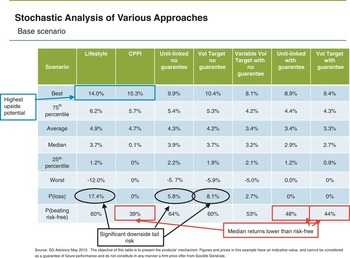
If you look down in the black circles on the bottom of
Figure 3you can see the non-guaranteed strategies contain a significant risk of getting back less than was put in. For example, with the life styling approach, there is a 17% chance that you will get less back than you actually put in. I appreciate it is 20 years. Obviously, you can go longer and then you will get less of an impact. But you can see that that is still a significant probability and risk. I am not sure how many people who are currently in a lifestyle product actually realise that there is that level of risk.
Figure 3

CPPI is the second product column on the slide and has the highest upside potential. That is basically because if it is going well, then you are heavily invested in equities. If it keeps going well then you are going to get a very strong performance.
However, as Mrs Foroughi said, there is a very significant chance of ending up in risk-free assets and the actual median result is only 0.1% annual return after fees. Thus there is a big risk of getting a substandard return.
Equally, you can see on both the guaranteed products as well that the medium returns are lower than risk-free. So your probability of beating risk-free is actually lower than half for a guaranteed product with 100 bps guarantee charge.
Under these assumptions, I think that we would argue that, whilst the guaranteed products remove the tail risk, the impact on the average and medium returns probably outweigh those benefits.
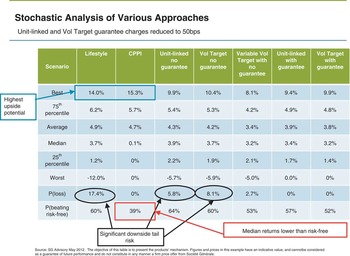
That is at 100 basis points. If the guarantee charge is reduced to 50 basis points per annum, the argument becomes less clear. As would be expected, the guaranteed products have lower average returns and upside potential than the other products. But they do compensate for this by removing the worst downside scenarios. Given what we discussed earlier about the impact that a guarantee may have to encourage savings, we believe that these distributions could easily be argued to be favourable, and the rationale for having guaranteed products or guaranteed return of premiums, or guaranteed return of contributions, starts to become attractive.
Of course, this is a model. What we have tried to do is to stress test the assumptions used in the model. Clearly, if I increase the equity risk premium I am going to favour those that have high equities. What we have tried to do is to stress test some of those where it is not so obvious. To be honest, the only one that materially impacted the argument was the assumed equity volatility.
See
Figure 4, we have done a run here which assumed the volatility reduced to 15%, and correspondingly the guarantee charges on the unit linked and the CPPI charges have been reduced as well because the risk is lower.
Figure 4

Reducing equity volatility increases the upside potential for the vol target strategies because you are ultimately putting more into equities at each point. It reduces the downside probabilities for the non-guaranteed products.
Interestingly, under all of these assumptions, each of the average and medium returns are above risk free. So all of these strategies are beginning to look like they have a rationale to them.
We would be interested to hear people's views on where we could progress with the modelling. As I said, we are planning to go out to 40 years and we are planning to try to introduce regular premiums
Any product that is designed will have to work for regular contributions. This is an important issue for a guaranteed product because the theoretical cost to be charged depends on the expected volatility and interest rates at the time of the contribution. These are obviously unknown in advance. So it is difficult to offer a fixed guarantee cost for future contributions. You may take the approach of having a variable guarantee charge. However, if you have a variable guarantee charge, this increases the administrative complexity because separate funds will have to be created for each contribution with a different guarantee rate.
For a company that offers a guarantee and wishes to hedge that guarantee, it can delta hedge it, although that exposes the provider to the risk of increased volatility and hedge cost. The alternative is potentially to buy an option from a bank. However, we are envisaging guarantees that could be up to 50 years in length, and realistically the availability of options on equities longer than 15 years is limited.
So one of the questions for yourselves is: do you think that the guarantee needs to be for 40 to 50 years, or can something like a 10 year rolling guarantee be an acceptable strategy for members and policyholders which nonetheless enables some risks to be passed to a bank rather than be kept within the provider?
There is also a question of portability. If an employee transfers from a guaranteed product, does the guarantee go with them? We have seen around the world that in some places it does and in some places it does not. If so, is there a transfer price to be paid between the original and the new employer? For example, when an employer buys a derivative to back a guarantee and equities and markets generally go up, the derivative will fall in value.
If that member then leaves and transfers to a different scheme, the employer will have to sell the derivative back into the market and he is going to get back a lot less than what he paid for it originally. So there is significant loss potentially for the employer.
An alternative could be that derivatives are bought within the fund and no explicit guarantee is given.
We have seen examples of this in the retail savings world. But, again, this may be hard to communicate.
We think communication is essential. There was a session here last month by the Transforming Consumer Information Working Party, who have done a lot of very good work on these ideas.
As discussed in the DWP default option section, we strongly believe that disclosing and communicating a floor is easier than communicating the upside that you might get from a strategy. So we believe that a guaranteed product could help communication.
In summary, our tentative conclusions are that a large number of needs of individuals, employers, providers, and regulators, can be met with the use of investment products with guarantees. In particular, guaranteeing a return of contributions at retirement may be important.
There is a widespread use of such guarantee products in DC offerings around the world, although these vary significantly between countries. There are clearly pros and cons for the approaches used.
We believe that a well-priced guaranteed maturity product could provide a strong default fund for DC schemes looking to meet the needs of mass-market participants.
Finally, it is fair to say that there are a number of challenges that exist to develop such a product. The potential for providers should encourage such effort.
The aim of the working party was not to provide a solution but to examine whether guarantees made sense, to highlight some of the tools available and, hopefully, to bring some of the issues into discussion to enable people to discuss them in detail and, it is hoped, to find a solution.
The Chairman: The authors conclude their paper with a very nice paragraph which says that they invite challenge and further thoughts on their views and, in particular, on the wants and needs of various parties; the existence of guarantees in the pension system; comparing methods of providing guarantees; and communication and other issues.
The working party are looking for your views. The focus is on the mass market rather than the high net worth segment, the 80% rather than the 20%.
I know that Paul Shelley has some comments and I invite him to open the discussion.
Mr P. M. Shelley, F.I.A.: I currently work on public policy here at the Institute and Faculty of Actuaries. But tonight I am talking from a personal capacity based on my experience in developing products for both bancassurance and the intermediary market over a number of years.
I think that this paper is particularly timely and welcome. I am sure that our members will be aware of the debate that Steve Webb, the Pensions Minister, has started instigating about whether there is potential for a third way for pensions savings between both defined contribution (DC) and defined benefit (DB), and guarantees are an intrinsic part of that. This paper addresses those issues.
I think, as actuaries, our skills at dealing with the interface between investment markets and the needs and wants of individual customers are particularly relevant to that debate.
One area where I thought the paper needed more work, and I welcome the slides today which started to do some of that work, was looking at the economic fundamentals behind the different methods of delivering guarantees.
To my mind when you cut through all of the detailed mechanics it boils down to two ways of delivering guarantees. Historically, lots of guarantees were provided by pooling, things like with-profits and indeed the experience of defined benefit schemes.
I would be interested to hear if the authors think that there is a possibility of pooling coming back into fashion; in particular, whether consumers will accept pooling across different time periods, which was one of the reasons I think why with-profits became increasingly difficult to sell.
In addition, any kind of pooling mechanism would need a float to support the fund. Would people be prepared to pay the cost of supplying the capital that acts as a float to the fund?
The other approach to providing guarantees comes down to an asset strategy that ultimately has some kind of sovereign debt as the underlying security.
We have seen in the markets how it is very expensive at the moment to purchase those assets. That makes it extremely difficult to manufacture these guarantees. Some of the calculations that you have shown demonstrate that the end return to the consumer is quite low and the probabilities of good returns in the consumer's mind of beating a zero return are sometimes smaller because of the costs of the guarantee and other costs associated with delivery of products.
Despite this, consumers are buying. I think that when you look at how consumers are saving for their pensions, not all of it is within the pensions wrappers. The banking industry has been particularly successful at selling short and medium term deposits in ISA wrappers, and those products have a guarantee. Part of the reason that people are buying those products rather than choosing to invest in pensions wrappers is because they understand them, they know that they are going to get their money back at the end of the investment period and that is a promise that they can believe.
I think there is a lot of work that we can do here that will be extremely useful to the public policy debate. I look forward to seeing that further work progressing as we go forward.
Mr A.P. Higham, F.I.A.: I work for Retirement Angels. I should like to ask you a couple of questions.
First, what do you consider retirement to be when you are looking at this? You are trying to provide some form of guarantee presumably at a retirement date, although you are not explicit in that. What is it you are trying to guarantee?
It feels like you are trying to guarantee an absolute amount of money, a cash sum, rather than a level of income. I think that it will be helpful if your final paper is clear on that. There are a number of different possibilities. Are you targeting a fund to buy an annuity at retirement or a certain level of income or a certain level of real income?
The second thing is the statement that you made that people are going to annuitise, and that you have not considered anything post-retirement. That might be okay if retirement is at age 75 when effectively the mortality drag means it is unlikely that staying invested is a sensible answer. If you are thinking of targeting retirement in the retiring from main employment aged 65, say, I think that there is still room for staying invested in asset classes other than the ones that underlie an annuity.
Mr Eason: Thank you, Mr Higham. I will respond to your fundamental question about guarantees.
We really started with that question. It comes back to the wants and needs. Ultimately, the need is to target an income. That is ignoring the whole issue about whether at, say, 65 you should annuitise or have flexible drawdown or some other option.
We decided to focus on a nominal cash amount at 65.
This is really linked to a lot of survey evidence from the mass market. People wanted to know that when they reached 65 they were not going to have lost half the money that they had put in.
What people do with their cash sum at 65 is a completely different debate. We focused very much on getting them to retirement with a pot that is acceptable from a nominal perspective. I appreciate, and I think it is controversial, that it is not on an inflation basis. Equally, in a real world you want to consider longevity and annuities. I know that there is an increasing ability for people not to have to annuitise. But I think the mass market will still annuitise in some way. I also think guarantees at post retirement ages are (a) too expensive and (b) too difficult to produce.
Therefore we came back to the fact that there needed to be a return of contribution type guarantee, and the question is: is there a place for it? We would like to think that there is.
Ms H. Salt, F.I.A.: I am from First Actuarial. I just wanted to float two ideas to see whether these are things that you have unpicked a little.
The first is that you said a few times that the price of a guarantee is the price of the guarantee. Of course, it is only that price if you buy it.
The price of a guarantee on my fridge is the price of the guarantee on my fridge but I am not going to pay it. The price of a guarantee is only a necessary thing for you to take into account if you assume that guarantee is purchased.
I am a little worried that you perhaps had too much of a retail rather than an occupational scheme perspective. Clearly, an insurer has to buy the guarantee or potentially has to buy the guarantee. Certainly within the regulatory space that DB schemes have traditionally occupied, they have not bought the guarantee. I accept that that has led to a lot of problems. I am not saying that it was definitely always the right thing to do.
But certainly there are lots of people who made the decision, and for long periods it was the right decision, not to buy the guarantee.
I think we need to consider the whole idea of pooling without promises.
I admit that this is difficult to do when people have individualistic and litigious attitudes. But I think that leads back to the other point that I wanted to raise which was whether members value guarantees if they have to pay a fair price for them.
We may find an answer to that question with our public service schemes because in these schemes we will have a situation where there are large numbers of members paying significantly more than their employer for a defined benefit.
In my view that undermines the whole basis of DB. The cross-subsidies that you have in DB schemes never mattered to members when they were paying less than half of the value of the benefits overall. When they are going to be paying for much more than 50% of the cost of the benefits on average, which could be well over 100% of the cost of benefits for them individually, we will find out whether they do value that guarantee.
I do think it is wrong to start from this assumption that members value guarantees. If members really want to guarantee themselves against longevity improvements, why do they commute pensions at atrocious rates at retirement?
Sometimes we think we know what people want and we maybe need to investigate that a bit further.
Mrs Foroughi: In the retail space the FSA has said that cross-subsidy in new products is something that it will be suspicious of going forwards.
Personally, I think that we need to think in a more societal way and think in terms of pooling but sadly I just do not think that that is the way that things are going.
When I mentioned the fair cost of guarantees I was using it in an economic sense; what they actually cost to manufacture rather than who was actually paying for them.
Mr P. N. Thornton, F.I.A.: In the paper you say the aim should be to have a default option that is appropriate for a wide range of members. I am not sure that is right. I think part of the good governance of DC plans is actually understanding the segmentation of the membership and designing default options which are good for the different segments.
How many different default options that results in is another issue, as is how you communicate with the members and educate them into making the appropriate selection. Nevertheless, I think that is the way to go.
A very high proportion of members do end up in the default options. That is not necessarily a bad thing because, if they have been well and carefully designed, you would expect that they would be appropriate for the majority of members and therefore it is good if members actively default.
On the question of with-profits, I think that the press have a false impression of with-profits. They think that some single actuary in a big insurance company sticks his finger in the air and decides what the bonus rates are. The reality is of course that in the bigger companies that are still actively open there are large numbers of actuaries doing some very high-tech work to ensure that the fund continues safely and delivers a good return.
I sit on the governance committee of a big with-profits fund, and I would say that the returns have been pretty good for savers in the recent volatile markets compared with either relying on cash in a building society, or investing in unit linked products in the market.
I think with-profits is greatly misrepresented and undervalued. I have no commercial interest in them being successful or otherwise. I just think they are a good savings vehicle otherwise I would not have got involved with them at all.
I think it would be very interesting to find some way of back testing with-profits funds against your stochastic analysis of different ways of providing guarantees.
You can unpick the methodology that is used to run with profits funds. They use hedging, Delta hedging, charging for guarantees, and all the techniques that you are talking about. I think that you should do some more work on this and maybe get some with-profits actuaries involved in your working party.
The reason I raise this suggestion is that the governance that surrounds with-profits contracts these days is very serious. The FSA takes it extremely seriously and the companies that run with-profits funds have to have very strong governance.
Whichever way we go for DC plans, part of the challenge will be introducing strong enough governance to deal with all of the relevant issues.
Mr Eason: I really appreciate Mr Thornton's first comment on default options. I think it is interesting as to whether or not there should be more than one default option. You are absolutely right that it is about understanding the membership and making sure that the right things are done.
Regarding with-profits, I am very happy to try to model things like management actions on bonuses, on equity backing ratios, and suchlike. It is then going to get very subjective. Maybe I could sit down with a couple of with-profits actuaries and consultants and see if there is a practical way of doing it.
Clearly, with-profits has been a key way of providing guarantees in the past, and maybe there is a way of regenerating this. It would probably have to have a different name these days. I do not think that it is just the FSA that does not like with-profits. I think that the press are quite against it.
The problem with with-profits is finding the appropriate duration. Some of the five-year bond guarantee charges are looking very expensive. With some of the longer bonds it is difficult for the insurance companies to hold capital against such policies. We will, however, consider the issues further.
Mr Thornton: I do not think that the guarantees are necessarily the major feature of with-profits business. The smoothing of investment returns and the protection from the downside volatility of the market may be more important. The price for this smoothing is losing some of the upside. Over time, because of the concept of asset shares, with profits provides an overall fair return, so the longer the period the more likely the saver will feel they have achieved the full return on the asset shares.
The objective of what you are seeking is how to develop a safe DC plan for members which meets their needs. That is pretty much what with-profits was designed to do. I know it has a bad name. But there is a huge amount of product development that has gone into with-profits which should not be set aside, because it is very much trying to address the same issues that you are.
The Chairman: Let me reiterate something that Mrs Foroughi said which I found profound. It was that there is a big question about whether it is our professional duty to do what we think is right for the customers who do not express a preference. I wonder whether we have any comments on that or anything else?
Mr C. D. Lewis, F.I.A.: I have a concern that if a significant proportion of defined contributions and pension funds give a guarantee and follow similar investment and hedging strategies, it may result in an area where there is a great deal of risk herding.
Should a lot of the funds decide to unwind or rebalance their portfolios, in particular the hedges, at the same time, they may find that the market is not sufficiently liquid.
I think before recommending guarantees as a default option for the mass-market, we ought to be aware of that.
Mrs Foroughi: If we are talking about dynamic hedging here, I think a key thing to note is the fact that the hedging instruments are really very simple short-term futures, and so on.
Even during the credit crunch most of those markets remained liquid. In the US all variable annuity guarantees were paid out. Obviously, there are some more complicated hedging instruments that are used by American companies which seek to hedge more of the risks.
I think Milliman did a study which showed that there was about 95% hedge effectiveness even over those really difficult times at the end of 2008.
A lot of the losses that accrued to shareholders and not investors, were as a result of basis risk, which was really brought about because a lot of the funds were not being hedged correctly.
For example, firms may have offered very high growth equity funds, but the hedging was done based on the US indices.
A lot of people have a question in their minds about whether dynamic hedging of guarantees, if used for huge volumes of business, will eventually just eat itself in a horribly circular way. But I think that we can look to the US and see that it actually did work quite well.
Mr A. H. Silverman, F.I.A.: I was slightly surprised by the variation in the return from the life styling product. In your further work perhaps you should look at a lifestyle product which was not 100% in equities for the first 10 years and where the proportion of equities came down rather quicker than you were saying as well. I think it would probably look a lot better.
A closely related point was that in modelling these lifestyle funds, the bond components may be invested in bond funds which can be, I do not know if this is how you did it, typically committed to a certain duration so that they are in effect rolling five or 10 year bond funds which do not actually mature at the point of retirement. But we need to consider what insurers do. So we either need to have funds that actually mature in cohorts or at least model something which matures, for example a bond fund which matures, when the saver retires.
The other point was actually considering what does the variation in the returns thrown up in these stochastic thought experiments actually mean post the event? We live through life in what becomes a sample size of one. That variation really only emerges into reality in terms of variation between cohorts.
If everybody gets the actual return that life delivers in each year, then they all get the same. The variation is entirely between cohorts. That I think leads us back to considering that if that is the risk that we are tackling, the one people like or do not like, the only way out of it is the with-profits fund.
There probably should be some consideration of this in the paper. The real-life risk is that between cohorts and what the consequences of that are.
A final point I wanted to make was regarding the conclusion of the paper, or certainly a strong preference expressed in the paper, which was for a default fund which was quite high in equities and was passive. I wonder if we would in retrospect be seen as doing pensions savers any favours if that were where we ended up, because that investment strategy is subject to being gamed by IPOs aimed at getting into the FTSE. We all know it has already happened. That possibility should be given some sort of consideration.
Mr J. K. Barnfield, F.I.A.: I work for aquilaheywood. I was a bit disappointed that there was complete focus on a guaranteed maturity product rather than a guaranteed income product. At the end of the day I think that is what consumers are really looking for. They do not want to be exposed to the vagaries of the investment markets and annuity markets at some date that has been predetermined, perhaps 40 years earlier. Increasingly, people do not know when they are going to retire. Retiring at a certain age seems to be becoming less prevalent in employment. It is hard enough to predict what your state pension age is going to be at the moment let alone your retirement age!
If there are reasons why you have decided that it ought to be a guaranteed maturity product rather than an income product, then I think that ought to be brought out in the future paper. Maybe the reasons are to do with regulation and legislation, but if Steve Webb is going to drive us down a ‘third way’, maybe we need to change some of the regulations and legislation to provide that sort of product going forward.
I have a more specific point related to the comparison of approaches that you are intending. I think it might be useful to have a benchmark that you can compare against. I think the NEST investment proposition is at least well-articulated and perhaps provides you with some way of illustrating the differences between the NEST approach and the various approaches that you might suggest. It would be a general comparison with a set benchmark that is known to the industry and will be used by lots of investors/consumers going forward.
I think you need to add consumer understanding to the list of criteria that you want to compare against. The approaches you are adopting seem to be reasonably sensible for a high net worth type proposition but may be challenging for a general mass-market proposition.
Mr Eason: One of the things that persuaded us to look at the guarantee on retirement was the fact that it is common in Europe. Guarantees on what you get back at retirement are more common than guarantees on income.
It was also our view that it was too difficult to provide an income guarantee because of the problems with predicting longevity. It may well be that this is too simplistic and we need to consider other approaches.
In regards to comparison between the benchmark and NEST, that is one of the strong recommendations in the Consumer Information Working Party paper. I think risk-free is the benchmark that you should be looking at beating and that should be part of your communication.
Using NEST as a benchmark leads to issues about complication and communication as NEST uses vol targeting.
Most of the insurers that I have spoken to in the last few years would love to do vol targeting for retail products but are concerned about how you communicate it to individuals.
NEST is the Government-backed pension scheme that is going to be provided for the mass market and it is using vol targeting. If vol targeting is suddenly now acceptable, it is a lot easier for insurers to be writing vol target products. Maybe in five or 10 years’ time we will be criticised for not having a vol target product rather than trying to put one in at the moment that nobody can explain.
Mr B. H. Davies, F.I.A.: I am from Union Pension Services. I think that this is an area where the profession needs to take a lead, explaining what people need.
The practical point that I would make is that I am not convinced that someone at the 80th income percentile has the same need for guarantees as someone at the 20th income percentile. I am particularly concerned with those between, say, the 20th and the 40th percentiles.
Those people are looking for some form of income guarantee on top of the state pension.
I would just make the point that I believe the sort of guarantee that is necessary can only be made by the Government. So, the Government needs to issue some sort of pension bonds.
I would make the modest suggestion that they could do it on a sort of collective basis and we could even call it the state earnings related pension scheme.
Mr Eason: I cannot disagree with you, to be honest. It would be nice for the government to turn round and offer the guarantees on these type of things. If it were an income, even better. Unfortunately, I am not Steve Webb. Even if I were, I suspect I would not be overly keen on putting an additional pension burden on the country at the moment.
Mr Higham: Communications to members is an extraordinarily difficult area. As a recent entrant into the IFA market, I have been trying to use a lot of the principles that you have considered for people at the point of retirement.
The reason why I focus so much at the point of retirement is that all the research shows people are much more willing, to the extent that they are willing at all, to engage and think about the subject matter of their finances, their savings and the adequacy at the point of retirement.
In many cases, individuals first really start seriously to engage with that approximately three months before they leave employment at whatever ripe old age that is.
So the guarantees are more valuable and more meaningful to people then. You will get more engagement. I think you might have more success in seeing vol targeted products introduced in funds closer to retirement then you would, say, as a default fund for an occupational pension scheme, which brings me back to the point that Ms Salt was making. If you are going to do this as a way of accumulating money, I think they largely have to be default funds. To expect members in that mid-ranking sector to engage and understand is probably a stretch too far.
Mr Eason: We ultimately need to understand the views of individuals. For example, if you took a large number of people and showed them the kinds of tables we have presented and said “You have a 17% chance of not getting back your money in 20 years’ time” how many people would say, “I am prepared to give up a little bit of the upside to protect myself against that situation.”
The Chairman: It remains for me to express my thanks, and I am sure the thanks of all us, to the authors and all of those who participated in this evening's discussion. [Applause]