INTRODUCTION
Recovery following traumatic brain injury (TBI) is characterized by an initial phase of confusion, disorientation, behavioral dysregulation, anterograde and retrograde memory deficits known as post-traumatic amnesia (PTA; Corrigan, Mysiw, Gribble, & Chock, Reference Corrigan, Mysiw, Gribble and Chock1992; Marshman, Jakabek, Hennessy, Quirk, & Guazzo, Reference Marshman, Jakabek, Hennessy, Quirk and Guazzo2013; Russell & Nathan, Reference Russell and Nathan1946). The duration of PTA is one of the strongest indicators of injury severity and outcome following TBI (Eastvold, Walker, Curtiss, Schwab, & Vanderploeg, Reference Eastvold, Walker, Curtiss, Schwab and Vanderploeg2013; Ponsford, Spitz, & McKenzie, Reference Ponsford, Spitz and McKenzie2016; Schönberger, Ponsford, Reutens, Beare, & O’Sullivan, Reference Schönberger, Ponsford, Reutens, Beare and O’Sullivan2009). Advancing understanding of PTA recovery is, therefore, not only important in informing patient management during hospitalization, but also in discharge and rehabilitation planning (Kosch, Browne, King, Fitzgerald, & Cameron, Reference Kosch, Browne, King, Fitzgerald and Cameron2010; Marshman et al., Reference Marshman, Jakabek, Hennessy, Quirk and Guazzo2013; Ponsford et al., Reference Ponsford, Downing, Olver, Ponsford, Acher, Carty and Spitz2014).
The early writings of Russell and Symonds describe PTA as a manifestation of “generalized cerebral injury” (Russell & Nathan, Reference Russell and Nathan1946; Symonds, Reference Symonds1962, p. 3). Consistent with this notion, overall PTA duration has been found to be most closely associated with measures of whole brain structure and function; for example, total lesion volume (Schönberger et al., Reference Schönberger, Ponsford, Reutens, Beare and O’Sullivan2009), the cumulative disruption to connectivity networks (Solmaz et al., Reference Solmaz, Tunc, Parker, Whyte, Hart, Rabinowitz and Verma2017), and, in the case of mild TBI, reduced cerebral blood flow (Gowda et al., Reference Gowda, Agrawal, Bal, Chandrashekar, Tripati, Bandopadhyaya and Mahapatra2006; Lorberboym, Lampl, Gerzon, & Sadeh, Reference Lorberboym, Lampl, Gerzon and Sadeh2002; Metting et al., Reference Metting, Rödiger, De Jong, Stewart, Kremer and Van Der Naalt2010). However, in light of the difficulty in imaging patients in PTA, much of our understanding of this phase of recovery has been drawn from studies using cognitive measures. Functions that have been found to discriminate most strongly between patients in and out of PTA include semantic processing, working memory and orientation (De Simoni et al., Reference De Simoni, Grover, Jenkins, Honeyfield, Quest, Ross and Sharp2016; Tate et al., Reference Tate, Pfaff, Baguley, Marosszeky, Gurka, Hodgkinson and Hanna2006; Wilson, Baddeley, Shiel, & Patton, Reference Wilson, Baddeley, Shiel and Patton1992; Wilson et al., Reference Wilson, Evans, Emslie, Balleny, Watson and Baddeley1999).
Anecdotal reports and observations suggest that memories for events before the injury are initially impaired and recover in order of remoteness (Benson & Geschwind, Reference Benson and Geschwind1967; Fisher, Reference Fisher1966; Russell & Nathan, Reference Russell and Nathan1946; Wasterlain, Reference Wasterlain1971). This phenomenon, known as “shrinking retrograde amnesia” (Russell, Reference Russell1935; Russell & Nathan, Reference Russell and Nathan1946), is reminiscent of Ribot’s (Reference Ribot1882) law which states that older memories are more resistant to disruption than more recent memories. In his law of regression, he suggested that the process of recovery should follow the opposite pattern to that of destruction; that is, more remote memories should return before more recent memories.
In head injury samples, trends have been reported whereby patients initially report their age and year as displaced further backward in time and across successive assessments these estimates become gradually (but not invariably) closer to the present (High, Levin, & Gary, Reference High, Levin and Gary1990). On the Westmead Post-Traumatic Amnesia Scale (WPTAS), date of birth, a well-learned and early-acquired personal fact, is the first item to recover (Leach, Kinsella, Jackson, & Matyas, Reference Leach, Kinsella, Jackson and Matyas2006; Roberts, Spitz, & Ponsford, Reference Roberts, Spitz and Ponsford2015). Other items that relate to information known before the injury (e.g., age, year, month), also tend to recover before consistent new learning (Roberts et al., Reference Roberts, Spitz and Ponsford2015). Examining trends in retrograde amnesia may, therefore, not only help to understand recovery during PTA, but assist with differentiating between a patient who is “in” versus “out” of PTA.
Autobiographical memory can be more episodic in nature, when referring to personally experienced incidents occurring at a specific place and time, or more semantic, for example personal facts (e.g., schools attended, home addresses) often referred to as personal semantic (PS) memory (Kopelman, Reference Kopelman1994; Renoult, Davidson, Palombo, Moscovitch, & Levine, Reference Renoult, Davidson, Palombo, Moscovitch and Levine2012). In the second part of their study investigating retrograde memory in young adults with TBI in PTA, Levin et al. (Reference Levin, High, Meyers, Von Laufen, Hayden and Eisenberg1985) found a negative gradient in PS memory, poorer recall for more recent than remote lifetime periods, in the PTA group that was not present in the group that had emerged from PTA. These findings were suggested to be consistent with anecdotal reports of “shrinking retrograde amnesia” and Ribot’s (Reference Ribot1882) law. The study by Levin et al. was, however, only very small and requires validation in a larger sample of prospectively monitored patients with TBI.
Although it would be ideal to assess both PS and episodic autobiographical memory to comprehensively evaluate this topic, patients in PTA have a limited attention span and fatigue easily. To maximize feasibility of participant engagement and completion of assessments, a decision was made to focus on PS memory in the present study. These questions are specific, and can be administered to patients in PTA in a directed and focused manner, minimizing the potential for increasing levels of confusion. Given the likely generalized nature of PTA described above and the diffuse network involved in PS memory retrieval (Martinelli, Sperduti, & Piolino, Reference Martinelli, Sperduti and Piolino2013), it was thought that PS memory might also be sensitive to PTA status and provide valuable information about the nature of the memory deficit in PTA and its recovery.
The aim of the present study was, therefore, to examine, using a repeated-measures design, the pattern of PS memory performance across lifetime periods in PTA and following emergence. Given observations of “shrinking retrograde amnesia”, it was hypothesized that patients would display a negative gradient in PS memory while in PTA, with poorer retrieval for recent events, compared to more remote lifetime periods. No gradient was expected to be observed following emergence from PTA or in healthy controls. It was also hypothesized that the degree of impairment in PS memory would be associated with the “depth” of PTA. Therefore, it was expected that PS scores would be positively correlated with WPTAS scores on the day of interview and negatively correlated with the number of days to emerge from PTA post-interview.
METHODS
Participants
Participants with TBI were recruited from the Head Injury Rehabilitation Unit at Epworth Hospital. Ethics approval was obtained from the Monash University and Epworth Hospital Human Research Ethics committees. Patients were eligible if they were still in PTA as assessed using the WPTAS, aged 18 to 75, fluent in English, with no prior history of significant alcohol or drug abuse, or known pre-existing cognitive deficits due to a neurological, psychiatric, or developmental condition. Patients with significant language impairment or levels of agitation precluding interview were excluded. In two instances, PTA duration was noted to be extended by other factors (e.g., reduced motivation and mood issues, medical complications), and one case was deemed to have a persistent chronic amnestic syndrome. These cases were excluded. Initially, because of the cognitive deficits characteristic of PTA, assent for participation was obtained from patients while in PTA and written informed consent was obtained from the next of kin, in accordance with national guidelines for ethical research. Formal written consent was obtained from participants themselves after PTA emergence.
The final sample of 20 participants was predominantly male (60%), with mean age at injury of 40.95 years (SD=18.46; range: 18–74 years). Mean PTA duration was 27.25 days (SD=13.84; range: 9–64 days), mean Glasgow Coma Scale (GCS) score at the scene was 8.15 (SD=4.02; range: 3–15), and mean years of education was 12.55 (SD=2.46; range: 9–18 years). All patients were classified as having sustained at least a moderate-severe TBI based on their PTA duration, depending on the classification scale adopted (Ponsford et al., Reference Ponsford, Spitz and McKenzie2016). Cause of injury was a motor vehicle accident in 45% of cases, bicycle accident (15%), falls (15%), motorcycle accident (10%), horse accident (10%), and pedestrian accident (5%). Abnormal pathology on initial CT was noted in 95% of cases (in one case, the image was degraded by movement). A patient-level table including imaging findings is included as Supplementary Material.
The healthy control (HC) group (n=20), recruited from the community to provide a normative comparison for PS memory performance were also fluent in English with no prior history of significant head injury, alcohol or drug abuse, or psychiatric, neurological, or developmental condition known to affect cognitive functioning. The HCs were predominantly male (75%), with mean age of 41.60 years (SD=19.27; range: 19–75 years). Mean years of education was 12.30 (SD=1.69; range: 9–17 years). Although matched only on distribution and not one-to-one with TBI participants, the control group did not differ significantly from the TBI group in gender, χ2(1, N=40)=1.03, p=.311, age, t(38)=0.11, p=.914, or education, t(38)=0.38, p=.710.
Measures and Procedure
All participants with TBI were monitored using the WPTAS (Shores, Marosszeky, Sandanam, & Batchelor, Reference Shores, Marosszeky, Sandanam and Batchelor1986) and the Agitated Behaviour Scale (ABS; Corrigan, Reference Corrigan1989) while in PTA. These scales were completed daily by the treating neuropsychologist on weekdays and by nursing staff on weekends. The WPTAS contains 12 items: 7 assessing orientation (age, date of birth, year, month, day of the week, time of day, place) and 5 assessing memory/new learning (name and face of the examiner, three picture cards). Each item is scored 1 for a correct response and 0 for an incorrect response and the patient is deemed out of PTA on the first of three consecutive days scoring 12/12. The ABS contains 14 items enquiring about various behaviors over the preceding 24 hr. Each behavior is rated from 1 (absent) to 4 (present to an extreme degree) and the total score indicates level of agitation (Mild=22–28, Moderate=29–35, Severe=>35).
Retrograde PS memory was assessed using the Personal Semantic Schedule of the Autobiographical Memory Interview (AMI; Kopelman, Wilson, & Baddeley, Reference Kopelman, Wilson and Baddeley1989). The interview was chosen because it is relatively brief, and, hence more likely to be tolerated by patients in PTA. The interview contains questions relating to factual information about the individual’s past (e.g., names of schools attended, friends, home addresses). It is divided into three lifetime periods (Childhood, Early Adulthood, and Recent Life), each with a maximum score of 21 (higher score indicates better performance). The overall PS score represents the sum of scores across the three lifetime periods (maximum 63).
To enable a focus on retrograde memory (i.e., memory for pre-injury events), questions in Part 7 of the Recent Life section referring to the current hospital admission were altered to relate to a hobby or activity the participant was engaging in close to the time of injury (must have been within the year prior). “Name of hospital” was replaced with “name of hobby or activity,” “location of hospital” was replaced with “location of hobby or activity,” and “date of arrival at hospital” was replaced with the last time they had engaged in the activity. This approach has also been used by others to prevent anterograde memory deficits confounding results for the Recent Life section (e.g., Greene, Hodges, & Baddeley, Reference Greene, Hodges and Baddeley1995).
Details of a recent hobby or activity, rather than a job, were elicited to ensure unemployed individuals were not disadvantaged. For the item relating to current address, participants were asked to report their address at the time of the injury. Instead of naming hospital staff or fellow patients, three current neighbors or colleagues were used (this is the alternate option for this question listed in the AMI manual). Only 3 of the 15 items in the Recent Life section, therefore, required alteration outside of what is specified in the AMI manual.
Participants were deemed appropriate for interview in PTA by the treating neuropsychologist when their behavior was settled and they were able to respond to questions and engage in conversation. On average the interview took place 18.60 days post-injury (SD=9.10; range: 7–45 days). Where possible, the interview was conducted in one 20- to 30-min session. However, where patients fatigued, the interview was administered across two sessions on the same day. The interview was repeated within 2 weeks of emergence from PTA (M=8.00 days, SD=2.96; range: 3–13). The mean number of days between interviews was 16.50 days (SD=6.48; range: 7–30 days). In most cases, participants could not recall the initial interview. Controls were tested once to provide an indication of the relative degree of PS memory impairment in the TBI group.
Data Analysis
All statistical analyses were performed using IBM SPSS version 23 for Windows. Pearson correlations were used to determine whether age at the time of injury was associated with any PS scores to ensure that a whole-group analysis was justified.
A two-factor within-subjects analysis of variance (ANOVA) was conducted to compare the gradient across lifetime periods within the TBI group in and out of PTA. The first factor was “PTA Status,” which included two levels (in PTA, out of PTA), and the second factor was “Lifetime Period”, which included three levels (Childhood, Early Adulthood, Recent Life). To ensure that there were no confounding effects of age or time-post injury, this analysis was repeated using age at injury as a covariate in one analysis and days post-injury that the interview was conducted in PTA as a covariate in a separate analysis. In three cases, PTA testing was ceased before reaching criterion on the WPTAS, and one individual was suspected to have been receiving help from her husband in learning the picture cards. Given that the inclusion or exclusion of these cases did not change the overall ANOVA results, they were retained in this analysis. They were, however, excluded from any correlational analyses involving overall PTA duration (see below) given that the accuracy of the overall duration was in question. An N of 16 is reported in this instance.
A two-factor ANOVA with one between-subjects and one within-subjects factor was used to compare PS scores in the TBI group with HCs across the three lifetime periods. The first factor was “Group,” with two levels (TBI out of PTA, HC), and the second factor was “Lifetime Period,” which included three levels (Childhood, Early Adulthood, Recent Life). The TBI group out of PTA were compared to the HC group in the first instance, and if this analysis was not significant, a second mixed ANOVA was conducted comparing the TBI group in PTA with the HC group. If PS memory was significantly more impaired in PTA than out of PTA with no interaction, it was presumed that HCs would also differ significantly from the TBI group when in PTA.
Graphical methods and Levene’s (Reference Levene1960) test were used to check the assumptions of normality and homogeneity of variance. The Brown and Forsythe (Reference Brown and Forsythe1974) robust version of ANOVA was also used to confirm the main effect when the homogeneity of variance assumption appeared to be violated. The Huynh and Feldt (Reference Huynh and Feldt1976) correction was applied to the degrees of freedom when the assumption of sphericity was violated (Tabachnick & Fidell, Reference Tabachnick and Fidell2013). Pairwise comparisons were used to analyze simple effects, with a Bonferroni corrected alpha level of .017 (.05 divided by three comparisons).
The proportion of participants who were impaired relative to controls according to criteria used in the AMI manual was also determined. TBI participants’ overall score and within each of the three lifetime periods were converted to Z-scores by subtracting the control mean and dividing by the standard deviation of the control group. This was done separately for scores in and out of PTA. Those in the “acceptable range” were less than one standard deviation below the control mean, “borderline impaired” between one and two standard deviations below, “probably abnormal” more than two standard deviations below, and “definitely abnormal” were at or below a level at which none of the healthy control participants scored.
Pearson correlations were used to examine associations between the overall PS score and the “depth” of PTA according to the number of days taken to emerge post-interview as well as WPTAS score on the day of interview. This analysis was also repeated as a partial correlation controlling for age and time post-injury of interview to ensure these variables were not confounding the results. Where these associations were statistically significant, each lifetime period was also examined independently with a Bonferroni correction (a=.017).
RESULTS
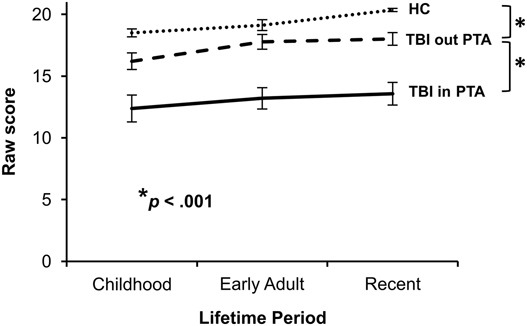
Figure 1 displays the mean scores across lifetime periods for the TBI participants in and out of PTA and relative to the HC group. From the graph, it can be seen that scores across lifetime periods were lower in PTA than for the TBI group out of PTA and the HCs, respectively. Age was not significantly associated with PS memory scores in or out of PTA.
Mean personal semantic scores across Childhood, Early Adulthood and Recent Life for TBI participants (n = 20) in PTA and out of PTA, and healthy controls (HCs; n = 20). Error bars represent that standard error of the mean. There was a main effect of PTA status whereby the TBI group performed significantly lower in PTA than out of PTA. There was also a main effect of group whereby the TBI group out of PTA performed significantly lower than the HC group. There were no statistically significant interaction effects, suggesting that the pattern across lifetime periods was similar between groups, and in PTA relative to out of PTA within the TBI group.

Within-Group Comparison: Performance In and Out of PTA
Mauchly’s test of sphericity was not statistically significant for either the Lifetime Period factor or the interaction effect, indicating that the variance in the difference scores was equal across the three lifetime periods. There was a statistically significant main effect of PTA status when comparing PS scores in and out of PTA, F(1,19)=64.33, p<.001, ηp 2=.77, whereby scores across the three lifetime periods were significantly lower in PTA than out of PTA. Scores appeared to increase across Childhood, Early Adulthood, and Recent Life; however, the main effect of Lifetime Period did not reach significance, F(2,38)=3.00, p=.062, ηp 2=.14. The interaction between PTA Status and Lifetime Period was also not statistically significant, F(2,38)=0.38, p=.689, ηp 2=.02.
Re-running the analysis with age at injury or time-post injury to first interview as a covariate in the repeated measures analysis did not change the interpretation of the results. There remained a significant main effect of PTA status, but no main effect of lifetime period or interaction between lifetime period and PTA status.
Comparison With the Control Group
It was first established whether there was a significant difference between the HC group and the TBI group when out of PTA. Mauchly’s test was significant for this analysis, suggesting violation of the assumption of sphericity and thus the Huynh and Feldt (Reference Huynh and Feldt1976) correction was applied (with the same result). Levene’s test was significant (indicating unequal variances) for the Childhood and Recent lifetime periods, but not for Early Adulthood.
The results showed a statistically significant, and large main effect of group, F(1,38)=18.81, p<.001, ηp 2=.33, with the TBI group out of PTA scoring significantly lower than the HCs. There was also a medium main effect of Lifetime Period, F(1.77,67.32)=9.01, p=.001, ηp 2=.19, and pairwise comparisons with a Bonferroni corrected alpha level revealed that scores in Childhood were significantly lower than Recent Life (p<.001). Early Adulthood and Recent Life did not differ significantly (p=.260). There was no statistically significant interaction between group and lifetime period, F(1.77,67.32)=0.85, p=.421, ηp 2=.02.
The main effect of group was also confirmed by comparing the overall score in the TBI group out of PTA with the HCs using Brown-Forsythe robust ANOVA. The TBI group still performed significantly below the HC group out of PTA, F(1,23.66)=18.60, p<.001, η2=.33, when compensating for unequal variances.
Degree of Impairment According to the AMI Manual
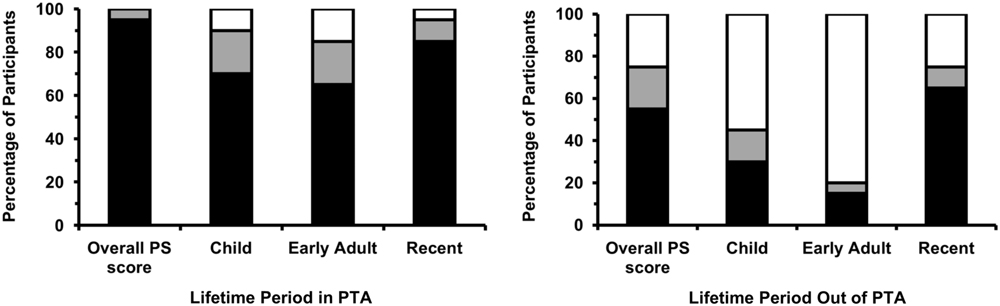
The number and percentage of participants falling within each impairment category according to the AMI manual is reflected in Figure 2 for the group in and out of PTA.
Percentage of TBI participants (n = 20) falling within each impairment category in and out of PTA based on the performance of the healthy control group. Participants falling in the ‘acceptable’ range (within one standard deviation below the control mean) are represented in white, ‘borderline’ range (between one and two standard deviations below the mean) in grey, and ‘probably abnormal’ range (more than two standard deviations below the mean) in black. The ‘Definitely Abnormal’ category is not included in this figure given that it is a different metric to the other three categories (i.e., not based on standard deviation) and therefore its inclusion would mean that the totals would not add up to 100 percent. The percentage falling in the ‘Definitely Abnormal’ category is reported in text.

In PTA, 100% of participants scored more than one standard deviation below the control mean for the overall PS score, 90% for childhood, 85% for Early Adulthood, and 95% for Recent Life. A similar trend was observed in the percentage of participants who were “Definitely Abnormal” according to the AMI manual (i.e., scored lower than all control participants), with the highest frequency for Recent Life (85%), followed by Childhood (70%) and Early Adulthood (50%). Out of PTA, 75% of participants remained greater than one standard deviation below the mean for the overall score, 45% for Childhood, 20% for Early Adulthood, and 75% for Recent Life. Only a very small percentage of participants (5%) were “Definitely Abnormal” for Young Adulthood, and equal to or less than half the sample were “Definitely Abnormal” for Childhood (30%) and Recent Life (50%).
Association Between PS Score and the “Depth” of PTA
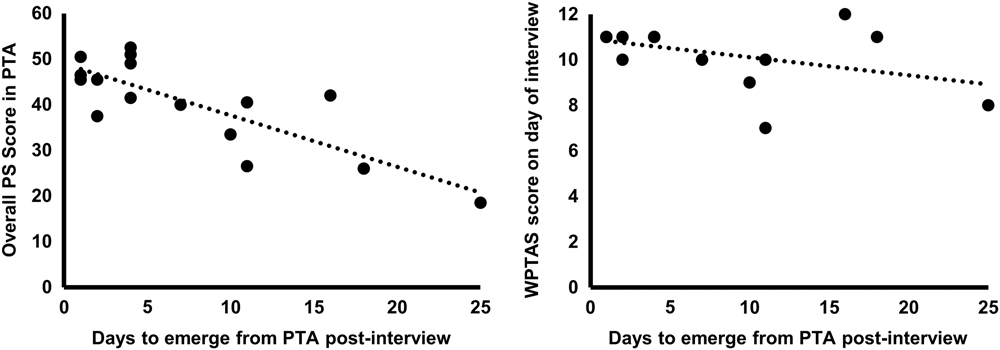
The association between overall PS score in PTA (M=40.41; SD=9.88) and WPTAS score on the day of interview (M=10.31; SD=1.30) did not reach statistical significance, r(14)=0.47, p=.069, R 2 =.22. Lower overall PS scores in PTA were associated with greater days to emerge from PTA post-interview (M=7.56; SD=7.10), r(14)=-0.81, p<.001. The R squared value (0.65) suggested that this association was strong, explaining 65% of the variability (see Figure 3), and the magnitude of the partial correlation controlling for age and days post-injury, r=-0.80, p=.001, R 2 =.64, suggested that these variables were not influencing the association.
Scatterplots of the Pearson correlation between personal semantic (PS) score in PTA (left-hand graph) and Westmead Post-Traumatic Amnesia Scale (WPTAS) score in PTA on the day of interview (right-hand graph), with the number of days taken to emerge from PTA post-interview (n = 16).

The correlation between each lifetime period and the number of days to emergence were all statistically significant using a Bonferroni corrected alpha level; Childhood accounted for the greatest variability (r=-0.71; p=.002; R 2 =.50), followed by Early Adulthood (r=-0.67; p=.005; R 2 =.45), and lastly Recent Life (r=-0.60; p=.015; R 2 =.36). WPTAS score on the day of interview was not significantly associated with the number of days taken to emerge from PTA (N=16), r(14)=-0.43, p=.095, R 2 =.19, despite being a moderate correlation. This relationship is also displayed in Figure 3 for comparison. The magnitude of the partial correlation controlling for age and days post-injury as covariates was also very similar, r=-0.38, p=.182, R 2 =.14.
DISCUSSION
Most research on PTA has focused on the ability to lay down new memories. The present study examined the presence and nature of retrograde amnesia in and out of PTA using a repeated-measures design. Based on the findings of Levin et al. (Reference Levin, High, Meyers, Von Laufen, Hayden and Eisenberg1985) and observations of “shrinking retrograde amnesia” (e.g., Benson & Geschwind, Reference Benson and Geschwind1967), it was hypothesized that there would be a negative gradient in PS memory in PTA, with poorer retrieval for recent than remote lifetime periods. It was also hypothesized that the degree of impairment in PS memory would be associated with measures of PTA “depth.”
Contrary to the first hypothesis, the pattern of memory retrieval across lifetime periods in PTA did not differ significantly from the same group out of PTA; scores were lower in PTA across the three lifetime periods. Several factors could potentially account for the discrepancy of these findings from the study by Levin et al. (Reference Levin, High, Meyers, Von Laufen, Hayden and Eisenberg1985), including the use of a more standardized and comprehensive measure, larger sample size, and, perhaps most notably, a repeated measures instead of a cross-sectional design that controls for interindividual differences. Given that the addition of age as a covariate did not change the results in the current study, it is unlikely that the age difference between these two samples accounts for this discrepancy. It is possible, however, that the potential for ceiling effects in the control group, particularly for the most recent lifetime period, may have to some degree masked a disproportionate impairment in Recent Life and, therefore, a relative gradient between groups and across lifetime periods.
When negative gradients, favoring the retrieval of older memories, are observed in amnestic disorders, it is typically when damage is restricted to the medial temporal lobe (Squire & Bayley, Reference Squire and Bayley2007). Standard consolidation theory proposes that this occurs because once memories have been consolidated, they no longer rely on the hippocampus for retrieval (Alvarez & Squire, Reference Alvarez and Squire1994; the reader is also directed to literature stemming from multiple trace theory; Nadel & Moscovitch, Reference Nadel and Moscovitch1997). More widespread damage, particularly involving the frontal lobes, can produce flatter gradients (Irish et al., Reference Irish, Hornberger, Lah, Miller, Pengas, Nestor and Piguet2011; Winocur & Moscovitch, Reference Winocur and Moscovitch2011). The parallel/global impairment of PS memory is, therefore, not out of keeping with the diffuse connectivity deficit thought to underlie PTA (De Simoni et al., Reference De Simoni, Grover, Jenkins, Honeyfield, Quest, Ross and Sharp2016).
Although PS memory improved significantly following emergence from PTA, recovery was not complete, as the TBI group still performed significantly below the control group. The persisting deficit within 2 weeks following emergence from PTA is consistent with studies which have found disruption to the default mode network (DMN), known to be involved in AM, following emergence from PTA and up to 6 months post-injury (Bonnelle et al., Reference Bonnelle, Leech, Kinnunen, Ham, Beckmann, De Boissezon and Sharp2011, Reference Bonnelle, Ham, Leech, Kinnunen, Mehta, Greenwood and Sharp2012; De Simoni et al., Reference De Simoni, Grover, Jenkins, Honeyfield, Quest, Ross and Sharp2016; Han, Chapman, & Krawczyk, Reference Han, Chapman and Krawczyk2016; Rigon, Duff, McAuley, Kramer, & Voss, Reference Rigon, Duff, McAuley, Kramer and Voss2016; Sharp et al., Reference Sharp, Beckmann, Greenwood, Kinnunen, Bonnelle, De Boissezon and Leech2011; Venkatesan, Dennis, & Hillary, Reference Venkatesan, Dennis and Hillary2015). Studies investigating AM in more chronic TBI have generally focused predominantly on episodic rather than PS memory. Some studies have, however, reported that individuals with TBI also perform poorer than controls at more semantic levels of retrieval (Coste et al., 2011, 2015). Although the findings would suggest that the PS memory deficit has not completely resolved by the time of emergence from PTA, longitudinal extension of this study is required to make comment on the extent of recovery that occurs across subsequent weeks.
A noteworthy finding was the association between the overall PS score in PTA and the number of days taken to emerge from PTA post-interview. Although the correlation with the WPTAS did not reach statistical significance, this correlation was still of moderate effect size and the two measures were also moderately associated with each other. The ability of the WPTAS to predict time to emergence from PTA may be limited by the range of scores on this measure in the current sample. A participant also has the potential to stay on the same score for several days. Given the widely distributed network of brain regions involved in PS memory retrieval (Martinelli et al., Reference Martinelli, Sperduti and Piolino2013; Renoult et al., Reference Renoult, Davidson, Palombo, Moscovitch and Levine2012), PS memory may be sensitive to the extent of disconnection and gradually resolving connectivity deficit thought to underlie PTA (De Simoni et al., Reference De Simoni, Grover, Jenkins, Honeyfield, Quest, Ross and Sharp2016).
This study did not include the autobiographical incidents section of the AMI given the overall length of the interview and the difficulty in conducting lengthy assessments with patients in PTA on the ward. As such, conclusions about the nature of episodic autobiographical memory impairment in PTA cannot be drawn based on the findings of this study. In future studies, it would be valuable to obtain a sample of the descriptive richness of patients’ episodic accounts, even if this was recorded in response to a single question relating to the remote past, in conjunction with personal semantic memory. Repeated assessment during PTA would not only shed further light on the recovery of retrograde amnesia, but help to establish which type of autobiographical memory is most sensitive to emergence.
TBI is, by nature, a heterogeneous pathology. Whereas the inclusion criteria and composition of this sample was similar to many other studies of TBI in the published literature, the limitations of a small sample size are acknowledged in this regard. Although small, this study is, however, the largest that has been conducted on this topic to date. A strength of the current study was its repeated-measures design, which minimized the variability associated with individual differences; including pre-injury characteristics and focal pathology. The sample contained only moderate to severe injuries and, therefore, cannot be applied to milder injuries. Future studies may benefit from exploring whether the pattern or gradient across lifetime periods is influenced by different patterns of pathology. Unfortunately, such a fine-grained analysis was not feasible in the present study given the sample size.
In addition to contributing to understanding of the nature of PTA, the present findings also have clinical implications for the management of individuals in the acute stage post-injury. Post-emergence from PTA, RA is rarely assessed beyond asking the patient their last memory before the injury. This is problematic given that the TBI group were still performing below the norm out of PTA. Investigation of how such a deficit in PS memory may be affecting rehabilitation, for example, in disrupting the individual’s sense of continuity in identity (Conway & Pleydell-Pearce, Reference Conway and Pleydell-Pearce2000), new learning (Greenberg & Verfaellie, Reference Greenberg and Verfaellie2010; Irish & Piguet, Reference Irish and Piguet2013), and social interaction (Bluck, Alea, Habermas, & Rubin, Reference Bluck, Alea, Habermas and Rubin2005), may, therefore, be worthwhile in the future.
The findings of the present study demonstrate a significant impairment in PS memory in PTA relative to the same group out of PTA, which has not previously been reported in the literature. This impairment was present across all lifetime periods, and was not significantly different from the gradient out of PTA or in healthy controls. Taken together with the extant literature on PTA, this would appear to reflect a more global connectivity deficit affecting the retrieval of information from a distributed network of brain regions. For this reason, PS memory may be a useful indicator of the overall degree of underlying brain network impairment and assist with the estimation of how much longer an individual is likely to remain in PTA.
Notably, the deficit in PS memory did not completely resolve following emergence from PTA, which may have clinical implications for the assessment and management of individuals in the acute stage post-injury. PTA provides a unique opportunity to examine a concomitantly resolving anterograde and retrograde memory deficit and these findings highlight the potential theoretical and practical importance of examining RA following TBI.
ACKNOWLEDGMENTS
This work was supported by the Institute for Safety, Compensation and Recovery Research (ISCRR; Grant number 089). The authors have no conflicts of interest to disclose.
SUPPLEMENTARY MATERIAL
To view supplementary material for this article, please visit https://doi.org/10.1017/S1355617718000565