Introduction
Sympagic communities exert an important role in the seasonal cycle and productivity of the Antarctic coastal ecosystems. During spring, their growth and accumulation make the sea ice a site where a concentrated quantity of food is available for higher trophic levels. Production processes associated with sea ice precede and extend the short period of high productivity in the water column. In summer, the release of particulate matter due to the sea ice melting increases the sedimentary fluxes in the pelagic and benthic compartments (Legendre et al. Reference Legendre, Ackley, Dieckmann, Gulliksen, Horner, Hoshiai, Melnikov, Reeburgh, Spindler and Sullivan1992, Ackley & Sullivan Reference Ackley and Sullivan1994, Lizotte & Arrigo Reference Lizotte and Arrigo1998, Thomas & Dieckmann Reference Thomas and Dieckmann2002, Reference Thomas and Dieckmann2003).
The development of sympagic communities in the land-fast ice and in the sub-ice platelet layer strongly affects the chemical characteristics of these habitats (Thomas & Dieckmann Reference Thomas and Dieckmann2002). The balance of dissolved inorganic nutrients is here driven by the interactions between biological processes (uptake, release, regeneration, excretion and sloppy feeding), the structure and age of sea ice, the events of freezing and melting and the drainage in the brine channels. Biologically mediated accumulations of nutrients often occur, in particular in those ice habitats where their supply due to the seawater influx contributes to the growth of the biomass. In contrast, strong decreases of nutrients may be induced by the growth of the interior communities, until to limit the production processes (Arrigo et al. Reference Arrigo, Dieckmann, Gosselin, Robinson, Fritsen and Sullivan1995, Günther et al. Reference Günther, Gleitz and Dieckmann1999, Günther & Dieckmann Reference Günther and Dieckmann1999, Stoecker et al. Reference Stoecker, Gustafson, Baier and Black2000, Riaux-Gobin et al. Reference Riaux-Gobin, Tréguer, Poulin and Vétion2000, Reference Riaux-Gobin, Tréguer, Dieckmann, Maria, Vétion and Poulin2005). Field experiments on nitrogen uptake have demonstrated that nitrate is an important source of nitrogen that sustains the sea ice microbial communities (Priscu et al. Reference Priscu, Palmisano, Priscu and Sullivan1989, Reference Priscu, Lizotte, Cota, Palmisano and Sullivan1991, Kristiansen et al. Reference Kristiansen, Syvertsen and Farbrot1992, Priscu & Sullivan Reference Priscu and Sullivan1998, Cochlan & Bronk Reference Cochlan and Bronk2003). However, the available studies do not so far permit a full understanding of the cycling of N-nutrients in the different sea ice habitats, as well as their possible selection in dependence on the community structures and on the ambient conditions.
Increases of DOM (dissolved organic matter) concentrations by several orders of magnitude with respect to the surrounding waters are also found in the sea ice habitats in to concomitantly with the accumulation of the biomass, because of temporary delays between its release and its remineralization. The different timing of the accumulation of DOC (dissolved organic carbon) and DON (dissolved organic nitrogen) determines highly variable DOC/DON ratios (Thomas et al. Reference Thomas, Lara, Haas, Schnack-Schiel, Dieckmann, Kattner, Nöthig and Mizdalski1998, Reference Thomas, Kattner, Engbrodt, Giannelli, Kennedy, Haas and Dieckmann2001, Thomas & Dieckmann Reference Thomas and Dieckmann2002, Carlson & Hansell Reference Carlson and Hansell2003). In contrast to dissolved organic carbon and nitrogen, the behaviour of phosphorus in the sea ice DOM assemblage has been poorly studied to date. Moreover, the dynamics of DOM in the sea ice is affected by the ambient conditions and by several biogeochemical processes. Changes in the photon flux, nutrient/osmotic stresses, mechanical damage, grazing, secretion and stimulating effects of bacteria may enhance the release of DOM by sympagic microalgae. They also cause changes in the allocation of the different classes of organic compounds into the cells (Palmisano et al. Reference Palmisano, Lizotte, Smith, Nichols, White and Sullivan1988, Nichols et al. Reference Nichols, Palmisano, Rayner, Smith and White1989, Lizotte & Sullivan Reference Lizotte and Sullivan1992, Arrigo et al. Reference Arrigo, Dieckmann, Gosselin, Robinson, Fritsen and Sullivan1995, Raymond Reference Raymond2000).
The general characteristics of the sea ice community and the physiological adaptation of sympagic microalgae to the ambient conditions were recently described at Terra Nova Bay during November 1999 (Guglielmo et al. Reference Guglielmo, Carrada, Catalano, Cozzi, Dell'Anno, Fabiano, Granata, Lazzara, Lorenzelli, Manganaro, Mangoni, Misic, Modigh, Pusceddu and Saggiomo2004, Lazzara et al. Reference Lazzara, Nardello, Ermanni, Mangoni and Saggiomo2007). The present study is focused on the concomitant dynamics of the chemical properties of the land-fast ice and platelet ice. Short-term temporal trends and vertical profiles of inorganic nutrients, DOC, DON and DOP are analysed, for the first time at Terra Nova Bay with a high resolution, in two sampling stations placed at sites in the bay with different characteristics. Nutrient dynamics in the bottom ice and in the unconsolidated platelet ice is compared to nitrate and ammonium uptakes. The role of assimilation, regeneration, release and external inputs on the behaviour of nutrients and DOM in the sea ice is discussed with respect to the evolution of the sympagic community.
Materials and methods
Study site
Terra Nova Bay is a continental shelf section of the Western Ross Sea, lying north along the Victoria Land coast from the Drygalski Glacier Tongue towards Cape Washington. The climate of the region is influenced by the land orography that locally drives the atmospheric flows. In particular, the presence in this area of strong katabatic winds during winter causes the production of sea ice, the formation of High Salinity Shelf Waters and the maintenance of the Terra Nova Bay polynya. In summer, the bay is characterized by phytoplankton blooms that are favoured by the ambient conditions and by the changes of the water column properties due to the sea ice melting (Faranda et al. Reference Faranda, Guglielmo and Ianora2000).
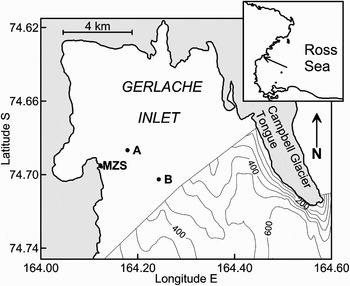
The land-fast ice annually covers the inner area of Gerlache Inlet (Fig. 1), providing a habitat for the accumulation and growth of the sympagic communities (Guglielmo et al. Reference Guglielmo, Carrada, Catalano, Dell'Anno, Fabiano, Lazzara, Mangoni, Pusceddu and Saggiomo2000, Reference Guglielmo, Carrada, Catalano, Cozzi, Dell'Anno, Fabiano, Granata, Lazzara, Lorenzelli, Manganaro, Mangoni, Misic, Modigh, Pusceddu and Saggiomo2004). In November 1999 a strong increase of the biomass of the sympagic microalgae was observed in the bottom ice and in the sub-ice platelet layer, where concentrations of chlorophaeopigments as high as 1740 and to 716 mg m-3 were reached, respectively (increase of cell densities from 2·106 to 70·106 cell dm-3). The concentration of the microalgal biomass remained instead up to three orders of magnitude lower in the upper sea ice layer. Pennate diatoms in particular two cryobenthic species: Entomoneis kjellmanni and Nitschia cf. stellata (Lazzara et al. Reference Lazzara, Nardello, Ermanni, Mangoni and Saggiomo2007) dominated the sympagic microalgal assemblage.
Sampling sites (A, B) on the annual land-fast ice (white area) in the Gerlache Inlet (Terra Nova Bay, Ross Sea) during November 1999, and position of the Italian Station “Mario Zucchelli” (MZS).

Sampling strategy
Two sampling stations were fixed on the annual land-fast ice: in the inner area of the bay (A; 74°41′12″S, 164°10′44″E; with 280 m water column depth) and close to the sea ice edge (B; 74°42′09″S, 164°14′36″E; with 530 m water column depth). From 1–26 November 1999, eighteen sea ice cores (10 cm internal diameter) were collected at these stations using an aluminium corer. In each station, ice cores were drilled in small areas (≈ 100 m2), in order to obtain homogeneous data for the whole time series. Immediately after collection ice cores were sliced into 10 cm (from 0–50 cm) and 20 cm (from 50–260 cm) sections in thickness, in dim light conditions to avoid plankton photodamage. Sections were melted in the dark into 1-litre acid-washed bottles, using a thermostatic bath (2°C, 4–6 h), and sub-sampled for analytical determinations. From 7 November 1999, the unconsolidated platelet ice (UPI) that rose into the ice core holes was collected separately from the interstitial water. Seawater (SW; 2.5 m beneath the bottom ice horizon) was sampled through the ice holes using a customized 1 litre stainless steel bottle. Samples of the snow covering the sea ice were also collected in both stations.
Three experiments of N-uptake were carried out in station A (19, 23 and 25 November 1999) to evaluate the assimilation of nitrate and ammonium in the particulates in the bottom ice (BI) and in UPI during a phase of accumulation of the sympagic biomass.
Analytical methods
Salinity was measured using an Autosal Guildline salinometer. Brine content in the bottom ice (%) was calculated after Cox & Weeks (Reference Cox and Weeks1983), setting the sea ice temperature at -2.0°C.
Samples for the determination of inorganic nutrients and DOM were filtered on precombusted (450°C, 6 h) Whatman GF/F filters. Nitrate (NO3), nitrite (NO2), ammonium (NH4), reactive phosphorus (PO4) and reactive silicate (SiO2) were determined by an Alpkem autoanalyser (Flow Solution III), using standard colorimetric methods (Grasshoff Reference Grasshoff, Grasshoff, Ehrhardt and Kremling1983). The concentration of dissolved inorganic nitrogen (DIN) was calculated as NO3 + NO2 + NH4.
For dissolved organic carbon (DOC), nitrogen (DON) and phosphorus (DOP), samples were frozen (-25°C) immediately after filtration and stored until the analysis in the laboratory of I.S.MAR. (Italy). DON and DOP were determined using the photo-oxidation method of Walsh (Reference Walsh1989). The analysis was preceded by an ultrasonic homogenization of the samples to dissolve the organic particulate that might be formed in the sample vials during storage (Ogawa et al. Reference Ogawa, Fakuda and Koike1999). The efficiency of the step of ultraviolet oxidation was checked daily with standard solutions and reference seawater. DOC was determined by High Temperature Catalytic Oxidation method, using a Shimadzu TOC-V analyser equipped with an ASI-V autosampler (Pettine et al. Reference Pettine, Patrolecco, Manganelli, Capri and Farrace1999). DOC concentrations were measured in triplicate (CV < 2%) against standard solutions of potassium hydrogen phthalate. The efficiency of the combustion system was checked daily with standard solutions, whereas the total system blank of DOC (3 ± 2 µM C) was estimated by the analysis of ultra-pure laboratory water produced by a Millipore (Milli-Q 185 Plus) system.
All concentrations of dissolved inorganic nutrients and DOM reported in this study are expressed for unit liquid (µM). From 19–25 November 1999, three incubations in situ were carried out to measure uptakes (QNO3 and QNH4; µmol N dm-3 d-1) and specific uptakes (VNO3 and VNH4 calculated as V = Q/PN; d-1) of nitrate and ammonium in BI and in UPI (Dugdale & Goering Reference Dugdale and Goering1967, Owens Reference Owens1988). Single ice samples were gently fragmented, mixed with filtered seawater and spiked with Na15NO3 or 15NH4Cl labelled standard solutions. At the beginning of the incubations, mean bulk concentrations of NO3 and NH4 in these samples (sea ice + filtered seawater) were 45.8 ± 12.6 and 3.5 ± 1.2 µM N, respectively. The samples were incubated for 24 hours at the horizon of the bottom ice, using glass capsules (200 ml) held by Plexiglas tubes (3 m in length) completely covered by sea ice. After incubations, samples were melted and filtered on precombusted Whatman GF/F filters. Filters were analysed using an Europa ANCA elemental analyser online with an Europa 20/20 isotope ratio mass spectrometer. Ammonium regeneration experiments were not carried out; therefore QNH4 data might underestimate the “true” values of ammonium uptake being uncorrected for 15NH4-isotope dilution.
Results
General characteristics of the sea ice-seawater system
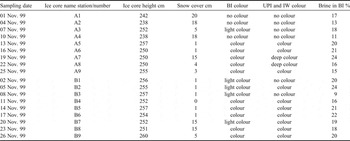
In November 1999, sea ice cores collected at Terra Nova Bay ranged from 238–260 cm in length (Table I). These values indicated that the land-fast ice was thicker than that found in the same area during 1997 (≈ 1.4 m; Guglielmo et al. Reference Guglielmo, Carrada, Catalano, Dell'Anno, Fabiano, Lazzara, Mangoni, Pusceddu and Saggiomo2000). Mean daily air temperatures were low at the beginning of the month (from -14 to -12°C), but they increased sharply during the following days (up to -2°C), and remained high until 16 November. After this, air temperature decreased again (down to -10°C) until the end of November. The complete breakup of the land-fast ice occurred in the bay after sampling, in January 2000.
Sampling dates, names and general characteristics of sea ice cores (BI = bottom ice; UPI = unconsolidated platelet ice; IW = interstitial water) and calculated percentage of brine in the bottom ice.

The snow cover ranged from 0–20 cm in thickness. It decreased in station A during the sampling, whereas it was scarce in station B because of the removal effect of local winds in the outer area of the bay. The brown ice was already present in BI in station B at the beginning of November 1999, but the deepest coloration was reached in the sub-ice platelet layer in station A at the end of the month. The colour rise was anticipated in some ice cores where snow cover was scarce or absent. The deepest colouration in the bottom ice had a variable thickness but mostly included in a layer of about 5 cm.
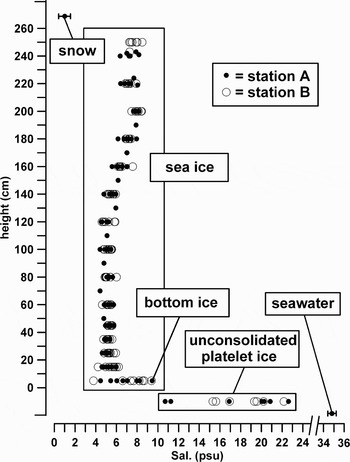
The vertical profiles of salinity in the ice cores (Fig. 2) showed the presence of two distinct layers, the upper one (150–260 cm) with salinity 7.30 ± 0.69 psu and the deeper one (10–150 cm) with salinity 5.35 ± 0.54 psu. During the sampling, salinity was reasonably constant in most of the sea ice. Major changes were found only in BI (from 3.78 to 9.46 psu) and in UPI (from 10.70 to 22.61 psu), where its value constantly increased during the period of sampling. Below the sea ice, a constant seawater salinity equal to 34.78 ± 0.07 psu indicated the presence in the bay of high salinity coastal waters (Budillon & Spezie Reference Budillon and Spezie2000).
Vertical profiles of salinity (psu) in the sea ice cores of station A (•) and B (○). Zero-depth in the plot refers to the ice-seawater interface.

During November 1999, the concentrations of inorganic nutrients and DOM changed in the bottom ice, in the platelet ice and in the interior sea ice layer from 10–150 cm. Their values however, remained constant in the snow, in seawater and in the consolidated sea ice above the horizon of 150 cm (Table II).
Salinity (psu) and concentrations (µM) of inorganic nutrients and dissolved organic matter in the snow, in seawater and in the upper sea ice layer (150–260 cm) in stations A and B.

avg = average, std = standard deviation, n = number of data; range of variation
NH4 (4.23 ± 1.17 µM N) and DOC (41.1 ± 9.7 µM C) were the most abundant chemical components in the snow, most probably because of their major atmospheric inputs in the bay that might also include local anthropogenic contributions.
In the upper sea ice layer (150–260 cm), concentrations of NO3, PO4 and SiO2 were lower than in seawater, whereas NH4 was more abundant in sea ice. Nutrient concentration showed neither a significant temporal trend nor a difference between the two stations. NO3 and PO4 slightly decreased in this sea ice layer (ice cores A9 and B9; -1.3 µM N and -0.05 µM P) only at the end of the sampling. Despite the fact that this decrease was in the range of the overall variability of the concentrations in this layer, it might indicate the beginning of a phase of nutrient uptake not covered by the sampling.
DOC and DON accumulated in the upper sea ice layer compared to seawater, whereas the concentrations of DOP were not significantly different (Table II). If the two stations are compared, the concentration of DOM in the outer station B (124.3 ± 38.1 µM C, 11.34 ± 3.30 µM N, 0.33 ± 0.10 µM P) was about 25% higher than in the inner station A (93.2 ± 18.9 µM C, 8.53 ± 2.75 µM N, 0.24 ± 0.10 µM P).
The concentration of nutrients remained constant also in seawater, with the highly significant exception of NH4 which decreased from 3.7 to 0.28 µM N. Dissolved organic matter in seawater (69.9 ± 12.8 µM C, 5.23 ± 2.91 µM N, 0.43 ± 0.39 µM P) showed a higher variability compared to dissolved inorganic nutrients, but not a clear temporal trend.
DOM and nutrient trends in the lower sea ice layer and in the unconsolidated platelet ice
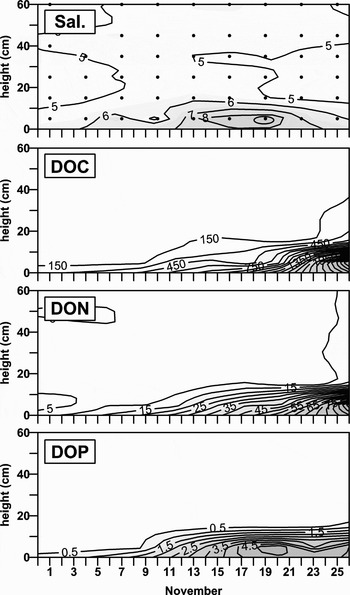
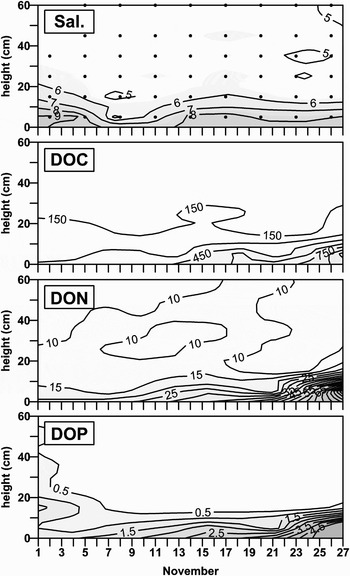
The concentration of DOC increased strongly in BI in station A, in particular during the second half of November 1999 (Fig. 3). It reached values of up to 1277 µM C with the highest concentration of 3480 µM C in the ice core A9. Concomitant increases of DON and DOP were observed in BI up to 107.2 µM N and 5.22 µM P, respectively. The accumulation of DOM was restricted to the bottom ice, whereas its concentration was mostly constant above its horizon. Salinity increased up to 9.46 psu in BI from 15–20 November. If this change was caused by a melting event induced by higher air temperatures observed in the bay from 8–15 November, a delay of few days has to be expected between the peak of air temperature and the bottom ice melting.
Temporal trends of salinity (psu) and of dissolved organic carbon, nitrogen and phosphorus (µM) in the sea ice layer 0–60 cm, in station A.

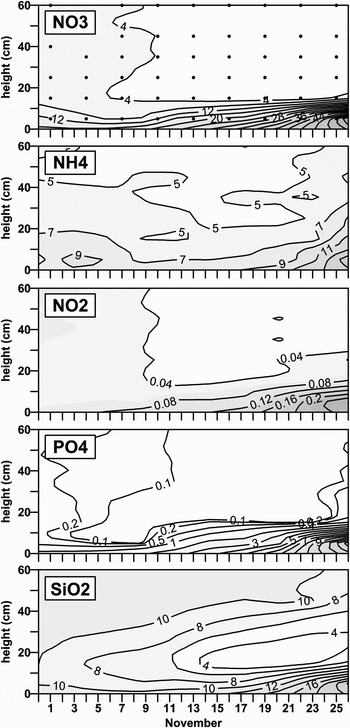
Two opposite trends were observed for inorganic nutrients in the lower section of the consolidated sea ice (Fig. 4). Their concentrations decreased in an interior sea ice layer during the first half of November 1999. The decrease of DIN and PO4 occurred in the sea ice layer 20–70 cm from 1 November (11.95 ± 1.94 µM N; 0.30 ± 0.06 µM P) to 13 November (5.26 ± 0.30 µM N; 0.06 ± 0.2 µM P). The concentration of SiO2 decreased in a thinner layer (10–40 cm) from the beginning of the month (10.49 ± 0.49 µM Si) to 16 November (4.64 ± 2.44 µM Si). At the same time, the concentrations of DIN (up to 87.2 µM N), PO4 (up to 14.1 µM P) and SiO2 (up to 22.9 µM Si) constantly increased in BI, showing a trend coupled to the accumulation of DOM.
Temporal trend of inorganic nutrients (µM) in the sea ice layer 0–60 cm, in station A.

At station B, the accumulation of DOM in BI preceded that in station A (Fig. 5). High concentrations were found at the beginning of November, in agreement with the observation of the early brown ice appearance in this outer site. Afterward, the concentrations of DOC, DON and DOP further increased during the sampling (1140 µM C, 108.2 µM N, 7.67 µM P).
Temporal trends of salinity (psu) and of dissolved organic carbon, nitrogen and phosphorus (µM) in the sea ice layer 0–60 cm, in station B.

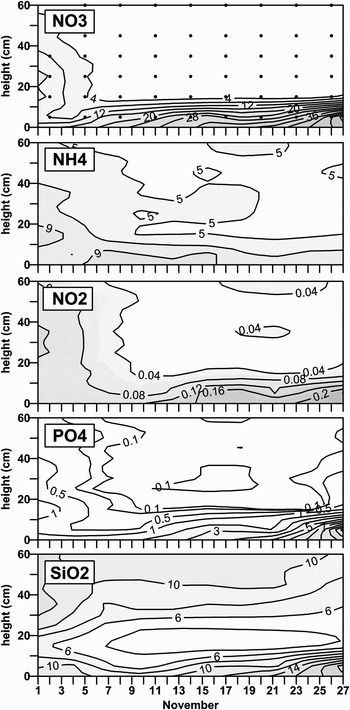
The trends of the inorganic nutrients in the interior sea ice layer and in BI were also opposite in station B (Fig. 6). Net decreases of DIN, PO4 and SiO2 occurred in the layer 10–70 cm from 2 November (16.79 ± 4.72 µM N, 0.60 ± 0.15 µM P, 10.16 ± 4.27 µM Si) to 11 November (5.83 ± 0.55 µM N, 0.07 ± 0.05 µM P, 4.55 ± 1.49 µM Si), whereas a strong nutrient accumulation occurred in BI (63.9 µM N, 11.9 µM P, 21.6 µM Si).
Temporal trend of inorganic nutrients (µM) in the sea ice layer 0–60 cm, in station B.

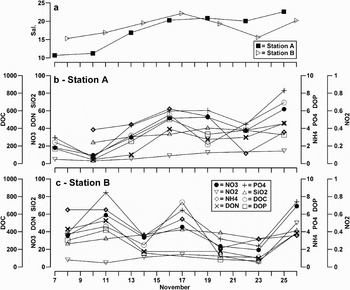
In the unconsolidated platelet ice, salinity increased during the sampling from 10.70–22.61 psu at station A, whereas it fluctuated from 15.30–22.16 psu at station B (Fig. 7a). The temporal trends of DOM and inorganic nutrients in this layer showed a greater variability compared to the consolidated sea ice. A general increase in the concentrations was detectable at the inshore station A (Fig. 7b), although with some variations, whereas at the offshore station B concentrations were even more variable (Fig. 7c). DOC, DON and DOP reached maximum concentrations of 804 µM C, 52.7 µM N and 5.04 µM P, respectively. DIN (up to 73.2 µM N) and PO4 (up to 8.45 µM P) also accumulated in UPI. The concentration of SiO2 increased up to 45.21 µM Si, but its value was always lower than that of seawater (74.89 µM Si). The trends of nutrients and DOM were not strictly matched to the salinity changes in UPI. Moreover, particularly low concentrations were found beneath some ice cores (A4, B7 and B8) covered by a thick layer of snow (15–18 cm).
a. Salinity (psu) in the unconsolidated platelet ice in stations A and B. Concentrations (µM) of nutrients and dissolved organic matter in the unconsolidated platelet ice in station b. station A, and c. station B.

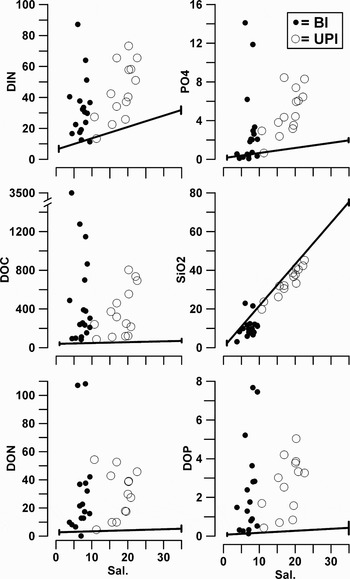
The importance of the biological processes with respect to the influx of seawater for the accumulation of nutrients and DOM was analysed by the comparison of their concentrations in BI and UPI with two end-member mixing models (Fig. 8). These linear models estimate the changes of concentrations due to the physical (i.e. conservative) mixing between seawater and ice melt of the lowest salinity.
Concentration (µM) of inorganic nutrients (DIN, PO4, SiO2) and dissolved organic matter (DOC, DON, DOP) in BI (•) and UPI (○) as a function of salinity (psu). Solid lines represent two end-member mixing models between seawater and ice melt of the lowest salinity (average concentrations; error bars = 2σ).

For DIN and PO4, up to ten-fold increases of the concentration was found in the sea ice with respect to those ascribable to the influx of seawater. The accumulation of DOM in BI and UPI was even higher than that of inorganic N- and P-nutrients. Concentrations up to 350 times higher for DOC, up to 50 times higher for DON and up to 16 times higher for DOP were found with respect to the linear dilution models. In contrast, the behaviour of SiO2 was strongly different, with its rise in concentration not exceeding the linear dilution in almost all samples of BI and UPI.
C:N:P composition of DOM and inorganic nutrient ratios
Inorganic nutrient ratios and C:N:P composition of DOM assemblage were highly variable in the sea ice-seawater system, both when these pools were constant in concentration and when they changed during the sampling (Table III).
C:N:P composition of DOM and inorganic nutrient ratios in the snow, sea ice, UPI and seawater. Ratios are estimated as slope of the linear regressions when the concentrations have changed during the sampling period (BI: n = 16, r 2 = 0.79 ÷ 0.83, UPI: n = 14, r 2 = 0.66 ÷ 0.92, Sea ice 20–70 cm: n = 30, r 2 = 0.63 ÷ 0.68).

High DOC:DON:DOP ratios were found in the snow (= 513:35:1) and in all sea ice layers above BI. The composition of DOM was similar in the upper sea ice layers of stations A (= 388:36:1) and B ( = 377:34:1), despite the different concentrations (Table II). The most important difference in the composition of DOM assemblage, when this pool was constant, concerned the variable content of DOP. In fact, DOC:DON ratios did not significantly differ in the sea ice layer 20–260 cm (= 11), in the snow (= 15) and in seawater (= 13), whereas the abundance of DOP in sea ice DOM assemblage (DOC:DOP = 377 ÷ 579) was about three times lower than in seawater (DOC:DOP = 162).
The strong increase of DOM in BI occurred on weekly scales, indicating that this pool was largely constituted by a fresher organic matter. In agreement with this, the rise of DOM occurred with DOC:DON:DOP ratio of 123:14:1, more similar to that of seawater than to those found in the upper layer of sea ice. The accumulation of DOM in UPI was characterized by even lower DOC:DON:DOP ratio (= 59:7:1), because of a greater abundance of phosphorus in this sea ice habitat.
The nutrient ratio in upper sea ice layer (Si:DIN:PO4 = 38:16:1) was almost equal to that of seawater (= 37:16:1). In both cases, the high abundance of reactive silicon with respect to dissolved inorganic nitrogen and phosphorus was confirmed. However, the composition of DIN was strongly different in these two cases, with NH4 the most important N-nutrient in sea ice (56% of DIN) and NO3 in seawater (94% of DIN).
During the first half of November, the decrease of nutrients observed in the interior sea ice layer occurred with a Si:DIN:PO4 ratio of 8:13:1. Among N-nutrients, NO3 was removed on the average (-87%) more than NH4 (-30%), which remained always present in the sea ice.
Finally, the accumulation of inorganic nutrients occurred with Si:DIN:PO4 ratios equal to 1:4:1 in BI, and equal to 2:8:1 in UPI. Nitrate was the prevalent inorganic nitrogen form that accumulated in these two sea ice habitats (71–94% of DIN).
Nitrogen uptake in BI and in UPI
From 19–25 November, nitrate and ammonium uptakes were measured in BI and in UPI in station A, in order to relate nitrogen cycling in these sea ice habitats to the presence of high microalgal biomasses (Table IV). The assimilation of inorganic nitrogen in the living particulate rose strongly in BI during this phase of the bloom, up to 7.33 µmol N dm-3 d-1 for nitrate and up to 2.85 µmol N dm-3 d-1 for ammonium. In UPI, QNO3 was significantly lower and more constant (1.21–1.66 µmol N dm-3 d-1), whereas QNH4 (1.25–1.18 µmol N dm-3 d-1) was in the same range of the values found in BI during the first two incubations but it did not increase during the third experiment.
Uptakes (Q; µmol dm-3 d-1) and specific uptakes (V = Q/PN; d-1) of nitrate and ammonium in the bottom ice (BI) and in the unconsolidated platelet ice (UPI), in station A.

The specific uptakes of nitrate (VNO3; from 0.030 down to 0.012 d-1) and ammonium (VNH4; from 0.010 down to 0.007 d-1) decreased in BI during the three incubations, showing trends clearly opposite to those of QNO3 and QNH4. In UPI, their values increased in the case of nitrate (from 0.017–0.025 d-1) and remained almost constant for ammonium (< 0.016 d-1).
Discussion
The microalgae biomass increases markedly in the sea ice at Terra Nova Bay during spring, reaching integrated values comparable to those found in the whole euphotic layer of the ice-free water column (Guglielmo et al. Reference Guglielmo, Carrada, Catalano, Dell'Anno, Fabiano, Lazzara, Mangoni, Pusceddu and Saggiomo2000, Reference Guglielmo, Carrada, Catalano, Cozzi, Dell'Anno, Fabiano, Granata, Lazzara, Lorenzelli, Manganaro, Mangoni, Misic, Modigh, Pusceddu and Saggiomo2004, Lazzara et al. Reference Lazzara, Nardello, Ermanni, Mangoni and Saggiomo2007). The overall accumulation of inorganic nutrients and DOM during these early production processes is less important. In November 1999, the highest integrated quantities of nutrients and DOM in the consolidated sea ice were 65 mmol N m-2 for total dissolved nitrogen, 3 mmol P m-2 for total dissolved phosphorus, 26 mmol Si m-2 for SiO2 and 600 mmol C m-2 for DOC. Even considering the contribution of the sub-ice platelet layer, their values did not exceed those usually found in a seawater column with a depth of about 20 m. Further increases of nutrients and DOM depend on the frequency of the release and regeneration in the interior of the sea ice habitats. The evolution of these processes during the productive summer season also determines the amount of nutrients released into the coastal zone waters after break up and melting of sea ice (Arrigo et al. Reference Arrigo, Dieckmann, Gosselin, Robinson, Fritsen and Sullivan1995, Günther & Dieckmann Reference Günther and Dieckmann1999, Riaux-Gobin et al. Reference Riaux-Gobin, Tréguer, Poulin and Vétion2000, Reference Riaux-Gobin, Tréguer, Dieckmann, Maria, Vétion and Poulin2005, Thomas & Dieckmann Reference Thomas and Dieckmann2002).
Chemical characteristics of the upper sea ice layer
In November 1999, the sea ice at Terra Nova Bay was made up of two distinct layers, with salinity 7.30 ± 0.69 psu over the horizon of 150 cm and 5.35 ± 0.54 psu below it. The upper sea ice layer was also characterized by lower concentrations of tritium and crustal radionuclides than the lower layer (Guglielmo et al. Reference Guglielmo, Carrada, Catalano, Cozzi, Dell'Anno, Fabiano, Granata, Lazzara, Lorenzelli, Manganaro, Mangoni, Misic, Modigh, Pusceddu and Saggiomo2004). These features suggested that water bodies with distinct geochemical characteristics were involved in separate events of sea ice formation in the area of the bay during 1999.
Dissolved inorganic nutrients showed a scarce variability above the sea ice horizon of 150 cm during the sampling. The concentrations of DIN, PO4 and SiO2 (Table II) were basically conservative with respect to the seawater dilution and the nutrient ratio in the sea ice (Si:DIN:PO4 = 38:16:1) was similar to that of the seawater (= 37:16:1). However, the partition of the inorganic nitrogen was clearly different, with a prevalence of NH4 among N-nutrients in this sea ice layer (56% of DIN) and of NO3 in seawater (94% of DIN).
The presence of high concentrations of NH4 in the sea ice is usually explained by bacterial activity (Arrigo et al. Reference Arrigo, Dieckmann, Gosselin, Robinson, Fritsen and Sullivan1995, Guglielmo et al. Reference Guglielmo, Carrada, Catalano, Dell'Anno, Fabiano, Lazzara, Mangoni, Pusceddu and Saggiomo2000). However, several diatom species might also contribute to the release of NH4 in the sea ice habitats, in particular when rapid increases of the irradiance and decreases of the ambient temperature occur in nitrate-replete environments (Lomas et al. Reference Lomas, Rumbley and Glibert2000). The precipitation of the snow has also been included among the factors that might contribute to NH4 enrichment in the sea ice (Dieckmann et al. Reference Dieckmann, Lange, Ackley and Jennings1991), in agreement to the present data that confirms the high abundance of NH4 in the snow (≈ 60% of DIN). Grazing and excretion by metazoans also cause the release of NH4 in the sea ice (Arrigo et al. Reference Arrigo, Dieckmann, Gosselin, Robinson, Fritsen and Sullivan1995, Thomas & Dieckmann Reference Thomas and Dieckmann2002). However, their presence is usually restricted to the lowermost sea ice layer, and the relationship between copepod number and NH4 concentration was found to be not significant in the area of interest during previous investigations (Guglielmo et al. Reference Guglielmo, Zagami, Saggiomo, Catalano and Granata2007).
Higher concentrations of DOC and DON (Table II) and higher DOC:DON:DOP ratios were found in the upper sea ice layer (= 388:36:1–377:34:1) with respect to seawater (= 162:12:1). This enrichment of carbon and nitrogen compared to phosphorus suggests that the DOM assemblage in the sea ice was constituted by more refractory organic compounds than the pool in seawater, as organic phosphorus is preferentially regenerated with aging of DOM (Clark et al. Reference Clark, Ingall and Benner1998, Loh & Bauer Reference Loh and Bauer2000, Kolowith et al. Reference Kolowith, Ingall and Benner2001). Moreover, DOM concentration was about 25% higher in the upper sea ice layer in the outer station B than in the inner station A (Table II). The two stations were placed in different sites of the bay, above water columns of 530 and 280 m of depth, where different water circulation and pelagic-benthic interactions were likely to occur. Coastal gradients in the consolidated sea ice and in sub-ice platelet layer have been reported for inorganic nutrients and sympagic biomass (Lizotte & Sullivan Reference Lizotte and Sullivan1992, Arrigo et al. Reference Arrigo, Dieckmann, Gosselin, Robinson, Fritsen and Sullivan1995, Günther et al. Reference Günther, Gleitz and Dieckmann1999, Riaux-Gobin et al. Reference Riaux-Gobin, Tréguer, Poulin and Vétion2000). Data presented in this study shows the existence of a spatial variability at Terra Nova Bay also for sea ice DOM, as a result of different processes of accumulation at a local scale.
Several biogeochemical processes that occur during its formation affect the chemical properties of the sea ice (Garrison et al. Reference Garrison, Jeffries, Gibson, Coale, Neeman, Fritsen, Okolodkov and Gowing2003). However, nutrients and DOM in the upper layer of sea ice at Terra Nova Bay might also be the signature of the chemical characteristics of the water column induced by the phytoplankton blooms and regeneration that occur in this coastal zone during late summer (Saggiomo et al. Reference Saggiomo, Carrada, Mangoni, Ribera d'Alcalà and Russo1998, Acosta Pomar et al. Reference Acosta Pomar, Maugheri, Bruni, Faranda, Guglielmo and Ianora2000, Innamorati et al. Reference Innamorati, Mori, Massi, Lazzara, Nuccio, Faranda, Guglielmo and Ianora2000, Saggiomo et al. Reference Saggiomo, Catalano, Mangoni, Budillon and Carrada2002, Monticelli et al. Reference Monticelli, La Ferla and Maimone2003).
Nutrient dynamics in the interior of the sea ice
The first important change in the nutrient availability in the consolidated sea ice was the decrease in the layer 10–70 cm, from 1–16 November 1999, which anticipated by two weeks the major accumulation of nutrients and DOM in BI. This process can be ascribed to the growth of an interior community, which was also reported for station A as an increase of the concentration of chlorophyll a (up to 4 µg l-1 in the layer from 20–80 cm; Guglielmo et al. Reference Guglielmo, Carrada, Catalano, Cozzi, Dell'Anno, Fabiano, Granata, Lazzara, Lorenzelli, Manganaro, Mangoni, Misic, Modigh, Pusceddu and Saggiomo2004). At the end of this phase, 60% of DIN, 84% of PO4 and 55% of SiO2 initially available in the sea ice were removed, with Si:DIN:PO4 uptake ratio equal to 8:13:1. PO4 was almost depleted in the sea ice (0.06 ± 0.02 µM P in station A; 0.07 ± 0.05 µM P in station B). NO3 was preferentially taken up with respect to NH4, which remained in the sea ice in concentration > 3 µM N. This behaviour was common with BI and it is further discussed in the following section.
The growth of the biomass in the interior sea ice layers is favoured by comparison to that in BI by the major penetration of light. It can occur in early spring, before the seasonal warming, determining variable decreases of inorganic phosphorus, nitrogen and silicon depending on the age of the sea ice and of the different timing of uptake/regeneration processes. Consequently, nutrient stress or depletion have been reported in the sea ice layers isolated from the seawater influx (Palmisano et al. Reference Palmisano, Lizotte, Smith, Nichols, White and Sullivan1988, Nichols et al. Reference Nichols, Palmisano, Rayner, Smith and White1989, Lizotte & Sullivan Reference Lizotte and Sullivan1992, Günther & Dieckmann Reference Günther and Dieckmann1999, Günther et al. Reference Günther, Gleitz and Dieckmann1999, Thomas & Dieckmann Reference Thomas and Dieckmann2002). In this case, the presence of NH4 prevented any strong inorganic nitrogen depletion in the sea ice, whereas PO4 seemed to become the scarcest nutrient after this early production phase.
This production event did not cause an accumulation of DOM, at least within the period of sampling. The concentrations of dissolved organic carbon, nitrogen and phosphorus remained mostly constant and characterized by an high DOC:DON:DOP ratio (= 579:53:1). Similarly to the upper layer of sea ice, these findings suggested that a refractory assemblage mainly dominated the pool of DOM in this interior sea ice habitat.
Cycling of inorganic nutrients and DOM in the bottom ice
Inorganic nutrients (DIN = 87.2 µM N, PO4 = 14.1 µM P, SiO2 = 22.9 µM Si) and dissolved organic matter (3480 µM C, 107.2 µM N, 5.22 µM P) strongly accumulated in BI, in particular in the inner station A during the last week of November 1999. The comparison between their concentration and two end-member mixing models (Fig. 8) clearly showed that the increases of DOM, N- and P-inorganic nutrients were mainly due to interior release and regeneration rather than to the seawater influx. In contrast, the increase of SiO2 was the result of the balance between the seawater influx and the uptake in the sea ice, as its rise of concentration almost never exceeded the linear dilution. These combined processes determined an overall accumulation ratio of Si:DIN:PO4 equal to 1:4:1. The importance of an external source of SiO2 for sea ice diatoms is also suggested by the consideration that biogenic silicon regeneration is a slower process than organic nitrogen and phosphorus recycling (Dieckmann et al. Reference Dieckmann, Lange, Ackley and Jennings1991, Lizotte & Sullivan Reference Lizotte and Sullivan1992). The accumulation of nutrients and DOM was concomitant to the strongest increase of the microalgal biomass in BI, which mainly occurred since 15 November 1999 (Lazzara et al. Reference Lazzara, Nardello, Ermanni, Mangoni and Saggiomo2007). Moreover, the high aminopeptidase activities reported during this phase of the bloom (up to 20 µmol dm-3 h-1; Gulglielmo et al. 2004) easily explain the high rate of NO3 accumulation in the sea ice as a result of the remineralization of organic nitrogen.
The dynamics of nutrients in BI is characterized by a high interannual variability at Terra Nova Bay, which is easily explained because of the variable effects of ambient conditions, snow cover and sea ice thickness on the spring blooms. In November 1997, SiO2 (< 24.4 µM Si) reached concentrations in BI similar to the present study, whereas those of NO3 + NO2 (< 35.9 µM N), PO4 (< 7.7 µM P) and NH4 (< 7.8 µM N) were strongly lower (Guglielmo et al. Reference Guglielmo, Carrada, Catalano, Dell'Anno, Fabiano, Lazzara, Mangoni, Pusceddu and Saggiomo2000, Lazzara et al. Reference Lazzara, Nardello, Ermanni, Mangoni and Saggiomo2007).
In station A, the total (NO3 + NH4) N-uptake in BI increased from 4.76 to 10.18 µmol N dm-3 d-1 during the three incubations, whereas the specific uptakes of nitrate and ammonium showed decreasing trends (Table IV). This difference indicated the sympagic community grew in a nutrient repleted microenvironment, where the increase of N-uptake was mainly due to an increase of the biomass rather than to higher specific rates of nitrogen assimilation into the cells. In McMurdo Sound, Priscu et al. (Reference Priscu, Lizotte, Cota, Palmisano and Sullivan1991) found in diatom-dominated assemblages specific uptakes of NO3 and NH4 up to 0.001 h-1 in the bottom ice, and up to 0.005 h-1 in the surface ice. Kristiansen et al. (Reference Kristiansen, Syvertsen and Farbrot1992) found variable N-uptakes by sea ice communities in the Weddell Sea, during October and November, in a period preceding the productive season (< 0.1 nmol N l-1 h-1 in the frazil ice community, 92.1 nmol N l-1 h-1 in the sub-ice community). Despite the fact that data published in these studies refers to different sea ice communities and sampling/incubation methodologies, they indicate that the land-fast ice at Terra Nova Bay may be highly productive during spring.
Our data also confirm the importance of NO3 as a nitrogen source for the sea ice biomass, in agreement with the results reported in other field works. However, this finding is partially in contrast to the results of physiological studies on sea ice microbial assemblages. They have shown that the incorporation of NO3 into the cellular macromolecules may be limited by its transport into the cells at the ambient temperatures of sea ice (Priscu et al. Reference Priscu, Palmisano, Priscu and Sullivan1989). At the same time, the repression of NO3 uptake might occur in the sea ice habitats in the presence of high concentrations of NH4 (Priscu & Sullivan Reference Priscu and Sullivan1998, Cochlan & Bronk Reference Cochlan and Bronk2003). The importance of these processes in the selection of the preferred N-nutrients by the different sea ice communities is uncertain and it needs to be further studied.
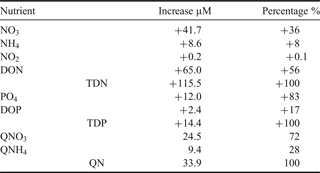
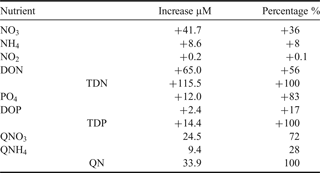
A rough comparison between the increases of nutrients and N-uptake may be drawn in BI, using the experimental data collected in station A from 19–25 November 1999 (Table V). During this period the rise in the concentrations of the total dissolved nitrogen and phosphorus were +115.5 µM N and +14.4 µM P, respectively. Nitrogen accumulated mainly as DON (56%), whereas phosphorus accumulated mainly as PO4 (83%). This difference suggested that the turnover of DOP was faster with respect to DON during this phase of the bloom. The total (NO3 + NH4) N-uptake estimated in BI during the same days was 33.9 µmol N dm-3. Even considering that the uptake of urea and losses of DO15N during incubations should be included to estimate the gross N-uptake (Wafar et al. Reference Wafar, Le Corre and L'Helguen1995, Cochlan & Bronk Reference Cochlan and Bronk2001), this growth in situ was much lower compared to the release of total dissolved nitrogen. This finding agrees with the results of previous studies in this bay, which have shown the occurrence of low growth rates in the sea ice by 14C measurements, in comparison to high biomass increases estimated by the temporal variation in cell densities. This discrepancy has suggested that an additional influx of the microalgal biomass from the sub-ice platelet layer is needed, over the growth in situ, to explain its strong accumulation in BI (Guglielmo et al. Reference Guglielmo, Carrada, Catalano, Dell'Anno, Fabiano, Lazzara, Mangoni, Pusceddu and Saggiomo2000, Reference Guglielmo, Carrada, Catalano, Cozzi, Dell'Anno, Fabiano, Granata, Lazzara, Lorenzelli, Manganaro, Mangoni, Misic, Modigh, Pusceddu and Saggiomo2004, Lazzara et al. Reference Lazzara, Nardello, Ermanni, Mangoni and Saggiomo2007). Data presented in this study further indicated that the sea ice biomass was subjected, during the evolution of the bloom, to a release and remineralization of nitrogen that strongly exceeded its uptake in situ.
Increases of the concentration (µM) of N- and P-nutrients in BI in station A, from 19–25 November 1999, calculated using the data of the ice cores A7 and A9. Total nitrogen uptake (QN = QNO3 + QNH4) in BI in station A, during the same days, calculated as integral of QN vs. time (trapezoidal rule; n = 3).
Nutrients, DOM and N uptake in the platelet ice and in seawater
Inorganic nutrients and DOM also accumulated in UPI, although their trends were more variable and their concentrations did not reached values as high as in BI (Fig. 7). However, the processes of accumulation were similar: the increases of DIN, PO4 and DOM were mainly due to internal release and regeneration, whereas SiO2 increase was the result of the influx of seawater reduced by the biological uptake in situ (Fig. 8). These combined effects determined an accumulation ratio of Si:DIN:PO4 equal to 2:8:1.
Nutrient accumulation in this habitat was concomitant with a sharp increase in the microalgal biomass, which was anticipated with respect to BI as it mostly occurred during the first half of November 1999 (Lazzara et al. Reference Lazzara, Nardello, Ermanni, Mangoni and Saggiomo2007). The accumulation of DOM was characterized by a DOC:DON:DOP ratio of 59:7:1, a value significantly lower compared to those found in the consolidated sea ice. Despite a combination of several biogeochemical processes influencing the composition of DOM assemblage, this nitrogen impoverishment agrees with the particularly high aminopeptidase activities reported in this layer (Guglielmo et al. Reference Guglielmo, Carrada, Catalano, Cozzi, Dell'Anno, Fabiano, Granata, Lazzara, Lorenzelli, Manganaro, Mangoni, Misic, Modigh, Pusceddu and Saggiomo2004).
During the sampling, increases of NO2 were observed in UPI (≤ 0.50 µM N), as well as in BI (≤ 0.29 µM N). NO2 release by several microalgal species often occurs at the same time as nitrate uptake, particularly in conditions of low temperature, high NO3 concentrations and low irradiance (Collos Reference Collos1998, Lomas & Glibert Reference Lomas and Glibert1999). However, the production of NO2 is also due to the activity of chemoautotrophic nitrifying bacteria, whose presence was reported in the sea ice and in the platelet ice in association with high microalgal biomasses. Their oxidizing activity can lead to the formation of NO2 as an intermediate product of the oxidation of NH4 to NO3 (Priscu et al. Reference Priscu, Downes, Priscu, Palmisano and Sullivan1990, Arrigo et al. Reference Arrigo, Dieckmann, Gosselin, Robinson, Fritsen and Sullivan1995).
Several observations confirmed that the scarce penetration of the light into the sub-ice platelet layer was critical for the evolution of this community. An average level of 1.4% of surface PAR was measured below the bottom ice (Lazzara et al. Reference Lazzara, Nardello, Ermanni, Mangoni and Saggiomo2007). Its variable reduction may explain limited accumulations of nutrients and DOM observed in UPI beneath some ice cores (A4, B7 and B8) with a thick snow cover. The uptake of NH4, which is usually favoured at low levels of the irradiance (Wada & Hattori Reference Wada and Hattori1991), did not decrease in UPI compared to BI as the uptake of NO3. Moreover, the specific uptake of NH4 remained high in UPI (0.013–0.016 d-1). Finally, ammonium was the only nutrient that showed a net assimilation in the seawater beneath the sea ice during the period of sampling.
The accumulation of the biomass in BI causes the reduction of the light penetration and the modification of its spectral distribution in the underlying unconsolidated layer (Arrigo et al. Reference Arrigo, Sullivan and Kremer1991). During November 1999, changes in the light penetration and its spectral quality were found to be important factors in modulating the structure of the community and the physiological adaptation of sympagic microalgae in UPI (Lazzara et al. Reference Lazzara, Nardello, Ermanni, Mangoni and Saggiomo2007).
Conclusions
Sympagic communities experience the effects of strong vertical gradients and fast temporal changes of the ambient conditions and of the availability of resources, both in the consolidated sea ice and in the sub-ice platelet layer. High-resolution data series are needed to characterize the complex spatial and temporal successions of the biogeochemical processes in these sea ice habitats.
At Terra Nova Bay, inorganic nutrients show major changes in the annual sea ice during spring. Data on N-uptake presented in this study indicate that this coastal zone may be highly productive. Changes in the abundance and C:N:P composition of the DOM assemblage reflects the role of sea ice biota in modulating this organic pool. This coastal area also shows a pronounced interannual variability, which should be further studied, in order to better evaluate the links among the development of the sympagic communities, the ambient conditions and the cycling of the major biogenic elements in this coastal zone.
Acknowledgements
This study was funded by Programma Nazionale di Ricerca in Antartide. It was part of PIED Research Project (Pack Ice Ecosystem Dynamics: planktonic communities and carbon and nitrogen cyclings). The author is grateful for the logistic support of the Italian station “Mario Zucchelli” at Terra Nova Bay, and wishes to thank the colleagues involved in the field activity and Dr Carolina Cantoni for the analysis of 15N enrichment in the particulate nitrogen. The help of the reviewers for critical reading and suggestions was greatly appreciated.