Candidates are becoming ever more comfortable making religious appeals in their quest for votes. Reagan's reference to America as “a shining city on a hill,” George W. Bush naming Christ as his favorite philosopher, Hillary Clinton's claim to Methodist roots, and Obama's overt attempts to reach out to white evangelicals in 2008 suggest that the nexus between politics and religion is stronger than ever for major party candidates (for more systematic evidence, see Domke and Coe Reference Domke and Coe2008; Leege, Wald, and Mueller Reference Leege, Wald, Krueger and Mueller2002).
Yet despite the growing trend of religious appeals in political campaigns, scant work has appeared at the individual level to assess the effects of those appeals. Furthermore, extant research has only investigated religious appeals from male sources (Calfano and Djupe Reference Calfano and Djupe2009; Djupe and Calfano Reference Djupe and Calfano2009; McKeown and Carlson Reference McKeown and Carlson1987). The question we address in this article, therefore, is whether the gender of the source affects the reception and translation of religious campaign appeals. Our particular concern is whether religious appeals by women candidates work as well, and in the same way, as for their male counterparts. We develop the argument that the rather delicate mechanism Republicans have traditionally employed in modern campaigns (Kuo Reference Kuo2006), and whose effectiveness Calfano and Djupe (Reference Calfano and Djupe2009) verified, is defeated by gender stereotypes governed by the dynamics of tokenism (Kanter Reference Kanter1977). In other words, our expectation is that women candidates face higher levels of scrutiny, are viewed through stereotypical lenses, and are evaluated more harshly than men — the patterns consistent with tokenism as Kanter first described it (see also Bratton Reference Bratton2005). Women candidates' use of religious appeals, therefore, may occasion different treatment from the electorate from that provided when the same appeals are furnished by men.
The consequences of this finding make the study of religious appeals from female candidates more than a point of theoretical interest. Although the imbalance in the number of females elected to major office, and the overall influence of women in political positions, have seen improvements in recent years (Ashmore and Del Boca Reference Ashmore and Del Boca1979; Paolino Reference Paolino1995; Rosenwasser et al. Reference Rosenwasser, Rogers, Fling, Silver-Pickens and Butemeyer1987; Sanbonmatsu Reference Sanbonmatsu2002), the percentage of women in political life remains far behind their numbers in the general public (Duerst-Lahti and Verstegen Reference Duerst-Lahti, Verstegen, Duerst-Lahti and Kelly1995; but see Dolan Reference Dolan2001). This makes the study of electoral strategies for women a critical one from the standpoint of democratic representation (Bratton Reference Bratton2002; Burrell Reference Burrell1994; Carroll Reference Carroll and Rosenthal2002; Dodson et al. Reference Dodson, Carroll, Mandel, Kleeman, Schreiber and Liebowitz1995; Swers Reference Swers2002). By combining advancement in the study of religious appeals with the assessment of how female candidates fare relative to men, we provide a more comprehensive look at the role of religiously-based cues in American elections.
CODED RELIGIOUS APPEALS
Historically, Republicans have been the ones to make religiously laden appeals to targeted voting groups (Haider-Markel Reference Haider-Markel1998; Reference Haider-Markel and Mooney2001) — a strategy employed well before the Rove era (Wilcox Reference Wilcox1989). In his book, Tempting Faith, David Kuo revealed a previously unpublicized facet of these appeals — the apparently common Republican tactic of infusing candidate speeches with highly selective, almost covert, cues that appeal specifically to evangelical Protestants without alerting and potentially alienating other voters. Although these cue statements may sound innocuous, to the socialized ear they reference classic biblical parables (in the case of the one stray lamb, see Matthew 18:12–13) and popular hymns (“wonder working power” comes from a hymn called “There Is Power in the Blood”).
Calfano and Djupe (Reference Calfano and Djupe2009) found the closed-circuit nature of these cues to be effective in an experimental setting when employed by white and African-American male candidates. Evangelicals recognized religious cue users as Republicans and increased their support for those candidates, while those from other religious traditions did not notice the significance of the cues, and their support levels remained unchanged. Such religious cue use, therefore, constitutes a highly sophisticated and empirically verified communication strategy designed to appeal to particular segments of the electorate without alienating other potential supporters (on a related note, see McDermott (Reference McDermott2009) for how voters view evangelical candidates). The question we address here is whether this strategy may be as efficacious for female candidates as it has been for males.
RELIGIOUS APPEALS AND GENDER STEREOTYPING
We have good evidence that the campaign environment for men and women cannot be assumed ceteris paribus, and the differences in their experiences may affect the influence of the religious cueing strategy on voters. These experiences, documented in a generation of research, is that women candidates face a large number of obstacles in positioning themselves as competent alternatives to voters (Ashmore and Del Boca Reference Ashmore and Del Boca1979; Paolino Reference Paolino1995; Rosenwasser et al. Reference Rosenwasser, Rogers, Fling, Silver-Pickens and Butemeyer1987). Even in relatively high information campaigns (Koch Reference Koch2000), voters still rely on stereotypical conceptions of women's leadership traits, issue expertise, and policy positions when casting ballots (Alexander and Andersen Reference Alexander and Andersen1993; Dolan Reference Dolan2004; Fox and Smith Reference Fox and Smith1998; Huddy and Terkildsen Reference Huddy and Terkildsen1993; Kahn Reference Kahn1993; Koch Reference Koch2002; Lawless Reference Lawless2004; McDermott Reference McDermott1997; Reference McDermott1998; Sanbonmatsu Reference Sanbonmatsu2002; Sapiro Reference Sapiro1982).
The difficulty for women candidates is that these stereotypes appear well entrenched, making their effects challenging to overcome. That is, women candidates making religious appeals may be subject to stereotyping associated with perceptions of tokenism. As Kanter (Reference Kanter1977) first described tokenism, women managers in workplaces where they were the vast minority (under 15 percent) faced heightened “performance pressures, boundary heightening, and role entrapment” (Bratton Reference Bratton2005, 97). Women were viewed with higher levels of scrutiny, were more likely to be viewed through stereotypical lenses, and were judged more harshly on gendered bases. Scholarship has examined how women legislators respond to tokenism pressures (with conflicting results), but little evidence has accumulated to assess whether voters may ascribe token status to candidates (see Bratton Reference Bratton2005; Crowley Reference Crowley2003; Thomas Reference Thomas1994; Saint-Germain Reference Saint-Germain1989).Footnote 1
On this basis, women candidates' use of religious cues may be received differently from the way cues from male candidates are received. In particular, the heightened levels of scrutiny often paid to female candidates may allow voters beyond the intended evangelical audience to recognize the religious cues that otherwise would have passed unnoticed if presented by a male source. This suggests, in part, that voters will recognize the woman candidate as religious, but not the male candidate using subtle religious cues. This is because the relative lack of voter scrutiny for men means that the closed-circuit nature of the cue can remain intact. Voter perception of the female candidate as religious may then trigger stereotypical responses, such as that religious people are conservative. Hence, ideological perceptions of the female candidate might track religious ones. By contrast, male candidates should not be perceived to lean in any ideological direction since most voters should miss the religious cue coming from him. Finally, the female candidate's religious and conservative stereotype should occasion harsher evaluations as a token, thereby reducing her support among voters.
That the largest proportion of women in state legislatures is concentrated in Democratic states may not help the tokenism perception among Republicans, who would be more likely to respond to candidate religious appeals overall (see Kuo Reference Kuo2006, 59–61). The correlation between the percentage of women in the state legislature and the 2008 percentage vote for Obama is 0.593 (p < 0.000), while the average percentage of women-held seats in the states that Obama won is 27 (versus 19 percent in McCain states). So, while women holding office is not now uncommon, it is still more common in Democratic states, as only 29 percent of women holding state legislative office are Republican (Center for the American Woman and Politics 2009a).Footnote 2
We see this electoral pattern as especially problematic for women candidates (1) because it cuts against the stereotypes that voters may conjure for women using the religious appeals, and (2) because it reduces their control over campaign messages. Since the issues stereotyped to lie within the areas of candidate competence for women — education, health care, and the environment — tend to be associated with the Democratic Party, voters often see women candidates as more liberal than men (Alexander and Andersen Reference Alexander and Andersen1993; Koch Reference Koch2002). Their assessed traits are often the antithesis of the strong, confident, and assertive male leader in the wider political domain. Not surprisingly, female candidates are seen to be more concerned with domestic policy — focused on issues of “compassion.” They may also be considered weaker, more emotional, and more passive leaders than men. Of course, sometimes this portrayal may work to the female candidates' advantage (Herrnson, Lay, and Stokes Reference Herrnson, Lay and Stokes2003). It may even be primed by women's campaigns (Schaffner Reference Schaffner2005), not to mention pressed by media coverage (e.g., Bystrom, Robertson, and Banwart Reference Bystrom, Robertson and Banwart2001). However, this portrayal runs counter to the manner in which voters are hypothesized to perceive female candidate religiosity and ideology under token conditions when religious electoral cues are in play.
Importantly, the stereotype of women as religious may be particularly easy to trigger since it is rooted in some measure of fact. Religious congregations have long been the province of women, at least outside of the pulpit. It is frequently remarked that, without the voluntary efforts of women, congregations would cease to exist (Fowler et al. Reference Fowler, Hertzke, Olson and Den Dulk2004). Women show higher religiosity than men, although the reasons for this difference vary (see Francis Reference Francis1997; Flere Reference Flere2007 for reviews). Moreover, women are more involved in church voluntary activities than men (Djupe, Sokhey, and Gilbert Reference Djupe, Sokhey and Gilbert2007), such that recurring efforts have been made to “masculinize” congregations and the religious experience (Bartkowski Reference Bartkowski2004; Bederman Reference Bederman, Juster and MacFarlane1996; Putney Reference Putney2003). Although not much (if any) evidence exists in print on this point, it is likely that women candidates are seen as more religious than men (indeed our study suggests as much, as we will see). That voters apply stereotypes of everyday men and women to candidates lends weight to this assumption (Dolan Reference Dolan2004).
An alternate possibility is that, since candidate religious appeals have not typically been associated with Democratic campaigns (see Leege et al. Reference Leege, Wald, Krueger and Mueller2002), female appeals might be a way to mitigate existing perceptions of women as generally tailored to Democratic Party interests by expanding their appeal to the Republican Party constituencies (via appearing more conservative to these voters). Religious appeals, especially those referencing themes of loving thy neighbor and the responsible use of resources, would seem natural coming from female candidates because these appeals resonate with women's perceived issue competencies (Sapiro Reference Sapiro1982; Rosenwasser et al. Reference Rosenwasser, Rogers, Fling, Silver-Pickens and Butemeyer1987).
Whereas use of a closed-circuit religious code has been found to allow male candidates to signal in-group credentials to evangelicals, women candidates may be more constrained in applying this mechanism. This is because female candidates are likely subject to a greater degree of scrutiny, stereotyping, and harsh evaluation consistent with the dynamics of tokenism, and their use of religious cues may simply spur that process. On this basis, use of religious appeals may compound the challenges that women candidates already face (rather than avoiding problems with certain constituencies, as it seems to allow male candidates).
DATA AND DESIGN
Our analysis is based on a survey-embedded experiment administered during spring 2009 to 205 undergraduates in introductory government courses at a university in the Midwest. While Sears (Reference Sears1986) has expressed concern about the use of a “narrow database,” the general characteristics of our sample mirror that of the larger population. The exception, of course, is age.Footnote 3 The intriguing aspect of the relative age of our subjects — the vast majority of whom are between 18 and 22 — is that one would suggest that they would to be less likely to employ a tokenistic view of female candidates, given the relative changes in social norms and expectations occurring in the last couple of decades, especially among those who have yet to enter the full-time workforce. Hence, any effect found supporting the tokenism effect in our analysis will be especially noteworthy.
Although we cannot claim that our subjects are representative of the general public, the degree to which they mirror basic demographic characteristics of the general voter population establishes expectations for the kinds of effects that may be found in future experimental studies on general population subjects. In particular, if the effect of tokenism is found to reduce subject support for female candidates, we might expect to find a similar outcome in experiments using members of the general public.
Our experiment presented subjects with either a male or a female candidate competing for an open U.S. Senate seat in a mock newspaper article. After identifying the candidate without any party affiliation, the article segued to a quote from a speech that the candidate recently delivered. We use these quotes in a 2 × 4 designFootnote 4 (candidate gender * what we refer to as “the Code” [specifically, three religious appeal statements and a control]) to introduce candidate use of religious appeals. The three religious statements were operationalized through Kuo's (Reference Kuo2006, 59–61) verbatim examples of appeals used by actual political candidates (see Appendix). We refer to these statements in the analysis as the “worth,” “land,” and “power” statements. We include all three because they offer potentially different religious messages, although they are hypothesized to have the same closed-circuit effect on voter support. Since they had essentially the same effect in initial testing (results not included), we combine them for the following analysis to be compared against a condition without a Code statement that serves as our control. We focus our analysis on the conditional effects that the female candidate's use of the Code has on subjects, tested specifically through an interaction term of candidate gender and exposure to a Code statement.Footnote 5
We explore three different dependent variables capturing the essential elements of our story about how the effect of religious appeals can shift depending on the moderating effect of candidate gender and associated stereotypes via tokenism. First, we investigate subject perception of candidate religiosity, a measure of perceived candidate ideology, and, finally, a measure of subject support for the candidate (see Appendix for full variable coding).
CANDIDATE STEREOTYPES — RELIGIOSITY
Our first dependent variable asks subjects how religious they believe the candidate to be on a 0–10 scale, with 10 being “very religious.” Our analysis begins by examining t-tests to assess (1) if the use of any religious statement raised religiosity assessments versus the control, and (2) whether subjects viewed the woman candidate as more religious than the male candidate absent statement use. Both tests are significant (p < 0.000) — subjects do see the candidate as more religious when employing a religious statement and stereotype women candidates as more religious than men. Of course, what remains is to consider the interactive effects of candidate gender and statement use on subject perception of candidate religiosity.
Our first model assesses whether subjects consider male and female candidates using the religious appeals to have a higher degree of religiosity. The model includes the experimental condition (exposure to a Code statement = 1, control = 0), subject race (white = 1), sex (female = 1), and party identification (using the traditional 1–7 scale generated from 1 question). We also include interactions between candidate gender and exposure to a statement.
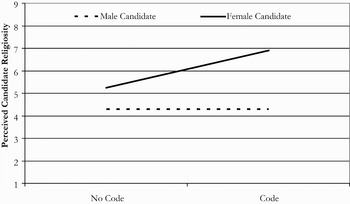
As expected, subjects see the female candidate as being more religious when she uses the Code. Specifically, subject appraisal of the female candidate's religiosity increases by about 1.7 points when she uses a Code statement.Footnote 6 Hence, subjects are quite willing to attach a stereotype of religiosity to women making religious appeals. There is no effect when the male candidate uses the Code statement. To illustrate these effects, Figure 1 graphs the interaction between the female candidate's use of the Code statement and subject perception of her religiosity. The male candidate's perceived religiosity is a flat line (4.3 in the control and 4.3 in the treatment cell). The results show that women candidates are seen as more religious (as noted above, the difference is significant), and it is clear that subjects picked-up the cue that the female candidate was more religious when they were presented with the Code statement (5.2 in the control to 6.9 when treated). The result suggests a higher level of subject scrutiny applied to the female candidate, which results in the detection of her Code use.Footnote 7
The interactive effects of the code statement and the candidate's gender on subjects' perception of the candidate's religiosity.

CANDIDATE STEREOTYPES — IDEOLOGY
The next assessment of conditional Code effects concerns subject perception of candidate ideology. Recall that our expectations are that subjects would see female candidates as more conservative since subject scrutiny would lead them to stereotype female candidates based on their perceived religiosity. Given the close association between the Code, political conservatism, and the Republican Party, it would make sense for subjects to consider candidates making religious statements to be conservative.
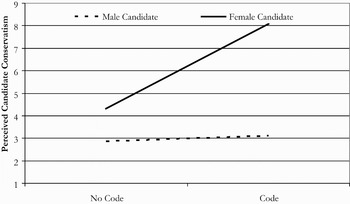
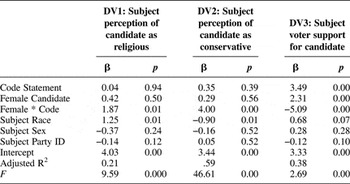
According to Model 2 in Table 1, where the female candidate employs the Code statements, subject assessment of her conservatism significantly increases — by almost 4 points (4.3 to 8.1). The perceived ideology of the male candidate changed by an insignificant amount (2.9 to 3.1). This effect is graphed in Figure 2. Since subjects see the statement-making female candidate as more religious, it comes as no surprise that they also see her as more conservative, especially given the oft-noted relationship between religiosity and conservatism.
The interactive effects of the code statement and the candidate's gender on subjects' perception of the candidate's ideology.

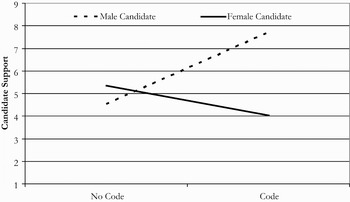
The interactive effects of the code statement and the candidate's gender on the subject's candidate support.

The interactive effects of religious code appeals and candidate gender on three dependent variables: religiosity, ideology, and candidate support

N = 194, unstandardized regression coefficients with two-tailed tests.
CANDIDATE SUPPORT
Calfano and Djupe (Reference Calfano and Djupe2009) found that male candidates significantly increased their approval among targeted voters (evangelicals) when making religious statements. So far, however, we have found that the average voter, not just targeted voters, picks up the religious cue used by female candidates, and stereotypes her as more conservative. Thus, we expect that support for the female candidate will drop, consistent with token treatment (Fig. 3).
Our third model tests subject willingness to support the female candidate when religious statements are used. We asked respondents to use a scale from 0 to 10, where 10 mean it is very likely that they will support the candidate. As stated above, there are two possibilities concerning a Code effect on subjects. First, rather than shore up support among voters, female Code use may reinforce existing negative stereotypes of women candidates. As such, Code use will drive down subject support. Alternatively, candidate Code use could counter certain stereotypes of women candidates, especially female liberalism, and may reinforce the perceived policy issue strengths women are already seen as having.
The evidence in Model 3 in Table 1 supports the former expectation. Support for the female significantly decreases among subjects when she uses a Code statement. Specifically, support falls 1.3 points when the female uses the Code. What makes these results even more intriguing is that subjects generally grant increased support for the female candidate (5.3 versus 4.5 for the male), suggesting that subjects wish to support the female candidate, other things being equal. It is only when the female uses the Code, which triggers token treatment, that support drops. This suggests that subjects are not opposed to female candidates in general, but this changes when the stereotypes evoked through the Code are in play.
We should not overlook the effects of Code use by the male candidate, which shows the opposite pattern from the female candidate — support for him goes up. While this would seem unexpected given that perceptions of the male candidate's religiosity and ideology did not change, it is actually supportive of the tokenism argument. The likely explanation for the male candidate's rise in support is that the Code statements contain positive language that should be appealing to most voters — recognizing “the worth of every individual,” being “good stewards” of the land, and recognizing “the goodness, idealism, and faith of the American people.” That subjects recognize these cues as religious, employ a conservative stereotype, and lower their support only for the female candidate when the Code language is otherwise so positive allows us more confidence in the conclusion that token treatment is in play here.
DISCUSSION AND CONCLUSION
It is hardly a new finding that gender is an important mediating factor in the projection of candidate qualities and fitness for office (e.g., Huddy and Terkildsen Reference Huddy and Terkildsen1993; McDermott Reference McDermott1998; Koch Reference Koch2000). Women candidates are stereotyped as caring and nurturing, unable to handle the tough tests and decisions those in higher office must face. They are held to a different standard in the media — which often comments on their appearance, and interprets the taking of tough stances as undesirable (or at least fodder for ridicule). Here, we show how traditional stereotypes of women candidates can trump potent in-group cues that work for men.
Yet these findings, rather than corroborating earlier work that found that the Code functioned as a highly sophisticated, closed-circuit cue for evangelicals regarding male candidate acceptability (see Calfano and Djupe Reference Calfano and Djupe2009), show that the Code does not work in the same way for female candidates. According to these results, non-evangelicals are quite aware of when women candidates use the Code, and impute qualities to the female candidate that one would most associate with its use — greater degrees of religiosity and conservatism. Moreover, participants are turned off by the woman candidate's statement usage, while the male candidate's coded communication did not occasion a decrease in support. This gender gap of sorts begs the question about the ramifications for the broader politics of those making such religious appeals as these.
Politicians, journalists, and academics have long claimed that Republicans have an advantage in using religious appeals by assuming that the Republican Party has a natural tie to conservatism (Thomas and Dobson Reference Thomas and Dobson1999; Leege et al. Reference Leege, Wald, Krueger and Mueller2002; Goren Reference Goren2005; Kuo Reference Kuo2006; Wills Reference Wills2007). This is an intuitively pleasing claim with calls for personal morality a constant refrain from religious elites. Hence, while we are hesitant to make conclusive determinations from our evidence to overturn conventional wisdom, these results do raise questions. For instance, what if the Republican “advantage” in using religious appeals is based on an inherent characteristic — gender — of those making the appeals? What if that “advantage” is based on the historically lopsided presentation of religious symbolism (by Republicans) through a long line of male candidates for elected office?
That the Code itself had an effect beyond the targeted evangelical audience suggests that the days in which such heuristics may be successfully employed could be numbered. Religion in America is tremendously diverse and flexible, meeting the social, economic, spiritual, psychological, and political needs of millions of people with different needs in different situations. To imagine that religion could long be stereotyped to stand for one political position, therefore, is almost unimaginable. Of course, religion has played a diverse role in American history, from its founding forward (e.g., Noll Reference Noll1990), and modern electioneering may just be becoming reacquainted with that fact. Therefore, as candidates become more diverse for both parties, and Democrats become more comfortable making religious appeals (which recent campaigns show is happening), the efficacy of such religious cues may weaken as partisan cues.
All of this suggests that the campaign tool of religious code language, which male candidates have used, and are using with great frequency, must be employed with care by female candidates because the religious appeals (at least those traditionally used) seem to overlap with the touchstones of female candidate stereotyping. The question for future research is whether successful religious appeals can be mounted in campaigns that spur voters to see the female candidates using them as competent, in command of a broader policy agenda, and, most importantly, more worthy of support. While female candidates will always face challenges in appealing to the electorate, the efficacy of religious appeals that extend beyond the love of neighbor and stewardship themes made so famous through Kuo's (Reference Kuo2006) revelations pose intriguing questions for future research.
APPENDIX
Variable coding and experimental treatments not otherwise mentioned in the text.

Code Statements: Worth: “I believe in an America that recognizes the worth of every individual, and leaves the ninety-nine to find the one stray lamb.” Land: “We have this land, and we're told to be good stewards of it, and each other.” Power: “There is power, wonder working power, in the goodness, idealism, and faith of the American people.”
Control Language: “For as much as government can do and must do, it is ultimately the faith and determination of the American people upon which this nation relies.”
Candidate Religiosity: “How religious is (the candidate)?” Pick 0 if she is not at all religious and 10 if she is very religious.
Candidate Ideology: “How liberal or conservative is (the candidate)?” Pick 0 if she is a strong liberal and 10 if she is a strong conservative.
Candidate Support: “How likely are you to vote for (the candidate)?” Pick 0 if very unlikely and 10 if very likely.
Subject party ID: “Generally, which of these party labels best describes you?” Coded 1 for “strong Democrat” 2 for “Democrat” 3 for “Independent, but lean Democrat” 4 for “Independent” 5 for “Independent, but lean Republican” 6 for “Republican” 7 for “strong Republican.”