INTRODUCTION
Rice is the major cereal crop for more than half of the world's population. FAO (2009) estimated that rice production needed to increase by 40% by 2030 to meet the rising demand from the increasing population. Soil fertility improvement is an important factor for increasing rice production (Ali et al., Reference Ali, Sattar, Islam and Inubushi2014). Several strategies for agricultural management are being tested for achieving both sustainable rice production and adequate soil fertility such as straw biochar (Zhao et al., Reference Zhao, Wang, Wang and Xing2014), anaerobically digested cattle manure (Nishikawa et al., Reference Nishikawa, Li, Inoue, Umeda, Hirooka and Inamura2012), rice straw (Zhang et al., Reference Zhang, Pang, Qin, Liu and Li2013), crop rotation (Nishida et al., Reference Nishida, Sekiya and Yoshida2013) and silicate fertilization (Lee et al., Reference Lee, Kim, Villamil, Pramanik, Hong and Kim2012). Rice is the base of the diet for 60% of the Chinese population, so the protection of rice production has a pivotal role for food security (Zhu, Reference Zhu2006). Rice cultivation accounts for approximately 28% of the total area of crop cultivation, and total rice production accounts for approximately 38% of the total China crop production (Zhu, Reference Zhu2006). Ninety percent of the paddy fields in China are located in subtropical regions, such as the provinces of Fujian, Jiangxi and Hunan. The development of methods for increasing soil fertility and sustaining productivity without jeopardizing environmental health in subtropical regions of China is therefore important.
The accumulation of industrial waste is a major environmental problem in urban areas and its rational use is the most effective way to solve such problem (Montejo et al., Reference Montejo, Tonini, Márquez and Astrup2013). Steel slag is an important waste product of the steel industry, with a total production of 90 x 106 tons in China (Yi et al., Reference Yi, Xu, Cheng, Wang, Wan and Chen2012) and only 22% of this amount used for other economical or environmental activities (Yi et al., Reference Yi, Xu, Cheng, Wang, Wan and Chen2012). Slag contains mainly calcium (Ca) and silicon (Si), which can reach more than 70% of the total weight, whereas the N and P concentrations are 10.33 and 0.07 mg g−1, respectively (Yi et al., Reference Yi, Xu, Cheng, Wang, Wan and Chen2012). Previous studies have found that steel slag amendment increased soil fertility and rice growth, yield and grain quality (Wang et al., Reference Wang, Li, Zeng, Wang and Lin2013). The effects of slag application on soil fertility and rice growth and yield in subtropical paddy fields, however, have been less well studied. C, N and P interact strongly and other nutrients such as Ca and Mg can be limiting in some terrestrial ecosystems (Baribault et al., Reference Baribault, Kobe and Finley2012; Lapenis et al., Reference Lapenis, Lawrence, Heim, Zheng and Shortle2013; Naples and Fisk, Reference Naples and Fisk2010). Thus extra Ca and Si inputs as well as moderate amounts of N and P would change concentration, availability and stoichiometry of soil nutrients and then affect plant growth (Sardans et al., Reference Sardans, Rivas-Ubach and Peñuelas2012a; Reference Sardans, Rivas-Ubach and Peñuelas2012b). Plant growth is generally N limited in Chinese wetlands (Zhang et al., Reference Zhang, Pang, Qin, Liu and Li2013), especially in paddy fields as periodic inundation limits the access to nutrients due to impaired root metabolism under hypoxia (Kirwan and Guntenspergen, Reference Kirwan and Guntenspergen2012), there is reduction of mineralization rates (Adame et al., Reference Adame, Virdi and Lovelock2010) and increases in nutrient leaching (Kobayashi et al., Reference Kobayashi, Ryder, Gordon, Shannon, Ingleton, Carpenter and Jacobs2009). The improvement of nutrient availability in paddy fields by sustainable practices would substantially improve rice production.
Increases in rice production due to the application of steel slag have been found (Carvalho-Pupatto et al., Reference Carvalho-Pupatto, Bull and Crusciol2004; Ning et al., Reference Ning, Song, Fan, Li and Liang2014; Wang et al., Reference Wang, Sardans, Lai, Wang, Zeng, Tong, Liang and Peñuelas2015), with increases in root growth (Carvalho-Pupatto et al., Reference Carvalho-Pupatto, Bull and Crusciol2004) and decreases in the bioavailability of soil trace elements (Gu et al., Reference Gu, Qiu, Tian, Zhan, Deng, Chaney, Wang, Tang, Morel and Qiu2011). Steel slag application can increase the resistance against diseases (Gu et al., Reference Gu, Qiu, Tian, Zhan, Deng, Chaney, Wang, Tang, Morel and Qiu2011; Ning et al., Reference Ning, Song, Fan, Li and Liang2014) and decrease the emission of greenhouse gases (Wang et al., Reference Wang, Sardans, Lai, Wang, Zeng, Tong, Liang and Peñuelas2015). Data, however, are not available for the effects of steel slag application on C, N and P concentrations and stoichiometry of the plant–soil system in rice croplands. Specifically, it is not known if steel slag amendment affects rice production and nutrient stoichiometry by altering the soil nutrient concentrations. We hypothesized that changes of nutrient concentrations in different plant organs and in the entire plant could provide a more realistic view of the role of nutrient concentrations and stoichiometric relationships on growth and other ecophysiological traits than focusing only on foliar stoichiometry. Several studies have noticed that the inclusion of more organs in ecological stoichiometry studies can drastically affect the relationships of stoichiometry with other ecophysiological traits (Elser et al., Reference Elser, Acharya, Kyle, Cotner, Markow, Watts, Hobbie, Fagan, Schade, Hood and Sterner2003; Sardans et al., Reference Sardans, Rivas-Ubach and Peñuelas2012a).
The present study was carried out in subtropical paddy fields in Fujian Province, China. We chose steel slag from the steel industry as the test material to improve soil nutrients and rice production. We previously reported that steel slag was an effective amendment for increasing rice yields (RY) in a subtropical paddy field in Fujian Province (Wang et al., Reference Wang, Li, Zeng, Wang and Lin2013), but the effect of steel slag application on plant and soil nutrient concentrations and stoichiometries and their relationships with the increasing yields remain unknown. The present study examined the effect of steel slag amendment on soil and rice nutrient concentrations and stoichiometries in a subtropical paddy field in southeastern China. Specifically, we studied the effects during the growing season of different amounts of steel slag amendments on soil nutrient concentrations and C:N, C:P and N:P ratios in rice leaves, stems and roots; and examined the relationships between yield and changes in nutrient uptake, allocation to different organs and concentrations and stoichiometries in the plant–soil system.
MATERIALS AND METHODS
Study site
All field experiments were carried out in the Wufeng Agronomy Field of the Fujian Academy of Agricultural Sciences (Figure S1, available online at https://doi.org/10.1017/S0014479717000412) in a subtropical region of southeastern China. The characteristics and historical management of the field site have been described by Wang et al. (Reference Wang, Sardans, Lai, Wang, Zeng, Tong, Liang and Peñuelas2015). The soil of the paddy field was moist, poorly drained and had a ratio of sand:silt:clay of 28:60:12 (Wang et al., Reference Wang, Li, Zeng, Wang and Lin2013). The bulk density of the soil before the study was 1.1 g cm−3. The soil had a pH (1:5 with H2O) of 6.5 and concentrations of organic carbon, total nitrogen and total phosphorus were 18.1, 1.2 and 1.1 g kg−1, respectively (Wang et al., Reference Wang, Li, Zeng and Tong2012). The water level was maintained at 5–7 cm above the soil surface during the periods of rice growth by an automatic water-level controller, and the paddy field was drained two weeks before harvesting. Fertilization consisted of a mix of NPK (N:P2O5:K2O at 16:16:16%, Keda Fertilizer Co., Ltd., Shandong, China) and urea (46% N) fertilizers applied to the crops at rates of 95, 70 and 70 kg ha−1 of N, P2O5, and K2O, respectively, in each of three growth phases: before transplantation, at tillering and at panicle formation (Wang et al., Reference Wang, Sardans, Lai, Wang, Zeng, Tong, Liang and Peñuelas2015).
Experimental design and treatments
Our study period was from 16 April to 17 July 2011, which is the first of the two yearly periods of rice crop. The field was plowed to a depth of 15 cm with a moldboard plow on 12 April 2011 and flooded on 14 April 2011. The rice (Oryza sativa) variety was Hesheng 10, and the spacing between rows was 28 cm and between plants in the row was 14 cm. Three replicates of four treatment plots (50 m2 each) were arranged in a randomized block design. The slag was granular (<2 mm in diameter), with a pH of 8.5 (when dissolved in water) and composed mainly of CaO (34.9%), SiO2 (40.7%) and Fe2O3 (4.8%) (Wang et al., Reference Wang, Li, Zeng and Tong2012), which was similar to slags used in previous studies (Wang et al., Reference Wang, Li, Zeng, Wang and Lin2013). The slag was applied to the paddy field at 0 (control), 2, 4 and 8 Mg ha−1, equivalent to the addition of 0, 67.2, 134 and 269 kg Fe ha−1, respectively, 2 days before rice transplantation. All control and amended plots followed the same scheme of crop management, including conventional fertilization. A total of 84 soil samples (four treatments × three replicates × seven evaluation dates) were collected. Rice stems, leaves and root (0–15 cm) biomasses were collected from random 0.25 × 0.25 m quadrats in all plots immediately after transplantation and then every two weeks until harvest. Plant material was gently washed with water. A total of 252 plant samples (four treatments × three replicates × seven evaluation dates × three organs) were thus collected. Shoot, root and total biomasses and yield were determined at harvest (15 July 2011).
Sampling and chemical analyses of plant and soil samples
Both above- and below-ground samples were oven-dried (80 °C for 24–36 h) to a constant weight and weighed. Plant C and N concentrations were determined using a Vario EL III Elemental Analyzer (Elementar Scientific Instruments, Hanau, Germany), and P concentration was measured by perchloric-acid digestion followed by molybdate-blue reaction using a UV-2450 spectrophotometer (Shimadzu Scientific Instruments, Kyoto, Japan) (Lu, Reference Lu1999).
Core soil samples were collected from the top layers (0–30 cm) of all plots the day after transplantation and then every two weeks until harvest. The samples were divided into two parts, one maintained fresh for evaluating the microbial biomass carbon (MBC) and dissolved organic carbon (DOC), and the other air-dried (in the shade) for measuring all other physicochemical characteristics after removing all roots and other plant components. Soil properties were determined following the methods of Lu (Reference Lu1999). Soil MBC concentration was determined by fumigation extraction (Lu, Reference Lu1999). DOC concentration was determined by extraction with 1:5 soil:deionized water (Lu, Reference Lu1999) and measured using an TOC-V CPH total carbon analyser (Shimadzu Scientific Instruments, Kyoto, Japan). Available-N concentrations were determined by diffusion using alkaline hydrolysis (Lu, Reference Lu1999), while available-P concentrations were determined by extraction with 0.5 mol L−1 NaHCO3 and then measured by Mo-Sb colourimetry (Lu, Reference Lu1999). Available-K concentrations were determined by extraction with 1 mol L−1 NH4Ac (Lu, Reference Lu1999) and then measured by FP 640 flame photometry (Shanghai Electronic Technology Instruments, Shanghai, China). Available-Si concentrations were determined by Si molybdenum blue colourimetry (Lu, Reference Lu1999). Available-Ca and -Mg concentrations were determined by EDTA titration (Lu, Reference Lu1999).
Statistical analyses
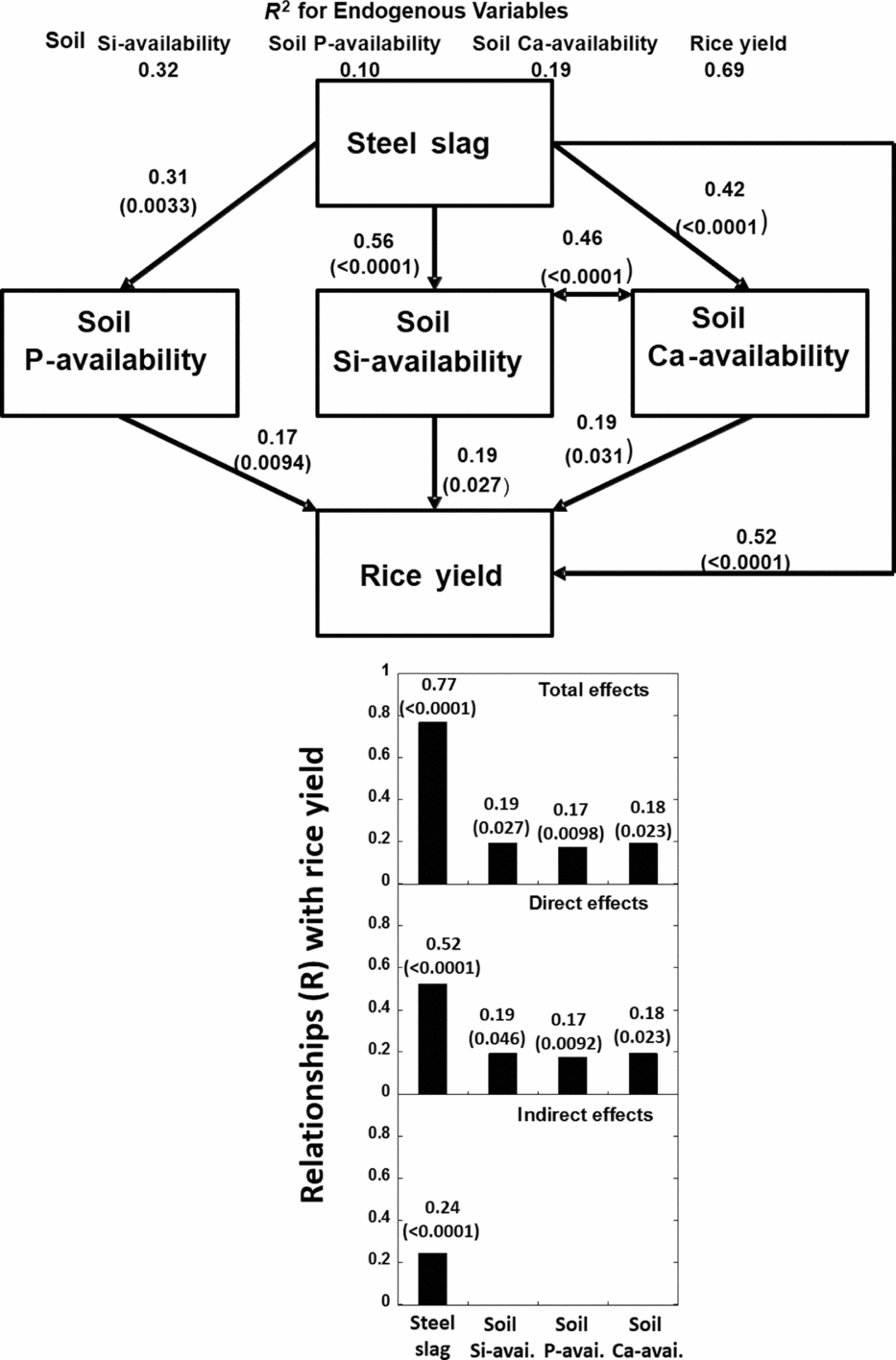
All statistical analyses were performed using SPSS 19.0 (SPSS Inc., Chicago, USA). The differences of all plant and soil variables among control and different amendments were analysed by repeated-measures analyses of variance. The relationships among the concentrations and stoichiometries of the various nutrients in the plant above- and below-ground samples, and the relationships of RY and shoot, root and total biomasses with nutrient concentrations and stoichiometries in the soil and plant samples, were examined by Pearson correlation analysis. For these relationships, data from all the experimental treatments were used, except for the correlations with yield in which only the final data was used. We used Hochberg and Benjanimi (Reference Hochberg and Benjamini1990) correction for the correction of type I error in multiple regressions. We performed multivariate statistical analyses using functional discriminant analysis (FDA) to determine the importance of soil Ca, Si, K, Mg, N and P availabilities; DOC and MBC concentrations; the ratios of DOC: available N, DOC:available P and available N:available P; foliar, stem, and root N, P and C concentrations and C:N, C:P and N:P concentration ratios; foliar, stem, root and total biomasses; and RY as variables. The FDA was performed using Statistica 6.0 (StatSoft Inc., Tulsa, USA). C:N, C:P and N:P ratios were calculated as mass ratios. We selected the soil and plant variables strongly correlated with slag amendment and RY by structural equation modelling. We thus analysed the total, direct and indirect effects of slag amendment on RY by the relationships between amendment and the chemical traits of soil and plants. We fitted the various models using the sem R package (Fox et al., Reference Fox, Nie and Byrnes2013) and determined the minimum adequate model using Akaike's information criterion (Akaike, Reference Akaike1974). Standard errors and significance levels (P) of the total, direct and indirect effects were calculated using bootstrapping (1200 repetitions).
RESULTS
Effect of slag amendment on the soil and plant nutrient concentrations and ratios
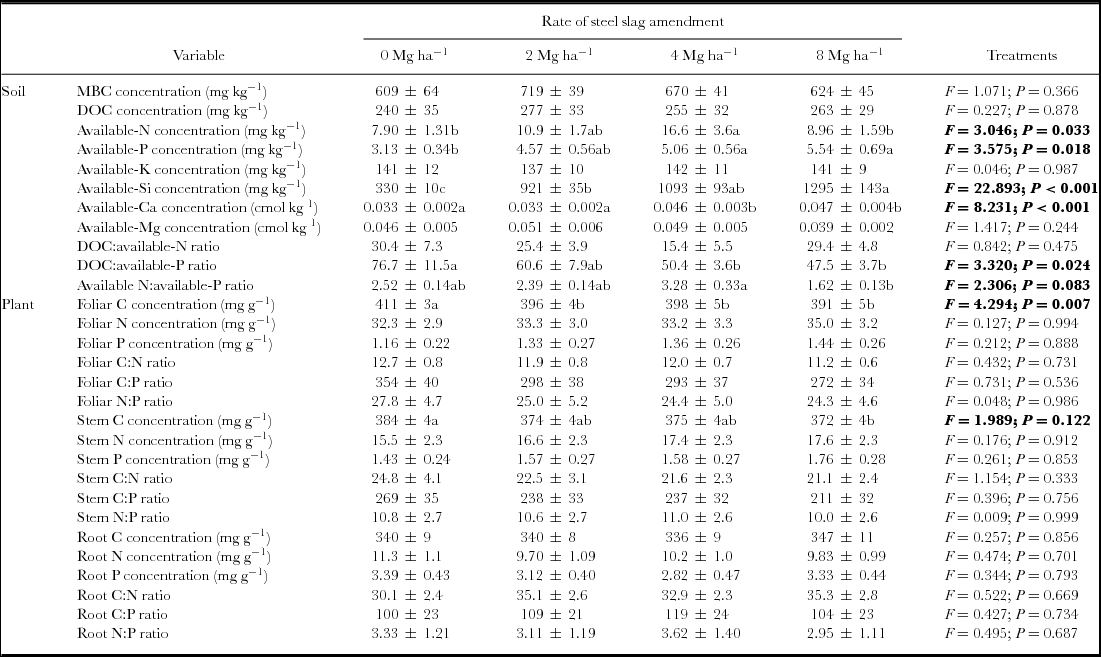
Soil available-N, -P, -Si and -Ca concentrations were significantly higher under slag amendment than in the control, whereas soil DOC:available-P ratios (Table 1, Figures S2 and S3) and foliar C concentrations (Table 1, Figures S4 and S5) were on average lower under slag application throughout the experimental period.
Soil and plant nutrient concentrations and stoichiometries (mean ± SE). Significant (P < 0.05) values are highlighted in bold type. Different letters among treatments indicate significant differences. MBC = Soil microbial biomass carbon. DOC = Soil dissolved organic carbon.

Relationships of C: N, C:P and N: P ratios between soil and rice plants
Foliar, stem and root C:N ratios were positively correlated with the soil DOC: available-N ratio (Table S1), whereas foliar, stem and root N:P ratios were positively correlated with the soil available-N: available-P ratio (Table S1). On the other hand, foliar, stem and root C:P ratios were negatively correlated with the soil DOC:available-P ratio (Table S1).
Relationships of crop yield with C, N and P availabilities
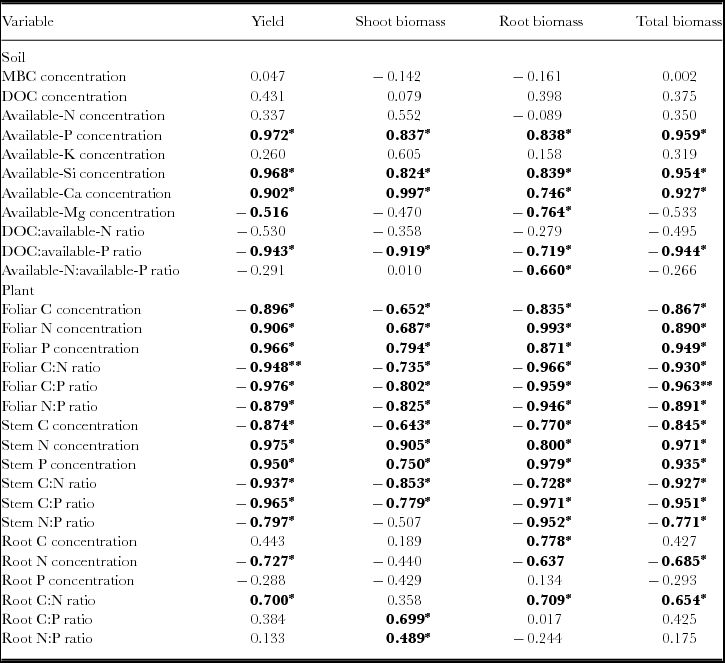
RY was correlated positively with soil available-P, -Si and -Ca concentrations, foliar and stem N and P concentrations, and root C:N ratio (Table 2). Negative correlations were found between yield and soil available-Mg concentration. Shoot, root and total biomass were correlated positively with soil available-N, -P, -Si and -Ca concentrations, foliar and stem N and P concentrations, and root C:P and N:P ratios. Yield, and shoot, root and total biomass were positively correlated with N and P concentrations in leaves and stems but not with the corresponding concentrations in roots that in the case of N concentrations were negatively correlated with yield, and root and total plant biomass. Stem C:P, C:N and N:P ratio and root C:N ratio were also positively correlated with yield and plant biomasses except root C:N ratio and shoot biomass. Root C:P and N:P ratios were positively correlated with shoot biomass.
Pearson correlations among rice yield and biomasses with soil and plant nutrient concentrations and ratios. Significant correlations after applying the Benjamini and Hoghberg correction of false discovery rate (R> ± 0.642, P < 0.0025) are highlighted in bold type (n = 12).

*Significant correlation at P < 0.05; **significant correlation at P < 0.0022 R = ±0.642 (after applying the Benjamini and Hoghberg correction of false discovery rate). MBC = Soil microbial biomass carbon DOC = Soil dissolved organic carbon.
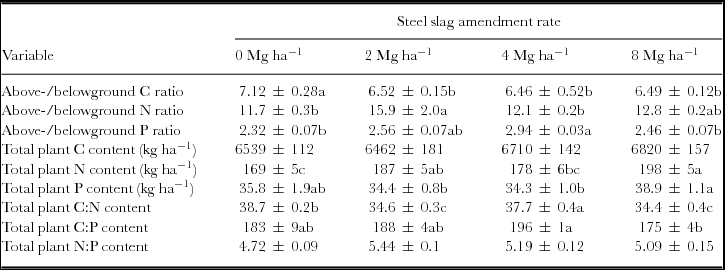
The application of slag did not change the C content of whole plants but it was associated with a higher allocation of C to roots (Table 3). In contrast, slag application caused increases in N and P contents of whole plants and higher allocation of these nutrients to aboveground plant organs at intermediate levels of application (Table 3).
Plant nutrient contents and stoichiometries in the various treatments (mean ± SE).

Different letters among treatments indicate significant differences (P < 0.05).
Multivariate and SEM analyses
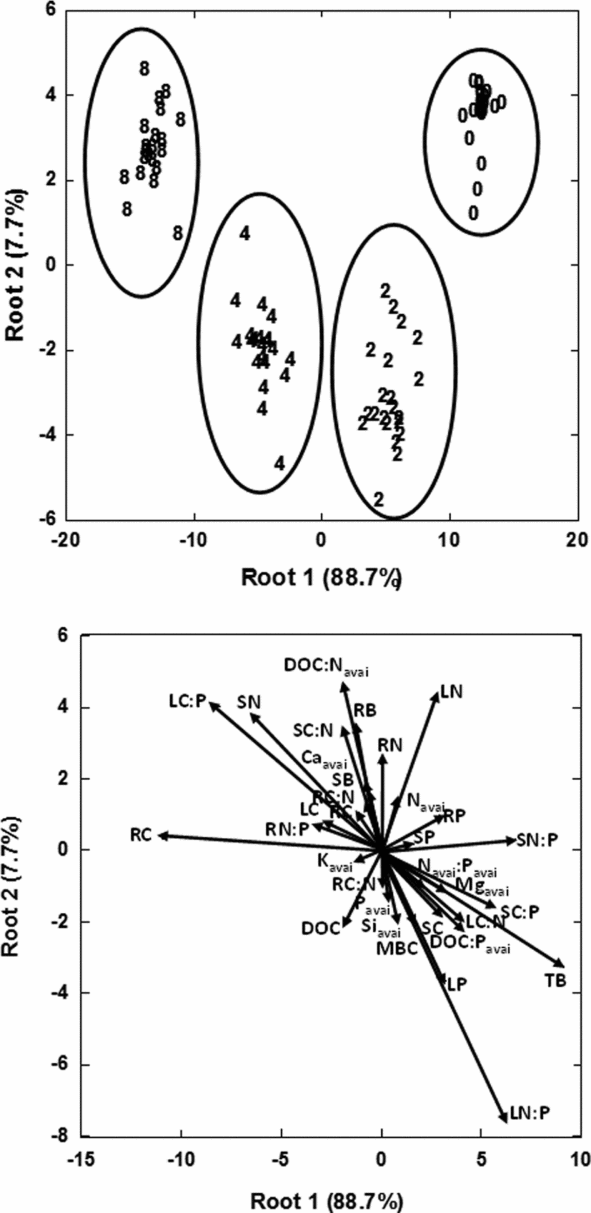
Soils amended with the various levels of slag were well separated in the DFA analyses (Table S2, Figure 1). RY best explained the DFA grouping factors (different plots of slag amendment). Changes in soil P, Ca, N and Si availabilities, foliar N and P concentrations, and soil and foliar N:P ratios were other variables explaining the separation among samples receiving different levels of slag (Table S3, Figure 1).
Biplots of the standardized canonical discriminate function coefficients for the first two roots representing the soil and plant variables as independent variables and the various grouping dependent factors corresponding to the levels of steel slag amendment (0, 2, 4 and 8 Mg ha−1). Caavai, soil Ca availability; Siavai, soil Si availability; Kavai, soil K availability; Mgavai, soil Mg availability; Navai, soil N availability; Pavai, soil P availability; DOC, dissolved organic C; DOC:Navai, DOC:soil available-N ratio; DOC:Pavai, DOC:soil available-P ratio; Navai;Pavai, soil available-N:soil available-P ratio; LN, foliar N concentration; LP, foliar P concentration; LC, foliar C concentration; SN, stem N concentration; SP, stem P concentration; SC, stem C concentration; RN, root N concentration; RP, root P concentration; RC, root C concentration; LC:N, foliar C:N concentration ratio; LC:P, foliar C:P concentration ratio; LN:P, foliar N:P concentration ratio; SC:N, stem C:N concentration ratio; SC:P, stem C:P concentration ratio; SN:P, stem N:P concentration ratio; RC:N, root C:N concentration ratio; RC:P, root C:P concentration ratio; RN:P, root N:P concentration ratio; MBC, soil microbial C; RC, rice yield; LB, foliar biomass; SB, stem biomass; RB, root biomass; TB, total biomass.

The best structural model explaining the variance in RY (R 2 = 0.69, P < 0.0001) identified a positive relationship between slag application and yield, partially due to an indirect effect (32% of the total effect) from the enhancement of soil Ca, Si and P availabilities, which were also positively correlated with yield (Figure 2).
Diagrams of the structural equation models that best explained the maximum variance of rice yield with steel slag application and soil P, Si and Ca availability as endogenous variables. Blue and red arrows indicate negative and positive relationships, respectively.

DISCUSSION
Effect of steel slag amendment on soil and plant nutrients
Application of steel slag has increased soil Ca-, Si-, N- and P-availability (Table 1), which are consistent with results of previous reports (Ali et al., Reference Ali, Sattar, Islam and Inubushi2014; Wang et al., Reference Wang, Li, Zeng, Wang and Lin2013). The addition of silicate ions could also increase N and P availabilities by displacing nitrogenous ions (NO3− and NH4+) and phosphates from ligand exchange sites (Lee et al., Reference Lee, Lee, Hwang, Lee and Kim2004) and/or by decreasing their sorption on soil colloids (Shariatmadari et al., Reference Shariatmadari and Mermut1999). The observed increases in soil pH due to the alkalinity of the slag should also decrease the mobilization of most heavy metals and thus reduce the risk of soil toxicity. There was a strong impact of steel slag fertilization not only in the soil availability of N, P, Ca and Si, but also on crop yield and plant biomass (Table 3). Thus, the results strongly suggest that this sub-tropical paddy that had historically been managed by conventional fertilization in Fujian had its rice production capacity limited by P, Ca and Si (Figure 2).
Slag can absorb and retain nutrients, slowing nutrient release, preventing leaching and consequent water eutrophication, and improving the capacity of soil to provide nutrients for plant uptake (Zhao, Reference Zhao2012). In fact, the total amount of nutrients stored in plants increased (Table 3) due to the increase of plant growth related to the improved nutrient availability under steel slag fertilization. Ca and Si are involved in several metabolic and physiological processes linked to growth, fruit development and defence against pathogens in rice plants (Cacique et al., Reference Cacique, Domiciano, Moreira, Rodrigues, Cruz, Serra and Catala2013; Datnoff et al., Reference Datnoff, Raid, Snyder and Jones1991; Frattini et al., Reference Frattini, Morello and Breviario1999; Guntzer et al., Reference Guntzer, Keller and Menunier2012; Rodrigues et al., Reference Rodrigues, Datnoff, Korndorfer, Seebold and Rush2001, Reference Rodrigues, Vale, Datnoff, Prabhu and Korndorfer2003; Sano et al., Reference Sano, Ono, Murata, Yamada, Hirasawa and Kanekatsu2015). In addition, simultaneous increases in soil availability of several nutrients at once can have positive synergies in crop growth and yield production because the fertilization of one nutrient increases the plant uptake and content of other nutrients (Deren, Reference Deren1997; He et al., Reference He, Alva, Calvert, Li and Banks1999; Kim et al., Reference Kim, Yang and Chang2005).
Soil DOC concentrations decreased with the steel slag application and this decrease is likely related to stabilization (fraction in non-soluble C forms) through combination with Fe2O3 (Song et al., Reference Song, Li, Zheng, Pan, Zhang, Zheng, Hussain, Han and Yu2012). In our study, the application of 2, 4 and 8 Mg ha−1 of steel slag added 96, 192 and 384 kg Fe2O3 ha−1, respectively.
Changes in soil and plant nutrient stoichiometry
The results of this study are in agreement with previous ones in paddy fields, where N is limiting. In the Minjiang estuary, N limitation has been previously described (Wang et al., Reference Wang, Li, Zeng and Tong2012). The success of the invasive Phragmites australis in a nearby wetland was associated with its high capacity to resorb N and increase N-use efficiency (Wang et al., Reference Wang, Sardans, Zeng, Zhong, Li and Peñuelas2014). Consistently with these previous studies, the paddy soils in our study had particularly low available-N:available-P ratios (1.6–3.3 on mass basis), which contrasted with the global average of 5.9 (Cleveland and Liptzin, Reference Cleveland and Liptzin2007), suggesting that N should be more limiting in our experimental conditions. However, the low soil availability of N and P and the fact that steel slag fertilization increased the concentrations of both nutrients, should be more important to improve rice growth than the changes of soil available-N:available-P ratio. Moreover, increases in above-/belowground-N ratio (in mass basis) from 11.7 in control plots to 15.9 in plots receiving 2 Mg ha−1 of steel slag and increases in above-/belowground-P ratio (in mass basis) from 2.32 in control plots to 2.94 in plots receiving 4 Mg ha−1 of steel slag suggest a greater proportional allocation of N and P to leaves versus roots when steel slag fertilization was applied (Tables 1 and 3). Thus, steel slag application produces higher N and P uptake associated with higher biomass and promotes higher proportional allocation of nutrients to leaves, where nutrients are needed to producing photoassimilates. The fact that steel slag did not increase C:N and C:P ratios allows us to conclude that the observed enhancement of rice plant biomass associated to steel slag was not due to an increase of efficiency in N- and P-use. This occurred despite increases in N and P soil availability and in N and P contents (but not concentrations) in plant tissues were observed associated to steel slag fertilization, the overall analysis showed that N and P soil availability rise was not the main or at least the unique cause associated with the rise in yield and growth of rice plants receiving steel slag fertilization. In fact, a previous study in this area reported that rice plants retained more N in plots amended with slag than in the control plots (Zhao, Reference Zhao2012). Our study thus found that steel slag fertilization did not cause higher N and P concentrations but increased accumulation of N, P, Ca and Si due to their high soil availability by steel slag amendment.
Finally, the increases in plant growth and yield associated to steel slag fertilization were mainly related to the increases in soil P-, Ca- and Mg-availability (Figure 2). Thus, this wetland area can also be P, Si and Ca limited as SEM analysis showed. The multivariate and SEM analyses also confirmed the positive relationships of slag amendment with plant growth and yield: these relationships were associated with an enhancement of nutrient availability in soil, higher N and P contents in plant tissues and a shift in nutrient allocation between stems and roots. The novelty of our results is that slag application did not alter plant N:P ratios, but it changed the nutrient allocation and improved resources use and growth rates. Specifically, changes in soil P, Ca, N and Si availabilities, foliar N and P concentrations, and soil available-N:available-P ratio explained the separation among samples receiving different levels of slag (Figure 1, Tables 1 to 3) and then high RYs were found when steel slag was used (Figure 1). However, we cannot discard the possible potential impacts of slag on soil, groundwater and wildlife or food quality, which must be monitored in agricultural systems. Until now, we have not detected significant impacts of steel slag when considering the most dangerous trace elements (Wang et al., Reference Wang, Sardans, Lai, Wang, Zeng, Tong, Liang and Peñuelas2015, Reference Wang, Zeng, Sardans, Wang, Zeng and Peñuelas2016). However, some negative environmental impacts associated with the use of steel slag at soil and superficial water level have been detected in other regions of China (Meng and Liu, Reference Meng and Liu2000). This last study showed an increase of some trace elements in paddy soils and rice plants mostly in northern regions of China, where steel slag has been used in long term and in high amounts. The establishment of an adequate dose/year to attain optimum results (maximum benefits without negative effects) at medium and long-term warrants further studies.
CONCLUSION
Steel slag increased soil N, P, Ca and Si availabilities and rice plant biomass and nutrient contents. The allocation of N and P to aboveground organs also increased at intermediate levels of slag application. This method of fertilization could be applied on a large scale at low cost in paddy fields to easily improve rice production in China.
Acknowledgements
The authors thank Pengfei Li, Na Zhao and Dehua Lin for their assistance with field sampling. Funding was provided by the National Science Foundation of China (41571287, 31000209), Natural Science Foundation Key Programs of Fujian Province (2014R1034-3, 2014Y0054 and 2014J01119), Science and Technology Program of Fuzhou City (2014-G-66), the Program for Innovative Research Team at Fujian Normal University (IRTL1205), European Research Council Synergy grant ERC-SyG-2013-610028 IMBALANCE-P, Spanish Government grant CGL2016-79836-P and Catalan Government grant SGR 2014–274.
SUPPLEMENTARY MATERIAL
To view supplementary material for this article, please visit https://doi.org/10.1017/S0014479717000412