Congenital cardiac disease is the most common birth defect, occurring in approximately 1 in 1,000 live births. It represents a diverse and heterogeneous group of malformations, but ten specific anatomic abnormalities occur most frequently. These ten malformations constitute the majority of cases, while a myriad of other anatomic abnormalities are complex and rare. Through decades of study, it appeared that congenital cardiac defects had associations, whether with gender, race, and specific chromosomal abnormalities, potentially allowing grouping of defects to be studied in an effort to develop an understanding of etiologic factors.
It is now accepted that more than 20% of congenital cardiac disease is associated with chromosomal abnormalities or syndromes. The association of structural cardiac malformations and non-cardiac malformations suggests a widespread embryopathy, involving a miscue in signalling of the development of multiple organs, or a common teratogenic insult, or both. The following associations are well established, and most frequently encountered:
• Down syndrome/trisomy 21 with atrioventricular septal defect;
• DiGeorge syndrome/22q11 microdeletion with common arterial trunk, interrupted aortic arch, tetralogy of Fallot;
• Noonan syndrome/PTPN1, KRAS, RAF, SOS1 with dysplastic pulmonary valve or hypertrophic cardiomyopathy;
• William's syndrome/7p microdeletion with branch pulmonary artery stenosis or supravalvar aortic stenosis;
• Holt–Oram syndrome/TBX5 mutation with atrial septal defect; and
• Turner syndrome/X0 with coarctation of the aorta.
The evolution of our understanding of these defects and their chromosomal or syndromic associations stemmed from the initial observations of astute clinicians, and then transitioned into the broader hypotheses generated by Nora and Nora, among others, with the development of the concept of multi-factorial inheritance as a comprehensive framework for aetiologic explanation, encompassing genetic factors, and environmental exposures as paramount. Regional databases, as exemplified by the New England Regional Infant Cardiac Program in the 1970s, furthered the case description of specific cardiac defects with malformations of organs other than the heart, strengthening the perception of a genetic and/or point-specific environmental insult in organogenesis. One glaring limitation of the New England Regional Infant Cardiac Program, however, was the dependence on a referred population of infants to the regional paediatric cardiac centre. It was not designed as an epidemiological study, but was a key step in that direction.
It was not until the ground-breaking approach of Dr Charlotte Ferencz and colleagues in the Baltimore-Washington Infant Study, from 1981 to 1997, which provided full ascertainment of a population of infants with congenital cardiac disease born in a defined geographic region, that this step could be taken.Reference Ferencz, Rubin, Loffredo and Magee1, Reference Ferencz, Loffredo, Correa-Villasenor and Wilson2 A critical aspect of this effort was to include a control group of neonates and infants born without congenital cardiac disease, for the first time permitting a meaningful description of associated malformations and a comparison of environmental influences in the developing embryo/foetus. From this database, researchers could develop hypotheses to enable focused investigation of genetic and environmental associations, which would go on for the ensuing two decades.
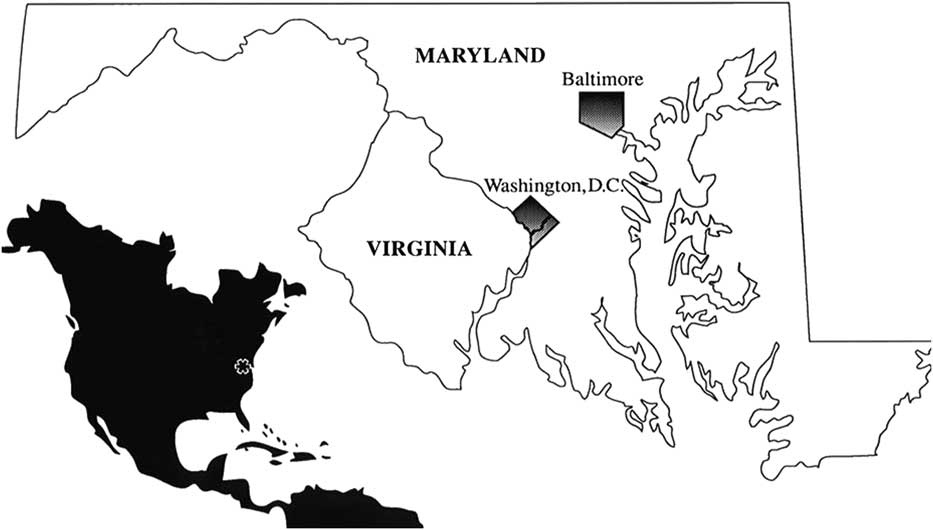
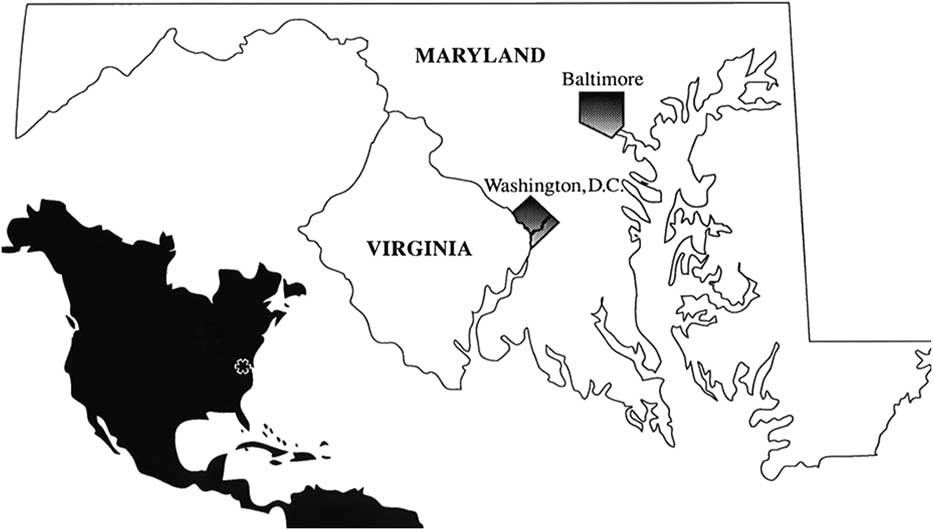
With the cooperation of six regional paediatric cardiac centres and 52 area hospitals of birthing, the staff of the Baltimore-Washington Infant Study enrolled 4390 infants born with congenital cardiac disease in a fixed geographical region, including the state of Maryland, District of Columbia, and nine counties of northern Virginia, from 1981 to 1989 (Fig 1). Congenital cardiac disease was established by echocardiography, cardiac catheterisation, cardiac surgery, or autopsy. Full ascertainment was assured by review of all area logs from hospitals of birthing and the offices of the Medical Examiner in each region to determine whether any neonates/infants had died before clinical recognition. Also enrolled were 3572 control infants. If an infant with a congenital cardiac malformation was to be reported in the randomly selected control family, another infant was selected from the eligible regional population. All families were contacted and agreed to a personal interview with staff from the study, completing a 60-page questionnaire, which included the following information:
The case–control population for the Baltimore-Washington Infant Study was derived from the fixed geographic area including Maryland, Washington DC, and northern Virginia.
• socio-demographic data,
• detailed familial medical history,
• place of residence in the peri-conceptional period – 3 months before and 3 months after the onset of pregnancy, and
• type of work for mother and for father.
The purpose of these data related to lifestyle and occupation was to permit investigation into the following variables:
• environmental exposures at home and at work,
• exposures to medications,
• use of recreational drugs,
• use of alcohol, and
• other variables.
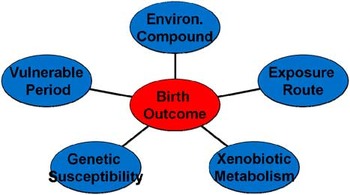
The fundamental hypotheses generated at the inception of the Baltimore-Washington Infant Study included the central idea that the outcome of birth, including the development of congenital cardiac malformations, was influenced by environmental factors and their route of introduction into a genetically susceptible host. To have impact on outcome, the interaction had to take place during a specific vulnerable period in the host (Fig 2).
The fundamental hypotheses driving the Baltimore-Washington Infant Study case–control model: the outcome of birth results from a series of complex interactions between the host and the environment.

Diseases of the left heart: population-based data
The spectrum of severity and the familial links in diseases of the left heart was evident early on in the enrollment of cases, where families with a proband with hypoplastic left heart syndrome were found with a pre-existing sibling or parent with disease of the aortic valve or coarctation of the aorta. The familial progression from bicuspid aortic valve to aortic valvar stenosis, coarctation of the aorta, and then to hypoplastic left heart syndrome was not observed in obstructive disease of the right heart, and in no other grouping of congenital cardiac malformations. One of the earliest observations in the familial data was the higher than expected pre-current cardiac disease in probands with obstruction of the left heart, 3.1% overall, but increasing with the severity of the disease of the left heart, reaching 6.7% and 8.0% if the proband had coarctation of the aorta or hypoplastic left heart syndrome, respectively. Moreover, several families reported concurrent left-sided lesions. In a pilot study of this population, we noted that echocardiography of first-degree relatives of infants with hypoplastic left heart syndrome had a 12% incidence, that is, 5 of 41 of bicuspid aortic valve, yet only one individual had been diagnosed previously.Reference Brenner, Berg and Schneider3
Other comparisons in the database suggested the strength of the genetic impact in severe disease of the left heart. For example, Wollins reported that of 126 infants with isolated coarctation of the aorta, 11% had associated non-cardiac malformation, 12% were small for gestational age, and there was a 7% all-cause mortality.Reference Wollins, Ferencz, Boughman and Loffredo4 However, of 67 infants with coarctation plus ventricular septal defect, 31% had non-cardiac malformation, 23% were small for gestational age, and there was a 21% all-cause mortality. The implications for understanding the different outcome as more than related to incrementally difficult medical and surgical management in the group with septal defect is clear, strongly suggesting a different genetic substrate.
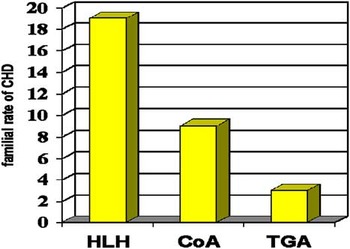
Published in 2004, a study of the first-, second-, and third-degree relatives of probands with one of three disorders: hypoplastic left heart syndrome, coarctation of the aorta, and transposition of the great arteries – as a disease control group – demonstrated that the prevalence of these structural abnormalities in 379 first-degree relatives detected by echocardiography was 19.3%, 9.9%, and 2.7%, respectively (Fig 3).Reference Loffredo, Chokkalingam and Sill5 Extended to 1329 third-degree relatives, the reported prevalence rates were 1.8%, 1.2%, and 0.4%, respectively. Moreover, of the first-degree relatives detected by echocardiography to have congenital cardiac disease, 21 of 29 (72%) had some form of disease of the left heart. Of the second- and third-degree relatives reporting cardiac disease, 25 of 37 (67%) had some form of disease of the left heart. These data permitted Loffredo et al to confirm the familial aggregation of congenital cardiac disease in probands with hypoplastic left heart syndrome and coarctation of the aorta. Loffredo et al asserted that these results may provide the basis for more formal genetic studies of linkage and segregation of obstructive defects of the left heart. The clinical point that deserves emphasis is clearly implied by the familial data: milder phenotypes are systematically under-diagnosed.
The rate of echocardiographic detection of structural cardiac disease in first-degree relatives of probands with hypoplastic left heart syndrome and coarctation of the aorta was significantly greater than in the families of probands with transposition of the great arteries, a disease control group. HLH = hypoplastic left heart syndrome; CoA = coarctation of the aorta; TGA = transposition of the great arteries.

This realisation has led to a modification of clinical practice in many centres. Clinical aortic valvar disease, stenosis or insufficiency, is the most common and obvious form of disease of the left heart; it is relatively easy to recognise and most likely to prompt clinical referral. However, the possibility exists that minimal valvar dysfunction, and therefore minimal clinical findings, may still be associated with clinically important aortic dilation, a clinically silent abnormality, or with undetected obstruction of the aortic arch, an often under-recognised anatomic defect. The more widespread utilisation of echocardiography, in the hands of a well-trained expert in congenital cardiac disease, to screen relatives of probands with severe defects of the left heart, or with less severe forms of disease of the left heart, is more prevalent in the current era, and more appropriate, based on these population-based data.
Diseases of the left heart: analysis of linkage
As the funding for population-based analysis was coming to an end, the burgeoning field of molecular genetics was, by 2005, revolutionising the effort to explain the observed relationships. Garg et al studied two families with aortic stenosis.Reference Garg, Muth and Ransom6 In one family, 11 of 24 (45.8%) had aortic valvar disease, and in the other family three of nine (33.3%) had severe aortic stenosis. It was found that seven of the 11 in the first family and all three affected in the second family had a mutation in NOTCH1 causing aortic valvar disease.
With the stated objective of identifying the loci of genetic susceptibility for the phenotype of broad left ventricular outflow tract obstruction, McBride et al genotyped 289 first-degree relatives of 43 probands with a variety of left ventricular outflow tract obstruction.Reference McBride, Sender and Fitzgerald-Butt7 They concluded that overlapping linkage peaks provide evidence for a common genetic aetiology. Hinton et al, also publishing their findings in 2009, explored the genetic relationship between hypoplastic left heart syndrome and bicuspid aortic valve.Reference Hinton, Martin and Rame-Gownda8 They performed family-based genome-wide analysis of linkage of probands with hypoplastic left heart syndrome and bicuspid aortic valve. They concluded that linkage 10q and 6q identify hypoplastic left heart syndrome as genetically heterogeneous. In addition, in some families, hypoplastic left heart syndrome and bicuspid aortic valve shared common linkage, further suggesting a genetic relationship.
Environmental exposure
The power of the case–control methodology allowed analysis of prevalence of specific cardiac malformations with a maternal/paternal history of environmental or occupational exposure. As it relates to diseases of the left heart, a clear association with maternal solvent exposure was reported by Wollins et al in 2001. Of 138 mothers of infants with hypoplastic left heart syndrome and 120 mothers of infants with coarctation of the aorta, nine (6.5%) and five (4.0%) mothers, respectively, reported occupational exposure to solvents. These data are compared with 80 of 3572 controls, or 2.2%, for an odds ratio of 3.4 (1.6–6.9).
Self-reporting of environmental exposures is inherently restrictive, however, based on the awareness of the individual, and the researcher, on all chemical exposures related to a wide variety of activities at the job and at home. Expanding the possibilities, Kuehl et al sought to go beyond the concept of known, self-reported exposures and individual susceptibility to the environmental exposures that cannot be self-reported. Using spatial mapping, and working within the data set from the Baltimore-Washington Infant Study, with specific attention to the peri-conceptional location of the mother, aggregation of the disease of the left heart might be established if:
1. the environmental exposure was aetiologic in the development of the defect and
2. exposures were differentially distributed in space.
Using systems of geographical information and reporting of environmental toxins available under the Freedom of Information Act, Loffredo and KuehlReference Loffredo and Kuehl9 were able to geocode the location of mother to the level of census block group and incorporate into the spatial levels various data available in the state of Maryland. These data included
• an inventory of toxic release – chemical release into the atmosphere reported as pounds per year,
• pesticide content of surface water,
• aerial survey maps of use of land, and
• data from stations that monitor the quality of the air.
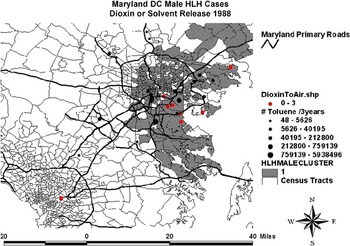
Using SaTScan™ (Information Management Services, Inc., Silver Spring, Maryland, United States of America), a software program developed by the National Cancer Institute, a spatial cluster of infants with hypoplastic left heart syndrome was identified and found to be significant for male infants only in south Baltimore (Fig 4). In fact, when the spectrum of diseases of the left heart is visualised in this manner, the map of density of geographical distribution strongly suggests an environmental influence.
The relative risk of hypoplastic left heart syndrome (HLH) in males is 2.1 within the cluster, compared with the rest of the region, with significance of p = 0.005, using SaTScan™ (Information Management Services, Inc., Silver Spring, Maryland, United States of America). Of 54 cases of hypoplastic left heart syndrome in males in the population of the Baltimore-Washington Infant Study in this study, 34 occurred within this cluster. The region is rich in the release of solvents such as toluene. Dioxin-like compounds are also released at multiple sites in the region.

How this exposure influences human cardiac development requires the development of a biologically plausible hypothesis. It is known that aryl hydrocarbon receptor occupancy induces CYP 1A1, even in the blastocyst stage of the mouse embryo. Genetic expression of CYP 1A1 is similar in the lymphocytes of the male and female mouse, but inducibility of the cytochrome is much higher in males. Further study of the genetic–environmental interaction in the animal model, and then in the human, is required to clarify how this interaction, in a potentially susceptible population, may become causational in the development of diseases of the left heart.
Conclusion
Aetiologic hypotheses in the causation of diseases of the left heart continue to be enriched, and complicated, by a growing body of evidence confirming the genetic impact and a variety of mutations. How and why these genetic variations develop, and how they result in the varying degrees of hypoplasia of the left heart, alter flow, and result in the wide spectrum of phenotypes of diseases of the left heart that we recognise postnatally, will continue to provide a challenge to researchers in the now closely linked worlds of population-based epidemiology, toxicology, and molecular biology. Only through such collaboration will the puzzle be more completely constructed.